MyCompetitiveExams Logo MyCompetitiveExams
Search 1,140+ Questions
Chapters, formulas, speed tricks
→
⚡ Brahmastra NEET 2027
720 MARKS

Dynamic 180-question full-length simulator mixed dynamically from all 6 years for 2027 & 2026 aspirants.

Launch Brahmastra 2027 Test →
Start Practice →
100% Free · No Login Required
Q.16 Botany ⭐ 360° Option Elimination Active
Vault ↗

NEET 2020 Botany Question 16 Solution

Topic: Cell: The Unit of Life · Official NTA Booklet Code E1
NEET 2020 Botany Question 16: Prokaryotic Inclusion Bodies: Reserve Material Storage without Membranes

Question

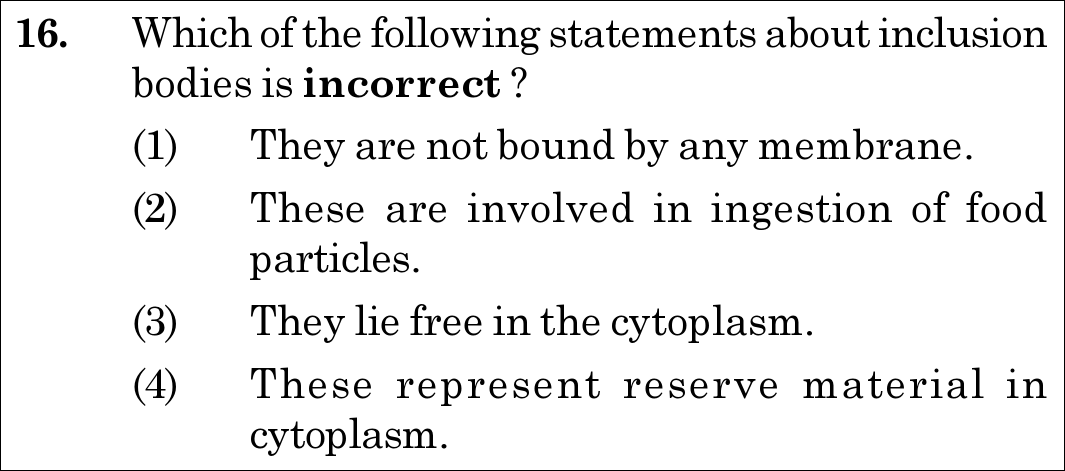
Which of the following statements about inclusion bodies is incorrect?

  1. (1)They are not bound by any membrane.
  2. (2)These are involved in ingestion of food particles.
  3. (3)They lie free in the cytoplasm.
  4. (4)These represent reserve material in cytoplasm.
✓
Verified Against NTA Final Answer Key
Option (2) : These are involved in ingestion of food particles.
📚 Cell: The Unit of Life Easy
📋 Given Parameters & Problem Setup
Cellular Structure Inclusion bodies in prokaryotic cells
Question Objective Identify the INCORRECT statement
⚡

The 30-Second Exam Hall Shortcut: ⚡ "Inclusion Bodies are STORAGE Granules, NOT Phagocytic Ingestion Vesicles!"

⏱️ Save ~20 seconds

Inclusion bodies in prokaryotes store reserve nutrients non-membranously (phosphate granules, cyanophycean granules, glycogen granules) floating freely in the cytoplasm. Bacteria lack endocytosis; inclusion bodies NEVER ingest food! Statement (2) is false. Select Option (2).

1 Recall NCERT characteristics of inclusion bodies: - Reserve material in prokaryotic cells is stored in cytoplasm in the form of inclusion bodies. - They are NOT bound by any membrane system. - They lie free in the cytoplasm (e.g. phosphate granules, cyanophycean granules, glycogen granules). - Gas vacuoles are found in photosynthetic bacteria.
2 Check statement (2): "These are involved in ingestion of food particles" -> Completely false (bacteria have rigid peptidoglycan walls and cannot ingest particles via phagocytosis).
3 Statement (2) is incorrect and is the required answer.
🛡️
Why You Can 100% Trust This Shortcut: NCERT Biology · Cell: The Unit of Life (Prokaryotic Cells: Reserve material in prokaryotic cells are stored in the cytoplasm in the form of inclusion bodies. These are not bound by any membrane system and lie free in the cytoplasm, e.g., phosphate granules, cyanophycean granules and glycogen granules).
📐

Step-by-Step Rigorous Workflow & Mathematical Proof

Step 1

Morphological Nature and Role of Prokaryotic Inclusion Bodies

Prokaryotic cells (bacteria and cyanobacteria) lack membrane-delimited organelles. Metabolic reserves are stockpiled in specialized dense aggregations known as inclusion bodies: - Reserve Storage: They represent non-living deposits of reserve materials accumulated during nutrient excess to support the cell during starvation. - *Phosphate granules (volutin):* Store inorganic polyphosphate. - *Cyanophycean granules:* Store protein reserves (arginine-aspartate polymers). - *Glycogen granules:* Store carbohydrates. - Membrane-less Structure: They are not surrounded by any unit lipid bilayer membrane; they lie free in the cytoplasmic cytosol.

Inclusion Bodies  ⟹  {Non-membrane bound(Lie free in cytoplasm)Reserve Material(Phosphate, Cyanophycean, Glycogen granules)Food IngestionABSENT (Bacteria lack phagocytosis)\textbf{Inclusion Bodies} \implies \begin{cases} \mathbf{Non\text{-}membrane\,bound} & \text{(Lie free in cytoplasm)} \\[3pt] \mathbf{Reserve\,Material} & \text{(Phosphate, Cyanophycean, Glycogen granules)} \\[3pt] \mathbf{Food\,Ingestion} & \mathbf{ABSENT\,(Bacteria\,lack\,phagocytosis)} \end{cases}
Step 2

Why Statement (2) is Biologically False

Prokaryotes are enveloped by a rigid peptidoglycan cell wall and absorb nutrients strictly via transmembrane transport systems (permeases, active transport, group translocation). Phagocytosis or particulate food ingestion does not occur in prokaryotes; food vacuoles are eukaryotic adaptations (e.g. *Amoeba*).

⭐

360° Option Elimination Engine Key Feature

Diagnose every choice: Know exactly why the right option works and why distractors fail.

4-Option Deep Scan
1 A
✗ Incorrect
Verdict & Scientific Reason:

This is a true statement. Inclusion bodies lack any surrounding membrane.

⚠️
Student Fallacy (Why candidates pick this trap): Thinking all cellular storage bodies have single membranes like peroxisomes or vacuoles.
2 B
✓ 100% Correct
Verdict & Scientific Reason:

Correct as the false statement. Inclusion bodies store reserves, playing zero role in ingestion.

💡
Why this is airtight: None. Candidate recognizes that bacteria do not ingest food particles.
3 C
✗ Incorrect
Verdict & Scientific Reason:

This is a true statement. Inclusion bodies float freely in the cytosol.

⚠️
Student Fallacy (Why candidates pick this trap): Assuming inclusion bodies are anchored to mesosomes.
4 D
✗ Incorrect
Verdict & Scientific Reason:

This is a true statement. Storing reserve polymers is their defining biological function.

⚠️
Student Fallacy (Why candidates pick this trap): Failing to remember the textbook function of inclusion bodies.
⚠️

NTA Trap Alert: Food Vacuoles vs Inclusion Bodies Confusion Trap

Candidates confuse eukaryotic food vacuoles (in *Amoeba*, which ingest food particles via phagocytosis) with prokaryotic inclusion bodies (which are inert non-membranous chemical reserve deposits).

🛡️ How to avoid the -1 mark: Remember: Inclusion bodies = Storage granules in bacteria; Ingestion = Eukaryotic food vacuoles.
📖

Core NEET Syllabus Standard

NEET / NCERT Biology · Cell: The Unit of Life Standard Benchmark
Core Scientific Principle Tested:

"Inclusion bodies store reserve materials in prokaryotes without membranes; they do not ingest food particles."

Syllabus Focus: Prokaryotic Inclusion Bodies
✓ Core NEET UG Syllabus Anchor Syllabus & Academic Standards ↗

Ready to attempt under real exam pressure?

Test your speed and accuracy in the authentic 180-minute timed NTA simulator.

Launch NEET 2020 CBT Test →

Spotted a mistake in this solution? Report an error (support@mycompetitiveexams.com)

⚖️ Legal & Fair Dealing Notice: Sourced from publicly released NEET 2020 question papers and NEET answer keys for private study, research, and non-commercial educational practice under Fair Dealing (Section 52(1)(a) of the Indian Copyright Act, 1957). Not affiliated with or endorsed by NTA or NMC.

Solve 4 NEET Questions a Day — One per Subject

Cover all 1,140 official NEET questions in 285 days at your own pace. Progress is saved on your device. No login needed.