MyCompetitiveExams Logo MyCompetitiveExams
Search 1,140+ Questions
Chapters, formulas, speed tricks
→
⚡ Brahmastra NEET 2027
720 MARKS

Dynamic 180-question full-length simulator mixed dynamically from all 6 years for 2027 & 2026 aspirants.

Launch Brahmastra 2027 Test →
Start Practice →
100% Free · No Login Required
Q.19 Botany ⭐ 360° Option Elimination Active
Vault ↗

NEET 2020 Botany Question 19 Solution

Topic: Breathing and Exchange of Gases · Official NTA Booklet Code E1
NEET 2020 Botany Question 19: Factors Influencing Oxyhaemoglobin Formation and Dissociation

Question

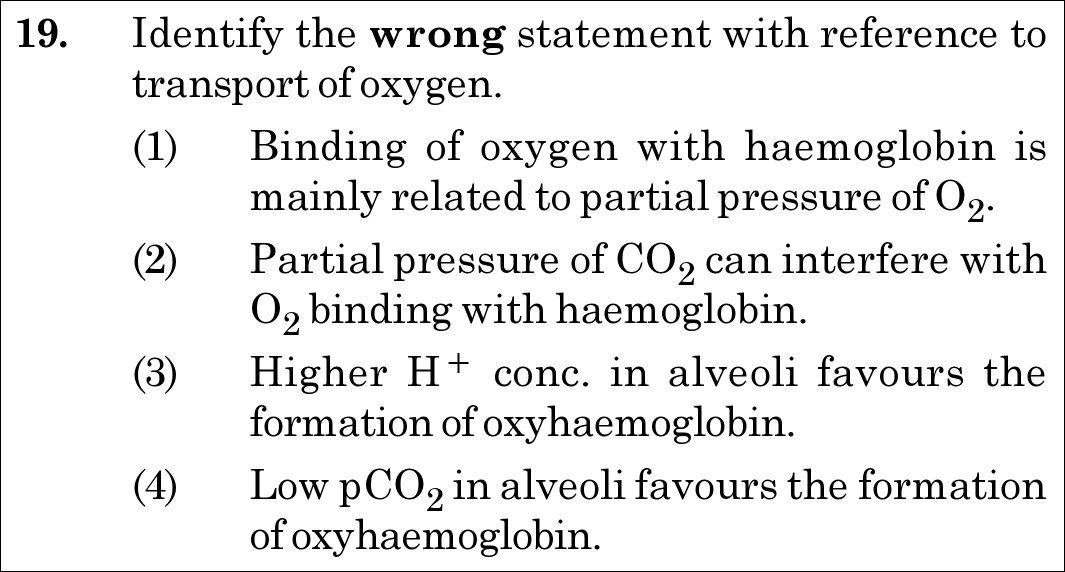
Identify the wrong statement with reference to transport of oxygen.

  1. (1)Binding of oxygen with haemoglobin is mainly related to partial pressure of O2.
  2. (2)Partial pressure of CO2 can interfere with O2 binding with haemoglobin.
  3. (3)Higher H+ conc. in alveoli favours the formation of oxyhaemoglobin.
  4. (4)Low pCO2 in alveoli favours the formation of oxyhaemoglobin.
✓
Verified Against NTA Final Answer Key
Option (3) : Higher H+ conc. in alveoli favours the formation of oxyhaemoglobin.
📚 Breathing and Exchange of Gases Easy
📋 Given Parameters & Problem Setup
Physiological Process Transport of Oxygen / Oxyhaemoglobin Dynamics
Microenvironment Pulmonary Alveoli vs Systemic Tissues
Question Objective Identify the WRONG / incorrect statement
⚡

The 30-Second Exam Hall Shortcut: ⚡ "Alveoli Must Have LESS H⁺ (Higher pH) to Form Oxyhaemoglobin!"

⏱️ Save ~20 seconds

At the alveoli, loading oxygen requires high pO₂, low pCO₂, LESS H⁺ concentration (alkaline pH), and lower temperature. Higher H⁺ (acidity) shifts the curve to the RIGHT and promotes DISSOCIATION (Bohr effect). Statement (3) claims higher H⁺ favours formation — which is completely WRONG! Select Option (3).

1 Recall alveolar conditions for oxyhaemoglobin formation: High pO2pO_2, low pCO2pCO_2, LESS H+H^+ conc. (high pH), and lower temperature.
2 Recall Bohr effect: Elevated [H+][H^+] (acidity) weakens oxygen binding and causes O₂ dissociation in tissues.
3 Analyze Statement (3): Claims "Higher H+ conc. in alveoli favours the formation" -> Blatantly false!
4 Option (3) is the wrong statement and therefore the correct answer.
🛡️
Why You Can 100% Trust This Shortcut: NCERT Biology · Breathing and Exchange of Gases (Transport of Gases: In the alveoli, where there is high pO2, low pCO2, lesser H+ concentration and lower temperature, the factors are all favourable for the formation of oxyhaemoglobin, whereas in the tissues, low pO2, high pCO2, high H+ concentration and higher temperature exist, the conditions are favourable for dissociation of oxygen from the oxyhaemoglobin).
📐

Step-by-Step Rigorous Workflow & Mathematical Proof

Step 1

Allosteric Regulation of Oxygen-Haemoglobin Binding

The reversible oxygenation of haemoglobin to form oxyhaemoglobin (Hb(O2)4Hb(O_2)_4) is governed by local allosteric modulators: - In Pulmonary Alveoli: Environmental conditions favor maximal oxygen saturation (leftward shift of dissociation curve): 1. High partial pressure of oxygen (pO2≈104 mm HgpO_2 \approx 104\text{ mm Hg}). 2. Low partial pressure of carbon dioxide (pCO2≈40 mm HgpCO_2 \approx 40\text{ mm Hg}). 3. Lesser H+H^+ concentration (higher, slightly alkaline pH ≈7.4\approx 7.4). 4. Lower body temperature. - In Systemic Tissues: Cellular respiration generates CO2CO_2 and lactic acid, creating: 1. Low pO2pO_2 (40 mm Hg40\text{ mm Hg}). 2. High pCO2pCO_2 (45 mm Hg45\text{ mm Hg}). 3. High H+H^+ concentration (acidosis). 4. Elevated temperature. - High [H+][H^+] protonates key histidine residues on haemoglobin subunits, stabilizing the low-affinity deoxygenated T-state (Bohr effect) and promoting oxygen dissociation, never formation.

Alveoli  ⟹  {↑pO2↓pCO2↓[H+](Lesser H+ Concentration)↓Temp  ⟹  Favour Oxyhaemoglobin Formation\text{Alveoli} \implies \begin{cases} \mathbf{\uparrow pO_2} & \\ \mathbf{\downarrow pCO_2} & \\ \mathbf{\downarrow [H^+]} & (\mathbf{Lesser\,H^+\,Concentration}) \\ \mathbf{\downarrow \text{Temp}} & \end{cases} \implies \mathbf{Favour\,Oxyhaemoglobin\,Formation}
Step 2

Statement Evaluation

Statement (3) asserts that "Higher H+ conc. in alveoli favours the formation of oxyhaemoglobin." This directly contradicts the Bohr effect and textbook facts; therefore, statement (3) is false and is the correct response.

⭐

360° Option Elimination Engine Key Feature

Diagnose every choice: Know exactly why the right option works and why distractors fail.

4-Option Deep Scan
1 A
✗ Incorrect
Verdict & Scientific Reason:

This is a true statement. pO2 is the primary determining factor governing cooperative oxygen binding.

⚠️
Student Fallacy (Why candidates pick this trap): Overlooking that pO2 is the principal driver of oxygen saturation.
2 B
✗ Incorrect
Verdict & Scientific Reason:

This is a true statement. Increased pCO2 decreases hemoglobin affinity for oxygen (Bohr effect).

⚠️
Student Fallacy (Why candidates pick this trap): Denying the competitive allosteric role of carbon dioxide.
3 C
✓ 100% Correct
Verdict & Scientific Reason:

Correct as the wrong statement. Lesser H+ concentration (not higher) in alveoli favours oxyhaemoglobin formation.

💡
Why this is airtight: None. Candidate accurately remembers that low H+ (high pH) is required at the alveoli.
4 D
✗ Incorrect
Verdict & Scientific Reason:

This is a true statement. Low pCO2 in alveoli shifts the curve to the left, promoting O2 loading.

⚠️
Student Fallacy (Why candidates pick this trap): Confusing alveolar pCO2 with tissue pCO2.
⚠️

NTA Trap Alert: H⁺ Concentration vs pH Reciprocal Trap

Remember that higher [H+][H^+] means *lower pH* (acidic, which unloads oxygen). Lower [H+][H^+] means *higher pH* (alkaline, which loads oxygen in the alveoli). The prompt uses "Higher H+ conc." which causes oxygen release, not binding.

🛡️ How to avoid the -1 mark: Remember: Alveoli = Less H⁺ (Basic); Tissues = More H⁺ (Acidic).
📖

Core NEET Syllabus Standard

NEET / NCERT Biology · Breathing and Exchange of Gases Standard Benchmark
Core Scientific Principle Tested:

"Lesser H+ concentration (higher pH) in alveoli favours oxyhaemoglobin formation."

Syllabus Focus: Transport of Oxygen
✓ Core NEET UG Syllabus Anchor Syllabus & Academic Standards ↗

Ready to attempt under real exam pressure?

Test your speed and accuracy in the authentic 180-minute timed NTA simulator.

Launch NEET 2020 CBT Test →

Spotted a mistake in this solution? Report an error (support@mycompetitiveexams.com)

⚖️ Legal & Fair Dealing Notice: Sourced from publicly released NEET 2020 question papers and NEET answer keys for private study, research, and non-commercial educational practice under Fair Dealing (Section 52(1)(a) of the Indian Copyright Act, 1957). Not affiliated with or endorsed by NTA or NMC.

Solve 4 NEET Questions a Day — One per Subject

Cover all 1,140 official NEET questions in 285 days at your own pace. Progress is saved on your device. No login needed.