MyCompetitiveExams Logo MyCompetitiveExams
Search 1,140+ Questions
Chapters, formulas, speed tricks
→
⚡ Brahmastra NEET 2027
720 MARKS

Dynamic 180-question full-length simulator mixed dynamically from all 6 years for 2027 & 2026 aspirants.

Launch Brahmastra 2027 Test →
Start Practice →
100% Free · No Login Required
Q.14 Botany ⭐ 360° Option Elimination Active
Vault ↗

NEET 2020 Botany Question 14 Solution

Topic: Cell Cycle and Cell Division · Official NTA Booklet Code E1
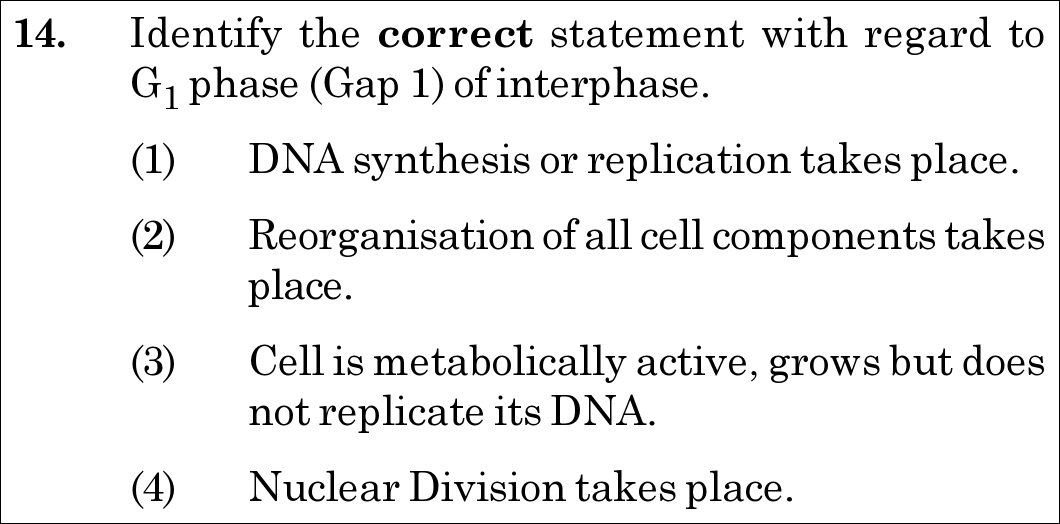
NEET 2020 Botany Question 14: Characteristics of G1 Phase (Gap 1) of Interphase

Question

Identify the correct statement with regard to G1 phase (Gap 1) of interphase.

  1. (1)DNA synthesis or replication takes place.
  2. (2)Reorganisation of all cell components takes place.
  3. (3)Cell is metabolically active, grows but does not replicate its DNA.
  4. (4)Nuclear Division takes place.
✓
Verified Against NTA Final Answer Key
Option (3) : Cell is metabolically active, grows but does not replicate its DNA.
📚 Cell Cycle and Cell Division Easy
📋 Given Parameters & Problem Setup
Cell Cycle Phase G1 Phase (Gap 1 of Interphase)
Question Objective Identify the correct physiological and cytological statement
⚡

The 30-Second Exam Hall Shortcut: ⚡ "G1 Phase = Metabolically Active, Cell Growth, NO DNA Replication!"

⏱️ Save ~20 seconds

G1 phase is the interval between mitosis and DNA replication. The cell is metabolically active and continuously grows in size, but DNA replication occurs strictly in the subsequent S phase! Option (3) is verbatim from NCERT.

1 Recall Interphase phases in sequence: G1 phase →\to S phase →\to G2 phase.
2 Match events: - G1 phase: Active metabolism, protein and RNA synthesis, organelle duplication, cell growth (NO DNA replication). - S phase: DNA replication and doubling of DNA content (2C→4C2C \to 4C). - G2 phase: Protein synthesis in preparation for mitosis. - M phase: Nuclear and cell division.
3 Select Option (3): Cell is metabolically active, grows but does not replicate its DNA.
🛡️
Why You Can 100% Trust This Shortcut: NCERT Biology · Cell Cycle and Cell Division (Phases of Cell Cycle: During G1 phase the cell is metabolically active and continuously grows but does not replicate its DNA. DNA synthesis or replication takes place during S phase).
📐

Step-by-Step Rigorous Workflow & Mathematical Proof

Step 1

Cytological Profile of the G1 Phase (Gap 1)

Interphase accounts for >95% of cell cycle duration, and G1 phase corresponds to the temporal interval between the completion of telophase (mitosis) and the initiation of chromosomal DNA replication: - Metabolic Activity: High rates of transcription (mRNA, tRNA, rRNA) and translation occur. Enzymes required for DNA synthesis (DNA polymerases, kinases, ribonucleotide reductase) are synthesized. - Cellular Growth: The volume of the cytoplasm increases, and cytoplasmic organelles (mitochondria, ribosomes, endoplasmic reticulum) proliferate. - Absence of DNA Replication: The nuclear DNA content remains strictly at the basal diploid complement (2C2C), and chromosomes remain un-replicated monads. Replication of DNA occurs exclusively during the subsequent S (Synthesis) phase.

G1 Phase  ⟹  {Metabolic Activity→Highly ActiveCell Volume→Continuous GrowthDNA Replication→ABSENT (Restricted to S phase)\textbf{G}_1 \textbf{ Phase} \implies \begin{cases} \text{Metabolic Activity} & \to \mathbf{Highly\,Active} \\[3pt] \text{Cell Volume} & \to \mathbf{Continuous\,Growth} \\[3pt] \text{DNA Replication} & \to \mathbf{ABSENT\,(Restricted\,to\,S\,phase)} \end{cases}
Step 2

Critique of Distractor Statements

- (1) DNA synthesis takes place: False; occurs exclusively in the S phase. - (2) Reorganisation of cell components: False; occurs in early Prophase / Mitosis. - (4) Nuclear division: False; karyokinesis is a hallmark of the M phase.

⭐

360° Option Elimination Engine Key Feature

Diagnose every choice: Know exactly why the right option works and why distractors fail.

4-Option Deep Scan
1 A
✗ Incorrect
Verdict & Scientific Reason:

Incorrect. DNA synthesis and chromosome replication take place in the S (Synthesis) phase.

⚠️
Student Fallacy (Why candidates pick this trap): Confusing G1 (Gap 1) with S phase.
2 B
✗ Incorrect
Verdict & Scientific Reason:

Incorrect. Massive reorganisation of cell components characterizes the mitotic (M) phase.

⚠️
Student Fallacy (Why candidates pick this trap): Confusing interphase cell growth with mitotic division.
3 C
✓ 100% Correct
Verdict & Scientific Reason:

Correct. Matches the verbatim NCERT definition of the G1 phase of interphase.

💡
Why this is airtight: None. Candidate accurately remembers cell cycle phase definitions.
4 D
✗ Incorrect
Verdict & Scientific Reason:

Incorrect. Nuclear division (karyokinesis) occurs during the M phase.

⚠️
Student Fallacy (Why candidates pick this trap): Confusing interphase preparation with nuclear division.
⚠️

NTA Trap Alert: Resting Stage Misconception Trap

Interphase was historically called the "resting stage". Students mistakenly infer that G1 cells are inactive. In reality, G1 cells are intensely metabolically active, growing rapidly while preparing substrates for DNA replication.

🛡️ How to avoid the -1 mark: Remember: G1 = Metabolically Active & Growing, but DNA replication is strictly S-phase.
📖

Core NEET Syllabus Standard

NEET / NCERT Biology · Cell Cycle and Cell Division Standard Benchmark
Core Scientific Principle Tested:

"During G1 phase, the cell is metabolically active and continuously grows but does not replicate its DNA."

Syllabus Focus: Interphase G1 Phase
✓ Core NEET UG Syllabus Anchor Syllabus & Academic Standards ↗

Ready to attempt under real exam pressure?

Test your speed and accuracy in the authentic 180-minute timed NTA simulator.

Launch NEET 2020 CBT Test →

Spotted a mistake in this solution? Report an error (support@mycompetitiveexams.com)

⚖️ Legal & Fair Dealing Notice: Sourced from publicly released NEET 2020 question papers and NEET answer keys for private study, research, and non-commercial educational practice under Fair Dealing (Section 52(1)(a) of the Indian Copyright Act, 1957). Not affiliated with or endorsed by NTA or NMC.

Solve 4 NEET Questions a Day — One per Subject

Cover all 1,140 official NEET questions in 285 days at your own pace. Progress is saved on your device. No login needed.