MyCompetitiveExams Logo MyCompetitiveExams
Search 1,140+ Questions
Chapters, formulas, speed tricks
→
⚡ Brahmastra NEET 2027
720 MARKS

Dynamic 180-question full-length simulator mixed dynamically from all 6 years for 2027 & 2026 aspirants.

Launch Brahmastra 2027 Test →
Start Practice →
100% Free · No Login Required
Q.113 Chemistry ⭐ 360° Option Elimination Active
Vault ↗

NEET 2020 Chemistry Question 113 Solution

Topic: Chemistry in Everyday Life · Official NTA Booklet Code E1
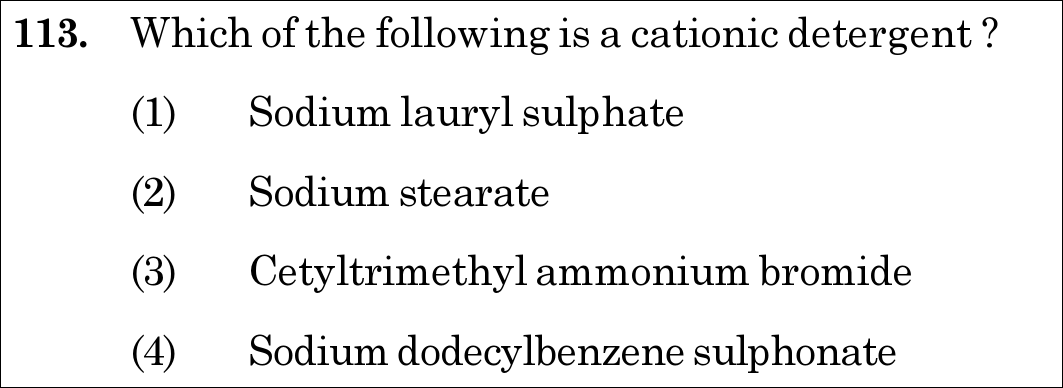
NEET 2020 Chemistry Question 113: Classification of Synthetic Detergents: Cationic, Anionic & Non-ionic

Question

Which of the following is a cationic detergent?

  1. (1)Sodium lauryl sulphate
  2. (2)Sodium stearate
  3. (3)Cetyltrimethyl ammonium bromide
  4. (4)Sodium dodecylbenzene sulphonate
✓
Verified Against NTA Final Answer Key
Option (3) : Cetyltrimethyl ammonium bromide
📚 Chemistry in Everyday Life Easy
📋 Given Parameters & Problem Setup
Surfactant Class Cationic detergent
Candidate Compounds Sodium lauryl sulphate, Sodium stearate, Cetyltrimethyl ammonium bromide, Sodium dodecylbenzene sulphonate
⚡

The 30-Second Exam Hall Shortcut: ⚡ "Cationic Detergent = Quaternary Ammonium Salt (Cetyltrimethyl Ammonium Bromide)!"

⏱️ 20 seconds

Cationic detergents are quaternary ammonium salts of amines with acetates, chlorides, or bromides as anions. The long hydrocarbon chain is on the CATION! Cetyltrimethylammonium bromide has germicidal properties and is used in hair conditioners. Sodium lauryl sulphate and Sodium dodecylbenzene sulphonate are ANIONIC detergents; Sodium stearate is a SOAP. Mark Option (3) in 5 seconds!

1 Cationic detergent: Cetyltrimethyl ammonium bromide (quaternary ammonium cation).
2 Anionic detergents: Sodium lauryl sulphate, Sodium dodecylbenzene sulphonate.
3 Soap: Sodium stearate.
4 Non-ionic detergent: Polyethylene glycol stearate.
5 Select Option (3) Cetyltrimethyl ammonium bromide.
🛡️
Why You Can 100% Trust This Shortcut: NCERT Chemistry · Chemistry in Everyday Life (Cleansing Agents: Synthetic Detergents)
📐

Step-by-Step Rigorous Workflow & Mathematical Proof

Step 1

Classify Synthetic Detergents

Synthetic detergents are classified into three major categories based on the ionic nature of their hydrophilic head group: 1. Anionic detergents 2. Cationic detergents 3. Non-ionic detergents.

Step 2

Evaluate Cationic Detergents

Cationic detergents are quaternary ammonium salts of amines with chlorides, bromides, or acetates as anions. The cationic part possesses a long hydrocarbon chain and a positive charge on the nitrogen atom: Cetyltrimethylammonium bromide: [CH3(CH2)15−N+(CH3)3]Br−\text{Cetyltrimethylammonium bromide: } [\text{CH}_3(\text{CH}_2)_{15}-\text{N}^+(\text{CH}_3)_3]\text{Br}^- Because the lipophilic cleaning activity resides in the cation, it is a cationic detergent. They possess germicidal properties and are commonly used in hair conditioners.

Step 3

Evaluate Other Candidate Options

- Sodium lauryl sulphate (CH3(CH2)11OSO3−Na+\text{CH}_3(\text{CH}_2)_{11}\text{OSO}_3^-\text{Na}^+): Anionic detergent. - Sodium dodecylbenzene sulphonate (CH3(CH2)11C6H4SO3−Na+\text{CH}_3(\text{CH}_2)_{11}\text{C}_6\text{H}_4\text{SO}_3^-\text{Na}^+): Anionic detergent. - Sodium stearate (C17H35COONa\text{C}_{17}\text{H}_{35}\text{COONa}): Saponified traditional soap, not a synthetic detergent.

Step 4

Conclude Option 3

Cetyltrimethyl ammonium bromide is uniquely the cationic detergent.

⭐

360° Option Elimination Engine Key Feature

Diagnose every choice: Know exactly why the right option works and why distractors fail.

4-Option Deep Scan
1 A
✗ Incorrect
Verdict & Scientific Reason:

Incorrect; sodium lauryl sulphate is an ANIONIC detergent because its large organic part is an anion (ROSO3−\text{ROSO}_3^-).

⚠️
Student Fallacy (Why candidates pick this trap): Confusing anionic sulfate detergent with cationic detergent.
2 B
✗ Incorrect
Verdict & Scientific Reason:

Incorrect; sodium stearate is a sodium salt of a fatty acid (traditional soap), not a synthetic detergent.

⚠️
Student Fallacy (Why candidates pick this trap): Confusing soaps with synthetic detergents.
3 C
✓ 100% Correct
Verdict & Scientific Reason:

Factually exact; quaternary ammonium cation bearing long cetyl chain makes it a classic cationic detergent.

💡
Why this is airtight: None; direct textbook example.
4 D
✗ Incorrect
Verdict & Scientific Reason:

Incorrect; this is the most common ANIONIC detergent used in household laundry powders.

⚠️
Student Fallacy (Why candidates pick this trap): Assuming common detergent is cationic.
⚠️

NTA Trap Alert: Quaternary Ammonium = Cationic Detergent

Any name containing "...ammonium chloride/bromide" is a quaternary ammonium cation -> CATIONIC DETERGENT! Names ending in "...sulphonate" or "...sulphate" with Sodium are ANIONIC.

🛡️ How to avoid the -1 mark: Look for "Ammonium": Cetyltrimethyl AMMONIUM bromide = Cationic detergent!
📖

Core NEET Syllabus Standard

Chemistry · Chemistry in Everyday Life Standard Benchmark
Core Scientific Principle Tested:

""

Syllabus Focus: Classification of Synthetic Detergents: Cationic, Anionic & Non-ionic
✓ Core NEET UG Syllabus Anchor Syllabus & Academic Standards ↗

Ready to attempt under real exam pressure?

Test your speed and accuracy in the authentic 180-minute timed NTA simulator.

Launch NEET 2020 CBT Test →

Spotted a mistake in this solution? Report an error (support@mycompetitiveexams.com)

⚖️ Legal & Fair Dealing Notice: Sourced from publicly released NEET 2020 question papers and NEET answer keys for private study, research, and non-commercial educational practice under Fair Dealing (Section 52(1)(a) of the Indian Copyright Act, 1957). Not affiliated with or endorsed by NTA or NMC.

Solve 4 NEET Questions a Day — One per Subject

Cover all 1,140 official NEET questions in 285 days at your own pace. Progress is saved on your device. No login needed.