NEET 2020 Chemistry Question 114 Solution
Question
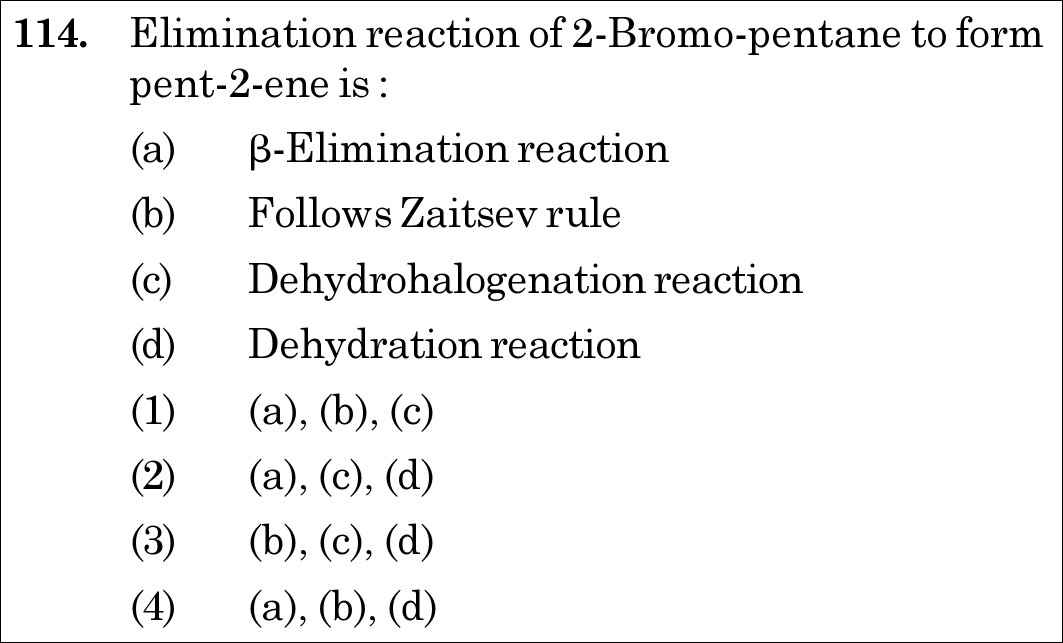
Elimination reaction of 2-Bromo-pentane to form pent-2-ene is: (a) β-Elimination reaction (b) Follows Zaitsev rule (c) Dehydrohalogenation reaction (d) Dehydration reaction
Dynamic 180-question full-length simulator mixed dynamically from all 6 years for 2027 & 2026 aspirants.
Elimination reaction of 2-Bromo-pentane to form pent-2-ene is: (a) β-Elimination reaction (b) Follows Zaitsev rule (c) Dehydrohalogenation reaction (d) Dehydration reaction
The reaction eliminates hydrogen from the β-carbon and halogen (Br) from the α-carbon, so it is a β-elimination reaction (a) and a dehydrohalogenation reaction (c). The more substituted, more stable alkene (pent-2-ene, 81%) is favored over pent-1-ene (19%), which follows Zaitsev's rule (b). Dehydration (d) means loss of WATER (from alcohols), not HBr! Thus, (a), (b), (c) only! Mark Option (1) in 5 seconds.
When 2-bromopentane is heated with alcoholic potassium hydroxide (), the base abstracts a proton from a -carbon while the bromide leaving group departs from the -carbon: Because hydrogen is abstracted from the -position, this is universally termed a -elimination reaction (Statement a).
2-Bromopentane has two different -carbons: (, methyl group) and (, methylene group). According to Zaitsev's rule, in dehydrohalogenation reactions, the preferred product is that alkene which has the greater number of alkyl groups attached to the doubly bonded carbon atoms. Hence, pent-2-ene (disubstituted alkene, 81%) is formed as the major product over pent-1-ene (monosubstituted alkene, 19%). Thus, it follows Zaitsev's rule (Statement b).
- Dehydrohalogenation: Elimination of a hydrogen halide (, here ) from an alkyl halide. Statement (c) is TRUE. - Dehydration: Elimination of a water molecule () from an alcohol to form an alkene. Here, is lost, not . Thus, Statement (d) is FALSE.
Statements (a), (b), and (c) are all correct descriptions, corresponding to Option 1.
Diagnose every choice: Know exactly why the right option works and why distractors fail.
Factually and mechanistically exact; β-elimination, Zaitsev rule adherence, and dehydrohalogenation all accurately describe this reaction.
Incorrect; erroneously includes (d) dehydration, which applies to alcohols losing water, not alkyl halides.
Incorrect; erroneously includes (d) and omits (a).
Incorrect; erroneously includes (d) dehydration and omits (c) dehydrohalogenation.
- Dehydration = Removal of WATER (), as in Acid-catalyzed dehydration of alcohols. - Dehydrohalogenation = Removal of HYDROGEN HALIDE (, e.g. ), as in base-catalyzed elimination of alkyl halides.
""
Test your speed and accuracy in the authentic 180-minute timed NTA simulator.
Spotted a mistake in this solution? Report an error (support@mycompetitiveexams.com)
Cover all 1,140 official NEET questions in 285 days at your own pace. Progress is saved on your device. No login needed.