MyCompetitiveExams Logo MyCompetitiveExams
Search 1,140+ Questions
Chapters, formulas, speed tricks
→
⚡ Brahmastra NEET 2027
720 MARKS

Dynamic 180-question full-length simulator mixed dynamically from all 6 years for 2027 & 2026 aspirants.

Launch Brahmastra 2027 Test →
Start Practice →
100% Free · No Login Required
Q.41 Botany ⭐ 360° Option Elimination Active
Vault ↗

NEET 2020 Botany Question 41 Solution

Topic: Organisms and Populations · Official NTA Booklet Code E1
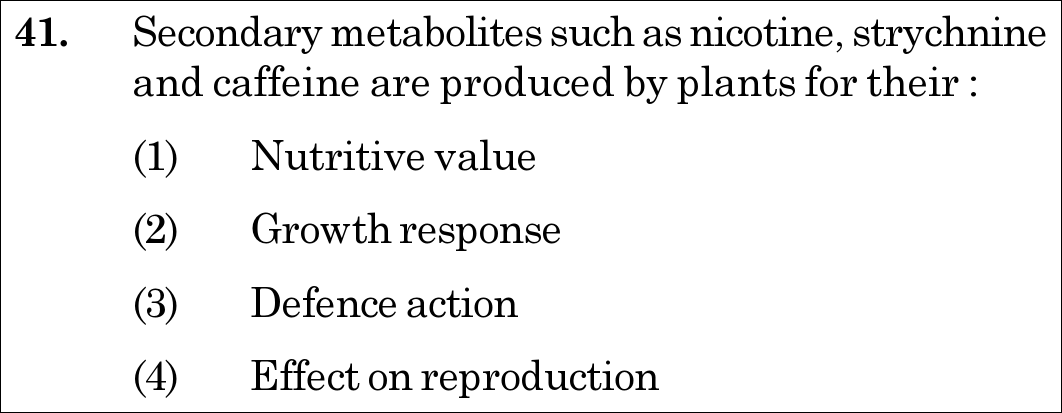
NEET 2020 Botany Question 41: Ecological Role of Secondary Metabolites: Defense Against Herbivores

Question

Secondary metabolites such as nicotine, strychnine and caffeine are produced by plants for their:

  1. (1)Nutritive value
  2. (2)Growth response
  3. (3)Defence action
  4. (4)Effect on reproduction
✓
Verified Against NTA Final Answer Key
Option (3) : Defence action
📚 Organisms and Populations Easy
📋 Given Parameters & Problem Setup
Chemical Classes Secondary metabolites: Nicotine, strychnine, caffeine, morphine, quinine
Question Objective Identify why plants produce these compounds in nature
⚡

The 30-Second Exam Hall Shortcut: ⚡ "Secondary Metabolites in Plants = Chemical DEFENCE Against Herbivores!"

⏱️ 25 seconds

Plants cannot run away from grazers and browsers, so they synthesize toxic/distasteful secondary metabolites (nicotine, caffeine, strychnine, cardiac glycosides) strictly as chemical DEFENCE mechanisms! Mark Defence action (Option 3) in 5 seconds.

1 Secondary metabolites do not serve direct nutritional or reproductive functions in plants.
2 They act as repellents, toxins, and anti-feedants against herbivores.
3 Select Option (3) Defence action.
🛡️
Why You Can 100% Trust This Shortcut: NCERT Biology · Organisms and Populations (Predation & Chemical Defenses in Plants)
📐

Step-by-Step Rigorous Workflow & Mathematical Proof

Step 1

Define Plant Secondary Metabolites

Secondary metabolites (alkaloids, tannins, terpenoids, resins, cardiac glycosides) are organic compounds not directly involved in the primary processes of plant growth, development, or reproduction.

Step 2

Evolutionary and Ecological Function

Because sessile plants cannot flee from predators (herbivores and browsers), they have evolved morphological defenses (thorns, spines) and chemical defenses (toxic secondary metabolites) to deter grazing.

Step 3

Specific Examples in NCERT

NCERT explicitly highlights that a wide variety of chemical substances that we extract from plants on a commercial scale (nicotine, caffeine, quinine, strychnine, opium) are produced by them actually as defenses against grazers and browsers.

Step 4

Eliminate Other Options

These toxic alkaloids have zero nutritive value for the plant, do not regulate growth (auxins/gibberellins do), and are not reproductive attractants.

⭐

360° Option Elimination Engine Key Feature

Diagnose every choice: Know exactly why the right option works and why distractors fail.

4-Option Deep Scan
1 A
✗ Incorrect
Verdict & Scientific Reason:

Incorrect; secondary metabolites provide no nutrition to the plant; primary metabolites (sugars, proteins, lipids) provide nutrition.

⚠️
Student Fallacy (Why candidates pick this trap): Thinking of human commercial uses of plant extracts.
2 B
✗ Incorrect
Verdict & Scientific Reason:

Incorrect; plant growth responses are orchestrated by phytohormones (auxins, cytokinins, gibberellins), not toxic alkaloids.

⚠️
Student Fallacy (Why candidates pick this trap): Confusing plant defense chemicals with growth regulators.
3 C
✓ 100% Correct
Verdict & Scientific Reason:

Factually exact; plants produce these bitter and toxic alkaloids specifically to defend against herbivory and predation.

💡
Why this is airtight: None; explicit ecological concept in NCERT.
4 D
✗ Incorrect
Verdict & Scientific Reason:

Incorrect; floral scents and nectar aid reproduction; toxic alkaloids in leaves and stems serve defensive roles.

⚠️
Student Fallacy (Why candidates pick this trap): Confusing pollination rewards with unpalatable vegetative defenses.
⚠️

NTA Trap Alert: Human Utility vs Plant Adaptive Function

Humans utilize nicotine, caffeine, and quinine for medicinal, pharmacological, or stimulant purposes, but the evolutionary reason the plant produces them is strictly PREDATION DEFENSE.

🛡️ How to avoid the -1 mark: Always view botanical chemistry through the lens of natural selection: Sessile plant + toxin = DEFENSE against herbivores!
📖

Core NEET Syllabus Standard

Botany · Organisms and Populations Standard Benchmark
Core Scientific Principle Tested:

""

Syllabus Focus: Ecological Role of Secondary Metabolites: Defense Against Herbivores
✓ Core NEET UG Syllabus Anchor Syllabus & Academic Standards ↗

Ready to attempt under real exam pressure?

Test your speed and accuracy in the authentic 180-minute timed NTA simulator.

Launch NEET 2020 CBT Test →

Spotted a mistake in this solution? Report an error (support@mycompetitiveexams.com)

⚖️ Legal & Fair Dealing Notice: Sourced from publicly released NEET 2020 question papers and NEET answer keys for private study, research, and non-commercial educational practice under Fair Dealing (Section 52(1)(a) of the Indian Copyright Act, 1957). Not affiliated with or endorsed by NTA or NMC.

Solve 4 NEET Questions a Day — One per Subject

Cover all 1,140 official NEET questions in 285 days at your own pace. Progress is saved on your device. No login needed.