MyCompetitiveExams Logo MyCompetitiveExams
Search 1,140+ Questions
Chapters, formulas, speed tricks
→
⚡ Brahmastra NEET 2027
720 MARKS

Dynamic 180-question full-length simulator mixed dynamically from all 6 years for 2027 & 2026 aspirants.

Launch Brahmastra 2027 Test →
Start Practice →
100% Free · No Login Required
Q.144 Physics ⭐ 360° Option Elimination Active
Vault ↗

NEET 2020 Physics Question 144 Solution

Topic: Current Electricity · Official NTA Booklet Code E1
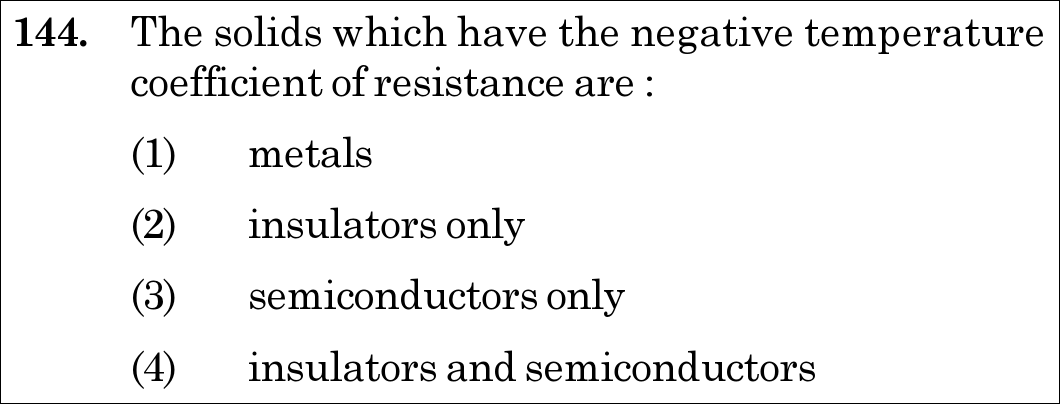
NEET 2020 Physics Question 144: Temperature Coefficient of Resistance (α): Negative Coefficient in Insulators and Semiconductors

Question

The solids which have the negative temperature coefficient of resistance are:

  1. (1)metals
  2. (2)insulators only
  3. (3)semiconductors only
  4. (4)insulators and semiconductors
✓
Verified Against NTA Final Answer Key
Option (4) : insulators and semiconductors
📚 Current Electricity Easy
📋 Given Parameters & Problem Setup
Physical Property Temperature coefficient of resistance (α)
Condition Negative temperature coefficient (α < 0, resistance decreases as temperature increases)
Solid Classes Metals, Insulators, Semiconductors
⚡

The 30-Second Exam Hall Shortcut: ⚡ "Metals Have Positive α (R increases with T); Insulators and Semiconductors Have Negative α (R decreases with T)!"

⏱️ 20 seconds

In metallic conductors, heating increases lattice vibrations and collision frequency, so resistance increases (α>0\alpha > 0). In semiconductors and insulators, heating breaks covalent bonds, exponentially increasing the charge carrier density (nn). Because ρ=mne2τ\rho = \frac{m}{n e^2 \tau}, the massive rise in nn dominates over the slight drop in τ\tau, causing resistance to drop sharply with temperature (α<0\alpha < 0). Hence, BOTH insulators and semiconductors have negative α\alpha! Mark Option (4) in 5 seconds.

1 Formula: ρ = m / (n e^2 τ).
2 In metals: n is constant. Increasing T decreases relaxation time τ -> ρ increases (α is POSITIVE).
3 In semiconductors: Increasing T excites electrons across band gap, causing exponential increase in n -> ρ decreases (α is NEGATIVE).
4 In insulators: Increasing T similarly frees carriers across band gap -> ρ decreases (α is NEGATIVE).
5 Both insulators and semiconductors exhibit negative temperature coefficient of resistance.
6 Select Option (4) insulators and semiconductors.
🛡️
Why You Can 100% Trust This Shortcut: NCERT Physics · Current Electricity (Temperature Dependence of Resistivity)
📐

Step-by-Step Rigorous Workflow & Mathematical Proof

Step 1

Microscopic Origin of Electrical Resistivity

According to the Drude-Lorentz free electron model, the electrical resistivity of a solid is given by: ρ=mne2τ\rho = \frac{m}{n e^2 \tau} where mm is electron mass, ee is electron charge, nn is charge carrier number density, and τ\tau is the average relaxation time between collisions.

Step 2

Behavior of Metallic Conductors

In metals, the carrier concentration nn is independent of temperature (∼1028 m−3\sim 10^{28}\text{ m}^{-3}). As temperature increases, lattice thermal vibrations amplify, reducing relaxation time τ\tau. Consequently, ρ\rho increases with temperature, yielding a POSITIVE temperature coefficient of resistance (α>0\alpha > 0).

Step 3

Behavior of Semiconductors and Insulators

In semiconductors and insulators, valence electrons are separated from the conduction band by an energy band gap (EgE_g). As temperature rises, thermal energy excites electrons across the band gap into the conduction band, causing the carrier density nn to increase exponentially according to Boltzmann distribution: n(T)∝e−Eg/(2kBT)n(T) \propto e^{-E_g / (2 k_B T)} This immense increase in nn overwhelmingly compensates for any modest decrease in relaxation time τ\tau. Consequently, resistivity and resistance decrease exponentially as temperature increases.

Step 4

Conclude Negative Temperature Coefficient

Because dRdT<0\frac{dR}{dT} < 0, both insulators and semiconductors possess a NEGATIVE temperature coefficient of resistance (α<0\alpha < 0).

⭐

360° Option Elimination Engine Key Feature

Diagnose every choice: Know exactly why the right option works and why distractors fail.

4-Option Deep Scan
1 A
✗ Incorrect
Verdict & Scientific Reason:

Incorrect; metals have a POSITIVE temperature coefficient of resistance (α>0\alpha > 0) because resistance increases with temperature.

⚠️
Student Fallacy (Why candidates pick this trap): Confusing metals with semiconductors.
2 B
✗ Incorrect
Verdict & Scientific Reason:

Incorrect; incomplete because semiconductors also exhibit a negative temperature coefficient.

⚠️
Student Fallacy (Why candidates pick this trap): Believing only non-conducting insulators have negative α.
3 C
✗ Incorrect
Verdict & Scientific Reason:

Incorrect; incomplete because insulators also exhibit a negative temperature coefficient of resistance.

⚠️
Student Fallacy (Why candidates pick this trap): Forgetting that insulators share the band-gap excitation mechanism with semiconductors.
4 D
✓ 100% Correct
Verdict & Scientific Reason:

Factually and physically exact; both insulators and semiconductors experience carrier generation upon heating, resulting in a negative temperature coefficient.

💡
Why this is airtight: None; verbatim NCERT statement in Current Electricity.
⚠️

NTA Trap Alert: The "Only" Distractor Trap

Students often know that semiconductors have negative α\alpha and hastily click "semiconductors only" (Option 3). But NCERT explicitly states: "for insulators and semiconductors, ρ\rho decreases with temperature. A negative temperature coefficient of resistance is observed for both."

🛡️ How to avoid the -1 mark: Remember: Negative temperature coefficient applies to BOTH INSULATORS AND SEMICONDUCTORS!
📖

Core NEET Syllabus Standard

Physics · Current Electricity Standard Benchmark
Core Scientific Principle Tested:

""

Syllabus Focus: Temperature Coefficient of Resistance (α): Negative Coefficient in Insulators and Semiconductors
✓ Core NEET UG Syllabus Anchor Syllabus & Academic Standards ↗

Ready to attempt under real exam pressure?

Test your speed and accuracy in the authentic 180-minute timed NTA simulator.

Launch NEET 2020 CBT Test →

Spotted a mistake in this solution? Report an error (support@mycompetitiveexams.com)

⚖️ Legal & Fair Dealing Notice: Sourced from publicly released NEET 2020 question papers and NEET answer keys for private study, research, and non-commercial educational practice under Fair Dealing (Section 52(1)(a) of the Indian Copyright Act, 1957). Not affiliated with or endorsed by NTA or NMC.

Solve 4 NEET Questions a Day — One per Subject

Cover all 1,140 official NEET questions in 285 days at your own pace. Progress is saved on your device. No login needed.