MyCompetitiveExams Logo MyCompetitiveExams
Search 1,140+ Questions
Chapters, formulas, speed tricks
→
⚡ Brahmastra NEET 2027
720 MARKS

Dynamic 180-question full-length simulator mixed dynamically from all 6 years for 2027 & 2026 aspirants.

Launch Brahmastra 2027 Test →
Start Practice →
100% Free · No Login Required
Q.109 Chemistry ⭐ 360° Option Elimination Active
Vault ↗

NEET 2020 Chemistry Question 109 Solution

Topic: Chemical Kinetics · Official NTA Booklet Code E1
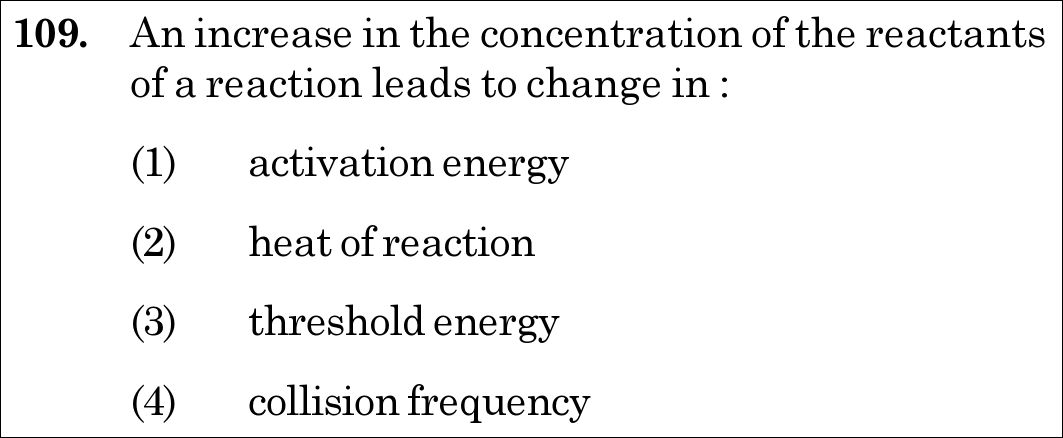
NEET 2020 Chemistry Question 109: Collision Theory: Reactant Concentration Directly Increases Collision Frequency (Z)

Question

An increase in the concentration of the reactants of a reaction leads to change in:

  1. (1)activation energy
  2. (2)heat of reaction
  3. (3)threshold energy
  4. (4)collision frequency
✓
Verified Against NTA Final Answer Key
Option (4) : collision frequency
📚 Chemical Kinetics Easy
📋 Given Parameters & Problem Setup
Manipulated Variable Increase in concentration of reactants
Candidate Reaction Properties Activation energy, heat of reaction, threshold energy, collision frequency
Question Objective Identify which parameter changes
⚡

The 30-Second Exam Hall Shortcut: ⚡ "More Molecules in Same Volume = MORE COLLISIONS PER SECOND (Collision Frequency)!"

⏱️ 20 seconds

Activation energy and threshold energy are intrinsic kinetic energy barriers characteristic of the reaction pathway (altered only by catalysts). Heat of reaction (ΔH\Delta H) is a state function dependent on temperature, independent of concentration. Increasing reactant concentration crowds more molecules per unit volume, directly increasing the COLLISION FREQUENCY (ZZ)! Mark Option (4) in 5 seconds.

1 Activation energy (Ea) depends only on nature of reaction and catalyst.
2 Threshold energy = Et = Ea + average initial energy, independent of concentration.
3 Heat of reaction (ΔH) is a standard molar thermodynamic property.
4 Collision frequency (Z) is the number of collisions per second per unit volume: Z ∝ [A][B].
5 Increasing reactant concentration directly increases collision frequency.
6 Select Option (4).
🛡️
Why You Can 100% Trust This Shortcut: NCERT Chemistry · Chemical Kinetics (Collision Theory of Chemical Reactions)
📐

Step-by-Step Rigorous Workflow & Mathematical Proof

Step 1

Define Collision Frequency

According to collision theory, the collision frequency (ZZ) is defined as the number of collisions per second per unit volume of the reacting mixture. For a bimolecular reaction A+B→ProductsA + B \to \text{Products}, the collision frequency is directly proportional to the product of molar concentrations: ZAB∝[A][B]Z_{AB} \propto [A][B].

Step 2

Impact of Increasing Reactant Concentration

When the concentration of reactants is increased, the number of reactant particles per unit volume increases. As a consequence, molecules collide more frequently with each other, leading to a direct increase in the collision frequency (ZZ).

Step 3

Evaluate Activation Energy and Threshold Energy

Activation energy (EaE_a) is the minimum extra energy required by reactant molecules to reach the activated transition state. It is an intrinsic feature of the reaction mechanism and is completely independent of reactant concentration (changed only by a catalyst).

Step 4

Evaluate Heat of Reaction

Heat of reaction (ΔrH\Delta_r H) is the difference in enthalpy between products and reactants per mole. It is a thermodynamic property determined by chemical bond energies, not affected by initial concentration.

⭐

360° Option Elimination Engine Key Feature

Diagnose every choice: Know exactly why the right option works and why distractors fail.

4-Option Deep Scan
1 A
✗ Incorrect
Verdict & Scientific Reason:

Incorrect; activation energy (EaE_a) is independent of concentration and can only be lowered by adding a catalyst.

⚠️
Student Fallacy (Why candidates pick this trap): Confusing reaction rate acceleration with lowering of activation energy.
2 B
✗ Incorrect
Verdict & Scientific Reason:

Incorrect; molar heat of reaction (ΔH\Delta H) is an intrinsic thermodynamic state function independent of reactant concentration.

⚠️
Student Fallacy (Why candidates pick this trap): Confusing total heat released in a beaker with molar heat of reaction.
3 C
✗ Incorrect
Verdict & Scientific Reason:

Incorrect; threshold energy is the total energy threshold needed for fruitful reaction, independent of particle concentration.

⚠️
Student Fallacy (Why candidates pick this trap): Believing higher concentration provides extra energy to individual molecules.
4 D
✓ 100% Correct
Verdict & Scientific Reason:

Factually and physically exact; crowding more molecules per unit volume directly raises the number of collisions per second (collision frequency).

💡
Why this is airtight: None; core kinetic collision theory statement.
⚠️

NTA Trap Alert: Rate of Reaction vs Kinetic Parameters

Increasing concentration increases the RATE because it increases COLLISION FREQUENCY (ZZ). It does NOT change EaE_a, kk, or ΔH\Delta H!

🛡️ How to avoid the -1 mark: Concentration affects: Collision Frequency & Rate. Catalyst affects: Activation Energy & Rate constant!
📖

Core NEET Syllabus Standard

Chemistry · Chemical Kinetics Standard Benchmark
Core Scientific Principle Tested:

""

Syllabus Focus: Collision Theory: Reactant Concentration Directly Increases Collision Frequency (Z)
✓ Core NEET UG Syllabus Anchor Syllabus & Academic Standards ↗

Ready to attempt under real exam pressure?

Test your speed and accuracy in the authentic 180-minute timed NTA simulator.

Launch NEET 2020 CBT Test →

Spotted a mistake in this solution? Report an error (support@mycompetitiveexams.com)

⚖️ Legal & Fair Dealing Notice: Sourced from publicly released NEET 2020 question papers and NEET answer keys for private study, research, and non-commercial educational practice under Fair Dealing (Section 52(1)(a) of the Indian Copyright Act, 1957). Not affiliated with or endorsed by NTA or NMC.

Solve 4 NEET Questions a Day — One per Subject

Cover all 1,140 official NEET questions in 285 days at your own pace. Progress is saved on your device. No login needed.