MyCompetitiveExams Logo MyCompetitiveExams
Search 1,140+ Questions
Chapters, formulas, speed tricks
→
⚡ Brahmastra NEET 2027
720 MARKS

Dynamic 180-question full-length simulator mixed dynamically from all 6 years for 2027 & 2026 aspirants.

Launch Brahmastra 2027 Test →
Start Practice →
100% Free · No Login Required
Q.15 Botany ⭐ 360° Option Elimination Active
Vault ↗

NEET 2020 Botany Question 15 Solution

Topic: Structural Organisation in Animals · Official NTA Booklet Code E1
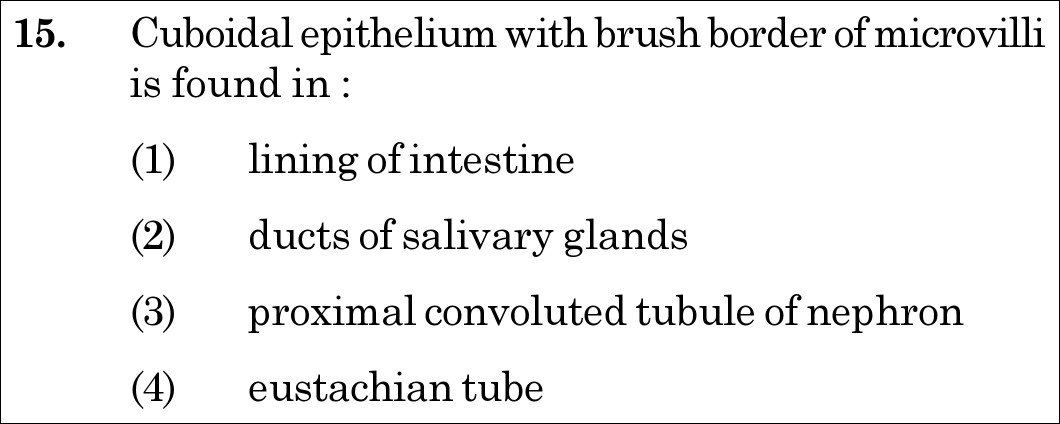
NEET 2020 Botany Question 15: Brush-Bordered Cuboidal Epithelium in Proximal Convoluted Tubule (PCT)

Question

Cuboidal epithelium with brush border of microvilli is found in:

  1. (1)lining of intestine
  2. (2)ducts of salivary glands
  3. (3)proximal convoluted tubule of nephron
  4. (4)eustachian tube
✓
Verified Against NTA Final Answer Key
Option (3) : proximal convoluted tubule of nephron
📚 Structural Organisation in Animals Easy
📋 Given Parameters & Problem Setup
Epithelium Shape Cuboidal cells (cube-like)
Apical Specialization Brush border of dense microvilli
Question Objective Identify the exact anatomical organ location
⚡

The 30-Second Exam Hall Shortcut: ⚡ "PCT of Nephron = Brush-Bordered Cuboidal Epithelium (70–80% Reabsorption)!"

⏱️ Save ~20 seconds

The proximal convoluted tubule (PCT) of the nephron is lined by simple cuboidal epithelium with a dense brush border of microvilli to amplify surface area for absorbing 70–80% of water and electrolytes! Mark PCT of nephron (Option 3) in under 10 seconds.

1 Recall NCERT epithelial locations: - Simple cuboidal epithelium with brush border of microvilli: PCT of nephron. - Simple columnar epithelium with microvilli: Lining of intestine. - Ciliated epithelium: Bronchioles and fallopian tubes. - Compound epithelium: Buccal cavity, ducts of salivary glands.
2 Match prompt: "Cuboidal epithelium with brush border of microvilli".
3 Select Option (3): Proximal convoluted tubule of nephron.
🛡️
Why You Can 100% Trust This Shortcut: NCERT Biology · Structural Organisation in Animals (Epithelial Tissue: The epithelium of proximal convoluted tubule (PCT) of nephron in the kidney has microvilli. Cuboidal epithelium with brush border of microvilli is found in proximal convoluted tubule of nephron).
📐

Step-by-Step Rigorous Workflow & Mathematical Proof

Step 1

Histological Architecture of the Proximal Convoluted Tubule

The proximal convoluted tubule (PCT) of the renal nephron performs the bulk of tubular reabsorption: - Approximately 70–80% of filtered water, electrolytes (Na+Na^+, K+K^+, Cl−Cl^-, HCO3−HCO_3^-), and virtually 100% of essential nutrients (glucose, amino acids) are actively and passively reabsorbed here. - To support this massive transport load, the PCT is lined by simple cuboidal epithelial cells featuring a densely packed apical array of finger-like projections called microvilli (brush border). - This brush border increases the luminal absorptive surface area more than 20-fold. The basolateral membranes are deeply invaginated and packed with abundant mitochondria to power Na+/K+Na^+/K^+ ATPase pumps.

PCT of Nephron  ⟺  Simple Cuboidal Epithelium+Brush Border (Microvilli)[↑Reabsorptive Area]\textbf{PCT of Nephron} \iff \mathbf{Simple\,Cuboidal\,Epithelium} + \mathbf{Brush\,Border\,(Microvilli)} \quad [\uparrow \text{Reabsorptive Area}]
Step 2

Review of Competing Anatomical Sites

- Lining of intestine: Lined by simple columnar epithelium with microvilli and goblet cells, not cuboidal. - Ducts of salivary glands: Lined by simple cuboidal/columnar or compound stratified epithelium without an apical brush border. - Eustachian tube: Lined by ciliated pseudostratified columnar epithelium.

⭐

360° Option Elimination Engine Key Feature

Diagnose every choice: Know exactly why the right option works and why distractors fail.

4-Option Deep Scan
1 A
✗ Incorrect
Verdict & Scientific Reason:

Incorrect. The intestinal mucosa is lined by simple columnar epithelium with microvilli, not cuboidal.

⚠️
Student Fallacy (Why candidates pick this trap): Confusing columnar cells of the gut with cuboidal cells of the renal tubule.
2 B
✗ Incorrect
Verdict & Scientific Reason:

Incorrect. Salivary ducts lack an apical brush border of microvilli.

⚠️
Student Fallacy (Why candidates pick this trap): Assuming all glandular ducts have a brush border.
3 C
✓ 100% Correct
Verdict & Scientific Reason:

Correct. Verbatim textbook histology: PCT of nephron possesses brush-bordered cuboidal epithelium.

💡
Why this is airtight: None. Direct recall of standard epithelial tissue examples.
4 D
✗ Incorrect
Verdict & Scientific Reason:

Incorrect. The Eustachian tube is lined by ciliated respiratory epithelium, not brush-bordered cuboidal.

⚠️
Student Fallacy (Why candidates pick this trap): Confusing cilia with microvilli.
⚠️

NTA Trap Alert: Columnar vs Cuboidal Brush Border Trap

Both the intestine and PCT possess a brush border of microvilli. The critical diagnostic differentiator is cell shape: Intestine = Columnar; PCT = Cuboidal.

🛡️ How to avoid the -1 mark: Remember: Intestinal villi = Columnar; Renal PCT = Cuboidal.
📖

Core NEET Syllabus Standard

NEET / NCERT Biology · Structural Organisation in Animals Standard Benchmark
Core Scientific Principle Tested:

"Cuboidal epithelium with a brush border of microvilli lines the proximal convoluted tubule (PCT) of nephrons."

Syllabus Focus: Cuboidal Epithelium Modifications
✓ Core NEET UG Syllabus Anchor Syllabus & Academic Standards ↗

Ready to attempt under real exam pressure?

Test your speed and accuracy in the authentic 180-minute timed NTA simulator.

Launch NEET 2020 CBT Test →

Spotted a mistake in this solution? Report an error (support@mycompetitiveexams.com)

⚖️ Legal & Fair Dealing Notice: Sourced from publicly released NEET 2020 question papers and NEET answer keys for private study, research, and non-commercial educational practice under Fair Dealing (Section 52(1)(a) of the Indian Copyright Act, 1957). Not affiliated with or endorsed by NTA or NMC.

Solve 4 NEET Questions a Day — One per Subject

Cover all 1,140 official NEET questions in 285 days at your own pace. Progress is saved on your device. No login needed.