MyCompetitiveExams Logo MyCompetitiveExams
Search 1,140+ Questions
Chapters, formulas, speed tricks
→
⚡ Brahmastra NEET 2027
720 MARKS

Dynamic 180-question full-length simulator mixed dynamically from all 6 years for 2027 & 2026 aspirants.

Launch Brahmastra 2027 Test →
Start Practice →
100% Free · No Login Required
Q.4 Botany ⭐ 360° Option Elimination Active
Vault ↗

NEET 2020 Botany Question 4 Solution

Topic: Human Health and Disease · Official NTA Booklet Code E1
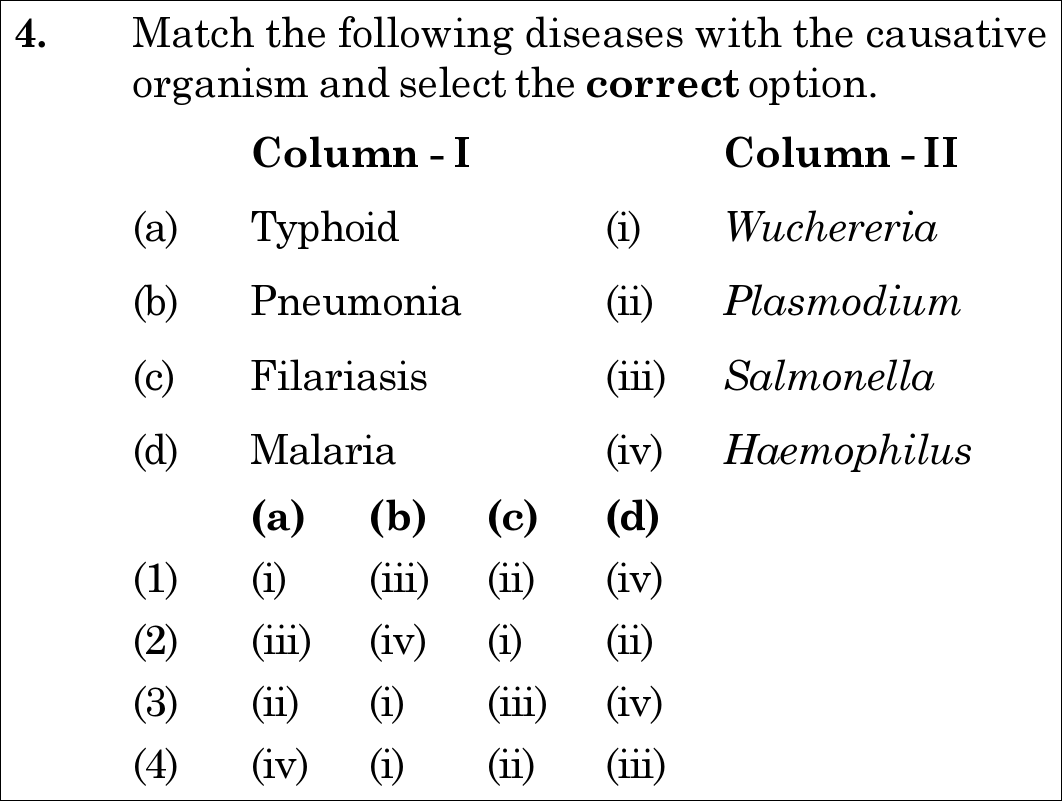
NEET 2020 Botany Question 4: Causative Pathogens of Typhoid, Pneumonia, Filariasis, and Malaria

Question

Match the following diseases with the causative organism and select the correct option. Column - I Column - II (a) Typhoid (i) Wuchereria (b) Pneumonia (ii) Plasmodium (c) Filariasis (iii) Salmonella (d) Malaria (iv) Haemophilus (a) (b) (c) (d)

  1. (1)(i) (iii) (ii) (iv)
  2. (2)(iii) (iv) (i) (ii)
  3. (3)(ii) (i) (iii) (iv)
  4. (4)(iv) (i) (ii) (iii)
✓
Verified Against NTA Final Answer Key
Option (2) : (a)-(iii), (b)-(iv), (c)-(i), (d)-(ii)
📚 Human Health and Disease Easy
📋 Given Parameters & Problem Setup
Column I (Diseases) (a) Typhoid, (b) Pneumonia, (c) Filariasis, (d) Malaria
Column II (Pathogens) (i) Wuchereria, (ii) Plasmodium, (iii) Salmonella, (iv) Haemophilus
⚡

The 30-Second Exam Hall Shortcut: ⚡ "Salmonella = Typhoid, Haemophilus = Pneumonia, Wuchereria = Filariasis"

⏱️ Save ~25 seconds

Typhoid is caused by Salmonella typhi ((a)-(iii)); Pneumonia by Haemophilus influenzae ((b)-(iv)); Filariasis by Wuchereria bancrofti ((c)-(i)); and Malaria by Plasmodium ((d)-(ii)). Pattern (iii), (iv), (i), (ii) matches Option (2) instantly!

1 Match (a) Typhoid -> (iii) Salmonella typhi (confirmed by Widal test).
2 Match (b) Pneumonia -> (iv) Haemophilus influenzae (infects alveoli).
3 Match (c) Filariasis -> (i) Wuchereria bancrofti (filarial worm in lymphatic vessels).
4 Match (d) Malaria -> (ii) Plasmodium (protozoan sporozoite parasite).
5 Match pattern (iii), (iv), (i), (ii) -> Select Option (2).
🛡️
Why You Can 100% Trust This Shortcut: NCERT Biology · Human Health and Disease (Common Infectious Diseases: Salmonella typhi causes typhoid fever; Streptococcus pneumoniae and Haemophilus influenzae cause pneumonia; Wuchereria causes filariasis; Plasmodium causes malaria).
📐

Step-by-Step Rigorous Workflow & Mathematical Proof

Step 1

Etiological Diagnosis of Listed Human Pathogens

- (a) Typhoid Fever: Caused by the pathogenic Gram-negative rod bacterium _Salmonella typhi_, which enters the small intestine via contaminated food and water, migrating to other organs via blood (diagnosed by Widal test). - (b) Pneumonia: An acute pulmonary infection caused by _Streptococcus pneumoniae_ and _Haemophilus influenzae_, leading to fluid accumulation within alveolar sacs. - (c) Filariasis (Elephantiasis): Caused by the filarial nematode roundworms _Wuchereria bancrofti_ and _W. malayi_, which chronically obstruct lymphatic vessels of the lower limbs. - (d) Malaria: Caused by the protozoan parasite _Plasmodium_ (_P. vivax_, _P. malariae_, _P. falciparum_), transmitted by the bite of female _Anopheles_ mosquitoes.

Typhoid  ⟺  Salmonella[(a)→(iii)]Pneumonia  ⟺  Haemophilus[(b)→(iv)]Filariasis  ⟺  Wuchereria[(c)→(i)]Malaria  ⟺  Plasmodium[(d)→(ii)]\begin{aligned} \text{Typhoid} &\iff \textit{Salmonella} \quad [\text{(a)} \to \text{(iii)}] \\ \text{Pneumonia} &\iff \textit{Haemophilus} \quad [\text{(b)} \to \text{(iv)}] \\ \text{Filariasis} &\iff \textit{Wuchereria} \quad [\text{(c)} \to \text{(i)}] \\ \text{Malaria} &\iff \textit{Plasmodium} \quad [\text{(d)} \to \text{(ii)}] \end{aligned}
Step 2

Option Alignment

Matching sequence is: (a)-(iii), (b)-(iv), (c)-(i), (d)-(ii). This corresponds precisely to Option (2).

⭐

360° Option Elimination Engine Key Feature

Diagnose every choice: Know exactly why the right option works and why distractors fail.

4-Option Deep Scan
1 A
✗ Incorrect
Verdict & Scientific Reason:

Incorrect. Assigns Wuchereria to typhoid and Plasmodium to filariasis.

⚠️
Student Fallacy (Why candidates pick this trap): Random misalignment of pathogens.
2 B
✓ 100% Correct
Verdict & Scientific Reason:

Correct. Accurately matches all 4 human diseases to their causative microorganisms.

💡
Why this is airtight: None. Direct recall of standard pathogen profiles.
3 C
✗ Incorrect
Verdict & Scientific Reason:

Incorrect. Assigns Plasmodium to typhoid.

⚠️
Student Fallacy (Why candidates pick this trap): Swapping bacterial and protozoan infections.
4 D
✗ Incorrect
Verdict & Scientific Reason:

Incorrect. Assigns Haemophilus to typhoid.

⚠️
Student Fallacy (Why candidates pick this trap): Confusing respiratory pneumonia bacteria with enteric typhoid bacteria.
⚠️

NTA Trap Alert: Haemophilus vs Salmonella Enteric/Respiratory Trap

Students sometimes know both are bacteria but reverse their target organs: Salmonella causes enteric fever (gut), while Haemophilus causes pneumonia (alveoli).

🛡️ How to avoid the -1 mark: Remember: Salmonella = Food & Gut (Typhoid); Haemophilus = Lungs (Pneumonia).
📖

Core NEET Syllabus Standard

NEET / NCERT Biology · Human Health and Disease Standard Benchmark
Core Scientific Principle Tested:

"Typhoid is caused by Salmonella; pneumonia by Haemophilus; filariasis by Wuchereria; malaria by Plasmodium."

Syllabus Focus: Infectious Pathogens
✓ Core NEET UG Syllabus Anchor Syllabus & Academic Standards ↗

Ready to attempt under real exam pressure?

Test your speed and accuracy in the authentic 180-minute timed NTA simulator.

Launch NEET 2020 CBT Test →

Spotted a mistake in this solution? Report an error (support@mycompetitiveexams.com)

⚖️ Legal & Fair Dealing Notice: Sourced from publicly released NEET 2020 question papers and NEET answer keys for private study, research, and non-commercial educational practice under Fair Dealing (Section 52(1)(a) of the Indian Copyright Act, 1957). Not affiliated with or endorsed by NTA or NMC.

Solve 4 NEET Questions a Day — One per Subject

Cover all 1,140 official NEET questions in 285 days at your own pace. Progress is saved on your device. No login needed.