MyCompetitiveExams Logo MyCompetitiveExams
Search 1,140+ Questions
Chapters, formulas, speed tricks
→
⚡ Brahmastra NEET 2027
720 MARKS

Dynamic 180-question full-length simulator mixed dynamically from all 6 years for 2027 & 2026 aspirants.

Launch Brahmastra 2027 Test →
Start Practice →
100% Free · No Login Required
Q.123 Chemistry ⭐ 360° Option Elimination Active
Vault ↗

NEET 2020 Chemistry Question 123 Solution

Topic: Some Basic Concepts of Chemistry · Official NTA Booklet Code E1
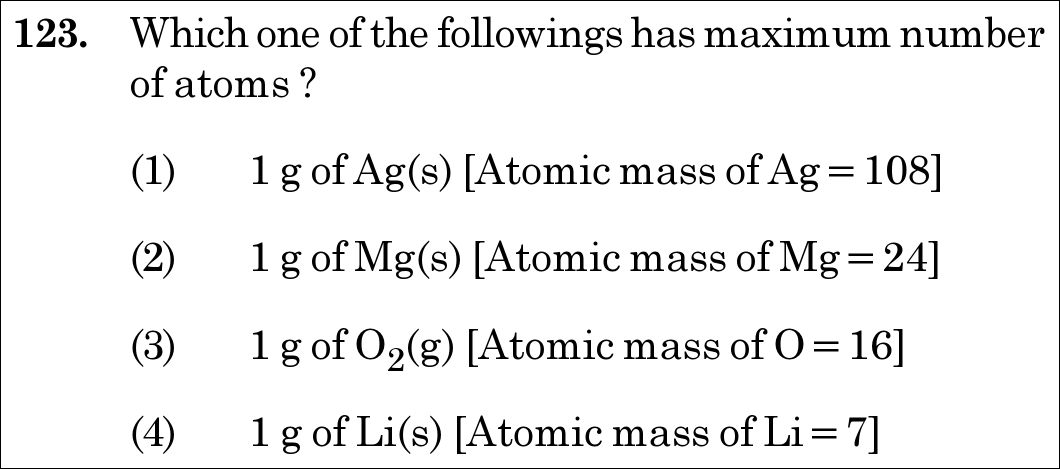
NEET 2020 Chemistry Question 123: Number of Atoms Comparison: Maximum Number of Atoms in 1 g Samples

Question

Which one of the followings has maximum number of atoms?

✓
Verified Against NTA Final Answer Key
Option (4) : 1 g of Li(s) [Atomic mass of Li=7]
📚 Some Basic Concepts of Chemistry Easy
📋 Given Parameters & Problem Setup
Sample Mass 1 g for all four options
Option 1 1 g Ag (Atomic mass = 108)
Option 2 1 g Mg (Atomic mass = 24)
Option 3 1 g O2 (Molar mass = 32, 2 atoms/molecule)
Option 4 1 g Li (Atomic mass = 7)
⚡

The 30-Second Exam Hall Shortcut: ⚡ "Number of Atoms = (Mass / Molar Mass) × Atomicity × NA: Smallest Molar Mass Gives MAXIMUM Atoms!"

⏱️ 20 seconds

For a fixed mass of 1 g, the number of atoms is inversely proportional to the atomic mass. Comparing atoms: 1 g Li has NA/7≈0.143NAN_A/7 \approx 0.143 N_A atoms. 1 g O2 has (1/32)×2NA=NA/16≈0.0625NA(1/32) \times 2 N_A = N_A/16 \approx 0.0625 N_A atoms. 1 g Mg has NA/24≈0.042NAN_A/24 \approx 0.042 N_A. 1 g Ag has NA/108≈0.009NAN_A/108 \approx 0.009 N_A. Lithium has the smallest atomic mass (7), yielding the MAXIMUM number of atoms! Mark Option (4) in 5 seconds.

1 Formula: Number of atoms = (Mass / Atomic mass) × NA.
2 For Ag (s): 1/108 × NA = 0.0092 NA.
3 For Mg (s): 1/24 × NA = 0.0417 NA.
4 For O2 (g): (1/32) × 2 × NA = 1/16 × NA = 0.0625 NA.
5 For Li (s): 1/7 × NA = 0.1428 NA.
6 0.1428 NA is the largest value. Select Option (4) 1 g of Li.
🛡️
Why You Can 100% Trust This Shortcut: NCERT Chemistry · Some Basic Concepts of Chemistry (Mole Concept and Avogadro Constant)
📐

Step-by-Step Rigorous Workflow & Mathematical Proof

Step 1

Formula for Calculating Total Atoms

For any substance of mass mm: Number of moles of molecules/atoms n=mM\text{Number of moles of molecules/atoms } n = \frac{m}{M} Total number of atoms=n×Atomicity×NA=(mM)×Atomicity×NA\text{Total number of atoms} = n \times \text{Atomicity} \times N_A = \left(\frac{m}{M}\right) \times \text{Atomicity} \times N_A

Step 2

Calculate Atoms in 1 g of Each Candidate

1. For 1 g of Ag (s)1\text{ g of Ag (s)} (Atomic mass=108 g mol−1\text{Atomic mass} = 108\text{ g mol}^{-1}, atomicity = 1): Atoms=1108NA≈0.00926NA\text{Atoms} = \frac{1}{108} N_A \approx 0.00926 N_A 2. For 1 g of Mg (s)1\text{ g of Mg (s)} (Atomic mass=24 g mol−1\text{Atomic mass} = 24\text{ g mol}^{-1}, atomicity = 1): Atoms=124NA≈0.04167NA\text{Atoms} = \frac{1}{24} N_A \approx 0.04167 N_A 3. For 1 g of O2 (g)1\text{ g of } \text{O}_2\text{ (g)} (Molar mass=32 g mol−1\text{Molar mass} = 32\text{ g mol}^{-1}, atomicity = 2): Atoms=(132)×2×NA=116NA≈0.06250NA\text{Atoms} = \left(\frac{1}{32}\right) \times 2 \times N_A = \frac{1}{16} N_A \approx 0.06250 N_A 4. For 1 g of Li (s)1\text{ g of Li (s)} (Atomic mass=7 g mol−1\text{Atomic mass} = 7\text{ g mol}^{-1}, atomicity = 1): Atoms=17NA≈0.14286NA\text{Atoms} = \frac{1}{7} N_A \approx 0.14286 N_A

Step 3

Compare the Calculated Values

0.14286NA>0.06250NA>0.04167NA>0.00926NA0.14286 N_A > 0.06250 N_A > 0.04167 N_A > 0.00926 N_A Clearly, 1 g of lithium possesses more than double the number of atoms compared to 1 g of oxygen gas, and over 15 times that of silver.

Step 4

Conclude 1 g of Li

Option (4) contains the maximum number of atoms.

⭐

360° Option Elimination Engine Key Feature

Diagnose every choice: Know exactly why the right option works and why distractors fail.

4-Option Deep Scan
1 A
✗ Incorrect
Verdict & Scientific Reason:

Incorrect; has the largest atomic mass (108), yielding the least number of atoms (NA/108N_A/108).

⚠️
Student Fallacy (Why candidates pick this trap): Confusing heavy atoms with large number of atoms.
2 B
✗ Incorrect
Verdict & Scientific Reason:

Incorrect; NA/24N_A/24 is much less than NA/7N_A/7.

⚠️
Student Fallacy (Why candidates pick this trap): Overlooking lighter elements.
3 C
✗ Incorrect
Verdict & Scientific Reason:

Incorrect; total atoms is NA/16N_A/16, which is less than half that of lithium (NA/7N_A/7).

⚠️
Student Fallacy (Why candidates pick this trap): Multiplying by 2 and forgetting to divide by molar mass 32, thinking it has 2/16 = 1/8 NA.
4 D
✓ 100% Correct
Verdict & Scientific Reason:

Factually and mathematically exact; with the smallest atomic mass (7), 1 g of Li yields the maximum number of atoms (NA/7N_A/7).

💡
Why this is airtight: None; classic mole concept comparison.
⚠️

NTA Trap Alert: Heavy Mass vs Atom Count Inverse Relation

Lighter elements contain MORE atoms per gram! 1 gram of light atoms contains many more individual particles than 1 gram of heavy atoms.

🛡️ How to avoid the -1 mark: Smallest atomic mass per atom = MAXIMUM number of atoms!
📖

Core NEET Syllabus Standard

Chemistry · Some Basic Concepts of Chemistry Standard Benchmark
Core Scientific Principle Tested:

""

Syllabus Focus: Number of Atoms Comparison: Maximum Number of Atoms in 1 g Samples
✓ Core NEET UG Syllabus Anchor Syllabus & Academic Standards ↗

Ready to attempt under real exam pressure?

Test your speed and accuracy in the authentic 180-minute timed NTA simulator.

Launch NEET 2020 CBT Test →

Spotted a mistake in this solution? Report an error (support@mycompetitiveexams.com)

⚖️ Legal & Fair Dealing Notice: Sourced from publicly released NEET 2020 question papers and NEET answer keys for private study, research, and non-commercial educational practice under Fair Dealing (Section 52(1)(a) of the Indian Copyright Act, 1957). Not affiliated with or endorsed by NTA or NMC.

Solve 4 NEET Questions a Day — One per Subject

Cover all 1,140 official NEET questions in 285 days at your own pace. Progress is saved on your device. No login needed.