MyCompetitiveExams Logo MyCompetitiveExams
Search 1,140+ Questions
Chapters, formulas, speed tricks
→
⚡ Brahmastra NEET 2027
720 MARKS

Dynamic 180-question full-length simulator mixed dynamically from all 6 years for 2027 & 2026 aspirants.

Launch Brahmastra 2027 Test →
Start Practice →
100% Free · No Login Required
Q.17 Botany ⭐ 360° Option Elimination Active
Vault ↗

NEET 2020 Botany Question 17 Solution

Topic: Cell: The Unit of Life · Official NTA Booklet Code E1
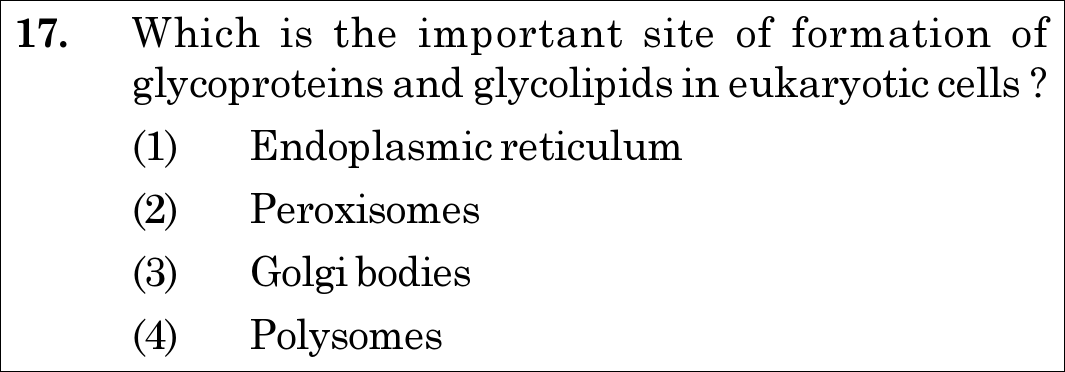
NEET 2020 Botany Question 17: Golgi Apparatus: Site of Glycosylation (Glycoproteins & Glycolipids Formation)

Question

Which is the important site of formation of glycoproteins and glycolipids in eukaryotic cells?

  1. (1)Endoplasmic reticulum
  2. (2)Peroxisomes
  3. (3)Golgi bodies
  4. (4)Polysomes
✓
Verified Against NTA Final Answer Key
Option (3) : Golgi bodies
📚 Cell: The Unit of Life Easy
📋 Given Parameters & Problem Setup
Macromolecules Glycoproteins and Glycolipids
Cellular Context Eukaryotic Cells
Question Objective Identify the principal organellar site of their formation
⚡

The 30-Second Exam Hall Shortcut: ⚡ "Golgi Bodies = Glycosylation Central (Glycoproteins + Glycolipids)!"

⏱️ Save ~20 seconds

The Golgi apparatus is the primary post-translational processing organelle where proteins and lipids undergo glycosylation to form glycoproteins and glycolipids! Golgi bodies are the site of glycoprotein and glycolipid formation. Select Option (3) in 5 seconds.

1 Recall NCERT Golgi functions: - Packaging materials into secretory vesicles. - Modification of proteins received from RER. - Important site of formation of glycoproteins and glycolipids.
2 Contrast with other organelles: ER synthesizes basic polypeptide chains and lipids; Golgi adds the carbohydrate oligosaccharide moieties.
3 Select Option (3): Golgi bodies.
🛡️
Why You Can 100% Trust This Shortcut: NCERT Biology · Cell: The Unit of Life (Endomembrane System - Golgi apparatus: Golgi apparatus is the important site of formation of glycoproteins and glycolipids).
📐

Step-by-Step Rigorous Workflow & Mathematical Proof

Step 1

Biosynthetic and Glycosylation Functions of the Golgi Apparatus

First observed by Camillo Golgi in 1898, the Golgi complex consists of stacked, curved cisternae arranged concentrically near the nucleus with a convex *cis* (forming) face and a concave *trans* (maturing) face: - Post-Translational Glycosylation: Proteins translated on rough endoplasmic reticulum (RER) ribosomes and lipids synthesized in smooth endoplasmic reticulum (SER) bud off as transport vesicles that fuse with the *cis* cisternae. - As these precursors migrate through medial to *trans* cisternae, resident glycosyltransferase enzymes attach carbohydrate oligosaccharides to: 1. Polypeptides via N-linked and O-linked glycosylation, forming Glycoproteins. 2. Sphingolipids and glycerol-lipids, forming Glycolipids. - NCERT explicitly designates the Golgi apparatus as the important site of formation of glycoproteins and glycolipids.

{Proteins from RER+Oligosaccharides→Golgi BodiesGlycoproteinsLipids from SER+Oligosaccharides→Golgi BodiesGlycolipids\begin{cases} \text{Proteins from RER} + \text{Oligosaccharides} \xrightarrow{\mathbf{Golgi\,Bodies}} \mathbf{Glycoproteins} \\[3pt] \text{Lipids from SER} + \text{Oligosaccharides} \xrightarrow{\mathbf{Golgi\,Bodies}} \mathbf{Glycolipids} \end{cases}
Step 2

Evaluation of Alternative Organelles

- Endoplasmic reticulum: Site of initial protein synthesis (RER) and steroid/phospholipid synthesis (SER), but the terminal completion of glycoproteins and glycolipids is the hallmark role of the Golgi. - Peroxisomes: Microbodies performing hydrogen peroxide metabolism (catalase) and photorespiration in plants. - Polysomes: Clusters of ribosomes simultaneously translating a single mRNA strand into polypeptides.

⭐

360° Option Elimination Engine Key Feature

Diagnose every choice: Know exactly why the right option works and why distractors fail.

4-Option Deep Scan
1 A
✗ Incorrect
Verdict & Scientific Reason:

Incorrect. While initial protein/lipid backbones originate in the ER, the definitive formation of glycoproteins and glycolipids occurs in Golgi bodies.

⚠️
Student Fallacy (Why candidates pick this trap): Failing to distinguish between synthesis of core proteins (ER) and final glycosylation (Golgi).
2 B
✗ Incorrect
Verdict & Scientific Reason:

Incorrect. Peroxisomes catabolize fatty acids and decompose H2O2.

⚠️
Student Fallacy (Why candidates pick this trap): Confusing microbodies with secretor organelles.
3 C
✓ 100% Correct
Verdict & Scientific Reason:

Correct. Verbatim NCERT principle: Golgi apparatus is the important site of formation of glycoproteins and glycolipids.

💡
Why this is airtight: None. Direct recall of cell biology functional mapping.
4 D
✗ Incorrect
Verdict & Scientific Reason:

Incorrect. Polysomes synthesize linear polypeptides only; they cannot perform lipid or carbohydrate glycosylation.

⚠️
Student Fallacy (Why candidates pick this trap): Confusing ribosome translation with post-translational modification.
⚠️

NTA Trap Alert: ER vs Golgi Glycosylation Attribution Trap

Candidates know ER synthesizes proteins and lipids, so they mistakenly choose Endoplasmic Reticulum. NCERT specifically reserves the phrase "important site of formation of glycoproteins and glycolipids" for the Golgi apparatus.

🛡️ How to avoid the -1 mark: Remember: G = Golgi = Glycoproteins & Glycolipids.
📖

Core NEET Syllabus Standard

NEET / NCERT Biology · Cell: The Unit of Life Standard Benchmark
Core Scientific Principle Tested:

"Golgi apparatus is the important site of formation of glycoproteins and glycolipids."

Syllabus Focus: Golgi Apparatus Functions
✓ Core NEET UG Syllabus Anchor Syllabus & Academic Standards ↗

Ready to attempt under real exam pressure?

Test your speed and accuracy in the authentic 180-minute timed NTA simulator.

Launch NEET 2020 CBT Test →

Spotted a mistake in this solution? Report an error (support@mycompetitiveexams.com)

⚖️ Legal & Fair Dealing Notice: Sourced from publicly released NEET 2020 question papers and NEET answer keys for private study, research, and non-commercial educational practice under Fair Dealing (Section 52(1)(a) of the Indian Copyright Act, 1957). Not affiliated with or endorsed by NTA or NMC.

Solve 4 NEET Questions a Day — One per Subject

Cover all 1,140 official NEET questions in 285 days at your own pace. Progress is saved on your device. No login needed.