MyCompetitiveExams Logo MyCompetitiveExams
Search 1,140+ Questions
Chapters, formulas, speed tricks
→
⚡ Brahmastra NEET 2027
720 MARKS

Dynamic 180-question full-length simulator mixed dynamically from all 6 years for 2027 & 2026 aspirants.

Launch Brahmastra 2027 Test →
Start Practice →
100% Free · No Login Required
Q.125 Chemistry ⭐ 360° Option Elimination Active
Vault ↗

NEET 2020 Chemistry Question 125 Solution

Topic: Redox Reactions · Official NTA Booklet Code E1
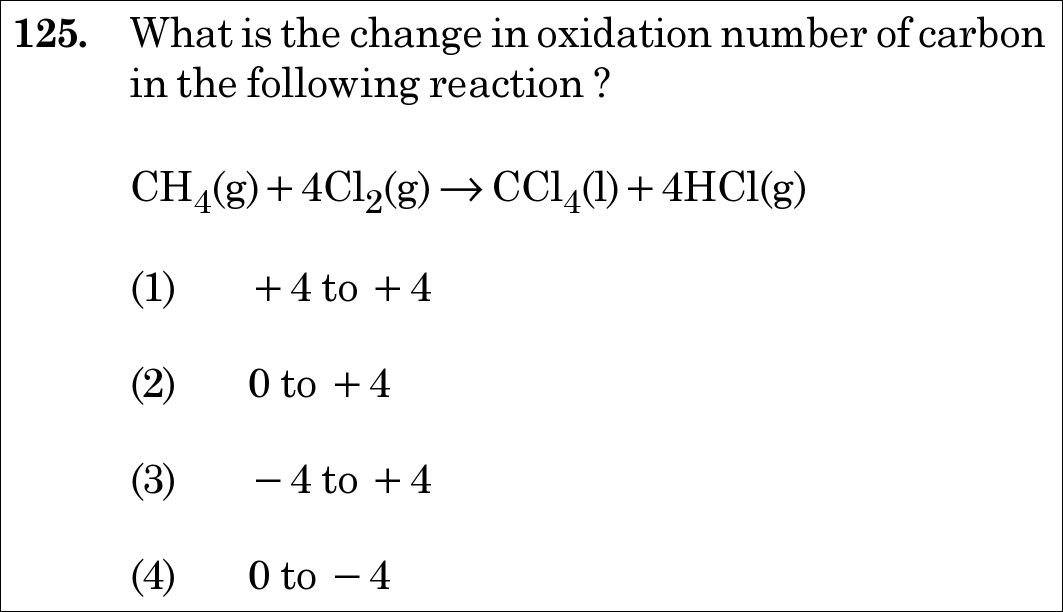
NEET 2020 Chemistry Question 125: Oxidation Number Calculation of Carbon: Conversion of CH4 to CCl4

Question

What is the change in oxidation number of carbon in the following reaction? CH4(g)+4Cl2(g) → CCl4(l)+4HCl(g)

✓
Verified Against NTA Final Answer Key
Option (3) : −4 to +4
📚 Redox Reactions Easy
📋 Given Parameters & Problem Setup
Chemical Equation CH4(g) + 4Cl2(g) -> CCl4(l) + 4HCl(g)
Element of Interest Carbon (C)
Question Objective Determine the change in oxidation state of carbon
⚡

The 30-Second Exam Hall Shortcut: ⚡ "In CH4, C is -4 (bonded to less electronegative H); in CCl4, C is +4 (bonded to more electronegative Cl)!"

⏱️ 15 seconds

Hydrogen is less electronegative than carbon, so in CH4CH_4: x+4(+1)=0  ⟹  x=−4x + 4(+1) = 0 \implies x = -4. Chlorine is more electronegative than carbon, so in CCl4CCl_4: x+4(−1)=0  ⟹  x=+4x + 4(-1) = 0 \implies x = +4. The oxidation state of carbon changes from −4-4 to +4+4 (loss of 8 electrons, oxidation)! Mark Option (3) in 5 seconds.

1 In CH4: C bonded to 4 H atoms (+1 each) -> Oxidation state of C = -4.
2 In CCl4: C bonded to 4 Cl atoms (-1 each) -> Oxidation state of C = +4.
3 Change in oxidation number = -4 to +4.
4 Select Option (3).
🛡️
Why You Can 100% Trust This Shortcut: NCERT Chemistry · Redox Reactions (Oxidation Number Rules)
📐

Step-by-Step Rigorous Workflow & Mathematical Proof

Step 1

Rules for Assigning Oxidation Numbers

When assigning oxidation states, bonding electrons are completely assigned to the more electronegative atom: - Electronegativity values on the Pauling scale: Cl (3.16)>C (2.55)>H (2.20)\text{Cl (3.16)} > \text{C (2.55)} > \text{H (2.20)}.

Step 2

Calculate Oxidation State of Carbon in CH4

Because carbon is more electronegative than hydrogen, hydrogen has an oxidation number of +1+1: x+4(+1)=0x + 4(+1) = 0 x=−4x = -4 Thus, carbon is in the −4-4 oxidation state in methane (CH4\text{CH}_4).

Step 3

Calculate Oxidation State of Carbon in CCl4

Because chlorine is more electronegative than carbon, each chlorine atom has an oxidation number of −1-1: x+4(−1)=0x + 4(-1) = 0 x=+4x = +4 Thus, carbon is in the +4+4 oxidation state in carbon tetrachloride (CCl4\text{CCl}_4).

Step 4

Determine the Overall Redox Change

The oxidation state of carbon increases from −4-4 in CH4\text{CH}_4 to +4+4 in CCl4\text{CCl}_4, representing an 8-electron oxidation. (Chlorine is concurrently reduced from 00 in Cl2\text{Cl}_2 to −1-1 in CCl4\text{CCl}_4 and HCl\text{HCl}).

⭐

360° Option Elimination Engine Key Feature

Diagnose every choice: Know exactly why the right option works and why distractors fail.

4-Option Deep Scan
1 A
✗ Incorrect
Verdict & Scientific Reason:

Incorrect; erroneously assigns +4 to carbon in methane as if hydrogen were a hydride (-1).

⚠️
Student Fallacy (Why candidates pick this trap): Treating hydrogen as hydride (-1) instead of +1.
2 B
✗ Incorrect
Verdict & Scientific Reason:

Incorrect; 0 is the oxidation state of elemental carbon (graphite/diamond), not methane.

⚠️
Student Fallacy (Why candidates pick this trap): Assuming covalent carbon in hydrocarbons has zero oxidation state.
3 C
✓ 100% Correct
Verdict & Scientific Reason:

Factually and chemically exact; carbon undergoes an 8-electron oxidation from -4 in CH4 to +4 in CCl4.

💡
Why this is airtight: None; clean electronegativity-based assignment.
4 D
✗ Incorrect
Verdict & Scientific Reason:

Incorrect; completely inverted sign and erroneous initial state.

⚠️
Student Fallacy (Why candidates pick this trap): Reversing signs and initial states.
⚠️

NTA Trap Alert: Electronegativity Comparison for C-H vs C-Cl

- In C-H: Carbon is MORE electronegative than H -> Carbon is NEGATIVE (−4-4). - In C-Cl: Carbon is LESS electronegative than Cl -> Carbon is POSITIVE (+4+4).

🛡️ How to avoid the -1 mark: Remember: CH4CH_4 = -4; CCl4CCl_4 = +4! Change is -4 to +4!
📖

Core NEET Syllabus Standard

Chemistry · Redox Reactions Standard Benchmark
Core Scientific Principle Tested:

""

Syllabus Focus: Oxidation Number Calculation of Carbon: Conversion of CH4 to CCl4
✓ Core NEET UG Syllabus Anchor Syllabus & Academic Standards ↗

Ready to attempt under real exam pressure?

Test your speed and accuracy in the authentic 180-minute timed NTA simulator.

Launch NEET 2020 CBT Test →

Spotted a mistake in this solution? Report an error (support@mycompetitiveexams.com)

⚖️ Legal & Fair Dealing Notice: Sourced from publicly released NEET 2020 question papers and NEET answer keys for private study, research, and non-commercial educational practice under Fair Dealing (Section 52(1)(a) of the Indian Copyright Act, 1957). Not affiliated with or endorsed by NTA or NMC.

Solve 4 NEET Questions a Day — One per Subject

Cover all 1,140 official NEET questions in 285 days at your own pace. Progress is saved on your device. No login needed.