MyCompetitiveExams Logo MyCompetitiveExams
Search 1,140+ Questions
Chapters, formulas, speed tricks
→
⚡ Brahmastra NEET 2027
720 MARKS

Dynamic 180-question full-length simulator mixed dynamically from all 6 years for 2027 & 2026 aspirants.

Launch Brahmastra 2027 Test →
Start Practice →
100% Free · No Login Required
Q.120 Chemistry ⭐ 360° Option Elimination Active
Vault ↗

NEET 2020 Chemistry Question 120 Solution

Topic: Environmental Chemistry · Official NTA Booklet Code E1
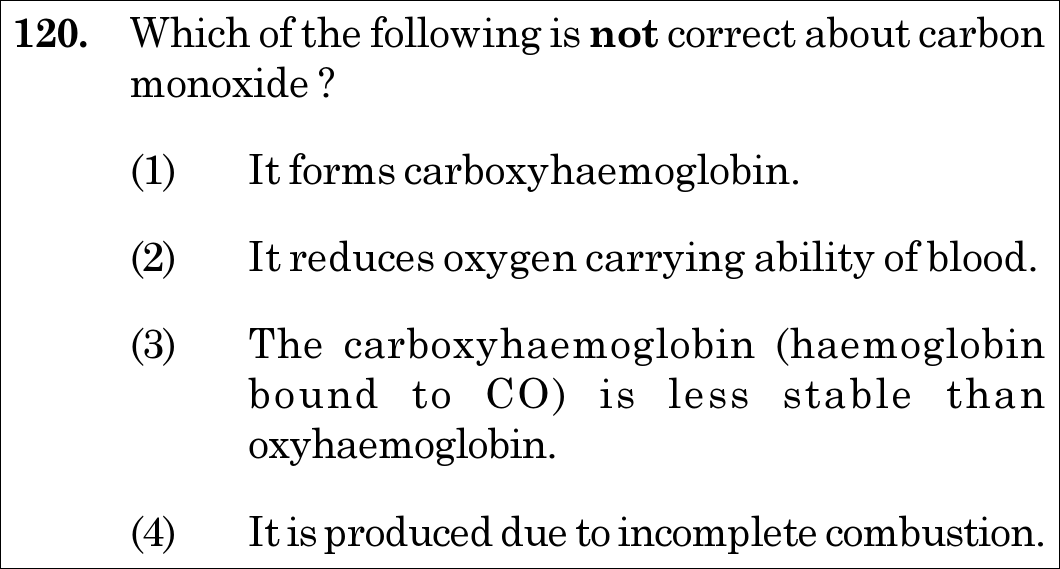
NEET 2020 Chemistry Question 120: Toxicity of Carbon Monoxide: Carboxyhaemoglobin Stability vs Oxyhaemoglobin

Question

Which of the following is not correct about carbon monoxide?

  1. (1)It forms carboxyhaemoglobin.
  2. (2)It reduces oxygen carrying ability of blood.
  3. (3)The carboxyhaemoglobin (haemoglobin bound to CO) is less stable than oxyhaemoglobin.
  4. (4)It is produced due to incomplete combustion.
✓
Verified Against NTA Final Answer Key
Option (3) : The carboxyhaemoglobin (haemoglobin bound to CO) is less stable than oxyhaemoglobin.
📚 Environmental Chemistry Easy
📋 Given Parameters & Problem Setup
Pollutant Gas Carbon monoxide (CO)
Physiological Complex Carboxyhaemoglobin
Question Objective Identify the statement which is NOT CORRECT
⚡

The 30-Second Exam Hall Shortcut: ⚡ "Carboxyhaemoglobin is 300 TIMES MORE STABLE than Oxyhaemoglobin, NOT Less Stable!"

⏱️ 20 seconds

Carbon monoxide binds to haemoglobin about 300 times more strongly than oxygen, forming carboxyhaemoglobin which is FAR MORE STABLE than oxyhaemoglobin. This locks haemoglobin and prevents oxygen delivery, causing hypoxia and asphyxiation. Statement (3) claims carboxyhaemoglobin is "less stable", which is completely false! Mark Option (3) in 5 seconds.

1 Check Statement 1: CO binds haemoglobin to form carboxyhaemoglobin (TRUE).
2 Check Statement 2: Reduces oxygen carrying ability of blood (TRUE).
3 Check Statement 3: Claims carboxyhaemoglobin is LESS stable than oxyhaemoglobin (FALSE! It is ~300 times MORE stable).
4 Check Statement 4: Produced by incomplete combustion of fossil fuels (TRUE).
5 The incorrect statement is (3). Select Option (3).
🛡️
Why You Can 100% Trust This Shortcut: NCERT Chemistry · Environmental Chemistry (Atmospheric Pollution: Gaseous Air Pollutants - Carbon Monoxide)
📐

Step-by-Step Rigorous Workflow & Mathematical Proof

Step 1

Formation of Carboxyhaemoglobin

Carbon monoxide (CO\text{CO}) is a dangerous gaseous air pollutant produced by incomplete combustion of carbonaceous fuels (coal, firewood, petrol). When inhaled, it crosses the alveolar membrane and binds to the ferrous iron (Fe2+\text{Fe}^{2+}) of blood haemoglobin to form carboxyhaemoglobin.

Step 2

Stability of Carboxyhaemoglobin vs Oxyhaemoglobin

NCERT states verbatim in Environmental Chemistry: "Carboxyhaemoglobin is about 300 times more stable than the oxygen-haemoglobin complex." Because CO binds with 300-fold higher affinity, it displaces oxygen and prevents reversible oxygen binding.

Step 3

Physiological Consequences

When concentration of carboxyhaemoglobin reaches 3-4%, the oxygen-carrying capacity of blood is drastically reduced, leading to headache, impaired vision, cardiovascular stress, and fatal asphyxiation.

Step 4

Identify the Erroneous Statement

Statement (3) asserts that carboxyhaemoglobin is "less stable than oxyhaemoglobin." This directly contradicts biochemistry, making Statement (3) the correct answer to the question.

⭐

360° Option Elimination Engine Key Feature

Diagnose every choice: Know exactly why the right option works and why distractors fail.

4-Option Deep Scan
1 A
✗ Incorrect
Verdict & Scientific Reason:

This statement is factually true, hence not the required incorrect answer.

⚠️
Student Fallacy (Why candidates pick this trap): Correctly identifies that CO forms carboxyhaemoglobin.
2 B
✗ Incorrect
Verdict & Scientific Reason:

Factually true; by irreversibly blocking haemoglobin binding sites, it starves body tissues of oxygen.

⚠️
Student Fallacy (Why candidates pick this trap): Standard physiological effect.
3 C
✓ 100% Correct
Verdict & Scientific Reason:

Factually FALSE statement (hence the correct choice); carboxyhaemoglobin is approximately 300 times MORE stable than oxyhaemoglobin.

💡
Why this is airtight: Students who skim over the words "less stable" might miss this explicit factual inversion.
4 D
✗ Incorrect
Verdict & Scientific Reason:

Factually true; incomplete combustion of coal, petrol, and organic matter releases CO.

⚠️
Student Fallacy (Why candidates pick this trap): Well-known environmental chemistry origin.
⚠️

NTA Trap Alert: Affinity Multiplier for Carbon Monoxide

CO affinity for haemoglobin is ~300 times HIGHER than O2. Carboxyhaemoglobin is 300 times MORE STABLE than oxyhaemoglobin.

🛡️ How to avoid the -1 mark: Carboxyhaemoglobin is MORE STABLE, NOT less stable!
📖

Core NEET Syllabus Standard

Chemistry · Environmental Chemistry Standard Benchmark
Core Scientific Principle Tested:

""

Syllabus Focus: Toxicity of Carbon Monoxide: Carboxyhaemoglobin Stability vs Oxyhaemoglobin
✓ Core NEET UG Syllabus Anchor Syllabus & Academic Standards ↗

Ready to attempt under real exam pressure?

Test your speed and accuracy in the authentic 180-minute timed NTA simulator.

Launch NEET 2020 CBT Test →

Spotted a mistake in this solution? Report an error (support@mycompetitiveexams.com)

⚖️ Legal & Fair Dealing Notice: Sourced from publicly released NEET 2020 question papers and NEET answer keys for private study, research, and non-commercial educational practice under Fair Dealing (Section 52(1)(a) of the Indian Copyright Act, 1957). Not affiliated with or endorsed by NTA or NMC.

Solve 4 NEET Questions a Day — One per Subject

Cover all 1,140 official NEET questions in 285 days at your own pace. Progress is saved on your device. No login needed.