MyCompetitiveExams Logo MyCompetitiveExams
Search 1,140+ Questions
Chapters, formulas, speed tricks
→
⚡ Brahmastra NEET 2027
720 MARKS

Dynamic 180-question full-length simulator mixed dynamically from all 6 years for 2027 & 2026 aspirants.

Launch Brahmastra 2027 Test →
Start Practice →
100% Free · No Login Required
Q.128 Chemistry ⭐ 360° Option Elimination Active
Vault ↗

NEET 2020 Chemistry Question 128 Solution

Topic: Surface Chemistry · Official NTA Booklet Code E1
NEET 2020 Chemistry Question 128: Electrical Properties of Colloids: Zeta Potential and Colloidal Stability

Question

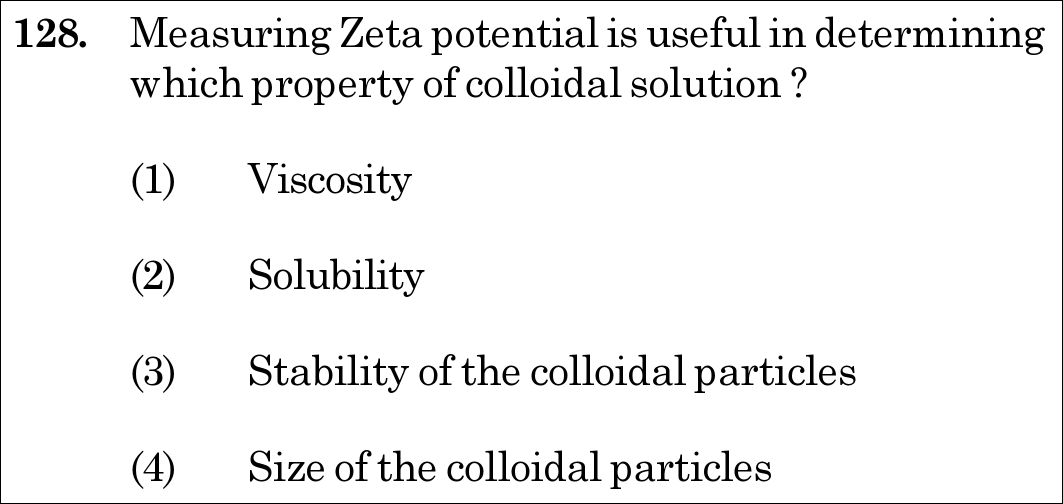
Measuring Zeta potential is useful in determining which property of colloidal solution?

  1. (1)Viscosity
  2. (2)Solubility
  3. (3)Stability of the colloidal particles
  4. (4)Size of the colloidal particles
✓
Verified Against NTA Final Answer Key
Option (3) : Stability of the colloidal particles
📚 Surface Chemistry Easy
📋 Given Parameters & Problem Setup
Electrochemical Parameter Zeta potential (Electrokinetic potential, ζ)
Medium Colloidal dispersion
Question Objective Identify which colloidal property is determined by measuring zeta potential
⚡

The 30-Second Exam Hall Shortcut: ⚡ "High Zeta Potential (> ±30 mV) = Electrostatic Repulsion = STABILITY OF COLLOIDS!"

⏱️ 20 seconds

The potential difference between the fixed Helmholtz layer and the diffused layer of opposite charges is called the Electrokinetic Potential or ZETA POTENTIAL. If the zeta potential is high, electrostatic repulsion between colloidal particles prevents them from aggregating or coagulating, ensuring the STABILITY OF THE COLLOIDAL PARTICLES! Mark Option (3) in 5 seconds.

1 Colloidal particles carry electrical charge, forming an electrical double layer (Helmholtz double layer).
2 Potential difference between fixed layer and diffused mobile layer is the Zeta Potential.
3 High magnitude of zeta potential provides repulsive forces that prevent coagulation.
4 Measuring zeta potential is therefore used to assess the STABILITY of colloidal sol.
5 Select Option (3) Stability of the colloidal particles.
🛡️
Why You Can 100% Trust This Shortcut: NCERT Chemistry · Surface Chemistry (Colloids: Charge on Colloidal Particles & Zeta Potential)
📐

Step-by-Step Rigorous Workflow & Mathematical Proof

Step 1

Origin of Charge on Colloidal Particles

Colloidal particles acquire positive or negative charge by preferential adsorption of ions from solution, forming a firmly attached "fixed layer" on the particle surface.

Step 2

Formation of the Electrical Double Layer

The fixed layer attracts counter-ions from the dispersion medium, forming a second, mobile "diffused layer". The arrangement of double layers of opposite charges around the colloidal particle is called the Helmholtz electrical double layer.

Step 3

Define Zeta Potential

The potential difference between the fixed layer and the diffused layer of opposite charges is termed the electrokinetic potential or zeta potential (denoted by ζ\zeta).

Step 4

Role in Determining Colloidal Stability

If the zeta potential is sufficiently large (typically exceeding ±30 mV\pm 30\text{ mV}), the electrostatic repulsion between approaching colloidal particles is strong enough to overcome attractive van der Waals forces, preventing agglomeration/coagulation. Thus, measurement of zeta potential is universally employed to determine and predict the stability of colloidal dispersions.

⭐

360° Option Elimination Engine Key Feature

Diagnose every choice: Know exactly why the right option works and why distractors fail.

4-Option Deep Scan
1 A
✗ Incorrect
Verdict & Scientific Reason:

Incorrect; viscosity is determined using an Ostwald viscometer, not from electrical zeta potential.

⚠️
Student Fallacy (Why candidates pick this trap): Confusing fluid flow resistance with electrokinetic potential.
2 B
✗ Incorrect
Verdict & Scientific Reason:

Incorrect; solubility is a thermodynamic phase property, not related to the surface charge double layer of lyophobic colloids.

⚠️
Student Fallacy (Why candidates pick this trap): Confusing dissolution with colloidal dispersion stability.
3 C
✓ 100% Correct
Verdict & Scientific Reason:

Factually exact; zeta potential is the direct quantitative metric used to assess the electrostatic stability of colloidal particles against coagulation.

💡
Why this is airtight: None; verbatim concept from NCERT Surface Chemistry.
4 D
✗ Incorrect
Verdict & Scientific Reason:

Incorrect; particle size is measured via dynamic light scattering (DLS), ultracentrifugation, or electron microscopy, not zeta potential.

⚠️
Student Fallacy (Why candidates pick this trap): Assuming electrical charge indicates physical dimensions.
⚠️

NTA Trap Alert: Zeta Potential Function

Zeta potential measures the net charge repulsion between particles: High Zeta potential = High Repulsion = STABLE COLLOID. Low Zeta potential = Aggregation/Coagulation.

🛡️ How to avoid the -1 mark: Zeta Potential = STABILITY of Colloidal Particles!
📖

Core NEET Syllabus Standard

Chemistry · Surface Chemistry Standard Benchmark
Core Scientific Principle Tested:

""

Syllabus Focus: Electrical Properties of Colloids: Zeta Potential and Colloidal Stability
✓ Core NEET UG Syllabus Anchor Syllabus & Academic Standards ↗

Ready to attempt under real exam pressure?

Test your speed and accuracy in the authentic 180-minute timed NTA simulator.

Launch NEET 2020 CBT Test →

Spotted a mistake in this solution? Report an error (support@mycompetitiveexams.com)

⚖️ Legal & Fair Dealing Notice: Sourced from publicly released NEET 2020 question papers and NEET answer keys for private study, research, and non-commercial educational practice under Fair Dealing (Section 52(1)(a) of the Indian Copyright Act, 1957). Not affiliated with or endorsed by NTA or NMC.

Solve 4 NEET Questions a Day — One per Subject

Cover all 1,140 official NEET questions in 285 days at your own pace. Progress is saved on your device. No login needed.