MyCompetitiveExams Logo MyCompetitiveExams
Search 1,140+ Questions
Chapters, formulas, speed tricks
→
⚡ Brahmastra NEET 2027
720 MARKS

Dynamic 180-question full-length simulator mixed dynamically from all 6 years for 2027 & 2026 aspirants.

Launch Brahmastra 2027 Test →
Start Practice →
100% Free · No Login Required
Q.20 Botany ⭐ 360° Option Elimination Active
Vault ↗

NEET 2020 Botany Question 20 Solution

Topic: Morphology of Flowering Plants · Official NTA Booklet Code E1
NEET 2020 Botany Question 20: Epigynous Flowers and Inferior Ovary in Ray Florets of Sunflower

Question

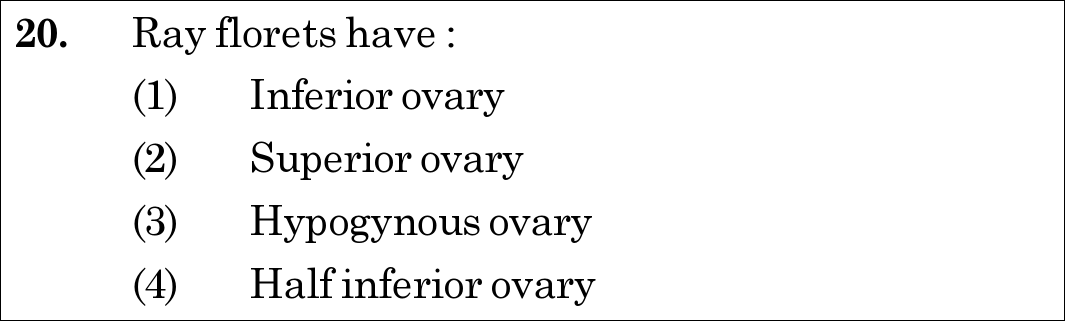
Ray florets have:

  1. (1)Inferior ovary
  2. (2)Superior ovary
  3. (3)Hypogynous ovary
  4. (4)Half inferior ovary
✓
Verified Against NTA Final Answer Key
Option (1) : Inferior ovary
📚 Morphology of Flowering Plants Easy
📋 Given Parameters & Problem Setup
Floral Structure Ray florets of Asteraceae (Sunflower head / Capitulum)
Question Objective Identify the position and type of ovary
⚡

The 30-Second Exam Hall Shortcut: ⚡ "Ray Florets of Sunflower = Epigynous Flower with INFERIOR Ovary!"

⏱️ Save ~20 seconds

In ray florets of sunflower (Asteraceae), the thalamus encloses the ovary completely and fuses with it, with calyx, corolla, and stamens arising ABOVE the ovary (Epigynous flower). Therefore, ray florets have an Inferior Ovary! Mark Option (1) in 5 seconds.

1 Recall NCERT ovary position types: - Hypogynous (Superior ovary): Mustard, China rose, Brinjal. - Perigynous (Half inferior ovary): Plum, Rose, Peach. - Epigynous (Inferior ovary): Guava, Cucumber, and ray florets of sunflower.
2 Identify target floral type: Ray florets of sunflower.
3 Match with Epigynous →\to Inferior ovary.
4 Select Option (1).
🛡️
Why You Can 100% Trust This Shortcut: NCERT Biology · Morphology of Flowering Plants (The Flower: In epigynous flowers, the margin of thalamus grows upward enclosing the ovary completely and getting fused with it, the other parts of flower arise above the ovary. Hence, the ovary is said to be inferior as in flowers of guava and cucumber, and the ray florets of sunflower).
📐

Step-by-Step Rigorous Workflow & Mathematical Proof

Step 1

Morphological Classification of Ovary Insertion

Based on the spatial insertion of calyx, corolla, and androecium relative to the gynoecium on the thalamus: - 1. Hypogynous Flower (Superior Ovary): Gynoecium occupies the highest position on the convex/conical thalamus while other floral whorls arise below it (e.g. mustard, China rose, brinjal). - 2. Perigynous Flower (Half-Inferior Ovary): Gynoecium is situated in the centre of a cup-shaped thalamus, and other parts arise on the rim of the thalamus at the same level (e.g. plum, rose, peach). - 3. Epigynous Flower (Inferior Ovary): The margin of the hollowed cup-shaped thalamus grows completely upward, enclosing and fusing with the ovary wall. The sepals, petals, and stamens arise above the top of the ovary. The ovary is consequently inferior. - NCERT explicitly provides three canonical examples of epigynous flowers with inferior ovaries: guava, cucumber, and the ray florets of sunflower.

Ray Florets of Sunflower  ⟺  Epigynous Flower  ⟹  Inferior Ovary\textbf{Ray Florets of Sunflower} \iff \mathbf{Epigynous\,Flower} \implies \mathbf{Inferior\,Ovary}
Step 2

Floral Morphology of the Capitulum Inflorescence

In the composite head (capitulum) of sunflower (*Helianthus annuus*), the marginal zygomorphic strap-shaped ray florets are pistillate or sterile and strictly epigynous, with the ovary situated inferior to the attached ligulate petal tube.

⭐

360° Option Elimination Engine Key Feature

Diagnose every choice: Know exactly why the right option works and why distractors fail.

4-Option Deep Scan
1 A
✓ 100% Correct
Verdict & Scientific Reason:

Correct. Ray florets of sunflower are epigynous and possess an inferior ovary.

💡
Why this is airtight: None. Direct recall of standard NCERT floral morphology examples.
2 B
✗ Incorrect
Verdict & Scientific Reason:

Incorrect. Superior ovaries belong to hypogynous flowers (mustard, brinjal).

⚠️
Student Fallacy (Why candidates pick this trap): Confusing hypogynous with epigynous flowers.
3 C
✗ Incorrect
Verdict & Scientific Reason:

Incorrect. "Hypogynous ovary" is a misnomer; the flower is hypogynous and the ovary is superior.

⚠️
Student Fallacy (Why candidates pick this trap): Confusing flower descriptor (hypogynous) with ovary descriptor (superior).
4 D
✗ Incorrect
Verdict & Scientific Reason:

Incorrect. Half-inferior ovaries characterize perigynous flowers (plum, rose, peach).

⚠️
Student Fallacy (Why candidates pick this trap): Confusing perigynous examples with epigynous sunflower florets.
⚠️

NTA Trap Alert: Ray Florets vs Disc Florets Capitulum Trap

Both ray florets (marginal ligulate) and disc florets (central tubular) of the sunflower capitulum have an inferior ovary (epigynous). Do not confuse epigynous flowers (guava, cucumber, sunflower) with perigynous flowers (plum, rose, peach).

🛡️ How to avoid the -1 mark: Remember the NCERT triad for Inferior Ovary: Guava, Cucumber, and Ray florets of Sunflower.
📖

Core NEET Syllabus Standard

NEET / NCERT Biology · Morphology of Flowering Plants Standard Benchmark
Core Scientific Principle Tested:

"In epigynous flowers like ray florets of sunflower, other floral parts arise above the ovary, making the ovary inferior."

Syllabus Focus: Ovary Positions in Flowers
✓ Core NEET UG Syllabus Anchor Syllabus & Academic Standards ↗

Ready to attempt under real exam pressure?

Test your speed and accuracy in the authentic 180-minute timed NTA simulator.

Launch NEET 2020 CBT Test →

Spotted a mistake in this solution? Report an error (support@mycompetitiveexams.com)

⚖️ Legal & Fair Dealing Notice: Sourced from publicly released NEET 2020 question papers and NEET answer keys for private study, research, and non-commercial educational practice under Fair Dealing (Section 52(1)(a) of the Indian Copyright Act, 1957). Not affiliated with or endorsed by NTA or NMC.

Solve 4 NEET Questions a Day — One per Subject

Cover all 1,140 official NEET questions in 285 days at your own pace. Progress is saved on your device. No login needed.