MyCompetitiveExams Logo MyCompetitiveExams
Search 1,140+ Questions
Chapters, formulas, speed tricks
→
⚡ Brahmastra NEET 2027
720 MARKS

Dynamic 180-question full-length simulator mixed dynamically from all 6 years for 2027 & 2026 aspirants.

Launch Brahmastra 2027 Test →
Start Practice →
100% Free · No Login Required
Q.2 Botany ⭐ 360° Option Elimination Active
Vault ↗

NEET 2020 Botany Question 2 Solution

Topic: Plant Growth and Development · Official NTA Booklet Code E1
NEET 2020 Botany Question 2: Phases of Growth in Sigmoid (S-shaped) Curve: Log Phase Maximum Growth

Question

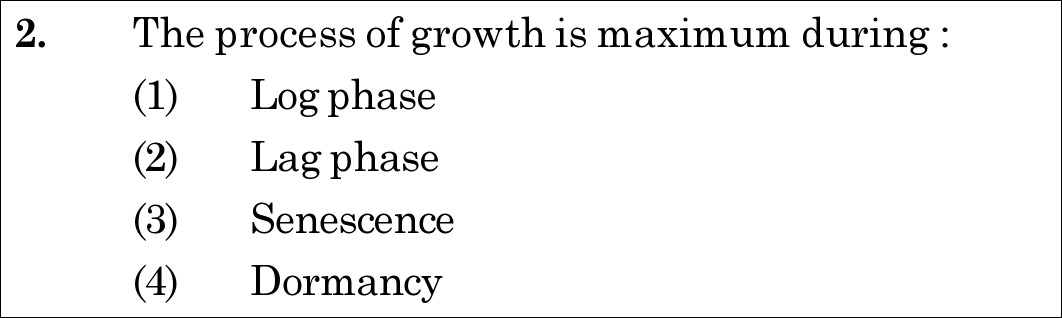
The process of growth is maximum during:

  1. (1)Log phase
  2. (2)Lag phase
  3. (3)Senescence
  4. (4)Dormancy
✓
Verified Against NTA Final Answer Key
Option (1) : Log phase
📚 Plant Growth and Development Easy
📋 Given Parameters & Problem Setup
Growth Curve Model Geometric / Sigmoid (S-shaped) Growth Curve
Question Objective Identify the phase where the process of growth is maximum
⚡

The 30-Second Exam Hall Shortcut: ⚡ "Sigmoid Curve: Lag (Slow) → Log (MAXIMUM / Exponential) → Stationary (Plateau)"

⏱️ Save ~20 seconds

In an S-shaped sigmoid growth curve, growth begins slowly (lag phase), surges exponentially to its MAXIMUM rate during the log (exponential) phase, and slows down due to limited resources (stationary phase). Growth is maximum in the Log phase! Mark Option (1).

1 Recall the classical geometric growth sigmoid phases: Lag phase →\to Log (Exponential) phase →\to Stationary phase.
2 Analyze growth rate: Lag phase = initial slow acceleration; Log phase = maximum exponential cell division and enlargement.
3 Contrast with senescence and dormancy: Senescence is terminal aging; Dormancy is metabolic inactivity.
4 Conclude: Growth rate peaks in the Log phase.
🛡️
Why You Can 100% Trust This Shortcut: NCERT Biology · Plant Growth and Development (Phases of Growth: A sigmoid curve is a characteristic of living organism growing in a natural environment. It is typical for all cells, tissues and organs. In geometric growth, after a slow initial lag phase, growth increases rapidly at an exponential/log phase where it reaches maximum rate).
📐

Step-by-Step Rigorous Workflow & Mathematical Proof

Step 1

Kinetics of the Sigmoid Growth Curve

Living cells, plant organs, and microbial populations growing in natural environments exhibit a characteristic sigmoid (S-shaped) growth curve comprising three successive phases: 1. Lag Phase: Initial phase where cells adapt biochemically, synthesize enzymes, and grow slowly without massive division. 2. Log (Exponential) Phase: Following the lag phase, both daughter cells retain the ability to divide. Cell division and cell elongation proceed at an accelerated exponential rate (W1=W0ertW_1 = W_0 e^{rt}), where the rate of growth reaches its absolute biological maximum. 3. Stationary Phase: As space, nutrients, and resources become limiting, the rate of growth decelerates and levels off.

W1=W0ert  ⟹  Growth Rate (dWdt) is Maximum during the Log PhaseW_1 = W_0 e^{rt} \implies \text{Growth Rate } \left(\frac{dW}{dt}\right) \text{ is } \mathbf{Maximum} \text{ during the } \mathbf{Log\,Phase}
Step 2

Elimination of Degenerative and Inactive Phases

- Senescence: The irreversible, terminal developmental phase of aging leading to tissue degradation and programmed death, characterized by negative growth. - Dormancy: A state of suspended metabolic development and zero mitotic growth, designed to survive adverse environmental conditions (e.g. seed dormancy).

⭐

360° Option Elimination Engine Key Feature

Diagnose every choice: Know exactly why the right option works and why distractors fail.

4-Option Deep Scan
1 A
✓ 100% Correct
Verdict & Scientific Reason:

Correct. The log (exponential) phase is characterized by unrestricted, maximal mitotic division and cellular expansion.

💡
Why this is airtight: None. Direct recall of plant physiological growth kinetics.
2 B
✗ Incorrect
Verdict & Scientific Reason:

Incorrect. The lag phase is the slow initial preparatory period before exponential multiplication.

⚠️
Student Fallacy (Why candidates pick this trap): Confusing the start of growth with the peak of growth rate.
3 C
✗ Incorrect
Verdict & Scientific Reason:

Incorrect. Senescence is biological aging and deteriorative breakdown preceding death.

⚠️
Student Fallacy (Why candidates pick this trap): Confusing size accumulation with rate of growth.
4 D
✗ Incorrect
Verdict & Scientific Reason:

Incorrect. Dormancy involves arrested growth and minimal metabolic activity.

⚠️
Student Fallacy (Why candidates pick this trap): Total misunderstanding of dormancy.
⚠️

NTA Trap Alert: Total Mass vs Growth Rate Trap

At the stationary phase or late maturity, total plant mass (WW) is highest, but the *rate of growth* (dW/dtdW/dt) is zero. The question explicitly asks when the *process/rate of growth* is maximum, which occurs during the log phase.

🛡️ How to avoid the -1 mark: Remember: Steepest slope on the sigmoid curve = Log phase = Maximum growth rate.
📖

Core NEET Syllabus Standard

NEET / NCERT Biology · Plant Growth and Development Standard Benchmark
Core Scientific Principle Tested:

"In geometric growth, the process of growth is maximum during the exponential/log phase."

Syllabus Focus: Phases of Growth and Sigmoid Curve
✓ Core NEET UG Syllabus Anchor Syllabus & Academic Standards ↗

Ready to attempt under real exam pressure?

Test your speed and accuracy in the authentic 180-minute timed NTA simulator.

Launch NEET 2020 CBT Test →

Spotted a mistake in this solution? Report an error (support@mycompetitiveexams.com)

⚖️ Legal & Fair Dealing Notice: Sourced from publicly released NEET 2020 question papers and NEET answer keys for private study, research, and non-commercial educational practice under Fair Dealing (Section 52(1)(a) of the Indian Copyright Act, 1957). Not affiliated with or endorsed by NTA or NMC.

Solve 4 NEET Questions a Day — One per Subject

Cover all 1,140 official NEET questions in 285 days at your own pace. Progress is saved on your device. No login needed.