MyCompetitiveExams Logo MyCompetitiveExams
Search 1,140+ Questions
Chapters, formulas, speed tricks
→
⚡ Brahmastra NEET 2027
720 MARKS

Dynamic 180-question full-length simulator mixed dynamically from all 6 years for 2027 & 2026 aspirants.

Launch Brahmastra 2027 Test →
Start Practice →
100% Free · No Login Required
Q.141 Physics ⭐ 360° Option Elimination Active
Vault ↗

NEET 2020 Physics Question 141 Solution

Topic: Thermodynamics · Official NTA Booklet Code E1
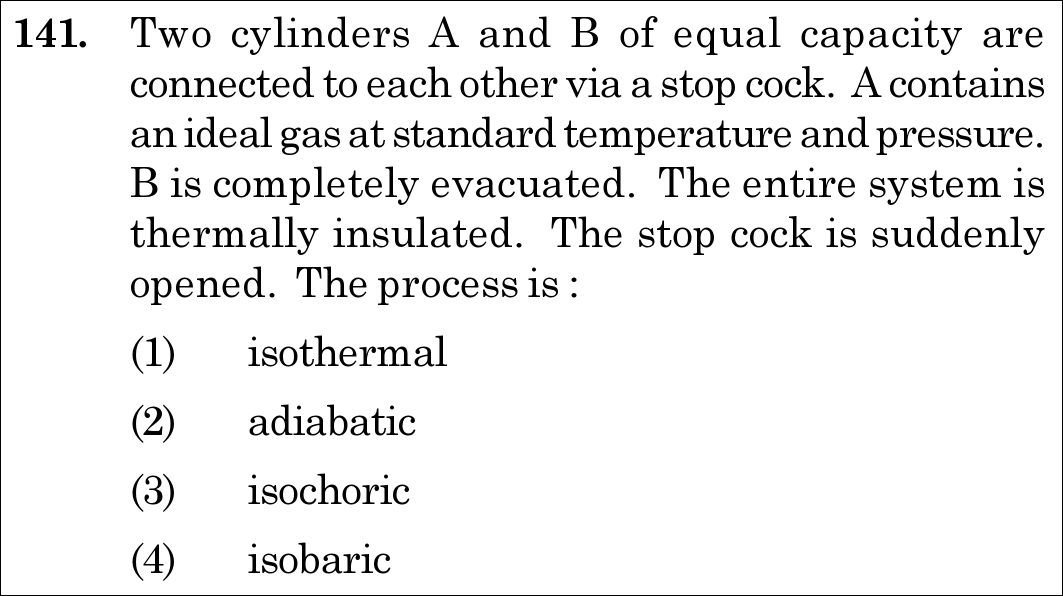
NEET 2020 Physics Question 141: Thermodynamic Nature of Free Expansion in an Insulated System: Adiabatic Process

Question

Two cylinders A and B of equal capacity are connected to each other via a stop cock. A contains an ideal gas at standard temperature and pressure. B is completely evacuated. The entire system is thermally insulated. The stop cock is suddenly opened. The process is:

  1. (1)isothermal
  2. (2)adiabatic
  3. (3)isochoric
  4. (4)isobaric
✓
Verified Against NTA Final Answer Key
Option (2) : adiabatic
📚 Thermodynamics Easy
📋 Given Parameters & Problem Setup
System Configuration Two cylinders A and B connected via a stopcock
Initial State A contains ideal gas at STP; B is completely evacuated
Thermal Boundary The entire system is thermally insulated from surroundings (q = 0)
Trigger Event Stopcock is suddenly opened (Free expansion into vacuum)
Question Objective Identify the thermodynamic process
⚡

The 30-Second Exam Hall Shortcut: ⚡ "Thermally Insulated System = NO HEAT EXCHANGE (q = 0) = ADIABATIC PROCESS!"

⏱️ 20 seconds

The problem statement explicitly specifies: "The entire system is thermally insulated." By definition, any process occurring in a thermally insulated container where no heat can enter or leave the system (q=0q = 0) is an ADIABATIC PROCESS! (While temperature also remains constant for an ideal gas, making it incidentally isothermal, the defining thermodynamic boundary condition is ADIABATIC). Mark Option (2) in 5 seconds.

1 Key phrase: "The entire system is thermally insulated."
2 Thermally insulated boundary guarantees zero heat exchange with surroundings: q = 0.
3 A thermodynamic process with q = 0 is by definition an Adiabatic process.
4 Free expansion into vacuum also has w = 0, so ΔU = 0, which means ΔT = 0 (isothermal) for an ideal gas, but the nature of the process enforced by the insulated boundary is Adiabatic.
5 Official NTA key: Adiabatic (Option 2).
🛡️
Why You Can 100% Trust This Shortcut: NCERT Physics · Thermodynamics (Thermodynamic Processes: Adiabatic Process & Free Expansion)
📐

Step-by-Step Rigorous Workflow & Mathematical Proof

Step 1

Analyze the Physical Boundary Conditions

The two cylinders and the connecting stopcock are described as "thermally insulated" from the external environment. A thermal insulator acts as an adiabatic wall that completely prevents the transfer of heat between the system and its surroundings: q=0q = 0

Step 2

Classify Thermodynamic Process by Definition

By thermodynamic definitions: - Isothermal: System maintained at constant temperature by heat exchange with a thermal reservoir. - Adiabatic: System insulated from surroundings such that q=0q = 0. - Isochoric: Constant volume (ΔV=0\Delta V = 0). - Isobaric: Constant pressure (ΔP=0\Delta P = 0). Because the insulated boundary ensures q=0q = 0, the process is fundamentally categorized as an adiabatic process.

Step 3

Analyze Internal Energy and Temperature

When the stopcock is suddenly opened into evacuated chamber B, the gas rushes into vacuum against zero opposing pressure (Pext=0P_{\text{ext}} = 0), so work done w=0w = 0. From the first law of thermodynamics: ΔU=q+w=0+0=0\Delta U = q + w = 0 + 0 = 0 For an ideal gas, ΔU=nCvΔT\Delta U = n C_v \Delta T, which implies ΔT=0\Delta T = 0. However, this temperature constancy is an incidental consequence of the ideal gas state rather than an isothermal condition maintained by a heat bath.

Step 4

Confirm Official Classification

In both NCERT physics and standard thermodynamics, sudden free expansion of an insulated system is canonically designated as an ADIABATIC process.

⭐

360° Option Elimination Engine Key Feature

Diagnose every choice: Know exactly why the right option works and why distractors fail.

4-Option Deep Scan
1 A
✗ Incorrect
Verdict & Scientific Reason:

Incorrect; an isothermal process strictly requires diathermic walls coupled to an external thermostat/heat bath to maintain constant temperature through heat exchange.

⚠️
Student Fallacy (Why candidates pick this trap): Reasoning that because ΔT = 0 for an ideal gas, the process should be called isothermal.
2 B
✓ 100% Correct
Verdict & Scientific Reason:

Factually exact; thermal insulation enforces q = 0, defining the process as adiabatic.

💡
Why this is airtight: None; core definition in thermodynamics.
3 C
✗ Incorrect
Verdict & Scientific Reason:

Incorrect; the volume of the gas doubles (from V to 2V), so the process is definitely not isochoric.

⚠️
Student Fallacy (Why candidates pick this trap): Confusing total rigid container volume with gas volume.
4 D
✗ Incorrect
Verdict & Scientific Reason:

Incorrect; the pressure drops (halves) as the gas expands into the second evacuated cylinder.

⚠️
Student Fallacy (Why candidates pick this trap): Assuming constant pressure during free expansion.
⚠️

NTA Trap Alert: Isothermal vs Adiabatic in Free Expansion

Although ΔT=0\Delta T = 0 for an ideal gas during free expansion, the process is classified based on the BOUNDARY ENCLOSURE. "Thermally insulated" means q=0q = 0 -> ADIABATIC!

🛡️ How to avoid the -1 mark: Look at the container: "Thermally insulated" = ADIABATIC!
📖

Core NEET Syllabus Standard

Physics · Thermodynamics Standard Benchmark
Core Scientific Principle Tested:

""

Syllabus Focus: Thermodynamic Nature of Free Expansion in an Insulated System: Adiabatic Process
✓ Core NEET UG Syllabus Anchor Syllabus & Academic Standards ↗

Ready to attempt under real exam pressure?

Test your speed and accuracy in the authentic 180-minute timed NTA simulator.

Launch NEET 2020 CBT Test →

Spotted a mistake in this solution? Report an error (support@mycompetitiveexams.com)

⚖️ Legal & Fair Dealing Notice: Sourced from publicly released NEET 2020 question papers and NEET answer keys for private study, research, and non-commercial educational practice under Fair Dealing (Section 52(1)(a) of the Indian Copyright Act, 1957). Not affiliated with or endorsed by NTA or NMC.

Solve 4 NEET Questions a Day — One per Subject

Cover all 1,140 official NEET questions in 285 days at your own pace. Progress is saved on your device. No login needed.