MyCompetitiveExams Logo MyCompetitiveExams
Search 1,140+ Questions
Chapters, formulas, speed tricks
→
⚡ Brahmastra NEET 2027
720 MARKS

Dynamic 180-question full-length simulator mixed dynamically from all 6 years for 2027 & 2026 aspirants.

Launch Brahmastra 2027 Test →
Start Practice →
100% Free · No Login Required
Q.137 Physics ⭐ 360° Option Elimination Active
Vault ↗

NEET 2020 Physics Question 137 Solution

Topic: Electromagnetic Waves · Official NTA Booklet Code E1
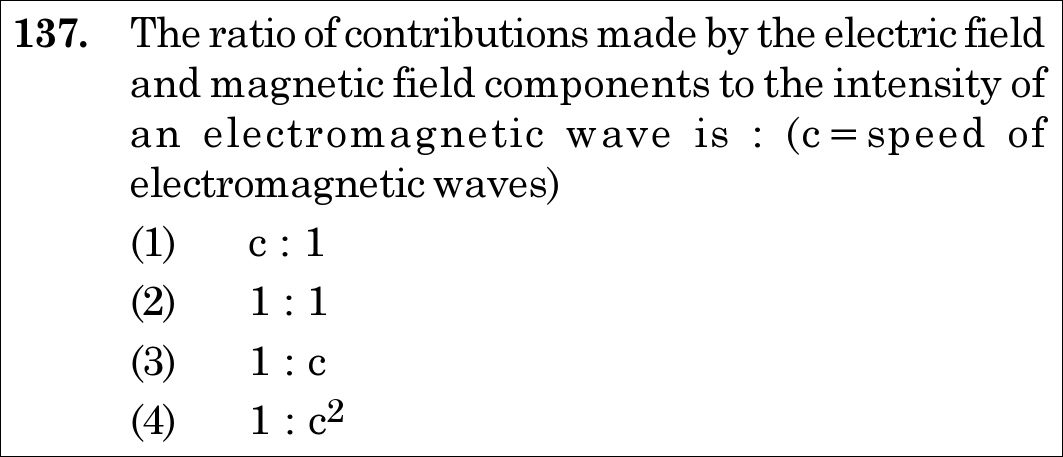
NEET 2020 Physics Question 137: Equipartition of Energy in EM Waves: Electric and Magnetic Field Intensity Contributions

Question

The ratio of contributions made by the electric field and magnetic field components to the intensity of an electromagnetic wave is: (c = speed of electromagnetic waves)

✓
Verified Against NTA Final Answer Key
Option (2) : 1 : 1
📚 Electromagnetic Waves Easy
📋 Given Parameters & Problem Setup
Wave Type Electromagnetic plane wave propagating in vacuum
Speed of Wave c = 1 / √(μ0 ε0)
Relation between Amplitudes E0 = c B0
Question Objective Determine the ratio of energy/intensity contributions of electric and magnetic fields
⚡

The 30-Second Exam Hall Shortcut: ⚡ "Electric and Magnetic Fields Share EM Wave Energy 50%-50%: Ratio is 1 : 1!"

⏱️ 20 seconds

In any electromagnetic wave, the average electric energy density is uE=14ε0E02u_E = \frac{1}{4}\varepsilon_0 E_0^2 and the average magnetic energy density is uB=B024μ0u_B = \frac{B_0^2}{4\mu_0}. Substituting E0=cB0E_0 = c B_0 and c2=1μ0ε0c^2 = \frac{1}{\mu_0 \varepsilon_0}, we find uE=uBu_E = u_B exactly! Because intensity is proportional to energy density (I=u⋅cI = u \cdot c), their contributions are equal: 1 : 1! Mark Option (2) in 5 seconds.

1 Electric energy density: u_E = 1/2 ε0 E_rms^2.
2 Magnetic energy density: u_B = 1/2 (B_rms^2 / μ0).
3 Relationship: E_rms = c × B_rms, and c = 1 / √(μ0 ε0).
4 Substitute: u_E = 1/2 ε0 (c B_rms)^2 = 1/2 ε0 (1 / (μ0 ε0)) B_rms^2 = 1/2 (B_rms^2 / μ0) = u_B.
5 Since u_E = u_B, their intensity contributions are equal (1 : 1).
6 Select Option (2) 1 : 1.
🛡️
Why You Can 100% Trust This Shortcut: NCERT Physics · Electromagnetic Waves (Energy Density and Intensity of EM Waves)
📐

Step-by-Step Rigorous Workflow & Mathematical Proof

Step 1

State Formulas for Average Energy Densities

In an electromagnetic wave traveling in free space, energy is stored in both the oscillating electric and magnetic fields. The time-averaged energy densities are given by: ⟨uE⟩=12ε0Erms2=14ε0E02\langle u_E \rangle = \frac{1}{2} \varepsilon_0 E_{\text{rms}}^2 = \frac{1}{4} \varepsilon_0 E_0^2 ⟨uB⟩=12Brms2μ0=B024μ0\langle u_B \rangle = \frac{1}{2} \frac{B_{\text{rms}}^2}{\mu_0} = \frac{B_0^2}{4 \mu_0}

Step 2

Relate Electric and Magnetic Amplitudes via Speed of Light

From Maxwell's equations, the ratio of electric field to magnetic field amplitude equals the speed of light in vacuum: E0=cB0  ⟹  Erms=cBrmsE_0 = c B_0 \implies E_{\text{rms}} = c B_{\text{rms}} Also, the speed of light is related to vacuum permittivity and permeability by: c=1μ0ε0  ⟹  c2=1μ0ε0c = \frac{1}{\sqrt{\mu_0 \varepsilon_0}} \implies c^2 = \frac{1}{\mu_0 \varepsilon_0}

Step 3

Compare the Energy Densities

Substitute Erms=cBrmsE_{\text{rms}} = c B_{\text{rms}} into the electric energy density expression: ⟨uE⟩=12ε0(cBrms)2=12ε0c2Brms2\langle u_E \rangle = \frac{1}{2} \varepsilon_0 (c B_{\text{rms}})^2 = \frac{1}{2} \varepsilon_0 c^2 B_{\text{rms}}^2 Substituting c2=1μ0ε0c^2 = \frac{1}{\mu_0 \varepsilon_0}: ⟨uE⟩=12ε0(1μ0ε0)Brms2=Brms22μ0=⟨uB⟩\langle u_E \rangle = \frac{1}{2} \varepsilon_0 \left(\frac{1}{\mu_0 \varepsilon_0}\right) B_{\text{rms}}^2 = \frac{B_{\text{rms}}^2}{2 \mu_0} = \langle u_B \rangle

Step 4

Relate Energy Density to Intensity

The intensity of an electromagnetic wave is the energy transported per unit area per unit time, given by I=u⋅cI = u \cdot c. Since ⟨uE⟩=⟨uB⟩\langle u_E \rangle = \langle u_B \rangle, the intensity contributions are identical: IE=⟨uE⟩c=⟨uB⟩c=IBI_E = \langle u_E \rangle c = \langle u_B \rangle c = I_B IEIB=11=1:1\frac{I_E}{I_B} = \frac{1}{1} = 1 : 1

⭐

360° Option Elimination Engine Key Feature

Diagnose every choice: Know exactly why the right option works and why distractors fail.

4-Option Deep Scan
1 A
✗ Incorrect
Verdict & Scientific Reason:

Incorrect; cc is the ratio of field amplitudes (E0/B0=cE_0 / B_0 = c), not the ratio of energy or intensity contributions.

⚠️
Student Fallacy (Why candidates pick this trap): Confusing field amplitude ratio (E/B=cE/B = c) with intensity ratio.
2 B
✓ 100% Correct
Verdict & Scientific Reason:

Factually and physically exact; electric and magnetic fields carry equal shares of the total energy and intensity in an EM wave.

💡
Why this is airtight: None; fundamental electromagnetic energy equipartition.
3 C
✗ Incorrect
Verdict & Scientific Reason:

Incorrect; inverted amplitude ratio.

⚠️
Student Fallacy (Why candidates pick this trap): Thinking magnetic field dominates intensity by a factor of cc.
4 D
✗ Incorrect
Verdict & Scientific Reason:

Incorrect; dimensional error.

⚠️
Student Fallacy (Why candidates pick this trap): Squaring the velocity ratio without accounting for ε0\varepsilon_0 and μ0\mu_0.
⚠️

NTA Trap Alert: Field Ratio vs Intensity Ratio Trap

- Ratio of AMPLITUDES: E0/B0=cE_0 / B_0 = c (c:1c : 1). - Ratio of INTENSITIES / ENERGIES: IE/IB=1:1I_E / I_B = 1 : 1 (Equally divided!).

🛡️ How to avoid the -1 mark: Read carefully: "Intensity/Energy contribution" = ALWAYS 1 : 1!
📖

Core NEET Syllabus Standard

Physics · Electromagnetic Waves Standard Benchmark
Core Scientific Principle Tested:

""

Syllabus Focus: Equipartition of Energy in EM Waves: Electric and Magnetic Field Intensity Contributions
✓ Core NEET UG Syllabus Anchor Syllabus & Academic Standards ↗

Ready to attempt under real exam pressure?

Test your speed and accuracy in the authentic 180-minute timed NTA simulator.

Launch NEET 2020 CBT Test →

Spotted a mistake in this solution? Report an error (support@mycompetitiveexams.com)

⚖️ Legal & Fair Dealing Notice: Sourced from publicly released NEET 2020 question papers and NEET answer keys for private study, research, and non-commercial educational practice under Fair Dealing (Section 52(1)(a) of the Indian Copyright Act, 1957). Not affiliated with or endorsed by NTA or NMC.

Solve 4 NEET Questions a Day — One per Subject

Cover all 1,140 official NEET questions in 285 days at your own pace. Progress is saved on your device. No login needed.