MyCompetitiveExams Logo MyCompetitiveExams
Search 1,140+ Questions
Chapters, formulas, speed tricks
→
⚡ Brahmastra NEET 2027
720 MARKS

Dynamic 180-question full-length simulator mixed dynamically from all 6 years for 2027 & 2026 aspirants.

Launch Brahmastra 2027 Test →
Start Practice →
100% Free · No Login Required
Q.136 Physics ⭐ 360° Option Elimination Active
Vault ↗

NEET 2020 Physics Question 136 Solution

Topic: Atoms · Official NTA Booklet Code E1
NEET 2020 Physics Question 136: Applicability of Bohr Atomic Model: Single-Electron Species Constraint

Question

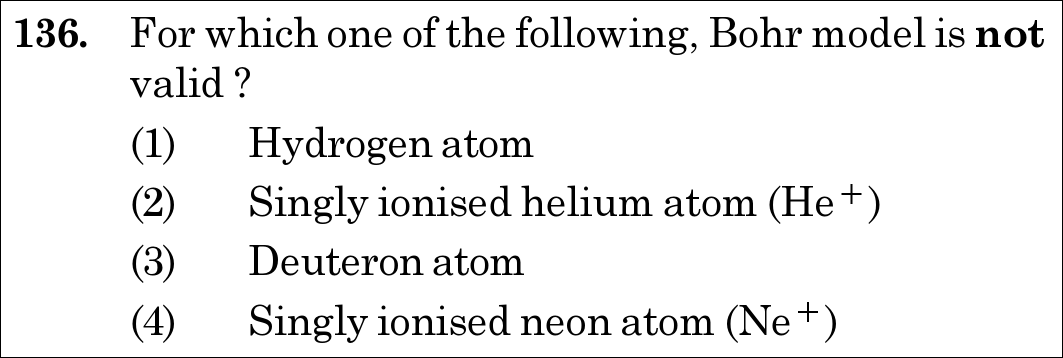
For which one of the following, Bohr model is not valid?

  1. (1)Hydrogen atom
  2. (2)Singly ionised helium atom (He+)
  3. (3)Deuteron atom
  4. (4)Singly ionised neon atom (Ne+)
✓
Verified Against NTA Final Answer Key
Option (4) : Singly ionised neon atom (Ne+)
📚 Atoms Easy
📋 Given Parameters & Problem Setup
Theoretical Model Bohr Model of the Atom
Fundamental Assumption Applicable strictly to single-electron (hydrogenic) systems
Candidate Species H, He+, Deuteron atom (2_1H), Ne+
⚡

The 30-Second Exam Hall Shortcut: ⚡ "Bohr Model is Valid ONLY for 1-Electron Systems: Ne+ Has 9 Electrons!"

⏱️ 20 seconds

The Bohr model accounts only for two-body electrostatic attraction between a nucleus and a SINGLE electron. Hydrogen (1e-), Singly ionized helium He+ (2 - 1 = 1e-), and Deuteron atom (isotope of hydrogen, 1e-) are all single-electron species. Singly ionized neon Ne+ has 10 - 1 = 9 electrons, where inter-electronic repulsions make the Bohr model completely invalid! Mark Ne+ (Option 4) in 5 seconds.

1 Bohr model postulate is valid only for hydrogen and hydrogen-like (single-electron) species.
2 Count electrons in each candidate: - Hydrogen atom (H): 1 electron (Valid). - Singly ionized helium (He+): 2 - 1 = 1 electron (Valid). - Deuteron atom (2_1H): isotope of H, 1 electron (Valid). - Singly ionized neon (Ne+): 10 - 1 = 9 electrons (Multi-electron system -> NOT valid).
3 Select Option (4) Singly ionised neon atom (Ne+).
🛡️
Why You Can 100% Trust This Shortcut: NCERT Physics · Atoms (Bohr's Model of the Hydrogen Atom: Limitations)
📐

Step-by-Step Rigorous Workflow & Mathematical Proof

Step 1

Fundamental Principle of Bohr's Model

Niels Bohr formulated his quantized atomic model based on Coulomb's inverse-square law between the nuclear positive charge (+Ze+Ze) and a single orbiting electron (−e-e): mv2r=14πε0Ze2r2\frac{m v^2}{r} = \frac{1}{4\pi\varepsilon_0} \frac{Z e^2}{r^2} Because it considers only two-body central force interactions, it cannot account for multi-electron repulsions.

Step 2

Evaluate Number of Electrons in Each System

- Hydrogen atom (HH): Atomic number Z=1Z = 1, contains 1 electron. - Singly ionized helium (He+He^+): Helium has Z=2Z = 2. After removing one electron, He+He^+ retains 2−1=12 - 1 = 1 electron. - Deuteron atom (12H^2_1H): Isotope of hydrogen with 1 proton, 1 neutron, and 1 orbiting electron. - Singly ionized neon (Ne+Ne^+): Neon has atomic number Z=10Z = 10. Removal of one electron leaves 10−1=910 - 1 = 9 electrons.

Step 3

Identify the Multi-Electron Ion

Because Ne+Ne^+ is a 9-electron system, electron-electron repulsions and screening effects dominate, rendering the simple hydrogenic Bohr quantization condition invalid.

Step 4

Conclude Option 4

Therefore, the Bohr model is not valid for singly ionized neon (Ne+Ne^+).

⭐

360° Option Elimination Engine Key Feature

Diagnose every choice: Know exactly why the right option works and why distractors fail.

4-Option Deep Scan
1 A
✗ Incorrect
Verdict & Scientific Reason:

Incorrect; Bohr model was formulated specifically for the 1-electron neutral hydrogen atom.

⚠️
Student Fallacy (Why candidates pick this trap): Assuming Bohr model fails for neutral hydrogen.
2 B
✗ Incorrect
Verdict & Scientific Reason:

Incorrect; He+He^+ has only 1 electron (Z=2Z = 2) and is a classic hydrogenic system obeying Bohr formulas with Z=2Z = 2.

⚠️
Student Fallacy (Why candidates pick this trap): Confusing nuclear charge with electron count.
3 C
✗ Incorrect
Verdict & Scientific Reason:

Incorrect; deuteron atom (deuterium) has a nucleus of 1 proton and 1 neutron, with 1 orbital electron, making it hydrogenic and fully valid under Bohr model.

⚠️
Student Fallacy (Why candidates pick this trap): Confusing an isotope of hydrogen with a multi-electron species.
4 D
✓ 100% Correct
Verdict & Scientific Reason:

Factually exact; Ne+Ne^+ has 9 electrons, making it a multi-electron atom for which the Bohr model fails completely.

💡
Why this is airtight: None; core limitation of the Bohr model.
⚠️

NTA Trap Alert: Hydrogenic Species Definition

A hydrogenic (hydrogen-like) species must have EXACTLY ONE ELECTRON (H,He+,Li2+,Be3+H, He^+, Li^{2+}, Be^{3+}). Ne+Ne^+ has 9 electrons, so it is NOT hydrogenic!

🛡️ How to avoid the -1 mark: Count remaining electrons: Z−chargeZ - \text{charge}. If >1> 1, Bohr model is NOT valid!
📖

Core NEET Syllabus Standard

Physics · Atoms Standard Benchmark
Core Scientific Principle Tested:

""

Syllabus Focus: Applicability of Bohr Atomic Model: Single-Electron Species Constraint
✓ Core NEET UG Syllabus Anchor Syllabus & Academic Standards ↗

Ready to attempt under real exam pressure?

Test your speed and accuracy in the authentic 180-minute timed NTA simulator.

Launch NEET 2020 CBT Test →

Spotted a mistake in this solution? Report an error (support@mycompetitiveexams.com)

⚖️ Legal & Fair Dealing Notice: Sourced from publicly released NEET 2020 question papers and NEET answer keys for private study, research, and non-commercial educational practice under Fair Dealing (Section 52(1)(a) of the Indian Copyright Act, 1957). Not affiliated with or endorsed by NTA or NMC.

Solve 4 NEET Questions a Day — One per Subject

Cover all 1,140 official NEET questions in 285 days at your own pace. Progress is saved on your device. No login needed.