MyCompetitiveExams Logo MyCompetitiveExams
Search 1,140+ Questions
Chapters, formulas, speed tricks
→
⚡ Brahmastra NEET 2027
720 MARKS

Dynamic 180-question full-length simulator mixed dynamically from all 6 years for 2027 & 2026 aspirants.

Launch Brahmastra 2027 Test →
Start Practice →
100% Free · No Login Required
Q.49 Zoology ⭐ 360° Option Elimination Active
Vault ↗

NEET 2020 Zoology Question 49 Solution

Topic: Excretory Products and their Elimination · Official NTA Booklet Code E1
NEET 2020 Zoology Question 49: Disorders of the Excretory System: Diagnostic Urine Markers for Diabetes Mellitus

Question

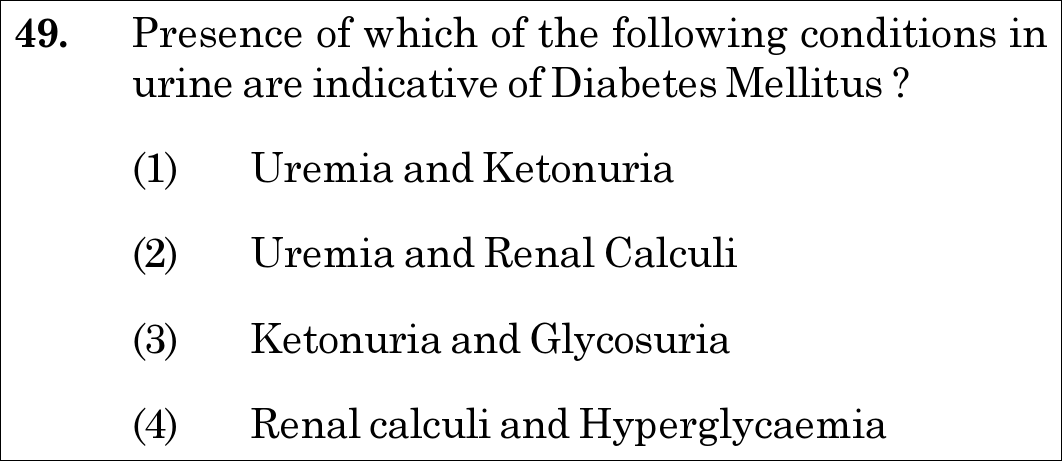
Presence of which of the following conditions in urine are indicative of Diabetes Mellitus?

  1. (1)Uremia and Ketonuria
  2. (2)Uremia and Renal Calculi
  3. (3)Ketonuria and Glycosuria
  4. (4)Renal calculi and Hyperglycaemia
✓
Verified Against NTA Final Answer Key
Option (3) : Ketonuria and Glycosuria
📚 Excretory Products and their Elimination Easy
📋 Given Parameters & Problem Setup
Clinical Condition Diabetes Mellitus
Excretory Specimen Urine analysis
Question Objective Identify which urinary findings indicate diabetes mellitus
⚡

The 30-Second Exam Hall Shortcut: ⚡ "Diabetes Mellitus Urine = Sugar + Ketones (Glycosuria & Ketonuria)!"

⏱️ 25 seconds

In diabetes mellitus, insulin deficiency or insensitivity causes hyperglycemia, leading to glucose spillover in urine (Glycosuria) and excessive fatty acid breakdown into ketone bodies in urine (Ketonuria). Uremia is high urea in blood. Mark Option (3) in 5 seconds!

1 Diabetes mellitus features hyperglycemia exceeding the renal threshold (180 mg/dL).
2 Excess glucose excreted in urine = Glycosuria.
3 Inability of cells to take up glucose causes fat catabolism, producing acetoacetate and beta-hydroxybutyrate excreted in urine = Ketonuria.
4 Select Option (3) Ketonuria and Glycosuria.
🛡️
Why You Can 100% Trust This Shortcut: NCERT Biology · Human Physiology: Excretory Products and their Elimination (Disorders of Excretory System)
📐

Step-by-Step Rigorous Workflow & Mathematical Proof

Step 1

Understand Diabetes Mellitus Pathophysiology

Diabetes mellitus is a metabolic disorder caused by deficiency of insulin or insulin resistance. As a result, blood glucose levels rise dramatically (hyperglycemia).

Step 2

Mechanism of Glycosuria

When blood glucose exceeds the renal threshold (normally ~180 mg/dL), proximal convoluted tubules cannot reabsorb all the filtered glucose, resulting in glucose excretion in urine (Glycosuria).

Step 3

Mechanism of Ketonuria

Because glucose cannot effectively enter insulin-dependent tissue cells, the body mobilizes fats for cellular energy. Accelerated beta-oxidation of fatty acids in the liver produces ketone bodies (acetoacetic acid, acetone) which spill into urine (Ketonuria).

Step 4

Eliminate Other Diagnostic Terms

Uremia is accumulation of urea in blood due to renal failure; Renal calculi are kidney stones composed of crystallized oxalates. Only Glycosuria and Ketonuria indicate Diabetes Mellitus.

⭐

360° Option Elimination Engine Key Feature

Diagnose every choice: Know exactly why the right option works and why distractors fail.

4-Option Deep Scan
1 A
✗ Incorrect
Verdict & Scientific Reason:

Incorrect; uremia is the accumulation of urea in the blood resulting from kidney failure, not a urinary indicator of diabetes mellitus.

⚠️
Student Fallacy (Why candidates pick this trap): Confusing blood urea accumulation (uremia) with glycosuria.
2 B
✗ Incorrect
Verdict & Scientific Reason:

Incorrect; renal calculi are insoluble stone formations (oxalates) and uremia is urea retention in blood.

⚠️
Student Fallacy (Why candidates pick this trap): Confusing renal failure/calculi with endocrine diabetes mellitus.
3 C
✓ 100% Correct
Verdict & Scientific Reason:

Factually exact; NCERT explicitly specifies that presence of glucose (glycosuria) and ketone bodies (ketonuria) in urine are indicative of diabetes mellitus.

💡
Why this is airtight: None; textbook diagnostic criteria.
4 D
✗ Incorrect
Verdict & Scientific Reason:

Incorrect; hyperglycemia is high glucose in BLOOD, not a condition in urine, and renal calculi are kidney stones.

⚠️
Student Fallacy (Why candidates pick this trap): Overlooking that the question asked for conditions in URINE, whereas hyperglycemia is a blood metric.
⚠️

NTA Trap Alert: Blood Finding vs Urine Finding

Hyperglycemia is in BLOOD; Glycosuria is in URINE. Uremia is high urea in BLOOD; Ketonuria is ketone bodies in URINE.

🛡️ How to avoid the -1 mark: Read the question carefully: "Presence in URINE indicative of Diabetes Mellitus" = Glycosuria and Ketonuria!
📖

Core NEET Syllabus Standard

Zoology · Excretory Products and their Elimination Standard Benchmark
Core Scientific Principle Tested:

""

Syllabus Focus: Disorders of the Excretory System: Diagnostic Urine Markers for Diabetes Mellitus
✓ Core NEET UG Syllabus Anchor Syllabus & Academic Standards ↗

Ready to attempt under real exam pressure?

Test your speed and accuracy in the authentic 180-minute timed NTA simulator.

Launch NEET 2020 CBT Test →

Spotted a mistake in this solution? Report an error (support@mycompetitiveexams.com)

⚖️ Legal & Fair Dealing Notice: Sourced from publicly released NEET 2020 question papers and NEET answer keys for private study, research, and non-commercial educational practice under Fair Dealing (Section 52(1)(a) of the Indian Copyright Act, 1957). Not affiliated with or endorsed by NTA or NMC.

Solve 4 NEET Questions a Day — One per Subject

Cover all 1,140 official NEET questions in 285 days at your own pace. Progress is saved on your device. No login needed.