MyCompetitiveExams Logo MyCompetitiveExams
Search 1,140+ Questions
Chapters, formulas, speed tricks
→
⚡ Brahmastra NEET 2027
720 MARKS

Dynamic 180-question full-length simulator mixed dynamically from all 6 years for 2027 & 2026 aspirants.

Launch Brahmastra 2027 Test →
Start Practice →
100% Free · No Login Required
Q.99 Chemistry ⭐ 360° Option Elimination Active
Vault ↗

NEET 2020 Chemistry Question 99 Solution

Topic: Electrochemistry · Official NTA Booklet Code E1
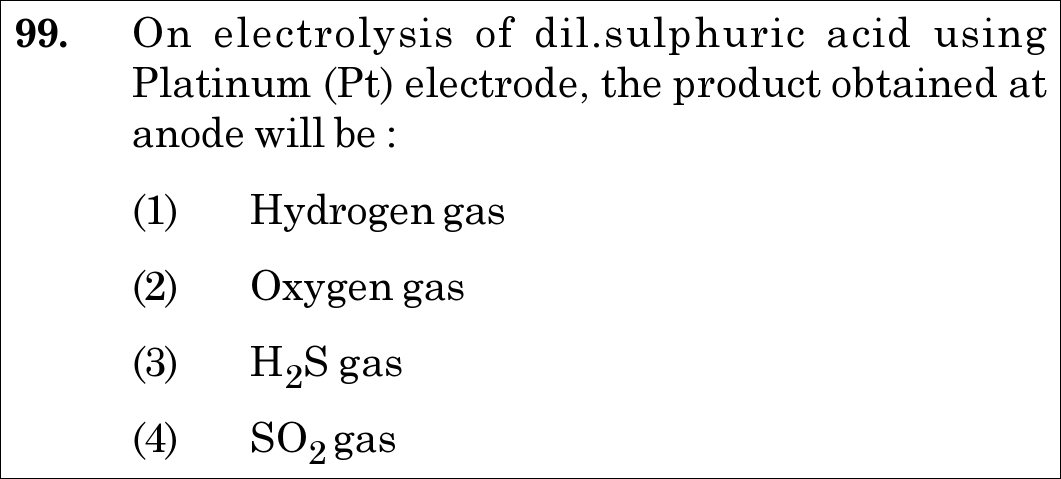
NEET 2020 Chemistry Question 99: Electrolysis of Dilute H2SO4 with Inert Pt Electrodes: Anodic Oxygen Evolution

Question

On electrolysis of dil.sulphuric acid using Platinum (Pt) electrode, the product obtained at anode will be:

  1. (1)Hydrogen gas
  2. (2)Oxygen gas
  3. (3)H2S gas
  4. (4)SO2 gas
✓
Verified Against NTA Final Answer Key
Option (2) : Oxygen gas
📚 Electrochemistry Easy
📋 Given Parameters & Problem Setup
Electrolyte Dilute sulphuric acid (H2SO4 aq)
Electrode Material Platinum (Pt, inert)
Electrode of Interest Anode (oxidation site)
Question Objective Identify the product obtained at the anode
⚡

The 30-Second Exam Hall Shortcut: ⚡ "Dilute H2SO4 Electrolysis on Pt: Cathode = H2, Anode = O2!"

⏱️ 20 seconds

In dilute H2SO4, water is present in large excess. At the cathode, protons are reduced to give H2H_2 gas. At the anode, oxidation of water (2H2O→O2+4H++4e−2H_2O \to O_2 + 4H^+ + 4e^-, E∘=+1.23 VE^\circ = +1.23\text{ V}) is thermodynamically and kinetically favored over the oxidation of sulfate (2SO42−→S2O82−+2e−2SO_4^{2-} \to S_2O_8^{2-} + 2e^-, E∘=+1.96 VE^\circ = +1.96\text{ V}). Product at anode is OXYGEN GAS! Mark Option (2) in 5 seconds.

1 Cathode reaction: 2H+ (aq) + 2e- -> H2 (g).
2 Anode competing reactions: - 2H2O (l) -> O2 (g) + 4H+ (aq) + 4e- (E° = +1.23 V) - 2SO4^2- (aq) -> S2O8^2- (aq) + 2e- (E° = +1.96 V)
3 Lower standard oxidation potential means water oxidation occurs preferentially.
4 Thus, Oxygen gas (O2) is evolved at the anode.
5 Select Option (2) Oxygen gas.
🛡️
Why You Can 100% Trust This Shortcut: NCERT Chemistry · Electrochemistry (Products of Electrolysis: Dilute vs Concentrated H2SO4)
📐

Step-by-Step Rigorous Workflow & Mathematical Proof

Step 1

Ions Present in Solution

Dilute sulphuric acid dissociates into hydrogen ions and sulphate ions, while water also self-ionizes: H2SO4(aq)→2H++SO42−\text{H}_2\text{SO}_4 \text{(aq)} \to 2\text{H}^+ + \text{SO}_4^{2-} H2O (l)⇌H++OH−\text{H}_2\text{O (l)} \rightleftharpoons \text{H}^+ + \text{OH}^-

Step 2

Cathode Reaction (Reduction)

Hydrogen ions are the only reducible cations present. They migrate to the inert platinum cathode and undergo reduction: 2H+(aq)+2e−→H2 (g)2\text{H}^+ \text{(aq)} + 2e^- \to \text{H}_2\text{ (g)} Hydrogen gas is evolved at the cathode.

Step 3

Anode Reaction (Oxidation Competition)

At the inert platinum anode, two competing oxidation half-reactions are possible: 1. Oxidation of water: 2H2O (l)→O2 (g)+4H++4e−(Ecell∘=+1.23 V)2\text{H}_2\text{O (l)} \to \text{O}_2\text{ (g)} + 4\text{H}^+ + 4e^- \quad (E^\circ_{\text{cell}} = +1.23\text{ V}) 2. Oxidation of sulphate ions: 2SO42−(aq)→S2O82−(aq)+2e−(Ecell∘=+1.96 V)2\text{SO}_4^{2-} \text{(aq)} \to \text{S}_2\text{O}_8^{2-} \text{(aq)} + 2e^- \quad (E^\circ_{\text{cell}} = +1.96\text{ V})

Step 4

Determine Favored Anodic Product in Dilute Solution

The reaction with the lower standard potential (E∘=+1.23 VE^\circ = +1.23\text{ V}) is thermodynamically favored. In dilute sulphuric acid, oxidation of water takes preference over sulphate oxidation, so oxygen gas (O2\text{O}_2) is evolved at the anode.

⭐

360° Option Elimination Engine Key Feature

Diagnose every choice: Know exactly why the right option works and why distractors fail.

4-Option Deep Scan
1 A
✗ Incorrect
Verdict & Scientific Reason:

Incorrect; hydrogen gas is evolved at the CATHODE (reduction of protons), not at the anode.

⚠️
Student Fallacy (Why candidates pick this trap): Swapping cathode and anode products.
2 B
✓ 100% Correct
Verdict & Scientific Reason:

Factually exact; water is oxidized at the anode in dilute H2SO4 to release oxygen gas.

💡
Why this is airtight: None; textbook electrochemical electrolysis principle.
3 C
✗ Incorrect
Verdict & Scientific Reason:

Incorrect; H2SH_2S is never formed during the electrolysis of sulphuric acid.

⚠️
Student Fallacy (Why candidates pick this trap): Assuming sulfur undergoes reduction to sulfide at the anode.
4 D
✗ Incorrect
Verdict & Scientific Reason:

Incorrect; SO2SO_2 is not an electrolysis product of dilute aqueous sulphuric acid.

⚠️
Student Fallacy (Why candidates pick this trap): Confusing thermal decomposition of sulfates with electrochemical electrolysis.
⚠️

NTA Trap Alert: Dilute H2SO4 vs Concentrated H2SO4 at Anode

- DILUTE H2SO4: Anode yields O2 gas (oxidation of water). - CONCENTRATED H2SO4: Anode yields peroxodisulphate (S2O82−S_2O_8^{2-}) or Caro's acid/persulphuric acid.

🛡️ How to avoid the -1 mark: Read the concentration: "DILUTE sulphuric acid" -> Oxygen gas at anode!
📖

Core NEET Syllabus Standard

Chemistry · Electrochemistry Standard Benchmark
Core Scientific Principle Tested:

""

Syllabus Focus: Electrolysis of Dilute H2SO4 with Inert Pt Electrodes: Anodic Oxygen Evolution
✓ Core NEET UG Syllabus Anchor Syllabus & Academic Standards ↗

Ready to attempt under real exam pressure?

Test your speed and accuracy in the authentic 180-minute timed NTA simulator.

Launch NEET 2020 CBT Test →

Spotted a mistake in this solution? Report an error (support@mycompetitiveexams.com)

⚖️ Legal & Fair Dealing Notice: Sourced from publicly released NEET 2020 question papers and NEET answer keys for private study, research, and non-commercial educational practice under Fair Dealing (Section 52(1)(a) of the Indian Copyright Act, 1957). Not affiliated with or endorsed by NTA or NMC.

Solve 4 NEET Questions a Day — One per Subject

Cover all 1,140 official NEET questions in 285 days at your own pace. Progress is saved on your device. No login needed.