MyCompetitiveExams Logo MyCompetitiveExams
Search 1,140+ Questions
Chapters, formulas, speed tricks
→
⚡ Brahmastra NEET 2027
720 MARKS

Dynamic 180-question full-length simulator mixed dynamically from all 6 years for 2027 & 2026 aspirants.

Launch Brahmastra 2027 Test →
Start Practice →
100% Free · No Login Required
Q.36 Botany ⭐ 360° Option Elimination Active
Vault ↗

NEET 2020 Botany Question 36 Solution

Topic: Anatomy of Flowering Plants · Official NTA Booklet Code E1
NEET 2020 Botany Question 36: Anatomy of Monocotyledonous Stem vs Dicotyledonous Stem

Question

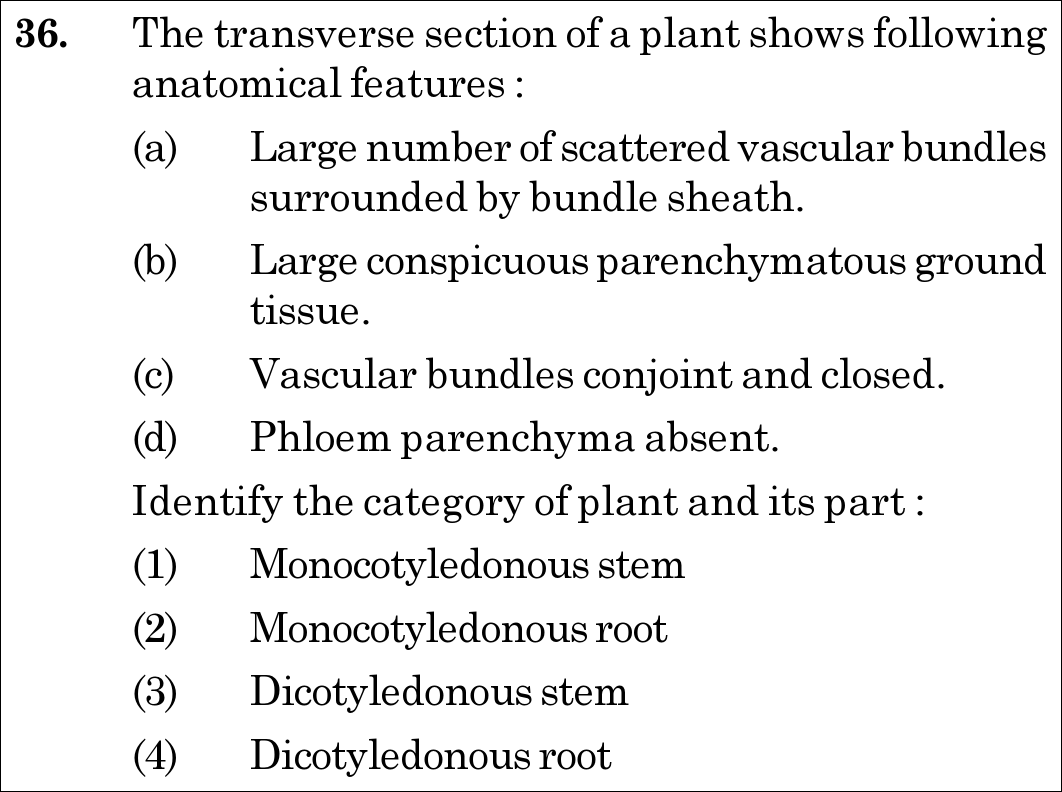
The transverse section of a plant shows following anatomical features: (a) Large number of scattered vascular bundles surrounded by bundle sheath. (b) Large conspicuous parenchymatous ground tissue. (c) Vascular bundles conjoint and closed. (d) Phloem parenchyma absent. Identify the category of plant and its part:

  1. (1)Monocotyledonous stem
  2. (2)Monocotyledonous root
  3. (3)Dicotyledonous stem
  4. (4)Dicotyledonous root
✓
Verified Against NTA Final Answer Key
Option (1) : Monocotyledonous stem
📚 Anatomy of Flowering Plants Easy
📋 Given Parameters & Problem Setup
Feature (a) Large number of scattered vascular bundles surrounded by bundle sheath
Feature (b) Large conspicuous parenchymatous ground tissue
Feature (c) Vascular bundles conjoint and closed
Feature (d) Phloem parenchyma absent
⚡

The 30-Second Exam Hall Shortcut: ⚡ "Scattered + Closed + Phloem Parenchyma Absent = Monocot Stem!"

⏱️ 35 seconds

Roots always have radial bundles. Dicot stems have ringed, open bundles with cambium. Stems with scattered, closed bundles (atactostele) lacking phloem parenchyma uniquely describe a Monocotyledonous Stem! Mark Option (1) instantly.

1 Stems have conjoint vascular bundles; roots have radial bundles (eliminates monocot/dicot roots).
2 Scattered vascular bundles (atactostele) + closed bundles (no cambium) + absence of phloem parenchyma = Monocot stem.
3 Select Option (1) Monocotyledonous stem.
🛡️
Why You Can 100% Trust This Shortcut: NCERT Biology · Anatomy of Flowering Plants (Monocotyledonous Stem)
📐

Step-by-Step Rigorous Workflow & Mathematical Proof

Step 1

Eliminate Root Anatomy

In all roots (dicot and monocot), vascular bundles are arranged radially (xylem and phloem on alternating radii). Feature (c) specifies "conjoint and closed", which is characteristic of stems, completely ruling out root options.

Step 2

Analyze Vascular Bundle Distribution

In monocot stems (e.g., maize), vascular bundles are numerous and scattered throughout the large conspicuous parenchymatous ground tissue (atactostele). Each bundle is surrounded by a sclerenchymatous bundle sheath.

Step 3

Assess Cambium and Phloem Parenchyma

Monocot stem vascular bundles are closed because they lack vascular cambium (incapable of secondary growth). Furthermore, phloem parenchyma is characteristically absent in monocots, and water-containing cavities (protoxylem lacunae) are present within the bundles.

Step 4

Synthesize Diagnostic Features

All four listed features (a, b, c, d) match the NCERT textbook description of a monocotyledonous stem verbatim.

⭐

360° Option Elimination Engine Key Feature

Diagnose every choice: Know exactly why the right option works and why distractors fail.

4-Option Deep Scan
1 A
✓ 100% Correct
Verdict & Scientific Reason:

Accurate; all four anatomical markers uniquely and completely define the transverse section of a monocot stem.

💡
Why this is airtight: None; textbook diagnostic criteria.
2 B
✗ Incorrect
Verdict & Scientific Reason:

Incorrect; roots possess radial bundles with alternating xylem and phloem, and conspicuous pith (in monocot roots), not conjoint closed scattered bundles.

⚠️
Student Fallacy (Why candidates pick this trap): Students confusing stem and root vascular arrangements.
3 C
✗ Incorrect
Verdict & Scientific Reason:

Incorrect; dicot stems feature vascular bundles arranged in a distinct ring (eustele), conjoint open bundles with cambium, and phloem parenchyma is present.

⚠️
Student Fallacy (Why candidates pick this trap): Overlooking that dicot stems have open bundles with cambium and phloem parenchyma.
4 D
✗ Incorrect
Verdict & Scientific Reason:

Incorrect; dicot roots have radial diarch to hexarch bundles with parenchymatous cortex and no bundle sheaths.

⚠️
Student Fallacy (Why candidates pick this trap): Confusing radial root bundles with conjoint stem bundles.
⚠️

NTA Trap Alert: Stem vs Root Vascular Bundle Organization

Roots = RADIAL vascular bundles (xylem and phloem on separate radii). Stems = CONJOINT vascular bundles (xylem and phloem along the same radius).

🛡️ How to avoid the -1 mark: Look at the word "conjoint" first: it immediately eliminates both roots! Then "closed + scattered" immediately eliminates dicot stem.
📖

Core NEET Syllabus Standard

Botany · Anatomy of Flowering Plants Standard Benchmark
Core Scientific Principle Tested:

""

Syllabus Focus: Anatomy of Monocotyledonous Stem vs Dicotyledonous Stem
✓ Core NEET UG Syllabus Anchor Syllabus & Academic Standards ↗

Ready to attempt under real exam pressure?

Test your speed and accuracy in the authentic 180-minute timed NTA simulator.

Launch NEET 2020 CBT Test →

Spotted a mistake in this solution? Report an error (support@mycompetitiveexams.com)

⚖️ Legal & Fair Dealing Notice: Sourced from publicly released NEET 2020 question papers and NEET answer keys for private study, research, and non-commercial educational practice under Fair Dealing (Section 52(1)(a) of the Indian Copyright Act, 1957). Not affiliated with or endorsed by NTA or NMC.

Solve 4 NEET Questions a Day — One per Subject

Cover all 1,140 official NEET questions in 285 days at your own pace. Progress is saved on your device. No login needed.