NEET 2020 Physics Question 161 Solution
Question
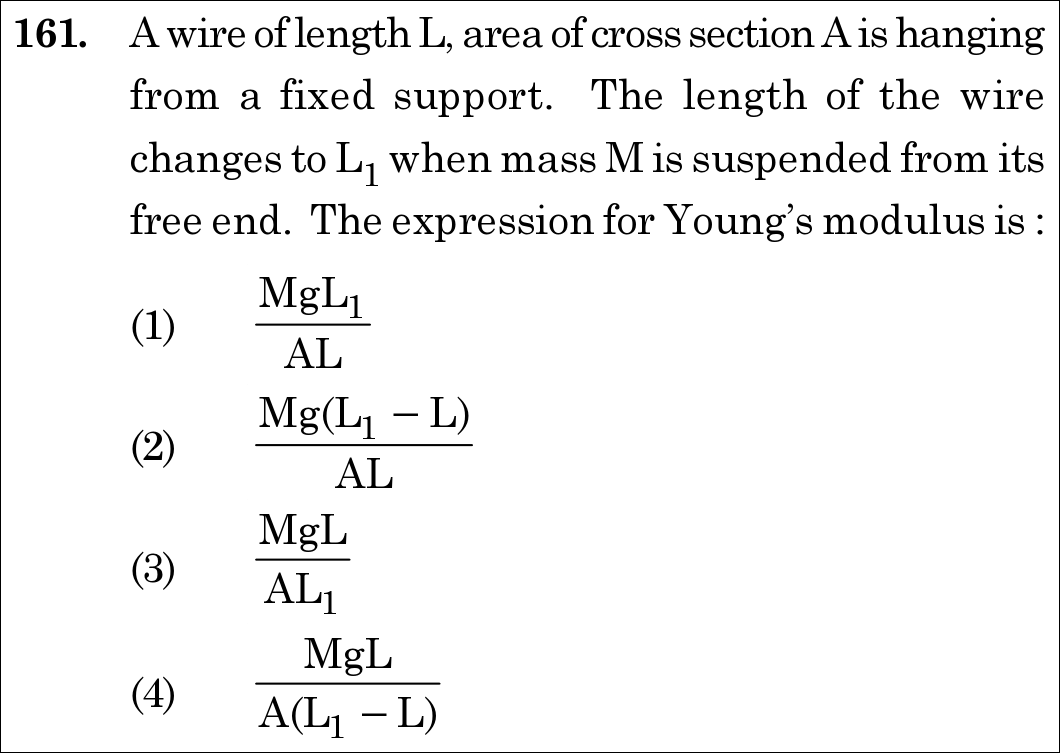
A wire of length L, area of cross section A is hanging from a fixed support. The length of the wire changes to L₁ when mass M is suspended from its free end. The expression for Young's modulus is:
Dynamic 180-question full-length simulator mixed dynamically from all 6 years for 2027 & 2026 aspirants.
A wire of length L, area of cross section A is hanging from a fixed support. The length of the wire changes to L₁ when mass M is suspended from its free end. The expression for Young's modulus is:
Young's modulus is defined as longitudinal stress divided by longitudinal strain. Stress = Mg/A and strain = (L1 - L)/L. Combining gives Y = MgL / [A(L1 - L)]. Spot elongation ΔL = (L1 - L) in the denominator to identify Option (4) instantly!
When mass is suspended from the free end, the deforming tensile force acting across the cross-sectional area of the wire is its weight: .
The initial length of the wire is , and the stretched final length is . Change in length (elongation): .
Young's modulus () is defined as the ratio of longitudinal stress to longitudinal strain within the elastic limit: .
Inverting the denominator fraction yields: . Matches Option 4.
Diagnose every choice: Know exactly why the right option works and why distractors fail.
Incorrect; substitutes final length L1 instead of change in length ΔL = L1 - L in the denominator.
Incorrect; inverts the strain term, putting elongation in the numerator.
Incorrect; would yield Y = Mg/A as if strain were equal to 1.
Accurate expression; Y = (Mg/A) / ((L1 - L)/L) = MgL / [A(L1 - L)].
Strain is fractional change in length (ΔL / L = (L1 - L) / L). Writing strain as L1 / L is a fatal mistake.
""
Test your speed and accuracy in the authentic 180-minute timed NTA simulator.
Spotted a mistake in this solution? Report an error (support@mycompetitiveexams.com)
Cover all 1,140 official NEET questions in 285 days at your own pace. Progress is saved on your device. No login needed.