MyCompetitiveExams Logo MyCompetitiveExams
Search 1,140+ Questions
Chapters, formulas, speed tricks
→
⚡ Brahmastra NEET 2027
720 MARKS

Dynamic 180-question full-length simulator mixed dynamically from all 6 years for 2027 & 2026 aspirants.

Launch Brahmastra 2027 Test →
Start Practice →
100% Free · No Login Required
Q.155 Physics ⭐ 360° Option Elimination Active
Vault ↗

NEET 2020 Physics Question 155 Solution

Topic: Kinetic Theory · Official NTA Booklet Code E1
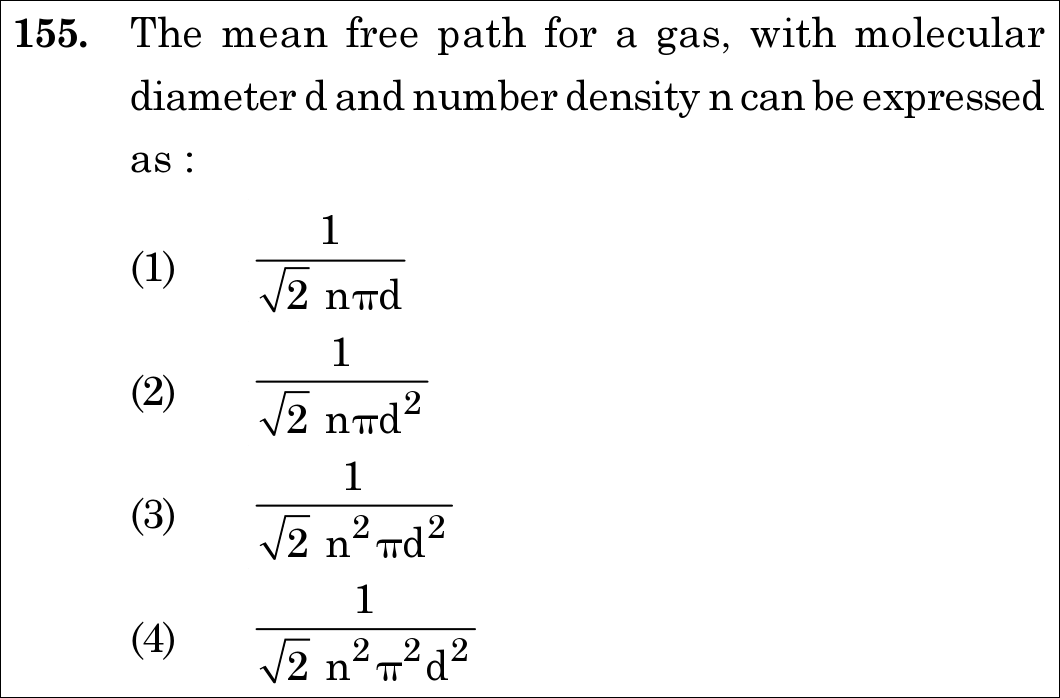
NEET 2020 Physics Question 155: Mean Free Path of Gas Molecules: λ = 1 / (√2 n π d^2)

Question

The mean free path for a gas, with molecular diameter d and number density n can be expressed as:

✓
Verified Against NTA Final Answer Key
Option (2) : 1 / (√2 n π d^2)
📚 Kinetic Theory Easy
📋 Given Parameters & Problem Setup
Kinetic Parameter Mean free path (λ)
Molecular Diameter d
Number Density of Molecules n (number of molecules per unit volume)
Question Objective Select the correct expression for mean free path
⚡

The 30-Second Exam Hall Shortcut: ⚡ "Mean Free Path Formula = 1 / (√2 n π d^2)!"

⏱️ 15 seconds

The collision cross-section of a spherical molecule of diameter dd is πd2\pi d^2. Accounting for the relative velocity distribution of moving molecules gives the factor of 2\sqrt{2} in the denominator. The standard formula for mean free path is λ=12nπd2\lambda = \frac{1}{\sqrt{2} n \pi d^2}. Option (2) has the exact formula! Mark Option (2) in 5 seconds.

1 Collision cross-section of a molecule: σ = π d^2.
2 If only one molecule moves: λ = 1 / (n π d^2).
3 When all molecules move with Maxwellian distribution: relative velocity = √2 v_avg.
4 Dividing by √2 gives: λ = 1 / (√2 n π d^2).
5 Option (2) matches verbatim.
6 Select Option (2).
🛡️
Why You Can 100% Trust This Shortcut: NCERT Physics · Kinetic Theory (Mean Free Path Formula)
📐

Step-by-Step Rigorous Workflow & Mathematical Proof

Step 1

Define Mean Free Path

The mean free path (λ\lambda) is the average distance traveled by a gas molecule between two successive collisions with other gas molecules.

Step 2

Derivation for Stationary Target Approximation

Suppose a molecule of diameter dd moves with speed vv while all other molecules are assumed stationary. A collision occurs whenever the center of another molecule lies within a distance dd. In time Δt\Delta t, it sweeps a collision cylinder of volume: Vcoll=πd2(vΔt)V_{\text{coll}} = \pi d^2 (v \Delta t) With number density nn, the number of collisions is Ncoll=nπd2vΔtN_{\text{coll}} = n \pi d^2 v \Delta t. The mean free path is the total distance divided by number of collisions: λ=vΔtNcoll=1nπd2\lambda = \frac{v \Delta t}{N_{\text{coll}}} = \frac{1}{n \pi d^2}

Step 3

Relative Velocity Correction Factor

In reality, all molecules are in random thermal motion. The effective collision frequency depends on the average relative speed ⟨vrel⟩\langle v_{\text{rel}} \rangle. For a Maxwell-Boltzmann velocity distribution: ⟨vrel⟩=2⟨v⟩\langle v_{\text{rel}} \rangle = \sqrt{2} \langle v \rangle Substituting this relative velocity into the collision rate introduces a factor of 2\sqrt{2} into the denominator: λ=12nπd2\lambda = \frac{1}{\sqrt{2} n \pi d^2}

Step 4

Confirm with NCERT Expression

NCERT states verbatim in the Kinetic Theory chapter: "λ=12nπd2\lambda = \frac{1}{\sqrt{2} n \pi d^2}". This corresponds uniquely to Option (2).

⭐

360° Option Elimination Engine Key Feature

Diagnose every choice: Know exactly why the right option works and why distractors fail.

4-Option Deep Scan
1 A
✗ Incorrect
Verdict & Scientific Reason:

Incorrect; dimensionally invalid (contains dd instead of d2d^2, resulting in units of m2\text{m}^2 instead of length m\text{m}).

⚠️
Student Fallacy (Why candidates pick this trap): Forgetting that cross-sectional area requires d2d^2.
2 B
✓ 100% Correct
Verdict & Scientific Reason:

Factually and dimensionally exact; the canonical NCERT formula for mean free path.

💡
Why this is airtight: None; standard textbook formula.
3 C
✗ Incorrect
Verdict & Scientific Reason:

Incorrect; contains n2n^2 in the denominator, which is dimensionally incorrect.

⚠️
Student Fallacy (Why candidates pick this trap): Squaring the number density.
4 D
✗ Incorrect
Verdict & Scientific Reason:

Incorrect; contains n2n^2 and π2\pi^2.

⚠️
Student Fallacy (Why candidates pick this trap): Squaring multiple constants.
⚠️

NTA Trap Alert: Dimensional Analysis Check for Mean Free Path

Mean free path must have units of LENGTH (meters\text{meters})! - nn has units m−3\text{m}^{-3}. - d2d^2 has units m2\text{m}^2. - Therefore, nd2n d^2 has units m−3⋅m2=m−1\text{m}^{-3} \cdot \text{m}^2 = \text{m}^{-1}. - 1/(nd2)1 / (n d^2) has units m\text{m} (length!). Only Option (2) has correct dimensions and constants.

🛡️ How to avoid the -1 mark: Dimensions must be length! 1/(2nπd2)1 / (\sqrt{2} n \pi d^2) is the only correct formula!
📖

Core NEET Syllabus Standard

Physics · Kinetic Theory Standard Benchmark
Core Scientific Principle Tested:

""

Syllabus Focus: Mean Free Path of Gas Molecules: λ = 1 / (√2 n π d^2)
✓ Core NEET UG Syllabus Anchor Syllabus & Academic Standards ↗

Ready to attempt under real exam pressure?

Test your speed and accuracy in the authentic 180-minute timed NTA simulator.

Launch NEET 2020 CBT Test →

Spotted a mistake in this solution? Report an error (support@mycompetitiveexams.com)

⚖️ Legal & Fair Dealing Notice: Sourced from publicly released NEET 2020 question papers and NEET answer keys for private study, research, and non-commercial educational practice under Fair Dealing (Section 52(1)(a) of the Indian Copyright Act, 1957). Not affiliated with or endorsed by NTA or NMC.

Solve 4 NEET Questions a Day — One per Subject

Cover all 1,140 official NEET questions in 285 days at your own pace. Progress is saved on your device. No login needed.