MyCompetitiveExams Logo MyCompetitiveExams
Search 1,140+ Questions
Chapters, formulas, speed tricks
→
⚡ Brahmastra NEET 2027
720 MARKS

Dynamic 180-question full-length simulator mixed dynamically from all 6 years for 2027 & 2026 aspirants.

Launch Brahmastra 2027 Test →
Start Practice →
100% Free · No Login Required
Q.56 Zoology ⭐ 360° Option Elimination Active
Vault ↗

NEET 2020 Zoology Question 56 Solution

Topic: Environmental Issues · Official NTA Booklet Code E1
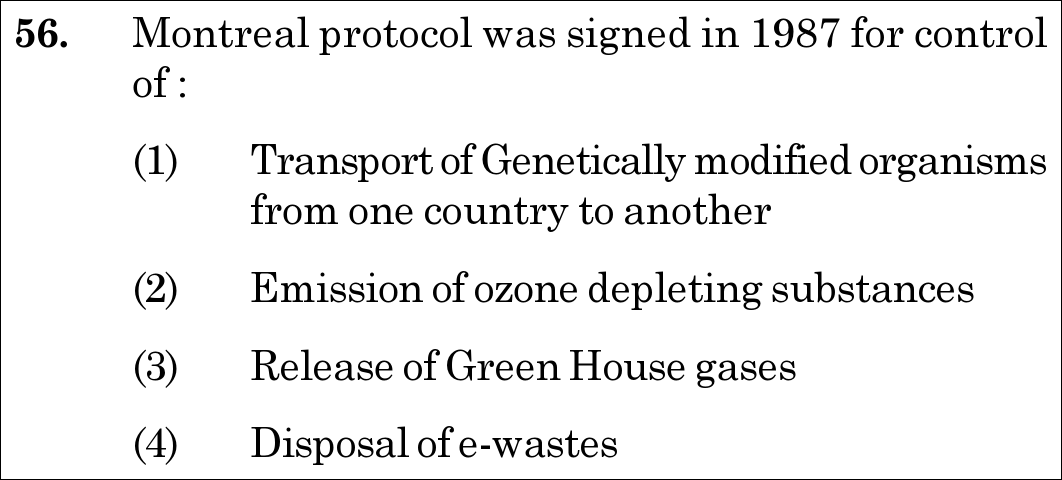
NEET 2020 Zoology Question 56: Montreal Protocol (1987): Control of Ozone Depleting Substances

Question

Montreal protocol was signed in 1987 for control of:

  1. (1)Transport of Genetically modified organisms from one country to another
  2. (2)Emission of ozone depleting substances
  3. (3)Release of Green House gases
  4. (4)Disposal of e-wastes
✓
Verified Against NTA Final Answer Key
Option (2) : Emission of ozone depleting substances
📚 Environmental Issues Easy
📋 Given Parameters & Problem Setup
International Treaty Montreal Protocol
Year Signed 1987 (Montreal, Canada; effective 1989)
Question Objective Identify the target environmental issue controlled by the treaty
⚡

The 30-Second Exam Hall Shortcut: ⚡ "Montreal = OZONE (ODSs); Kyoto = Greenhouse Gases!"

⏱️ 25 seconds

The Montreal Protocol was signed in Montreal (Canada) in 1987 to control the emission of Ozone Depleting Substances (ODSs like chlorofluorocarbons). The Kyoto Protocol controls Greenhouse Gases. Mark Emission of ozone depleting substances (Option 2) in 5 seconds!

1 Montreal Protocol (1987) = Control of ozone depleting substances (ODSs).
2 Kyoto Protocol (1997) = Reducing greenhouse gas emissions.
3 Basel Convention = Hazardous and electronic wastes.
4 Cartagena Protocol = Biosafety of genetically modified organisms.
5 Select Option (2).
🛡️
Why You Can 100% Trust This Shortcut: NCERT Biology · Environmental Issues (Ozone Depletion in Stratosphere & Montreal Protocol)
📐

Step-by-Step Rigorous Workflow & Mathematical Proof

Step 1

History of the Montreal Protocol

Recognizing the deleterious effects of ozone depletion over the Antarctic stratosphere caused by chlorofluorocarbons (CFCs), an international treaty, known as the Montreal Protocol, was signed at Montreal (Canada) in 1987 (and became effective in 1989).

Step 2

Core Objective of the Treaty

The explicit goal of the Montreal Protocol was to control and phase out the emission of ozone depleting substances (ODSs) globally.

Step 3

Differentiate Other Environmental Protocols

Kyoto Protocol (1997) is aimed at reducing greenhouse gas emissions to combat climate change; Cartagena Protocol regulates transboundary movements of Living Modified Organisms (GMOs); Basel Convention regulates hazardous waste disposal.

Step 4

Conclude Correct Option

Option (2) directly captures the mandated objective of the Montreal Protocol.

⭐

360° Option Elimination Engine Key Feature

Diagnose every choice: Know exactly why the right option works and why distractors fail.

4-Option Deep Scan
1 A
✗ Incorrect
Verdict & Scientific Reason:

Incorrect; transboundary movement of GMOs is governed by the Cartagena Protocol on Biosafety, not the Montreal Protocol.

⚠️
Student Fallacy (Why candidates pick this trap): Confusing biosafety treaties with atmospheric environmental treaties.
2 B
✓ 100% Correct
Verdict & Scientific Reason:

Factually exact; the Montreal Protocol was signed in 1987 specifically to curb substances that deplete the stratospheric ozone layer.

💡
Why this is airtight: None; classic environmental biology landmark.
3 C
✗ Incorrect
Verdict & Scientific Reason:

Incorrect; reduction of greenhouse gas emissions is the objective of the Kyoto Protocol and Paris Agreement, not Montreal.

⚠️
Student Fallacy (Why candidates pick this trap): Mixing up Montreal Protocol (Ozone) with Kyoto Protocol (Greenhouse gases).
4 D
✗ Incorrect
Verdict & Scientific Reason:

Incorrect; e-waste management is addressed under the Basel Convention, not the Montreal Protocol.

⚠️
Student Fallacy (Why candidates pick this trap): Confusing hazardous waste management with atmospheric ozone protection.
⚠️

NTA Trap Alert: Montreal vs Kyoto Protocol

Montreal Protocol (1987) = OZONE Depletion (CFCs/ODSs). Kyoto Protocol (1997) = GREENHOUSE Gases & Global Warming.

🛡️ How to avoid the -1 mark: Mnemonic: "M-O-K-G" -> Montreal = Ozone; Kyoto = Greenhouse!
📖

Core NEET Syllabus Standard

Zoology · Environmental Issues Standard Benchmark
Core Scientific Principle Tested:

""

Syllabus Focus: Montreal Protocol (1987): Control of Ozone Depleting Substances
✓ Core NEET UG Syllabus Anchor Syllabus & Academic Standards ↗

Ready to attempt under real exam pressure?

Test your speed and accuracy in the authentic 180-minute timed NTA simulator.

Launch NEET 2020 CBT Test →

Spotted a mistake in this solution? Report an error (support@mycompetitiveexams.com)

⚖️ Legal & Fair Dealing Notice: Sourced from publicly released NEET 2020 question papers and NEET answer keys for private study, research, and non-commercial educational practice under Fair Dealing (Section 52(1)(a) of the Indian Copyright Act, 1957). Not affiliated with or endorsed by NTA or NMC.

Solve 4 NEET Questions a Day — One per Subject

Cover all 1,140 official NEET questions in 285 days at your own pace. Progress is saved on your device. No login needed.