MyCompetitiveExams Logo MyCompetitiveExams
Search 1,140+ Questions
Chapters, formulas, speed tricks
→
⚡ Brahmastra NEET 2027
720 MARKS

Dynamic 180-question full-length simulator mixed dynamically from all 6 years for 2027 & 2026 aspirants.

Launch Brahmastra 2027 Test →
Start Practice →
100% Free · No Login Required
Q.168 Physics ⭐ 360° Option Elimination Active
Vault ↗

NEET 2020 Physics Question 168 Solution

Topic: Wave Optics · Official NTA Booklet Code E1
NEET 2020 Physics Question 168: Limit of Resolution of an Astronomical Telescope by Rayleigh Criterion

Question

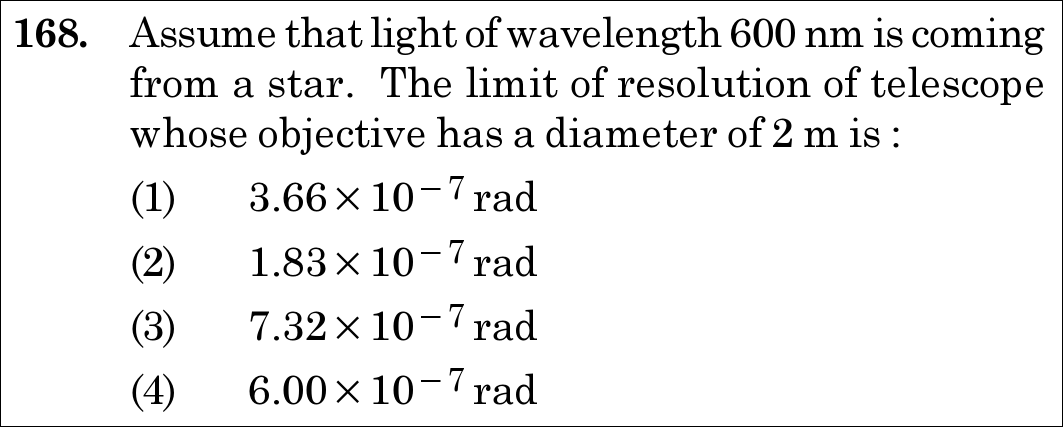
Assume that light of wavelength 600 nm is coming from a star. The limit of resolution of telescope whose objective has a diameter of 2 m is:

✓
Verified Against NTA Final Answer Key
Option (1) : 3.66 x 10^-7 rad
📚 Wave Optics Medium
📋 Given Parameters & Problem Setup
Wavelength of Light (lambda) 600 nm = 6 × 10^-7 m
Objective Aperture Diameter (D) 2 m
⚡

The 30-Second Exam Hall Shortcut: ⚡ "Limit of resolution Δθ = 1.22 λ / D = 1.22 × (6 × 10^-7) / 2 = 1.22 × 3 × 10^-7 = 3.66 × 10^-7 rad!"

⏱️ 20 seconds

According to Rayleigh's criterion for a circular aperture, the angular limit of resolution of a telescope objective is Δθ = 1.22 λ / D. Substituting λ = 600 nm = 6 × 10^-7 m and D = 2 m: Δθ = 1.22 × (6 × 10^-7) / 2 = 1.22 × 3 × 10^-7 = 3.66 × 10^-7 rad. Instant 5-second calculation!

1 Formula: Δθ=1.22λD\Delta\theta = \frac{1.22 \lambda}{D}.
2 Substitute: λ=600×10−9 m=6×10⁻⁷ m\lambda = 600 \times 10^{-9}\text{ m} = 6 \times 10^{-7}\text{ m} and D=2 mD = 2\text{ m}.
3 Compute: Δθ=1.22×6×10−72=1.22×3×10−7=3.66×10⁻⁷ rad\Delta\theta = \frac{1.22 \times 6 \times 10^{-7}}{2} = 1.22 \times 3 \times 10^{-7} = 3.66 \times 10^{-7}\text{ rad}.
4 Select Option (1).
🛡️
Why You Can 100% Trust This Shortcut: NCERT Physics · Wave Optics (Diffraction at a Circular Aperture and Resolving Power)
📐

Step-by-Step Rigorous Workflow & Mathematical Proof

Step 1

Rayleigh Criterion for Circular Apertures

Light passing through a circular telescope objective of diameter DD forms an Airy diffraction pattern consisting of a central bright disc surrounded by dark and bright concentric rings. The angular radius of the first dark ring (Airy disc) defines the angular limit of resolution: Δθ=1.22λD\Delta\theta = \frac{1.22 \lambda}{D}.

Step 2

List Given Numerical Values

- Wavelength of light: λ=600 nm=600×10−9 m=6×10⁻⁷ m\lambda = 600\text{ nm} = 600 \times 10^{-9}\text{ m} = 6 \times 10^{-7}\text{ m} - Diameter of telescope objective: D=2 mD = 2\text{ m}.

Step 3

Calculate Angular Separation

Δθ=1.22×(6×10−7 m)2 m=1.22×3×10−7=3.66×10⁻⁷ rad\Delta\theta = \frac{1.22 \times (6 \times 10^{-7}\text{ m})}{2\text{ m}} = 1.22 \times 3 \times 10^{-7} = 3.66 \times 10^{-7}\text{ rad}.

Step 4

Match with Options

Matches Option 1 exactly.

⭐

360° Option Elimination Engine Key Feature

Diagnose every choice: Know exactly why the right option works and why distractors fail.

4-Option Deep Scan
1 A
✓ 100% Correct
Verdict & Scientific Reason:

Accurate value; Δθ = 1.22 λ / D = 1.22 × 6 × 10^-7 / 2 = 3.66 × 10^-7 rad.

💡
Why this is airtight: None; rigorous application of Rayleigh criterion.
2 B
✗ Incorrect
Verdict & Scientific Reason:

Incorrect; divided by 4 instead of 2 (or used radius R = 1 m and divided by 2 again).

⚠️
Student Fallacy (Why candidates pick this trap): Double halving of the aperture.
3 C
✗ Incorrect
Verdict & Scientific Reason:

Incorrect; multiplied by diameter instead of dividing (1.22 × 6 × 10^-7 × 2 / 2^2).

⚠️
Student Fallacy (Why candidates pick this trap): Inverting diameter position in formula.
4 D
✗ Incorrect
Verdict & Scientific Reason:

Incorrect; omitted the Airy circular factor 1.22 and used λ / 1.

⚠️
Student Fallacy (Why candidates pick this trap): Ignoring the 1.22 factor from circular aperture Bessel diffraction.
⚠️

NTA Trap Alert: Limit of Resolution vs Resolving Power

Limit of resolution is the angular separation Δθ = 1.22 λ / D (in radians). Resolving power is its reciprocal: RP = D / (1.22 λ).

🛡️ How to avoid the -1 mark: Smaller Δθ means higher resolving power. Don't invert the formula!
📖

Core NEET Syllabus Standard

Physics · Wave Optics Standard Benchmark
Core Scientific Principle Tested:

""

Syllabus Focus: Limit of Resolution of an Astronomical Telescope by Rayleigh Criterion
✓ Core NEET UG Syllabus Anchor Syllabus & Academic Standards ↗

Ready to attempt under real exam pressure?

Test your speed and accuracy in the authentic 180-minute timed NTA simulator.

Launch NEET 2020 CBT Test →

Spotted a mistake in this solution? Report an error (support@mycompetitiveexams.com)

⚖️ Legal & Fair Dealing Notice: Sourced from publicly released NEET 2020 question papers and NEET answer keys for private study, research, and non-commercial educational practice under Fair Dealing (Section 52(1)(a) of the Indian Copyright Act, 1957). Not affiliated with or endorsed by NTA or NMC.

Solve 4 NEET Questions a Day — One per Subject

Cover all 1,140 official NEET questions in 285 days at your own pace. Progress is saved on your device. No login needed.