MyCompetitiveExams Logo MyCompetitiveExams
Search 1,140+ Questions
Chapters, formulas, speed tricks
→
⚡ Brahmastra NEET 2027
720 MARKS

Dynamic 180-question full-length simulator mixed dynamically from all 6 years for 2027 & 2026 aspirants.

Launch Brahmastra 2027 Test →
Start Practice →
100% Free · No Login Required
🌿 Botany 🔥 High-Yield Core Topic (~3–4 Qs/Year)

NEET Molecular Basis of Inheritance Previous Year Questions with Solutions

Complete repository of official NTA NEET questions for Molecular Basis of Inheritance from 2020 to 2026. Every question includes 30-second elimination tricks, step-by-step NCERT solutions, option-by-option traps, and official answer keys.

37 Questions 6 Exam Years (2026, 2025, 2024, 2023, 2021, 2020) 31 Easy · 6 Medium · 0 Challenging
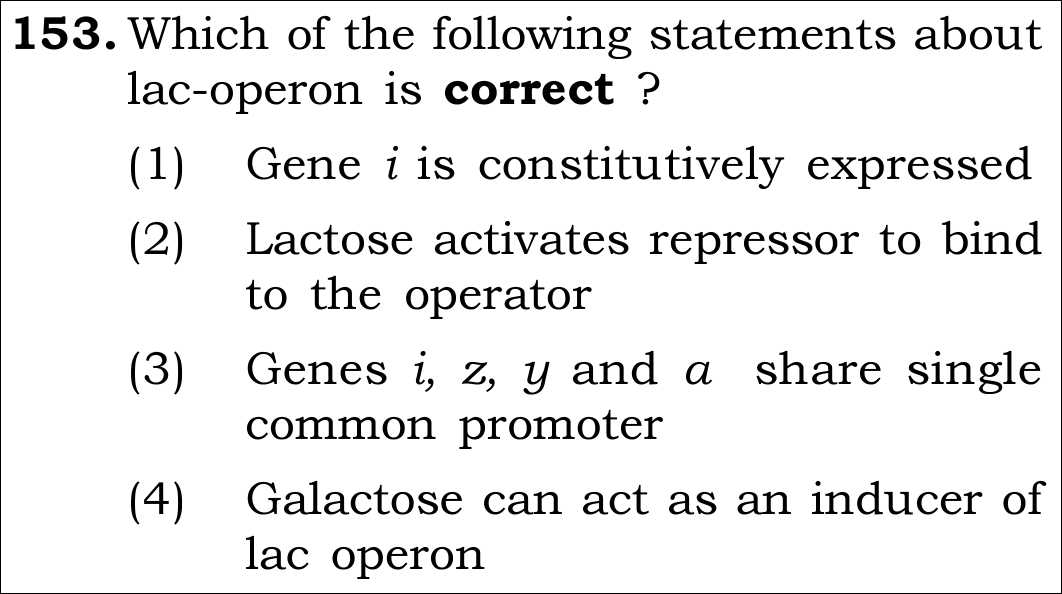
NEET 2026 · Q153 Medium
Official NEET 2026 Question 153 - Molecular Basis of Inheritance
1 ✓ Key
2
3
4
💡 Verified Solution & 30-Second Hack
✓
Verified Against NTA Final Answer Key
Option (1) : The gene i synthesizes the repressor constitutively.
📚 Molecular Basis of Inheritance Medium
📋 Given Parameters & Problem Setup
Genetic System Lac Operon of Escherichia coli
Components i gene (inhibitor), promoter (p), operator (o), structural genes (z, y, a)
⚡

The 30-Second Exam Hall Shortcut: ⚡ Lac Operon Diagnostic Filter

⏱️ Save ~45 seconds

i-gene is ON 24/7 (Constitutive); Lactose is INDUCER (not co-repressor)!

1 Check Option (1): "The gene i synthesizes the repressor constitutively." -> TRUE! (NCERT verbatim: "The i gene codes for the repressor of the lac operon... synthesized constitutively (all the time)").
2 Check Option (2): "Lactose acts as a co-repressor..." -> FALSE (Lactose is an INDUCER; tryptophan is a co-repressor in trp operon).
3 Check Option (3): Jacob & Monod elucidated in 1961 (Nobel Prize in 1965) -> Misleading year.
4 Check Option (4): "z gene codes for transacetylase" -> FALSE (z = β-galactosidase, y = permease, a = transacetylase).
5 Confirm Option (1) with 100% confidence.
🛡️
Why You Can 100% Trust This Shortcut: NCERT Biology · Molecular Basis of Inheritance (DNA Fingerprinting: Variable Number of Tandem Repeats VNTRs as minisatellites).
📐

Step-by-Step Rigorous Workflow & Mathematical Proof

Step 1

Function of the i-Gene

The lac operon consists of one regulatory gene (the i gene, from the term inhibitor) and three structural genes (z, y, and a). The i gene codes for the repressor protein of the lac operon. It is synthesized constitutively (all the time) at a basal level.

i\text{-gene} \xrightarrow{\text{Constitutive Transcription & Translation}} \text{Lac Repressor Monomer} \rightarrow \text{Active Tetramer}
  • • Constitutive expression means continuous, non-regulated transcription regardless of lactose presence.
Step 2

Action of Inducer vs. Structural Genes

Lactose (or allolactose) acts as an inducer by binding to the repressor tetramer, causing conformational change and inactivating it. The structural genes code for enzymes: z = β-galactosidase, y = permease, a = transacetylase.

z→β-galactosidase,y→permease,a→transacetylasez \rightarrow \beta\text{-galactosidase}, \quad y \rightarrow \text{permease}, \quad a \rightarrow \text{transacetylase}
  • • Negative regulation: the repressor bound to operator blocks RNA polymerase; inducer lifts repression.
⭐

360° Option Elimination Engine Key Feature

Diagnose every choice: Know exactly why the right option works and why distractors fail.

4-Option Deep Scan
1 A
✓ 100% Correct
Verdict & Scientific Reason:

100% correct. NCERT states verbatim: "The repressor of the operon is synthesised, all the time – constitutively – from the i gene."

💡
Why this is airtight: None; textbook definition.
2 B
✗ Incorrect
Verdict & Scientific Reason:

Incorrect. Lactose is an INDUCER that binds and inactivates the repressor. A co-repressor (like tryptophan in the trp operon) activates the repressor.

⚠️
Student Fallacy (Why candidates pick this trap): Confusing "inducer" with "co-repressor".
3 C
✗ Incorrect
Verdict & Scientific Reason:

Incorrect. Jacob and Monod elucidated the lac operon in 1961. They received the Nobel Prize in 1965.

⚠️
Student Fallacy (Why candidates pick this trap): Confusing year of discovery (1961) with year of Nobel Prize award (1965).
4 D
✗ Incorrect
Verdict & Scientific Reason:

Incorrect. The z gene codes for beta-galactosidase. The "a" gene codes for transacetylase.

⚠️
Student Fallacy (Why candidates pick this trap): Swapping z gene product (beta-galactosidase) with a gene product (transacetylase).
⚠️

NTA Trap Alert: Structural Gene Product Inversion (z, y, a)

Students frequently mix up the three structural genes. Use the mnemonic "Z-B, Y-P, A-T" (Zebra Bites, Yellow Panther, Always Tired) to remember z -> β-gal, y -> permease, a -> transacetylase.

🛡️ How to avoid the -1 mark: Write out "z = beta-gal, y = permease, a = transacetylase" before reading the choices.
📖

Core NEET Syllabus Standard

NEET Biology Core Syllabus · Molecular Basis of Inheritance Standard Benchmark
Core Scientific Principle Tested:

"The repressor of the lac operon is synthesized constitutively from the i gene."
Syllabus Focus: The Lac Operon
✓ Core NEET UG Syllabus Anchor Syllabus & Academic Standards ↗
i-gene is an Island: It works Indefinitely and All the time (Constitutive)!
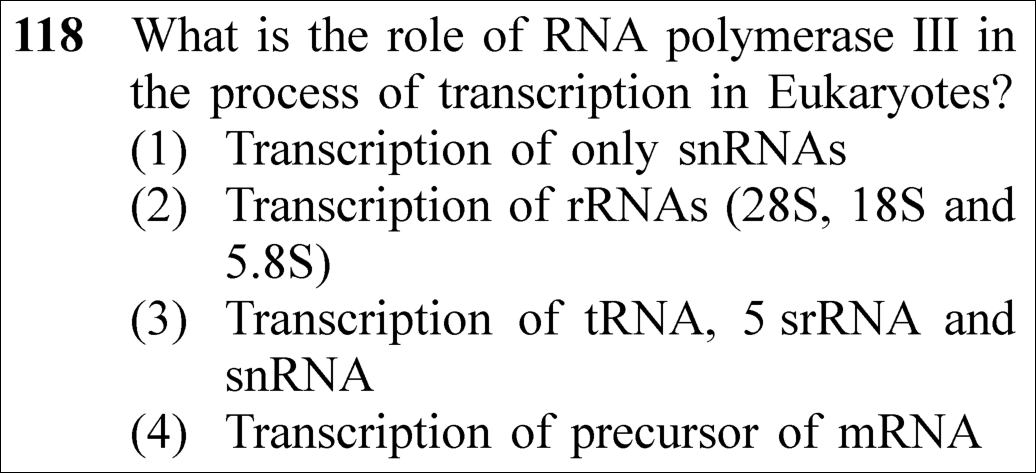
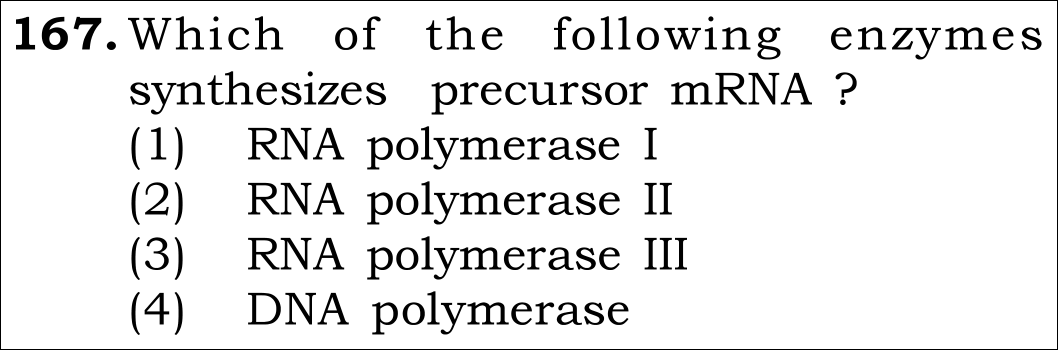
NEET 2026 · Q167 Easy
Official NEET 2026 Question 167 - Molecular Basis of Inheritance
1 RNA polymerase I
2 RNA polymerase II ✓ Key
3 RNA polymerase II
4 DNA polymerase
💡 Verified Solution & 30-Second Hack
✓
Verified Against NTA Final Answer Key
Option (2) : RNA polymerase II
📚 Molecular Basis of Inheritance Easy
📋 Given Parameters & Problem Setup
Cell Type Eukaryote
Target Transcript Precursor of mRNA (Heterogeneous nuclear RNA / hnRNA)
⚡

The 30-Second Exam Hall Shortcut: ⚡ 1-2-3 / R-M-T Eukaryotic RNA Pol Formula

⏱️ Save ~40 seconds

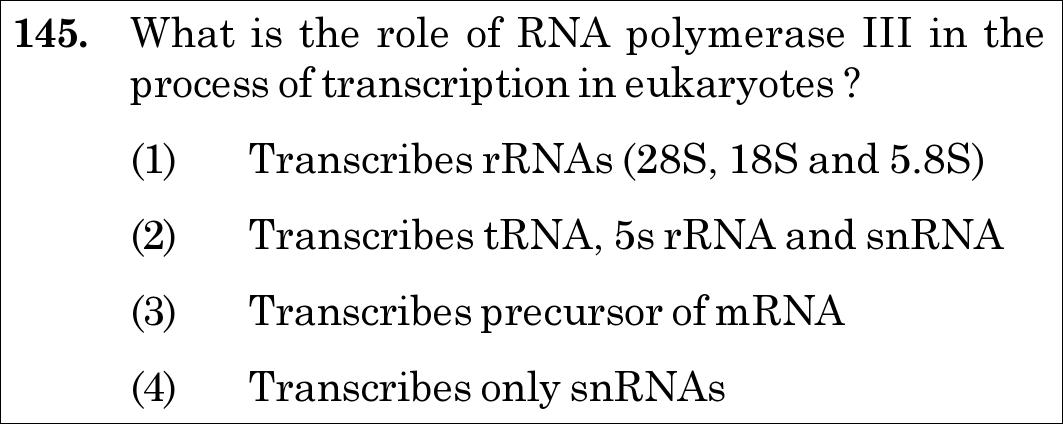
Pol I = rRNA; Pol II = mRNA (hnRNA); Pol III = tRNA (5S rRNA, snRNA)!

1 Use the universal mnemonic: "1-r, 2-m, 3-t" (Ready Made Transcripts).
2 RNA Polymerase I -> transcribes rRNAs (28S, 18S, and 5.8S).
3 RNA Polymerase II -> transcribes hnRNA (precursor of mRNA).
4 RNA Polymerase III -> transcribes tRNA, 5S rRNA, and snRNAs.
5 The question asks for precursor of mRNA (hnRNA) -> RNA Polymerase II.
6 Pick Option (2) in under 10 seconds!
🛡️
Why You Can 100% Trust This Shortcut: NCERT Biology · Molecular Basis of Inheritance (Central Dogma & Genetic Code: AUG codes for Methionine and acts as initiator).
📐

Step-by-Step Rigorous Workflow & Mathematical Proof

Step 1

Division of Labour Among Eukaryotic RNA Polymerases

In eukaryotes, there are at least three RNA polymerases in the nucleus (in addition to the RNA polymerase found in the organelles). There is a clear division of labour among them.

RNA Pol I→28S,18S,5.8S rRNARNA Pol II→hnRNA (precursor of mRNA)RNA Pol III→tRNA,5S rRNA,snRNAs\begin{aligned} \text{RNA Pol I} &\rightarrow 28\text{S}, 18\text{S}, 5.8\text{S rRNA} \\ \mathbf{\text{RNA Pol II}} &\rightarrow \mathbf{\text{hnRNA (precursor of mRNA)}} \\ \text{RNA Pol III} &\rightarrow \text{tRNA}, 5\text{S rRNA}, \text{snRNAs} \end{aligned}
  • • Eukaryotic RNA polymerase II also synthesizes microRNAs (miRNAs).
Step 2

Processing of hnRNA into Mature mRNA

The primary transcript (hnRNA) synthesized by RNA polymerase II contains both exons (coding) and introns (non-coding). It undergoes post-transcriptional processing: 5' capping with methylguanosine triphosphate, splicing out of introns by spliceosomes, and 3' polyadenylation (tailing).

hnRNA→Capping + Splicing + TailingMature mRNA\text{hnRNA} \xrightarrow{\text{Capping + Splicing + Tailing}} \text{Mature mRNA}
  • • DNA polymerases synthesize DNA, not RNA.
⭐

360° Option Elimination Engine Key Feature

Diagnose every choice: Know exactly why the right option works and why distractors fail.

4-Option Deep Scan
1 A
✗ Incorrect
Verdict & Scientific Reason:

Incorrect. RNA polymerase I transcribes ribosomal RNAs (28S, 18S, and 5.8S), not hnRNA.

⚠️
Student Fallacy (Why candidates pick this trap): Confusing RNA Pol I with RNA Pol II.
2 B
✓ 100% Correct
Verdict & Scientific Reason:

100% correct. RNA polymerase II specifically transcribes the precursor of mRNA, namely heterogeneous nuclear RNA (hnRNA).

💡
Why this is airtight: None; fundamental molecular genetics rule.
3 C
✗ Incorrect
Verdict & Scientific Reason:

Incorrect. RNA polymerase III is responsible for transcription of tRNA, 5S rRNA, and snRNAs (small nuclear RNAs).

⚠️
Student Fallacy (Why candidates pick this trap): Confusing Pol III targets with Pol II.
4 D
✗ Incorrect
Verdict & Scientific Reason:

Incorrect. DNA polymerase II is a prokaryotic DNA-dependent DNA polymerase involved in DNA repair, not an RNA polymerase.

⚠️
Student Fallacy (Why candidates pick this trap): Conflating DNA polymerase with RNA polymerase.
⚠️

NTA Trap Alert: 5S rRNA Exception Trap

Students often generalize "all rRNA is made by Pol I". 28S, 18S, and 5.8S are made by Pol I, but 5S rRNA is transcribed by RNA Polymerase III.

🛡️ How to avoid the -1 mark: Use R-M-T mnemonic: 1 = Ribosomal (except 5S), 2 = Messenger (hnRNA), 3 = Transfer (plus 5S & snRNA).
📖

Core NEET Syllabus Standard

NEET Biology Core Syllabus · Molecular Basis of Inheritance Standard Benchmark
Core Scientific Principle Tested:

"RNA polymerase II transcribes precursor of mRNA, the heterogeneous nuclear RNA (hnRNA)."

Syllabus Focus: Transcription in Eukaryotes
✓ Core NEET UG Syllabus Anchor Syllabus & Academic Standards ↗
1-R, 2-M, 3-T: Polymerase Two Makes Messenger (hnRNA)!
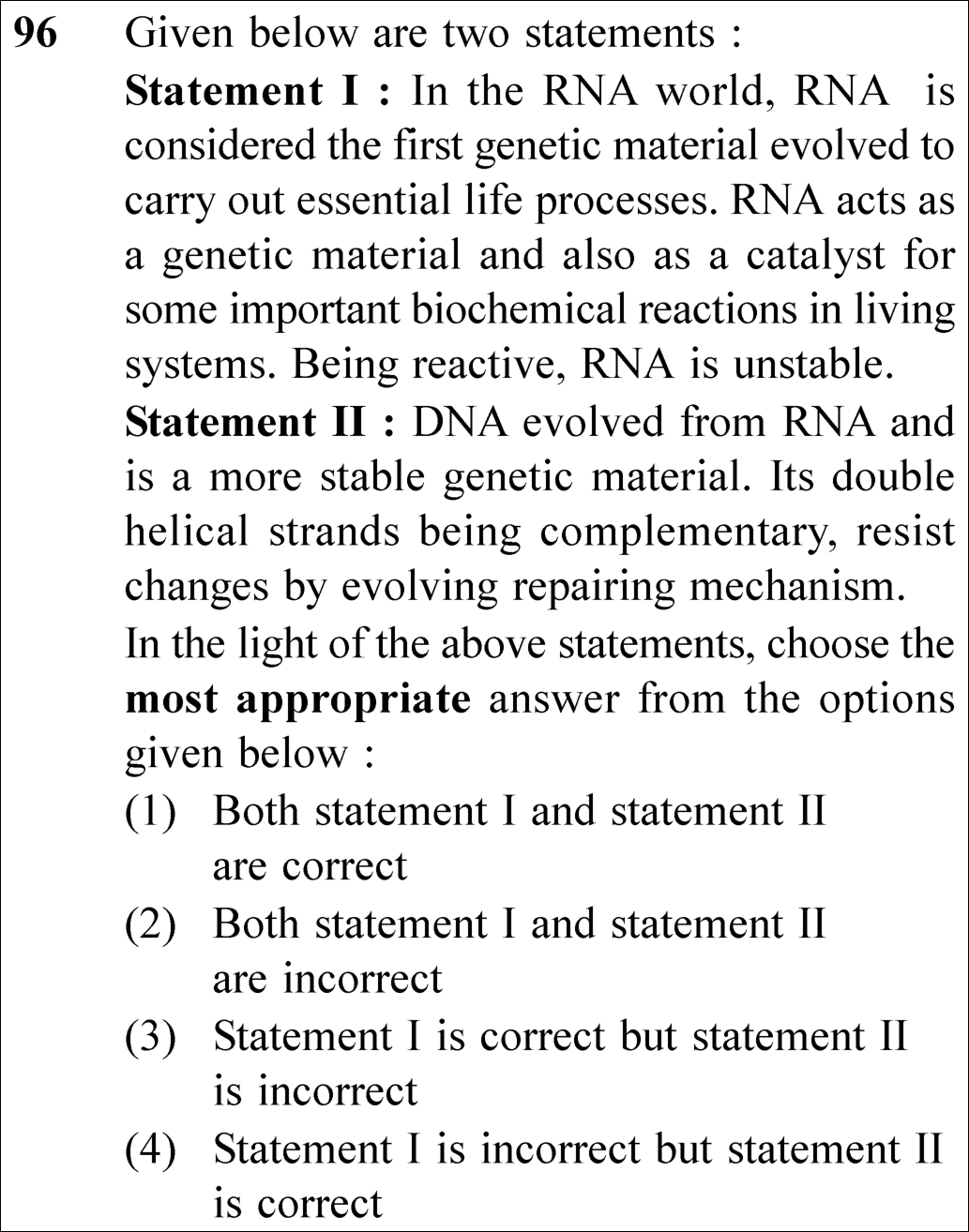
NEET 2025 · Q96 Easy
Official NEET 2025 Question 96 - Molecular Basis of Inheritance
1 Both statement I and statement II are correct ✓ Key
2 Both statement I and statement II are incorrect
3 Statement I is correct but statement II is incorrect
4 Statement I is incorrect but statement II is correct
💡 Verified Solution & 30-Second Hack
✓
Verified Against NTA Final Answer Key
Option (1) : Both statement I and statement II are correct
📚 Molecular Basis of Inheritance Easy
📋 Given Parameters & Problem Setup
Statement I In the RNA world, RNA is considered the first genetic material evolved to carry out essential life processes. RNA acts as a genetic material and also as a catalyst for some important biochemical reactions in living systems. Being reactive, RNA is unstable.
Statement II DNA evolved from RNA and is a more stable genetic material. Its double helical strands being complementary, resist changes by evolving repairing mechanism.
⚡

The 30-Second Exam Hall Shortcut: ⚡ NCERT RNA World Verbatim Verification

⏱️ Save ~30 seconds

Statement I is NCERT verbatim: "RNA was the first genetic material... acts as catalyst... being reactive, RNA is unstable" (TRUE)! Statement II is NCERT verbatim: "DNA evolved from RNA... complementary strands resist changes by evolving repair mechanism" (TRUE)! Both statements are CORRECT!

1 Check Statement I: Molecular evidence confirms essential processes (splicing, translation) evolved around RNA. RNA functioned as both hereditary material and catalytic ribozymes (e.g., 23S rRNA peptide bond formation). Due to its 2'-OH group and catalytic nature, RNA is chemically reactive and unstable. Statement I is TRUE.
2 Check Statement II: To store information securely without degradation, DNA evolved chemically from RNA (loss of 2'-OH to deoxyribose, replacement of uracil with 5-methyluracil/thymine). Complementary base-pairing allows the undamaged strand to template error-free repair of mutations. Statement II is TRUE.
3 Conclusion: Both statement I and statement II are correct.
4 Select Option (1) in under 10 seconds!
🛡️
Why You Can 100% Trust This Shortcut: RNA as First Genetic Material & Ribozymes (NCERT Biology · Molecular Basis of Inheritance).
📐

Step-by-Step Rigorous Workflow & Mathematical Proof

Step 1

Evaluate Statement I (Hypothesis of the RNA World)

Analyze the canonical principles of the RNA World hypothesis from NCERT Chapter 6:

RNA=First genetic material+Biocatalyst (Ribozyme)  ⟹  Reactive and chemically unstable\text{RNA} = \text{First genetic material} + \text{Biocatalyst (Ribozyme)} \implies \text{Reactive and chemically unstable}
  • • Prebiotic evolution centered around RNA performing both informational storage and enzymic catalysis.
  • • The reactive 2'-OH group on ribose makes RNA labile and prone to alkaline hydrolysis.
  • • Statement I is verbatim accurate from NCERT and completely TRUE.
Step 2

Evaluate Statement II (Evolution and Stability of DNA)

Analyze the structural adaptations that favored DNA as the permanent repository of genetic information:

RNA→Deoxygenation (2’-H) + Methylation (Thymine)DNA (Chemically unreactive and physically stable)\text{RNA} \xrightarrow{\text{Deoxygenation (2'-H) + Methylation (Thymine)}} \text{DNA (Chemically unreactive and physically stable)}
  • • Double-stranded DNA with complementary base-pairing provides redundancy: if one strand is damaged, the complementary strand directs high-fidelity enzymatic repair.
  • • Statement II is verbatim accurate from NCERT and completely TRUE.
Step 3

Select Matching Option

Both statements are true and accurate:

Statement I: True,Statement II: True  ⟹  Option (1)\text{Statement I: True}, \quad \text{Statement II: True} \implies \text{Option (1)}
  • • Matches Option (1) perfectly.
⭐

360° Option Elimination Engine Key Feature

Diagnose every choice: Know exactly why the right option works and why distractors fail.

4-Option Deep Scan
1 A
✓ 100% Correct
Verdict & Scientific Reason:

100% correct. Verbatim quotes from NCERT Molecular Basis of Inheritance Section 6.2.2.

💡
Why this is airtight: None; flawless mastery of molecular biology.
2 B
✗ Incorrect
Verdict & Scientific Reason:

Incorrect. Both statements represent core biological facts.

⚠️
Student Fallacy (Why candidates pick this trap): Doubting whether RNA was the first genetic material.
3 C
✗ Incorrect
Verdict & Scientific Reason:

Incorrect. Statement II is correct.

⚠️
Student Fallacy (Why candidates pick this trap): Unaware of DNA repair mechanisms based on complementary strands.
4 D
✗ Incorrect
Verdict & Scientific Reason:

Incorrect. Statement I is correct.

⚠️
Student Fallacy (Why candidates pick this trap): Believing DNA was the primordial genetic material.
⚠️

NTA Trap Alert: Thinking Proteins Were the First Biocatalysts

Students sometimes assume all biological catalysts are proteins. The discovery of ribozymes proved that RNA can act as an enzyme, solidifying RNA’s role as the first genetic and catalytic molecule in prebiotic evolution!

🛡️ How to avoid the -1 mark: Remember: RNA was BOTH the first genetic material AND the first catalyst!
📖

Core NEET Syllabus Standard

NEET Biology Core Syllabus · Molecular Basis of Inheritance Standard Benchmark
Core Scientific Principle Tested:

"RNA was the primordial genetic material; DNA evolved from RNA with greater stability and repair mechanisms."

Syllabus Focus: The RNA World & Stability of Genetic Material
✓ Core NEET UG Syllabus Anchor Syllabus & Academic Standards ↗
RNA came first (reactive catalyst), DNA evolved later (stable double-strand with repair) ⟹ Both TRUE!
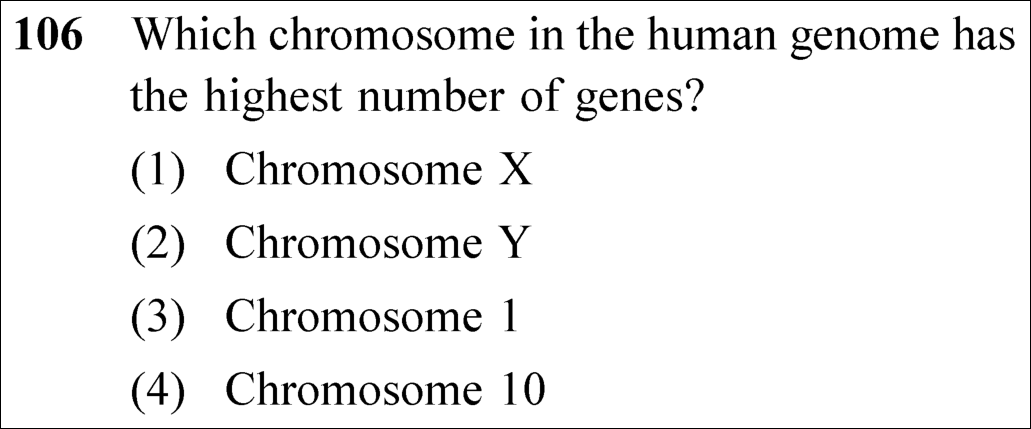
NEET 2025 · Q106 Easy
Official NEET 2025 Question 106 - Molecular Basis of Inheritance
1
2
3 ✓ Key
4
💡 Verified Solution & 30-Second Hack
✓
Verified Against NTA Final Answer Key
Option (3) : Chromosome 1
📚 Molecular Basis of Inheritance Easy
📋 Given Parameters & Problem Setup
Organism Homo sapiens (Human genome)
Target Feature Chromosome with highest gene count
⚡

The 30-Second Exam Hall Shortcut: ⚡ HGP Extremes Fingerprint

⏱️ Save ~25 seconds

Chromosome 1 is the BIGGEST with the MOST genes (2,968 genes)! Chromosome Y is the SMALLEST with FEWEST genes (231 genes)!

1 Recall the salient features of the Human Genome Project (HGP):
2 - Total genes estimated: ~30,000.
3 - Chromosome 1 has the most genes: 2,968 genes.
4 - Chromosome Y has the fewest genes: 231 genes.
5 - Average gene size: 3000 bases (largest human gene is dystrophin at 2.4 million bases).
6 Highest gene count = Chromosome 1!
7 Select Option (3) immediately!
🛡️
Why You Can 100% Trust This Shortcut: Human Genome Project Salient Findings (NCERT Biology · Molecular Basis of Inheritance: Chromosome 1 has 2968 genes, Y has 231).
📐

Step-by-Step Rigorous Workflow & Mathematical Proof

Step 1

Core Findings of the Human Genome Project (HGP)

The complete sequencing of the human genome revealed extraordinary insights into the genetic architecture of humans:

  • • The human genome contains 3164.7 million nucleotide base pairs (3.164 Gb).
  • • The total number of genes is estimated at 30,000, much lower than previous estimates of 80,000 to 140,000 genes.
  • • Almost all (99.9%) nucleotide bases are exactly the same in all people.
Step 2

Distribution of Genes Across Human Chromosomes

Genes are not evenly distributed across human chromosomes:

  • • Chromosome 1 (the largest human autosome) contains the highest number of genes: exactly 2,968 genes.
  • • Chromosome 1 was the last chromosome to be completely sequenced (completed in May 2006).
  • • Chromosome Y contains the fewest genes: only 231 genes.
Step 3

Conclusion

Chromosome 1 holds the record for harboring the highest number of annotated protein-coding genes in the human genome.

Max Genes=Chromosome 1 (2,968 genes)\text{Max Genes} = \text{Chromosome 1 (2,968 genes)}
⭐

360° Option Elimination Engine Key Feature

Diagnose every choice: Know exactly why the right option works and why distractors fail.

4-Option Deep Scan
1 A
✗ Incorrect
Verdict & Scientific Reason:

Incorrect. Chromosome X contains approximately 800–900 genes, far fewer than Chromosome 1.

⚠️
Student Fallacy (Why candidates pick this trap): Assuming the sex chromosome X has the most genes due to its high frequency in sex-linked inheritance questions.
2 B
✗ Incorrect
Verdict & Scientific Reason:

Incorrect. Chromosome Y has the FEWEST genes in the entire human genome (only 231 genes).

⚠️
Student Fallacy (Why candidates pick this trap): Confusing highest with lowest extremes.
3 C
✓ 100% Correct
Verdict & Scientific Reason:

100% correct. Chromosome 1 contains 2,968 genes, the maximum among all human chromosomes.

💡
Why this is airtight: None; direct NCERT factual recall.
4 D
✗ Incorrect
Verdict & Scientific Reason:

Incorrect. Chromosome 10 contains roughly 700–800 genes, well below Chromosome 1.

⚠️
Student Fallacy (Why candidates pick this trap): Random guessing.
⚠️

NTA Trap Alert: Confusing Chromosome 1 (Most Genes) with Chromosome Y (Fewest Genes)

NCERT highlights both extremes together: Chromosome 1 has 2968 genes, while Chromosome Y has 231 genes. Always check whether the question asks for highest or lowest!

🛡️ How to avoid the -1 mark: Remember: #1 is first and biggest (2968 genes); Y is tiny and has the fewest (231 genes).
📖

Core NEET Syllabus Standard

NEET Biology Core Syllabus · Molecular Basis of Inheritance Standard Benchmark
Core Scientific Principle Tested:

"Chromosome 1 has the most genes (2968), and the Y chromosome has the fewest (231)."

Syllabus Focus: Human Genome Project · Salient Features
✓ Core NEET UG Syllabus Anchor Syllabus & Academic Standards ↗
Number #1 is FIRST and has the MOST (2,968 genes)!
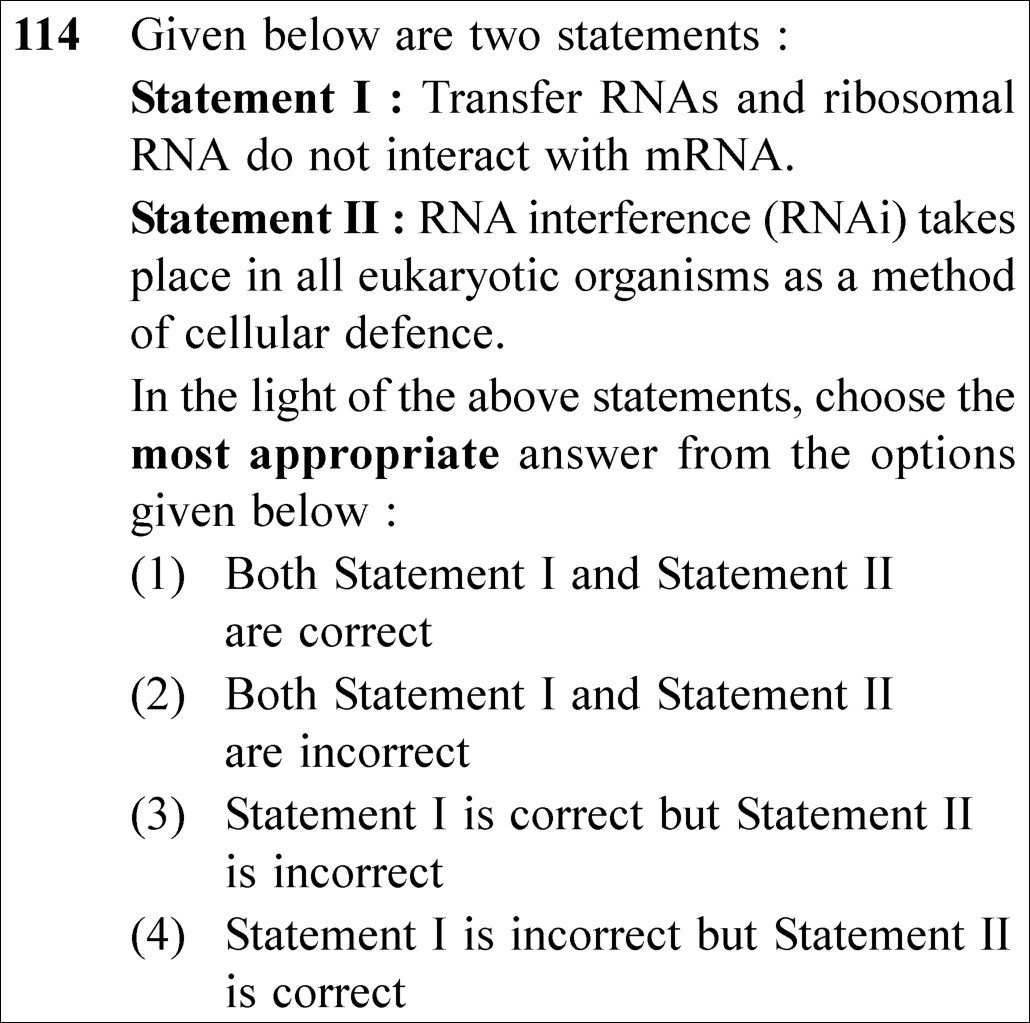
NEET 2025 · Q114 Medium
Official NEET 2025 Question 114 - Molecular Basis of Inheritance
1 Both Statement I and Statement II are correct
2 Both Statement I and Statement II are incorrect
3 Statement I is correct but Statement II is incorrect
4 Statement I is incorrect but Statement II is correct ✓ Key
💡 Verified Solution & 30-Second Hack
✓
Verified Against NTA Final Answer Key
Option (4) : Statement I is incorrect but Statement II is correct
📚 Molecular Basis of Inheritance & Biotechnology Medium
📋 Given Parameters & Problem Setup
Statement I Transfer RNAs and ribosomal RNA do not interact with mRNA.
Statement II RNA interference (RNAi) takes place in all eukaryotic organisms as a method of cellular defence.
⚡

The 30-Second Exam Hall Shortcut: ⚡ Statement Validity Fingerprint

⏱️ Save ~25 seconds

tRNA reads mRNA codons and rRNA binds mRNA on ribosomes -> Statement I is blatantly FALSE! RNAi is a universal eukaryotic defence mechanism -> Statement II is 100% TRUE!

1 Analyze Statement I:
2 - "tRNAs and ribosomal RNA do not interact with mRNA." -> Absurd! tRNA binds mRNA through codon-anticodon pairing, and rRNA positions mRNA in the ribosome! Statement I is INCORRECT.
3 Analyze Statement II:
4 - "RNA interference (RNAi) takes place in all eukaryotic organisms as a method of cellular defence." -> NCERT Biotechnology Applications verbatim! Statement II is CORRECT.
5 Conclusion: Statement I is incorrect but Statement II is correct.
6 Select Option (4)!
🛡️
Why You Can 100% Trust This Shortcut: Gene Silencing & RNA Interference (NCERT Biology · Biotechnology and its Applications: dsRNA-mediated silencing).
📐

Step-by-Step Rigorous Workflow & Mathematical Proof

Step 1

Analysis of Statement I (tRNA and rRNA Interactions with mRNA)

During protein translation, multiple RNA species exhibit essential, highly coordinated physical and functional interactions:

  • • tRNA (transfer RNA) possesses an anticodon loop that specifically base-pairs with complementary codons on mRNA.
  • • rRNA (ribosomal RNA) forms the structural and catalytic framework of ribosomes; the smaller subunit binds mRNA, and rRNA sequences (like 16S rRNA in prokaryotes or 18S in eukaryotes) interact with mRNA to position it correctly for translation.
  • • Therefore, asserting that tRNA and rRNA "do not interact with mRNA" is factually and conceptually INCORRECT.
Step 2

Analysis of Statement II (RNA Interference in Eukaryotes)

RNA interference (RNAi) is a conserved post-transcriptional gene silencing mechanism:

  • • NCERT explicitly states: "RNA interference (RNAi) takes place in all eukaryotic organisms as a method of cellular defence."
  • • It involves silencing of a specific mRNA due to a complementary double-stranded RNA (dsRNA) molecule that binds to and prevents translation (or degrades) the target mRNA.
  • • Therefore, Statement II is completely CORRECT.
Step 3

Conclusion

Statement I is incorrect, but Statement II is correct. This corresponds to Option (4).

Statement I: False,Statement II: True  ⟹  Option (4)\text{Statement I: False}, \quad \text{Statement II: True} \implies \text{Option (4)}
⭐

360° Option Elimination Engine Key Feature

Diagnose every choice: Know exactly why the right option works and why distractors fail.

4-Option Deep Scan
1 A
✗ Incorrect
Verdict & Scientific Reason:

Incorrect. Statement I is false because tRNA and rRNA extensively interact with mRNA during translation.

⚠️
Student Fallacy (Why candidates pick this trap): Failing to realize that translation is built entirely on RNA-mRNA interactions.
2 B
✗ Incorrect
Verdict & Scientific Reason:

Incorrect. Statement II is a direct verbatim quote from NCERT Biotechnology and is completely true.

⚠️
Student Fallacy (Why candidates pick this trap): Doubting whether RNAi occurs in all eukaryotes.
3 C
✗ Incorrect
Verdict & Scientific Reason:

Incorrect. Exactly reverses the veracity of both statements.

⚠️
Student Fallacy (Why candidates pick this trap): Complete confusion regarding translation and RNAi.
4 D
✓ 100% Correct
Verdict & Scientific Reason:

100% correct. Statement I contradicts the core mechanism of translation, while Statement II is textbook fact.

💡
Why this is airtight: None; rigorous conceptual clarity.
⚠️

NTA Trap Alert: Reading "Do Not Interact" Too Casually

Students reading quickly might gloss over the negative word "not" in Statement I. Always circle negative qualifiers like "not", "incorrect", or "incompatible" in statement-based questions!

🛡️ How to avoid the -1 mark: Identify the verb phrase: "do NOT interact" vs reality (they interact intimately in every round of translation).
📖

Core NEET Syllabus Standard

NEET Biology Core Syllabus · Molecular Basis of Inheritance / Biotechnology and its Applications Standard Benchmark
Core Scientific Principle Tested:

"tRNA and rRNA actively bind and translate mRNA; RNAi operates across all eukaryotes for cellular defence."

Syllabus Focus: Translation Machinery & RNA Interference
✓ Core NEET UG Syllabus Anchor Syllabus & Academic Standards ↗
I is FALSE (tRNA/rRNA LOVE mRNA), II is TRUE (RNAi defends ALL eukaryotes)!
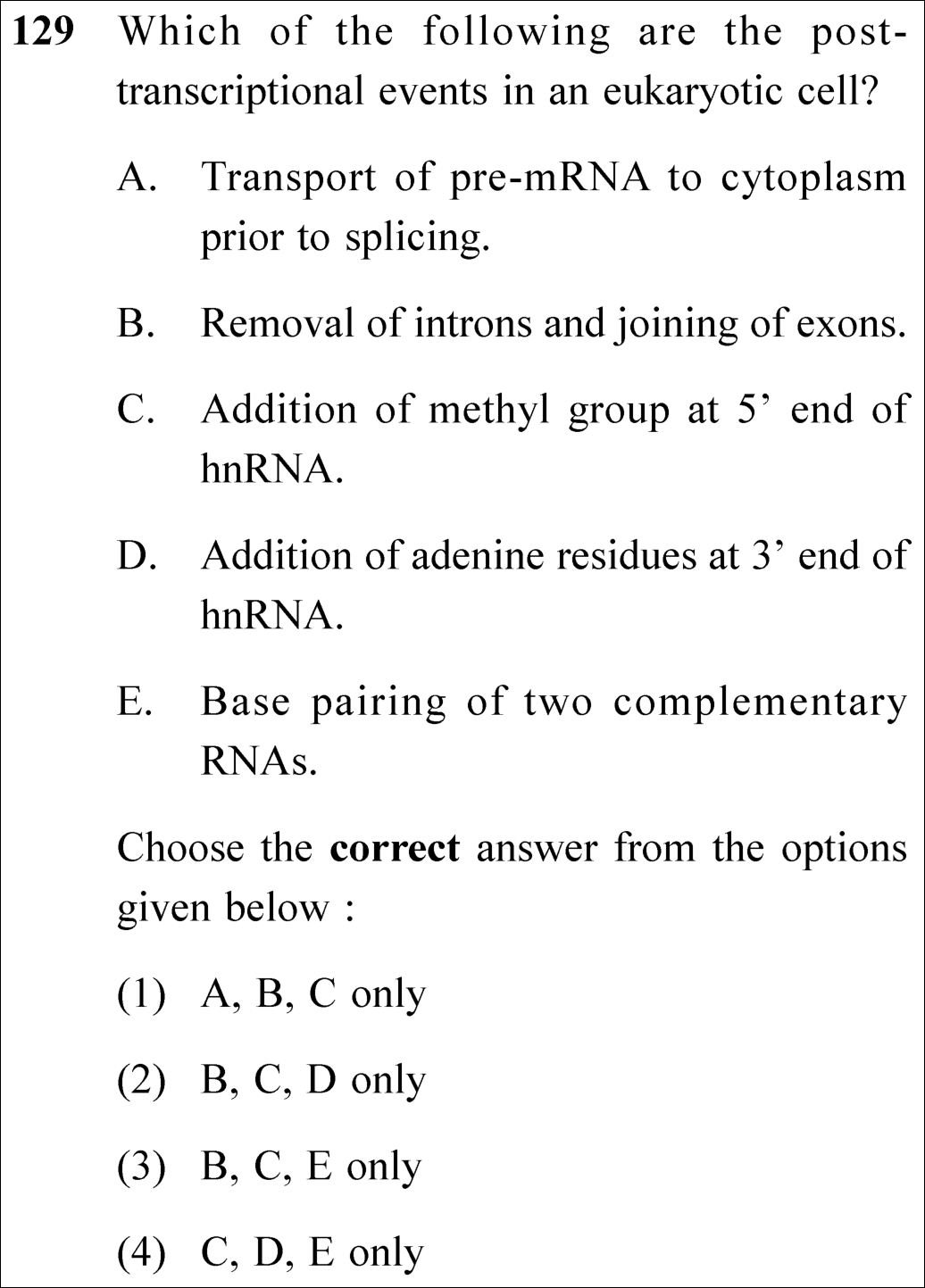
NEET 2025 · Q129 Medium
Official NEET 2025 Question 129 - Molecular Basis of Inheritance
1 A, B, C only
2 B, C, D only ✓ Key
3 B,C, E only
4 C, D, E only
💡 Verified Solution & 30-Second Hack
✓
Verified Against NTA Final Answer Key
Option (2) : B, C, D only
📚 Molecular Basis of Inheritance Medium
📋 Given Parameters & Problem Setup
Event A Transport of pre-mRNA to cytoplasm prior to splicing
Event B Removal of introns and joining of exons
Event C Addition of methyl group at 5' end of hnRNA
Event D Addition of adenine residues at 3' end of hnRNA
Event E Base pairing of two complementary RNAs
⚡

The 30-Second Exam Hall Shortcut: ⚡ Eukaryotic mRNA Processing Triad Fingerprint

⏱️ Save ~30 seconds

Post-transcriptional processing in eukaryotes consists of: 1. Splicing (Removal of introns/joining of exons, B); 2. Capping (5' methylguanosine triphosphate, C); 3. Tailing (3' poly-A tail, D)! Splicing occurs INSIDE nucleus, never in cytoplasm (A false)! B, C, D only!

1 Recall the three hallmark post-transcriptional events in eukaryotes:
2 - B: Splicing: Introns are removed and exons are joined in a defined order. [TRUE]
3 - C: Capping: Methyl guanosine triphosphate (methyl group) added to the 5'-end of hnRNA. [TRUE]
4 - D: Tailing: 200–300 adenylate residues added at the 3'-end. [TRUE]
5 - A: Pre-mRNA transported to cytoplasm prior to splicing? FALSE! Splicing occurs strictly IN THE NUCLEUS; only fully processed mature mRNA is exported to cytoplasm.
6 - E: Base pairing of two complementary RNAs is RNAi / dsRNA formation, not normal mRNA maturation.
7 Correct combination: B, C, D only (Option 2)!
8 Select Option (2)!
🛡️
Why You Can 100% Trust This Shortcut: tRNA Adapter Structure & Anticodon Arm (NCERT Biology · Molecular Basis of Inheritance: Cloverleaf secondary, inverted-L tertiary).
📐

Step-by-Step Rigorous Workflow & Mathematical Proof

Step 1

Complexity of Eukaryotic Primary Transcripts (hnRNA)

In eukaryotes, RNA Polymerase II transcribes heterogeneous nuclear RNA (hnRNA), which contains both coding exons and non-coding introns and is non-functional until post-transcriptional processing:

  • • Splicing (Event B): The non-coding introns are excised by spliceosomes and the coding exons are ligated together in a specific, defined sequence. This occurs entirely within the nucleoplasm.
  • • Capping (Event C): An unusual nucleotide, 7-methylguanosine triphosphate (m⁷G), is added to the 5'-end of the primary transcript. This cap protects the mRNA from exonucleases and assists in ribosome binding during translation.
  • • Tailing (Event D): Polyadenylation involves the template-independent enzymatic addition of 200–300 adenylate residues (poly-A tail) to the 3'-end of hnRNA.
Step 2

Evaluation of Distractor Statements A and E

Analyzing incorrect statements:

  • • Statement A claims "Transport of pre-mRNA to cytoplasm prior to splicing". Eukaryotic nuclear pore complexes enforce strict quality control: unspliced pre-mRNAs are retained within the nucleus until splicing and processing are complete. Only mature, fully spliced mRNA is exported to the cytoplasm.
  • • Statement E claims "Base pairing of two complementary RNAs". This is the mechanism of RNA interference (RNAi) or antisense regulation, not a regular step in eukaryotic mRNA maturation.
Step 3

Conclusion

The genuine post-transcriptional modification events are B (splicing), C (capping), and D (tailing). Hence, B, C, D only are correct.

Events=B (Splicing)+C (Capping)+D (Tailing)\text{Events} = B \text{ (Splicing)} + C \text{ (Capping)} + D \text{ (Tailing)}
⭐

360° Option Elimination Engine Key Feature

Diagnose every choice: Know exactly why the right option works and why distractors fail.

4-Option Deep Scan
1 A
✗ Incorrect
Verdict & Scientific Reason:

Incorrect. Statement A is false because splicing occurs inside the nucleus before cytoplasmic export.

⚠️
Student Fallacy (Why candidates pick this trap): Believing pre-mRNA is spliced in the cytoplasm.
2 B
✓ 100% Correct
Verdict & Scientific Reason:

100% correct. Accurately encompasses the classical triad of eukaryotic mRNA maturation: Splicing, Capping, and Polyadenylation.

💡
Why this is airtight: None; master-level knowledge of molecular genetics.
3 C
✗ Incorrect
Verdict & Scientific Reason:

Incorrect. Omits tailing (D) and includes double-stranded RNA formation (E).

⚠️
Student Fallacy (Why candidates pick this trap): Confusing post-transcriptional gene silencing (RNAi) with post-transcriptional mRNA processing.
4 D
✗ Incorrect
Verdict & Scientific Reason:

Incorrect. Omits splicing (B) and incorporates erroneous statement E.

⚠️
Student Fallacy (Why candidates pick this trap): Leaving out splicing as an essential maturation event.
⚠️

NTA Trap Alert: Subcellular Site of Splicing: Nucleus vs Cytoplasm

A critical conceptual rule in eukaryotic cell biology: transcription and RNA processing (splicing, capping, tailing) take place entirely inside the NUCLEUS. Translation occurs in the CYTOPLASM. Pre-mRNA is NEVER exported to cytoplasm prior to splicing!

🛡️ How to avoid the -1 mark: Remember: Process in the nucleus, translate in the cytoplasm.
📖

Core NEET Syllabus Standard

NEET Biology Core Syllabus · Molecular Basis of Inheritance Standard Benchmark
Core Scientific Principle Tested:

"Eukaryotic hnRNA undergoes splicing (intron removal), 5'-capping (methylguanosine), and 3'-polyadenylation (tailing) in the nucleus before export."

Syllabus Focus: Transcription · Post-Transcriptional Processing in Eukaryotes
✓ Core NEET UG Syllabus Anchor Syllabus & Academic Standards ↗
SCT: Splicing (B), Capping (C), Tailing (D) = The Eukaryotic Processing Trio!
NEET 2025 · Q134 Easy
Official NEET 2025 Question 134 - Molecular Basis of Inheritance
1
2
3 ✓ Key
4
💡 Verified Solution & 30-Second Hack
✓
Verified Against NTA Final Answer Key
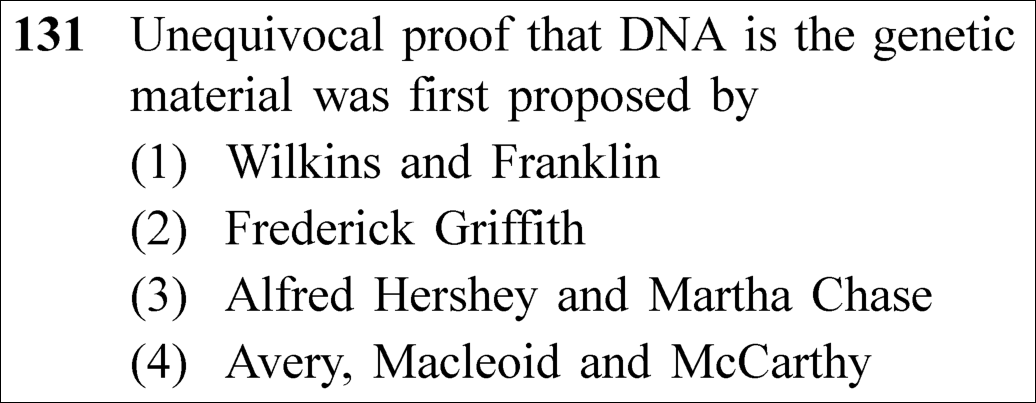
Option (3) : A-IV, B-III, C-I, D-II
📚 Molecular Basis of Inheritance Easy
📋 Given Parameters & Problem Setup
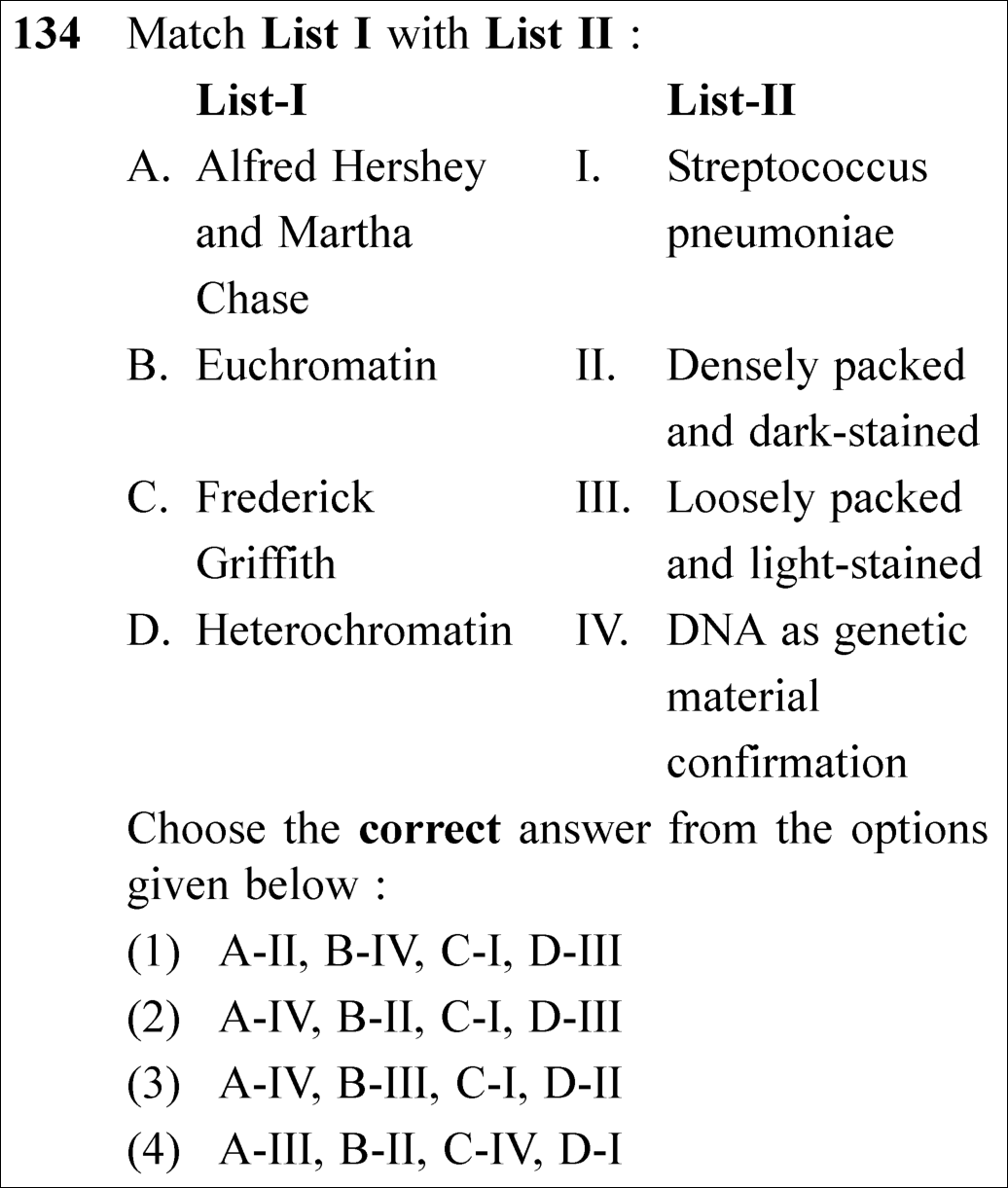
List-I A. Alfred Hershey and Martha Chase, B. Euchromatin, C. Frederick Griffith, D. Heterochromatin
List-II I. Streptococcus pneumoniae, II. Densely packed and dark-stained, III. Loosely packed and light-stained, IV. DNA as genetic material confirmation
⚡

The 30-Second Exam Hall Shortcut: ⚡ Molecular Genetics Match Fingerprint

⏱️ Save ~30 seconds

Hershey-Chase = DNA confirmation using ³²P/³⁵S (IV); Euchromatin = Loosely packed, light-stained, active (III); Griffith = Transformation in Streptococcus pneumoniae (I); Heterochromatin = Densely packed, dark-stained, inactive (II)!

1 Match each scientist and chromatin structure instantly:
2 - Alfred Hershey and Martha Chase (1952): Unequivocal confirmation that DNA is the genetic material using bacteriophage T2 (A -> IV).
3 - Euchromatin: Loosely coiled region of chromatin, stains light, transcriptionally active (B -> III).
4 - Frederick Griffith (1928): Transformation experiments with Streptococcus pneumoniae (Diplococcus) in mice (C -> I).
5 - Heterochromatin: Densely packed chromatin, stains dark, transcriptionally inactive (D -> II).
6 Combined code: A-IV, B-III, C-I, D-II -> Option (3)!
7 Solved in under 10 seconds!
🛡️
Why You Can 100% Trust This Shortcut: DNA Replication Machinery & Okazaki Fragments (NCERT Biology · Molecular Basis of Inheritance: DNA polymerase continuous vs discontinuous synthesis).
📐

Step-by-Step Rigorous Workflow & Mathematical Proof

Step 1

Review of the Scientists and Their Discoveries

Foundational experiments in the discovery and proof of the genetic material:

  • • Frederick Griffith (1928): Conducted experiments with *Streptococcus pneumoniae* (bacteria responsible for pneumonia). Discovered that non-virulent R strain was transformed into virulent S strain by heat-killed S bacteria (Transforming Principle). Hence, C matches I.
  • • Alfred Hershey and Martha Chase (1952): Provided the unequivocal, definitive proof that DNA is the genetic material. Worked with bacteriophage T2 and *E. coli*, labeling viral DNA with ³²P and viral protein capsid with ³⁵S. Hence, A matches IV.
Step 2

Chromatin Organization in Eukaryotic Nucleus

Cytological differentiation of interphase chromatin:

  • • Euchromatin: In a typical nucleus, some regions of chromatin are loosely packed and stain light with basic dyes. Euchromatin is transcriptionally active. Hence, B matches III.
  • • Heterochromatin: The chromatin regions that are more densely packed and stain dark are called heterochromatin. Heterochromatin is transcriptionally inactive. Hence, D matches II.
Step 3

Assembling the Matching Matrix

Combining the verified pairings:

  • • A -> IV (DNA as genetic material confirmation)
  • • B -> III (Loosely packed and light-stained)
  • • C -> I (Streptococcus pneumoniae)
  • • D -> II (Densely packed and dark-stained)
Step 4

Conclusion

The unambiguous combination is A-IV, B-III, C-I, D-II, matching Option (3).

Matching: A-IV,  B-III,  C-I,  D-II\text{Matching: } A\text{-IV}, \; B\text{-III}, \; C\text{-I}, \; D\text{-II}
⭐

360° Option Elimination Engine Key Feature

Diagnose every choice: Know exactly why the right option works and why distractors fail.

4-Option Deep Scan
1 A
✗ Incorrect
Verdict & Scientific Reason:

Incorrect. Assigns densely packed to Hershey-Chase and DNA confirmation to euchromatin.

⚠️
Student Fallacy (Why candidates pick this trap): Scrambling historical experiments with structural terms.
2 B
✗ Incorrect
Verdict & Scientific Reason:

Incorrect. Inverts the staining and packing states of euchromatin (III) and heterochromatin (II).

⚠️
Student Fallacy (Why candidates pick this trap): Confusing euchromatin (light/loose) with heterochromatin (dark/dense).
3 C
✓ 100% Correct
Verdict & Scientific Reason:

100% correct. Accurately links both landmark genetic experiments and the two cytological chromatin states.

💡
Why this is airtight: None; textbook mastery.
4 D
✗ Incorrect
Verdict & Scientific Reason:

Incorrect. Scrambles scientists and chromatin properties completely.

⚠️
Student Fallacy (Why candidates pick this trap): Random guessing.
⚠️

NTA Trap Alert: Euchromatin vs Heterochromatin Inversion

A frequent stumbling block: EUchromatin is "TRUE" chromatin -> loose, light-staining, transcriptionally active. HETEROchromatin is densely packed, dark-staining, transcriptionally silent.

🛡️ How to avoid the -1 mark: Eu = "Good/Active" (Loose & Light); Hetero = "Heavy" (Dense & Dark).
📖

Core NEET Syllabus Standard

NEET Biology Core Syllabus · Molecular Basis of Inheritance Standard Benchmark
Core Scientific Principle Tested:

"Hershey-Chase proved DNA is the genetic material; Griffith used Streptococcus; euchromatin is light/loose, and heterochromatin is dark/dense."

Syllabus Focus: The Genetic Material & Packaging of DNA Helix
✓ Core NEET UG Syllabus Anchor Syllabus & Academic Standards ↗
H-C confirms DNA (IV), Griffith did Strep (I), Eu is Light (III), Hetero is Dark (II)!
NEET 2025 · Q146 Easy
Official NEET 2025 Question 146 - Molecular Basis of Inheritance
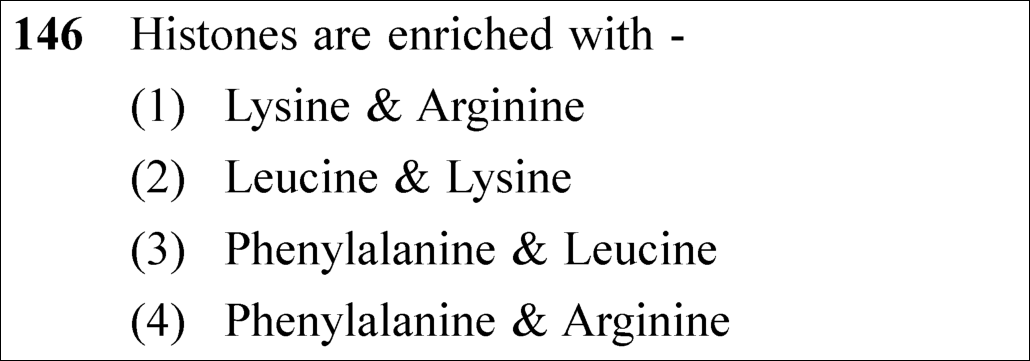
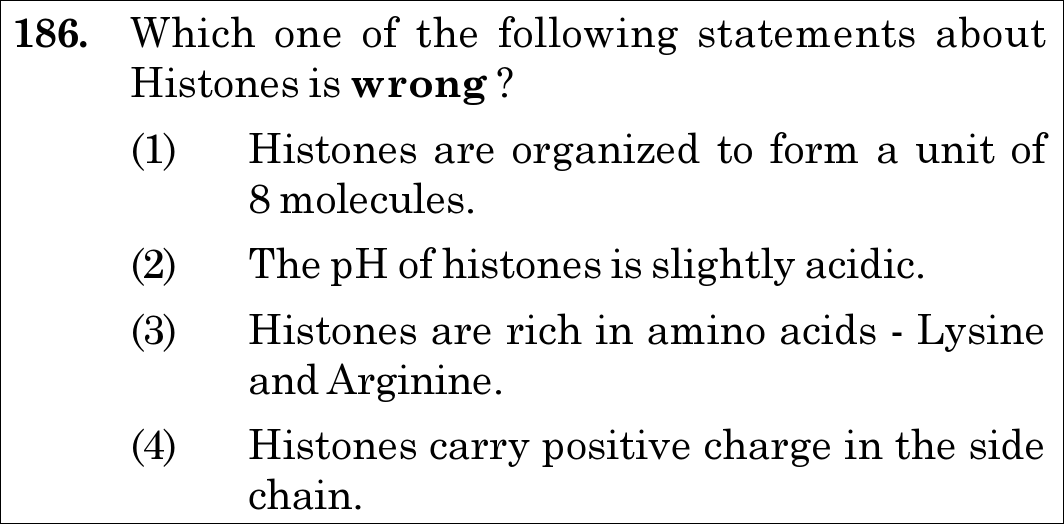
1 Lysine & Arginine ✓ Key
2 Leucine & Lysine
3 Phenylalanine & Leucine
4 Phenylalanine & Arginine
💡 Verified Solution & 30-Second Hack
✓
Verified Against NTA Final Answer Key
Option (1) : Lysine & Arginine
📚 Molecular Basis of Inheritance Easy
📋 Given Parameters & Problem Setup
Target Biomolecule Histones (basic chromosomal proteins in eukaryotic chromatin)
Target Characteristic Enriched amino acid residues
⚡

The 30-Second Exam Hall Shortcut: ⚡ Histone Charge Fingerprint

⏱️ Save ~15 seconds

DNA is negatively charged (acidic due to phosphates); to wrap it, histones must be POSITIVELY charged (basic)! Positively charged basic amino acids = LYSINE and ARGININE!

1 Recall NCERT Section 6.2.1 (Packaging of DNA Helix):
2 - "Histones are rich in the basic amino acid residues lysines and arginines."
3 - "Both the amino acid residues carry positive charges in their side chains."
4 - Histones organize to form a unit of eight molecules called histone octamer (H2A, H2B, H3, H4 pairs) wrapped by 200 bp of DNA to form a nucleosome.
5 Direct answer: Lysine & Arginine!
6 Select Option (1)!
🛡️
Why You Can 100% Trust This Shortcut: Avery-MacLeod-McCarty Transformation Experiment (NCERT Biology · Molecular Basis of Inheritance: DNase destroys transforming principle).
📐

Step-by-Step Rigorous Workflow & Mathematical Proof

Step 1

The Challenge of Eukaryotic DNA Compaction

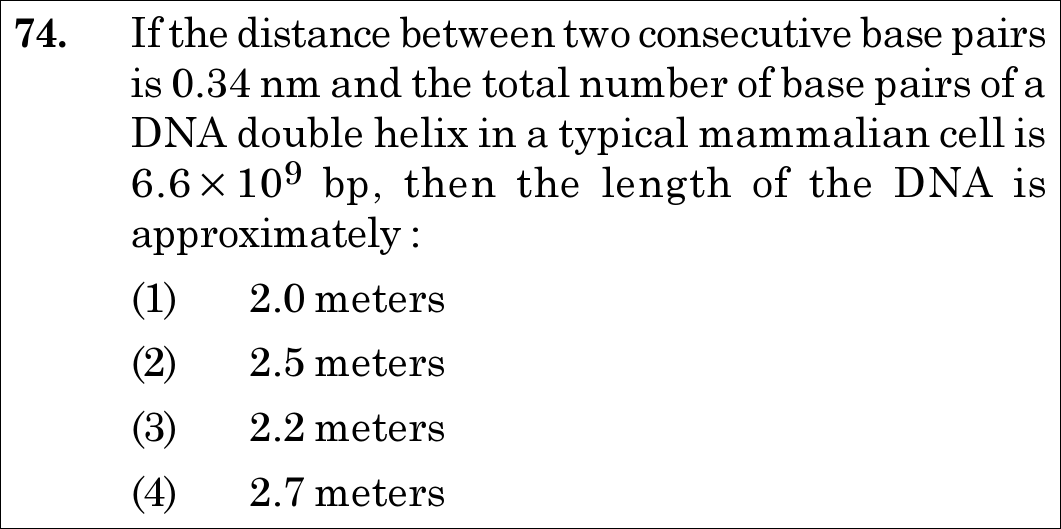
Human diploid cells contain approximately 2.2 meters of DNA (6.6×1096.6 \times 10^9 bp) that must be condensed to fit inside a nucleus of ~10 μ\mum diameter:

  • • DNA possesses a net negative electrical charge because of the phosphate groups in its phosphodiester backbone.
  • • Packaging is facilitated by specialized basic proteins called histones.
Step 2

Chemical Nature of Histone Proteins

Why histones carry a high positive charge density:

  • • Histone proteins are enriched with the basic amino acids Lysine and Arginine.
  • • At physiological pH (7.4), the amino side chains of lysine (epsilonepsilon-amino group) and arginine (guanidino group) are protonated (−NH3+-\text{NH}_3^+ and −C(NH2)2+-\text{C(NH}_2)_2^+), giving histones a strong positive charge.
  • • Electrostatic attraction between the positively charged basic histone octamer and negatively charged acidic DNA forms the nucleosome core particle.
Step 3

Conclusion

Histones are specifically enriched with the basic amino acids Lysine & Arginine, corresponding to Option (1).

Histone Enrichment=Lysine (Lys) & Arginine (Arg)\text{Histone Enrichment} = \text{Lysine (Lys) \& Arginine (Arg)}
⭐

360° Option Elimination Engine Key Feature

Diagnose every choice: Know exactly why the right option works and why distractors fail.

4-Option Deep Scan
1 A
✓ 100% Correct
Verdict & Scientific Reason:

100% correct. Direct verbatim NCERT fact: histones are rich in basic amino acid residues lysines and arginines.

💡
Why this is airtight: None; pristine cytology and molecular biology knowledge.
2 B
✗ Incorrect
Verdict & Scientific Reason:

Incorrect. Leucine is a non-polar, hydrophobic neutral amino acid, not an enriched basic constituent of histones.

⚠️
Student Fallacy (Why candidates pick this trap): Confusing basic lysine with neutral hydrophobic leucine.
3 C
✗ Incorrect
Verdict & Scientific Reason:

Incorrect. Both are non-polar hydrophobic amino acids that carry no net positive charge.

⚠️
Student Fallacy (Why candidates pick this trap): Random selection of hydrophobic amino acids.
4 D
✗ Incorrect
Verdict & Scientific Reason:

Incorrect. Phenylalanine is an aromatic hydrophobic amino acid, not a basic histone constituent.

⚠️
Student Fallacy (Why candidates pick this trap): Pairing a correct basic amino acid (arginine) with an incorrect aromatic one (phenylalanine).
⚠️

NTA Trap Alert: Lysine/Arginine vs Leucine/Histidine

Histone sounds like Histidine, but histones are primarily enriched in LYSINE and ARGININE. Leucine is a neutral hydrophobic amino acid found in leucine zippers, NOT histone core proteins!

🛡️ How to avoid the -1 mark: Remember: Histones L-A-P up negative DNA: Lysine and Arginine (Positive).
📖

Core NEET Syllabus Standard

NEET Biology Core Syllabus · Molecular Basis of Inheritance Standard Benchmark
Core Scientific Principle Tested:

"Histones are basic proteins rich in the positively charged basic amino acids lysine and arginine."
Syllabus Focus: Packaging of DNA Helix · Nucleosome
✓ Core NEET UG Syllabus Anchor Syllabus & Academic Standards ↗
Histones LOVE Acidity: L-A = Lysine & Arginine wrap DNA!
NEET 2025 · Q163 Easy
Official NEET 2025 Question 163 - Molecular Basis of Inheritance
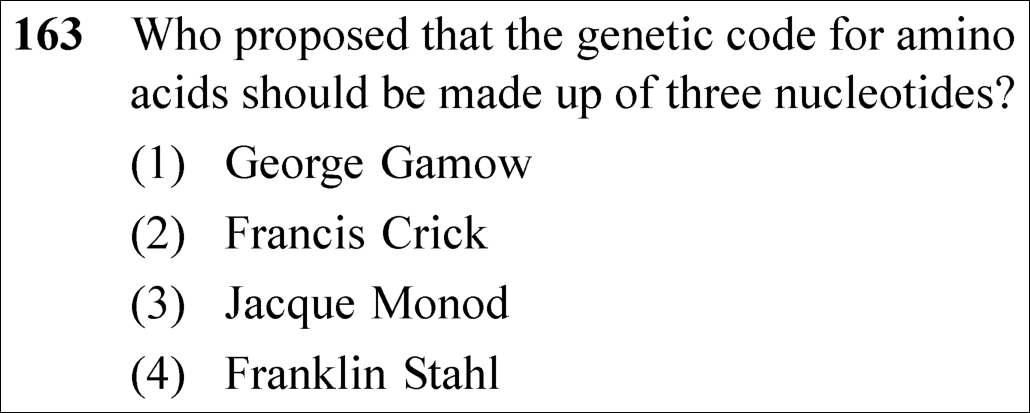
1 George Gamow ✓ Key
2 Francis Crick
3 Jacque Monod
4 Franklin Stahl
💡 Verified Solution & 30-Second Hack
✓
Verified Against NTA Final Answer Key
Option (1) : George Gamow
📚 Molecular Basis of Inheritance Easy
📋 Given Parameters & Problem Setup
Hypothesis The genetic code for amino acids must be composed of three nucleotides (triplet code)
Target Scientist Scientist / physicist who formulated this theoretical proposition
⚡

The 30-Second Exam Hall Shortcut: ⚡ Triplet Code Proposal Fingerprint

⏱️ Save ~15 seconds

George Gamow, a physicist, mathematically proposed the TRIPLET code: 4 bases combined as triplets give 4³ = 64 codons, enough to code for all 20 amino acids! Gamow proposed it!

1 Recall NCERT Section 6.6 (Genetic Code) verbatim:
2 - "It was George Gamow, a physicist, who argued that since there are only 4 bases and if they have to code for 20 amino acids, the code should constitute a combination of bases."
3 - "He suggested that in order to code for all the 20 amino acids, the code should be made up of three nucleotides. This was a very bold proposition, because a permutation combination of 4³ (4 × 4 × 4) would generate 64 codons, generating many more codons than required."
4 - Direct answer: George Gamow!
5 Select Option (1) George Gamow!
🛡️
Why You Can 100% Trust This Shortcut: Lac Operon Genetic Circuit Regulation (NCERT Biology · Molecular Basis of Inheritance: Allolactose inducer binds repressor).
📐

Step-by-Step Rigorous Workflow & Mathematical Proof

Step 1

The Coding Problem in Molecular Biology

After the discovery of the double helix structure of DNA, deciphering how a sequence of 4 nucleotide bases (A, U, G, C) directs the synthesis of proteins containing 20 distinct amino acids emerged as the central challenge:

  • • If a codon were a singlet (41=44^1 = 4), only 4 amino acids could be specified.
  • • If a codon were a doublet (42=164^2 = 16), only 16 amino acids could be specified, which is insufficient for 20 amino acids.
Step 2

George Gamow's Theoretical Deduction

The physical and mathematical argument:

  • • George Gamow (a theoretical physicist and cosmologist) proposed that the genetic code must be a triplet of nucleotides.
  • • A triplet code generates 43=644^3 = 64 possible codons, providing ample capacity to specify all 20 amino acids with degeneracy.
  • • Subsequent biochemical experiments by Har Gobind Khorana, Marshall Nirenberg, and Severo Ochoa experimentally verified Gamow's triplet hypothesis.
Step 3

Profiles of Distractor Scientists

Contributions of the other scientists listed:

  • • Francis Crick: Proposed the Central Dogma, adaptor hypothesis (tRNA), and comma-less reading frame.
  • • Jacques Monod (with François Jacob): Elucidated the operon model (*lac* operon) of transcriptional gene regulation.
  • • Franklin Stahl (with Matthew Meselson): Proved the semi-conservative replication of DNA using 15N^{15}\text{N} isotope labeling.
Step 4

Conclusion

George Gamow is the scientist who proposed that the genetic code must be made up of three nucleotides.

43=64 codons for 20 amino acids  ⟹  Proposed by George Gamow4^3 = 64 \text{ codons for } 20 \text{ amino acids} \implies \text{Proposed by George Gamow}
⭐

360° Option Elimination Engine Key Feature

Diagnose every choice: Know exactly why the right option works and why distractors fail.

4-Option Deep Scan
1 A
✓ 100% Correct
Verdict & Scientific Reason:

100% correct. Direct verbatim NCERT fact: George Gamow, a physicist, suggested the triplet code (4³ = 64 codons).

💡
Why this is airtight: None; textbook mastery of scientific history.
2 B
✗ Incorrect
Verdict & Scientific Reason:

Incorrect. Crick proposed the adaptor hypothesis for tRNA and the central dogma, but Gamow first proposed the triplet combination.

⚠️
Student Fallacy (Why candidates pick this trap): Attributing all genetic code theories to Crick.
3 C
✗ Incorrect
Verdict & Scientific Reason:

Incorrect. Monod worked on the lac operon with Jacob.

⚠️
Student Fallacy (Why candidates pick this trap): Confusing gene regulation with genetic code proposal.
4 D
✗ Incorrect
Verdict & Scientific Reason:

Incorrect. Stahl demonstrated semi-conservative DNA replication with Meselson.

⚠️
Student Fallacy (Why candidates pick this trap): Confusing replication experiments with code proposal.
⚠️

NTA Trap Alert: Gamow (Proposal) vs Nirenberg/Khorana (Proof)

George Gamow PROPOSED the triplet code mathematically. Marshall Nirenberg and Har Gobind Khorana DECIPHERED and PROVED the code biochemically. The question asks who PROPOSED it -> Gamow!

🛡️ How to avoid the -1 mark: Proposed = George Gamow (Physicist); Deciphered = Nirenberg & Khorana.
📖

Core NEET Syllabus Standard

NEET Biology Core Syllabus · Molecular Basis of Inheritance Standard Benchmark
Core Scientific Principle Tested:

"George Gamow proposed that the genetic code should be made up of three nucleotides to code for 20 amino acids."

Syllabus Focus: The Genetic Code · Theoretical Basis
✓ Core NEET UG Syllabus Anchor Syllabus & Academic Standards ↗
GAMOW = Genius Math on 4³ = 64 Triplet Codons!
NEET 2025 · Q174 Easy
Official NEET 2025 Question 174 - Molecular Basis of Inheritance
1
2
3 ✓ Key
4
💡 Verified Solution & 30-Second Hack
✓
Verified Against NTA Final Answer Key
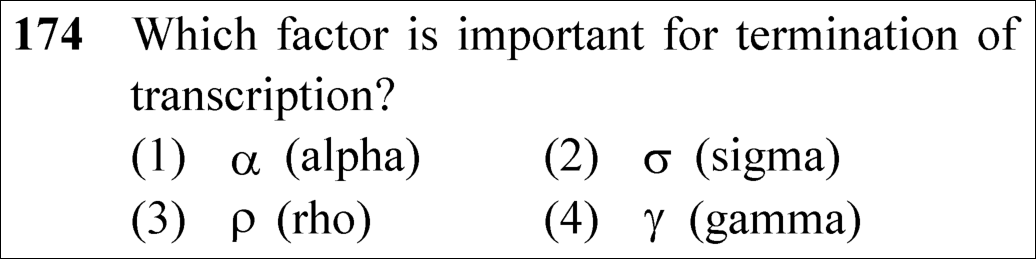
Option (3) : ρ (rho)
📚 Molecular Basis of Inheritance Easy
📋 Given Parameters & Problem Setup
Process Bacterial transcription termination
Target Molecular Factor Protein factor responsible for terminating RNA synthesis
⚡

The 30-Second Exam Hall Shortcut: ⚡ Bacterial Transcription Factors Fingerprint

⏱️ Save ~10 seconds

Sigma (σ) factor initiates transcription! Rho (ρ) factor terminates transcription! Rho = RHO-cks the enzyme off the DNA (TERMINATION)!

1 Recall NCERT Section 6.5.2 (Transcription in Prokaryotes) verbatim:
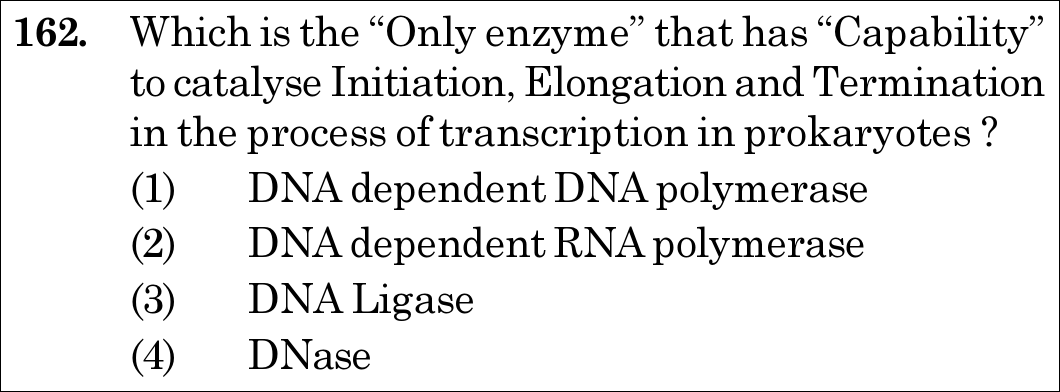
2 - In bacteria, a single DNA-dependent RNA polymerase catalyzes transcription of all three types of RNA.
3 - "It associates transiently with initiation-factor (σ) and termination-factor (ρ) to initiate and terminate the transcription, respectively."
4 - Initiation factor = σ\sigma (sigma).
5 - Termination factor = ρ\rho (rho).
6 Direct answer: ρ\rho (rho)!
7 Select Option (3) ρ\rho (rho)!
🛡️
Why You Can 100% Trust This Shortcut: Genetic Code Characteristics (NCERT Biology · Molecular Basis of Inheritance: Triplet, degenerate, unambiguous, non-overlapping).
📐

Step-by-Step Rigorous Workflow & Mathematical Proof

Step 1

Catalytic Activity of Bacterial RNA Polymerase Core Enzyme

Bacterial RNA polymerase core enzyme (alpha_2 eta eta' omega) is catalytically competent for chain elongation but cannot recognize promoters or terminate faithfully on its own:

  • • To ensure stage-specific regulation, the core enzyme associates reversibly with auxiliary protein factors.
  • • Initiation: The core enzyme binds the sigma (σ\sigma) factor to form the holoenzyme, enabling sequence-specific promoter recognition at the −10-10 (Pribnow box) and −35-35 consensus sequences.
Step 2

Mechanism of Transcription Termination by Rho (ρ) Factor

How RNA synthesis is brought to an end:

  • • Elongation proceeds until the polymerase reaches a terminator sequence.
  • • In rho-dependent termination, the termination factor rho (ρ\rho) (an ATP-dependent hexameric RNA helicase) binds to a C-rich *rut* site on the nascent RNA transcript.
  • • Rho migrates along the RNA transcript toward the stalled RNA polymerase.
  • • Upon contacting the transcription elongation complex, Rho unwinds the RNA-DNA hybrid within the transcription bubble, releasing the newly synthesized nascent RNA chain and dissociating RNA polymerase from the template DNA.
Step 3

Conclusion

The factor important for the termination of transcription is ρ\rho (rho), corresponding to Option (3).

Initiation Factor=σ(sigma),Termination Factor=ρ(rho)\text{Initiation Factor} = \sigma (\text{sigma}), \quad \text{Termination Factor} = \rho (\text{rho})
⭐

360° Option Elimination Engine Key Feature

Diagnose every choice: Know exactly why the right option works and why distractors fail.

4-Option Deep Scan
1 A
✗ Incorrect
Verdict & Scientific Reason:

Incorrect. The α\alpha subunit is a structural core subunit responsible for enzyme assembly and upstream promoter interaction, not a termination factor.

⚠️
Student Fallacy (Why candidates pick this trap): Confusing core enzyme subunits with transient regulatory factors.
2 B
✗ Incorrect
Verdict & Scientific Reason:

Incorrect. Sigma (σ\sigma) is the INITIATION factor, the exact opposite of termination.

⚠️
Student Fallacy (Why candidates pick this trap): Confusing initiation factor with termination factor.
3 C
✓ 100% Correct
Verdict & Scientific Reason:

100% correct. Direct verbatim NCERT fact: termination factor is ρ\rho (rho).

💡
Why this is airtight: None; textbook mastery.
4 D
✗ Incorrect
Verdict & Scientific Reason:

Incorrect. Gamma is not a transcription factor in prokaryotic RNA synthesis.

⚠️
Student Fallacy (Why candidates pick this trap): Arbitrary selection of a Greek letter.
⚠️

NTA Trap Alert: Sigma vs Rho Factor Role Inversion

The two famous Greek factors in transcription: σ\sigma = START (Initiation); ρ\rho = RELEASE (Termination). Never swap them!

🛡️ How to avoid the -1 mark: Sigma = Start (Initiation); Rho = Release/Halt (Termination).
📖

Core NEET Syllabus Standard

NEET Biology Core Syllabus · Molecular Basis of Inheritance Standard Benchmark
Core Scientific Principle Tested:

"RNA polymerase transiently associates with initiation-factor (σ) and termination-factor (ρ) to initiate and terminate transcription."

Syllabus Focus: Transcription · Process of Transcription in Bacteria
✓ Core NEET UG Syllabus Anchor Syllabus & Academic Standards ↗
Sigma = START; Rho = RELEASE (Termination)!
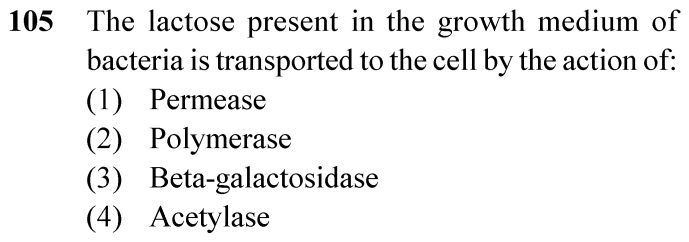
NEET 2024 · Q105 Easy
Official NEET 2024 Question 105 - Molecular Basis of Inheritance
1 ✓ Key
2
3
4
💡 Verified Solution & 30-Second Hack
✓
Verified Against NTA Final Answer Key
Option (1) : Permease
📚 Molecular Basis of Inheritance Easy
📋 Given Parameters & Problem Setup
Organism Escherichia coli
Process Entry/transport of lactose from medium into bacterial cell
⚡

The 30-Second Exam Hall Shortcut: ⚡ Lac Operon Gene-Enzyme Mnemonic (Z-Y-A -> B-P-T)

⏱️ Save ~20 seconds

z = β-galactosidase (hydrolysis), y = permease (membrane permeability/entry), a = transacetylase (acetyl transfer). Permease allows entry!

1 z gene -> β-galactosidase
2 y gene -> Permease: increases membrane permeability to β-galactosides (lactose).
3 a gene -> Transacetylase
4 The question asks for the enzyme responsible for transporting lactose into bacterial cells -> Permease -> Option (1) / A.
🛡️
Why You Can 100% Trust This Shortcut: NCERT Biology · Molecular Basis of Inheritance (The Lac Operon Structural Genes)
📐

Step-by-Step Rigorous Workflow & Mathematical Proof

Step 1

Examine the Lac Operon Polycistronic Structural Genes

The lac operon consists of three structural genes: z, y, and a. Each encodes a specific polypeptide essential for lactose metabolism in E. coli.

Step 2

Define the Role of Each Protein

The z gene codes for beta-galactosidase, which cleaves lactose into galactose and glucose. The y gene codes for permease, a transmembrane protein that increases cell permeability to beta-galactosides, allowing lactose uptake. The a gene encodes a transacetylase.

Step 3

Conclude Transport Function

Transport of lactose across the bacterial cell membrane into the cytoplasm is strictly mediated by lactose permease.

⭐

360° Option Elimination Engine Key Feature

Diagnose every choice: Know exactly why the right option works and why distractors fail.

4-Option Deep Scan
1 (1)
✓ 100% Correct
Verdict & Scientific Reason:

Permease increases membrane permeability to beta-galactosides, enabling lactose uptake into E. coli.

💡
Why this is airtight: None.
2 (2)
✗ Incorrect
Verdict & Scientific Reason:

RNA polymerase carries out transcription; DNA polymerase carries out replication.

⚠️
Student Fallacy (Why candidates pick this trap): RNA polymerase carries out transcription; DNA polymerase carries out replication.
3 (3)
✗ Incorrect
Verdict & Scientific Reason:

Beta-galactosidase hydrolyzes lactose into glucose and galactose intracellularly.

⚠️
Student Fallacy (Why candidates pick this trap): Beta-galactosidase hydrolyzes lactose into glucose and galactose intracellularly.
4 (4)
✗ Incorrect
Verdict & Scientific Reason:

Transacetylase transfers an acetyl group from acetyl-CoA to beta-galactosides.

⚠️
Student Fallacy (Why candidates pick this trap): Transacetylase transfers an acetyl group from acetyl-CoA to beta-galactosides.
⚠️

NTA Trap Alert: Hydrolysis vs Transport Confusion

Selecting beta-galactosidase because it is the most well-known enzyme of the lac operon.

🛡️ How to avoid the -1 mark: Focus on the physical action: "transported into the cell" = Permease (y gene).
📖

Core NEET Syllabus Standard

Biology Core Botany · Molecular Basis of Inheritance Standard Benchmark
Core Scientific Principle Tested:

"The y gene codes for permease, which increases permeability of the cell to beta-galactosides. A very low level of expression of lac operon has to be present in the cell all the time, otherwise lactose cannot enter the cells."

Syllabus Focus: Lac Operon Structural Genes and Lactose Permease Function
✓ Core NEET UG Syllabus Anchor Syllabus & Academic Standards ↗
NEET 2024 · Q108 Easy
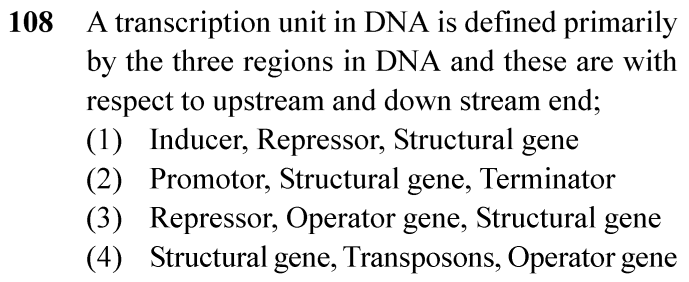
Official NEET 2024 Question 108 - Molecular Basis of Inheritance
1
2 ✓ Key
3
4
💡 Verified Solution & 30-Second Hack
✓
Verified Against NTA Final Answer Key
Option (2) : Promoter, Structural gene, Terminator
📚 Molecular Basis of Inheritance Easy
📋 Given Parameters & Problem Setup
Structure Transcription unit in DNA
Directional Orientation From upstream (5') to downstream (3') with respect to coding strand
⚡

The 30-Second Exam Hall Shortcut: ⚡ Standard Transcription Sequence

⏱️ Save ~20 seconds

Transcription unit order is always: Promoter (upstream) -> Structural gene (middle) -> Terminator (downstream)!

1 Every transcription unit is defined by three structural regions:
2 Promoter: located towards 5'-end (upstream) of coding strand.
3 Structural gene: central coding segment transcribed into RNA.
4 Terminator: located towards 3'-end (downstream) of coding strand.
5 Sequence from upstream to downstream: Promoter, Structural gene, Terminator -> Option (2) / B.
🛡️
Why You Can 100% Trust This Shortcut: NCERT Biology · Molecular Basis of Inheritance (Transcription Unit)
📐

Step-by-Step Rigorous Workflow & Mathematical Proof

Step 1

Define the Transcription Unit

A transcription unit in DNA is defined primarily by three regions: a Promoter, the Structural gene, and a Terminator.

Step 2

Orient Relative to Coding Strand Reference Frame

By convention, positions of sequence elements are defined with respect to the coding strand (5' to 3'). The promoter is situated towards the 5'-end (upstream). It provides the binding site for RNA polymerase. The structural gene lies between the promoter and terminator. The terminator is situated towards the 3'-end (downstream) and defines the end of transcription.

Step 3

Verify Directional Alignment

Reading from upstream to downstream yields: Promoter -> Structural gene -> Terminator.

⭐

360° Option Elimination Engine Key Feature

Diagnose every choice: Know exactly why the right option works and why distractors fail.

4-Option Deep Scan
1 (1)
✗ Incorrect
Verdict & Scientific Reason:

Structural gene is in the middle, not upstream of the promoter.

⚠️
Student Fallacy (Why candidates pick this trap): Structural gene is in the middle, not upstream of the promoter.
2 (2)
✓ 100% Correct
Verdict & Scientific Reason:

Correct canonical sequence from upstream (5') to downstream (3').

💡
Why this is airtight: None.
3 (3)
✗ Incorrect
Verdict & Scientific Reason:

Terminator is downstream at the 3'-end, not the initiating upstream element.

⚠️
Student Fallacy (Why candidates pick this trap): Terminator is downstream at the 3'-end, not the initiating upstream element.
4 (4)
✗ Incorrect
Verdict & Scientific Reason:

Structural gene is transcribed before transcription terminates at the terminator.

⚠️
Student Fallacy (Why candidates pick this trap): Structural gene is transcribed before transcription terminates at the terminator.
⚠️

NTA Trap Alert: Reference Strand Confusion

Thinking with respect to the template strand instead of the standard coding strand reference.

🛡️ How to avoid the -1 mark: All positional conventions (upstream 5', downstream 3') are established relative to the coding strand.
📖

Core NEET Syllabus Standard

Biology Core Botany · Molecular Basis of Inheritance Standard Benchmark
Core Scientific Principle Tested:

"A transcription unit in DNA is defined primarily by the three regions: (i) A Promoter (ii) The Structural gene (iii) A Terminator. The promoter is said to be located towards 5'-end (upstream) of the structural gene (the reference is made with respect to the polarity of coding strand)."

Syllabus Focus: Components of a Transcription Unit: Upstream to Downstream Order
✓ Core NEET UG Syllabus Anchor Syllabus & Academic Standards ↗
NEET 2024 · Q147 Easy
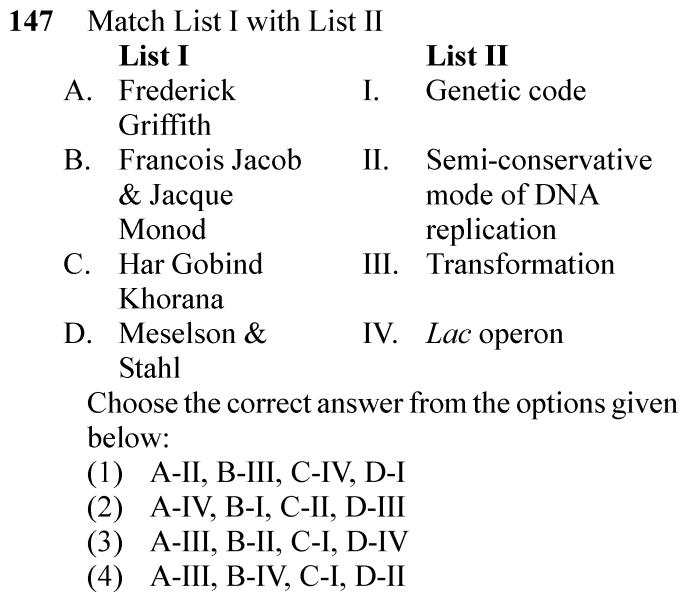
Official NEET 2024 Question 147 - Molecular Basis of Inheritance
1
2
3
4 ✓ Key
💡 Verified Solution & 30-Second Hack
✓
Verified Against NTA Final Answer Key
Option (4) : A-III, B-IV, C-I, D-II
📚 Molecular Basis of Inheritance Easy
📋 Given Parameters & Problem Setup
List I (Scientists) A: Frederick Griffith; B: Francois Jacob & Jacque Monod; C: Har Gobind Khorana; D: Meselson & Stahl
List II (Milestone Discoveries) I: Genetic code; II: Semi-conservative mode of DNA replication; III: Transformation; IV: Lac operon
⚡

The 30-Second Exam Hall Shortcut: ⚡ Molecular Genetics Pioneers Match

⏱️ Save ~25 seconds

Griffith = Transformation in mice (III); Jacob & Monod = Lac operon (IV); Khorana = Genetic code synthesis (I); Meselson & Stahl = Semi-conservative DNA replication (II)! Match: A-III, B-IV, C-I, D-II!

1 A. Frederick Griffith (1928): Transforming principle in Streptococcus pneumoniae (III).
2 B. Francois Jacob & Jacques Monod (1961): First elucidated transcriptionally regulated system, the Lac operon (IV).
3 C. Har Gobind Khorana: Developed chemical method for synthesizing defined RNA homopolymers/copolymers to decipher Genetic code (I).
4 D. Meselson & Stahl (1958): Proved semi-conservative DNA replication using 15N in E. coli (II).
5 Matching order: A-III, B-IV, C-I, D-II -> Option (4) / D.
🛡️
Why You Can 100% Trust This Shortcut: NCERT Biology · Molecular Basis of Inheritance (Milestones in Molecular Genetics)
📐

Step-by-Step Rigorous Workflow & Mathematical Proof

Step 1

Match Transformation and Operon Model

Frederick Griffith conducted transformation experiments with Streptococcus pneumoniae, demonstrating transfer of genetic virulence (A -> III). Francois Jacob (geneticist) and Jacques Monod (biochemist) elucidated the lac operon mechanism in E. coli (B -> IV).

Step 2

Match Genetic Code and Semi-Conservative Replication

Har Gobind Khorana developed chemical synthesis of RNA molecules with defined combinations of bases to crack the genetic code (C -> I). Matthew Meselson and Franklin Stahl performed equilibrium density gradient centrifugation with heavy isotope 15N in E. coli, proving semi-conservative DNA replication (D -> II).

Step 3

Select Final Match

A-III, B-IV, C-I, D-II matches Option (4).

⭐

360° Option Elimination Engine Key Feature

Diagnose every choice: Know exactly why the right option works and why distractors fail.

4-Option Deep Scan
1 (1)
✗ Incorrect
Verdict & Scientific Reason:

Mismatches Griffith with Semi-conservative replication.

⚠️
Student Fallacy (Why candidates pick this trap): Mismatches Griffith with Semi-conservative replication.
2 (2)
✗ Incorrect
Verdict & Scientific Reason:

Mismatches Griffith with Lac operon.

⚠️
Student Fallacy (Why candidates pick this trap): Mismatches Griffith with Lac operon.
3 (3)
✗ Incorrect
Verdict & Scientific Reason:

Mismatches Jacob & Monod with Semi-conservative replication and Meselson & Stahl with Lac operon.

⚠️
Student Fallacy (Why candidates pick this trap): Mismatches Jacob & Monod with Semi-conservative replication and Meselson & Stahl with Lac operon.
4 (4)
✓ 100% Correct
Verdict & Scientific Reason:

Accurately pairs all four historic scientists with their celebrated molecular biology breakthroughs.

💡
Why this is airtight: None.
⚠️

NTA Trap Alert: Khorana vs Nirenberg

Wondering whether Nirenberg or Khorana cracked the genetic code.

🛡️ How to avoid the -1 mark: Both contributed jointly; Khorana synthesized defined RNA sequences while Nirenberg used cell-free translation systems.
📖

Core NEET Syllabus Standard

Biology Core Botany · Molecular Basis of Inheritance Standard Benchmark
Core Scientific Principle Tested:

"Frederick Griffith conducted transformation experiments... Francois Jacob and Jacques Monod elucidated the lac operon... Har Gobind Khorana developed chemical method for synthesis of RNA... Meselson and Stahl proved semi-conservative DNA replication."

Syllabus Focus: Historical Discoveries: Griffith, Jacob & Monod, Khorana, Meselson & Stahl
✓ Core NEET UG Syllabus Anchor Syllabus & Academic Standards ↗
NEET 2024 · Q148 Easy
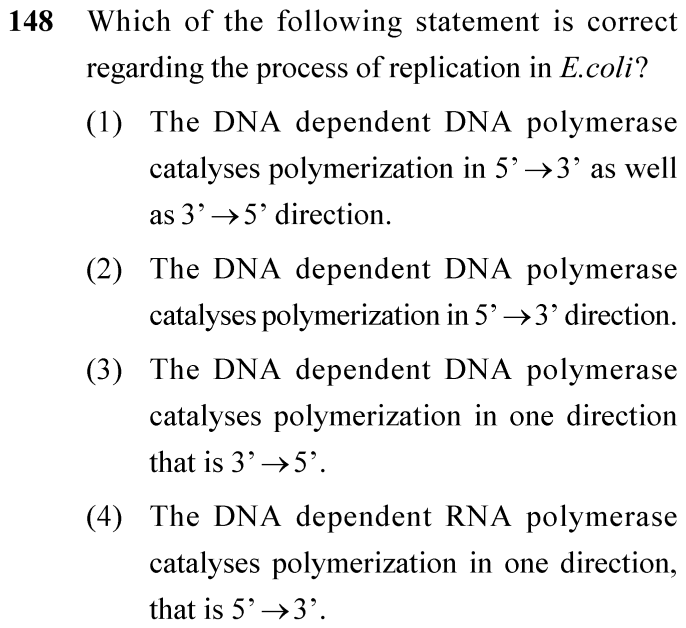
Official NEET 2024 Question 148 - Molecular Basis of Inheritance
1 The DNA dependent DNA polymerase catalyses polymerization in 5' 3' as well as 3' 5' direction.
2 The DNA dependent DNA polymerase catalyses polymerization in 5' +3' direction. ✓ Key
3 The DNA dependent DNA polymerase catalyses polymerization in one direction that is 3' 5'.
4 The DNA dependent RNA polymerase catalyses polymerization in one direction, that is 5' 3'.
💡 Verified Solution & 30-Second Hack
✓
Verified Against NTA Final Answer Key
Option (2) : The DNA dependent DNA polymerase catalyses polymerization in 5' -> 3' direction.
📚 Molecular Basis of Inheritance Easy
📋 Given Parameters & Problem Setup
Process Replication in Escherichia coli
Key Enzyme DNA-dependent DNA polymerase (DNA Pol III)
⚡

The 30-Second Exam Hall Shortcut: ⚡ Universal Polymerization Polarity

⏱️ Save ~20 seconds

ALL DNA and RNA polymerases synthesize new nucleic acid chains strictly in the 5' -> 3' direction (adding new nucleotides to the free 3'-OH group)!

1 Recall polymerase catalytic directionality:
2 - DNA-dependent DNA polymerase catalyses polymerization ONLY in the 5' -> 3' direction.
3 - Because of this unidirectional constraint, on one strand (template 3'->5') replication is continuous (leading strand), while on the other (template 5'->3') it is discontinuous (lagging strand/Okazaki fragments).
4 Option (2) states: "catalyses polymerization in 5' -> 3' direction" -> Option (2) / B.
🛡️
Why You Can 100% Trust This Shortcut: NCERT Biology · Molecular Basis of Inheritance (DNA Replication Machinery and Directionality)
📐

Step-by-Step Rigorous Workflow & Mathematical Proof

Step 1

Understand Polymerase Enzymatic Requirements

In living cells, such as E. coli, the main enzyme is DNA-dependent DNA polymerase. It uses a DNA template to catalyse the polymerisation of deoxynucleotides with high speed and exceptional fidelity.

Step 2

Directionality of Catalysis

The DNA-dependent DNA polymerases catalyse polymerisation only in one direction, that is, 5′→3′5' \rightarrow 3'. Nucleotides can only be added to a pre-existing free 3′-OH3'\text{-OH} group on the elongating strand.

Step 3

Impact on Replication Fork

Consequently, at the replication fork, one strand (template with polarity 3′→5′3' \rightarrow 5') experiences continuous synthesis, whereas the other strand (template with polarity 5′→3′5' \rightarrow 3') experiences discontinuous synthesis.

⭐

360° Option Elimination Engine Key Feature

Diagnose every choice: Know exactly why the right option works and why distractors fail.

4-Option Deep Scan
1 (1)
✗ Incorrect
Verdict & Scientific Reason:

Polymerisation can never occur in the 3' -> 5' direction; 3' -> 5' activity is exonucleolytic proofreading, not polymerisation.

⚠️
Student Fallacy (Why candidates pick this trap): Polymerisation can never occur in the 3' -> 5' direction; 3' -> 5' activity is exonucleolytic proofreading, not polymerisation.
2 (2)
✓ 100% Correct
Verdict & Scientific Reason:

Correctly identifies that polymerisation occurs exclusively in the 5' to 3' direction.

💡
Why this is airtight: None.
3 (3)
✗ Incorrect
Verdict & Scientific Reason:

Polymerisation proceeds 5' -> 3', not 3' -> 5'.

⚠️
Student Fallacy (Why candidates pick this trap): Polymerisation proceeds 5' -> 3', not 3' -> 5'.
4 (4)
✗ Incorrect
Verdict & Scientific Reason:

While RNA polymerase also synthesizes 5' -> 3', the question specifically focuses on the process of DNA replication in E. coli.

⚠️
Student Fallacy (Why candidates pick this trap): While RNA polymerase also synthesizes 5' -> 3', the question specifically focuses on the process of DNA replication in E. coli.
⚠️

NTA Trap Alert: Template Polarity vs Synthesis Polarity

Confusing the template reading direction (3' to 5') with the new strand synthesis direction (5' to 3').

🛡️ How to avoid the -1 mark: Templates are read 3' to 5'; new DNA is ALWAYS synthesized 5' to 3'.
📖

Core NEET Syllabus Standard

Biology Core Botany · Molecular Basis of Inheritance Standard Benchmark
Core Scientific Principle Tested:

"The DNA-dependent DNA polymerases catalyse polymerisation only in one direction, that is, 5'->3'. This creates some additional complications at the replicating fork. Consequently, on one strand (the template with polarity 3'->5'), the replication is continuous, while on the other (the template with polarity 5'->3'), it is discontinuous."

Syllabus Focus: Catalytic Directionality of DNA-Dependent DNA Polymerase
✓ Core NEET UG Syllabus Anchor Syllabus & Academic Standards ↗
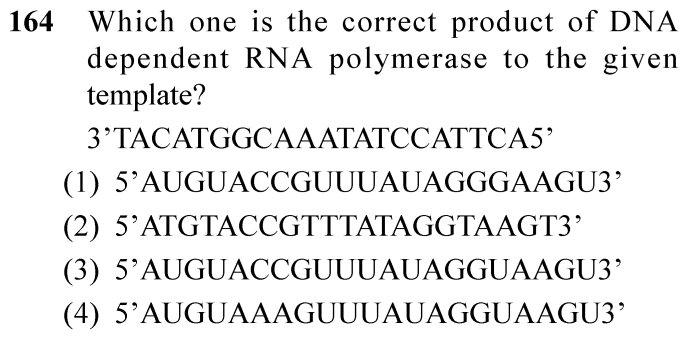
NEET 2024 · Q164 Easy
Official NEET 2024 Question 164 - Molecular Basis of Inheritance
1
2
3 ✓ Key
4
💡 Verified Solution & 30-Second Hack
✓
Verified Against NTA Final Answer Key
Option (3) : 5'AUGUACCGUUUAUAGGUAAGU3'
📚 Molecular Basis of Inheritance Easy
📋 Given Parameters & Problem Setup
Enzyme DNA-dependent RNA polymerase
Template DNA Strand 3' TACATGGCAAATATCCATTCA 5'
⚡

The 30-Second Exam Hall Shortcut: ⚡ RNA Transcription Complementarity Rule

⏱️ Save ~30 seconds

RNA polymerase reads template 3'->5' and synthesizes complementary RNA 5'->3' with Uracil (U) replacing Thymine (T)! 3' TAC... 5' becomes 5' AUG... 3'!

1 Template: 3' TAC ATG GCA AAT ATC CAT TCA 5'
2 Complementary RNA rules: A pairs with U, T pairs with A, G pairs with C, C pairs with G.
3 Antiparallel direction: 5' to 3'.
4 Base-by-base transcription:
5 - TAC -> AUG
6 - ATG -> UAC
7 - GCA -> CGU
8 - AAT -> UUA
9 - ATC -> UAG
10 - CAT -> GUA
11 - TCA -> AGU
12 Full synthesized mRNA: 5' AUG UAC CGU UUA UAG GUA AGU 3'
13 Matches Option (3) / C perfectly!
🛡️
Why You Can 100% Trust This Shortcut: NCERT Biology · Molecular Basis of Inheritance (Transcription Process)
📐

Step-by-Step Rigorous Workflow & Mathematical Proof

Step 1

Understand Transcription Polarity and Complementarity

DNA-dependent RNA polymerase catalyses the polymerisation in only one direction, that is, 5′→3′5' \rightarrow 3'. The strand that has the polarity 3′→5′3' \rightarrow 5' acts as a template, and is referred to as the template strand.

Step 2

Apply Base Pairing Rules for RNA

The RNA transcript is complementary to the DNA template strand with Adenine (AA) pairing with Uracil (UU), and Cytosine (CC) pairing with Guanine (GG): DNA Template:3′  TACATGGCAAATATCCATTCA  5′\text{DNA Template:}\quad 3'\;\text{TACATGGCAAATATCCATTCA}\;5' RNA Transcript:5′  AUGUACCGUUUAUAGGUAAGU  3′\text{RNA Transcript:}\quad 5'\;\text{AUGUACCGUUUAUAGGUAAGU}\;3'

Step 3

Eliminate DNA-Containing Options

Option (2) contains Thymine (TT), which cannot exist in an RNA transcript. Option (1) has incorrect terminal bases. Option (3) is exact.

⭐

360° Option Elimination Engine Key Feature

Diagnose every choice: Know exactly why the right option works and why distractors fail.

4-Option Deep Scan
1 (1)
✗ Incorrect
Verdict & Scientific Reason:

Has G instead of U at position 16 (AGGG instead of AGGU).

⚠️
Student Fallacy (Why candidates pick this trap): Has G instead of U at position 16 (AGGG instead of AGGU).
2 (2)
✗ Incorrect
Verdict & Scientific Reason:

Contains Thymine (T) instead of Uracil (U); RNA contains Uracil.

⚠️
Student Fallacy (Why candidates pick this trap): Contains Thymine (T) instead of Uracil (U); RNA contains Uracil.
3 (3)
✓ 100% Correct
Verdict & Scientific Reason:

Exact antiparallel complementary RNA transcript matching the given 3' to 5' DNA template.

💡
Why this is airtight: None.
4 (4)
✗ Incorrect
Verdict & Scientific Reason:

Incorrect base sequence in the first third of the transcript.

⚠️
Student Fallacy (Why candidates pick this trap): Incorrect base sequence in the first third of the transcript.
⚠️

NTA Trap Alert: Coding vs Template Strand Polarity

Treating the given strand as the coding strand instead of the template strand.

🛡️ How to avoid the -1 mark: The prompt specifies "to the given template 3'...5'", so you must generate the complementary antiparallel 5'...3' RNA sequence.
📖

Core NEET Syllabus Standard

Biology Core Zoology · Molecular Basis of Inheritance Standard Benchmark
Core Scientific Principle Tested:

"The strand that has the polarity 3'->5' acts as a template, and is referred to as template strand... The promoter and terminator flank the structural gene in a transcription unit."

Syllabus Focus: Transcription from Template Strand: Complementarity and Polarity Rules
✓ Core NEET UG Syllabus Anchor Syllabus & Academic Standards ↗
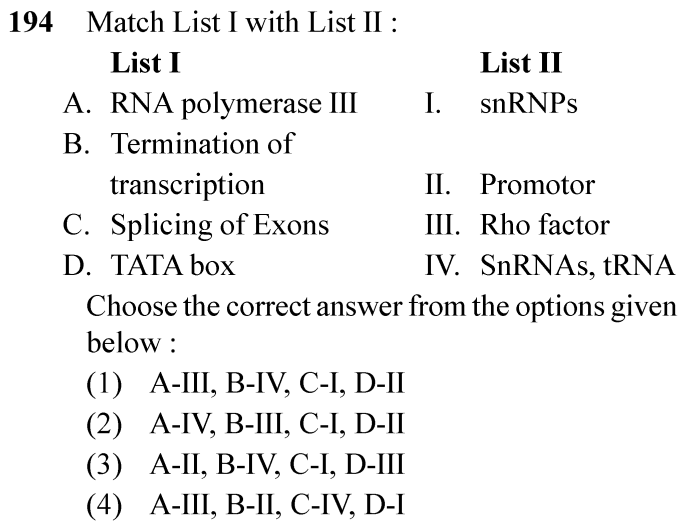
NEET 2024 · Q194 Medium
Official NEET 2024 Question 194 - Molecular Basis of Inheritance
1
2 ✓ Key
3
4
💡 Verified Solution & 30-Second Hack
✓
Verified Against NTA Final Answer Key
Option (2) : A-IV, B-III, C-I, D-II
📚 Molecular Basis of Inheritance Medium
📋 Given Parameters & Problem Setup
List I (Transcriptional Elements) A: RNA polymerase III; B: Termination of transcription; C: Splicing of Exons; D: TATA box
List II (Molecules / Factors) I: snRNPs; II: Promotor; III: Rho factor; IV: SnRNAs, tRNA
⚡

The 30-Second Exam Hall Shortcut: ⚡ Eukaryotic Molecular Machinery Match

⏱️ Save ~25 seconds

RNA Pol III = tRNA and snRNAs (IV); Termination = Rho factor (III); Splicing = snRNPs / spliceosome (I); TATA box = Core promoter element (II)! Match: A-IV, B-III, C-I, D-II!

1 A. RNA polymerase III: Transcribes tRNA, 5S rRNA, and snRNAs (IV).
2 B. Termination of transcription: Mediated by termination factor Rho (ρ) in prokaryotes (III).
3 C. Splicing of Exons: Mediated by spliceosome complex containing snRNPs (snurps) (I).
4 D. TATA box: Gold-Hogness box located in the Promotor region of genes (II).
5 Matching order: A-IV, B-III, C-I, D-II -> Option (2) / B.
🛡️
Why You Can 100% Trust This Shortcut: NCERT Biology · Molecular Basis of Inheritance (Eukaryotic Transcription Machinery)
📐

Step-by-Step Rigorous Workflow & Mathematical Proof

Step 1

Match Eukaryotic RNA Polymerase Types

In eukaryotes, there are at least three RNA polymerases in the nucleus. RNA polymerase I transcribes rRNAs (28S, 18S, and 5.8S). RNA polymerase II transcribes precursor of mRNA (hnRNA). RNA polymerase III is responsible for transcription of tRNA, 5S rRNA, and snRNAs (small nuclear RNAs) (A -> IV).

Step 2

Match Termination, Splicing, and Promoters

- In bacteria, RNA polymerase associates transiently with termination factor (ρ\rho, rho factor) to terminate transcription (B -> III). - Splicing involves removal of introns and joining of exons, catalyzed by the spliceosome formed of small nuclear ribonucleoproteins (snRNPs) (C -> I). - The TATA box is a conserved hexanucleotide sequence found within the core promoter region of eukaryotic genes where transcription factors bind (D -> II).

Step 3

Confirm Sequence

A-IV, B-III, C-I, D-II corresponds to Option (2).

⭐

360° Option Elimination Engine Key Feature

Diagnose every choice: Know exactly why the right option works and why distractors fail.

4-Option Deep Scan
1 (1)
✗ Incorrect
Verdict & Scientific Reason:

Mismatches RNA polymerase III with Rho factor.

⚠️
Student Fallacy (Why candidates pick this trap): Mismatches RNA polymerase III with Rho factor.
2 (2)
✓ 100% Correct
Verdict & Scientific Reason:

Accurately pairs all transcriptional components and processing machinery with their molecular counterparts.

💡
Why this is airtight: None.
3 (3)
✗ Incorrect
Verdict & Scientific Reason:

Mismatches RNA polymerase III with promoter.

⚠️
Student Fallacy (Why candidates pick this trap): Mismatches RNA polymerase III with promoter.
4 (4)
✗ Incorrect
Verdict & Scientific Reason:

Mismatches RNA polymerase III with Rho factor.

⚠️
Student Fallacy (Why candidates pick this trap): Mismatches RNA polymerase III with Rho factor.
⚠️

NTA Trap Alert: RNA Pol I vs II vs III Substrates

Confusing products of RNA Polymerase II (hnRNA/mRNA) with RNA Polymerase III (tRNA, 5S rRNA, snRNA).

🛡️ How to avoid the -1 mark: Remember: Pol I = 28S, 18S, 5.8S rRNA; Pol II = hnRNA (mRNA); Pol III = tRNA, 5S rRNA, snRNA.
📖

Core NEET Syllabus Standard

Biology Core Zoology · Molecular Basis of Inheritance Standard Benchmark
Core Scientific Principle Tested:

"The RNA polymerase III is responsible for transcription of tRNA, 5srRNA, and snRNAs (small nuclear RNAs). The RNA polymerase associates transiently with termination-factor (rho) to terminate transcription. Splicing removes introns and joins exons."

Syllabus Focus: Transcription Machinery: Polymerases, Promoters, Rho Factor, and Spliceosomes
✓ Core NEET UG Syllabus Anchor Syllabus & Academic Standards ↗
NEET 2023 · Q118 Easy
Official NEET 2023 Question 118 - Molecular Basis of Inheritance
1 Transcription of only snRNAs
2 Transcription of rRNAs (28S, 18S and 5.8S)
3 Transcription of tRNA, 5 srRNA and snRNA ✓ Key
4 Transcription of precursor of mRNA
💡 Verified Solution & 30-Second Hack
✓
Verified Against NTA Final Answer Key
Option (3) : Transcription of tRNA, 5 srRNA and snRNA
📚 Molecular Basis of Inheritance Easy
📋 Given Parameters & Problem Setup
Enzyme RNA Polymerase III
Organism Group Eukaryotes
⚡

The 30-Second Exam Hall Shortcut: ⚡ Eukaryotic RNA Polymerase 1-2-3 Rule

⏱️ Save ~20 seconds

Remember the mnemonic "r-m-t" for RNA Pol I, II, III: Pol I transcribes rRNAs; Pol II transcribes mRNA (hnRNA); Pol III transcribes tRNA, 5S rRNA, and snRNAs!

1 RNA Polymerase I: rRNAs (28S, 18S, 5.8S).
2 RNA Polymerase II: precursor of mRNA (hnRNA).
3 RNA Polymerase III: tRNA, 5S rRNA, and snRNAs (small nuclear RNAs).
4 Option (3) contains tRNA, 5 srRNA and snRNA.
🛡️
Why You Can 100% Trust This Shortcut: Canonical NCERT Molecular Genetics eukaryotic transcription division of labour.
📐

Step-by-Step Rigorous Workflow & Mathematical Proof

Step 1

Division of Labour in Eukaryotic Transcription

Unlike prokaryotes where a single RNA polymerase transcribes all classes of RNA, eukaryotes possess at least three distinct RNA polymerases in the nucleus:

RNA Pol I:rRNAs (28S,18S, and 5.8S)RNA Pol II:Precursor of mRNA, heterogeneous nuclear RNA (hnRNA)RNA Pol III:tRNA, 5S rRNA, and snRNAs (small nuclear RNAs)\begin{aligned} \text{\textbf{RNA Pol I:}} & \quad \text{rRNAs } (28S, 18S, \text{ and } 5.8S) \\[4pt] \text{\textbf{RNA Pol II:}} & \quad \text{Precursor of mRNA, heterogeneous nuclear RNA (hnRNA)} \\[4pt] \text{\textbf{RNA Pol III:}} & \quad \mathbf{\text{tRNA, } 5S\text{ rRNA, and snRNAs (small nuclear RNAs)}} \end{aligned}
Step 2

Verbatim NCERT Reference

NCERT states verbatim: "The RNA polymerase I transcribes rRNAs (28S, 18S, and 5.8S), whereas the RNA polymerase III is responsible for transcription of tRNA, 5srRNA, and snRNAs (small nuclear RNAs). The RNA polymerase II transcribes precursor of mRNA, the heterogeneous nuclear RNA (hnRNA)."

Step 3

Special Note on 5S rRNA

Notice that while 28S, 18S, and 5.8S rRNAs are transcribed by RNA Pol I as a single polycistronic pre-rRNA in the nucleolus, 5S rRNA is uniquely transcribed outside the nucleolus by RNA Pol III.

⭐

360° Option Elimination Engine Key Feature

Diagnose every choice: Know exactly why the right option works and why distractors fail.

4-Option Deep Scan
1 1
✗ Incorrect
Verdict & Scientific Reason:

Unduly restrictive: RNA Pol III transcribes tRNA and 5S rRNA in addition to snRNAs.

⚠️
Student Fallacy (Why candidates pick this trap): Overlooking major tRNA transcription duties of Pol III.
2 2
✗ Incorrect
Verdict & Scientific Reason:

28S, 18S, and 5.8S rRNAs are transcribed exclusively by RNA Polymerase I.

⚠️
Student Fallacy (Why candidates pick this trap): Confusing RNA Polymerase I with RNA Polymerase III.
3 3
✓ 100% Correct
Verdict & Scientific Reason:

Matches NCERT verbatim: RNA Pol III transcribes tRNA, 5S rRNA, and snRNAs.

💡
Why this is airtight: None; textbook verbatim.
4 4
✗ Incorrect
Verdict & Scientific Reason:

The precursor of mRNA (hnRNA) is transcribed by RNA Polymerase II.

⚠️
Student Fallacy (Why candidates pick this trap): Confusing RNA Polymerase II with RNA Polymerase III.
⚠️

NTA Trap Alert: The 5S rRNA Exception Trap

Students frequently assume all ribosomal RNAs (rRNAs) are synthesized by RNA Polymerase I. 5S rRNA is the key exception transcribed by RNA Polymerase III.

🛡️ How to avoid the -1 mark: Remember: Pol I = 28S, 18S, 5.8S rRNA. Pol III = 5S rRNA + tRNA + snRNA.
📖

Core NEET Syllabus Standard

NCERT Biology · Molecular Basis of Inheritance Standard Benchmark
Core Scientific Principle Tested:

"RNA polymerase III is responsible for transcription of tRNA, 5srRNA, and snRNAs (small nuclear RNAs)."

Syllabus Focus: Transcription in Eukaryotes
✓ Core NEET UG Syllabus Anchor Syllabus & Academic Standards ↗
NEET 2023 · Q131 Easy
Official NEET 2023 Question 131 - Molecular Basis of Inheritance
1
2
3 ✓ Key
4
💡 Verified Solution & 30-Second Hack
✓
Verified Against NTA Final Answer Key
Option (3) : Alfred Hershey and Martha Chase
📚 Molecular Basis of Inheritance Easy
📋 Given Parameters & Problem Setup
Discovery Unequivocal proof of DNA as genetic material
Model System Bacteriophage T2 and Escherichia coli
Radioisotopes Used ³²P (DNA phosphate) and ³⁵S (Protein methionine/cysteine)
⚡

The 30-Second Exam Hall Shortcut: ⚡ Genetic Material Proof Hierarchy: Unequivocal = Hershey & Chase

⏱️ Save ~20 seconds

Griffith discovered transformation (1928), Avery-MacLeod-McCarty provided biochemical characterization (1944), but UNEQUIVOCAL proof was conclusively established by Alfred Hershey and Martha Chase in 1952 using radioactive isotopes ³²P and ³⁵S!

1 Griffith (1928): Transforming principle in Streptococcus pneumoniae (unproven chemical identity).
2 Avery, MacLeod, McCarty (1944): Biochemical evidence that DNA is transforming agent (not universally accepted by biologists).
3 Hershey and Chase (1952): Unequivocal proof using ³²P-DNA and ³⁵S-protein bacteriophage infection.
4 Match Option (3) Alfred Hershey and Martha Chase.
🛡️
Why You Can 100% Trust This Shortcut: Canonical NCERT Molecular Genetics historical milestone taxonomy.
📐

Step-by-Step Rigorous Workflow & Mathematical Proof

Step 1

Chronology of Genetic Material Evidence

The search for the genetic material followed three landmark historical stages:

Griffith (1928):Transforming principle demonstrated in S. pneumoniaeAvery et al. (1944):Biochemical proof that DNA is the transforming agentHershey & Chase (1952):Unequivocal proof using radioactive 32P and 35S in T2 phage\begin{aligned} \text{Griffith (1928):} & \quad \text{Transforming principle demonstrated in } \textit{S. pneumoniae} \\[3pt] \text{Avery et al. (1944):} & \quad \text{Biochemical proof that DNA is the transforming agent} \\[3pt] \text{\textbf{Hershey \& Chase (1952):}} & \quad \mathbf{\text{Unequivocal proof using radioactive } ^{32}\text{P and }^{35}\text{S in T2 phage}} \end{aligned}
Step 2

Verbatim NCERT Association

NCERT states verbatim: "The unequivocal proof that DNA is the genetic material came from the experiments of Alfred Hershey and Martha Chase (1952). They worked with viruses that infect bacteria called bacteriophages."

Step 3

Experimental Logic

Bacteria infected with viruses grown on radioactive phosphorus (32P^{32}\text{P}) were radioactive because DNA entered the host cells. Bacteria infected with viruses grown on radioactive sulfur (35S^{35}\text{S}) were not radioactive, confirming that protein did not enter bacteria.

⭐

360° Option Elimination Engine Key Feature

Diagnose every choice: Know exactly why the right option works and why distractors fail.

4-Option Deep Scan
1 1
✗ Incorrect
Verdict & Scientific Reason:

Maurice Wilkins and Rosalind Franklin produced X-ray diffraction photographs of DNA B-form fiber.

⚠️
Student Fallacy (Why candidates pick this trap): Confusing X-ray crystallography with phage transduction experiments.
2 2
✗ Incorrect
Verdict & Scientific Reason:

Griffith observed bacterial transformation in mice but could not elucidate the chemical nature of the transforming agent.

⚠️
Student Fallacy (Why candidates pick this trap): Ignoring the qualifying descriptor "unequivocal proof".
3 3
✓ 100% Correct
Verdict & Scientific Reason:

Verbatim NCERT attribution: Hershey and Chase provided the unequivocal experimental proof that DNA is the genetic material in 1952.

💡
Why this is airtight: None; textbook verbatim.
4 4
✗ Incorrect
Verdict & Scientific Reason:

Avery, MacLeod, and McCarty discovered that DNA was the transforming substance, but their proof was debated until Hershey-Chase confirmed it unequivocally.

⚠️
Student Fallacy (Why candidates pick this trap): Overlooking that Avery et al.'s work was still contested by skeptics until Hershey-Chase.
⚠️

NTA Trap Alert: Avery et al. vs. Hershey & Chase "Unequivocal" Trap

Questions in NEET deliberately use the word "unequivocal" because NCERT reserves that exact adjective exclusively for Hershey and Chase.

🛡️ How to avoid the -1 mark: Keywords: "Biochemical characterisation of transforming principle" = Avery et al. "Unequivocal proof" = Hershey and Chase.
📖

Core NEET Syllabus Standard

NCERT Biology · Molecular Basis of Inheritance Standard Benchmark
Core Scientific Principle Tested:

"The unequivocal proof that DNA is the genetic material came from the experiments of Alfred Hershey and Martha Chase (1952)."

Syllabus Focus: The Genetic Material is DNA
✓ Core NEET UG Syllabus Anchor Syllabus & Academic Standards ↗
NEET 2023 · Q133 Easy
Official NEET 2023 Question 133 - Molecular Basis of Inheritance
1 Certain important expressed genes.
2 All genes that are expressed as RNA. ✓ Key
3 All genes that are expressed as proteins.
4 All genes whether expressed or unexpressed.
💡 Verified Solution & 30-Second Hack
✓
Verified Against NTA Final Answer Key
Option (2) : All genes that are expressed as RNA.
📚 Molecular Basis of Inheritance Easy
📋 Given Parameters & Problem Setup
Term Expressed Sequence Tags (ESTs)
Context Human Genome Project (HGP) methodologies
⚡

The 30-Second Exam Hall Shortcut: ⚡ HGP Strategy Anchor: Expressed = RNA

⏱️ Save ~20 seconds

The Human Genome Project employed two major methodologies: (1) Expressed Sequence Tags (ESTs) focusing on all genes expressed as RNA, and (2) Sequence Annotation sequencing the entire genome blindly including coding and non-coding regions!

1 Recall HGP sequencing strategies.
2 Blind sequencing of coding + non-coding regions = Sequence Annotation.
3 Identifying all genes that are transcribed and expressed as RNA = Expressed Sequence Tags (ESTs).
4 Match Option (2) All genes that are expressed as RNA.
🛡️
Why You Can 100% Trust This Shortcut: Canonical NCERT Human Genome Project genomics methodology definitions.
📐

Step-by-Step Rigorous Workflow & Mathematical Proof

Step 1

Two Methodological Approaches in HGP

The Human Genome Project utilized two contrasting sequencing paradigms:

1. Expressed Sequence Tags (ESTs):Identify all genes that are expressed as RNA (transcribed sequences)2. Sequence Annotation:Sequence the entire genome (coding + non-coding) and assign functions\begin{aligned} \mathbf{\text{1. Expressed Sequence Tags (ESTs):}} & \quad \mathbf{\text{Identify all genes that are expressed as RNA (transcribed sequences)}} \\[4pt] \text{2. Sequence Annotation:} & \quad \text{Sequence the entire genome (coding + non-coding) and assign functions} \end{aligned}
Step 2

Verbatim NCERT Statement

NCERT states verbatim: "The methodologies involved two major approaches. One approach focused on identifying all the genes that are expressed as RNA (referred to as Expressed Sequence Tags (ESTs))."

Step 3

Molecular Basis of ESTs

ESTs are generated by reverse-transcribing cellular messenger RNAs into complementary DNAs (cDNAs) and sequencing short fragments, completely bypassing non-coding intergenic and intronic genomic DNA.

⭐

360° Option Elimination Engine Key Feature

Diagnose every choice: Know exactly why the right option works and why distractors fail.

4-Option Deep Scan
1 1
✗ Incorrect
Verdict & Scientific Reason:

ESTs represent an unbiased, comprehensive survey of all transcribed RNAs in a tissue, not an arbitrary selection of "certain important" genes.

⚠️
Student Fallacy (Why candidates pick this trap): Assuming researchers selectively pre-filter "important" genes.
2 2
✓ 100% Correct
Verdict & Scientific Reason:

Matches NCERT verbatim: ESTs specifically refers to identifying all genes that are expressed as RNA.

💡
Why this is airtight: None; textbook verbatim.
3 3
✗ Incorrect
Verdict & Scientific Reason:

Many transcribed RNAs (e.g., rRNAs, tRNAs, snRNAs, miRNAs, lncRNAs) are non-coding RNAs that are never translated into proteins.

⚠️
Student Fallacy (Why candidates pick this trap): Equating gene expression strictly with protein translation.
4 4
✗ Incorrect
Verdict & Scientific Reason:

Sequencing the entire genome regardless of expression status is the Sequence Annotation approach.

⚠️
Student Fallacy (Why candidates pick this trap): Confusing Sequence Annotation with ESTs.
⚠️

NTA Trap Alert: RNA vs. Protein Expression Trap

Students frequently equate "expression" with "protein synthesis". In molecular genetics, the primary step of gene expression is transcription into RNA. ESTs capture all RNA transcripts, including non-coding RNAs.

🛡️ How to avoid the -1 mark: Remember: ESTs = Expressed as RNA. Entire genome (expressed + unexpressed) = Sequence Annotation.
📖

Core NEET Syllabus Standard

NCERT Biology · Molecular Basis of Inheritance Standard Benchmark
Core Scientific Principle Tested:

"One approach focused on identifying all the genes that are expressed as RNA (referred to as Expressed Sequence Tags (ESTs))."

Syllabus Focus: Human Genome Project (Methodologies)
✓ Core NEET UG Syllabus Anchor Syllabus & Academic Standards ↗
NEET 2023 · Q145 Easy
Official NEET 2023 Question 145 - Molecular Basis of Inheritance
1 20
2 80 ✓ Key
3 60
4 40
💡 Verified Solution & 30-Second Hack
✓
Verified Against NTA Final Answer Key
Option (2) : 80
📚 Molecular Basis of Inheritance Easy
📋 Given Parameters & Problem Setup
Cellular Organelle Ribosome (Ribonucleoprotein complex)
Parameter Number of different ribosomal proteins
⚡

The 30-Second Exam Hall Shortcut: ⚡ Ribosomal Protein Constant = About 80 Proteins

⏱️ Save ~25 seconds

NCERT Molecular Basis of Inheritance states verbatim under Translation: "The ribosome consists of structural RNAs and about 80 different proteins!" Instant 3-second recall!

1 Recall the biochemical composition of a ribosome.
2 Composed of structural rRNAs (23S, 16S, 5S in prokaryotes or 28S, 18S, 5.8S, 5S in eukaryotes).
3 Contains about 80 different distinct proteins.
4 Match Option (2) 80 directly.
🛡️
Why You Can 100% Trust This Shortcut: Canonical NCERT Translation molecular machinery composition inventory.
📐

Step-by-Step Rigorous Workflow & Mathematical Proof

Step 1

Biochemical Composition of the Ribosome

Ribosomes are ribonucleoprotein complexes consisting of structural ribosomal RNAs (rRNAsrRNAs) and a diverse set of ribosomal proteins (rr-proteins):

Ribosome=Structural rRNAs+≈80 different proteins\text{Ribosome} = \text{Structural rRNAs} + \mathbf{\approx 80\text{ different proteins}}
Step 2

Verbatim NCERT Reference

NCERT states verbatim in the section on Translation: "The ribosome consists of structural RNAs and about 80 different proteins. In its inactive state, it exists as two subunits; a large subunit and a small subunit."

Step 3

Functional Roles of Ribosomal Proteins

These ~80 proteins stabilize the complex tertiary and quaternary folded architecture of the ribosomal RNAs and facilitate translation factor binding, while the peptidyl transferase catalytic activity itself is mediated by the 23S rRNA ribozyme.

⭐

360° Option Elimination Engine Key Feature

Diagnose every choice: Know exactly why the right option works and why distractors fail.

4-Option Deep Scan
1 1
✗ Incorrect
Verdict & Scientific Reason:

20 is the number of standard amino acids used to build proteins, not the number of ribosomal proteins.

⚠️
Student Fallacy (Why candidates pick this trap): Confusing the 20 universal proteinogenic amino acids with ribosomal proteins.
2 2
✓ 100% Correct
Verdict & Scientific Reason:

Matches NCERT verbatim: ribosomes consist of about 80 different proteins.

💡
Why this is airtight: None; textbook verbatim.
3 3
✗ Incorrect
Verdict & Scientific Reason:

60S is the sedimentation coefficient of the large subunit of eukaryotic 80S ribosomes, not the protein count.

⚠️
Student Fallacy (Why candidates pick this trap): Confusing 60S sedimentation value with protein quantity.
4 4
✗ Incorrect
Verdict & Scientific Reason:

40S is the sedimentation coefficient of the small subunit of eukaryotic 80S ribosomes, not the protein count.

⚠️
Student Fallacy (Why candidates pick this trap): Confusing 40S subunit size with protein quantity.
⚠️

NTA Trap Alert: Svedberg Sedimentation Units vs. Protein Count Trap

Eukaryotic ribosomes are 80S with 60S and 40S subunits. Students frequently confound the subunit sedimentation coefficients (40, 60, 80) with the protein count.

🛡️ How to avoid the -1 mark: Remember: Ribosomes contain ~80 different proteins (coincidentally identical to the 80S eukaryotic total Svedberg value).
📖

Core NEET Syllabus Standard

NCERT Biology · Molecular Basis of Inheritance Standard Benchmark
Core Scientific Principle Tested:

"The ribosome consists of structural RNAs and about 80 different proteins."

Syllabus Focus: Translation
✓ Core NEET UG Syllabus Anchor Syllabus & Academic Standards ↗
NEET 2023 · Q157 Easy
Official NEET 2023 Question 157 - Molecular Basis of Inheritance
1 Statement I false but Statement II is true.
2 Both Statement I and Statement II are true. ✓ Key
3 Both Statement I and Statement II are false.
4 Statement I is true but Statement II is false.
💡 Verified Solution & 30-Second Hack
✓
Verified Against NTA Final Answer Key
Option (2) : Both Statement I and Statement II are true.
📚 Molecular Basis of Inheritance Easy
📋 Given Parameters & Problem Setup
Statement I RNA mutates at a faster rate.
Statement II Viruses having RNA genome and shorter life span mutate and evolve faster.
⚡

The 30-Second Exam Hall Shortcut: ⚡ 2′-OH Labile Bond = Fast RNA Viral Evolution

⏱️ Save ~20 seconds

RNA has a reactive 2′-OH group making it labile and prone to high mutation rates (Statement I is TRUE). Consequently, RNA viruses with short generation times mutate and evolve rapidly (Statement II is TRUE). Both statements are TRUE!

1 Check Statement I: RNA is chemically reactive (2′-OH) and mutates at a faster rate than DNA -> True.
2 Check Statement II: RNA viruses with short life spans mutate and evolve faster -> Verbatim NCERT, True.
3 Both Statement I and Statement II are true.
4 Match Option (2).
🛡️
Why You Can 100% Trust This Shortcut: Canonical NCERT Molecular Genetics nucleic acid stability and viral mutation dynamics.
📐

Step-by-Step Rigorous Workflow & Mathematical Proof

Step 1

Chemical Basis of RNA Instability

RNA possesses a 2′-hydroxyl group on each ribose sugar ring, making the phosphodiester backbone catalytic and chemically labile, while uracil is less stable than thymine:

Ribose 2’-OH+Uracil  ⟹  Higher chemical reactivity  ⟹  RNA mutates at a faster rate\text{Ribose 2'-OH} + \text{Uracil} \implies \text{Higher chemical reactivity} \implies \mathbf{\text{RNA mutates at a faster rate}}
Step 2

Verbatim NCERT Reference

NCERT states verbatim under "RNA World / Properties of Genetic Material": - "RNA being unstable, mutates at a faster rate." - "Consequently, viruses having RNA genome and having shorter life span mutate and evolve faster."

Step 3

Evolutionary Corroboration

Examples include influenza virus, HIV, and SARS-CoV-2, whose error-prone RNA-dependent RNA polymerases lack 3′ to 5′ proofreading, leading to rapid antigenic drift and antigenic shifts.

⭐

360° Option Elimination Engine Key Feature

Diagnose every choice: Know exactly why the right option works and why distractors fail.

4-Option Deep Scan
1 1
✗ Incorrect
Verdict & Scientific Reason:

Statement I is factually true: RNA mutates faster than DNA.

⚠️
Student Fallacy (Why candidates pick this trap): Assuming DNA and RNA mutate at identical baseline rates.
2 2
✓ 100% Correct
Verdict & Scientific Reason:

Both statements are verbatim excerpts from NCERT Molecular Basis of Inheritance.

💡
Why this is airtight: None; textbook verbatim recall.
3 3
✗ Incorrect
Verdict & Scientific Reason:

Both statements are scientifically established biological facts.

⚠️
Student Fallacy (Why candidates pick this trap): Skeptical rejection of viral evolution kinetics.
4 4
✗ Incorrect
Verdict & Scientific Reason:

Statement II is factually true: RNA viruses evolve exceptionally rapidly.

⚠️
Student Fallacy (Why candidates pick this trap): Believing shorter lifespan retards the rate of evolution.
⚠️

NTA Trap Alert: DNA Stability vs. RNA Evolution Trap

DNA was selected over evolutionary time for stability of genetic storage (double-stranded, thymine instead of uracil, no 2′-OH). RNA is dynamic and prone to mutations, allowing rapid viral evolution.

🛡️ How to avoid the -1 mark: Remember: DNA = Stable storage. RNA = Unstable, mutates and evolves faster.
📖

Core NEET Syllabus Standard

NCERT Biology · Molecular Basis of Inheritance Standard Benchmark
Core Scientific Principle Tested:

"RNA being unstable, mutates at a faster rate. Consequently, viruses having RNA genome and having shorter life span mutate and evolve faster."

Syllabus Focus: Properties of Genetic Material (DNA vs. RNA)
✓ Core NEET UG Syllabus Anchor Syllabus & Academic Standards ↗
NEET 2023 · Q169 Easy
Official NEET 2023 Question 169 - Molecular Basis of Inheritance
1
2
3 ✓ Key
4
💡 Verified Solution & 30-Second Hack
✓
Verified Against NTA Final Answer Key
Option (3) : A-II, B-III, C-IV, D-I
📚 Molecular Basis of Inheritance Easy
📋 Given Parameters & Problem Setup
Operon System Lac Operon (Lactose Operon in E. coli)
Genes Gene a, Gene y, Gene i, Gene z
⚡

The 30-Second Exam Hall Shortcut: ⚡ Lac Operon "Z-Y-A" + "i" Code

⏱️ Save ~20 seconds

Remember the order: Gene i = Repressor protein (IV). Gene z = β-galactosidase (I). Gene y = Permease (III). Gene a = Transacetylase (II). Match Option (3)!

1 Gene i (inhibitor): Codes for the lac repressor protein -> C-IV.
2 Gene z: Codes for beta-galactosidase (hydrolyzes lactose) -> D-I.
3 Gene y: Codes for permease (increases cell permeability to beta-galactosides) -> B-III.
4 Gene a: Codes for transacetylase -> A-II.
5 Match combination: A-II, B-III, C-IV, D-I -> Option (3).
🛡️
Why You Can 100% Trust This Shortcut: Canonical NCERT Molecular Genetics Jacob-Monod lac operon structural gene inventory.
📐

Step-by-Step Rigorous Workflow & Mathematical Proof

Step 1

Organization of the Lac Operon Genes

The lactose operon of E. coli\textit{E. coli} consists of one regulatory gene and three polycistronic structural genes:

Gene  i (Inhibitor):Synthesizes the active Repressor protein  ⟹  IVGene  z:Codes for β-galactosidase (hydrolyzes lactose to glucose + galactose)  ⟹  IGene  y:Codes for Permease (facilitates lactose entry)  ⟹  IIIGene  a:Codes for Transacetylase  ⟹  II\begin{aligned} \text{\textbf{Gene } } \mathbf{i}\textbf{ (Inhibitor):} & \quad \text{Synthesizes the active } \mathbf{\text{Repressor protein}} \implies \mathbf{\text{IV}} \\[4pt] \text{\textbf{Gene } } \mathbf{z}\textbf{:} & \quad \text{Codes for } \mathbf{\beta\text{\textbf{-galactosidase}}} \text{ (hydrolyzes lactose to glucose + galactose)} \implies \mathbf{\text{I}} \\[4pt] \text{\textbf{Gene } } \mathbf{y}\textbf{:} & \quad \text{Codes for } \mathbf{\text{Permease}} \text{ (facilitates lactose entry)} \implies \mathbf{\text{III}} \\[4pt] \text{\textbf{Gene } } \mathbf{a}\textbf{:} & \quad \text{Codes for } \mathbf{\text{Transacetylase}} \implies \mathbf{\text{II}} \end{aligned}
Step 2

Verbatim NCERT Reference

NCERT states verbatim: "The z gene codes for beta-galactosidase... The y gene codes for permease... The a gene encodes a transacetylase... The i gene codes for the repressor of the lac operon."

Step 3

Option Elimination

Matching C-IV and D-I immediately narrows to Option (3), completely ruling out Options 1, 2, and 4.

⭐

360° Option Elimination Engine Key Feature

Diagnose every choice: Know exactly why the right option works and why distractors fail.

4-Option Deep Scan
1 1
✗ Incorrect
Verdict & Scientific Reason:

Mismatches Gene a with permease and Gene z with transacetylase.

⚠️
Student Fallacy (Why candidates pick this trap): Scrambling structural gene enzymatic products.
2 2
✗ Incorrect
Verdict & Scientific Reason:

Mismatches Gene y with β-galactosidase and Gene z with permease.

⚠️
Student Fallacy (Why candidates pick this trap): Inverting gene z and gene y products.
3 3
✓ 100% Correct
Verdict & Scientific Reason:

Exact match with the canonical NCERT gene-product associations for the lac operon.

💡
Why this is airtight: None; textbook verbatim match.
4 4
✗ Incorrect
Verdict & Scientific Reason:

Mismatches Gene i with β-galactosidase.

⚠️
Student Fallacy (Why candidates pick this trap): Mistaking the "i" gene for an inducer rather than the repressor inhibitor.
⚠️

NTA Trap Alert: Gene "i" = Inhibitor (Repressor), NOT Inducer!

Students frequently think the letter "i" in gene i stands for "inducer". The inducer is lactose/allolactose. The letter "i" stands for "inhibitor", which produces the repressor protein.

🛡️ How to avoid the -1 mark: Remember: Gene i = Inhibitor (codes for Repressor). Inducer = Allolactose (metabolite, not a gene).
📖

Core NEET Syllabus Standard

NCERT Biology · Molecular Basis of Inheritance Standard Benchmark
Core Scientific Principle Tested:

"In lac operon, z gene codes for beta-galactosidase, y gene codes for permease, a gene codes for transacetylase, and i gene codes for repressor."

Syllabus Focus: The Lac Operon
✓ Core NEET UG Syllabus Anchor Syllabus & Academic Standards ↗
NEET 2023 · Q182 Medium
Official NEET 2023 Question 182 - Molecular Basis of Inheritance
1 Statement I incorrect but Statement II is true. ✓ Key
2 Both Statement I and Statement II are true.
3 Both Statement I and Statement II are false.
4 Statement I is correct but Statement II is false.
💡 Verified Solution & 30-Second Hack
✓
Verified Against NTA Final Answer Key
Option (1) : Statement I incorrect but Statement II is true.
📚 Molecular Basis of Inheritance Medium
📋 Given Parameters & Problem Setup
Statement I In prokaryotes, positively charged DNA is held with negatively charged proteins in nucleoid.
Statement II In eukaryotes, negatively charged DNA is wrapped around positively charged histone octamer to form nucleosome.
⚡

The 30-Second Exam Hall Shortcut: ⚡ DNA Charge Inversion Alert: DNA is ALWAYS Negatively Charged!

⏱️ Save ~25 seconds

DNA is universally negatively charged due to its phosphate (PO43−PO_4^{3-}) groups! Statement I claims "positively charged DNA is held with negatively charged proteins"—this inverts both charges completely and is FALSE! Statement II is TRUE (nucleosome). Select Option (1)!

1 Check Statement I: Claims DNA is positively charged and held by negatively charged proteins -> False! (DNA is negatively charged, proteins are positively charged polyamines/non-histones).
2 Check Statement II: Negatively charged DNA wrapped around positively charged histone octamer = nucleosome -> Verbatim NCERT, True.
3 Statement I is incorrect but Statement II is true.
4 Match Option (1).
🛡️
Why You Can 100% Trust This Shortcut: Canonical NCERT Molecular Genetics DNA chemical structure and packaging electrostatics.
📐

Step-by-Step Rigorous Workflow & Mathematical Proof

Step 1

Electrostatic Basis of DNA Packaging

Every phosphodiester linkage in the DNA backbone carries a net negative charge at physiological pH due to ionization of the phosphate group (PO43−PO_4^{3-}):

DNA Backbone  ⟹  Universally Negatively Charged (due to Phosphate groups)\text{DNA Backbone} \implies \mathbf{\text{Universally Negatively Charged (due to Phosphate groups)}}
Step 2

Evaluation of Statement I (Prokaryotic Nucleoid Packaging)

In prokaryotes (e.g., E. coli\textit{E. coli}), lacking histones, the negatively charged DNA is held in large loops by positively charged non-histone polyamine proteins in a region termed the nucleoid. Statement I states "positively charged DNA is held with negatively charged proteins", which is a complete polarity inversion and unambiguously FALSE.

Prokaryotic Nucleoid=Negatively Charged DNA+Positively Charged Proteins  ⟹  Statement I is INCORRECT\text{Prokaryotic Nucleoid} = \mathbf{\text{Negatively Charged DNA}} + \mathbf{\text{Positively Charged Proteins}} \implies \text{Statement I is } \mathbf{\text{INCORRECT}}
Step 3

Evaluation of Statement II (Eukaryotic Nucleosome)

In eukaryotes, basic proteins rich in lysine and arginine residues (histones) form an octamer bearing positive charges on their side chains. Approximately 200 bp of negatively charged DNA wraps around this core:

Nucleosome=200 bp Negatively Charged DNA+Positively Charged Histone Octamer  ⟹  Statement II is TRUE\mathbf{\text{Nucleosome}} = 200\text{ bp Negatively Charged DNA} + \mathbf{\text{Positively Charged Histone Octamer}} \implies \text{Statement II is } \mathbf{\text{TRUE}}
⭐

360° Option Elimination Engine Key Feature

Diagnose every choice: Know exactly why the right option works and why distractors fail.

4-Option Deep Scan
1 1
✓ 100% Correct
Verdict & Scientific Reason:

Statement I falsely inverts the electrostatic charges of DNA and proteins; Statement II accurately describes the eukaryotic nucleosome.

💡
Why this is airtight: None; rigorous molecular electrostatic literacy.
2 2
✗ Incorrect
Verdict & Scientific Reason:

Statement I is false because DNA is never positively charged.

⚠️
Student Fallacy (Why candidates pick this trap): Failing to notice the inverted "positively charged DNA" in Statement I.
3 3
✗ Incorrect
Verdict & Scientific Reason:

Statement II is a fundamental verified principle of chromatin biology.

⚠️
Student Fallacy (Why candidates pick this trap): Doubting whether histone octamers are positively charged.
4 4
✗ Incorrect
Verdict & Scientific Reason:

Both statement verdicts are completely reversed.

⚠️
Student Fallacy (Why candidates pick this trap): Gross misunderstanding of nucleic acid biochemistry.
⚠️

NTA Trap Alert: Subtle Charge Polarity Swap Trap

NTA replaced "negatively charged DNA" with "positively charged DNA" in Statement I. Students reading rapidly recognize the words "DNA", "proteins", and "nucleoid" and assume the sentence is true.

🛡️ How to avoid the -1 mark: Always verify charges: DNA is ALWAYS NEGATIVE (phosphates); Packaging proteins are ALWAYS POSITIVE (basic residues/polyamines).
📖

Core NEET Syllabus Standard

NCERT Biology · Molecular Basis of Inheritance Standard Benchmark
Core Scientific Principle Tested:

"In prokaryotes, negatively charged DNA is held with positively charged proteins in a nucleoid. In eukaryotes, negatively charged DNA wraps around positively charged histone octamer forming nucleosome."

Syllabus Focus: Packaging of DNA Helix
✓ Core NEET UG Syllabus Anchor Syllabus & Academic Standards ↗
NEET 2023 · Q188 Easy
Official NEET 2023 Question 188 - Molecular Basis of Inheritance
1
2
3
4 ✓ Key
💡 Verified Solution & 30-Second Hack
✓
Verified Against NTA Final Answer Key
Option (4) : 5’ ATCGATCGATCGATCGATCGATCGATCG 3’
📚 Molecular Basis of Inheritance Easy
📋 Given Parameters & Problem Setup
mRNA Sequence 5’ AUCGAUCGAUCGAUCGAUCGAUCGAUCG 3’
Target Strand Corresponding coding strand of DNA
⚡

The 30-Second Exam Hall Shortcut: ⚡ Golden Rule: Coding Strand = mRNA (Just Replace U with T!)

⏱️ Save ~25 seconds

The sequence of the coding strand is 100% identical in sequence and polarity (5′ to 3′) to the mRNA formed, with the only single change being Thymine (T) in place of Uracil (U)! Match Option (4) directly!

1 By convention, the coding strand has the same sequence as the RNA transcript (except T for U).
2 Polarity of mRNA = 5′ to 3′; therefore polarity of coding strand = 5′ to 3′.
3 Take the mRNA: 5′ AUCGAUCG... 3′.
4 Substitute T for U: 5′ ATCGATCG... 3′.
5 Match Option (4) 5’ ATCGATCGATCGATCGATCGATCGATCG 3’.
🛡️
Why You Can 100% Trust This Shortcut: Canonical NCERT Molecular Genetics transcription unit strand polarity convention.
📐

Step-by-Step Rigorous Workflow & Mathematical Proof

Step 1

Transcription Conventions in Molecular Genetics

The DNA strand with 3′→5′3' \to 5' polarity acts as the template for RNA polymerase. The other strand with 5′→3′5' \to 3' polarity has the sequence identical to mRNA (except TT instead of UU) and is termed the coding strand:

Template Strand (3′→5′):3′ TAGCTAGCTAGCTAGCTAGCTAGCTAGC 5′mRNA (5′→3′):5′ AUCGAUCGAUCGAUCGAUCGAUCGAUCG 3′Coding Strand (5′→3′):5′ ATCGATCGATCGATCGATCGATCGATCG 3′\begin{aligned} \text{Template Strand (} 3' \to 5' \text{):} & \quad 3'\text{ TAGCTAGCTAGCTAGCTAGCTAGCTAGC } 5' \\[4pt] \mathbf{\text{mRNA (}} 5' \to 3' \mathbf{\text{):}} & \quad 5'\text{ \textbf{AUCGAUCGAUCGAUCGAUCGAUCGAUCG} } 3' \\[4pt] \mathbf{\text{Coding Strand (}} 5' \to 3' \mathbf{\text{):}} & \quad \mathbf{5'\text{ ATCGATCGATCGATCGATCGATCGATCG } 3'} \end{aligned}
Step 2

Verbatim NCERT Reference

NCERT states verbatim under Transcription Unit: "The other strand which has the polarity (5'->3') and the sequence same as RNA (except thymine at the place of uracil), is displaced during transcription. Strangely, this strand (which does not code for anything) is referred to as coding strand."

Step 3

Option Cross-Verification

Option (1) has reversed 3′→5′3' \to 5' polarity. Options (2) and (3) contain RNA Uracil residues and complementary antisense sequences. Only Option (4) has the correct 5′ to 3′ polarity with DNA Thymine residues.

⭐

360° Option Elimination Engine Key Feature

Diagnose every choice: Know exactly why the right option works and why distractors fail.

4-Option Deep Scan
1 1
✗ Incorrect
Verdict & Scientific Reason:

Inverted polarity; the coding strand has 5′ to 3′ polarity, not 3′ to 5′.

⚠️
Student Fallacy (Why candidates pick this trap): Writing the correct sequence but with inverted 3′ to 5′ ends.
2 2
✗ Incorrect
Verdict & Scientific Reason:

Contains Uracil (impossible for a DNA strand) and is complementary rather than identical.

⚠️
Student Fallacy (Why candidates pick this trap): Generating a complementary RNA sequence.
3 3
✗ Incorrect
Verdict & Scientific Reason:

Contains Uracil and inverted complementary sequence.

⚠️
Student Fallacy (Why candidates pick this trap): Confusing template transcription with coding strand identity.
4 4
✓ 100% Correct
Verdict & Scientific Reason:

Exact match: same 5′ to 3′ polarity and sequence as mRNA, with Thymine (T) replacing Uracil (U).

💡
Why this is airtight: None; textbook verbatim rule application.
⚠️

NTA Trap Alert: Template vs. Coding Strand Complementarity Trap

Students frequently waste 2 minutes taking the reverse-complement of the mRNA. The question asks for the CODING strand, which is IDENTICAL to mRNA (just swap U for T).

🛡️ How to avoid the -1 mark: Remember: mRNA = Coding strand (just replace U with T, keep 5' to 3' direction).
📖

Core NEET Syllabus Standard

NCERT Biology · Molecular Basis of Inheritance Standard Benchmark
Core Scientific Principle Tested:

"The coding strand has the sequence same as RNA (except thymine at the place of uracil) and has 5' to 3' polarity."

Syllabus Focus: Transcription Unit
✓ Core NEET UG Syllabus Anchor Syllabus & Academic Standards ↗
NEET 2021 · Q131 Easy
Official NEET 2021 Question 131 - Molecular Basis of Inheritance
1 (a)-Replication; (b)-Transcription; (c)-Transduction; (d)-Protein
2 (a)-Translation; (b)-Replication; (c)-Transcription; (d)-Transduction
3 (a)-Replication; (b)-Transcription; (c)-Translation; (d)-Protein ✓ Key
4 (a)-Transduction; (b)-Translation; (c)-Replication; (d)-Protein
💡 Verified Solution & 30-Second Hack
✓
Verified Against NTA Final Answer Key
Option (3) : (a)-Replication; (b)-Transcription; (c)-Translation; (d)-Protein
📚 Molecular Basis of Inheritance Easy
📋 Given Parameters & Problem Setup
Flow Chart (a) circular arrow on DNA -> DNA --(b)--> mRNA --(c)--> (d)
⚡

The 30-Second Exam Hall Shortcut: ⚡ Central Dogma: DNA →Transcription\xrightarrow{\text{Transcription}} mRNA →Translation\xrightarrow{\text{Translation}} Protein

⏱️ Save ~15 seconds

Francis Crick proposed the Central Dogma: DNA copies itself via Replication (a), expresses into mRNA via Transcription (b), which directs synthesis of Protein (d) via Translation (c)! Matches Option (3)!

1 Circular arrow on DNA represents DNA self-copying   ⟹  \implies (a) Replication.
2 DNA directing synthesis of mRNA   ⟹  \implies (b) Transcription.
3 mRNA directing peptide sequence synthesis   ⟹  \implies (c) Translation.
4 Terminal macromolecular product   ⟹  \implies (d) Protein.
5 Match Option (3).
🛡️
Why You Can 100% Trust This Shortcut: Canonical NCERT Molecular Basis of Inheritance on Central Dogma.
📐

Step-by-Step Rigorous Workflow & Mathematical Proof

Step 1

Francis Crick's Central Dogma Scheme

Francis Crick formulated the fundamental paradigm of information transfer in molecular biology:

DNA→(a)ReplicationDNA→(b)TranscriptionmRNA→(c)TranslationProtein (d)\mathbf{\text{DNA}} \xrightarrow[(a)]{\text{Replication}} \mathbf{\text{DNA}} \xrightarrow[(b)]{\text{Transcription}} \mathbf{\text{mRNA}} \xrightarrow[(c)]{\text{Translation}} \mathbf{\text{Protein } (d)}
Step 2

Label Correspondence

- (a): DNA replication (autocatalytic function). - (b): Transcription (synthesis of RNA from DNA template). - (c): Translation (synthesis of polypeptide chain specified by mRNA codons). - (d): Protein (the structural or catalytic end-product).

⭐

360° Option Elimination Engine Key Feature

Diagnose every choice: Know exactly why the right option works and why distractors fail.

4-Option Deep Scan
1 1
✗ Incorrect
Verdict & Scientific Reason:

Transduction is viral gene transfer in bacteria, not translation of mRNA into protein.

⚠️
Student Fallacy (Why candidates pick this trap): Confusing translation with transduction.
2 2
✗ Incorrect
Verdict & Scientific Reason:

Gross transposition of all three central dogma processes.

⚠️
Student Fallacy (Why candidates pick this trap): Scrambling the order of genetic information flow.
3 3
✓ 100% Correct
Verdict & Scientific Reason:

Direct, exact mapping of Francis Crick’s classic Central Dogma diagram.

💡
Why this is airtight: None. Textbook diagram match.
4 4
✗ Incorrect
Verdict & Scientific Reason:

Incorrectly assigns transduction to DNA self-copying.

⚠️
Student Fallacy (Why candidates pick this trap): Confusing DNA replication with bacterial transduction.
⚠️

NTA Trap Alert: Transduction vs Translation Distractor

NTA intentionally inserts "Transduction" into Option (1) and (4) to trap students scanning hastily for "Replication... Transcription... Trans...".

🛡️ How to avoid the -1 mark: Read the full word: mRNA to protein is TRANSLATION, not transduction.
📖

Core NEET Syllabus Standard

NEET / NCERT Biology · Molecular Basis of Inheritance Standard Benchmark
Core Scientific Principle Tested:

"Francis Crick proposed the Central dogma in molecular biology, which states that genetic information flows from DNA -> RNA -> Protein."

Syllabus Focus: The Search for Genetic Material: Central Dogma
✓ Core NEET UG Syllabus Anchor Syllabus & Academic Standards ↗
NEET 2021 · Q139 Easy
Official NEET 2021 Question 139 - Molecular Basis of Inheritance
1 In capping, methyl guanosine triphosphate is added to the 39 end of hnRNA.
2 RNA polymerase binds with Rho factor to terminate the process of transcription in bacteria. ✓ Key
3 The coding strand in a transcription unit is copied to an mRNA.
4 Split gene arrangement is characteristic of prokaryotes.
💡 Verified Solution & 30-Second Hack
✓
Verified Against NTA Final Answer Key
Option (2) : RNA polymerase binds with Rho factor to terminate the process of transcription in bacteria.
📚 Molecular Basis of Inheritance Easy
📋 Given Parameters & Problem Setup
Process Transcription in bacteria and eukaryotes
Target Identify the statement that is CORRECT
⚡

The 30-Second Exam Hall Shortcut: ⚡ Sigma (σ) Initiates, Rho (ρ) Terminates Bacterial Transcription!

⏱️ Save ~20 seconds

In bacteria, the core RNA polymerase enzyme associates transiently with initiation factor Sigma (σ\sigma) to start transcription and with termination factor Rho (ρ\rho) to terminate transcription and release the nascent RNA transcript! Statement (2) is 100% correct. Match Option (2)!

1 Check Statement (1): Capping adds methyl guanosine triphosphate to the 5' end, NOT the 3' end   ⟹  \implies INCORRECT.
2 Check Statement (2): RNA polymerase binds with Rho (ρ\rho) factor to terminate transcription in bacteria   ⟹  \implies CORRECT.
3 Check Statement (3): The template strand (not coding strand) is copied to synthesize mRNA   ⟹  \implies INCORRECT.
4 Check Statement (4): Split gene arrangement (introns + exons) is characteristic of eukaryotes, NOT prokaryotes   ⟹  \implies INCORRECT.
5 Match Option (2).
🛡️
Why You Can 100% Trust This Shortcut: Canonical NCERT Molecular Basis of Inheritance on Transcription.
📐

Step-by-Step Rigorous Workflow & Mathematical Proof

Step 1

Bacterial Transcription Machinery and Auxiliary Factors

In prokaryotes (bacteria), a single DNA-dependent RNA polymerase catalyzes the transcription of all three types of RNA (mRNA,tRNA,rRNAmRNA, tRNA, rRNA). Although the core enzyme is capable of elongation, it requires specific accessory protein factors for initiation and termination:

Initiation:Core RNA Polymerase+σ (Sigma factor)⟶Promoter recognition and InitiationElongation:Core RNA Polymerase alone catalyzes rapid chain elongationTermination:Core RNA Polymerase+ρ (Rho factor)⟶Transcript Release and Termination\begin{aligned} \text{\textbf{Initiation:}} & \quad \text{Core RNA Polymerase} + \boldsymbol{\sigma} \text{ (Sigma factor)} \longrightarrow \text{Promoter recognition and Initiation} \\[4pt] \text{\textbf{Elongation:}} & \quad \text{Core RNA Polymerase alone catalyzes rapid chain elongation} \\[4pt] \text{\textbf{Termination:}} & \quad \text{Core RNA Polymerase} + \boldsymbol{\rho} \text{ (Rho factor)} \longrightarrow \mathbf{\text{Transcript Release and Termination}} \end{aligned}
Step 2

Refutation of False Statements

- Option (1): Capping involves adding an unusual nucleotide—methyl guanosine triphosphate—to the 5′−end5'-end of hnRNAhnRNA (polyadenylation/tailing occurs at the 3′−end3'-end). - Option (3): The strand that acts as a template during transcription is the template strand (3′→5′3' \to 5'), whereas the coding strand (5′→3′5' \to 3') has the same sequence as the newly synthesized RNA (except thymine is replaced by uracil). - Option (4): The split-gene arrangement (interrupted by non-coding introns) is a diagnostic feature of eukaryotes; prokaryotes have continuous coding cistrons.

⭐

360° Option Elimination Engine Key Feature

Diagnose every choice: Know exactly why the right option works and why distractors fail.

4-Option Deep Scan
1 1
✗ Incorrect
Verdict & Scientific Reason:

Incorrect. In capping, methyl guanosine triphosphate is added to the 5' end of hnRNA.

⚠️
Student Fallacy (Why candidates pick this trap): Confusing 5' capping with 3' polyadenylation (tailing).
2 2
✓ 100% Correct
Verdict & Scientific Reason:

This statement is scientifically and canonically TRUE. Association with Rho factor terminates transcription.

💡
Why this is airtight: None. Textbook principle.
3 3
✗ Incorrect
Verdict & Scientific Reason:

Incorrect. The template strand (3'->5') is copied by complementary base pairing, not the coding strand.

⚠️
Student Fallacy (Why candidates pick this trap): Misunderstanding the definition of template vs coding strands.
4 4
✗ Incorrect
Verdict & Scientific Reason:

Incorrect. Split genes with exons and introns are exclusive to eukaryotes.

⚠️
Student Fallacy (Why candidates pick this trap): Assuming bacteria contain spliced intron-exon split genes.
⚠️

NTA Trap Alert: 5' vs 3' End Modification Confusion in Eukaryotic Post-Transcriptional Processing

Candidates routinely flip capping (5') and tailing (3').

🛡️ How to avoid the -1 mark: Mnemonic: "Cap goes on the Head (5'); Tail goes on the Rear (3')".
📖

Core NEET Syllabus Standard

NEET / NCERT Biology · Molecular Basis of Inheritance Standard Benchmark
Core Scientific Principle Tested:

"RNA polymerase is only capable of catalyzing the process of elongation. It associates transiently with initiation-factor (sigma) and termination-factor (rho) to initiate and terminate the transcription, respectively."

Syllabus Focus: Transcription: Transcription in Bacteria
✓ Core NEET UG Syllabus Anchor Syllabus & Academic Standards ↗
NEET 2021 · Q142 Easy
Official NEET 2021 Question 142 - Molecular Basis of Inheritance
1 Satellite DNA
2 Repetitive DNA ✓ Key
3 Single nucleotides
4 Polymorphic DNA
💡 Verified Solution & 30-Second Hack
✓
Verified Against NTA Final Answer Key
Option (2) : Repetitive DNA
📚 Molecular Basis of Inheritance Easy
📋 Given Parameters & Problem Setup
Technique DNA fingerprinting (Alec Jeffreys)
Target Specific regions in DNA sequence showing high polymorphism
⚡

The 30-Second Exam Hall Shortcut: ⚡ DNA Fingerprinting Identifies Repetitive DNA Sequences (VNTRs)!

⏱️ Save ~15 seconds

DNA fingerprinting involves identifying differences in specific regions of DNA called Repetitive DNA, where a small stretch of DNA is repeated tandemly many times! These repetitive sequences form satellite DNA that exhibits high degree of polymorphism. Match Option (2)!

1 DNA fingerprinting is based on identifying sequence polymorphisms.
2 The specific target regions containing repeated sequence motifs are called Repetitive DNA.
3 These repetitive sequences are separated as satellite DNA during density gradient centrifugation.
4 Match Option (2).
🛡️
Why You Can 100% Trust This Shortcut: Canonical NCERT Molecular Basis of Inheritance on DNA Fingerprinting.
📐

Step-by-Step Rigorous Workflow & Mathematical Proof

Step 1

Principle of DNA Fingerprinting

Human genomic DNA contains regions that do not code for proteins but consist of tandemly repeated nucleotide sequences:

Human Genome⟶Repetitive DNA Sequences (Tandem Repeats)→Variable Copy NumberVNTR Polymorphism\text{Human Genome} \longrightarrow \mathbf{\text{Repetitive DNA Sequences (Tandem Repeats)}} \xrightarrow{\text{Variable Copy Number}} \mathbf{\text{VNTR Polymorphism}}
Step 2

Verbatim NCERT Definition

Verbatim from the textbook: *"DNA fingerprinting involves identifying differences in some specific regions in DNA sequence called as repetitive DNA, because in these sequences, a small stretch of DNA is repeated many times."*

Step 3

Relationship Between Repetitive DNA and Satellite DNA

During density gradient centrifugation, bulk genomic DNA forms a major peak, while repetitive DNA separates out as distinct smaller peaks termed satellite DNA. The underlying DNA sequence category is repetitive DNA.

⭐

360° Option Elimination Engine Key Feature

Diagnose every choice: Know exactly why the right option works and why distractors fail.

4-Option Deep Scan
1 1
✗ Incorrect
Verdict & Scientific Reason:

Satellite DNA is the physical sub-fraction observed upon density gradient centrifugation; the general sequence category targeted by the definition is repetitive DNA.

⚠️
Student Fallacy (Why candidates pick this trap): Selecting satellite DNA rather than the exact verbatim textbook term "repetitive DNA".
2 2
✓ 100% Correct
Verdict & Scientific Reason:

Verbatim NCERT textbook definition: differences are identified in specific regions called repetitive DNA.

💡
Why this is airtight: None. Exact textbook phrase.
3 3
✗ Incorrect
Verdict & Scientific Reason:

Single nucleotides are individual monomer subunits, not repetitive genomic regions.

⚠️
Student Fallacy (Why candidates pick this trap): Confusing single nucleotide polymorphisms (SNPs) with repetitive DNA sequences.
4 4
✗ Incorrect
Verdict & Scientific Reason:

Polymorphism is the biological property of variation, not the specific name of the repetitive DNA sequence region.

⚠️
Student Fallacy (Why candidates pick this trap): Confusing the adjective describing the variation with the name of the DNA sequence.
⚠️

NTA Trap Alert: Repetitive DNA vs Satellite DNA Verbatim Choice

Both terms appear in the DNA fingerprinting section. NCERT explicitly states: "...specific regions in DNA sequence, called as repetitive DNA".

🛡️ How to avoid the -1 mark: Recall the exact sentence: "identifying differences in some specific regions in DNA sequence, called as repetitive DNA".
📖

Core NEET Syllabus Standard

NEET / NCERT Biology · Molecular Basis of Inheritance Standard Benchmark
Core Scientific Principle Tested:

"DNA fingerprinting involves identifying differences in some specific regions in DNA sequence, called as repetitive DNA, because in these sequences, a small stretch of DNA is repeated many times."

Syllabus Focus: DNA Fingerprinting
✓ Core NEET UG Syllabus Anchor Syllabus & Academic Standards ↗
NEET 2021 · Q145 Easy
Official NEET 2021 Question 145 - Molecular Basis of Inheritance
1 Transcribes rRNAs (28S, 18S and 5.8S)
2 Transcribes tRNA, 5s rRNA and snRNA ✓ Key
3 Transcribes precursor of mRNA
4 Transcribes only snRNAs
💡 Verified Solution & 30-Second Hack
✓
Verified Against NTA Final Answer Key
Option (2) : Transcribes tRNA, 5s rRNA and snRNA
📚 Molecular Basis of Inheritance Easy
📋 Given Parameters & Problem Setup
Enzyme RNA polymerase III in eukaryotes
Target RNA transcripts synthesized by this specific enzyme
⚡

The 30-Second Exam Hall Shortcut: ⚡ Eukaryotic RNA Polymerase Division: I →\to rRNA, II →\to mRNA, III →\to tRNA + 5S + snRNA

⏱️ Save ~15 seconds

NCERT defines the strict tripartite division of labor in eukaryotic nuclei: RNA Pol I transcribes 28S, 18S, and 5.8S rRNA; RNA Pol II transcribes hnRNA (precursor of mRNA); RNA Pol III transcribes tRNA, 5S rRNA, and snRNAs! RNA Pol III corresponds to Option (2)!

1 RNA Polymerase I: Transcribes rRNAs (28S, 18S, and 5.8S).
2 RNA Polymerase II: Transcribes precursor of mRNA (heterogeneous nuclear RNA, hnRNA).
3 RNA Polymerase III: Transcribes tRNA, 5S rRNA, and snRNA (small nuclear RNAs).
4 Match Option (2).
🛡️
Why You Can 100% Trust This Shortcut: Canonical NCERT Molecular Basis of Inheritance on Eukaryotic RNA Polymerases.
📐

Step-by-Step Rigorous Workflow & Mathematical Proof

Step 1

Eukaryotic Nuclear RNA Polymerase Specialization

Unlike bacteria where a single RNA polymerase transcribes all RNAs, eukaryotic nuclei contain three distinct RNA polymerases showing complete division of labor:

RNA Polymerase I:Transcribes rRNAs (28S,18S,5.8S)RNA Polymerase II:Transcribes precursor of mRNA (hnRNA)RNA Polymerase III:Transcribes tRNA, 5S rRNA, and snRNAs (small nuclear RNAs)\begin{aligned} \text{\textbf{RNA Polymerase I:}} & \quad \text{Transcribes rRNAs } (28\text{S}, 18\text{S}, 5.8\text{S}) \\[4pt] \text{\textbf{RNA Polymerase II:}} & \quad \text{Transcribes precursor of mRNA } (hn\text{RNA}) \\[4pt] \mathbf{\text{RNA Polymerase III:}} & \quad \mathbf{\text{Transcribes tRNA, 5S rRNA, and snRNAs (small nuclear RNAs)}} \end{aligned}
Step 2

Option Alignment

Question asks for the specific role of RNA polymerase III. Option (2) explicitly lists "tRNA, 5s rRNA and snRNA", which is identical to the canonical NCERT text.

⭐

360° Option Elimination Engine Key Feature

Diagnose every choice: Know exactly why the right option works and why distractors fail.

4-Option Deep Scan
1 1
✗ Incorrect
Verdict & Scientific Reason:

This is the specific function of RNA polymerase I, not RNA polymerase III.

⚠️
Student Fallacy (Why candidates pick this trap): Confusing RNA Polymerase I with RNA Polymerase III.
2 2
✓ 100% Correct
Verdict & Scientific Reason:

This is the precise, canonical role of eukaryotic RNA polymerase III.

💡
Why this is airtight: None. Direct textbook fact.
3 3
✗ Incorrect
Verdict & Scientific Reason:

Precursor of mRNA (hnRNA) is transcribed by RNA polymerase II.

⚠️
Student Fallacy (Why candidates pick this trap): Confusing RNA Polymerase II with RNA Polymerase III.
4 4
✗ Incorrect
Verdict & Scientific Reason:

RNA polymerase III also transcribes tRNA and 5S rRNA, not "only" snRNAs.

⚠️
Student Fallacy (Why candidates pick this trap): Falling for the restrictive "only" qualifier.
⚠️

NTA Trap Alert: 5S rRNA Exception Trap

Notice that 28S, 18S, and 5.8S rRNAs are transcribed by Pol I, but the 5S rRNA is transcribed by Pol III! NTA frequently tests this exact exception.

🛡️ How to avoid the -1 mark: Mnemonic: "Pol I makes big rRNAs; Pol II makes mRNA; Pol III makes small RNAs (tRNA, 5S rRNA, snRNA)".
📖

Core NEET Syllabus Standard

NEET / NCERT Biology · Molecular Basis of Inheritance Standard Benchmark
Core Scientific Principle Tested:

"In eukaryotes, there are three RNA polymerases. RNA polymerase I transcribes rRNAs (28S, 18S, and 5.8S); RNA polymerase III transcribes tRNA, 5srRNA, and snRNAs; RNA polymerase II transcribes hnRNA."

Syllabus Focus: Transcription: Process of Transcription in Eukaryotes
✓ Core NEET UG Syllabus Anchor Syllabus & Academic Standards ↗
NEET 2021 · Q155 Easy
Official NEET 2021 Question 155 - Molecular Basis of Inheritance
1 T: 20; G: 30; C: 20
2 T: 20; G: 20; C: 30
3 T: 30; G: 20; C: 20 ✓ Key
4 T: 20; G: 25; C: 25
💡 Verified Solution & 30-Second Hack
✓
Verified Against NTA Final Answer Key
Option (3) : T : 30 ; G : 20 ; C : 20
📚 Molecular Basis of Inheritance Easy
📋 Given Parameters & Problem Setup
DNA Type Double-stranded DNA molecule
Adenine content (%A) 30%
Target Parameters % Thymine (%T), % Guanine (%G), % Cytosine (%C)
⚡

The 30-Second Exam Hall Shortcut: ⚡ "Chargaff's Law: %A = %T, and %G = %C = (100 - 2A) / 2"

⏱️ Save ~30 seconds

In double-stranded DNA, Adenine pairs with Thymine (%T = %A = 30%). A + T = 60%, leaving 40% equally divided between Guanine and Cytosine (%G = %C = 20%). Hence: T: 30, G: 20, C: 20. Match Option (3) in 10 seconds!

1 Set %T = %A = 30% (base complementarity A = T).
2 Calculate %G + %C = 100% - (%A + %T) = 100% - 60% = 40%.
3 By base complementarity (G = C): %G = 20% and %C = 20%.
4 Match Option (3): T : 30 ; G : 20 ; C : 20.
🛡️
Why You Can 100% Trust This Shortcut: NCERT Biology · Molecular Basis of Inheritance (Erwin Chargaff's rule: for dsDNA, [A] = [T] and [G] = [C], [A+G] = [T+C]).
📐

Step-by-Step Rigorous Workflow & Mathematical Proof

Step 1

Formulation of Chargaff's Base Equivalence Rules

Erwin Chargaff established that in double-stranded DNA (dsDNA): 1. The molar ratio of Adenine (A) to Thymine (T) is always 1: [A]=[T][A] = [T]. 2. The molar ratio of Guanine (G) to Cytosine (C) is always 1: [G]=[C][G] = [C]. 3. The total percentage of all four nitrogenous bases equals 100%:

%A+%T+%G+%C=100%\%A + \%T + \%G + \%C = 100\%
Step 2

Step-by-Step Stoichiometric Calculation

Given that Adenine makes up 30%30\% of the DNA: - Because Adenine strictly pairs with Thymine via two hydrogen bonds (A=TA = T): %T=%A=30%\%T = \%A = 30\% - The sum of A and T is: %A+%T=30%+30%=60%\%A + \%T = 30\% + 30\% = 60\% - Therefore, the remaining fraction of the molecule comprises Guanine and Cytosine: %G+%C=100%−60%=40%\%G + \%C = 100\% - 60\% = 40\% - Because Guanine pairs with Cytosine via three hydrogen bonds (G≡CG \equiv C): %G=%C=40%2=20%\%G = \%C = \frac{40\%}{2} = 20\%

%T=30%%G=20%%C=20%\begin{aligned} \%T &= 30\% \\[3pt] \%G &= 20\% \\[3pt] \%C &= 20\% \end{aligned}
⭐

360° Option Elimination Engine Key Feature

Diagnose every choice: Know exactly why the right option works and why distractors fail.

4-Option Deep Scan
1 1
✗ Incorrect
Verdict & Scientific Reason:

Incorrect. Sets T = 20%, which violates the fundamental base pairing requirement A = T (A was given as 30%).

⚠️
Student Fallacy (Why candidates pick this trap): Aspirants accidentally assign the 30% figure to Guanine instead of Thymine.
2 2
✗ Incorrect
Verdict & Scientific Reason:

Incorrect. Again fails A = T and G = C parity.

⚠️
Student Fallacy (Why candidates pick this trap): Confusing purine-to-pyrimidine pairing partners.
3 3
✓ 100% Correct
Verdict & Scientific Reason:

Correct. Obeys Chargaff's rule: %A = %T = 30% and %G = %C = 20%, summing to 100%.

💡
Why this is airtight: None. Perfect mathematical and biological execution.
4 4
✗ Incorrect
Verdict & Scientific Reason:

Incorrect. Sums to 30 + 20 + 25 + 25 = 100%, but violates %A = %T.

⚠️
Student Fallacy (Why candidates pick this trap): Creating an arbitrary distribution of bases that totals 100% while ignoring base-pairing specificity.
⚠️

NTA Trap Alert: Applying Chargaff's Rules to Single-Stranded Nucleic Acids

Chargaff's equivalence rules apply strictly to double-stranded DNA. In single-stranded DNA (e.g. bacteriophage ϕ×174\phi \times 174) or RNA, %A does not necessarily equal %T or %U.

🛡️ How to avoid the -1 mark: Confirm the molecule is dsDNA before setting %A = %T and %G = %C.
📖

Core NEET Syllabus Standard

NEET / NCERT Biology · Molecular Basis of Inheritance Standard Benchmark
Core Scientific Principle Tested:

"In dsDNA, purines equal pyrimidines: %A = %T and %G = %C."

Syllabus Focus: Chargaff's Rules of DNA Base Composition
✓ Core NEET UG Syllabus Anchor Syllabus & Academic Standards ↗
NEET 2021 · Q156 Easy
Official NEET 2021 Question 156 - Molecular Basis of Inheritance
1 mRNA
2 tRNA
3 rRNA
4 siRNA ✓ Key
💡 Verified Solution & 30-Second Hack
✓
Verified Against NTA Final Answer Key
Option (4) : siRNA
📚 Molecular Basis of Inheritance Easy
📋 Given Parameters & Problem Setup
Candidate RNA Types (1) mRNA, (2) tRNA, (3) rRNA, (4) siRNA
Biological Process Synthesis of protein (Translation)
⚡

The 30-Second Exam Hall Shortcut: ⚡ "m, t, and r-RNA Build Proteins; siRNA Silences Genes (RNAi)"

⏱️ Save ~20 seconds

The central translation machinery requires mRNA (template), tRNA (adapter), and rRNA (catalytic ribosome). siRNA (small interfering RNA) is a post-transcriptional gene-silencing agent in RNA interference (RNAi) that destroys mRNA to PREVENT protein synthesis! Match Option (4) instantly!

1 Recall the 3 canonical RNAs required for translation: mRNA, tRNA, rRNA.
2 Identify siRNA: small interfering RNA involved in RNA interference / silencing, not the ribosomal translation apparatus.
3 Select Option (4).
🛡️
Why You Can 100% Trust This Shortcut: NCERT Biology · Molecular Basis of Inheritance & Biotechnology (Translation requires mRNA, tRNA, rRNA; siRNA functions in RNA interference).
📐

Step-by-Step Rigorous Workflow & Mathematical Proof

Step 1

The Essential Triad of RNAs in Translation

Protein synthesis (translation) in all living cells relies directly on three specialized classes of non-coding and coding RNAs: 1. mRNA (messenger RNA): Transcribes genetic information from DNA and provides the linear template of triplet codons. 2. tRNA (transfer RNA / adapter RNA): Reads codons via its anticodon loop and delivers specific amino acids to the growing polypeptide chain. 3. rRNA (ribosomal RNA): Forms the structural framework of the ribosome and acts as a ribozyme (e.g. 23S rRNA in bacteria) to catalyse peptide bond formation.

Protein Synthesis=mRNA⏟Genetic Template+tRNA⏟Aminoacyl Adapter+rRNA⏟Ribozyme Catalyst\text{Protein Synthesis} = \underbrace{\text{mRNA}}_{\text{Genetic Template}} + \underbrace{\text{tRNA}}_{\text{Aminoacyl Adapter}} + \underbrace{\text{rRNA}}_{\text{Ribozyme Catalyst}}
Step 2

Function of siRNA in Eukaryotic Cells

siRNA (small interfering RNA): Short 20–25 base-pair double-stranded RNA molecules that participate in the RNA interference (RNAi) pathway. When loaded into the RISC (RNA-Induced Silencing Complex), siRNA binds to complementary target mRNA molecules and cleaves them, blocking translation rather than aiding it. Therefore, siRNA is not an enzyme or component required for protein synthesis.

⭐

360° Option Elimination Engine Key Feature

Diagnose every choice: Know exactly why the right option works and why distractors fail.

4-Option Deep Scan
1 1
✗ Incorrect
Verdict & Scientific Reason:

Incorrect. mRNA carries the primary coding sequence that dictates amino acid order.

⚠️
Student Fallacy (Why candidates pick this trap): None; mRNA is universally recognized as the genetic template for translation.
2 2
✗ Incorrect
Verdict & Scientific Reason:

Incorrect. tRNA is the essential adapter molecule matching codons to cognate amino acids.

⚠️
Student Fallacy (Why candidates pick this trap): Overlooking the adapter hypothesis formulated by Francis Crick.
3 3
✗ Incorrect
Verdict & Scientific Reason:

Incorrect. rRNA is the catalytic component of peptidyl transferase in the ribosome.

⚠️
Student Fallacy (Why candidates pick this trap): Treating rRNA merely as passive ribosomal scaffold rather than a functional ribozyme.
4 4
✓ 100% Correct
Verdict & Scientific Reason:

Correct. siRNA is an effector of RNA interference (RNAi) used in gene silencing and antiviral defense, not translation.

💡
Why this is airtight: None. This correctly discriminates regulatory non-coding RNAs from translation machinery.
⚠️

NTA Trap Alert: Confusing Translation with Gene Regulation

Students see the letters "RNA" and assume all RNAs listed in NCERT contribute positively to protein synthesis.

🛡️ How to avoid the -1 mark: Remember that siRNA and miRNA act as silencers that inhibit protein expression.
📖

Core NEET Syllabus Standard

NEET / NCERT Biology · Molecular Basis of Inheritance Standard Benchmark
Core Scientific Principle Tested:

"mRNA, tRNA, and rRNA are the three functional RNAs required for protein synthesis; siRNA functions in RNA interference."

Syllabus Focus: Types of RNA and Translation Mechanism
✓ Core NEET UG Syllabus Anchor Syllabus & Academic Standards ↗
NEET 2021 · Q162 Easy
Official NEET 2021 Question 162 - Molecular Basis of Inheritance
1 DNA dependent DNA polymerase
2 DNA dependent RNA polymerase ✓ Key
3 DNA Ligase
4 DNase
💡 Verified Solution & 30-Second Hack
✓
Verified Against NTA Final Answer Key
Option (2) : DNA dependent RNA polymerase
📚 Molecular Basis of Inheritance Easy
📋 Given Parameters & Problem Setup
Capability Criteria Only enzyme capable of catalysing Initiation, Elongation, and Termination of transcription in prokaryotes
Organism Context Prokaryotes (Bacteria)
⚡

The 30-Second Exam Hall Shortcut: ⚡ "RNA Polymerase: Elongates Alone, Initiates with σ, Terminates with ρ"

⏱️ Save ~25 seconds

In bacteria, a single DNA-dependent RNA polymerase catalyses all three steps of transcription: it catalyses elongation alone, and binds transiently to initiation factor (sigma, σ) to start, and termination factor (rho, ρ) to end. Match Option (2) in 5 seconds!

1 Recall transcription in bacteria: a single RNA polymerase synthesizes all types of RNA (mRNA, tRNA, rRNA).
2 RNA polymerase facilitates Initiation (via transient association with sigma factor), Elongation (core enzyme), and Termination (via transient association with rho factor).
3 Name of this enzyme: DNA dependent RNA polymerase.
4 Select Option (2).
🛡️
Why You Can 100% Trust This Shortcut: NCERT Biology · Molecular Basis of Inheritance (Transcription in prokaryotes: DNA-dependent RNA polymerase facilitates initiation, elongation and termination by associating with sigma and rho factors).
📐

Step-by-Step Rigorous Workflow & Mathematical Proof

Step 1

Mechanistic Steps of Prokaryotic Transcription

In prokaryotes, there is only a single DNA-dependent RNA polymerase responsible for transcribing all three types of RNA (mRNA, tRNA, rRNA): 1. Initiation: The core RNA polymerase enzyme (α2ββ′ω\alpha_2\beta\beta'\omega) associates transiently with the initiation factor, sigma (σ\sigma) factor, allowing it to recognize and bind the promoter sequence specifically. 2. Elongation: The core enzyme itself unwinds the DNA helix and polymerizes ribonucleoside triphosphates processively in the 5′→3′5' \rightarrow 3' direction. 3. Termination: Upon reaching the terminator region, the polymerase associates transiently with the termination factor, rho (ρ\rho) factor, which dissociates the nascent RNA and halts transcription.

DNA-dependent RNA Polymerase  ⟹  {Core +σ factor⟶InitiationCore enzyme alone⟶ElongationCore +ρ factor⟶Termination\text{DNA-dependent RNA Polymerase} \implies \begin{cases} \text{Core } + \sigma \text{ factor} & \longrightarrow \textbf{Initiation} \\[3pt] \text{Core enzyme alone} & \longrightarrow \textbf{Elongation} \\[3pt] \text{Core } + \rho \text{ factor} & \longrightarrow \textbf{Termination} \end{cases}
Step 2

Evaluation of Distractor Enzymes

- DNA dependent DNA polymerase: Catalyses semi-conservative DNA replication, not transcription. - DNA Ligase: Catalyses phosphodiester bond formation between Okazaki fragments or recombinant DNA ends. - DNase: Hydrolyses and degrades DNA strands.

⭐

360° Option Elimination Engine Key Feature

Diagnose every choice: Know exactly why the right option works and why distractors fail.

4-Option Deep Scan
1 1
✗ Incorrect
Verdict & Scientific Reason:

Incorrect. This enzyme catalyses DNA replication, not transcription of RNA from a DNA template.

⚠️
Student Fallacy (Why candidates pick this trap): Confusing DNA replication with RNA transcription.
2 2
✓ 100% Correct
Verdict & Scientific Reason:

Correct. In bacteria, DNA-dependent RNA polymerase is the sole enzyme that carries out elongation, while recruiting sigma and rho factors to execute initiation and termination.

💡
Why this is airtight: None. Textbook verbatim formulation.
3 3
✗ Incorrect
Verdict & Scientific Reason:

Incorrect. Ligase joins DNA fragments during replication and repair.

⚠️
Student Fallacy (Why candidates pick this trap): Confusing polymerases with ligases.
4 4
✗ Incorrect
Verdict & Scientific Reason:

Incorrect. DNase is a catabolic nuclease that breaks down DNA.

⚠️
Student Fallacy (Why candidates pick this trap): Complete misunderstanding of hydrolytic nucleases vs synthetic polymerases.
⚠️

NTA Trap Alert: Sigma/Rho Separate Enzyme Misconception

Some candidates think sigma and rho are separate independent enzymes that perform initiation and termination alone. NCERT explicitly clarifies that sigma and rho are non-catalytic protein factors that associate with RNA polymerase to confer initiation and termination capabilities.

🛡️ How to avoid the -1 mark: The catalytic enzyme is always RNA polymerase; sigma and rho are transient cofactors.
📖

Core NEET Syllabus Standard

NEET / NCERT Biology · Molecular Basis of Inheritance Standard Benchmark
Core Scientific Principle Tested:

"In bacteria, a single DNA-dependent RNA polymerase catalyses all three steps of transcription (initiation, elongation, and termination) with the help of sigma and rho factors."

Syllabus Focus: Transcription in Prokaryotes
✓ Core NEET UG Syllabus Anchor Syllabus & Academic Standards ↗
NEET 2021 · Q186 Easy
Official NEET 2021 Question 186 - Molecular Basis of Inheritance
1 Histones are organized to form a unit of 8 molecules.
2 The pH of histones is slightly acidic. ✓ Key
3 Histones are rich in amino acids - Lysine and Arginine.
4 Histones carry positive charge in the side chain.
💡 Verified Solution & 30-Second Hack
✓
Verified Against NTA Final Answer Key
Option (2) : The pH of histones is slightly acidic.
📚 Molecular Basis of Inheritance Easy
📋 Given Parameters & Problem Setup
Macromolecule Histone Proteins (Chromatin Packaging)
Question Objective Identify the WRONG / incorrect statement regarding histones
⚡

The 30-Second Exam Hall Shortcut: ⚡ "Histones are BASIC Proteins with Positive Charge (Alkaline pH, NOT Acidic!)"

⏱️ Save ~20 seconds

DNA is an acid (Deoxyribonucleic ACID) carrying negative charges on phosphate groups. To bind DNA tightly, histones must be BASIC proteins rich in positively charged Lysine and Arginine. Basic proteins have a basic/alkaline pH, NEVER an acidic pH! Option (2) is blatantly wrong!

1 Recall histone chemistry: Histones are a set of positively charged, BASIC proteins.
2 Recall amino acid composition: Abundant in basic amino acids with positively charged side chains (Lysine and Arginine).
3 Analyze statement (2): "The pH of histones is slightly acidic" contradicts their basic/alkaline nature.
4 Conclude statement (2) is false and therefore the correct answer.
🛡️
Why You Can 100% Trust This Shortcut: NCERT Biology · Molecular Basis of Inheritance (Packaging of DNA Helix: Histones are rich in the basic amino acid residues lysines and arginines. Both the amino acid residues carry positive charges in their side chains. Histones are organized to form a unit of eight molecules called histone octamer).
📐

Step-by-Step Rigorous Workflow & Mathematical Proof

Step 1

Electrostatic Architecture of the Nucleosome Core

Eukaryotic genomic DNA is enormous in length (approx. 2.2 metres per diploid human nucleus) and must be compacted to fit inside a microscopic nucleus (~10−6 m10^{-6}\text{ m}). This compaction is mediated by histones: - DNA carries a continuous negative charge along its polyanionic sugar-phosphate backbone. - Histones are a family of small, highly evolutionary conserved basic proteins that carry net positive charges under physiological pH. - The net positive charge arises because histones are unusually enriched with basic amino acid residues: Lysine (ϵ\epsilon-amino group, pKa≈10.5\text{p}K_a \approx 10.5) and Arginine (guanidinium group, pKa≈12.5\text{p}K_a \approx 12.5). - Because histones are basic proteins, their isoelectric point (pIpI) is high (pI>10pI > 10), and in solution they behave as bases (alkaline), never acidic.

DNA (Polyanionic, Acidic)  ⟺  Histones (Polybasic, Alkaline)Histone Octamer=(H2A, H2B, H3, H4)2[8 basic subunits]\begin{aligned} \text{DNA (Polyanionic, } \mathbf{Acidic}\text{)} &\iff \text{Histones (Polybasic, } \mathbf{Alkaline}\text{)} \\[4pt] \text{Histone Octamer} &= (\text{H2A, H2B, H3, H4})_2 \quad [8\text{ basic subunits}] \end{aligned}
Step 2

Structural Assembly and Evaluation of Competing Statements

- Statement (1): Histones assemble as a cylindrical hetero-octamer containing two copies each of H2A, H2B, H3, and H4 (8 molecules total), around which 146 base pairs of duplex DNA wrap 1.65 times (True). - Statement (3): Histones are exceptionally rich in Lysine and Arginine residues (True). - Statement (4): Lysine and Arginine side chains bear protonated amino/guanidino groups carrying positive charges (True). - Statement (2): Claiming histones have a slightly acidic pH is chemically and biologically false.

⭐

360° Option Elimination Engine Key Feature

Diagnose every choice: Know exactly why the right option works and why distractors fail.

4-Option Deep Scan
1 1
✗ Incorrect
Verdict & Scientific Reason:

This is a true statement describing the histone octamer (nucleosome core particle).

⚠️
Student Fallacy (Why candidates pick this trap): Forgetting that nucleosome cores consist of 8 histone molecules (two each of H2A, H2B, H3, H4).
2 2
✓ 100% Correct
Verdict & Scientific Reason:

Correct as the wrong statement. Histones are basic proteins rich in lysine and arginine, exhibiting basic (alkaline) properties, not acidic.

💡
Why this is airtight: None. Candidate recognizes that basic proteins do not exhibit acidic pH.
3 3
✗ Incorrect
Verdict & Scientific Reason:

This is a true statement. Lysine and arginine make up a substantial fraction of histone amino acids.

⚠️
Student Fallacy (Why candidates pick this trap): Confusing basic amino acids (Lys, Arg) with acidic amino acids (Asp, Glu).
4 4
✗ Incorrect
Verdict & Scientific Reason:

This is a true statement. The basic side chains are positively charged at physiological pH.

⚠️
Student Fallacy (Why candidates pick this trap): Confusing the charge of DNA (negative) with the charge of histones (positive).
⚠️

NTA Trap Alert: Acidic DNA vs Basic Histone Charge Polarization Trap

Students frequently associate the term "nucleic ACID" with the entire chromatin complex and inadvertently assume histones must also be acidic. Histones MUST be basic to neutralize the acidic phosphate backbone of DNA.

🛡️ How to avoid the -1 mark: Remember: Opposites attract! Acidic DNA (-) binds Basic Histones (+).
📖

Core NEET Syllabus Standard

NEET / NCERT Biology · Molecular Basis of Inheritance Standard Benchmark
Core Scientific Principle Tested:

"Histones are basic proteins rich in lysine and arginine; they are basic/alkaline, not acidic."

Syllabus Focus: Packaging of DNA Helix
✓ Core NEET UG Syllabus Anchor Syllabus & Academic Standards ↗
NEET 2021 · Q199 Medium
Official NEET 2021 Question 199 - Molecular Basis of Inheritance
1 Both Statement I and Statement II are true
2 Both Statement I and Statement II are false
3 Statement I is correct but Statement II is false
4 Statement is incorrect but Statement II is true ✓ Key
💡 Verified Solution & 30-Second Hack
✓
Verified Against NTA Final Answer Key
Option (4) : Statement I is incorrect but Statement II is true
📚 Molecular Basis of Inheritance Medium
📋 Given Parameters & Problem Setup
Statement I The codon ‘AUG’ codes for methionine and phenylalanine
Statement II ‘AAA’ and ‘AAG’ both codons code for the amino acid lysine
Question Objective Evaluate the biological truth of Statement I and Statement II
⚡

The 30-Second Exam Hall Shortcut: ⚡ "AUG = Methionine ONLY (Phenylalanine is UUU/UUC!); AAA & AAG = Lysine!"

⏱️ Save ~20 seconds

The codon AUG has dual functions: it acts as the initiation codon and codes strictly for Methionine (Met). It NEVER codes for phenylalanine (Phe is coded by UUU and UUC!). Thus, Statement I is completely FALSE. AAA and AAG both code for Lysine due to degeneracy, making Statement II TRUE. Statement I is incorrect but Statement II is true! Mark Option (4).

1 Check Statement I: Does AUG code for phenylalanine? No! AUG codes strictly for Methionine (Met). Phenylalanine is encoded by UUU and UUC. Statement I is FALSE.
2 Check Statement II: Do both AAA and AAG code for lysine? Yes! Due to degeneracy of the genetic code, AAA and AAG both specify Lysine (Lys). Statement II is TRUE.
3 Match with options: Statement I is incorrect but Statement II is true -> Option (4).
🛡️
Why You Can 100% Trust This Shortcut: NCERT Biology · Molecular Basis of Inheritance (Genetic Code: The codon is triplet. 61 codons code for amino acids. AUG has dual functions: it codes for Methionine (met), and it also acts as initiator codon. UUU codes for phenylalanine. Some amino acids are coded by more than one codon, hence the code is degenerate – e.g. AAA and AAG both code for lysine).
📐

Step-by-Step Rigorous Workflow & Mathematical Proof

Step 1

Critical Dissection of Statement I (Codon AUG)

The genetic code table maps 64 mRNA triplet codons to 20 standard proteinogenic amino acids and stop signals: - The codon AUG has dual functions in translation: 1. It serves as the canonical initiator codon where ribosomal translation initiation complexes assemble. 2. It specifies the amino acid Methionine (Met) (formylmethionine in prokaryotes). - The genetic code is unambiguous and specific: one codon codes for only one amino acid. Therefore, AUG can never simultaneously code for another amino acid. - Phenylalanine (Phe) is encoded specifically by UUU and UUC, as historically deciphered by Marshall Nirenberg and Heinrich Matthaei using poly-U RNA templates. - Hence, Statement I is unequivocally incorrect/false.

Step 2

Critical Dissection of Statement II (Codons AAA and AAG)

- The genetic code is degenerate: most amino acids are specified by more than one synonymous triplet codon (with the exceptions of Methionine [AUG] and Tryptophan [UGG]). - The basic amino acid Lysine (Lys) is encoded by two synonymous codons that differ only in their wobble third base: AAA and AAG. - Hence, Statement II is completely true.

{AUG  ⟹  Methionine (Met)(Initiator Codon; NEVER Phenylalanine)UUU, UUC  ⟹  Phenylalanine (Phe)AAA, AAG  ⟹  Lysine (Lys)(Degenerate Codons)\begin{cases} \textbf{AUG} &\implies \mathbf{Methionine\,(Met)} \quad (\text{Initiator Codon; NEVER Phenylalanine}) \\[4pt] \textbf{UUU, UUC} &\implies \mathbf{Phenylalanine\,(Phe)} \\[4pt] \textbf{AAA, AAG} &\implies \mathbf{Lysine\,(Lys)} \quad (\text{Degenerate Codons}) \end{cases}
⭐

360° Option Elimination Engine Key Feature

Diagnose every choice: Know exactly why the right option works and why distractors fail.

4-Option Deep Scan
1 1
✗ Incorrect
Verdict & Scientific Reason:

Incorrect because Statement I is false (AUG does not code for phenylalanine).

⚠️
Student Fallacy (Why candidates pick this trap): Assuming AUG has multiple amino acid assignments because it has "dual functions".
2 2
✗ Incorrect
Verdict & Scientific Reason:

Incorrect because Statement II is true (AAA and AAG both code for lysine).

⚠️
Student Fallacy (Why candidates pick this trap): Denying the degeneracy of the genetic code for lysine.
3 3
✗ Incorrect
Verdict & Scientific Reason:

Incorrect. Statement I is false and Statement II is true.

⚠️
Student Fallacy (Why candidates pick this trap): Completely inverting the veracity of both statements.
4 4
✓ 100% Correct
Verdict & Scientific Reason:

Correct. Accurately identifies that Statement I is false and Statement II is true.

💡
Why this is airtight: None. Candidate remembers the exact codon-amino acid mappings.
⚠️

NTA Trap Alert: Dual Function vs Dual Amino Acid Trap

NCERT states that "AUG has dual functions". Students mistakenly interpret "dual functions" as "codes for two different amino acids (methionine and phenylalanine)". In reality, its dual function is: (1) coding for Methionine, and (2) acting as the Initiator codon.

🛡️ How to avoid the -1 mark: Remember: AUG dual function = Methionine + Start codon. It NEVER codes for phenylalanine.
📖

Core NEET Syllabus Standard

NEET / NCERT Biology · Molecular Basis of Inheritance Standard Benchmark
Core Scientific Principle Tested:

"AUG codes for methionine and initiates translation; phenylalanine is coded by UUU/UUC; AAA and AAG both code for lysine."

Syllabus Focus: The Genetic Code
✓ Core NEET UG Syllabus Anchor Syllabus & Academic Standards ↗
NEET 2020 · Q33 Easy
Official NEET 2020 Question 33 - Molecular Basis of Inheritance
1 Binding of mRNA to ribosome
2 Recognition of DNA molecule
3 Aminoacylation of tRNA ✓ Key
4 Recognition of an anti-codon
💡 Verified Solution & 30-Second Hack
✓
Verified Against NTA Final Answer Key
Option (3) : Aminoacylation of tRNA
📚 Molecular Basis of Inheritance Easy
📋 Given Parameters & Problem Setup
Biological Process Translation (Protein Synthesis)
Question Objective Identify the very first phase of translation
⚡

The 30-Second Exam Hall Shortcut: ⚡ "First Phase of Translation = Aminoacylation of tRNA (Charging of tRNA)!"

⏱️ Save ~20 seconds

Before peptide bonds can form or ribosomes can assemble, amino acids must be activated by ATP and covalently linked to their cognate tRNA molecules. This initial preparatory step is called Aminoacylation of tRNA (charging of tRNA)! Mark Option (3) in 5 seconds.

1 Recall NCERT introductory paragraph on Translation: - Translation refers to the process of polymerisation of amino acids to form a polypeptide. - Amino acids are activated in the presence of ATP and linked to their cognate tRNA – a process commonly called as charging of tRNA or aminoacylation of tRNA to be more specific. - The very first phase of translation is aminoacylation of tRNA.
2 Select Option (3): Aminoacylation of tRNA.
🛡️
Why You Can 100% Trust This Shortcut: NCERT Biology · Molecular Basis of Inheritance (Translation: The order and sequence of amino acids are defined by the sequence of bases in the mRNA. Amino acids are activated in the presence of ATP and linked to their cognate tRNA – a process commonly called as charging of tRNA or aminoacylation of tRNA to be more specific. The first phase itself is aminoacylation of tRNA).
📐

Step-by-Step Rigorous Workflow & Mathematical Proof

Step 1

Biochemical Energetics and Aminoacylation of tRNA

Polypeptide synthesis requires energetic priming because the formation of an amide peptide bond between free amino acids is thermodynamically unfavorable: 1. Activation of Amino Acid: The amino acid reacts with ATP in the presence of the enzyme aminoacyl-tRNA synthetase to form an enzyme-bound aminoacyl-AMP intermediate (aminoacyl-adenylate), releasing inorganic pyrophosphate (PPiPP_i). 2. Transfer to tRNA (Charging): The amino acid is transferred to the 3′-CCA3'\text{-CCA} terminal ribose of its cognate tRNA, forming high-energy aminoacyl-tRNA (charged tRNA). 3. Sequential Significance: NCERT explicitly designates aminoacylation of tRNA as the first phase of translation. Without charged tRNAs carrying energized amino acids, ribosomal initiation complexes cannot proceed.

Amino Acid+ATP+tRNA→Aminoacyl-tRNA SynthetaseAminoacyl-tRNA (Charged tRNA)+AMP+PPi\text{Amino Acid} + \text{ATP} + \text{tRNA} \xrightarrow{\mathbf{Aminoacyl\text{-}tRNA\,Synthetase}} \mathbf{Aminoacyl\text{-}tRNA\,(Charged\,tRNA)} + \text{AMP} + PP_i
Step 2

Chronology of Subsequent Ribosomal Phases

- Binding of mRNA to ribosome: Occurs during the initiation phase on the small 40S/30S ribosomal subunit, *after* tRNAs have been charged. - Recognition of an anti-codon: Occurs at the ribosomal A-site during the elongation phase.

⭐

360° Option Elimination Engine Key Feature

Diagnose every choice: Know exactly why the right option works and why distractors fail.

4-Option Deep Scan
1 A
✗ Incorrect
Verdict & Scientific Reason:

Incorrect. Ribosomal mRNA binding is part of initiation, which requires pre-charged aminoacyl-tRNAs.

⚠️
Student Fallacy (Why candidates pick this trap): Assuming ribosomal assembly precedes chemical activation of amino acids.
2 B
✗ Incorrect
Verdict & Scientific Reason:

Incorrect. DNA recognition occurs during transcription, not translation.

⚠️
Student Fallacy (Why candidates pick this trap): Confusing transcription with translation.
3 C
✓ 100% Correct
Verdict & Scientific Reason:

Correct. Verbatim NCERT fact: The first phase of translation is aminoacylation (charging) of tRNA.

💡
Why this is airtight: None. Direct recall of molecular biology mechanisms.
4 D
✗ Incorrect
Verdict & Scientific Reason:

Incorrect. Codon-anticodon base pairing occurs during the elongation phase at the A-site.

⚠️
Student Fallacy (Why candidates pick this trap): Confusing elongation codon inspection with the initial phase.
⚠️

NTA Trap Alert: Initiation Complex vs Chemical Charging Trap

Students frequently think "Translation Step 1 = Initiation (Ribosome binds mRNA)". NCERT explicitly highlights that *before* ribosomal initiation, the chemical charging of tRNA (aminoacylation) is the first phase of the entire translation process.

🛡️ How to avoid the -1 mark: Remember: Charging of tRNA (Aminoacylation) is Step 1 of translation.
📖

Core NEET Syllabus Standard

NEET / NCERT Biology · Molecular Basis of Inheritance Standard Benchmark
Core Scientific Principle Tested:

"The first phase of translation is the activation of amino acids and aminoacylation (charging) of tRNA."

Syllabus Focus: Translation
✓ Core NEET UG Syllabus Anchor Syllabus & Academic Standards ↗
NEET 2020 · Q67 Easy
Official NEET 2020 Question 67 - Molecular Basis of Inheritance
1 DNA ligase
2 DNA helicase
3 DNA polymerase
4 RNA polymerase ✓ Key
💡 Verified Solution & 30-Second Hack
✓
Verified Against NTA Final Answer Key
Option (4) : RNA polymerase
📚 Molecular Basis of Inheritance Easy
📋 Given Parameters & Problem Setup
Process Transcription (DNA -> RNA synthesis)
Biochemical Event Opening / unwinding of the DNA double helix
Question Objective Identify the specific enzyme that facilitates opening of DNA helix during transcription
⚡

The 30-Second Exam Hall Shortcut: ⚡ "Transcription Bubble Opened by RNA Polymerase Itself!"

⏱️ 20 seconds

In DNA replication, DNA Helicase opens the double helix. But in TRANSCRIPTION, RNA polymerase is a versatile holoenzyme that binds the promoter, unwinds/opens the DNA helix to create the transcription bubble, and catalyzes RNA chain elongation! Mark RNA polymerase (Option 4) in 5 seconds.

1 In DNA replication, DNA helicase unwinds the double helix.
2 In transcription, RNA polymerase binds promoter and unwinds the DNA helix itself to initiate transcription.
3 Select Option (4) RNA polymerase.
🛡️
Why You Can 100% Trust This Shortcut: NCERT Biology · Molecular Basis of Inheritance (Transcription: Transcription Unit and RNA Polymerase)
📐

Step-by-Step Rigorous Workflow & Mathematical Proof

Step 1

Distinguish Replication from Transcription Machinery

In replication, a dedicated DNA helicase unwinds the duplex DNA ahead of the replication fork, followed by single-stranded binding proteins (SSBs).

Step 2

Intrinsic Unwinding Activity of RNA Polymerase

In transcription, RNA polymerase binds to the promoter sequence (with the assistance of sigma factor in prokaryotes) and possesses intrinsic helicase-like activity that melts roughly 14 base pairs of DNA to form an open promoter complex (transcription bubble).

Step 3

NCERT Transcription Mechanism

NCERT states: "RNA polymerase facilitates opening of the helix and continues elongation." It is capable of catalyzing the polymerization as well as unwinding the DNA template without needing a separate helicase.

Step 4

Eliminate Other Enzymes

DNA ligase joins Okazaki fragments; DNA helicase functions in replication; DNA polymerase synthesizes DNA. Only RNA polymerase performs this function during transcription.

⭐

360° Option Elimination Engine Key Feature

Diagnose every choice: Know exactly why the right option works and why distractors fail.

4-Option Deep Scan
1 A
✗ Incorrect
Verdict & Scientific Reason:

Incorrect; DNA ligase catalyzes phosphodiester bond formation between DNA fragments (molecular glue), having no unwinding function.

⚠️
Student Fallacy (Why candidates pick this trap): Confusing DNA joining with helix unwinding.
2 B
✗ Incorrect
Verdict & Scientific Reason:

Incorrect; DNA helicase unwinds DNA during replication, not during transcription.

⚠️
Student Fallacy (Why candidates pick this trap): Students habitually associate "opening helix" with helicase without noticing the word "transcription".
3 C
✗ Incorrect
Verdict & Scientific Reason:

Incorrect; DNA polymerase synthesizes DNA during replication and cannot transcribe RNA.

⚠️
Student Fallacy (Why candidates pick this trap): Confusing DNA replication with transcription.
4 D
✓ 100% Correct
Verdict & Scientific Reason:

Factually exact; RNA polymerase facilitates opening of the DNA helix during transcription and catalyzes RNA elongation.

💡
Why this is airtight: None; core molecular biology fact explicitly emphasized in NCERT.
⚠️

NTA Trap Alert: Replication (Helicase) vs Transcription (RNA Polymerase)

DNA replication uses DNA Helicase to unwind DNA. Transcription uses RNA Polymerase itself to open the helix!

🛡️ How to avoid the -1 mark: Read the process name: "During TRANSCRIPTION" -> RNA Polymerase does the unwinding!
📖

Core NEET Syllabus Standard

Zoology · Molecular Basis of Inheritance Standard Benchmark
Core Scientific Principle Tested:

""

Syllabus Focus: Transcription: RNA Polymerase Catalyzes Both Unwinding and Polymerization
✓ Core NEET UG Syllabus Anchor Syllabus & Academic Standards ↗
NEET 2020 · Q74 Easy
Official NEET 2020 Question 74 - Molecular Basis of Inheritance
1 2.0 meters
2 2.5 meters
3 2.2 meters ✓ Key
4 2.7 meters
💡 Verified Solution & 30-Second Hack
✓
Verified Against NTA Final Answer Key
Option (3) : 2.2 meters
📚 Molecular Basis of Inheritance Easy
📋 Given Parameters & Problem Setup
Distance between consecutive bp 0.34 nm = 0.34 × 10^-9 m
Total bp in mammalian diploid genome 6.6 × 10^9 bp
Calculation Formula Length = Total bp × distance per bp
⚡

The 30-Second Exam Hall Shortcut: ⚡ "Length = 6.6 × 10^9 × 0.34 × 10^-9 = 2.244 m ≈ 2.2 meters!"

⏱️ 20 seconds

Multiply total base pairs (6.6×1096.6 \times 10^9) by the distance between consecutive base pairs (0.34×10⁻⁹ m0.34 \times 10^{-9}\text{ m}): the powers of 10 cancel (109×10−9=110^9 \times 10^{-9} = 1), leaving 6.6×0.34=2.244 m≈2.2 meters6.6 \times 0.34 = 2.244\text{ m} \approx 2.2\text{ meters}. Mark Option (3) in 5 seconds!

1 Formula: Length of DNA double helix = (Total number of bp) × (Distance between two consecutive bp).
2 Substitute: Length = 6.6 × 10^9 bp × 0.34 × 10^-9 m/bp.
3 Simplify exponents: 10^9 × 10^-9 = 1.
4 Calculate: 6.6 × 0.34 = 2.244 m ≈ 2.2 meters.
5 Select Option (3) 2.2 meters.
🛡️
Why You Can 100% Trust This Shortcut: NCERT Biology · Molecular Basis of Inheritance (Packaging of DNA Helix)
📐

Step-by-Step Rigorous Workflow & Mathematical Proof

Step 1

Formula for DNA Double Helix Length

The physical length of a double-stranded B-DNA molecule is simply the product of the total number of base pairs and the distance between adjacent base pairs along the helical axis: Length=Nbp×dbp\text{Length} = N_{\text{bp}} \times d_{\text{bp}}

Step 2

Identify Given Numerical Values

Total base pairs in diploid mammalian cell (NbpN_{\text{bp}}) = 6.6×10⁹ bp6.6 \times 10^9\text{ bp}. Distance between adjacent base pairs (dbpd_{\text{bp}}) = 0.34 nm=0.34×10⁻⁹ meters0.34\text{ nm} = 0.34 \times 10^{-9}\text{ meters}.

Step 3

Perform Dimensional Multiplication

Length=(6.6×109)×(0.34×10−9 m)\text{Length} = (6.6 \times 10^9) \times (0.34 \times 10^{-9}\text{ m}) Length=6.6×0.34=2.244 meters≈2.2 meters\text{Length} = 6.6 \times 0.34 = 2.244\text{ meters} \approx 2.2\text{ meters}

Step 4

Biological Significance in NCERT

NCERT emphasizes that this ~2.2 meter long DNA thread is packaged into a typical microscopic nucleus measuring only approximately 10−6 m10^{-6}\text{ m} in diameter, necessitating elaborate supercoiling around histone octamers into nucleosomes and chromatin fibers.

⭐

360° Option Elimination Engine Key Feature

Diagnose every choice: Know exactly why the right option works and why distractors fail.

4-Option Deep Scan
1 A
✗ Incorrect
Verdict & Scientific Reason:

Incorrect; mathematical calculation yields 2.244 meters, not 2.0 meters.

⚠️
Student Fallacy (Why candidates pick this trap): Rough rounding error.
2 B
✗ Incorrect
Verdict & Scientific Reason:

Incorrect; overestimation of the product 6.6×0.346.6 \times 0.34.

⚠️
Student Fallacy (Why candidates pick this trap): Calculation arithmetic error.
3 C
✓ 100% Correct
Verdict & Scientific Reason:

Factually and mathematically exact; 6.6×109×0.34×10−9=2.244 m≈2.2 meters6.6 \times 10^9 \times 0.34 \times 10^{-9} = 2.244\text{ m} \approx 2.2\text{ meters}.

💡
Why this is airtight: None; textbook quantitative constant.
4 D
✗ Incorrect
Verdict & Scientific Reason:

Incorrect; significant overestimation.

⚠️
Student Fallacy (Why candidates pick this trap): Mistakenly multiplying by pitch (3.4 nm) instead of distance between base pairs.
⚠️

NTA Trap Alert: Haploid vs Diploid Base Pair Count

Human haploid genome = 3.3×10⁹ bp3.3 \times 10^9\text{ bp} (length ~1.1 m). Human diploid mammalian cell = 6.6×10⁹ bp6.6 \times 10^9\text{ bp} (length ~2.2 m).

🛡️ How to avoid the -1 mark: Double check whether question specifies haploid (1.1 m) or typical diploid mammalian cell (2.2 m)!
📖

Core NEET Syllabus Standard

Zoology · Molecular Basis of Inheritance Standard Benchmark
Core Scientific Principle Tested:

""

Syllabus Focus: Length of Human Diploid DNA Calculation: Total Base Pairs × Base-to-Base Distance
✓ Core NEET UG Syllabus Anchor Syllabus & Academic Standards ↗
NEET 2020 · Q77 Easy
Official NEET 2020 Question 77 - Molecular Basis of Inheritance
1 Adenine pairs with thymine through two H-bonds. ✓ Key
2 Adenine pairs with thymine through one H-bond.
3 Adenine pairs with thymine through three H-bonds.
4 Adenine does not pair with thymine.
💡 Verified Solution & 30-Second Hack
✓
Verified Against NTA Final Answer Key
Option (1) : Adenine pairs with thymine through two H-bonds.
📚 Molecular Basis of Inheritance Easy
📋 Given Parameters & Problem Setup
Molecular Structure Double-stranded B-DNA
Nitrogenous Base Pair Adenine (A) and Thymine (T)
Question Objective Identify the correct hydrogen bonding statement
⚡

The 30-Second Exam Hall Shortcut: ⚡ "A = T (Two H-Bonds); G ≡ C (Three H-Bonds)!"

⏱️ 20 seconds

According to Watson and Crick base-pairing rules, Adenine pairs with Thymine from the opposite strand through TWO hydrogen bonds (A=TA = T). Guanine pairs with Cytosine through THREE hydrogen bonds (G≡CG \equiv C). Statement (1) is 100% correct! Mark Option (1) in 5 seconds.

1 Watson-Crick double helix: Purine always pairs with pyrimidine.
2 Adenine (A) forms 2 hydrogen bonds with Thymine (T) (A=TA = T).
3 Guanine (G) forms 3 hydrogen bonds with Cytosine (C) (G≡CG \equiv C).
4 Statement 1 states: "Adenine pairs with thymine through two H-bonds."
5 Select Option (1).
🛡️
Why You Can 100% Trust This Shortcut: NCERT Biology · Molecular Basis of Inheritance (Structure of Polynucleotide Chain and Double Helix)
📐

Step-by-Step Rigorous Workflow & Mathematical Proof

Step 1

Watson-Crick Base Pairing Principle

In 1953, James Watson and Francis Crick proposed the double helix model for the structure of DNA based on X-ray diffraction data produced by Rosalind Franklin and Maurice Wilkins and Chargaff's base equivalence rules.

Step 2

Complementary Hydrogen Bonding Details

The two strands are held together by hydrogen bonds between nitrogenous bases: - Adenine forms TWO hydrogen bonds with Thymine (A=TA = T). - Guanine forms THREE hydrogen bonds with Cytosine (G≡CG \equiv C).

Step 3

Uniform Diameter of the Double Helix

Because a purine (two rings) always pairs with a pyrimidine (one ring), the distance between the two polynucleotide backbones remains constant at 2.0 nm throughout the length of the duplex.

Step 4

Evaluate the Four Statements

Statement (1) correctly states two H-bonds for A-T. Statements (2), (3), and (4) propose one, three, or no bonds, all of which are chemically erroneous.

⭐

360° Option Elimination Engine Key Feature

Diagnose every choice: Know exactly why the right option works and why distractors fail.

4-Option Deep Scan
1 A
✓ 100% Correct
Verdict & Scientific Reason:

Factually and chemically exact; Adenine and Thymine form two complementary hydrogen bonds in B-DNA.

💡
Why this is airtight: None; universally known cornerstone of molecular biology.
2 B
✗ Incorrect
Verdict & Scientific Reason:

Incorrect; one hydrogen bond is insufficient to stabilize base pairing.

⚠️
Student Fallacy (Why candidates pick this trap): Misremembering bond count.
3 C
✗ Incorrect
Verdict & Scientific Reason:

Incorrect; THREE hydrogen bonds exist between Guanine and Cytosine (G≡CG \equiv C), not Adenine and Thymine.

⚠️
Student Fallacy (Why candidates pick this trap): Confusing A-T pairing with G-C pairing.
4 D
✗ Incorrect
Verdict & Scientific Reason:

Incorrect; Adenine canonically pairs with Thymine in DNA.

⚠️
Student Fallacy (Why candidates pick this trap): Absurd distractor.
⚠️

NTA Trap Alert: A-T (2 bonds) vs G-C (3 bonds)

Never mix up the bond numbers: A-T has 2 H-bonds (lower melting temperature); G-C has 3 H-bonds (higher melting temperature).

🛡️ How to avoid the -1 mark: Mnemonic: "A-T = 2 letters = 2 bonds; G-C = 3 bonds"!
📖

Core NEET Syllabus Standard

Zoology · Molecular Basis of Inheritance Standard Benchmark
Core Scientific Principle Tested:

""

Syllabus Focus: Watson-Crick Base Pairing Rules: Adenine Pairs with Thymine via Two H-Bonds
✓ Core NEET UG Syllabus Anchor Syllabus & Academic Standards ↗

Solve 4 NEET Questions a Day — One per Subject

Cover all 1,140 official NEET questions in 285 days at your own pace. Progress is saved on your device. No login needed.