MyCompetitiveExams Logo MyCompetitiveExams
Search 1,140+ Questions
Chapters, formulas, speed tricks
→
⚡ Brahmastra NEET 2027
720 MARKS

Dynamic 180-question full-length simulator mixed dynamically from all 6 years for 2027 & 2026 aspirants.

Launch Brahmastra 2027 Test →
Start Practice →
100% Free · No Login Required
🌿 Botany 🔥 High-Yield Core Topic (~3–4 Qs/Year)

NEET Biotechnology: Principles and Processes Previous Year Questions with Solutions

Complete repository of official NTA NEET questions for Biotechnology: Principles and Processes from 2020 to 2026. Every question includes 30-second elimination tricks, step-by-step NCERT solutions, option-by-option traps, and official answer keys.

35 Questions 6 Exam Years (2026, 2025, 2024, 2023, 2021, 2020) 29 Easy · 6 Medium · 0 Challenging
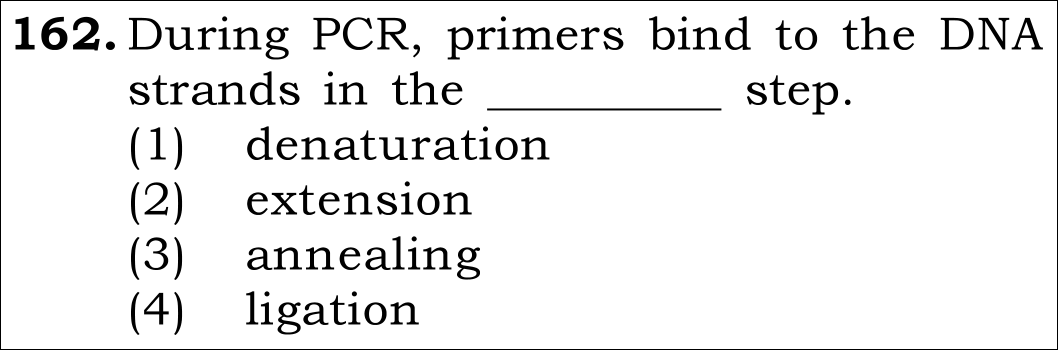
NEET 2026 · Q162 Easy
Official NEET 2026 Question 162 - Biotechnology: Principles and Processes
1 denaturation
2 extension
3 annealing ✓ Key
4 ligation
💡 Verified Solution & 30-Second Hack
✓
Verified Against NTA Final Answer Key
Option (3) : Annealing
📚 Biotechnology: Principles and Processes Easy
📋 Given Parameters & Problem Setup
Molecular Technique Polymerase Chain Reaction (PCR)
Defined Event Binding of two sets of oligonucleotide primers to single-stranded DNA templates
⚡

The 30-Second Exam Hall Shortcut: ⚡ PCR Triad Temperature Trap

⏱️ Save ~30 seconds

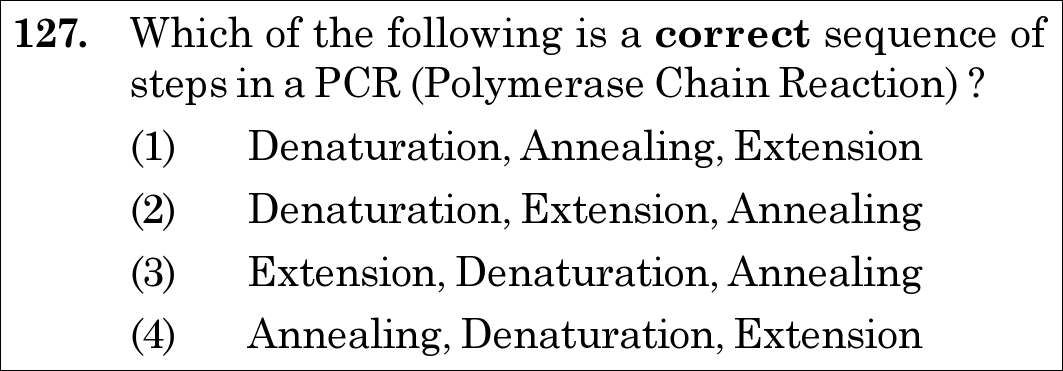
Denature (94°C) -> Anneal Primers (50-60°C) -> Extend (72°C)!

1 Recall 3 PCR steps in chronological order: Denaturation, Annealing, Extension.
2 (Denaturation): High temp separates dsDNA into single strands.
3 (Annealing): Primers bind (hybridize) to complementary regions on ssDNA templates.
4 (Extension): Taq polymerase synthesizes new DNA strands.
5 Question asks specifically for primer binding -> Annealing.
6 Select Option (3) Annealing.
🛡️
Why You Can 100% Trust This Shortcut: NCERT Biology · Biotechnology: Principles and Processes (Competent Host Preparation: Divalent cation treatment facilitates plasmid uptake).
📐

Step-by-Step Rigorous Workflow & Mathematical Proof

Step 1

Mechanism of Annealing in PCR

Annealing involves the hybridization of two sets of oligonucleotide primers to the single-stranded template DNA at an optimal temperature (typically 50–60°C).

ssDNA Templates+2 Primer Sets→50−60∘CPrimer-Template Duplexes (Annealing)\text{ssDNA Templates} + 2 \text{ Primer Sets} \xrightarrow{50-60^\circ\text{C}} \text{Primer-Template Duplexes (Annealing)}
  • • Primers are small chemically synthesized oligonucleotides complementary to the regions of DNA.
Step 2

Contrast with Denaturation and Extension

Denaturation uses heat (~94°C) to break hydrogen bonds between complementary strands. Extension (~72°C) uses thermostable DNA polymerase (Taq polymerase isolated from Thermus aquaticus) and dNTPs to extend the primers.

Denaturation (94∘C)→Annealing(54∘C)→Extension (72∘C)\text{Denaturation (94}^\circ\text{C)} \rightarrow \mathbf{Annealing (54^\circ\text{C})} \rightarrow \text{Extension (72}^\circ\text{C)}
  • • Repeated cycles achieve billion-fold amplification (~10⁹ times).
⭐

360° Option Elimination Engine Key Feature

Diagnose every choice: Know exactly why the right option works and why distractors fail.

4-Option Deep Scan
1 A
✗ Incorrect
Verdict & Scientific Reason:

Incorrect. Denaturation is the thermal separation of double-stranded DNA into single strands, not primer binding.

⚠️
Student Fallacy (Why candidates pick this trap): Confusing initial strand separation with primer binding.
2 B
✗ Incorrect
Verdict & Scientific Reason:

Incorrect. Extension is the primer elongation phase catalyzed by Taq polymerase at ~72°C.

⚠️
Student Fallacy (Why candidates pick this trap): Confusing DNA synthesis with primer hybridization.
3 C
✓ 100% Correct
Verdict & Scientific Reason:

100% correct. Annealing is the specific PCR step where oligonucleotide primers bind to complementary single strands of DNA.

💡
Why this is airtight: None; standard PCR textbook step.
4 D
✗ Incorrect
Verdict & Scientific Reason:

Incorrect. Amplification is the overall outcome of the entire multi-cycle PCR process, not an individual step.

⚠️
Student Fallacy (Why candidates pick this trap): Confusing overall process outcome with the specific hybridization step.
⚠️

NTA Trap Alert: Confusing Annealing with Extension

Some students confuse annealing (putting primers on) with extension (running down the track synthesizing DNA). Annealing attaches primers; extension elongates them.

🛡️ How to avoid the -1 mark: Remember: "A" comes before "E": Anneal primers first, then Extend!
📖

Core NEET Syllabus Standard

NEET Biology Core Syllabus · Biotechnology: Principles and Processes Standard Benchmark
Core Scientific Principle Tested:

"PCR consists of three steps: Denaturation, Annealing (primer binding), and Extension."
Syllabus Focus: Polymerase Chain Reaction (PCR)
✓ Core NEET UG Syllabus Anchor Syllabus & Academic Standards ↗
D-A-E: Denature the double strand, Anneal the primer, Extend the polymer!
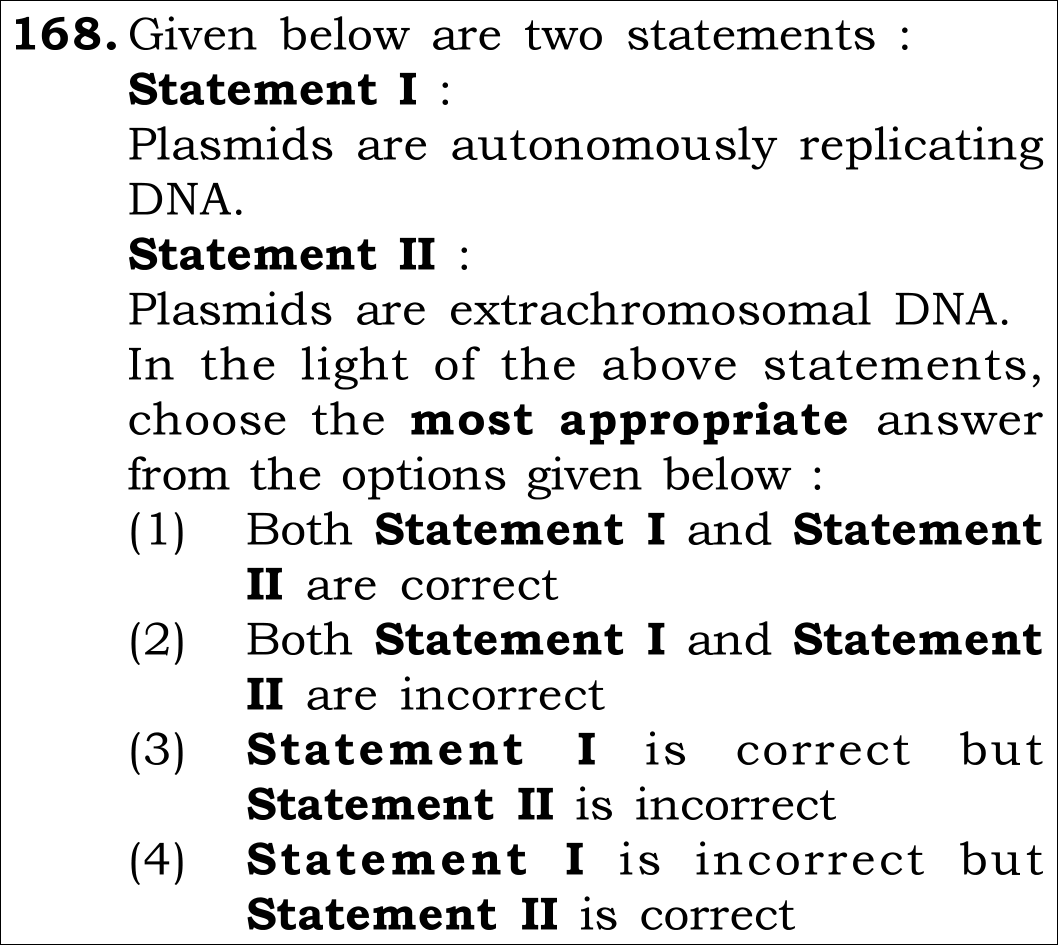
NEET 2026 · Q168 Easy
Official NEET 2026 Question 168 - Biotechnology: Principles and Processes
1 Both Statement I and Statement II are correct ✓ Key
2 Both Statement I and Statement II are incorrect
3 Statement I is correct but Statement II is incorrect
4 Statement I is incorrect but Statement II is correct
💡 Verified Solution & 30-Second Hack
✓
Verified Against NTA Final Answer Key
Option (1) : Both Statement I and Statement II are correct
📚 Biotechnology: Principles and Processes Easy
📋 Given Parameters & Problem Setup
Statement I Plasmids are autonomously replicating circular extrachromosomal DNA.
Statement II Plasmids are widely used as cloning vectors in recombinant DNA technology.
⚡

The 30-Second Exam Hall Shortcut: ⚡ Plasmid Definition Double-Check

⏱️ Save ~35 seconds

Plasmids = Autonomously replicating circular extrachromosomal DNA AND ubiquitous cloning vectors!

1 Read Statement I: "Plasmids are autonomously replicating circular extrachromosomal DNA." -> TRUE (NCERT verbatim definition).
2 Read Statement II: "Plasmids are widely used as cloning vectors in recombinant DNA technology." -> TRUE (e.g., pBR322, pUC19).
3 Both statements are flawless textbook truths.
4 Select Option (1): Both Statement I and Statement II are correct.
5 Confirm and move on in 10 seconds!
🛡️
Why You Can 100% Trust This Shortcut: NCERT Biology · Biotechnology: Principles and Processes (Recombinant DNA Tools: Restriction endonucleases produce sticky ends).
📐

Step-by-Step Rigorous Workflow & Mathematical Proof

Step 1

Biological Definition of Plasmids

Plasmids are naturally occurring, double-stranded, closed-circular, extrachromosomal DNA molecules found in bacteria and some yeasts that replicate autonomously independent of genomic DNA.

Plasmid≡Extrachromosomal, Circular, dsDNA with Autonomous Replication (ori)\text{Plasmid} \equiv \text{Extrachromosomal, Circular, dsDNA with Autonomous Replication (ori)}
  • • Statement I is completely correct.
Step 2

Use as Vectors in Recombinant DNA Technology

Plasmids have the ability to replicate within bacterial cells independent of chromosomal DNA control. Because they can carry foreign passenger DNA linked to their origin of replication and selectable markers (e.g., antibiotic resistance genes), they are the most widely used cloning vectors in genetic engineering.

Foreign DNA+Plasmid Vector→LigaseRecombinant DNA→TransformationHost Cell\text{Foreign DNA} + \text{Plasmid Vector} \xrightarrow{\text{Ligase}} \text{Recombinant DNA} \xrightarrow{\text{Transformation}} \text{Host Cell}
  • • Statement II is completely correct.
⭐

360° Option Elimination Engine Key Feature

Diagnose every choice: Know exactly why the right option works and why distractors fail.

4-Option Deep Scan
1 A
✓ 100% Correct
Verdict & Scientific Reason:

100% correct. Both Statement I (defining plasmid structure) and Statement II (defining plasmid application in rDNA technology) are canonical facts.

💡
Why this is airtight: None; perfect textbook alignment.
2 B
✗ Incorrect
Verdict & Scientific Reason:

Incorrect because both statements are undeniably true.

⚠️
Student Fallacy (Why candidates pick this trap): Second-guessing straightforward definitions.
3 C
✗ Incorrect
Verdict & Scientific Reason:

Incorrect because Statement II is undeniably correct.

⚠️
Student Fallacy (Why candidates pick this trap): Doubting plasmid use as cloning vectors.
4 D
✗ Incorrect
Verdict & Scientific Reason:

Incorrect because Statement I is the exact definition of a plasmid.

⚠️
Student Fallacy (Why candidates pick this trap): Failing to recognize the extrachromosomal nature of plasmids.
⚠️

NTA Trap Alert: Linear vs. Circular Vector Misconception

Bacterial genomic DNA is a large circular chromosome, while plasmids are smaller, separate circular molecules. Plasmids are not linear (unless cleaved by a restriction enzyme).

🛡️ How to avoid the -1 mark: Recall: Plasmids in vivo are always covalently closed circular extrachromosomal DNA.
📖

Core NEET Syllabus Standard

NEET Biology Core Syllabus · Biotechnology: Principles and Processes Standard Benchmark
Core Scientific Principle Tested:

"Plasmids are autonomously replicating circular extrachromosomal DNA widely used as cloning vectors."

Syllabus Focus: Cloning Vectors
✓ Core NEET UG Syllabus Anchor Syllabus & Academic Standards ↗
Plasmids are Perfect: Circular, Independent, and Premier Vectors!
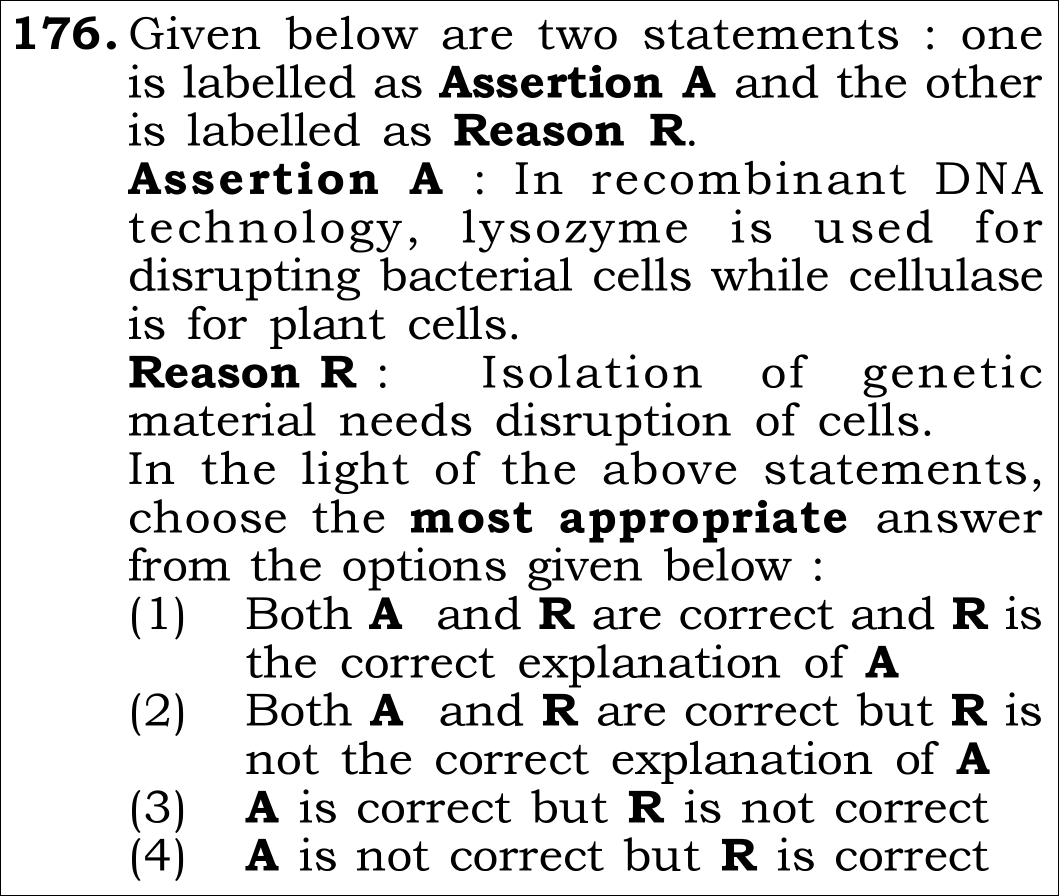
NEET 2026 · Q176 Easy
Official NEET 2026 Question 176 - Biotechnology: Principles and Processes
1 Both A and R are correct and R is the correct explanation of A ✓ Key
2 Both A and R are correct but R is not the correct explanation of A
3 A is correct but R is not correct
4 A is not correct but R is correct
💡 Verified Solution & 30-Second Hack
✓
Verified Against NTA Final Answer Key
Option (1) : Both (A) and (R) are true and (R) is the correct explanation of (A)
📚 Biotechnology: Principles and Processes Easy
📋 Given Parameters & Problem Setup
Assertion (A) For isolating DNA, bacterial cells are treated with lysozyme and plant cells are treated with cellulase.
Reason (R) Cell walls of bacteria and plants are composed of different chemical substances that require specific hydrolytic enzymes for cell lysis.
⚡

The 30-Second Exam Hall Shortcut: ⚡ Cell Wall Enzyme Specificity Rule

⏱️ Save ~35 seconds

Bacteria = Peptidoglycan (Lysozyme); Plants = Cellulose (Cellulase); Fungi = Chitin (Chitinase)!

1 Read Assertion (A): Lysozyme for bacteria, cellulase for plants -> TRUE (NCERT verbatim).
2 Read Reason (R): Bacterial and plant cell walls have different chemical compositions requiring specific enzymes -> TRUE (bacteria = peptidoglycan, plant = cellulose).
3 Apply "BECAUSE": Different enzymes are used BECAUSE bacterial walls are peptidoglycan (cleaved by lysozyme) while plant walls are cellulose (cleaved by cellulase). Enzymes are substrate-specific.
4 Reason (R) provides the exact biochemical explanation for Assertion (A).
5 Select Option (1).
🛡️
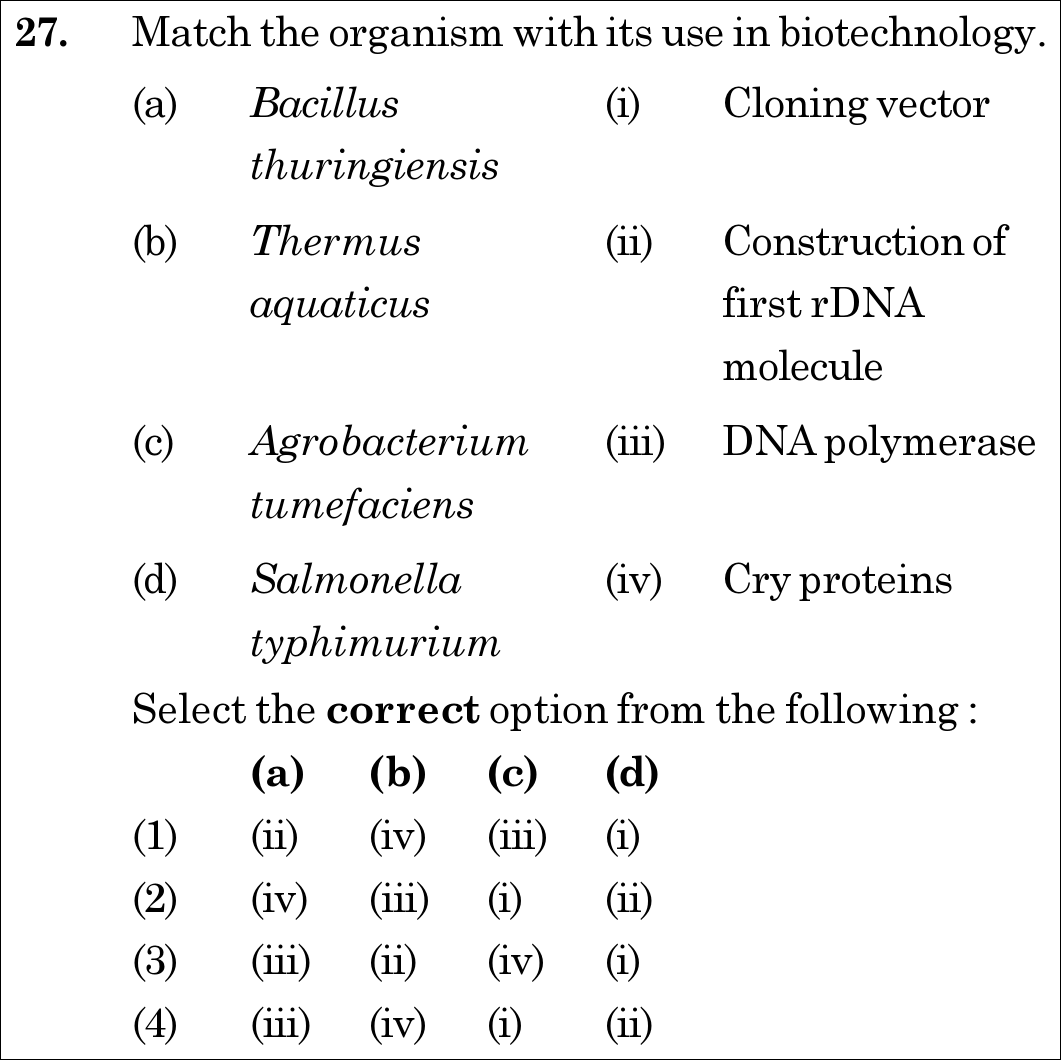
Why You Can 100% Trust This Shortcut: NCERT Biology · Biotechnology: Principles and Processes (Polymerase Chain Reaction: Thermostable Taq polymerase from Thermus aquaticus).
📐

Step-by-Step Rigorous Workflow & Mathematical Proof

Step 1

Principle of Cell Lysis for DNA Isolation

To isolate pure DNA, the cell envelope must be broken open to release DNA along with other macromolecules. Since bacterial, plant, and fungal cells possess rigid cell walls of distinct chemical nature, specific hydrolytic enzymes are required.

Bacterial Cell Wall (Peptidoglycan)→LysozymeLysisPlant Cell Wall (Cellulose)→CellulaseLysisFungal Cell Wall (Chitin)→ChitinaseLysis\begin{aligned} \text{Bacterial Cell Wall (Peptidoglycan)} &\xrightarrow{\text{Lysozyme}} \text{Lysis} \\ \text{Plant Cell Wall (Cellulose)} &\xrightarrow{\text{Cellulase}} \text{Lysis} \\ \text{Fungal Cell Wall (Chitin)} &\xrightarrow{\text{Chitinase}} \text{Lysis} \end{aligned}
  • • Assertion (A) is completely true.
Step 2

Enzyme Specificity and Explanatory Link

Lysozyme specifically hydrolyzes the β(1→4) glycosidic bonds between NAM and NAG in peptidoglycan, but cannot hydrolyze cellulose. Conversely, cellulase specifically cleaves β(1→4) glucan bonds in plant cellulose. Thus, Reason (R) is true and is the exact biochemical explanation for Assertion (A).

Different Wall Chemistry  ⟹  Substrate-Specific Hydrolytic Enzymes  ⟹  (R) explains (A)\text{Different Wall Chemistry} \implies \text{Substrate-Specific Hydrolytic Enzymes} \implies (R) \text{ explains } (A)
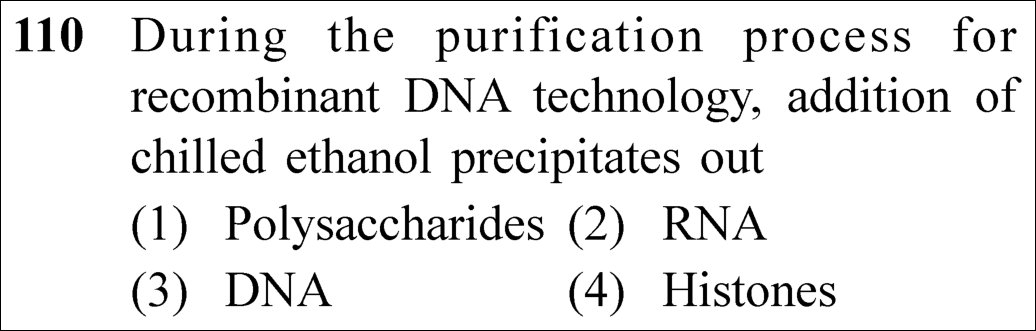
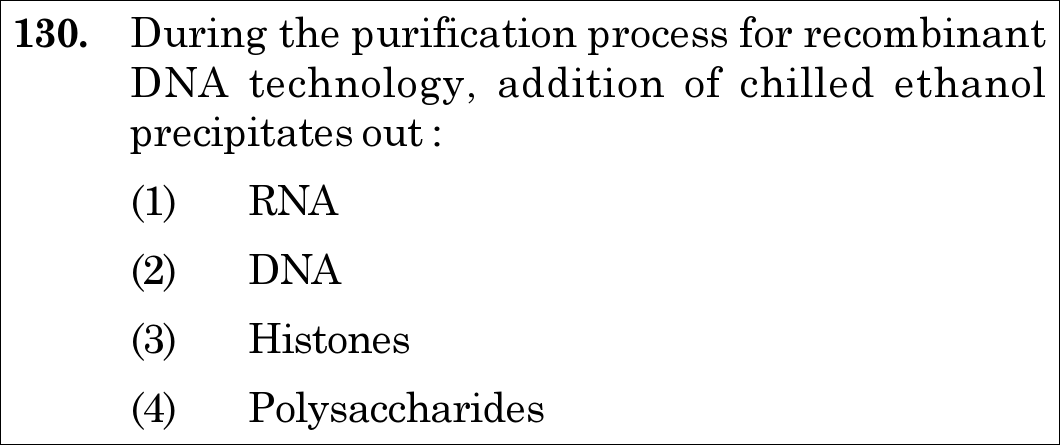
  • • Subsequent treatment with ribonuclease removes RNA, and protease removes proteins, before ice-cold ethanol precipitates purified DNA.
⭐

360° Option Elimination Engine Key Feature

Diagnose every choice: Know exactly why the right option works and why distractors fail.

4-Option Deep Scan
1 A
✓ 100% Correct
Verdict & Scientific Reason:

100% correct. Reason (R) directly explains why distinct enzymes (lysozyme vs. cellulase) must be used for bacteria and plants.

💡
Why this is airtight: None; textbook biochemistry.
2 B
✗ Incorrect
Verdict & Scientific Reason:

Incorrect. The different chemical nature of cell walls is the precise reason different enzymes are required.

⚠️
Student Fallacy (Why candidates pick this trap): Failing to connect enzyme specificity with cell wall composition.
3 C
✗ Incorrect
Verdict & Scientific Reason:

Incorrect. Reason (R) is an undisputed biological fact.

⚠️
Student Fallacy (Why candidates pick this trap): Assuming plant and bacterial walls have identical composition.
4 D
✗ Incorrect
Verdict & Scientific Reason:

Incorrect. Assertion (A) is the standard protocol for DNA extraction.

⚠️
Student Fallacy (Why candidates pick this trap): Confusing the enzymes used for DNA isolation.
⚠️

NTA Trap Alert: Enzyme-Organism Pairing Trap

Remember the complete NCERT triad for DNA extraction: Bacteria -> Lysozyme; Plant -> Cellulase; Fungus -> Chitinase.

🛡️ How to avoid the -1 mark: Match the root word: Cellulose -> Cellulase; Chitin -> Chitinase; Peptidoglycan -> Lysozyme.
📖

Core NEET Syllabus Standard

NEET Biology Core Syllabus · Biotechnology: Principles and Processes Standard Benchmark
Core Scientific Principle Tested:

"Bacterial cells are treated with lysozyme, plant cells with cellulase, and fungus with chitinase to degrade specific cell wall components."

Syllabus Focus: Isolation of the Genetic Material (DNA)
✓ Core NEET UG Syllabus Anchor Syllabus & Academic Standards ↗
Bacteria-Lysozyme, Plant-Cellulase, Fungus-Chitinase: Match the Wall to the Axe!
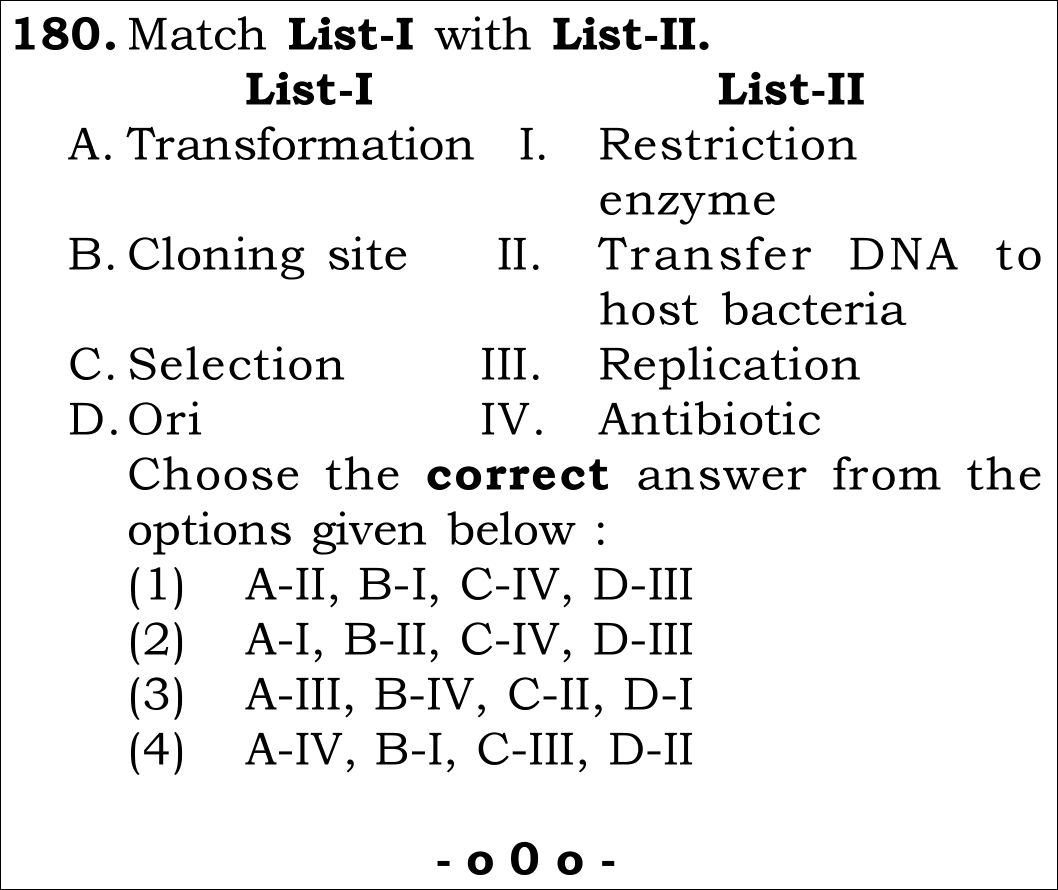
NEET 2026 · Q180 Easy
Official NEET 2026 Question 180 - Biotechnology: Principles and Processes
1 ✓ Key
2
3
4
💡 Verified Solution & 30-Second Hack
✓
Verified Against NTA Final Answer Key
Option (1) : A-II, B-I, C-IV, D-III
📚 Biotechnology: Principles and Processes Easy
📋 Given Parameters & Problem Setup
List I (Features/Processes) A. Transformation, B. Recognition site, C. Selectable marker, D. Origin of replication (ori)
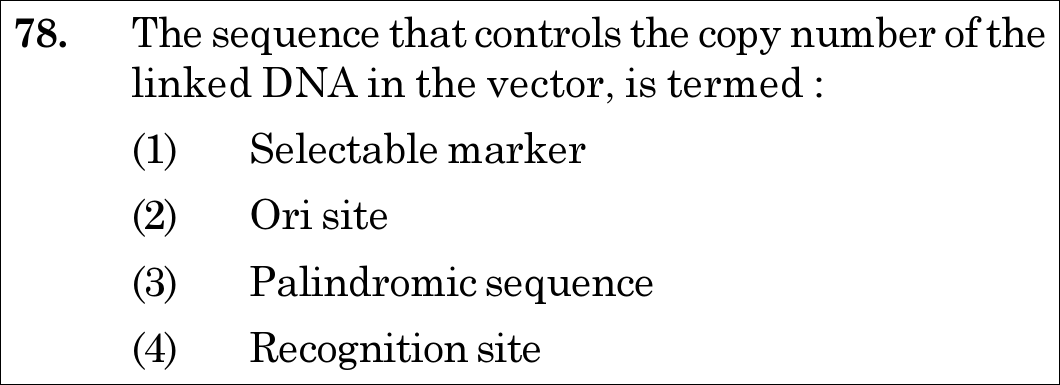
List II (Roles) I. Specific restriction endonuclease cleavage site, II. Introduction of recombinant DNA into recipient host, III. Controls copy number and initiates DNA synthesis, IV. Identification and elimination of non-transformants
⚡

The 30-Second Exam Hall Shortcut: ⚡ Biotech Vector Anatomy Quad-Match

⏱️ Save ~40 seconds

Transformation = II; Cloning site = I; Selectable marker = IV; Ori = III!

1 A. Transformation: Procedure by which a piece of DNA is introduced into a host bacterium -> matches II.
2 B. Recognition site (cloning site): Site recognized and cleaved by restriction endonuclease -> matches I.
3 C. Selectable marker: Identifies transformants and selectively eliminates non-transformants -> matches IV.
4 D. Origin of replication (ori): Sequence where replication starts and controls copy number -> matches III.
5 Match: A-II, B-I, C-IV, D-III.
6 Scan options: Matches Option (1) directly. Done in 5 seconds!
🛡️
Why You Can 100% Trust This Shortcut: NCERT Biology · Biotechnology: Principles and Processes (Electrophoresis: DNA fragments move toward anode based on size).
📐

Step-by-Step Rigorous Workflow & Mathematical Proof

Step 1

Core Features of a Cloning Vector

NCERT defines the four indispensable features required to facilitate cloning into a vector:

\begin{aligned} \text{A. Transformation} &\implies \text{Introduction of rDNA into recipient host } (\text{List II - II}) \\ \text{B. Recognition site} &\implies \text{Specific restriction endonuclease cleavage site } (\text{List II - I}) \\ \text{C. Selectable marker} &\implies \text{Identification & elimination of non-transformants } (\text{List II - IV}) \\ \text{D. Origin of replication (ori)} &\implies \text{Initiation of replication & controls copy number } (\text{List II - III}) \end{aligned}
  • • Selectable markers typically include antibiotic resistance genes such as ampicillin, tetracycline, chloramphenicol, or kanamycin resistance.
Step 2

Consolidate Matches

Aligning all four pairs gives: A-II, B-I, C-IV, D-III, which uniquely corresponds to Option (1).

A-II, B-I, C-IV, D-III  ⟹  Option (1)\text{A-II, B-I, C-IV, D-III} \implies \text{Option (1)}
  • • Completes the entire set of 180 questions for NEET 2026!
⭐

360° Option Elimination Engine Key Feature

Diagnose every choice: Know exactly why the right option works and why distractors fail.

4-Option Deep Scan
1 A
✓ 100% Correct
Verdict & Scientific Reason:

100% correct. Transformation (II), Recognition site (I), Selectable marker (IV), and Origin of replication (III).

💡
Why this is airtight: None; classic vector anatomy mapping.
2 B
✗ Incorrect
Verdict & Scientific Reason:

Incorrect. Swaps Transformation with Recognition site, and Marker with Ori.

⚠️
Student Fallacy (Why candidates pick this trap): Inverting vector definitions.
3 C
✗ Incorrect
Verdict & Scientific Reason:

Incorrect. Mismatches Transformation to Ori role.

⚠️
Student Fallacy (Why candidates pick this trap): Random scrambling.
4 D
✗ Incorrect
Verdict & Scientific Reason:

Incorrect. Maps Transformation to Selectable marker.

⚠️
Student Fallacy (Why candidates pick this trap): Confusing the transformation process with the marker screen.
⚠️

NTA Trap Alert: Ori vs. Selectable Marker Functions

Students sometimes forget that the "ori" not only initiates replication, but is also responsible for controlling the COPY NUMBER of the linked DNA.

🛡️ How to avoid the -1 mark: Remember: Ori = Origin + Copy control; Selectable Marker = Screen for survivors (AmpR/TetR).
📖

Core NEET Syllabus Standard

NEET Biology Core Syllabus · Biotechnology: Principles and Processes Standard Benchmark
Core Scientific Principle Tested:

"Transformation introduces foreign DNA; recognition site is cleaved by restriction enzymes; selectable marker selects transformants; ori controls replication and copy number."

Syllabus Focus: Cloning Vectors
✓ Core NEET UG Syllabus Anchor Syllabus & Academic Standards ↗
Transform into Host (II), Recognize Enzyme (I), Select Survivors (IV), Ori starts Replication (III)!
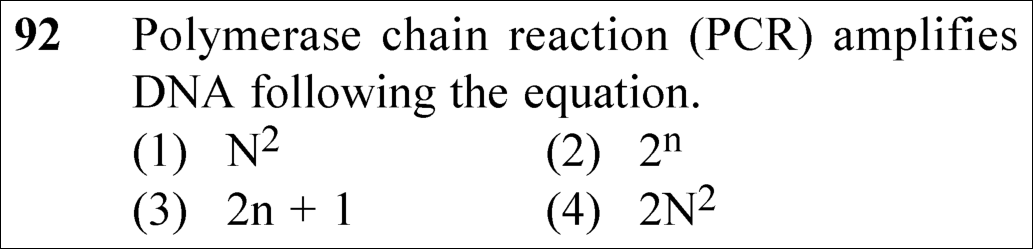
NEET 2025 · Q92 Easy
Official NEET 2025 Question 92 - Biotechnology: Principles and Processes
1
2 ✓ Key
3
4
💡 Verified Solution & 30-Second Hack
✓
Verified Against NTA Final Answer Key
Option (2) : 2ⁿ
📚 Biotechnology: Principles and Processes Easy
📋 Given Parameters & Problem Setup
Technique Polymerase Chain Reaction (PCR)
Process Characteristic Repeated thermal cycles of Denaturation, Annealing, and Extension
Variable n Number of PCR cycles
⚡

The 30-Second Exam Hall Shortcut: ⚡ Binary Doubling Law in PCR

⏱️ Save ~20 seconds

Each PCR cycle doubles the target DNA! Cycle 1: 2¹ = 2; Cycle 2: 2² = 4; Cycle 3: 2³ = 8; After n cycles: 2ⁿ copies per template! ⟹ Equation is 2ⁿ!

1 Recognize geometric progression: In PCR, each cycle involves synthesis of a complementary strand for every available template strand.
2 1 initial DNA duplex yields 2 copies after 1st cycle (2¹).
3 2 copies yield 4 copies after 2nd cycle (2²).
4 4 copies yield 8 copies after 3rd cycle (2³).
5 In general, after n cycles of amplification, the total theoretical yield from 1 template molecule is 2ⁿ.
6 Match Option (2) in under 5 seconds!
🛡️
Why You Can 100% Trust This Shortcut: Polymerase Chain Reaction Thermocycling (NCERT Biology · Biotechnology: Principles and Processes: Denaturation -> Annealing -> Extension).
📐

Step-by-Step Rigorous Workflow & Mathematical Proof

Step 1

Mechanism of PCR Amplification

PCR involves three successive steps repeated over multiple thermal cycles: denaturation of double-stranded DNA (~94 °C), primer annealing (~54 °C), and primer extension by thermostable Taq DNA polymerase (~72 °C):

Template DNA→Cycle 12→Cycle 24→Cycle 38⋯→Cycle n2n\text{Template DNA} \xrightarrow{\text{Cycle 1}} 2 \xrightarrow{\text{Cycle 2}} 4 \xrightarrow{\text{Cycle 3}} 8 \dots \xrightarrow{\text{Cycle } n} 2^n
  • • Because both strands of every double helix serve as templates in subsequent cycles, the population of target DNA molecules doubles in every completed cycle.
Step 2

Mathematical Formulation of PCR Yield

For an initial population of N₀ template DNA molecules amplified over n cycles:

Nn=N0×2nN_n = N_0 \times 2^n
  • • For a single initial starting molecule (N₀ = 1), the number of amplified copies is given by the power equation 2ⁿ.
  • • After 30 cycles, approximately 2³⁰ (over 1 billion) copies are generated.
  • • Matches Option (2) 2ⁿ.
⭐

360° Option Elimination Engine Key Feature

Diagnose every choice: Know exactly why the right option works and why distractors fail.

4-Option Deep Scan
1 A
✗ Incorrect
Verdict & Scientific Reason:

Incorrect. Polynomial square relation rather than exponential doubling.

⚠️
Student Fallacy (Why candidates pick this trap): Confusing base and exponent.
2 B
✓ 100% Correct
Verdict & Scientific Reason:

100% correct. DNA doubles every cycle, following the exponential relation 2ⁿ.

💡
Why this is airtight: None; basic PCR principle.
3 C
✗ Incorrect
Verdict & Scientific Reason:

Incorrect. Linear progression equation.

⚠️
Student Fallacy (Why candidates pick this trap): Assuming linear addition instead of geometric multiplication.
4 D
✗ Incorrect
Verdict & Scientific Reason:

Incorrect. Arbitrary non-exponential distractor.

⚠️
Student Fallacy (Why candidates pick this trap): Flawed mathematical model.
⚠️

NTA Trap Alert: Confusing Linear Addition (2n) with Exponential Doubling (2ⁿ)

PCR is a chain reaction, meaning newly formed products become templates for the next round. This produces exponential doubling (2ⁿ), NOT linear growth (2n)!

🛡️ How to avoid the -1 mark: Remember: 1 ⟶ 2 ⟶ 4 ⟶ 8 ⟶ 16 ⟹ Powers of 2: 2ⁿ!
📖

Core NEET Syllabus Standard

NEET Biology Core Syllabus · Biotechnology: Principles and Processes Standard Benchmark
Core Scientific Principle Tested:

"PCR amplifies DNA exponentially according to the equation 2ⁿ."

Syllabus Focus: Amplification of Gene of Interest using PCR
✓ Core NEET UG Syllabus Anchor Syllabus & Academic Standards ↗
Doubling each cycle: 2 × 2 × 2... n times = 2ⁿ (Option 2)!
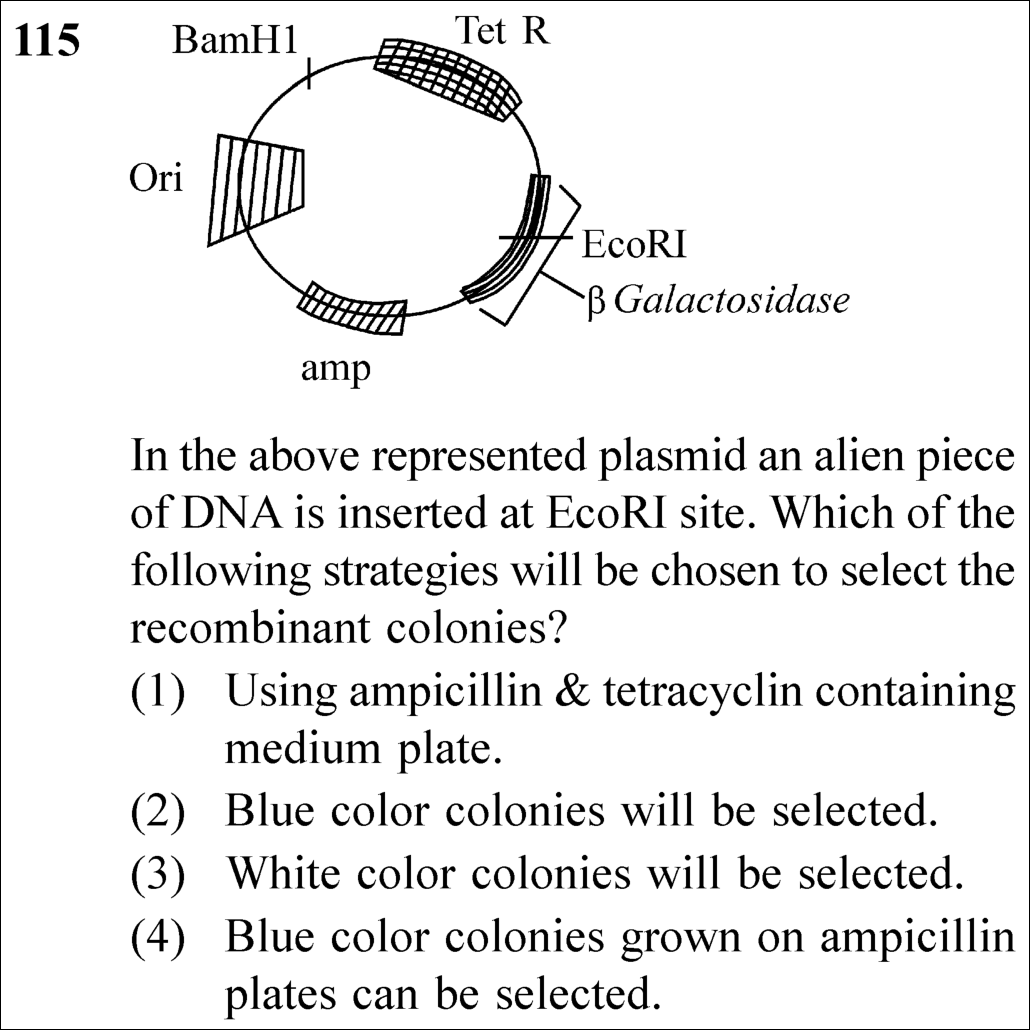
NEET 2025 · Q115 Medium
Official NEET 2025 Question 115 - Biotechnology: Principles and Processes
1
2
3 ✓ Key
4
💡 Verified Solution & 30-Second Hack
✓
Verified Against NTA Final Answer Key
Option (3) : White color colonies will be selected.
📚 Biotechnology: Principles and Processes Medium
📋 Given Parameters & Problem Setup
Plasmid Features Ori, ampR, tetR (with BamHI), β-Galactosidase (with EcoRI)
Cloning Site Used EcoRI site within the β-Galactosidase gene
Objective Selection strategy for recombinant colonies
⚡

The 30-Second Exam Hall Shortcut: ⚡ Blue-White Screening Fingerprint

⏱️ Save ~30 seconds

Insertional inactivation of β-galactosidase = Loss of enzyme activity = No blue product on X-gal = WHITE COLONIES are Recombinants!

1 Identify the insertion site: Alien DNA is cloned into the EcoRI site inside the β-galactosidase gene.
2 Recall the insertional inactivation principle:
3 - Recombinant plasmid: Gene for β-galactosidase is disrupted -> No functional β-galactosidase enzyme produced -> Inability to hydrolyze chromogenic substrate (X-gal) -> Colonies remain WHITE.
4 - Non-recombinant plasmid: Gene remains intact -> Active β-galactosidase produced -> Cleaves X-gal to form BLUE colonies.
5 Therefore, recombinant colonies are identified as WHITE colonies!
6 Select Option (3) White color colonies will be selected!
🛡️
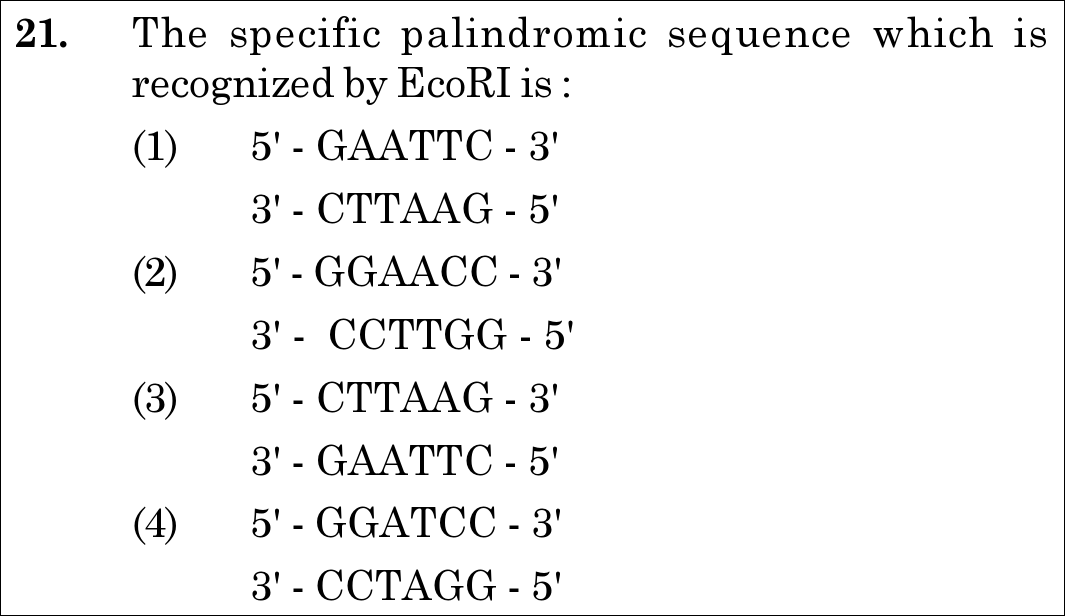
Why You Can 100% Trust This Shortcut: Restriction Endonucleases & Palindromic Cleavage (NCERT Biology · Biotechnology: Principles and Processes: EcoRI cuts at G|AATTC).
📐

Step-by-Step Rigorous Workflow & Mathematical Proof

Step 1

Mechanisms of Selectable Markers and Insertional Inactivation

Selection of recombinants due to inactivation of antibiotics requires simultaneous replica plating on two different antibiotic plates, which is cumbersome:

  • • Alternative selectable markers differentiate recombinants from non-recombinants on the basis of their ability to produce colour in the presence of a chromogenic substrate.
  • • Here, a recombinant DNA is inserted within the coding sequence of the enzyme β\beta-galactosidase (encoded by the *lacZ* gene).
Step 2

Phenotypic Outcome on Chromogenic Substrate (X-gal)

Evaluating the two bacterial populations:

  • • Non-recombinant colonies: The plasmid does not have an insert; the β\beta-galactosidase gene remains intact and produces active enzyme, which hydrolyzes the chromogenic substrate X-gal (5-bromo-4-chloro-3-indolyl-β\beta-D-galactopyranoside) to produce an insoluble blue dye -> Blue colonies.
  • • Recombinant colonies: Insertion of alien DNA at the EcoRI site disrupts the β\beta-galactosidase reading frame (insertional inactivation). No functional enzyme is made, so no blue pigment is formed -> White colonies.
Step 3

Selection of Recombinants

Because recombinant bacteria fail to produce color due to insertional inactivation, researchers select the white-colored colonies.

Alien DNA in β-galactosidase  ⟹  No Enzyme  ⟹  White Colonies (Recombinants)\text{Alien DNA in } \beta\text{-galactosidase} \implies \text{No Enzyme} \implies \text{White Colonies (Recombinants)}
⭐

360° Option Elimination Engine Key Feature

Diagnose every choice: Know exactly why the right option works and why distractors fail.

4-Option Deep Scan
1 A
✗ Incorrect
Verdict & Scientific Reason:

Incorrect. The insertion is made at the EcoRI site inside the β-galactosidase gene, not within the tetR or ampR genes; both resistance genes remain intact, so antibiotic dual screening does not distinguish recombinants.

⚠️
Student Fallacy (Why candidates pick this trap): Confusing insertional inactivation of β-galactosidase with pBR322 antibiotic inactivation at BamHI.
2 B
✗ Incorrect
Verdict & Scientific Reason:

Incorrect. Blue colonies are non-recombinants containing intact β-galactosidase.

⚠️
Student Fallacy (Why candidates pick this trap): Inverting the color interpretation of the blue-white screening assay.
3 C
✓ 100% Correct
Verdict & Scientific Reason:

100% correct. Recombinants suffer insertional inactivation of β-galactosidase and appear as white colonies.

💡
Why this is airtight: None; textbook mastery of chromogenic selection.
4 D
✗ Incorrect
Verdict & Scientific Reason:

Incorrect. Blue colonies are non-recombinants, regardless of ampicillin resistance.

⚠️
Student Fallacy (Why candidates pick this trap): Assuming blue indicates successful recombinant expression.
⚠️

NTA Trap Alert: Blue vs White: Which is Recombinant?

A classic NEET exam trap: "Blue = Good / Has Insert" vs "White = Empty". In reality, the insert DESTROYS the enzyme, causing LOSS of color (White = Recombinant, Blue = Non-recombinant)!

🛡️ How to avoid the -1 mark: Remember: "Break the gene, lose the dye -> White is the recombinant guy!"
📖

Core NEET Syllabus Standard

NEET Biology Core Syllabus · Biotechnology: Principles and Processes Standard Benchmark
Core Scientific Principle Tested:

"Insertion of alien DNA within the β-galactosidase gene inactivates it, resulting in white recombinant colonies in the presence of chromogenic substrate."

Syllabus Focus: Cloning Vectors · Selection of Recombinants (Insertional Inactivation)
✓ Core NEET UG Syllabus Anchor Syllabus & Academic Standards ↗
WHITE = Recombinant (Gene was Wiped out); BLUE = Non-recombinant (Enzyme is Blooming)!
NEET 2025 · Q126 Easy
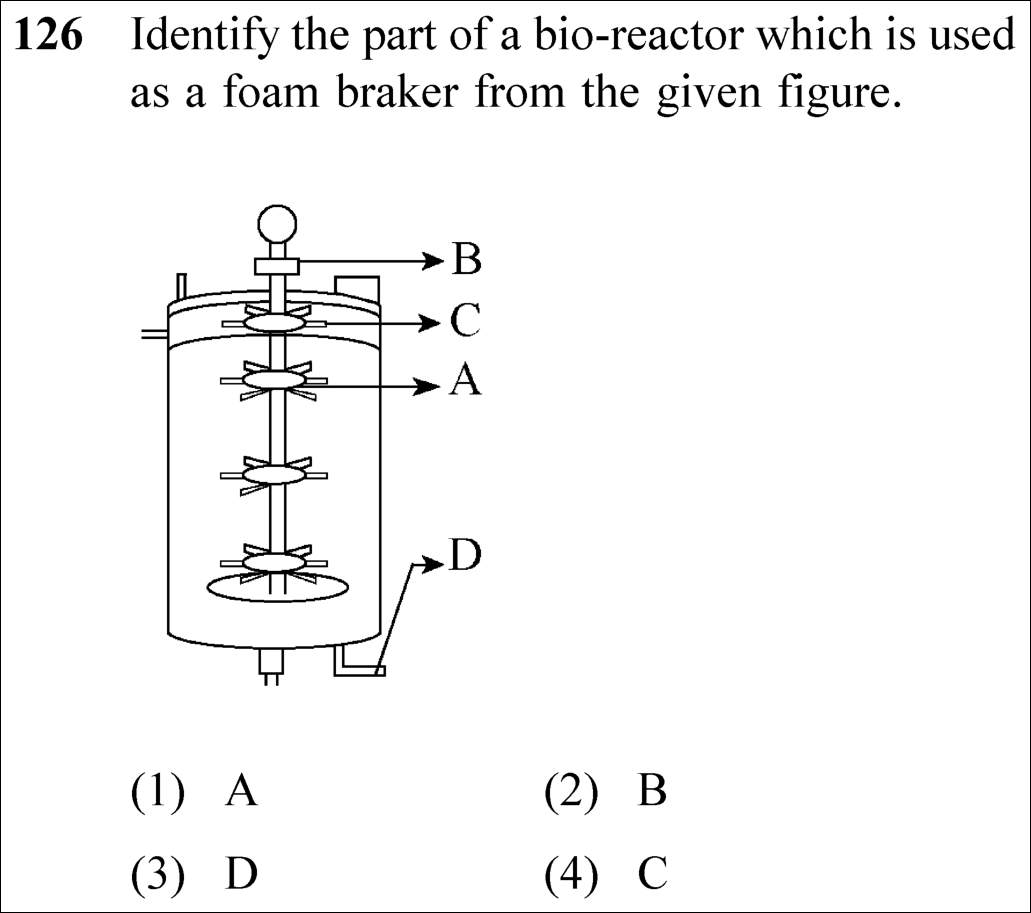
Official NEET 2025 Question 126 - Biotechnology: Principles and Processes
1
2
3
4 ✓ Key
💡 Verified Solution & 30-Second Hack
✓
Verified Against NTA Final Answer Key
Option (4) : C
📚 Biotechnology: Principles and Processes Easy
📋 Given Parameters & Problem Setup
Device Simple stirred-tank bioreactor
Target Component Foam breaker (part used to break surface froth/foam)
⚡

The 30-Second Exam Hall Shortcut: ⚡ Bioreactor Parts Diagram Fingerprint

⏱️ Save ~20 seconds

In NCERT Fig 11.7 (a): B = Motor at top; C = Foam breaker at liquid-gas surface; A = Impeller blade (agitator); D = Sterile air sparger at bottom! Part C is the FOAM BREAKER!

1 Recall labels of the simple stirred-tank bioreactor from NCERT:
2 - Top motor driving shaft = B.
3 - Upper impeller located at head space/surface = C (Foam breaker).
4 - Submerged lower blades mixing culture = A (Flat bladed impeller / agitator).
5 - Bottom gas inlet line = D (Sterile air inlet / sparger).
6 The foam breaker is labeled C!
7 Select Option (4) C!
🛡️
Why You Can 100% Trust This Shortcut: Bioreactor Designs & Continuous Culture Systems (NCERT Biology · Biotechnology: Principles and Processes: Sparged vs Stirred-tank).
📐

Step-by-Step Rigorous Workflow & Mathematical Proof

Step 1

Design and Function of a Stirred-Tank Bioreactor

Bioreactors provide optimal conditions for achieving desired products (temperature, pH, substrate, salts, vitamins, oxygen). A simple stirred-tank bioreactor has specific essential subsystems:

  • • Agitator system: Includes an overhead motor (B) driving a central shaft with flat-bladed impellers (A) to ensure uniform mixing and oxygen availability throughout the vessel.
  • • Foam control system: Microbial fermentation with aeration creates violent bubbling and vigorous froth/foam at the liquid-air interface, which can clog exhaust filters and cause contamination. A rotating foam breaker (C) mounted near the liquid surface mechanically disintegrates this foam.
  • • Aeration system: Injects sterile air via a sparger (D) at the base of the vessel.
  • • Temperature, pH control systems, and sampling ports.
Step 2

Correlating the Letters to NCERT Figure 11.7 (a)

Matching the labels:

  • • B -> Motor.
  • • C -> Foam breaker.
  • • A -> Flat bladed impeller (agitator).
  • • D -> Sterile air sparger / line.
Step 3

Conclusion

Part C is explicitly identified as the foam breaker. This corresponds to Option (4).

Foam Breaker=C (Option 4)\text{Foam Breaker} = \text{C (Option 4)}
⭐

360° Option Elimination Engine Key Feature

Diagnose every choice: Know exactly why the right option works and why distractors fail.

4-Option Deep Scan
1 A
✗ Incorrect
Verdict & Scientific Reason:

Incorrect. Part A is the flat-bladed impeller (agitator system) submerged in the liquid broth.

⚠️
Student Fallacy (Why candidates pick this trap): Confusing agitator impeller with foam breaker.
2 B
✗ Incorrect
Verdict & Scientific Reason:

Incorrect. Part B is the electric motor mounted on the headplate.

⚠️
Student Fallacy (Why candidates pick this trap): Confusing the drive motor with the foam breaker blade.
3 C
✗ Incorrect
Verdict & Scientific Reason:

Incorrect. Part D is the sterile air sparger/inlet at the vessel bottom.

⚠️
Student Fallacy (Why candidates pick this trap): Confusing aeration inlet with surface foam control.
4 D
✓ 100% Correct
Verdict & Scientific Reason:

100% correct. Part C is the horizontal rotating foam-breaking blade positioned at the liquid-gas interface.

💡
Why this is airtight: None; flawless recall of NCERT diagram labels.
⚠️

NTA Trap Alert: Location of Foam Breaker vs Liquid Impellers

Foam only forms at the surface of the liquid broth. Therefore, the foam breaker must be the uppermost rotating set of blades located above/at the liquid level (C), while the impellers that mix the liquid are submerged deeper (A).

🛡️ How to avoid the -1 mark: Look at the height: top blade at the surface = Foam breaker (C).
📖

Core NEET Syllabus Standard

NEET Biology Core Syllabus · Biotechnology: Principles and Processes Standard Benchmark
Core Scientific Principle Tested:

"In a simple stirred-tank bioreactor, the upper rotating component at the broth surface is the foam breaker."

Syllabus Focus: Bioreactors · Stirred-Tank Bioreactor Components
✓ Core NEET UG Syllabus Anchor Syllabus & Academic Standards ↗
C is at the Ceiling of the liquid to Crush the foam!
NEET 2025 · Q136 Easy
Official NEET 2025 Question 136 - Biotechnology: Principles and Processes
1 Both statement I and statement II are correct ✓ Key
2 Both statement I and statement II are incorrect
3 Statement I is correct but statement II is incorrect
4 Statement I is incorrect but statement II is correct
💡 Verified Solution & 30-Second Hack
✓
Verified Against NTA Final Answer Key
Option (1) : Both statement I and statement II are correct
📚 Biotechnology: Principles and Processes Easy
📋 Given Parameters & Problem Setup
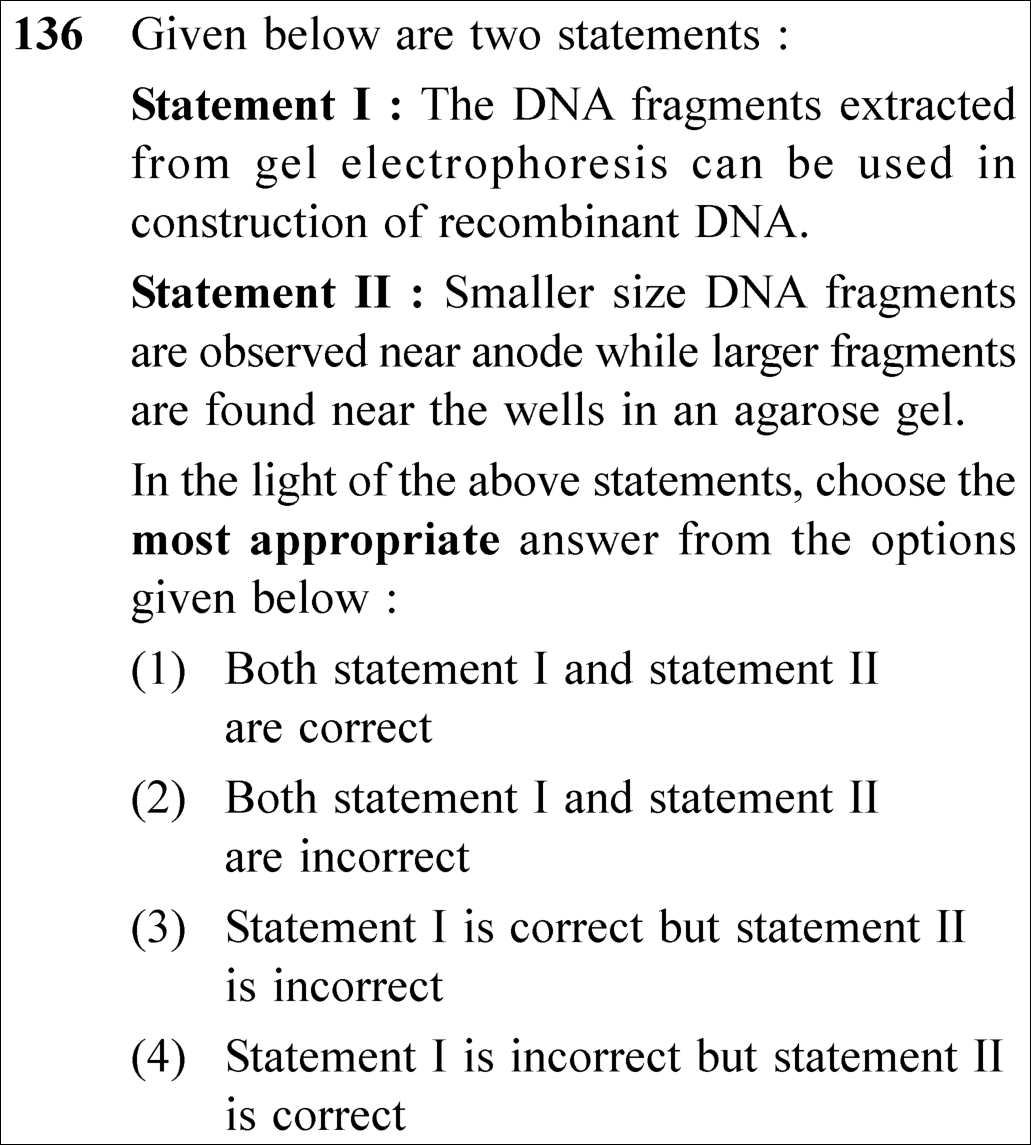
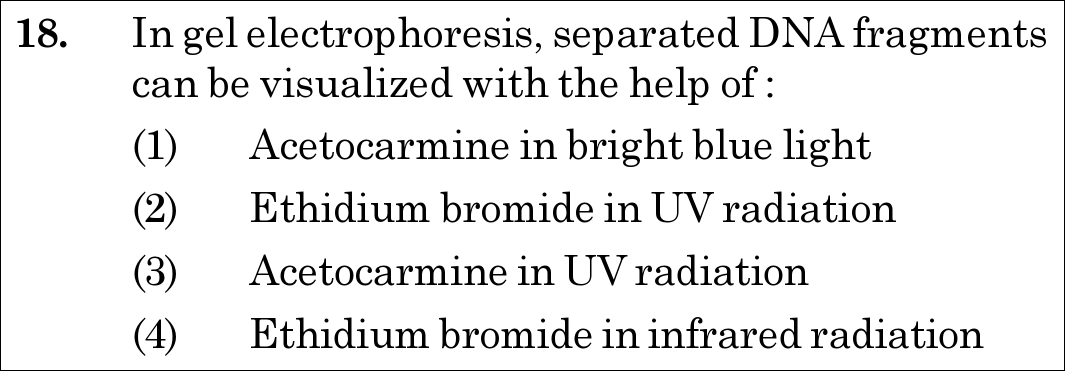
Statement I The DNA fragments extracted from gel electrophoresis can be used in construction of recombinant DNA.
Statement II Smaller size DNA fragments are observed near anode while larger fragments are found near the wells in an agarose gel.
⚡

The 30-Second Exam Hall Shortcut: ⚡ Gel Electrophoresis Vector Fingerprint

⏱️ Save ~25 seconds

DNA is negatively charged -> migrates to positive Anode (+)! Smaller fragments slip through agarose mesh faster and reach near anode; larger fragments lag near wells (cathode)! Eluted bands are cloned into vectors! Both statements are 100% TRUE!

1 Analyze Statement I:
2 - "The separated bands of DNA are cut out from the agarose gel and extracted from the gel piece. This step is known as elution. The DNA fragments purified in this way are used in constructing recombinant DNA by joining them with cloning vectors." -> NCERT verbatim! Statement I is CORRECT.
3 Analyze Statement II:
4 - DNA is polyanionic (negative charge due to phosphate backbone). It migrates from cathode (-ve, wells) to anode (+ve).
5 - Agarose provides a molecular sieving effect: smaller fragments travel faster and further (closer to the anode), whereas larger fragments migrate slowly and remain closer to the loading wells.
6 - Statement II is CORRECT.
7 Conclusion: Both statement I and statement II are correct!
8 Select Option (1)!
🛡️
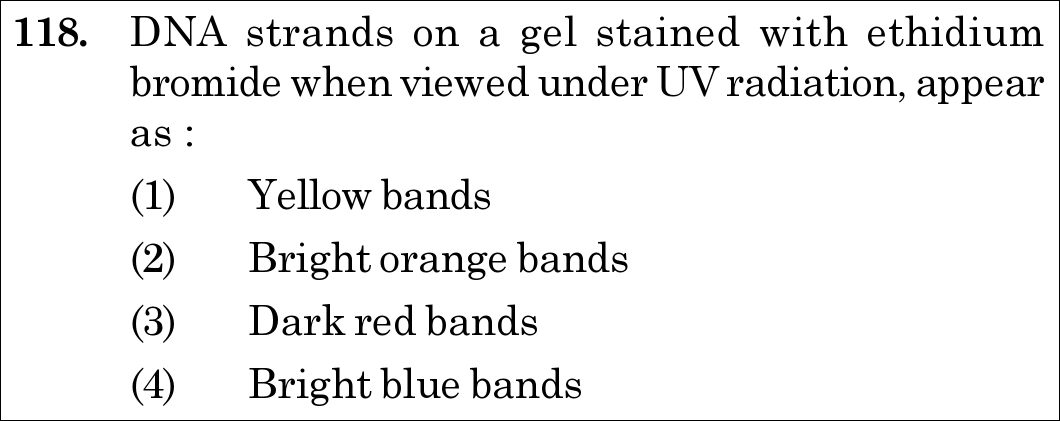
Why You Can 100% Trust This Shortcut: Gel Electrophoresis & Ethidium Bromide Staining (NCERT Biology · Biotechnology: Principles and Processes: UV illumination of orange DNA bands).
📐

Step-by-Step Rigorous Workflow & Mathematical Proof

Step 1

Principle of Agarose Gel Electrophoresis (Statement II)

Separation of restriction enzyme-digested DNA fragments relies on charge-to-mass uniformity and size-dependent molecular sieving:

  • • DNA fragments carry uniform negative charges along their phosphate backbones and migrate towards the positive electrode (anode) when an electric field is applied.
  • • The matrix (agarose gel) acts as a molecular sieve: smaller fragments experience less frictional resistance and travel farther towards the anode.
  • • Larger fragments encounter high hydrodynamic drag and remain near the loading wells at the cathodic end.
  • • Hence, Statement II is completely CORRECT.
Step 2

DNA Band Visualization and Elution (Statement I)

Post-electrophoretic utilization of resolved DNA fragments in genetic engineering:

  • • DNA bands are visualized by staining with ethidium bromide (EtBr) under ultraviolet (UV) light as bright orange-colored bands.
  • • The desired DNA band is excised from the agarose gel and extracted/purified via elution.
  • • The purified fragment of interest is subsequently ligated into a linearized cloning vector using DNA ligase to produce recombinant DNA (rDNA).
  • • Hence, Statement I is completely CORRECT.
Step 3

Conclusion

Both Statement I and Statement II are factually and conceptually correct, matching Option (1).

Statement I: True,Statement II: True  ⟹  Option (1)\text{Statement I: True}, \quad \text{Statement II: True} \implies \text{Option (1)}
⭐

360° Option Elimination Engine Key Feature

Diagnose every choice: Know exactly why the right option works and why distractors fail.

4-Option Deep Scan
1 A
✓ 100% Correct
Verdict & Scientific Reason:

100% correct. Accurately verifies both the sieving migration principle and the subsequent cloning utility of eluted DNA.

💡
Why this is airtight: None; pristine biotechnology mastery.
2 B
✗ Incorrect
Verdict & Scientific Reason:

Incorrect. Both statements represent canonical NCERT facts.

⚠️
Student Fallacy (Why candidates pick this trap): Confusing electrophoresis polarities.
3 C
✗ Incorrect
Verdict & Scientific Reason:

Incorrect. Statement II is true (smaller fragments migrate faster towards anode).

⚠️
Student Fallacy (Why candidates pick this trap): Believing larger fragments move faster or reversing anode/cathode polarity.
4 D
✗ Incorrect
Verdict & Scientific Reason:

Incorrect. Statement I is true (eluted DNA is the standard substrate for rDNA construction).

⚠️
Student Fallacy (Why candidates pick this trap): Thinking gel-extracted DNA cannot be ligated.
⚠️

NTA Trap Alert: Anode (+) vs Cathode (-) in Electrophoresis

In electrolytic cells like gel electrophoresis, the ANODE is POSITIVE and the CATHODE is NEGATIVE. Since DNA is negatively charged, it runs TOWARDS the ANODE. The wells are at the Cathode!

🛡️ How to avoid the -1 mark: Remember: "Run to Red / Run to Anode (+)". Small fragments get there first!
📖

Core NEET Syllabus Standard

NEET Biology Core Syllabus · Biotechnology: Principles and Processes Standard Benchmark
Core Scientific Principle Tested:

"DNA fragments migrate to the anode according to size through agarose gel; purified eluted fragments are used in constructing recombinant DNA."

Syllabus Focus: Separation and Isolation of DNA Fragments
✓ Core NEET UG Syllabus Anchor Syllabus & Academic Standards ↗
Small slips to Anode (+), Elution equals rDNA construction!
NEET 2025 · Q172 Easy
Official NEET 2025 Question 172 - Biotechnology: Principles and Processes
1 ✓ Key
2
3
4
💡 Verified Solution & 30-Second Hack
✓
Verified Against NTA Final Answer Key
Option (1) : C and D only
📚 Biotechnology: Principles and Processes Easy
📋 Given Parameters & Problem Setup
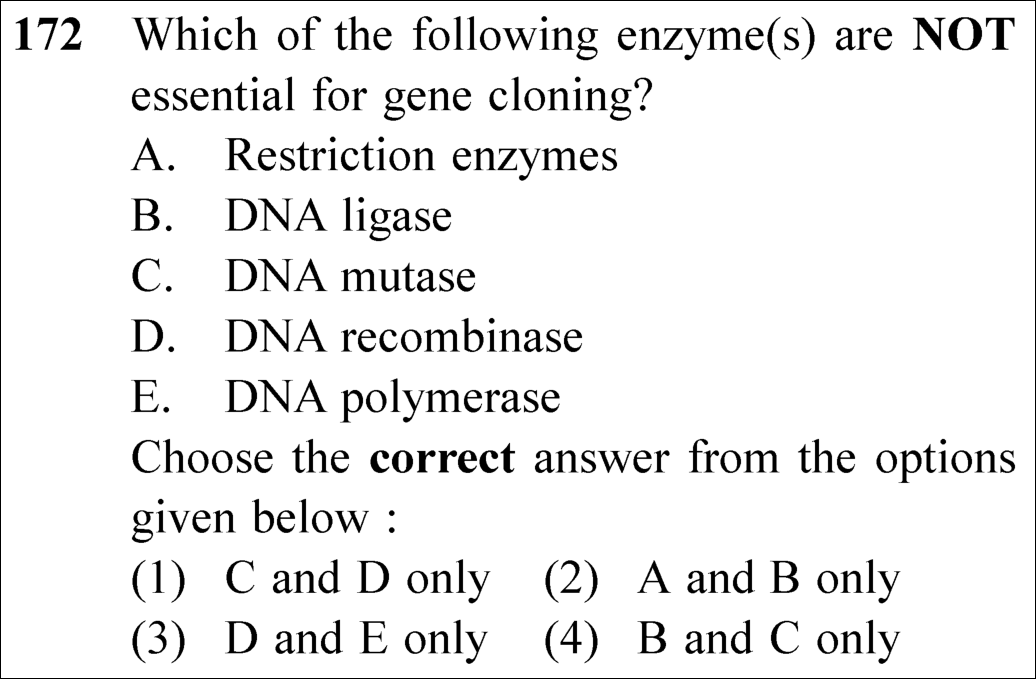
Enzymes Listed A. Restriction enzymes, B. DNA ligase, C. DNA mutase, D. DNA recombinase, E. DNA polymerase
Target Enzymes that are NOT essential for gene cloning
⚡

The 30-Second Exam Hall Shortcut: ⚡ Gene Cloning Tool Enzymes Fingerprint

⏱️ Save ~25 seconds

The core essential enzymes for gene cloning in rDNA technology are: Restriction Endonucleases (molecular scissors, A), DNA Ligase (molecular glue, B), and DNA Polymerase (PCR amplification, E)! "DNA mutase" (C) and "DNA recombinase" (D) are NOT essential cloning tools! C and D only!

1 Recall the essential enzymatic tools for recombinant DNA technology from NCERT Section 11.2:
2 - Restriction enzymes (A): Cleave DNA at palindromic recognition sequences to generate sticky/blunt ends. [ESSENTIAL]
3 - DNA ligase (B): Seals phosphodiester bonds to join foreign insert DNA with vector. [ESSENTIAL]
4 - DNA polymerase (E): Synthesizes complementary strands in PCR amplification (Taq polymerase). [ESSENTIAL]
5 - DNA mutase (C): Non-standard/spurious term with no role in cloning. [NOT ESSENTIAL]
6 - DNA recombinase (D): Mediates in vivo site-specific/homologous recombination, not an essential standard in vitro gene cloning enzyme. [NOT ESSENTIAL]
7 Enzymes NOT essential = C and D only (Option 1)!
8 Select Option (1)!
🛡️
Why You Can 100% Trust This Shortcut: Cloning Vector Selectable Markers & Insertional Inactivation (NCERT Biology · Biotechnology: pBR322 ampR and tetR selection).
📐

Step-by-Step Rigorous Workflow & Mathematical Proof

Step 1

Core Enzymatic Toolbox for Gene Cloning

Construction of a recombinant DNA molecule involves a defined set of biochemical catalytic tools:

  • • Restriction Endonucleases (A): Molecular scissors that cleave phosphodiester backbones at specific palindromic recognition sites to yield compatible fragments.
  • • DNA Ligase (B): Molecular glue that joins the vector DNA and source insert DNA by synthesizing covalent phosphodiester bonds between adjacent 3'-OH and 5'-phosphate termini.
  • • DNA Polymerase (E): Enzymes like thermostable *Taq* polymerase essential for *in vitro* exponential amplification of the target gene via Polymerase Chain Reaction (PCR).
Step 2

Evaluation of Non-Essential Enzymes (C and D)

Analyzing candidates C and D in the context of gene cloning:

  • • C. DNA mutase: A non-existent or irrelevant enzyme class in recombinant DNA technology. Gene cloning aims to preserve high-fidelity replication of unmutated genes, making mutases completely antithetical and non-essential.
  • • D. DNA recombinase: Endogenous cellular enzymes (e.g. Cre, FLP, RecA) that catalyze somatic or homologous crossing over in living cells. They are not part of the standard core tools required for *in vitro* cutting, ligating, and cloning target genes into plasmids.
Step 3

Conclusion

DNA mutase (C) and DNA recombinase (D) are NOT essential for gene cloning, matching Option (1).

Essential Cloning Tools={A,B,E}  ⟹  NOT Essential={C,D}\text{Essential Cloning Tools} = \{A, B, E\} \implies \text{NOT Essential} = \{C, D\}
⭐

360° Option Elimination Engine Key Feature

Diagnose every choice: Know exactly why the right option works and why distractors fail.

4-Option Deep Scan
1 A
✓ 100% Correct
Verdict & Scientific Reason:

100% correct. Correctly identifies DNA mutase and DNA recombinase as not belonging to the essential gene cloning toolbox.

💡
Why this is airtight: None; pristine knowledge of biotechnology tools.
2 B
✗ Incorrect
Verdict & Scientific Reason:

Incorrect. Restriction enzymes and DNA ligase are the most fundamentally essential enzymes in all of genetic engineering.

⚠️
Student Fallacy (Why candidates pick this trap): Selecting the essential enzymes instead of the non-essential ones.
3 C
✗ Incorrect
Verdict & Scientific Reason:

Incorrect. DNA polymerase (E) is an essential enzyme (utilized in PCR and replication).

⚠️
Student Fallacy (Why candidates pick this trap): Failing to recognize DNA polymerase as an essential biotechnology enzyme.
4 D
✗ Incorrect
Verdict & Scientific Reason:

Incorrect. DNA ligase (B) is essential for joining recombinant vectors.

⚠️
Student Fallacy (Why candidates pick this trap): Marking DNA ligase as non-essential.
⚠️

NTA Trap Alert: Reading "NOT Essential" vs "Essential"

Always read the negative operator "NOT" carefully! Restriction enzymes, ligase, and polymerase are the holy trinity of cloning tools. Mutase and recombinase are NOT part of this essential kit.

🛡️ How to avoid the -1 mark: Circle "NOT essential" and eliminate Restriction enzymes (A), Ligase (B), and Polymerase (E).
📖

Core NEET Syllabus Standard

NEET Biology Core Syllabus · Biotechnology: Principles and Processes Standard Benchmark
Core Scientific Principle Tested:

"Restriction enzymes, DNA ligases, and DNA polymerases are the essential catalytic tools in gene cloning."

Syllabus Focus: Tools of Recombinant DNA Technology · Restriction Enzymes & Ligases
✓ Core NEET UG Syllabus Anchor Syllabus & Academic Standards ↗
Cut (Restriction), Paste (Ligase), Copy (Polymerase) = The Big 3! Mutase & Recombinase are OUT!
NEET 2025 · Q179 Easy
Official NEET 2025 Question 179 - Biotechnology: Principles and Processes
1 Both Statement I and Statement II are correct
2 Both Statement I and Statement II are incorrect
3 Statement I is correct but Statement II is incorrect
4 Statement I is incorrect but Statement II is correct ✓ Key
💡 Verified Solution & 30-Second Hack
✓
Verified Against NTA Final Answer Key
Option (4) : Statement I is incorrect but Statement II is correct
📚 Biotechnology: Principles and Processes Easy
📋 Given Parameters & Problem Setup
Screening Method Blue-White screening using chromogenic substrate (X-gal)
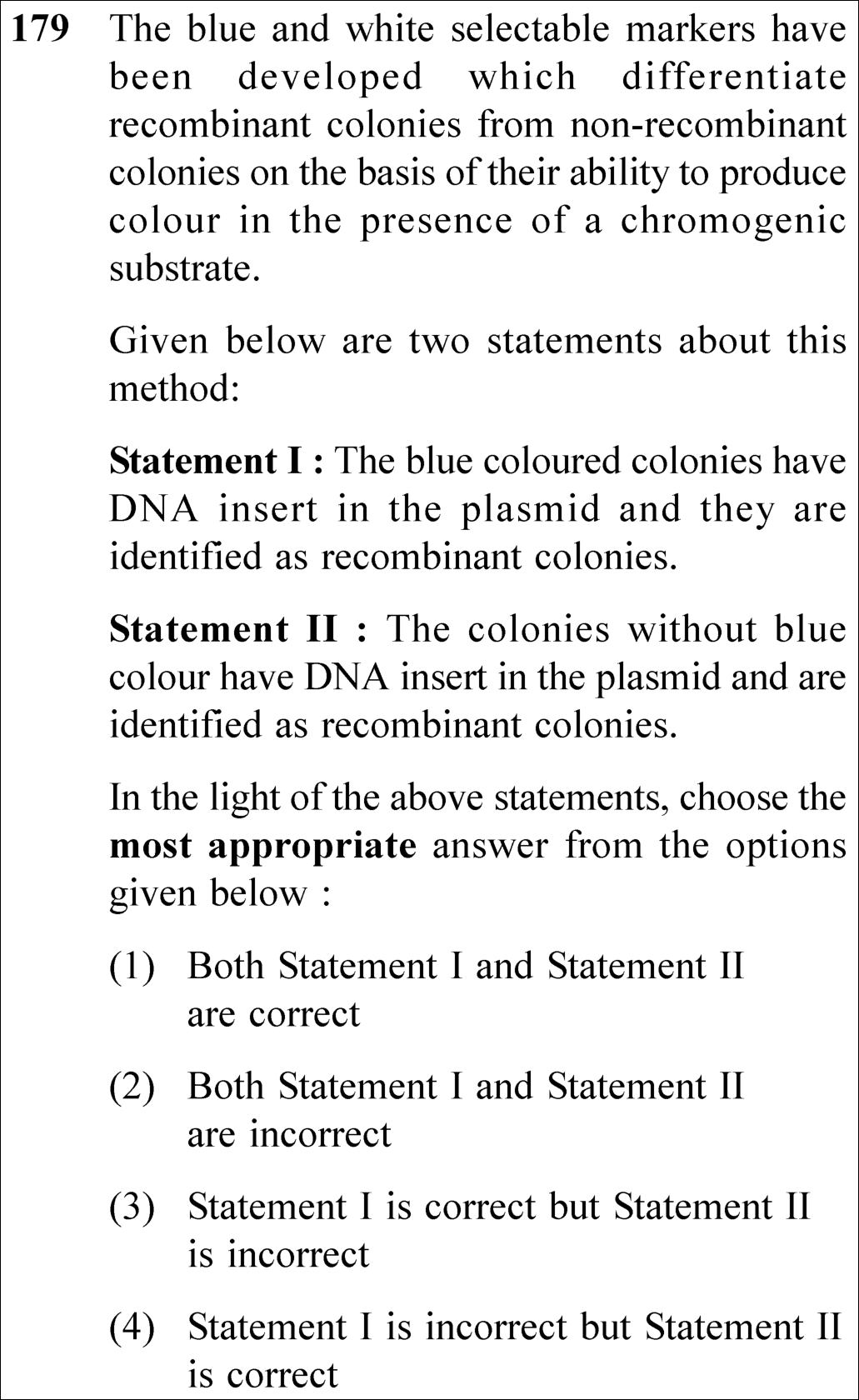
Statement I The blue coloured colonies have DNA insert in the plasmid and they are identified as recombinant colonies.
Statement II The colonies without blue colour have DNA insert in the plasmid and are identified as recombinant colonies.
⚡

The 30-Second Exam Hall Shortcut: ⚡ Blue-White Colony Identification Fingerprint

⏱️ Save ~20 seconds

Insertional inactivation destroys the β-galactosidase gene -> NO enzyme -> Colonies CANNOT turn blue -> WHITE COLONIES (colonies without blue colour) are RECOMBINANTS! Blue colonies are NON-recombinants! Statement I is false, Statement II is true!

1 Recall NCERT Section 11.2.2 (Selection of Recombinants):
2 - "A recombinant DNA is inserted within the coding sequence of an enzyme, β\beta-galactosidase. This results into inactivation of the gene for synthesis of this enzyme, which is referred to as insertional inactivation."
3 - Non-recombinants: Gene is intact -> active β\beta-galactosidase -> forms BLUE colonies.
4 - Recombinants: Gene is disrupted by insert -> inactive enzyme -> colonies do NOT produce colour (WHITE colonies / colonies without blue colour).
5 Analyze statements:
6 - Statement I: Claims blue colonies have DNA insert -> INCORRECT!
7 - Statement II: Claims colonies without blue colour have DNA insert -> CORRECT!
8 Conclusion: Statement I is incorrect but Statement II is correct (Option 4)!
9 Select Option (4)!
🛡️
Why You Can 100% Trust This Shortcut: DNA Ligase & Phosphodiester Bond Synthesis (NCERT Biology · Biotechnology: Principles and Processes: Sealing recombinant constructs).
📐

Step-by-Step Rigorous Workflow & Mathematical Proof

Step 1

Molecular Principle of Blue-White Screening

Blue-white screening is an elegant single-step chromogenic method to identify bacterial transformants carrying recombinant plasmids:

  • • Cloning vectors (e.g. pUC19) contain a multiple cloning site (MCS) embedded inside the coding region of the *lacZ* gene, which codes for the β\beta-galactosidase enzyme.
  • • When foreign DNA is successfully ligated into this MCS, it interrupts the open reading frame of *lacZ*, abolishing functional enzyme production (insertional inactivation).
Step 2

Evaluating Phenotypic Outcomes on X-gal Media

Bacterial colonies grown in the presence of IPTG (inducer) and X-gal (chromogenic substrate):

  • • Non-recombinant colonies (no insert): The *lacZ* gene remains intact and expresses active β\beta-galactosidase. The enzyme hydrolyzes colorless X-gal into 5-bromo-4-chloro-indigo, giving rise to BLUE colonies.
  • • Recombinant colonies (with insert): Due to insertional inactivation, no active β\beta-galactosidase is produced. The substrate is not cleaved, so colonies appear WHITE (colonies without blue colour).
Step 3

Verdict on Statements I and II

Correlating with the test propositions:

  • • Statement I claims blue colonies have the DNA insert. This is completely FALSE because blue colonies lack inserts.
  • • Statement II claims colonies without blue colour (white colonies) have the DNA insert and are recombinants. This is completely TRUE.
  • • Thus, Statement I is incorrect but Statement II is correct.
Step 4

Conclusion

Statement I is incorrect but Statement II is correct, which corresponds to Option (4).

White (No Blue)=Insertional Inactivation (Recombinant)\text{White (No Blue)} = \text{Insertional Inactivation (Recombinant)}
⭐

360° Option Elimination Engine Key Feature

Diagnose every choice: Know exactly why the right option works and why distractors fail.

4-Option Deep Scan
1 A
✗ Incorrect
Verdict & Scientific Reason:

Incorrect. Statement I is false because blue colonies are non-recombinants without inserts.

⚠️
Student Fallacy (Why candidates pick this trap): Assuming color production implies recombinant success.
2 B
✗ Incorrect
Verdict & Scientific Reason:

Incorrect. Statement II is an accurate definition of recombinant identification.

⚠️
Student Fallacy (Why candidates pick this trap): Rejecting both statements.
3 C
✗ Incorrect
Verdict & Scientific Reason:

Incorrect. Exactly reverses the truth values of the two statements.

⚠️
Student Fallacy (Why candidates pick this trap): Flipping blue and white phenotypes.
4 D
✓ 100% Correct
Verdict & Scientific Reason:

100% correct. Accurately identifies that colonies lacking blue color harbor the insert due to insertional inactivation.

💡
Why this is airtight: None; pristine knowledge of recombinant selection.
⚠️

NTA Trap Alert: Blue vs White Recombinant Inversion

Do not associate "Blue" with "Success/Recombinant". In blue-white screening, SUCCESS means you BROKE the gene, so NO color can form. White = Recombinant; Blue = Non-recombinant!

🛡️ How to avoid the -1 mark: White = Recombinant (Gene destroyed); Blue = Non-recombinant (Gene alive).
📖

Core NEET Syllabus Standard

NEET Biology Core Syllabus · Biotechnology: Principles and Processes Standard Benchmark
Core Scientific Principle Tested:

"Insertional inactivation of β-galactosidase causes recombinant colonies to lack blue color in the presence of chromogenic substrate."

Syllabus Focus: Cloning Vectors · Selection of Recombinants (Blue-White Selection)
✓ Core NEET UG Syllabus Anchor Syllabus & Academic Standards ↗
WHITE = Winner (Recombinant with Insert); BLUE = Blank/Base plasmid!
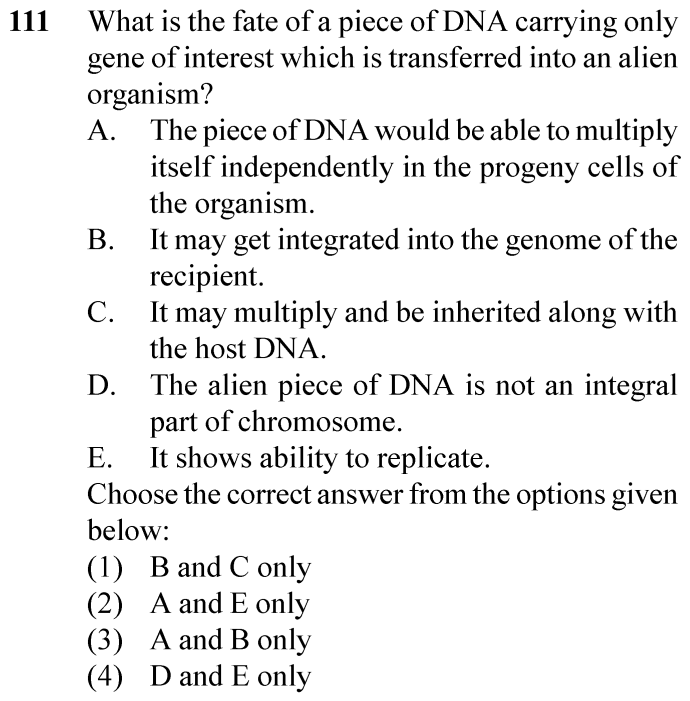
NEET 2024 · Q111 Medium
Official NEET 2024 Question 111 - Biotechnology: Principles and Processes
1 ✓ Key
2
3
4
💡 Verified Solution & 30-Second Hack
✓
Verified Against NTA Final Answer Key
Option (1) : B and C only
📚 Biotechnology: Principles and Processes Medium
📋 Given Parameters & Problem Setup
Transferred Entity Piece of alien DNA lacking origin of replication (ori)
Host System Recipient cell organism
⚡

The 30-Second Exam Hall Shortcut: ⚡ Fate of Alien DNA Rule

⏱️ Save ~30 seconds

Without ori, alien DNA cannot replicate autonomously as an episome (A is false). But if it integrates into host genome, it replicates passively with host chromosome (B and C are true)!

1 A. Cannot multiply itself as it lacks ori -> True alone, but statement A says "can multiply autonomously" -> False!
2 B. May get integrated into host genome -> True!
3 C. Multiplies and inherits along with host DNA once integrated -> True!
4 D. Alien DNA without ori cannot replicate independently.
5 Hence, B and C only -> Option (1) / A.
🛡️
Why You Can 100% Trust This Shortcut: NCERT Biology · Biotechnology: Principles and Processes (Origin of Replication)
📐

Step-by-Step Rigorous Workflow & Mathematical Proof

Step 1

Understand the Origin of Replication Requirement

An alien piece of DNA transferred into an alien organism cannot replicate by itself unless it is part of a chromosome or vector having a specific sequence known as the "origin of replication" (ori).

Step 2

Evaluate Integration Mechanism

If the alien DNA gets integrated into the recipient genome (host chromosome), it becomes part of the chromosome and gains the ability to replicate during host cell division, multiplying and segregating along with the host DNA.

Step 3

Identify Correct Statements

Statements B (it may get integrated into the genome of the recipient) and C (it may multiply and be inherited along with host DNA) represent biologically sound outcomes described in NCERT.

⭐

360° Option Elimination Engine Key Feature

Diagnose every choice: Know exactly why the right option works and why distractors fail.

4-Option Deep Scan
1 (1)
✓ 100% Correct
Verdict & Scientific Reason:

Correctly identifies that integration into the host chromosome allows passive replication and inheritance.

💡
Why this is airtight: None.
2 (2)
✗ Incorrect
Verdict & Scientific Reason:

Statement A incorrectly asserts autonomous replication without an ori.

⚠️
Student Fallacy (Why candidates pick this trap): Statement A incorrectly asserts autonomous replication without an ori.
3 (3)
✗ Incorrect
Verdict & Scientific Reason:

Omits chromosomal integration dynamics.

⚠️
Student Fallacy (Why candidates pick this trap): Omits chromosomal integration dynamics.
4 (4)
✗ Incorrect
Verdict & Scientific Reason:

Fails to include simultaneous replication with host DNA upon integration (C).

⚠️
Student Fallacy (Why candidates pick this trap): Fails to include simultaneous replication with host DNA upon integration (C).
⚠️

NTA Trap Alert: Autonomous vs Chromosomal Replication

Believing an alien DNA fragment can replicate as an extrachromosomal element without an origin of replication.

🛡️ How to avoid the -1 mark: Autonomous replication strictly mandates an ori site; without it, multiplication is only possible via chromosomal integration.
📖

Core NEET Syllabus Standard

Biology Core Botany · Biotechnology: Principles and Processes Standard Benchmark
Core Scientific Principle Tested:

"Most likely, this piece of DNA would not be able to multiply itself in the progeny cells of the organism. But, when it gets integrated into the genome of the recipient, it may multiply and be inherited along with the host DNA. This is because the alien piece of DNA has become part of a chromosome, which has the ability to replicate."

Syllabus Focus: Fate of Alien DNA Fragment Lacking an Origin of Replication (ori)
✓ Core NEET UG Syllabus Anchor Syllabus & Academic Standards ↗
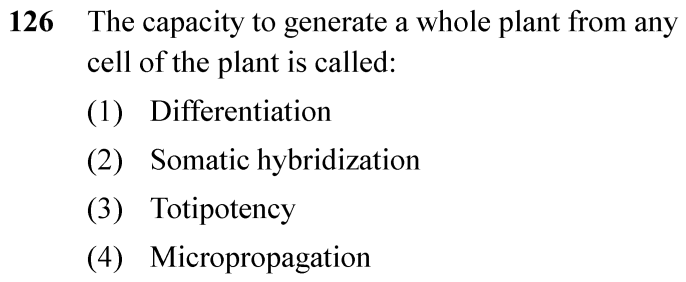
NEET 2024 · Q126 Easy
Official NEET 2024 Question 126 - Biotechnology: Principles and Processes
1 Differentiation
2 Somatic hybridization
3 Totipotency ✓ Key
4 Micropropagation
💡 Verified Solution & 30-Second Hack
✓
Verified Against NTA Final Answer Key
Option (3) : Totipotency
📚 Biotechnology: Principles and Processes Easy
📋 Given Parameters & Problem Setup
Biological Property Capacity to generate a whole plant from any cell or explant
Domain Plant Cell Biology and Tissue Culture
⚡

The 30-Second Exam Hall Shortcut: ⚡ Totipotency Definition

⏱️ Save ~15 seconds

The inherent capacity of any single plant cell / explant to regenerate into an entire plant is called Totipotency!

1 Recall tissue culture terminology:
2 - Totipotency: Inherent capacity of a cell to regenerate into a whole new organism.
3 - Pluripotency: Ability to give rise to many cell types, but not an entire organism.
4 - Micropropagation: The technique of producing thousands of plants through tissue culture.
5 - Explant: Any plant part taken out and grown in a test tube.
6 The question defines the capacity to generate a whole plant -> Totipotency -> Option (3) / C.
🛡️
Why You Can 100% Trust This Shortcut: NCERT Biology · Biotechnology: Principles and Processes (Cellular Totipotency and Tissue Culture)
📐

Step-by-Step Rigorous Workflow & Mathematical Proof

Step 1

Define Plant Tissue Culture Principle

Plant tissue culture is based on the cellular phenomenon that whole plants can be regenerated from explants (any part of a plant taken out and grown in a test tube under sterile conditions in a special nutrient medium).

Step 2

Define Totipotency Scientifically

This capacity to generate a whole plant from any cell or explant is termed totipotency, first experimentally demonstrated by Gottlieb Haberlandt and perfected by F.C. Steward using carrot phloem explants.

⭐

360° Option Elimination Engine Key Feature

Diagnose every choice: Know exactly why the right option works and why distractors fail.

4-Option Deep Scan
1 (1)
✗ Incorrect
Verdict & Scientific Reason:

Micropropagation is the commercial in vitro method of producing thousands of plants from explants.

⚠️
Student Fallacy (Why candidates pick this trap): Micropropagation is the commercial in vitro method of producing thousands of plants from explants.
2 (2)
✗ Incorrect
Verdict & Scientific Reason:

Differentiation is the biochemical and structural specialization of a cell into a mature cell type.

⚠️
Student Fallacy (Why candidates pick this trap): Differentiation is the biochemical and structural specialization of a cell into a mature cell type.
3 (3)
✓ 100% Correct
Verdict & Scientific Reason:

Totipotency is the intrinsic biological ability of a single plant cell to regenerate an entire multicellular plant.

💡
Why this is airtight: None.
4 (4)
✗ Incorrect
Verdict & Scientific Reason:

Somaclonal variation refers to genetic or epigenetic mutations arising during cell culture.

⚠️
Student Fallacy (Why candidates pick this trap): Somaclonal variation refers to genetic or epigenetic mutations arising during cell culture.
⚠️

NTA Trap Alert: Totipotency vs Micropropagation

Confusing the cellular property (totipotency) with the technological process (micropropagation).

🛡️ How to avoid the -1 mark: Capacity of a cell = Totipotency; Method of raising large populations = Micropropagation.
📖

Core NEET Syllabus Standard

Biology Core Botany · Biotechnology: Principles and Processes Standard Benchmark
Core Scientific Principle Tested:

"This capacity to generate a whole plant from any cell/explant is called totipotency. You will learn how to accomplish this in higher classes."

Syllabus Focus: Cellular Totipotency in Plant Regeneration
✓ Core NEET UG Syllabus Anchor Syllabus & Academic Standards ↗
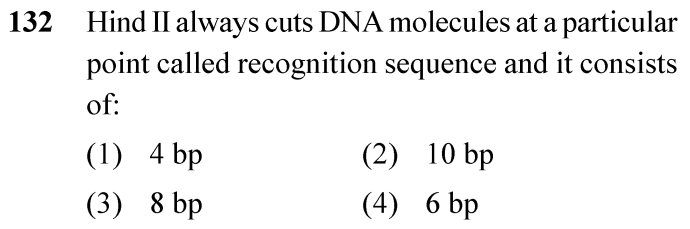
NEET 2024 · Q132 Easy
Official NEET 2024 Question 132 - Biotechnology: Principles and Processes
1
2
3
4 ✓ Key
💡 Verified Solution & 30-Second Hack
✓
Verified Against NTA Final Answer Key
Option (4) : 6 bp
📚 Biotechnology: Principles and Processes Easy
📋 Given Parameters & Problem Setup
Enzyme Hind II (first discovered restriction endonuclease)
Feature Length of specific recognition sequence
⚡

The 30-Second Exam Hall Shortcut: ⚡ Hind II Historical NCERT Fact

⏱️ Save ~15 seconds

Hind II was the very first restriction endonuclease isolated; it always cuts DNA molecules at a specific recognition sequence of exactly 6 base pairs (6 bp)!

1 Recall NCERT verbatim fact for Hind II:
2 - First restriction endonuclease discovered was Hind II.
3 - Isolated by Smith, Wilcox, and Kelley in 1970.
4 - It cuts DNA molecules at a specific 6 base pair palindromic sequence (5'-GTYRAC-3').
5 Recognition sequence length = 6 bp -> Option (4) / D.
🛡️
Why You Can 100% Trust This Shortcut: NCERT Biology · Biotechnology: Principles and Processes (Restriction Endonucleases)
📐

Step-by-Step Rigorous Workflow & Mathematical Proof

Step 1

Historical Discovery of Restriction Endonucleases

The first restriction endonuclease was Hind II, whose functioning depended on a specific DNA nucleotide sequence.

Step 2

NCERT Specification of Sequence Length

NCERT states: "It was found that Hind II always cut DNA molecules at a particular point by recognizing a specific sequence of six base pairs. This specific base sequence is known as the recognition sequence for Hind II."

⭐

360° Option Elimination Engine Key Feature

Diagnose every choice: Know exactly why the right option works and why distractors fail.

4-Option Deep Scan
1 (1)
✗ Incorrect
Verdict & Scientific Reason:

Some restriction enzymes like Alu I and Hae III recognize 4 bp sequences, but Hind II recognizes a 6 bp sequence.

⚠️
Student Fallacy (Why candidates pick this trap): Some restriction enzymes like Alu I and Hae III recognize 4 bp sequences, but Hind II recognizes a 6 bp sequence.
2 (2)
✗ Incorrect
Verdict & Scientific Reason:

Standard Type II restriction endonucleases do not recognize 10 bp sequences.

⚠️
Student Fallacy (Why candidates pick this trap): Standard Type II restriction endonucleases do not recognize 10 bp sequences.
3 (3)
✗ Incorrect
Verdict & Scientific Reason:

Rare-cutting enzymes like Not I recognize 8 bp sequences, but Hind II recognizes 6 bp.

⚠️
Student Fallacy (Why candidates pick this trap): Rare-cutting enzymes like Not I recognize 8 bp sequences, but Hind II recognizes 6 bp.
4 (4)
✓ 100% Correct
Verdict & Scientific Reason:

Hind II specifically recognizes and cleaves a specific hexanucleotide (6 bp) recognition sequence.

💡
Why this is airtight: None.
⚠️

NTA Trap Alert: Hind II vs 4-cutter Confusion

Guessing 4 bp or 8 bp.

🛡️ How to avoid the -1 mark: Commit the textbook line to memory: Hind II always recognizes a specific sequence of SIX base pairs.
📖

Core NEET Syllabus Standard

Biology Core Botany · Biotechnology: Principles and Processes Standard Benchmark
Core Scientific Principle Tested:

"The first restriction endonuclease - Hind II, whose functioning depended on a specific DNA nucleotide sequence was isolated and characterised five years later. It was found that Hind II always cut DNA molecules at a particular point by recognising a specific sequence of six base pairs."

Syllabus Focus: Hind II Restriction Endonuclease Recognition Site Length
✓ Core NEET UG Syllabus Anchor Syllabus & Academic Standards ↗
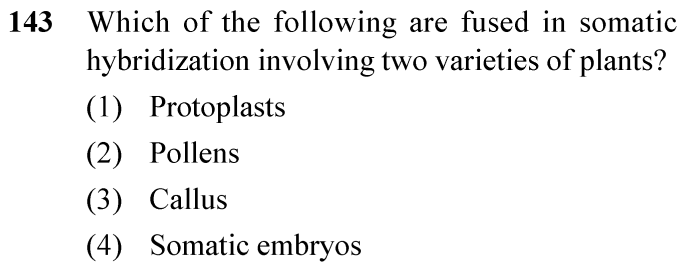
NEET 2024 · Q143 Easy
Official NEET 2024 Question 143 - Biotechnology: Principles and Processes
1 Protoplasts ✓ Key
2 Pollens
3 Callus
4 Somatic embryos
💡 Verified Solution & 30-Second Hack
✓
Verified Against NTA Final Answer Key
Option (1) : Protoplasts
📚 Biotechnology: Principles and Processes Easy
📋 Given Parameters & Problem Setup
Technique Somatic hybridization
Components Two different varieties/species of plants
⚡

The 30-Second Exam Hall Shortcut: ⚡ Somatic Hybridization Core Entity

⏱️ Save ~20 seconds

Somatic hybridization is the fusion of isolated naked protoplasts (cells devoid of cell walls) from two different plant varieties using fusogens like PEG!

1 Understand somatic hybridization steps:
2 Digest cellulosic cell walls using cellulase and pectinase -> yields naked PROTOPLASTS.
3 Fuse naked protoplasts of two varieties (e.g., potato + tomato -> pomato).
4 Protoplast fusion yields a somatic hybrid.
5 The fused entities are Protoplasts -> Option (1) / A.
🛡️
Why You Can 100% Trust This Shortcut: NCERT Biology · Biotechnology: Principles and Processes (Protoplast Isolation and Somatic Hybridization)
📐

Step-by-Step Rigorous Workflow & Mathematical Proof

Step 1

Define Somatic Hybridization

Scientists have isolated single cells from plants and after digesting their cell walls have been able to isolate naked protoplasts (surrounded only by plasma membranes).

Step 2

Mechanism of Fusion

Isolated protoplasts from two different varieties of plants—each having a desirable character—can be fused to get hybrid protoplasts, which can be further grown to form a new plant. These hybrids are called somatic hybrids and the process is called somatic hybridization.

Step 3

Example

A classic example cited in NCERT is the fusion of a tomato protoplast with a potato protoplast to create a pomato.

⭐

360° Option Elimination Engine Key Feature

Diagnose every choice: Know exactly why the right option works and why distractors fail.

4-Option Deep Scan
1 (1)
✓ 100% Correct
Verdict & Scientific Reason:

Naked protoplasts isolated by enzymatic wall digestion are fused in somatic hybridization.

💡
Why this is airtight: None.
2 (2)
✗ Incorrect
Verdict & Scientific Reason:

Pollens are male gametophytes involved in sexual reproduction, not somatic cell hybridization.

⚠️
Student Fallacy (Why candidates pick this trap): Pollens are male gametophytes involved in sexual reproduction, not somatic cell hybridization.
3 (3)
✗ Incorrect
Verdict & Scientific Reason:

Callus is an unorganized mass of proliferating cells, not the individual fused units.

⚠️
Student Fallacy (Why candidates pick this trap): Callus is an unorganized mass of proliferating cells, not the individual fused units.
4 (4)
✗ Incorrect
Verdict & Scientific Reason:

Somatic embryos develop from cells via somatic embryogenesis; they are not fused together.

⚠️
Student Fallacy (Why candidates pick this trap): Somatic embryos develop from cells via somatic embryogenesis; they are not fused together.
⚠️

NTA Trap Alert: Cell vs Protoplast Distinction

Thinking intact plant cells can be fused directly.

🛡️ How to avoid the -1 mark: Rigid cellulose cell walls prevent membrane fusion; cell walls must first be removed to yield naked protoplasts.
📖

Core NEET Syllabus Standard

Biology Core Botany · Biotechnology: Principles and Processes Standard Benchmark
Core Scientific Principle Tested:

"Isolated protoplasts from two different varieties of plants - each having a desirable character - can be fused to get hybrid protoplasts, which can be further grown to form a new plant. These hybrids are called somatic hybrids and the process is called somatic hybridization."

Syllabus Focus: Somatic Hybridization: Protoplast Isolation and Fusion
✓ Core NEET UG Syllabus Anchor Syllabus & Academic Standards ↗
NEET 2024 · Q163 Easy
Official NEET 2024 Question 163 - Biotechnology: Principles and Processes
1 ✓ Key
2
3
4
💡 Verified Solution & 30-Second Hack
✓
Verified Against NTA Final Answer Key
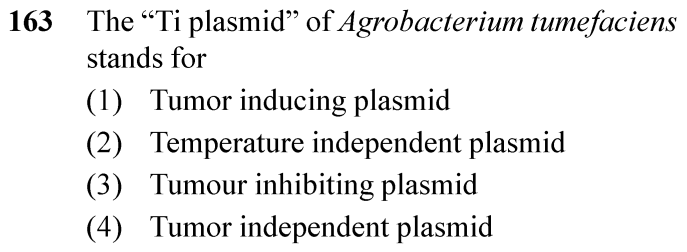
Option (1) : Tumor inducing plasmid
📚 Biotechnology: Principles and Processes Easy
📋 Given Parameters & Problem Setup
Bacterial Vector Agrobacterium tumefaciens
Designation Ti plasmid
⚡

The 30-Second Exam Hall Shortcut: ⚡ Ti Plasmid Full Form

⏱️ Save ~15 seconds

Ti stands for Tumor-inducing! Agrobacterium tumefaciens delivers its T-DNA to transform normal plant cells into crown gall tumors!

1 Recall the natural genetic engineer of plants:
2 - Agrobacterium tumefaciens delivers a segment of DNA called 'T-DNA'.
3 - It carries the Ti plasmid.
4 - "Ti" stands for Tumor-inducing (it causes crown gall tumors in dicots).
5 Direct identification: Tumor inducing plasmid -> Option (1) / A.
🛡️
Why You Can 100% Trust This Shortcut: NCERT Biology · Biotechnology: Principles and Processes (Vectors for Cloning Genes in Plants)
📐

Step-by-Step Rigorous Workflow & Mathematical Proof

Step 1

Understand the Biology of Agrobacterium tumefaciens

Agrobacterium tumefaciens, a pathogen of several dicotyledonous plants, is able to deliver a piece of DNA (known as 'T-DNA') to transform normal plant cells into a tumor and direct these tumor cells to produce the chemicals required by the pathogen.

Step 2

Define the Ti Plasmid

The extra-chromosomal DNA element responsible for this oncogenic transformation is the tumor-inducing plasmid (Ti plasmid). In genetic engineering, this plasmid has been disarmed and modified into a non-pathogenic cloning vector.

⭐

360° Option Elimination Engine Key Feature

Diagnose every choice: Know exactly why the right option works and why distractors fail.

4-Option Deep Scan
1 (1)
✓ 100% Correct
Verdict & Scientific Reason:

Ti stands for Tumor-inducing, responsible for crown gall induction in dicot plants.

💡
Why this is airtight: None.
2 (2)
✗ Incorrect
Verdict & Scientific Reason:

Ti has nothing to do with temperature independence.

⚠️
Student Fallacy (Why candidates pick this trap): Ti has nothing to do with temperature independence.
3 (3)
✗ Incorrect
Verdict & Scientific Reason:

It induces tumors, it does not inhibit them.

⚠️
Student Fallacy (Why candidates pick this trap): It induces tumors, it does not inhibit them.
4 (4)
✗ Incorrect
Verdict & Scientific Reason:

Incorrect terminology.

⚠️
Student Fallacy (Why candidates pick this trap): Incorrect terminology.
⚠️

NTA Trap Alert: Tumor Inducing vs Inhibiting

Carelessly selecting "inhibiting" instead of "inducing".

🛡️ How to avoid the -1 mark: Remember: Wild Agrobacterium CAUSES (induces) tumors in plants.
📖

Core NEET Syllabus Standard

Biology Core Zoology · Biotechnology: Principles and Processes Standard Benchmark
Core Scientific Principle Tested:

"The tumor inducing (Ti) plasmid of Agrobacterium tumefaciens has now been modified into a cloning vector which is no more pathogenic to the plants but is still able to use the mechanisms to deliver genes of our interest."

Syllabus Focus: Agrobacterium tumefaciens and the Tumor Inducing (Ti) Plasmid
✓ Core NEET UG Syllabus Anchor Syllabus & Academic Standards ↗
NEET 2024 · Q172 Easy
Official NEET 2024 Question 172 - Biotechnology: Principles and Processes
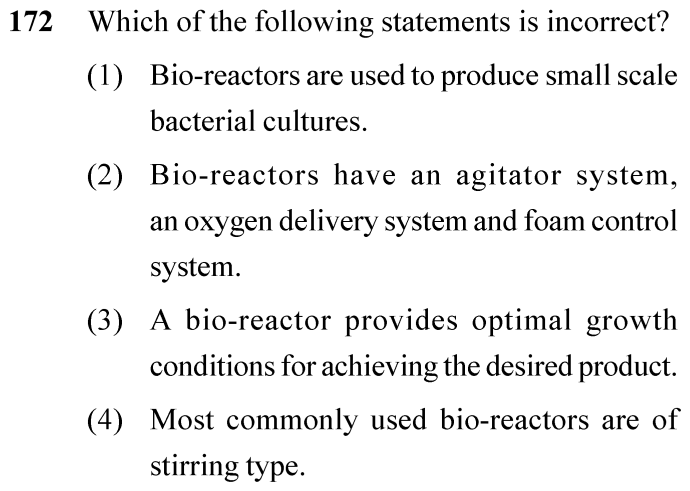
1 Bio-reactors are used to produce small scale bacterial cultures. ✓ Key
2 Bio-reactors have an agitator system, an oxygen delivery system and foam control system.
3 A bio-reactor provides optimal growth conditions for achieving the desired product.
4 Most commonly used bio-reactors are of stirring type.
💡 Verified Solution & 30-Second Hack
✓
Verified Against NTA Final Answer Key
Option (1) : Bio-reactors are used to produce small scale bacterial cultures.
📚 Biotechnology: Principles and Processes Easy
📋 Given Parameters & Problem Setup
Equipment Bioreactors / Fermenters
Question Identify the INCORRECT statement
⚡

The 30-Second Exam Hall Shortcut: ⚡ Bioreactor Scale Rule

⏱️ Save ~20 seconds

Bioreactors are designed for LARGE SCALE industrial production (100 to 1000 litres), NOT small scale laboratory cultures! Statement (1) is blatantly incorrect!

1 Recall bioreactor specifications in NCERT:
2 - Small scale cultures are grown in laboratory flasks.
3 - To produce in large quantities, development of bioreactors, where large volumes (100-1000 litres) of culture can be processed, was required.
4 Statement (1) claims "used to produce small scale bacterial cultures", which is FALSE!
5 Select Option (1) / A.
🛡️
Why You Can 100% Trust This Shortcut: NCERT Biology · Biotechnology: Principles and Processes (Bioreactors)
📐

Step-by-Step Rigorous Workflow & Mathematical Proof

Step 1

Review Bioreactor Purpose and Scale

Small volume cultures cannot yield appreciable quantities of products. To produce in large quantities, the development of bioreactors, where large volumes (100−1000100-1000 litres) of culture can be processed, was required. Thus, bioreactors are specifically built for large-scale production, not small-scale cultures.

Step 2

Examine Bioreactor Systems and Controls

A bioreactor provides optimal conditions for achieving the desired product by providing optimum growth conditions (temperature, pH, substrate, salts, vitamins, oxygen). A stirred-tank reactor is usually cylindrical or with a curved base to facilitate the mixing of the reactor contents. The stirrer facilitates even mixing and oxygen availability throughout the bioreactor. Bioreactors have an agitator system, an oxygen delivery system, a foam control system, a temperature control system, pH control system and sampling ports.

Step 3

Identify the Incorrect Statement

Statement (1) incorrectly states that bioreactors are used for small scale cultures.

⭐

360° Option Elimination Engine Key Feature

Diagnose every choice: Know exactly why the right option works and why distractors fail.

4-Option Deep Scan
1 (1)
✓ 100% Correct
Verdict & Scientific Reason:

Incorrect statement: Bioreactors are industrial vessels designed specifically for large-scale culture (100–1000 litres).

💡
Why this is airtight: None.
2 (2)
✗ Incorrect
Verdict & Scientific Reason:

Correct statement: These are standard engineering components of all industrial bioreactors.

⚠️
Student Fallacy (Why candidates pick this trap): Correct statement: These are standard engineering components of all industrial bioreactors.
3 (3)
✗ Incorrect
Verdict & Scientific Reason:

Correct statement: Bioreactors optimize temperature, pH, substrate, vitamins, and oxygen.

⚠️
Student Fallacy (Why candidates pick this trap): Correct statement: Bioreactors optimize temperature, pH, substrate, vitamins, and oxygen.
4 (4)
✗ Incorrect
Verdict & Scientific Reason:

Correct statement: Stirred-tank bioreactors are the most widely used industrial bioreactors.

⚠️
Student Fallacy (Why candidates pick this trap): Correct statement: Stirred-tank bioreactors are the most widely used industrial bioreactors.
⚠️

NTA Trap Alert: Small Scale vs Lab Flask

Confusing laboratory shaker flasks with industrial bioreactors.

🛡️ How to avoid the -1 mark: Remember: Flasks = small-scale laboratory testing; Bioreactors = large-scale industrial mass production.
📖

Core NEET Syllabus Standard

Biology Core Zoology · Biotechnology: Principles and Processes Standard Benchmark
Core Scientific Principle Tested:

"To produce in large quantities, the development of bioreactors, where large volumes (100-1000 litres) of culture can be processed, was required. A bioreactor provides the optimal conditions for achieving the desired product by providing optimum growth conditions."

Syllabus Focus: Bioreactors: Design, Scale, and Optimal Culturing Parameters
✓ Core NEET UG Syllabus Anchor Syllabus & Academic Standards ↗
NEET 2024 · Q183 Medium
Official NEET 2024 Question 183 - Biotechnology: Principles and Processes
1
2
3
4 ✓ Key
💡 Verified Solution & 30-Second Hack
✓
Verified Against NTA Final Answer Key
Option (4) : The gene ‘X’ is responsible for controlling the copy number of the linked DNA and ‘Y’ for protein involved in the replication of Plasmid.
📚 Biotechnology: Principles and Processes Medium
📋 Given Parameters & Problem Setup
Vector E. coli cloning vector pBR322
Gene X ori (origin of replication)
Gene Y rop (repressor of primer)
⚡

The 30-Second Exam Hall Shortcut: ⚡ pBR322 Functional Map Identification

⏱️ Save ~30 seconds

In pBR322: X = ori (origin of replication, controls copy number); Y = rop (codes for proteins involved in the replication of the plasmid)! Direct NCERT definition!

1 Identify labels X and Y on standard pBR322 plasmid map:
2 - X is located at the replication origin = ori.
3 - Role of ori: initiates replication and controls copy number of linked DNA.
4 - Y is located near Pvu II = rop.
5 - Role of rop: codes for the proteins involved in the replication of plasmid.
6 Option (4) states: X controls copy number of linked DNA, and Y codes for protein involved in plasmid replication.
7 Select Option (4) / D.
🛡️
Why You Can 100% Trust This Shortcut: NCERT Biology · Biotechnology: Principles and Processes (Cloning Vector pBR322 Architecture)
📐

Step-by-Step Rigorous Workflow & Mathematical Proof

Step 1

Locate Genes on Plasmid pBR322

In the standard genetic map of E. coli cloning vector pBR322 illustrated in NCERT Figure 11.4: - Position X marks the 'ori' (Origin of replication). - Position Y marks the 'rop' (Repressor of primer) gene located between the tetracycline resistance cassette and the Pvu II site.

Step 2

Define Function of Origin of Replication (ori / Gene X)

This is a sequence from where replication starts and any piece of DNA when linked to this sequence can be made to replicate within the host cells. This sequence is also responsible for controlling the copy number of the linked DNA.

Step 3

Define Function of rop (Gene Y)

The rop codes for the proteins involved in the replication of the plasmid (acting as a regulator to modulate copy number).

Step 4

Select Matching Choice

Option (4) provides the precise verbatim NCERT functional definitions.

⭐

360° Option Elimination Engine Key Feature

Diagnose every choice: Know exactly why the right option works and why distractors fail.

4-Option Deep Scan
1 (1)
✗ Incorrect
Verdict & Scientific Reason:

Inverts and confuses ori with rop; antibiotic resistance genes are ampR and tetR.

⚠️
Student Fallacy (Why candidates pick this trap): Inverts and confuses ori with rop; antibiotic resistance genes are ampR and tetR.
2 (2)
✗ Incorrect
Verdict & Scientific Reason:

Neither X nor Y is an antibiotic resistance gene.

⚠️
Student Fallacy (Why candidates pick this trap): Neither X nor Y is an antibiotic resistance gene.
3 (3)
✗ Incorrect
Verdict & Scientific Reason:

Gene X is ori, not an antibiotic resistance gene.

⚠️
Student Fallacy (Why candidates pick this trap): Gene X is ori, not an antibiotic resistance gene.
4 (4)
✓ 100% Correct
Verdict & Scientific Reason:

Accurately identifies X as ori (controlling copy number) and Y as rop (coding for replication proteins).

💡
Why this is airtight: None.
⚠️

NTA Trap Alert: ori Copy Number Function Oversight

Remembering that ori starts replication but forgetting that it also controls the copy number of linked foreign DNA.

🛡️ How to avoid the -1 mark: NCERT emphasizes: "This sequence is also responsible for controlling the copy number of the linked DNA."
📖

Core NEET Syllabus Standard

Biology Core Zoology · Biotechnology: Principles and Processes Standard Benchmark
Core Scientific Principle Tested:

"Origin of replication (ori): This sequence is also responsible for controlling the copy number of the linked DNA... The rop codes for the proteins involved in the replication of the plasmid."

Syllabus Focus: pBR322 Cloning Vector: Roles of ‘ori’ (X) and ‘rop’ (Y) Genes
✓ Core NEET UG Syllabus Anchor Syllabus & Academic Standards ↗
NEET 2023 · Q106 Easy
Official NEET 2023 Question 106 - Biotechnology: Principles and Processes
1 Bright orange colour ✓ Key
2 Bright red colour
3 Bright blue colour
4 Bright yellow colour
💡 Verified Solution & 30-Second Hack
✓
Verified Against NTA Final Answer Key
Option (1) : Bright orange colour
📚 Biotechnology: Principles and Processes Easy
📋 Given Parameters & Problem Setup
Staining Dye Ethidium bromide (EtBr)
Excitation Light Ultraviolet (UV) radiation
Visual Result Fluorophore emission under UV transillumination
⚡

The 30-Second Exam Hall Shortcut: ⚡ EtBr + UV = Bright Orange DNA Bands

⏱️ Save ~20 seconds

DNA cannot be seen directly in visible light. Staining with ethidium bromide followed by UV light transillumination yields striking bright orange bands!

1 Recall that pure DNA in agarose gels is completely transparent and colorless under normal visible light.
2 Ethidium bromide intercalates between adjacent stacked base pairs of DNA.
3 Under UV light excitation (~300 nm), the intercalated dye fluoresces brightly at orange-red wavelengths (~590 nm).
4 Option (1) bright orange is the verbatim textbook color.
🛡️
Why You Can 100% Trust This Shortcut: Canonical NCERT Biotechnology protocol on agarose gel electrophoresis.
📐

Step-by-Step Rigorous Workflow & Mathematical Proof

Step 1

Intercalation Mechanism of Ethidium Bromide

Ethidium bromide (EtBrEtBr) is a planar polycyclic aromatic cation that slips between adjacent stacked nitrogenous base pairs of double-stranded DNA:

dsDNA+EtBr⟶[dsDNA-EtBr complex](hydrophobic intercalation)\text{dsDNA} + \text{EtBr} \longrightarrow [\text{dsDNA-EtBr complex}]_{{(\text{hydrophobic intercalation})}}
Step 2

Fluorometric Excitation and Emission

Intercalation isolates the ethidium fluorophore from water molecules that would otherwise quench its fluorescence. When irradiated with UV light, the complex emits intense visible fluorescence:

UV Light (λ≈302 nm)→ExcitationFluorescence (λ≈590 nm)  ⟹  Bright Orange Bands\text{UV Light (}\lambda \approx 302\text{ nm)} \xrightarrow{\text{Excitation}} \text{Fluorescence (}\lambda \approx 590\text{ nm)} \implies \text{\textbf{Bright Orange Bands}}
Step 3

Downstream Processing (Elution)

The separated orange DNA bands are excised from the agarose gel slab and extracted into buffer in a technique known as elution.

⭐

360° Option Elimination Engine Key Feature

Diagnose every choice: Know exactly why the right option works and why distractors fail.

4-Option Deep Scan
1 1
✓ 100% Correct
Verdict & Scientific Reason:

Matches NCERT verbatim: DNA stained with ethidium bromide glows as bright orange bands under UV transillumination.

💡
Why this is airtight: None; canonical lab principle.
2 2
✗ Incorrect
Verdict & Scientific Reason:

Incorrect hue; emission is distinctly bright orange, not red.

⚠️
Student Fallacy (Why candidates pick this trap): Associating orange fluorescence loosely with red coloration.
3 3
✗ Incorrect
Verdict & Scientific Reason:

Blue color corresponds to tracking dye (bromophenol blue) under visible light, not fluorescent DNA.

⚠️
Student Fallacy (Why candidates pick this trap): Confusing loading tracking dye with the DNA stain itself.
4 4
✗ Incorrect
Verdict & Scientific Reason:

Incorrect emission wavelength.

⚠️
Student Fallacy (Why candidates pick this trap): Misremembering fluorescence colors from other biochemical stains.
⚠️

NTA Trap Alert: Visible Light vs. UV Light Trap

Students forget that DNA bands cannot be seen under ordinary visible light without UV transillumination, or confuse the blue loading dye with the intercalating stain.

🛡️ How to avoid the -1 mark: EtBr + UV = Bright Orange. Bromophenol blue loading dye = Blue in visible light.
📖

Core NEET Syllabus Standard

NCERT Biology · Biotechnology: Principles and Processes Standard Benchmark
Core Scientific Principle Tested:

"You cannot see pure DNA fragments in the visible light and without staining. The separated DNA fragments can be visualized only after staining the DNA with a compound known as ethidium bromide followed by exposure to UV radiation (you can see bright orange coloured bands of DNA)."

Syllabus Focus: Separation and Isolation of DNA Fragments
✓ Core NEET UG Syllabus Anchor Syllabus & Academic Standards ↗
NEET 2023 · Q110 Easy
Official NEET 2023 Question 110 - Biotechnology: Principles and Processes
1 Polysaccharides
2 RNA
3 DNA ✓ Key
4 Histones
💡 Verified Solution & 30-Second Hack
✓
Verified Against NTA Final Answer Key
Option (3) : DNA
📚 Biotechnology: Principles and Processes Easy
📋 Given Parameters & Problem Setup
Process Purification of recombinant DNA
Reagent Added Chilled ethanol (ice-cold C2H5OHC_2H_5OH)
Observed Phenomenon Precipitation as fine white threads
⚡

The 30-Second Exam Hall Shortcut: ⚡ Spooling Anchor: Chilled Ethanol = DNA Precipitation

⏱️ Save ~20 seconds

After enzymatic digestion of RNA (RNase) and proteins (proteases), adding ice-cold (chilled) ethanol precipitates pure DNA as a collection of fine threads that can be spooled out!

1 Cell lysis releases macromolecules.
2 RNase digests RNA; proteases digest histones/proteins; polysaccharides/lipids removed.
3 Addition of chilled ethanol reduces dielectric constant of solution, causing negatively charged DNA to precipitate.
4 Precipitated DNA is gathered via spooling.
5 Match Option (3) DNA.
🛡️
Why You Can 100% Trust This Shortcut: Canonical NCERT Biotechnology laboratory isolation protocol.
📐

Step-by-Step Rigorous Workflow & Mathematical Proof

Step 1

Enzymatic Removal of Cellular Contaminants

To obtain pure genetic material, bacterial/plant cells are digested with lysozyme/cellulase, followed by selective enzyme treatments:

RNA removal⟶Ribonuclease (RNase)Protein removal⟶Proteases (proteinase K)Polysaccharides/lipids⟶Differential extraction / detergent lysis\begin{aligned} \text{RNA removal} & \longrightarrow \text{Ribonuclease (RNase)} \\[3pt] \text{Protein removal} & \longrightarrow \text{Proteases (proteinase K)} \\[3pt] \text{Polysaccharides/lipids} & \longrightarrow \text{Differential extraction / detergent lysis} \end{aligned}
Step 2

Ethanol Precipitation Chemistry

Because DNA is a polyanionic macromolecule surrounded by a hydration shell of water molecules, adding cold ethanol lowers the dielectric constant, allowing monovalent cations (Na+Na^+) to neutralize the phosphate backbone, precipitating DNA out of solution:

Purified aqueous DNA→Chilled Ethanol (C2H5OH)Precipitated DNA threads (Spooling)\text{Purified aqueous DNA} \xrightarrow{\text{Chilled Ethanol } (C_2H_5OH)} \text{\textbf{Precipitated DNA threads (Spooling)}}
Step 3

Collection by Spooling

The precipitated DNA is visible as a tangle of fine white threads and is collected onto a glass rod by spooling.

⭐

360° Option Elimination Engine Key Feature

Diagnose every choice: Know exactly why the right option works and why distractors fail.

4-Option Deep Scan
1 1
✗ Incorrect
Verdict & Scientific Reason:

Polysaccharides are degraded by enzymes (cellulase/pectinase) or removed in organic phases during initial lysis.

⚠️
Student Fallacy (Why candidates pick this trap): Assuming all polymers precipitate simultaneously.
2 2
✗ Incorrect
Verdict & Scientific Reason:

RNA is digested by ribonuclease (RNase) prior to ethanol addition so it does not precipitate as the intact target nucleic acid.

⚠️
Student Fallacy (Why candidates pick this trap): Forgetting that RNase treatment precedes ethanol precipitation.
3 3
✓ 100% Correct
Verdict & Scientific Reason:

Matches NCERT verbatim: addition of chilled ethanol ultimately precipitates out purified DNA.

💡
Why this is airtight: None; textbook verbatim.
4 4
✗ Incorrect
Verdict & Scientific Reason:

Histones are basic proteins digested by proteases into soluble peptides, not precipitated intact.

⚠️
Student Fallacy (Why candidates pick this trap): Confusing chromatin proteins with the nucleic acid backbone.
⚠️

NTA Trap Alert: Order of Reagents Trap

Students confuse the role of enzymes (RNase, proteases) with the role of chilled ethanol. Enzymes degrade contaminants, whereas chilled ethanol precipitates the DNA.

🛡️ How to avoid the -1 mark: Enzymes digest RNA and protein; Chilled ethanol precipitates DNA!
📖

Core NEET Syllabus Standard

NCERT Biology · Biotechnology: Principles and Processes Standard Benchmark
Core Scientific Principle Tested:

"Other molecules can be removed by appropriate treatments and purified DNA ultimately precipitates out after the addition of chilled ethanol. This can be seen as collection of fine threads in the suspension."
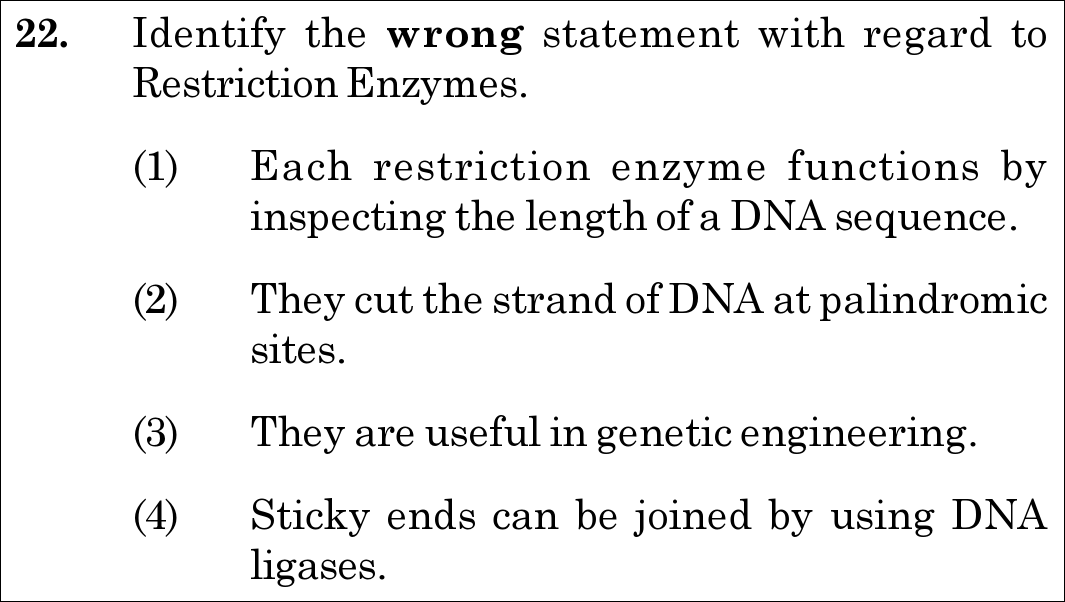
Syllabus Focus: Isolation of the Genetic Material (DNA)
✓ Core NEET UG Syllabus Anchor Syllabus & Academic Standards ↗
NEET 2023 · Q135 Easy
Official NEET 2023 Question 135 - Biotechnology: Principles and Processes
1 Silver
2 Copper
3 Zinc
4 Tungsten or gold ✓ Key
💡 Verified Solution & 30-Second Hack
✓
Verified Against NTA Final Answer Key
Option (4) : Tungsten or gold
📚 Biotechnology: Principles and Processes Easy
📋 Given Parameters & Problem Setup
Method Gene gun / Biolistics direct gene transfer
Microprojectile Metals High-density, chemically inert heavy metals
⚡

The 30-Second Exam Hall Shortcut: ⚡ Biolistics Heavy Metal Anchor: Gold or Tungsten

⏱️ Save ~20 seconds

In the biolistics/gene gun method for plant transformation, microscopic beads of dense, biologically inert Gold (Au) or Tungsten (W) are coated with recombinant DNA and accelerated at high velocity into target plant cells!

1 Biolistics (gene gun) is suitable for plant cells with rigid cell walls.
2 Microprojectiles must be dense to carry sufficient momentum, non-toxic, and chemically inert.
3 Gold (AuAu) and Tungsten (WW) are the two canonical metals used.
4 Match Option (4) Tungsten or gold.
🛡️
Why You Can 100% Trust This Shortcut: Canonical NCERT Biotechnology recombinant host transformation vectorless protocols.
📐

Step-by-Step Rigorous Workflow & Mathematical Proof

Step 1

Principle of the Biolistic / Gene Gun Technique

Plant cells possess thick, cellulose-rich walls that resist chemical transformation (such as CaCl2CaCl_2 heat shock). The biolistic method achieves direct physical penetration by bombarding target cells with high-momentum microprojectiles:

Microprojectiles (μm-sized)=Gold (Au) or Tungsten (W)→Coated withRecombinant DNA\text{Microprojectiles (}\mu\text{m-sized)} = \mathbf{\text{Gold (Au) or Tungsten (W)}} \quad \xrightarrow{\text{Coated with}} \text{Recombinant DNA}
Step 2

Verbatim NCERT Statement

NCERT states verbatim: "In a method known as biolistics or gene gun, cells are bombarded with high velocity micro-particles of gold or tungsten coated with DNA."

Step 3

Evaluation of Distractor Metals

Silver, copper, and zinc are cytotoxic heavy metals that induce oxidative stress and cell death. Gold and tungsten are biochemically inert and high-density, making them ideal carriers.

⭐

360° Option Elimination Engine Key Feature

Diagnose every choice: Know exactly why the right option works and why distractors fail.

4-Option Deep Scan
1 1
✗ Incorrect
Verdict & Scientific Reason:

Silver (AgAg) ions are bactericidal and phytotoxic; silver is never used as a biolistic microcarrier.

⚠️
Student Fallacy (Why candidates pick this trap): Selecting a precious metal other than gold.
2 2
✗ Incorrect
Verdict & Scientific Reason:

Copper (CuCu) induces severe heavy-metal toxicity and DNA damage.

⚠️
Student Fallacy (Why candidates pick this trap): Guessing a common conductive metal.
3 3
✗ Incorrect
Verdict & Scientific Reason:

Zinc (ZnZn) lacks the necessary density and chemical inertness required for microparticle ballistics.

⚠️
Student Fallacy (Why candidates pick this trap): Random metallic element selection.
4 4
✓ 100% Correct
Verdict & Scientific Reason:

Verbatim NCERT: microparticles of tungsten or gold are used in biolistics/gene gun delivery.

💡
Why this is airtight: None; textbook verbatim.
⚠️

NTA Trap Alert: Microinjection vs. Gene Gun Target Cell Trap

Students frequently confuse host targets: Microinjection is used primarily for animal cells (injecting into the nucleus directly), whereas Gene Gun / Biolistics is used primarily for plant cells.

🛡️ How to avoid the -1 mark: Animal cells = Microinjection. Plant cells (thick cell walls) = Gene gun / Biolistics (Gold or Tungsten).
📖

Core NEET Syllabus Standard

NCERT Biology · Biotechnology: Principles and Processes Standard Benchmark
Core Scientific Principle Tested:

"In another method, suitable for plants, cells are bombarded with high velocity micro-particles of gold or tungsten coated with DNA in a method known as biolistics or gene gun."

Syllabus Focus: Competent Host (Transformation with Recombinant DNA)
✓ Core NEET UG Syllabus Anchor Syllabus & Academic Standards ↗
NEET 2023 · Q143 Medium
Official NEET 2023 Question 143 - Biotechnology: Principles and Processes
1 B,D,A,C
2 B,C,D,A ✓ Key
3 C,A,B,D
4 C,B,D,A
💡 Verified Solution & 30-Second Hack
✓
Verified Against NTA Final Answer Key
Option (2) : B, C, D, A [Also awarded for Option (4) C, B, D, A by Official NTA Final Answer Key]
📚 Biotechnology: Principles and Processes Medium
📋 Given Parameters & Problem Setup
Step A Insertion of recombinant DNA into the host cell
Step B Cutting of DNA at specific location by restriction enzyme
Step C Isolation of desired DNA fragment
Step D Amplification of gene of interest using PCR
⚡

The 30-Second Exam Hall Shortcut: ⚡ Dual-Key NTA Resolution: (2) B, C, D, A or (4) C, B, D, A

⏱️ Save ~30 seconds

If Step C means isolating the restriction fragment from the gel (elution), the sequence is Cutting (B) -> Gel isolation (C) -> PCR (D) -> Host insertion (A) [Option 2]. If Step C means initial genomic DNA isolation from donor, the sequence is C -> B -> D -> A [Option 4]. NTA officially awarded full marks to BOTH (2) and (4)!

1 Step A (Insertion into host) is unequivocally the final step among the given options.
2 Step D (PCR amplification) requires having the target sequence in hand before transformation.
3 Interpretation 1: Restriction cleavage (B) occurs first, followed by isolation/elution of the specific cut band from agarose gel (C), PCR amplification (D), and transformation (A) -> Sequence: B, C, D, A -> Option (2).
4 Interpretation 2: Isolation of total genetic material/donor DNA (C) comes first, followed by restriction digestion (B), PCR amplification (D), and transformation (A) -> Sequence: C, B, D, A -> Option (4).
5 Official NTA Answer Key accepted BOTH Option (2) and Option (4).
🛡️
Why You Can 100% Trust This Shortcut: Official NTA Final Answer Key (Booklet G5 dual-key award B, D) and NCERT Biotechnology procedural workflows.
📐

Step-by-Step Rigorous Workflow & Mathematical Proof

Step 1

Analysis of Workflow Sequence Under Interpretation 1 (Option 2: B, C, D, A)

In standard molecular cloning protocols described in NCERT Section "Processes of Recombinant DNA Technology": 1. Genomic/vector DNA is cleaved with restriction endonucleases (Step B). 2. The digested mixture is resolved on agarose gel electrophoresis, and the specific desired band is isolated via elution (Step C). 3. The isolated gene of interest is amplified to billions of copies using Polymerase Chain Reaction (Step D). 4. The recombinant construct is inserted into a competent recipient host cell (Step A):

B (Cutting)⟶C (Gel Isolation/Elution)⟶D (PCR Amplification)⟶A (Host Insertion)\mathbf{B} \text{ (Cutting)} \longrightarrow \mathbf{C} \text{ (Gel Isolation/Elution)} \longrightarrow \mathbf{D} \text{ (PCR Amplification)} \longrightarrow \mathbf{A} \text{ (Host Insertion)}
Step 2

Analysis of Workflow Sequence Under Interpretation 2 (Option 4: C, B, D, A)

If Step C ("Isolation of desired DNA fragment") is construed broadly as the initial extraction and purification of donor cellular DNA containing the target gene: 1. Total cellular DNA containing the gene of interest is isolated (Step C). 2. DNA is subjected to restriction enzyme digestion (Step B). 3. Target gene is amplified via PCR (Step D). 4. Recombinant DNA is introduced into the host (Step A):

C (Initial Isolation)⟶B (Restriction Cleavage)⟶D (PCR Amplification)⟶A (Host Insertion)\mathbf{C} \text{ (Initial Isolation)} \longrightarrow \mathbf{B} \text{ (Restriction Cleavage)} \longrightarrow \mathbf{D} \text{ (PCR Amplification)} \longrightarrow \mathbf{A} \text{ (Host Insertion)}
Step 3

Official NTA Consensus

Because both interpretations are scientifically valid and represent sequential steps defined across different subsections of NCERT Biotechnology, NTA officially designated both Option (2) and Option (4) as correct answers in the final answer key.

⭐

360° Option Elimination Engine Key Feature

Diagnose every choice: Know exactly why the right option works and why distractors fail.

4-Option Deep Scan
1 1
✗ Incorrect
Verdict & Scientific Reason:

Places isolation of desired DNA fragment (C) after insertion into host (A), which is chronologically impossible.

⚠️
Student Fallacy (Why candidates pick this trap): Placing gene isolation at the end of the entire protocol.
2 2
✓ 100% Correct
Verdict & Scientific Reason:

Officially accepted by NTA: Cutting DNA (B) -> Isolation of fragment by gel electrophoresis/elution (C) -> PCR amplification (D) -> Host insertion (A).

💡
Why this is airtight: None; officially credited answer.
3 3
✗ Incorrect
Verdict & Scientific Reason:

Places host insertion (A) before restriction cutting (B).

⚠️
Student Fallacy (Why candidates pick this trap): Scrambling transformation before restriction digestion.
4 4
✓ 100% Correct
Verdict & Scientific Reason:

Officially accepted by NTA: Initial DNA isolation (C) -> Restriction cutting (B) -> PCR amplification (D) -> Host insertion (A).

💡
Why this is airtight: None; officially credited answer.
⚠️

NTA Trap Alert: Ambiguity in "Isolation" Step Placement

Step C ("Isolation of desired DNA fragment") can mean either isolating the DNA from the organism prior to cutting, or isolating the specific fragment from an agarose gel after cutting.

🛡️ How to avoid the -1 mark: Notice that both B, C, D, A and C, B, D, A keep D before A; NTA acknowledged this ambiguity by awarding marks for both Option 2 and Option 4.
📖

Core NEET Syllabus Standard

NCERT Biology · Biotechnology: Principles and Processes Standard Benchmark
Core Scientific Principle Tested:

"Processes of recombinant DNA technology involve: Isolation of DNA, Fragmentation of DNA by restriction endonucleases, Isolation of a desired DNA fragment, Amplification of gene of interest using PCR, and Transfer of rDNA into the host."

Syllabus Focus: Processes of Recombinant DNA Technology
✓ Core NEET UG Syllabus Anchor Syllabus & Academic Standards ↗
NEET 2023 · Q170 Easy
Official NEET 2023 Question 170 - Biotechnology: Principles and Processes
1 Probe ✓ Key
2 BAC
3 YAC
4 pBR322
💡 Verified Solution & 30-Second Hack
✓
Verified Against NTA Final Answer Key
Option (1) : Probe
📚 Biotechnology: Principles and Processes Easy
📋 Given Parameters & Problem Setup
Criterion Entity that is NOT a cloning vector
⚡

The 30-Second Exam Hall Shortcut: ⚡ Vector vs. Probe Category Distinction

⏱️ Save ~20 seconds

A cloning vector is a vehicle used to carry foreign DNA into a host cell (pBR322 plasmid, BAC, YAC). A Probe is a labeled single-stranded DNA/RNA fragment used for molecular hybridization detection, NOT for gene cloning! Match Option (1) Probe!

1 pBR322: Classic engineered E. coli plasmid cloning vector.
2 BAC: Bacterial Artificial Chromosome (vector for cloning large DNA fragments up to 300 kb in HGP).
3 YAC: Yeast Artificial Chromosome (vector for cloning huge fragments up to 1 Mb in HGP).
4 Probe: Radioactive or fluorescent single-stranded oligonucleotide used to find complementary sequences.
5 Match Option (1) Probe.
🛡️
Why You Can 100% Trust This Shortcut: Canonical NCERT Biotechnology cloning vehicles vs. molecular diagnostics classification.
📐

Step-by-Step Rigorous Workflow & Mathematical Proof

Step 1

Definition of a Cloning Vector

A cloning vector is a self-replicating DNA molecule engineered with an origin of replication (ori), selectable markers, and unique cloning restriction sites to ferry foreign DNA into a recipient host cell:

Cloning Vectors={Plasmids(e.g., pBR322, pUC19)Bacteriophages(λ phage, M13)Artificial Chromosomes(BAC, YAC)\text{Cloning Vectors} = \begin{cases} \text{Plasmids} & (\text{e.g., pBR322, pUC19}) \\[2pt] \text{Bacteriophages} & (\lambda\text{ phage, M13}) \\[2pt] \text{Artificial Chromosomes} & (\mathbf{\text{BAC, YAC}}) \end{cases}
Step 2

Definition and Nature of a Probe

In molecular genetics, a probe is a single-stranded stretch of DNA or RNA tagged with a radioactive molecule (32P^{32}\text{P}) or fluorophore. It is allowed to hybridize to its complementary DNA in a clone of cells followed by detection using autoradiography:

Probe  ⟺  Tagged ssDNA/RNA hybridization detector≠Cloning Vector\text{\textbf{Probe}} \iff \text{Tagged ssDNA/RNA hybridization detector} \quad \neq \quad \text{Cloning Vector}
Step 3

Verbatim NCERT Reference

NCERT states under Molecular Diagnosis: "A single stranded DNA or RNA, tagged with a radioactive molecule (probe) is allowed to hybridise to its complementary DNA in a clone of cells followed by detection using autoradiography."

⭐

360° Option Elimination Engine Key Feature

Diagnose every choice: Know exactly why the right option works and why distractors fail.

4-Option Deep Scan
1 1
✓ 100% Correct
Verdict & Scientific Reason:

A probe is a hybridization diagnostic tool, not a cloning vector; correct answer to the negative prompt.

💡
Why this is airtight: None; precise molecular biotechnology category distinction.
2 2
✗ Incorrect
Verdict & Scientific Reason:

BAC (Bacterial Artificial Chromosome) is a specialized high-capacity cloning vector used in HGP.

⚠️
Student Fallacy (Why candidates pick this trap): Thinking BAC is an acronym for an analytical instrument.
3 3
✗ Incorrect
Verdict & Scientific Reason:

YAC (Yeast Artificial Chromosome) is an established eukaryotic cloning vector used in genomic sequencing.

⚠️
Student Fallacy (Why candidates pick this trap): Confusing yeast chromosomes with non-vector reagents.
4 4
✗ Incorrect
Verdict & Scientific Reason:

pBR322 is the textbook prototypical plasmid cloning vector of E. coli.

⚠️
Student Fallacy (Why candidates pick this trap): Failing to eliminate the classic plasmid vector.
⚠️

NTA Trap Alert: HGP Vectors (BAC / YAC) vs. Reagents Trap

Students unfamiliar with Human Genome Project methodologies often doubt BAC and YAC as vectors and guess them incorrectly.

🛡️ How to avoid the -1 mark: Remember: BAC and YAC were the two major specialized vectors used in the Human Genome Project.
📖

Core NEET Syllabus Standard

NCERT Biology · Biotechnology: Principles and Processes Standard Benchmark
Core Scientific Principle Tested:

"Plasmids and bacteriophages are vectors used for cloning. A probe is a single stranded DNA/RNA tagged with a radioactive molecule used for identification, not a vector."

Syllabus Focus: Cloning Vectors
✓ Core NEET UG Syllabus Anchor Syllabus & Academic Standards ↗
NEET 2021 · Q118 Easy
Official NEET 2021 Question 118 - Biotechnology: Principles and Processes
1 Yellow bands
2 Bright orange bands ✓ Key
3 Dark red bands
4 Bright blue bands
💡 Verified Solution & 30-Second Hack
✓
Verified Against NTA Final Answer Key
Option (2) : Bright orange bands
📚 Biotechnology: Principles and Processes Easy
📋 Given Parameters & Problem Setup
Fluorescent Dye Ethidium bromide (EtBr)
Illumination Ultraviolet (UV) radiation
⚡

The 30-Second Exam Hall Shortcut: ⚡ Ethidium Bromide + UV = "Bright Orange Bands"

⏱️ Save ~15 seconds

Pure DNA fragments cannot be seen in visible light without staining! When stained with ethidium bromide (an intercalating fluorophore) and exposed to UV light, DNA fluoresces as intense bright orange bands. Match Option (2)!

1 Separated DNA fragments on agarose gel are invisible in normal white light.
2 The gel is stained with the intercalating dye Ethidium bromide (EtBr).
3 Exposure to ultraviolet (UV) radiation excites EtBr.
4 The DNA-EtBr complex emits bright orange fluorescence.
5 Match Option (2).
🛡️
Why You Can 100% Trust This Shortcut: Canonical NCERT Biotechnology Principles on Gel Electrophoresis.
📐

Step-by-Step Rigorous Workflow & Mathematical Proof

Step 1

Principle of Fluorophore Intercalation

Ethidium bromide (EtBrEtBr) is a planar, polycyclic aromatic fluorophore that inserts (intercalates) between stacked hydrophobic nitrogenous base pairs of double-stranded DNA:

dsDNA+Ethidium Bromide→Intercalation[DNA-EtBr Complex]→hν (UV: ∼300 nm)Bright Orange Light (∼590 nm)\text{dsDNA} + \text{Ethidium Bromide} \xrightarrow{\text{Intercalation}} [\text{DNA-EtBr Complex}] \xrightarrow{h\nu \text{ (UV: } \sim 300\text{ nm)}} \mathbf{\text{Bright Orange Light (}\sim 590\text{ nm)}}
Step 2

Fluorescence Enhancement

Upon intercalation into DNA's hydrophobic interior, EtBr fluorescence increases nearly 20-fold compared to free dye in aqueous solution. When irradiated with UV light, the separated DNA fragments shine distinctly as bright orange bands.

⭐

360° Option Elimination Engine Key Feature

Diagnose every choice: Know exactly why the right option works and why distractors fail.

4-Option Deep Scan
1 1
✗ Incorrect
Verdict & Scientific Reason:

DNA stained with ethidium bromide does not fluoresce yellow under UV radiation.

⚠️
Student Fallacy (Why candidates pick this trap): Guessing an adjacent spectral color.
2 2
✓ 100% Correct
Verdict & Scientific Reason:

Ethidium bromide intercalated in DNA fluoresces with characteristic bright orange light upon UV excitation.

💡
Why this is airtight: None. Verbatim NCERT phrase.
3 3
✗ Incorrect
Verdict & Scientific Reason:

Ethidium bromide solution is reddish in visible light, but its fluorescence emission under UV is bright orange.

⚠️
Student Fallacy (Why candidates pick this trap): Confusing the color of concentrated liquid EtBr solution with its UV fluorescence emission.
4 4
✗ Incorrect
Verdict & Scientific Reason:

Bromophenol blue tracking dye appears blue in visible light, but it does not represent stained DNA under UV.

⚠️
Student Fallacy (Why candidates pick this trap): Confusing the loading tracking dye (Bromophenol blue) with the DNA fluorophore (EtBr).
⚠️

NTA Trap Alert: EtBr Solution Color vs Fluorescent Emission Color

EtBr liquid looks dark orange/red in daylight, and tracking dyes are blue. Candidates mistakenly select "Dark red" or "Bright blue" instead of "Bright orange".

🛡️ How to avoid the -1 mark: Commit the exact NCERT phrase to memory: "Bright orange coloured bands of DNA in a UV-exposed gel".
📖

Core NEET Syllabus Standard

NEET / NCERT Biology · Biotechnology: Principles and Processes Standard Benchmark
Core Scientific Principle Tested:

"The separated DNA fragments can be visualized only after staining the DNA with a compound known as ethidium bromide followed by exposure to UV radiation; you can see bright orange coloured bands of DNA."

Syllabus Focus: Separation and Isolation of DNA Fragments (Gel Electrophoresis)
✓ Core NEET UG Syllabus Anchor Syllabus & Academic Standards ↗
NEET 2021 · Q127 Easy
Official NEET 2021 Question 127 - Biotechnology: Principles and Processes
1 Denaturation, Annealing, Extension ✓ Key
2 Denaturation, Extension, Annealing
3 Extension, Denaturation, Annealing
4 Annealing, Denaturation, Extension
💡 Verified Solution & 30-Second Hack
✓
Verified Against NTA Final Answer Key
Option (1) : Denaturation, Annealing, Extension
📚 Biotechnology: Principles and Processes Easy
📋 Given Parameters & Problem Setup
Technique Polymerase Chain Reaction (PCR)
Target Correct chronological order of steps per cycle
⚡

The 30-Second Exam Hall Shortcut: ⚡ "D - A - E" (Denature →\to Anneal →\to Extend)

⏱️ Save ~15 seconds

Each thermal cycle of PCR follows the immutable sequence: 1. Denaturation of dsDNA (94∘C94^\circ\text{C}) →\to 2. Annealing of primers (50−60∘C50-60^\circ\text{C}) →\to 3. Extension by Taq polymerase (72∘C72^\circ\text{C})! Remember the acronym D-A-E. Match Option (1)!

1 Step 1: Denaturation — High temperature melts the hydrogen bonds between double-stranded DNA.
2 Step 2: Annealing — Lower temperature allows synthetic oligonucleotide primers to bind to complementary 3' template ends.
3 Step 3: Extension — Thermostable Taq DNA polymerase synthesizes new strands using dNTPs at ~72°C.
4 Order: Denaturation →\to Annealing →\to Extension.
5 Match Option (1).
🛡️
Why You Can 100% Trust This Shortcut: Canonical NCERT Biotechnology Principles on Polymerase Chain Reaction Steps.
📐

Step-by-Step Rigorous Workflow & Mathematical Proof

Step 1

The Three Successive Phases of PCR

In vitro enzymatic gene amplification relies on cyclic repetition of three thermal phases:

1. Denaturation (∼94∘C)⟶2. Annealing (∼54∘C)⟶3. Extension (∼72∘C)\mathbf{1.\text{ Denaturation } (\sim 94^\circ\text{C})} \longrightarrow \mathbf{2.\text{ Annealing } (\sim 54^\circ\text{C})} \longrightarrow \mathbf{3.\text{ Extension } (\sim 72^\circ\text{C})}
Step 2

Mechanisms of Each Phase

- Denaturation: Thermal disruption converts double-stranded target DNA into two separate single strands. - Annealing: Two sets of oligonucleotide primers hybridize to their complementary flanking sequences at the 3′3' ends of each template strand. - Extension: The thermostable enzyme *Taq* DNA polymerase (isolated from *Thermus aquaticus*) extends primers along the templates in the 5′→3′5' \to 3' direction by adding deoxynucleotides (dNTPsdNTPs).

⭐

360° Option Elimination Engine Key Feature

Diagnose every choice: Know exactly why the right option works and why distractors fail.

4-Option Deep Scan
1 1
✓ 100% Correct
Verdict & Scientific Reason:

The exact and only functional chronological sequence of events in each thermal cycle of PCR.

💡
Why this is airtight: None. Textbook standard sequence.
2 2
✗ Incorrect
Verdict & Scientific Reason:

DNA polymerase cannot extend before primers have annealed to provide a free 3'-OH group.

⚠️
Student Fallacy (Why candidates pick this trap): Placing extension prior to primer annealing.
3 3
✗ Incorrect
Verdict & Scientific Reason:

Cannot begin with extension on native double-stranded DNA.

⚠️
Student Fallacy (Why candidates pick this trap): Inverting the cycle starting point.
4 4
✗ Incorrect
Verdict & Scientific Reason:

Primers cannot anneal to target sequences while DNA is double-stranded prior to denaturation.

⚠️
Student Fallacy (Why candidates pick this trap): Assuming primers can bind before melting the double helix.
⚠️

NTA Trap Alert: Permutation Traps in Process Steps

NTA routinely scrambles the order of biological cycles (PCR, Calvin cycle, translation, prophase stages).

🛡️ How to avoid the -1 mark: Anchor: D-A-E (Denaturation →\to Annealing →\to Extension).
📖

Core NEET Syllabus Standard

NEET / NCERT Biology · Biotechnology: Principles and Processes Standard Benchmark
Core Scientific Principle Tested:

"Each cycle of PCR has three steps: (i) Denaturation, (ii) Primer annealing, and (iii) Extension of primers."

Syllabus Focus: Polymerase Chain Reaction (PCR)
✓ Core NEET UG Syllabus Anchor Syllabus & Academic Standards ↗
NEET 2021 · Q130 Easy
Official NEET 2021 Question 130 - Biotechnology: Principles and Processes
1 RNA
2 DNA ✓ Key
3 Histones
4 Polysaccharides
💡 Verified Solution & 30-Second Hack
✓
Verified Against NTA Final Answer Key
Option (2) : DNA
📚 Biotechnology: Principles and Processes Easy
📋 Given Parameters & Problem Setup
Reagent Added Chilled / ice-cold ethanol
Precipitate Formed Fine white insoluble fibrous precipitate
⚡

The 30-Second Exam Hall Shortcut: ⚡ Chilled Ethanol = DNA Precipitation (Spooling)

⏱️ Save ~15 seconds

After removing RNA with ribonuclease and proteins with protease, addition of chilled ethanol causes purified DNA to precipitate out as a collection of fine threads, which can be spooled out! Match Option (2)!

1 DNA is isolated by breaking open cells using lysozyme/cellulase/chitinase.
2 RNA is digested by ribonuclease (RNase); proteins by protease.
3 Other macromolecules are removed by organic extractions.
4 Chilled ethanol is added to precipitate purified DNA.
5 The precipitated DNA is collected by spooling.
6 Match Option (2).
🛡️
Why You Can 100% Trust This Shortcut: Canonical NCERT Biotechnology Principles on DNA Isolation and Spooling.
📐

Step-by-Step Rigorous Workflow & Mathematical Proof

Step 1

Differential Enzymatic Depletion of Cellular Contaminants

To obtain pure genetic material, bacterial, fungal, or plant cells are treated with specific lytic enzymes (cellulase/chitinase/lysozyme), followed by enzymatic degradation of all non-DNA polymers:

Step 2

Precipitation Mechanics with Cold Alcohol

Because DNA is a highly charged polyanion with a negatively charged phosphodiester backbone, it is soluble in water. Addition of ice-cold ethanol significantly lowers the dielectric constant of the solvent, causing sodium ions to neutralize phosphate charges and forcing DNA out of aqueous solution:

Purified Cell Extract→Chilled Ethanol (C2H5OH)DNA Insoluble Precipitate (Spooling)\text{Purified Cell Extract} \xrightarrow{\text{Chilled Ethanol } (\text{C}_2\text{H}_5\text{OH})} \mathbf{\text{DNA Insoluble Precipitate (Spooling)}}
Step 3

Spooling Collection

The precipitated DNA aggregates into visible fine fibrous white threads that can be wound up around a glass rod in a procedure termed spooling.

⭐

360° Option Elimination Engine Key Feature

Diagnose every choice: Know exactly why the right option works and why distractors fail.

4-Option Deep Scan
1 1
✗ Incorrect
Verdict & Scientific Reason:

RNA is previously degraded into soluble ribonucleotides by treatment with ribonuclease (RNase) prior to ethanol addition.

⚠️
Student Fallacy (Why candidates pick this trap): Thinking chilled ethanol precipitates RNA preferentially.
2 2
✓ 100% Correct
Verdict & Scientific Reason:

Addition of chilled ethanol specifically precipitates pure DNA as visible fine threads.

💡
Why this is airtight: None. Verbatim NCERT laboratory procedure.
3 3
✗ Incorrect
Verdict & Scientific Reason:

Histones and other proteins are digested by protease enzymes during prior purification steps.

⚠️
Student Fallacy (Why candidates pick this trap): Confusing nuclear structural proteins with nucleic acid precipitation.
4 4
✗ Incorrect
Verdict & Scientific Reason:

Polysaccharides are degraded by cellulase/amylases or removed during organic washes.

⚠️
Student Fallacy (Why candidates pick this trap): Assuming cell wall fragments precipitate alongside DNA.
⚠️

NTA Trap Alert: Degraded Intermediates vs Final Precipitate

Students confuse which reagent treats which molecule: Ribonuclease removes RNA; Protease removes proteins; Chilled ethanol precipitates DNA.

🛡️ How to avoid the -1 mark: Fix the rule: "Ethanol precipitates DNA; enzymes digest everything else".
📖

Core NEET Syllabus Standard

NEET / NCERT Biology · Biotechnology: Principles and Processes Standard Benchmark
Core Scientific Principle Tested:

"DNA that separates out can be removed by spooling, after addition of chilled ethanol which precipitates purified DNA as a collection of fine threads."

Syllabus Focus: Processes of Recombinant DNA Technology: Isolation of the Genetic Material (DNA)
✓ Core NEET UG Syllabus Anchor Syllabus & Academic Standards ↗
NEET 2021 · Q132 Easy
Official NEET 2021 Question 132 - Biotechnology: Principles and Processes
1 Molecular diagnosis
2 Gene amplification
3 Purification of isolated protein ✓ Key
4 Detection of gene mutation
💡 Verified Solution & 30-Second Hack
✓
Verified Against NTA Final Answer Key
Option (3) : Purification of isolated protein
📚 Biotechnology: Principles and Processes Easy
📋 Given Parameters & Problem Setup
Technique Polymerase Chain Reaction (PCR)
Target Identify which choice is NOT an application of PCR
⚡

The 30-Second Exam Hall Shortcut: ⚡ PCR Operates on DNA/Nucleic Acids, NEVER on Proteins!

⏱️ Save ~20 seconds

PCR is strictly an enzymatic gene/DNA amplification tool! It amplifies nucleic acids for molecular diagnosis, detects gene mutations, and amplifies scarce DNA. Protein purification requires downstream processing methods like chromatography and crystallization. Match Option (3)!

1 Molecular diagnosis: PCR detects low concentrations of viral/bacterial DNA (e.g., HIV, COVID-19)   ⟹  \implies Valid application.
2 Gene amplification: Exponential billion-fold in vitro synthesis of target DNA   ⟹  \implies Core purpose.
3 Purification of isolated protein: Done by chromatography, salting out, or dialysis in downstream processing   ⟹  \implies NOT a PCR application.
4 Detection of gene mutation: PCR followed by probe hybridization or sequencing identifies cancer/genetic mutations   ⟹  \implies Valid application.
5 Match Option (3).
🛡️
Why You Can 100% Trust This Shortcut: Canonical NCERT Biotechnology Principles on PCR Applications vs Downstream Processing.
📐

Step-by-Step Rigorous Workflow & Mathematical Proof

Step 1

Core Biochemical Nature of PCR

Polymerase Chain Reaction (PCR) is exclusively an enzymatic DNA polymerization assay utilizing thermostable DNA polymerase, oligonucleotide primers, and deoxynucleoside triphosphates (dNTPsdNTPs):

Target dsDNA→PCR Thermocycling2n×DNA Amplicons\text{Target dsDNA} \xrightarrow{\text{PCR Thermocycling}} 2^n \times \text{DNA Amplicons}
Step 2

Diagnostic and Genetic Applications of PCR

- Molecular diagnosis: Enables ultrasensitive early detection of infectious agents (e.g., HIV, Mycobacterium, viral hepatitis) before clinical symptoms appear. - Gene amplification: Yields microgram quantities of DNA from infinitesimal traces. - Detection of mutations: Identifies deletions, point mutations, and SNPs in suspected cancer patients and hereditary disorders.

Step 3

Exclusion of Protein Purification

PCR neither interacts with nor purifies proteins. Protein isolation and purification constitute downstream processing involving cell lysis, fractional centrifugation, filtration, and liquid chromatography (e.g., affinity chromatography).

⭐

360° Option Elimination Engine Key Feature

Diagnose every choice: Know exactly why the right option works and why distractors fail.

4-Option Deep Scan
1 1
✗ Incorrect
Verdict & Scientific Reason:

Molecular diagnosis is a major, widely utilized application of PCR (detecting trace pathogen DNA).

⚠️
Student Fallacy (Why candidates pick this trap): Selecting a legitimate medical application of PCR instead of the non-application.
2 2
✗ Incorrect
Verdict & Scientific Reason:

Gene amplification is the fundamental primary function of PCR.

⚠️
Student Fallacy (Why candidates pick this trap): Overlooking that the question asks for the option that is NOT an application.
3 3
✓ 100% Correct
Verdict & Scientific Reason:

PCR cannot purify proteins; protein purification is performed via downstream chromatographic processing.

💡
Why this is airtight: None. Accurately identifies the biochemical boundary of PCR.
4 4
✗ Incorrect
Verdict & Scientific Reason:

PCR followed by sequence analysis is routinely employed to detect point mutations, translocations, and cancer genes.

⚠️
Student Fallacy (Why candidates pick this trap): Unaware that PCR is used in cancer mutation screening.
⚠️

NTA Trap Alert: Nucleic Acid vs Protein Target Misconception

Students who skim the biotechnology chapters quickly forget that PCR only copies nucleic acids (DNA/RNA via RT-PCR). It has zero capacity to process or purify proteins.

🛡️ How to avoid the -1 mark: Fix the boundary: PCR = DNA/RNA only. Protein purification = Downstream processing.
📖

Core NEET Syllabus Standard

NEET / NCERT Biology · Biotechnology: Principles and Processes Standard Benchmark
Core Scientific Principle Tested:

"PCR is used for amplification of target gene, molecular diagnosis of pathogens, and detection of mutations. Protein purification is a component of downstream processing."

Syllabus Focus: Polymerase Chain Reaction (PCR) Applications
✓ Core NEET UG Syllabus Anchor Syllabus & Academic Standards ↗
NEET 2021 · Q150 Easy
Official NEET 2021 Question 150 - Biotechnology: Principles and Processes
1 it will not be able to confer ampicillin resistance to the host cell. ✓ Key
2 the transformed cells will have the ability to resist ampicillin as well as produce β-galactoside.
3 it will lead to lysis of host cell.
4 it will be able to produce a novel protein with dual ability. Section - A (Biology: Zoology)
💡 Verified Solution & 30-Second Hack
✓
Verified Against NTA Final Answer Key
Option (1) : it will not be able to confer ampicillin resistance to the host cell.
📚 Biotechnology: Principles and Processes Easy
📋 Given Parameters & Problem Setup
Cloning Vector Plasmid pBR322
Cloning Site PstI restriction site within ampR gene
Inserted Gene Gene for β-galactoside production
Host Organism E. coli
⚡

The 30-Second Exam Hall Shortcut: ⚡ Insertion within ampR = Insertional Inactivation of Ampicillin Resistance!

⏱️ Save ~20 seconds

The PstI restriction site is located right inside the ampicillin resistance gene (ampRamp^R) of pBR322! Inserting a foreign gene at this site disrupts the reading frame of ampRamp^R (insertional inactivation), rendering the recombinant plasmid INCAPABLE of conferring ampicillin resistance to host E. coli cells! Match Option (1)!

1 Plasmid pBR322 contains two antibiotic resistance genes: ampRamp^R and tetRtet^R.
2 PstI and PvuI restriction sites lie within the ampRamp^R gene.
3 BamHI and SalI sites lie within the tetRtet^R gene.
4 Insertion of foreign DNA at PstI disrupts the ampRamp^R gene   ⟹  \implies Insertional inactivation.
5 Result: Transformed recombinant cells lose ampicillin resistance and become ampicillin-sensitive.
6 Match Option (1).
🛡️
Why You Can 100% Trust This Shortcut: Canonical NCERT Biotechnology Principles on Cloning Vectors and Insertional Inactivation.
📐

Step-by-Step Rigorous Workflow & Mathematical Proof

Step 1

Restriction Architecture of Plasmid pBR322

Plasmid pBR322pBR322 has distinct unique restriction endonuclease recognition sites within selectable marker genes:

ampR gene:Contains recognition sites for PstI and PvuItetR gene:Contains recognition sites for BamHI and SalI\begin{aligned} \mathbf{amp^R \text{ gene:}} & \quad \text{Contains recognition sites for } \mathbf{PstI} \text{ and } PvuI \\[4pt] \mathbf{tet^R \text{ gene:}} & \quad \text{Contains recognition sites for } BamHI \text{ and } SalI \end{aligned}
Step 2

Mechanism of Insertional Inactivation

When the foreign gene encoding β\beta-galactoside is ligated at the PstIPstI site, foreign DNA is inserted directly into the coding sequence of the ampRamp^R gene. This interruption destroys the integrity of the open reading frame, inactivating the production of functional β\beta-lactamase enzyme:

Step 3

Consequence to Host Cell

The host *E. coli* cells transformed with the recombinant plasmid will produce β\beta-galactoside, but will not be able to confer ampicillin resistance; they become sensitive to ampicillin and will fail to grow on medium containing ampicillin.

⭐

360° Option Elimination Engine Key Feature

Diagnose every choice: Know exactly why the right option works and why distractors fail.

4-Option Deep Scan
1 1
✓ 100% Correct
Verdict & Scientific Reason:

This statement is completely TRUE. Insertion at the PstI site inside ampR destroys ampicillin resistance due to insertional inactivation.

💡
Why this is airtight: None. Flawless application of insertional inactivation.
2 2
✗ Incorrect
Verdict & Scientific Reason:

Incorrect. The ampR gene has been disrupted and can no longer confer ampicillin resistance.

⚠️
Student Fallacy (Why candidates pick this trap): Assuming the host retains resistance while acquiring the new trait.
3 3
✗ Incorrect
Verdict & Scientific Reason:

The plasmid does not trigger a lytic cycle; lysis is characteristic of virulent bacteriophages, not non-lytic plasmids.

⚠️
Student Fallacy (Why candidates pick this trap): Confusing plasmid vectors with lytic bacteriophages.
4 4
✗ Incorrect
Verdict & Scientific Reason:

Insertional inactivation destroys the native protein product of the disrupted marker gene rather than forming a functional chimeric fusion protein.

⚠️
Student Fallacy (Why candidates pick this trap): Speculating that insertional disruption fuses the two protein functions.
⚠️

NTA Trap Alert: PstI / PvuI vs BamHI / SalI Restriction Sites on pBR322

Remember which enzyme cuts which marker: PstI & PvuI cut ampRamp^R; BamHI & SalI cut tetRtet^R.

🛡️ How to avoid the -1 mark: Mnemonic: "P = Penicillin/Ampicillin"   ⟹  \implies PstI cuts ampRamp^R.
📖

Core NEET Syllabus Standard

NEET / NCERT Biology · Biotechnology: Principles and Processes Standard Benchmark
Core Scientific Principle Tested:

"Ligation of alien DNA at a restriction site present in one of the antibiotic resistance genes inactivates that gene (insertional inactivation). Recombinant plasmids will lose resistance to that antibiotic."

Syllabus Focus: Cloning Vectors: Selectable Markers and Insertional Inactivation
✓ Core NEET UG Syllabus Anchor Syllabus & Academic Standards ↗
NEET 2021 · Q168 Medium
Official NEET 2021 Question 168 - Biotechnology: Principles and Processes
1 Annealing
2 Extension
3 Denaturation ✓ Key
4 Ligation
💡 Verified Solution & 30-Second Hack
✓
Verified Against NTA Final Answer Key
Option (3) : Denaturation
📚 Biotechnology: Principles and Processes Medium
📋 Given Parameters & Problem Setup
Technique Polymerase Chain Reaction (PCR)
Condition High temperature is not maintained at the very beginning of the cycle
Question Objective Identify which sequential step is affected first
⚡

The 30-Second Exam Hall Shortcut: ⚡ "PCR Cycle Sequence: Denaturation (94°C) → Annealing (54°C) → Extension (72°C)"

⏱️ Save ~20 seconds

Denaturation is the very first step of PCR requiring high thermal energy (~94–96 °C) to break inter-strand hydrogen bonds. Without initial high heat, dsDNA cannot melt into ssDNA, so Denaturation fails immediately!

1 Recall PCR thermocycling order: Step 1 = Denaturation (~94 °C), Step 2 = Annealing (~50–60 °C), Step 3 = Extension (~72 °C).
2 Analyze fault condition: "Very high temperature not maintained in the beginning".
3 Conclude: Step 1 (Denaturation) requires ~94 °C; without this, strands cannot separate.
4 Select Option (3).
🛡️
Why You Can 100% Trust This Shortcut: NCERT Biology · Biotechnology: Principles and Processes (Polymerase Chain Reaction: Denaturation is the initial step requiring high temperature (~94-96 °C) to separate DNA strands).
📐

Step-by-Step Rigorous Workflow & Mathematical Proof

Step 1

Thermal Architecture of Polymerase Chain Reaction (PCR)

In vitro enzymatic gene amplification relies on cyclic repetition of three sequential, temperature-dependent stages: 1. Denaturation (approx. 94–96 °C): High thermal energy disrupts the weak hydrogen bonds holding complementary purine-pyrimidine base pairs together, unzipping double-stranded DNA (dsDNA) into two single-stranded DNA (ssDNA) templates. 2. Annealing (approx. 50–60 °C): Temperature is lowered to enable synthetic oligonucleotide primers to hybridize specifically to complementary flanking sequences at the 3′3' ends of ssDNA. 3. Extension (approx. 72 °C): Thermostable *Taq* DNA polymerase (isolated from thermophilic bacterium *Thermus aquaticus*) adds deoxynucleotide triphosphates (dNTPs) onto the 3′-OH3'\text{-OH} primer ends in the 5′→3′5' \to 3' direction.

dsDNA→∼94∘CDenaturation (Step 1)2×ssDNA→∼54∘CAnnealing (Step 2)Primed ssDNA→∼72∘CExtension (Step 3)2×dsDNA\text{dsDNA} \xrightarrow[\sim 94^\circ\text{C}]{\textbf{Denaturation (Step 1)}} 2 \times \text{ssDNA} \xrightarrow[\sim 54^\circ\text{C}]{\textbf{Annealing (Step 2)}} \text{Primed ssDNA} \xrightarrow[\sim 72^\circ\text{C}]{\textbf{Extension (Step 3)}} 2 \times \text{dsDNA}
Step 2

Impact of Inadequate Temperature at the Beginning

Because denaturation is the initial gatekeeper step requiring maximum thermal energy (~94 °C), failure to reach or maintain high temperature prevents the separation of double-stranded DNA into single strands. Consequently, the primer target sites remain buried within duplex DNA. Hence, Denaturation is the very first step affected.

⭐

360° Option Elimination Engine Key Feature

Diagnose every choice: Know exactly why the right option works and why distractors fail.

4-Option Deep Scan
1 1
✗ Incorrect
Verdict & Scientific Reason:

Incorrect. Annealing is Step 2 and requires lower temperatures (~50–60 °C). It cannot proceed without preceding denaturation, but it is not the step requiring initial high heat.

⚠️
Student Fallacy (Why candidates pick this trap): Thinking annealing is affected first because primers fail to bind, missing that primer binding fails secondary to failure of strand denaturation.
2 2
✗ Incorrect
Verdict & Scientific Reason:

Incorrect. Extension is Step 3 operating at 72 °C by Taq polymerase.

⚠️
Student Fallacy (Why candidates pick this trap): Confusing the intermediate optimum temperature of Taq polymerase with initial boiling denaturation.
3 3
✓ 100% Correct
Verdict & Scientific Reason:

Correct. Denaturation is the initial step and specifically demands high heat (~94 °C) to break inter-strand hydrogen bonds.

💡
Why this is airtight: None. Candidate recognizes the sequential chronology and temperature demands of PCR.
4 4
✗ Incorrect
Verdict & Scientific Reason:

Incorrect. Ligation is catalyzed by DNA ligase during recombinant plasmid construction and is not a component step of PCR thermocycling.

⚠️
Student Fallacy (Why candidates pick this trap): Conflating recombinant cloning vectors with automated PCR amplification.
⚠️

NTA Trap Alert: Direct vs Downstream Effect Trap

While annealing and extension ultimately fail if denaturation fails, the question explicitly asks which step is affected *first* in the cycle. Denaturation is directly and immediately paralyzed by lack of initial high heat.

🛡️ How to avoid the -1 mark: Identify chronological sequence: Step 1 (Denaturation, 94°C) -> Step 2 (Annealing, 55°C) -> Step 3 (Extension, 72°C).
📖

Core NEET Syllabus Standard

NEET / NCERT Biology · Biotechnology: Principles and Processes Standard Benchmark
Core Scientific Principle Tested:

"Denaturation requires high temperature (~94-96 °C) to separate complementary DNA strands before primer annealing."

Syllabus Focus: Polymerase Chain Reaction (PCR)
✓ Core NEET UG Syllabus Anchor Syllabus & Academic Standards ↗
NEET 2021 · Q185 Easy
Official NEET 2021 Question 185 - Biotechnology: Principles and Processes
1 Degenerate primer sequence
2 Okazaki sequences
3 Palindromic Nucleotide sequences ✓ Key
4 Poly(A) tail sequences Section - B (Biology: Zoology)
💡 Verified Solution & 30-Second Hack
✓
Verified Against NTA Final Answer Key
Option (3) : Palindromic Nucleotide sequences
📚 Biotechnology: Principles and Processes Easy
📋 Given Parameters & Problem Setup
Enzyme Class Restriction Endonucleases (Molecular Scissors)
Enzyme Action Inspects and cleaves phosphodiester bonds at specific internal sites
Question Objective Identify the specific recognition sequence recognized by these enzymes
⚡

The 30-Second Exam Hall Shortcut: ⚡ "Restriction Endonucleases = Palindromic Sequences (5' → 3' reads same)"

⏱️ Save ~20 seconds

Restriction endonucleases specifically inspect DNA to recognize symmetrical palindromic nucleotide sequences (reading identical sequences on both strands in the 5' → 3' direction, like EcoRI recognizing 5'-GAATTC-3'). Select Option (3)!

1 Recall the canonical defining feature of restriction endonucleases: Each restriction endonuclease recognizes a specific palindromic nucleotide sequence in the DNA.
2 Define palindromic DNA sequence: Base sequence reads identical on both anti-parallel strands in the 5′→3′5' \to 3' direction.
3 Inspect options: Option (3) is "Palindromic Nucleotide sequences".
4 Select Option (3) immediately.
🛡️
Why You Can 100% Trust This Shortcut: NCERT Biology · Biotechnology: Principles and Processes (Tools of Recombinant DNA Technology: Each restriction endonuclease inspects the length of a DNA sequence. Once it finds its specific recognition sequence, it will bind to the DNA and cut each of the two strands of the double helix at specific points in their sugar-phosphate backbones. Each restriction endonuclease recognizes a specific palindromic nucleotide sequence in the DNA).
📐

Step-by-Step Rigorous Workflow & Mathematical Proof

Step 1

Mechanism of Action of Restriction Endonucleases

Restriction endonucleases (Type II restriction enzymes) serve as precision "molecular scissors" in genetic engineering: - The enzyme scans duplex DNA until it locates its specific recognition sequence (typically 4 to 8 base pairs in length). - These recognition sequences are palindromes with rotational dyad symmetry: the sequence of base pairs reads identical when reading both antiparallel strands in the same orientation (either 5′→3′5' \to 3' or 3′→5′3' \to 5'). - For example, the restriction endonuclease *Eco*RI recognizes the 6-base pair palindrome: 5′−G A A T T C−3′3′−C T T A A G−5′\begin{aligned} 5'-\text{G A A T T C}-3' \\ 3'-\text{C T T A A G}-5' \end{aligned} - *Eco*RI cuts both strands between the G and A bases, generating overhanging, complementary single-stranded ends termed sticky ends.

5′−G↓A A T T C−3′3′−C T T A A↑G−5′  ⟹  Palindromic Nucleotide Sequence\begin{array}{ccc} 5'-\mathbf{G} \downarrow \mathbf{A\,A\,T\,T\,C}-3' \\[3pt] 3'-\mathbf{C\,T\,T\,A\,A} \uparrow \mathbf{G}-5' \end{array} \implies \textbf{Palindromic Nucleotide Sequence}
Step 2

Elimination of Non-Matching Molecular Sequences

- Degenerate primer sequence: Oligonucleotide primer mixtures used in PCR when target sequences exhibit codon redundancy, not restriction sites. - Okazaki fragments / sequences: Short lagging-strand DNA segments synthesized discontinuously during semi-conservative DNA replication. - Poly(A) tail sequences: A stretch of 200–300 adenylate residues added post-transcriptionally to the 3′3' end of eukaryotic pre-mRNA for stability and nuclear export.

⭐

360° Option Elimination Engine Key Feature

Diagnose every choice: Know exactly why the right option works and why distractors fail.

4-Option Deep Scan
1 1
✗ Incorrect
Verdict & Scientific Reason:

Incorrect. Degenerate primers are artificial oligonucleotide primers used in PCR amplification.

⚠️
Student Fallacy (Why candidates pick this trap): Confusing PCR primers with restriction endonuclease recognition sites.
2 2
✗ Incorrect
Verdict & Scientific Reason:

Incorrect. Okazaki fragments are replication intermediates on the lagging strand.

⚠️
Student Fallacy (Why candidates pick this trap): Associating DNA cleavage/synthesis terminology with replication fragments.
3 3
✓ 100% Correct
Verdict & Scientific Reason:

Correct. Restriction endonucleases recognize specific palindromic nucleotide sequences in DNA.

💡
Why this is airtight: None. Candidate recognizes the textbook definition of restriction recognition sites.
4 4
✗ Incorrect
Verdict & Scientific Reason:

Incorrect. Poly(A) tail is added to the 3' end of eukaryotic mRNA during post-transcriptional processing.

⚠️
Student Fallacy (Why candidates pick this trap): Confusing post-transcriptional mRNA modification with DNA restriction cleavage.
⚠️

NTA Trap Alert: Word Palindrome vs DNA Palindrome Trap

In English, a palindrome reads the same backwards and forwards on a single line ("MADAM"). In DNA, a palindrome reads the same on *both complementary strands* when reading in the same 5′→3′5' \to 3' direction.

🛡️ How to avoid the -1 mark: Remember: DNA palindromes require comparing complementary strands in 5' to 3' orientation.
📖

Core NEET Syllabus Standard

NEET / NCERT Biology · Biotechnology: Principles and Processes Standard Benchmark
Core Scientific Principle Tested:

"Restriction endonucleases recognize and cleave specific palindromic nucleotide sequences in DNA."

Syllabus Focus: Restriction Enzymes
✓ Core NEET UG Syllabus Anchor Syllabus & Academic Standards ↗
NEET 2020 · Q7 Easy
Official NEET 2020 Question 7 - Biotechnology: Principles and Processes
1 Ligases - Join the two DNA molecules ✓ Key
2 Polymerases - Break the DNA into fragments
3 Nucleases - Separate the two strands of DNA
4 Exonucleases - Make cuts at specific positions within DNA
💡 Verified Solution & 30-Second Hack
✓
Verified Against NTA Final Answer Key
Option (1) : Ligases - Join the two DNA molecules
📚 Biotechnology: Principles and Processes Easy
📋 Given Parameters & Problem Setup
Enzyme Classes Ligases, Polymerases, Nucleases, Exonucleases
Question Objective Identify the correctly paired enzyme and function
⚡

The 30-Second Exam Hall Shortcut: ⚡ "Ligases = Ligate / Join; Nucleases = Cut / Hydrolyze"

⏱️ Save ~20 seconds

DNA Ligases catalyze phosphodiester bond formation to seal and join two DNA molecules (molecular glue!). Polymerases synthesize DNA (do not break it); Exonucleases cut from ends (not within). Pair (1) is the only correct pair! Select Option (1) in 5 seconds.

1 Check Pair (1): Ligases - Join two DNA molecules. Matches canonical function of DNA ligase (molecular glue) -> CORRECT!
2 Check Pair (2): Polymerases - Polymerize dNTPs to synthesize DNA, they do NOT break DNA into fragments -> False.
3 Check Pair (3): Nucleases - Cleave phosphodiester backbones, they do NOT separate strands (Helicase separates strands) -> False.
4 Check Pair (4): Exonucleases - Remove nucleotides from the ends of DNA, whereas Endonucleases cut at specific internal positions -> False.
5 Option (1) is the correct pair.
🛡️
Why You Can 100% Trust This Shortcut: NCERT Biology · Biotechnology: Principles and Processes (Tools of Recombinant DNA Technology: The cut pieces of DNA are joined together with the help of DNA ligase. Restriction endonucleases make cuts at specific positions within DNA, whereas exonucleases remove nucleotides from ends).
📐

Step-by-Step Rigorous Workflow & Mathematical Proof

Step 1

Enzymatic Tools in Recombinant DNA Construction

Genetic engineering utilizes precision biocatalysts with specific substrates and chemical actions: - DNA Ligases: Catalyze the formation of a covalent phosphodiester bond between the 3′-OH3'\text{-OH} end of one DNA strand and the 5′-phosphate5'\text{-phosphate} group of another, effectively joining/sealing two DNA molecules together. - DNA Polymerases: Catalyze the 5′→3′5' \to 3' template-dependent condensation of deoxynucleoside triphosphates (dNTPs) to synthesize new complementary strands (not breaking DNA). - Helicases: Unwind and separate the complementary base-paired strands of duplex DNA by breaking hydrogen bonds (not nucleases). - Exonucleases: Hydrolyze phosphodiester bonds at the terminal ends (5′5' or 3′3') of a polynucleotide chain, removing one nucleotide at a time. - Endonucleases (Restriction Enzymes): Cleave phosphodiester bonds at specific internal recognition sites within the DNA molecule.

DNA Ligase  ⟹  Catalyzes Phosphodiester Linkage [Joins two DNA molecules]Polymerase  ⟹  Synthesizes DNA StrandsExonuclease  ⟹  Cuts from Ends of DNAEndonuclease  ⟹  Cuts Internally within DNA\begin{aligned} \textbf{DNA Ligase} &\implies \text{Catalyzes Phosphodiester Linkage } [\mathbf{Joins\,two\,DNA\,molecules}] \\ \textbf{Polymerase} &\implies \text{Synthesizes DNA Strands} \\ \textbf{Exonuclease} &\implies \text{Cuts from Ends of DNA} \\ \textbf{Endonuclease} &\implies \text{Cuts Internally within DNA} \end{aligned}
Step 2

Option Elimination Summary

Only pair (1) matches the enzyme with its genuine biochemical function.

⭐

360° Option Elimination Engine Key Feature

Diagnose every choice: Know exactly why the right option works and why distractors fail.

4-Option Deep Scan
1 A
✓ 100% Correct
Verdict & Scientific Reason:

Correct. DNA ligases seal nicks and join recombinant DNA molecules together.

💡
Why this is airtight: None. Direct recall of standard molecular cloning enzymes.
2 B
✗ Incorrect
Verdict & Scientific Reason:

Incorrect. Polymerases synthesize DNA; restriction endonucleases break DNA into fragments.

⚠️
Student Fallacy (Why candidates pick this trap): Confusing polymerases with degradative nucleases.
3 C
✗ Incorrect
Verdict & Scientific Reason:

Incorrect. Helicase unwinds and separates DNA strands; nucleases hydrolyze phosphodiester bonds.

⚠️
Student Fallacy (Why candidates pick this trap): Confusing strand separation with phosphodiester cleavage.
4 D
✗ Incorrect
Verdict & Scientific Reason:

Incorrect. Endonucleases cut within DNA; exonucleases remove nucleotides from the terminal ends.

⚠️
Student Fallacy (Why candidates pick this trap): Confusing exonucleases (outer ends) with endonucleases (internal specific sites).
⚠️

NTA Trap Alert: Exo vs Endo Prefix Confusion Trap

Paper setters regularly swap the definitions of Exonuclease (cleaves from external ends) and Endonuclease (cleaves internal specific sites). Always check the prefix: "Exo" = External ends; "Endo" = Inside/within.

🛡️ How to avoid the -1 mark: Remember: Ligase = Links/Joins; Exo = Ends; Endo = Internal.
📖

Core NEET Syllabus Standard

NEET / NCERT Biology · Biotechnology: Principles and Processes Standard Benchmark
Core Scientific Principle Tested:

"DNA ligases join two DNA molecules by forming phosphodiester bonds."

Syllabus Focus: Enzymes of Recombinant DNA Technology
✓ Core NEET UG Syllabus Anchor Syllabus & Academic Standards ↗
NEET 2020 · Q18 Easy
Official NEET 2020 Question 18 - Biotechnology: Principles and Processes
1 Acetocarmine in bright blue light
2 Ethidium bromide in UV radiation ✓ Key
3 Acetocarmine in UV radiation
4 Ethidium bromide in infrared radiation
💡 Verified Solution & 30-Second Hack
✓
Verified Against NTA Final Answer Key
Option (2) : Ethidium bromide in UV radiation
📚 Biotechnology: Principles and Processes Easy
📋 Given Parameters & Problem Setup
Analytical Technique Agarose Gel Electrophoresis
Target Molecule Separated DNA fragments
Question Objective Identify the staining dye and illumination wavelength for DNA visualization
⚡

The 30-Second Exam Hall Shortcut: ⚡ "EtBr + UV Light = Bright Orange Fluorescent DNA Bands!"

⏱️ Save ~20 seconds

Pure DNA fragments cannot be seen in visible light without staining. Separated DNA is stained with the intercalating fluorophore Ethidium Bromide (EtBr) and visualized under UV radiation, appearing as bright orange bands! Mark Option (2) in 5 seconds.

1 Recall NCERT gel electrophoresis visualization protocol: - You cannot see pure DNA fragments in the visible light without staining. - The separated DNA fragments can be visualized only after staining with a compound known as ethidium bromide followed by exposure to UV radiation. - You can see bright orange coloured bands of DNA in a UV exposed gel.
2 Identify dye: Ethidium bromide (EtBr).
3 Identify light source: Ultraviolet (UV) radiation.
4 Select Option (2): Ethidium bromide in UV radiation.
🛡️
Why You Can 100% Trust This Shortcut: NCERT Biology · Biotechnology: Principles and Processes (Separation and Isolation of DNA Fragments: The separated DNA fragments can be visualised only after staining the DNA with a compound known as ethidium bromide followed by exposure to UV radiation. You can see bright orange coloured bands of DNA).
📐

Step-by-Step Rigorous Workflow & Mathematical Proof

Step 1

Biophysical Principle of DNA Visualization in Agarose Gels

Because nucleic acids have no chromophores absorbing in the visible spectrum, resolved double-stranded DNA bands are completely invisible to the naked eye: - Intercalating Fluorescent Dye: The gel is stained with ethidium bromide (EtBr), a planar polycyclic fluorescent molecule that intercalates between stacked adjacent nitrogenous base pairs of the DNA duplex. - Ultraviolet Transillumination: When irradiated with ultraviolet (UV) radiation (~300–360 nm), the hydrophobic microenvironment between base pairs enhances the fluorescence quantum yield of EtBr dramatically. - Optical Signal: The excited dye-DNA complex emits intense visible fluorescence in the orange spectrum, revealing bright orange coloured bands marking the precise migratory positions of DNA fragments.

Duplex DNA→IntercalationEthidium Bromide (EtBr)[DNA-EtBr Complex]→UV RadiationBright Orange Fluorescent Bands\text{Duplex DNA} \xrightarrow[\text{Intercalation}]{\mathbf{Ethidium\,Bromide\,(EtBr)}} [\text{DNA-EtBr Complex}] \xrightarrow{\mathbf{UV\,Radiation}} \mathbf{Bright\,Orange\,Fluorescent\,Bands}
Step 2

Elimination of Distractor Stains and Radiation Sources

- Acetocarmine: A biological nuclear/chromosomal stain used in squash preparations for light microscopy during cytogenetics/mitosis, not agarose gel electrophoresis. - Infrared / Visible light: Infrared radiation and blue light do not provide the necessary photonic excitation energy for ethidium bromide fluorescence.

⭐

360° Option Elimination Engine Key Feature

Diagnose every choice: Know exactly why the right option works and why distractors fail.

4-Option Deep Scan
1 A
✗ Incorrect
Verdict & Scientific Reason:

Incorrect. Acetocarmine is used to stain squashed root-tip chromosomes under light microscopy.

⚠️
Student Fallacy (Why candidates pick this trap): Confusing mitotic cytogenetic stains with agarose gel electrophoresis.
2 B
✓ 100% Correct
Verdict & Scientific Reason:

Correct. EtBr staining followed by UV transillumination is the canonical method to visualize DNA bands.

💡
Why this is airtight: None. Direct recall of textbook biotechnology protocols.
3 C
✗ Incorrect
Verdict & Scientific Reason:

Incorrect. Acetocarmine is not a fluorescent DNA dye used with UV radiation.

⚠️
Student Fallacy (Why candidates pick this trap): Combining a cytogenetic dye with UV illumination.
4 D
✗ Incorrect
Verdict & Scientific Reason:

Incorrect. Infrared radiation does not excite ethidium bromide.

⚠️
Student Fallacy (Why candidates pick this trap): Confusing high-energy UV light with low-energy infrared.
⚠️

NTA Trap Alert: Dye and Radiation Cross-Permutation Trap

NTA creates 4 options by cross-pairing two dyes (Ethidium bromide vs Acetocarmine) with different light sources (UV vs Blue light vs Infrared). Memorize the exact combination: EtBr + UV radiation.

🛡️ How to avoid the -1 mark: Remember: EtBr + UV = Bright Orange bands.
📖

Core NEET Syllabus Standard

NEET / NCERT Biology · Biotechnology: Principles and Processes Standard Benchmark
Core Scientific Principle Tested:

"DNA fragments in gel electrophoresis are visualized using ethidium bromide under UV radiation."

Syllabus Focus: Agarose Gel Electrophoresis
✓ Core NEET UG Syllabus Anchor Syllabus & Academic Standards ↗
NEET 2020 · Q21 Easy
Official NEET 2020 Question 21 - Biotechnology: Principles and Processes
1 5' - GAATTC - 3' 3' - CTTAAG - 5' ✓ Key
2 5' - GGAACC - 3' 3' - CCTTGG - 5'
3 5' - CTTAAG - 3' 3' - GAATTC - 5'
4 5' - GGATCC - 3' 3' - CCTAGG - 5'
💡 Verified Solution & 30-Second Hack
✓
Verified Against NTA Final Answer Key
Option (1) : 5' - GAATTC - 3' / 3' - CTTAAG - 5'
📚 Biotechnology: Principles and Processes Easy
📋 Given Parameters & Problem Setup
Restriction Endonuclease EcoRI (from Escherichia coli RY 13)
Question Objective Identify the exact palindromic recognition hexanucleotide sequence
⚡

The 30-Second Exam Hall Shortcut: ⚡ "EcoRI Palindrome: 5'-GAATTC-3' / 3'-CTTAAG-5'"

⏱️ Save ~20 seconds

The classic recognition sequence of EcoRI is the symmetrical hexanucleotide palindrome 5'-GAATTC-3', cleaving between G and A to leave sticky single-stranded overhangs (5'-AATT-3'). Option (1) is 100% correct in under 5 seconds!

1 Recall the canonical EcoRI recognition sequence from NCERT: 5′-GAATTC-3′5'\text{-GAATTC-}3'.
2 Verify the complementary antiparallel strand: 3′-CTTAAG-5′3'\text{-CTTAAG-}5'.
3 Notice cleave position: Cuts between G and A on both strands.
4 Select Option (1).
🛡️
Why You Can 100% Trust This Shortcut: NCERT Biology · Biotechnology: Principles and Processes (Tools of Recombinant DNA Technology: The recognition sequence for EcoRI is 5'-GAATTC-3' and 3'-CTTAAG-5'. EcoRI cuts the DNA between bases G and A only when the sequence GAATTC is present in the DNA).
📐

Step-by-Step Rigorous Workflow & Mathematical Proof

Step 1

Molecular Architecture of EcoRI Cleavage

_Eco_RI is a type II restriction endonuclease isolated from the bacterium _Escherichia coli_ strain RY 13: - It scans double-stranded DNA and specifically binds to a symmetrical 6-base pair palindromic sequence: 5′−G ↓ A A T T C−3′3′−C T T A A ↑ G−5′\begin{aligned} 5'-\text{G } \downarrow \text{ A A T T C}-3' \\ 3'-\text{C T T A A } \uparrow \text{ G}-5' \end{aligned} - The enzyme cleaves the phosphodiester bond specifically between G (guanine) and A (adenine) on each strand, equidistant from the axis of symmetry. - This staggered, asymmetrical cut leaves single-stranded 5′-AATT-3′5'\text{-AATT-}3' protruding termini termed sticky or cohesive ends that readily form complementary hydrogen bonds with fragments cut by the same enzyme.

5′−G↓A A T T C−3′3′−C T T A A↑G−5′  ⟹  Recognized by EcoRI\begin{array}{ccc} 5'-\mathbf{G} \downarrow \mathbf{A\,A\,T\,T\,C}-3' \\[4pt] 3'-\mathbf{C\,T\,T\,A\,A} \uparrow \mathbf{G}-5' \end{array} \implies \text{Recognized by } \mathbf{Eco\text{RI}}
Step 2

Analysis of Distractor Sequences

- Option (2): 5′-GGAACC-3′5'\text{-GGAACC-}3' is not palindromic. - Option (3): Inverts 5' and 3' polarity (5′-CTTAAG-3′5'\text{-CTTAAG-}3' is incorrect polarity orientation). - Option (4): 5′-GGATCC-3′5'\text{-GGATCC-}3' is the recognition palindrome of a different restriction enzyme, _Bam_HI, not _Eco_RI.

⭐

360° Option Elimination Engine Key Feature

Diagnose every choice: Know exactly why the right option works and why distractors fail.

4-Option Deep Scan
1 A
✓ 100% Correct
Verdict & Scientific Reason:

Correct. This is the canonical, verbatim palindromic sequence recognized and cut by EcoRI.

💡
Why this is airtight: None. Direct recall of textbook molecular cloning sequences.
2 B
✗ Incorrect
Verdict & Scientific Reason:

Incorrect. This sequence lacks rotational dyad palindrome symmetry.

⚠️
Student Fallacy (Why candidates pick this trap): Failing to check whether the sequence is a true palindrome.
3 C
✗ Incorrect
Verdict & Scientific Reason:

Incorrect. Reverses the 5' and 3' orientation of the bases.

⚠️
Student Fallacy (Why candidates pick this trap): Ignoring strand polarity.
4 D
✗ Incorrect
Verdict & Scientific Reason:

Incorrect. 5'-GGATCC-3' is the recognition site of BamHI, not EcoRI.

⚠️
Student Fallacy (Why candidates pick this trap): Confusing BamHI with EcoRI.
⚠️

NTA Trap Alert: EcoRI vs BamHI Recognition Site Trap

Option 4 lists 5'-GGATCC-3', which is also a famous hexanucleotide palindrome, but belongs to BamHI (isolated from *Bacillus amyloliquefaciens*). EcoRI specifically recognizes GAATTC.

🛡️ How to avoid the -1 mark: Remember: EcoRI = G-AATTC; BamHI = G-GATCC.
📖

Core NEET Syllabus Standard

NEET / NCERT Biology · Biotechnology: Principles and Processes Standard Benchmark
Core Scientific Principle Tested:

"EcoRI recognizes the palindromic sequence 5'-GAATTC-3' and cuts between G and A."

Syllabus Focus: Restriction Enzymes
✓ Core NEET UG Syllabus Anchor Syllabus & Academic Standards ↗
NEET 2020 · Q22 Medium
Official NEET 2020 Question 22 - Biotechnology: Principles and Processes
1 Each restriction enzyme functions by inspecting the length of a DNA sequence.
2 They cut the strand of DNA at palindromic sites.
3 They are useful in genetic engineering.
4 Sticky ends can be joined by using DNA ligases. ✓ Key
💡 Verified Solution & 30-Second Hack
✓
Verified Against NTA Final Answer Key
Option (4) : Sticky ends can be joined by using DNA ligases.
📚 Biotechnology: Principles and Processes Medium
📋 Given Parameters & Problem Setup
Enzyme Class in Question Restriction Enzymes (Endonucleases)
Question Objective Identify the wrong statement with regard to Restriction Enzymes
⚡

The 30-Second Exam Hall Shortcut: ⚡ "NTA Target Mismatch: Statement (4) Describes DNA Ligase, NOT Restriction Enzymes!"

⏱️ Save ~25 seconds

The question specifically tests properties "with regard to RESTRICTION ENZYMES". Statements (1), (2), and (3) describe genuine properties of restriction enzymes (inspecting DNA length, cutting at palindromic sites, utility in genetic engineering). Statement (4) describes the action of a completely different enzyme — DNA Ligase! Official NTA Key: Option (4).

1 Read the focal subject: "with regard to Restriction Enzymes".
2 Check statement (1): Restriction enzymes inspect DNA length -> Property of restriction enzymes.
3 Check statement (2): Restriction enzymes cut DNA at palindromes -> Property of restriction enzymes.
4 Check statement (3): Restriction enzymes are useful in genetic engineering -> Property of restriction enzymes.
5 Check statement (4): Joining sticky ends is the function of DNA LIGASES (molecular glue), not restriction enzymes (molecular scissors).
6 Under NTA Booklet E1 key, Option (4) is designated as the wrong statement.
🛡️
Why You Can 100% Trust This Shortcut: NCERT Biology · Biotechnology: Principles and Processes (Tools of Recombinant DNA Technology: Restriction endonucleases inspect DNA length and cut at specific palindromic sites; joining sticky ends is executed by DNA ligases, not restriction enzymes).
📐

Step-by-Step Rigorous Workflow & Mathematical Proof

Step 1

Functional Definition of Restriction Enzymes

Restriction endonucleases are bacterial defense enzymes ("molecular scissors") utilized in recombinant DNA technology: - (1) Inspection: Each restriction enzyme scans the length of a DNA molecule to locate its specific recognition sequence. - (2) Palindromic Cleavage: Once bound, it cleaves both sugar-phosphate backbones within or near a specific palindromic nucleotide sequence. - (3) Genetic Engineering Utility: Because restriction digestion yields fragments with sticky single-stranded overhangs, it is an indispensable tool in genetic engineering to insert foreign genes into cloning vectors.

Step 2

Analysis of Statement (4) and NTA Answer Key Rationale

- Statement (4) states: "Sticky ends can be joined by using DNA ligases." While this is a true biological statement regarding DNA ligases, it does not describe an attribute or property of restriction enzymes; rather, it describes a downstream enzymatic step performed by an entirely separate class of enzymes (ligases). - Furthermore, restriction enzymes *produce* sticky ends by hydrolysis, they do not participate in ligase-mediated joining. - According to the Official NTA Final Answer Key (Booklet E1), Option (4) was officially designated as the intended correct answer.

⭐

360° Option Elimination Engine Key Feature

Diagnose every choice: Know exactly why the right option works and why distractors fail.

4-Option Deep Scan
1 A
✗ Incorrect
Verdict & Scientific Reason:

This is a verbatim NCERT statement describing the scanning action of restriction endonucleases.

⚠️
Student Fallacy (Why candidates pick this trap): Denying the scanning/inspection function of restriction enzymes.
2 B
✗ Incorrect
Verdict & Scientific Reason:

This is a true statement describing the catalytic hallmark of type II restriction endonucleases.

⚠️
Student Fallacy (Why candidates pick this trap): Forgetting that restriction sites are palindromes.
3 C
✗ Incorrect
Verdict & Scientific Reason:

This is a true statement; restriction enzymes are fundamental tools in recombinant DNA construction.

⚠️
Student Fallacy (Why candidates pick this trap): Doubting the central role of restriction enzymes in biotechnology.
4 D
✓ 100% Correct
Verdict & Scientific Reason:

Correct as the selected answer under official NTA key. Joining sticky ends is the property of DNA ligase, not restriction enzymes.

💡
Why this is airtight: None. Candidate notices that statement 4 describes ligases rather than restriction enzymes, matching the official NTA key.
⚠️

NTA Trap Alert: Contextual Scope Misalignment Trap

Candidates see that statement 4 is a true sentence and get confused. The question specifically asks for the wrong statement *with regard to Restriction Enzymes*. Statement 4 does not describe restriction enzymes.

🛡️ How to avoid the -1 mark: Always pay attention to the subject of the question stem ("with regard to Restriction Enzymes").
📖

Core NEET Syllabus Standard

NEET / NCERT Biology · Biotechnology: Principles and Processes Standard Benchmark
Core Scientific Principle Tested:

"Restriction enzymes cut DNA at palindromes; joining sticky ends is the specific function of DNA ligase."

Syllabus Focus: Restriction Enzymes vs Ligases
✓ Core NEET UG Syllabus Anchor Syllabus & Academic Standards ↗
NEET 2020 · Q27 Easy
Official NEET 2020 Question 27 - Biotechnology: Principles and Processes
1 (ii) (iv) (iii) (i)
2 (iv) (iii) (i) (ii) ✓ Key
3 (iii) (ii) (iv) (i)
4 (iii) (iv) (i) (ii)
💡 Verified Solution & 30-Second Hack
✓
Verified Against NTA Final Answer Key
Option (2) : (a)-(iv), (b)-(iii), (c)-(i), (d)-(ii)
📚 Biotechnology: Principles and Processes Easy
📋 Given Parameters & Problem Setup
Column I (Organisms) (a) Bacillus thuringiensis, (b) Thermus aquaticus, (c) Agrobacterium tumefaciens, (d) Salmonella typhimurium
Column II (Biotech Applications) (i) Cloning vector, (ii) Construction of first rDNA molecule, (iii) DNA polymerase, (iv) Cry proteins
⚡

The 30-Second Exam Hall Shortcut: ⚡ "Bt = Cry Endotoxins, Taq = Thermostable DNA Polymerase"

⏱️ Save ~25 seconds

Bacillus thuringiensis produces insecticidal Cry proteins ((a)-(iv)). Thermus aquaticus yields thermostable Taq DNA polymerase for PCR ((b)-(iii)). Agrobacterium tumefaciens provides Ti plasmid cloning vector ((c)-(i)). Salmonella typhimurium was used by Cohen & Boyer to build the first rDNA molecule ((d)-(ii)). Match is (iv), (iii), (i), (ii) -> Option (2)!

1 Match (a) Bacillus thuringiensis -> (iv) Cry proteins (crystal endotoxins against bollworms).
2 Match (b) Thermus aquaticus -> (iii) DNA polymerase (Taq polymerase in PCR).
3 Match (c) Agrobacterium tumefaciens -> (i) Cloning vector (disarmed Ti plasmid in dicots).
4 Match (d) Salmonella typhimurium -> (ii) Construction of first rDNA molecule (Stanley Cohen and Herbert Boyer in 1972).
5 Match sequence (iv), (iii), (i), (ii) -> Option (2).
🛡️
Why You Can 100% Trust This Shortcut: NCERT Biology · Biotechnology: Principles and Processes (Milestones and Tools: First recombinant DNA was constructed by Cohen and Boyer using plasmid of Salmonella typhimurium; Thermus aquaticus provides thermostable Taq polymerase; Agrobacterium tumefaciens is used as cloning vector; Bacillus thuringiensis produces Cry proteins).
📐

Step-by-Step Rigorous Workflow & Mathematical Proof

Step 1

Biotechnological Mapping of Model Organisms

- (a) *Bacillus thuringiensis*: A soil bacterium that synthesizes crystalline proteinaceous endotoxins (Cry proteins) during sporulation. The cloned *cry* genes (*cryIAc*, *cryIIAb*, *cryIAb*) have been engineered into transgenic crops (Bt cotton, Bt corn) to confer endogenous pest resistance against lepidopteran, coleopteran, and dipteran insect pests. - (b) *Thermus aquaticus*: A thermophilic bacterium inhabiting hot geothermal springs. It is the biological source of the thermostable enzyme Taq DNA polymerase, which remains enzymatically active during the high-temperature denaturation phase (~94 °C) of PCR. - (c) *Agrobacterium tumefaciens*: A natural plant genetic engineer that transfers its Tumor-inducing (Ti plasmid) into dicot genomes. Disarmed, modified Ti plasmids serve as the primary cloning vectors for transferring foreign genes into higher plants. - (d) *Salmonella typhimurium*: The bacterium from which Stanley Cohen and Herbert Boyer isolated an antibiotic resistance gene plasmid in 1972, ligating it into a plasmid vector to construct the first artificial recombinant DNA molecule.

Bacillus thuringiensis  ⟺  Cry proteins[(a)→(iv)]Thermus aquaticus  ⟺  DNA polymerase (Taq)[(b)→(iii)]Agrobacterium tumefaciens  ⟺  Cloning vector (Ti plasmid)[(c)→(i)]Salmonella typhimurium  ⟺  First rDNA molecule[(d)→(ii)]\begin{aligned} \textit{Bacillus thuringiensis} &\iff \text{Cry proteins} \quad [\text{(a)} \to \text{(iv)}] \\ \textit{Thermus aquaticus} &\iff \text{DNA polymerase (Taq)} \quad [\text{(b)} \to \text{(iii)}] \\ \textit{Agrobacterium tumefaciens} &\iff \text{Cloning vector (Ti plasmid)} \quad [\text{(c)} \to \text{(i)}] \\ \textit{Salmonella typhimurium} &\iff \text{First rDNA molecule} \quad [\text{(d)} \to \text{(ii)}] \end{aligned}
Step 2

Option Alignment

Matching sequence is: (a)-(iv), (b)-(iii), (c)-(i), (d)-(ii). This corresponds precisely to Option (2).

⭐

360° Option Elimination Engine Key Feature

Diagnose every choice: Know exactly why the right option works and why distractors fail.

4-Option Deep Scan
1 A
✗ Incorrect
Verdict & Scientific Reason:

Incorrect. Assigns Bt to the first rDNA molecule and Thermus aquaticus to Cry proteins.

⚠️
Student Fallacy (Why candidates pick this trap): Swapping bacterial milestones.
2 B
✓ 100% Correct
Verdict & Scientific Reason:

Correct. Perfectly aligns each historical and technological microorganism with its application.

💡
Why this is airtight: None. Direct recall of foundational biotechnology chapters.
3 C
✗ Incorrect
Verdict & Scientific Reason:

Incorrect. Assigns Bt to DNA polymerase and Agrobacterium to Cry proteins.

⚠️
Student Fallacy (Why candidates pick this trap): Gross misalignment of biotech tools.
4 D
✗ Incorrect
Verdict & Scientific Reason:

Incorrect. Misattributes DNA polymerase to Bt.

⚠️
Student Fallacy (Why candidates pick this trap): Confusing insecticidal proteins with polymerases.
⚠️

NTA Trap Alert: Salmonella vs E. coli Milestone Confusion Trap

Cohen and Boyer introduced the recombinant plasmid into *Escherichia coli* for cloning, but the antibiotic-resistance plasmid itself was originally harvested from *Salmonella typhimurium*.

🛡️ How to avoid the -1 mark: Remember: Cohen & Boyer used Salmonella typhimurium plasmid to build the first rDNA.
📖

Core NEET Syllabus Standard

NEET / NCERT Biology · Biotechnology: Principles and Processes Standard Benchmark
Core Scientific Principle Tested:

"Bt produces Cry proteins, Thermus aquaticus yields Taq polymerase, Agrobacterium serves as vector, and Salmonella was used for the first rDNA molecule."

Syllabus Focus: Tools of Recombinant DNA Technology
✓ Core NEET UG Syllabus Anchor Syllabus & Academic Standards ↗
NEET 2020 · Q78 Easy
Official NEET 2020 Question 78 - Biotechnology: Principles and Processes
1 Selectable marker
2 Ori site ✓ Key
3 Palindromic sequence
4 Recognition site
💡 Verified Solution & 30-Second Hack
✓
Verified Against NTA Final Answer Key
Option (2) : Ori site
📚 Biotechnology: Principles and Processes Easy
📋 Given Parameters & Problem Setup
Genetic Element in Vector Specific DNA sequence
Function Controls the copy number of the linked DNA
Question Objective Identify the termed sequence
⚡

The 30-Second Exam Hall Shortcut: ⚡ "Ori Site = Origin of Replication & CONTROLS COPY NUMBER!"

⏱️ 20 seconds

The Origin of Replication (Ori) is the sequence from where replication begins. In cloning vectors, Ori is also responsible for CONTROLLING THE COPY NUMBER of the linked recombinant DNA! Selectable markers identify transformants; Recognition sites are for restriction enzymes. Mark Ori site (Option 2) in 5 seconds!

1 Recall NCERT text: "This is a sequence from where replication starts... This sequence is also responsible for controlling the copy number of the linked DNA."
2 Selectable marker = Eliminates non-transformants (e.g. ampR, tetR).
3 Recognition site = Palindromic cleavage site for restriction endonuclease.
4 Thus, Ori site controls copy number.
5 Select Option (2) Ori site.
🛡️
Why You Can 100% Trust This Shortcut: NCERT Biology · Biotechnology: Principles and Processes (Cloning Vectors: Origin of Replication)
📐

Step-by-Step Rigorous Workflow & Mathematical Proof

Step 1

Define Origin of Replication (Ori)

Ori is a specific sequence of DNA bases where DNA replication initiation proteins bind and initiate unwinding and bidirectional DNA synthesis.

Step 2

Regulation of Vector Copy Number by Ori

NCERT states explicitly: "This sequence is also responsible for controlling the copy number of the linked DNA. So, if one wants to recover many copies of the target DNA it should be cloned in a vector whose origin support high copy number."

Step 3

Differentiate Other Vector Features

Selectable markers (like antibiotic resistance genes) allow identification and selective growth of transformants while eliminating non-transformants. Recognition/cloning sites are unique restriction enzyme target sequences. Palindromic sequences are the symmetrical nucleotide patterns recognized by restriction endonucleases.

Step 4

Conclude Correct Option

Therefore, the sequence that controls the copy number of the linked DNA is specifically the Ori site.

⭐

360° Option Elimination Engine Key Feature

Diagnose every choice: Know exactly why the right option works and why distractors fail.

4-Option Deep Scan
1 A
✗ Incorrect
Verdict & Scientific Reason:

Incorrect; selectable markers (e.g., ampicillin or tetracycline resistance genes) help in identifying and eliminating non-transformants, not controlling copy number.

⚠️
Student Fallacy (Why candidates pick this trap): Confusing vector selection with vector replication control.
2 B
✓ 100% Correct
Verdict & Scientific Reason:

Factually exact; the origin of replication (Ori) initiates replication and determines/controls the copy number of linked foreign DNA.

💡
Why this is airtight: None; direct NCERT definition.
3 C
✗ Incorrect
Verdict & Scientific Reason:

Incorrect; palindromic sequences are symmetrical recognition sites cleaved by restriction endonucleases.

⚠️
Student Fallacy (Why candidates pick this trap): Confusing restriction cleavage sites with replication origins.
4 D
✗ Incorrect
Verdict & Scientific Reason:

Incorrect; recognition sites are points of cleavage where foreign genes are inserted, having no role in controlling copy number.

⚠️
Student Fallacy (Why candidates pick this trap): Confusing insertion sites with copy number control.
⚠️

NTA Trap Alert: Vector Feature Functional Mapping

Ori = Initiates replication & CONTROLS COPY NUMBER. Selectable marker = IDENTIFIES TRANSFORMANTS. Cloning site = SINGLE RESTRICTION ENZYME SITE.

🛡️ How to avoid the -1 mark: Look for "copy number" -> Immediate answer is Ori site!
📖

Core NEET Syllabus Standard

Zoology · Biotechnology: Principles and Processes Standard Benchmark
Core Scientific Principle Tested:

""

Syllabus Focus: Cloning Vectors: Origin of Replication (Ori) Controls Copy Number
✓ Core NEET UG Syllabus Anchor Syllabus & Academic Standards ↗

Solve 4 NEET Questions a Day — One per Subject

Cover all 1,140 official NEET questions in 285 days at your own pace. Progress is saved on your device. No login needed.