MyCompetitiveExams Logo MyCompetitiveExams
Search 1,140+ Questions
Chapters, formulas, speed tricks
→
⚡ Brahmastra NEET 2027
720 MARKS

Dynamic 180-question full-length simulator mixed dynamically from all 6 years for 2027 & 2026 aspirants.

Launch Brahmastra 2027 Test →
Start Practice →
100% Free · No Login Required
🌿 Botany 🔥 High-Yield Core Topic (~3–4 Qs/Year)

NEET Principles of Inheritance and Variation Previous Year Questions with Solutions

Complete repository of official NTA NEET questions for Principles of Inheritance and Variation from 2020 to 2026. Every question includes 30-second elimination tricks, step-by-step NCERT solutions, option-by-option traps, and official answer keys.

23 Questions 6 Exam Years (2026, 2025, 2024, 2023, 2021, 2020) 19 Easy · 4 Medium · 0 Challenging
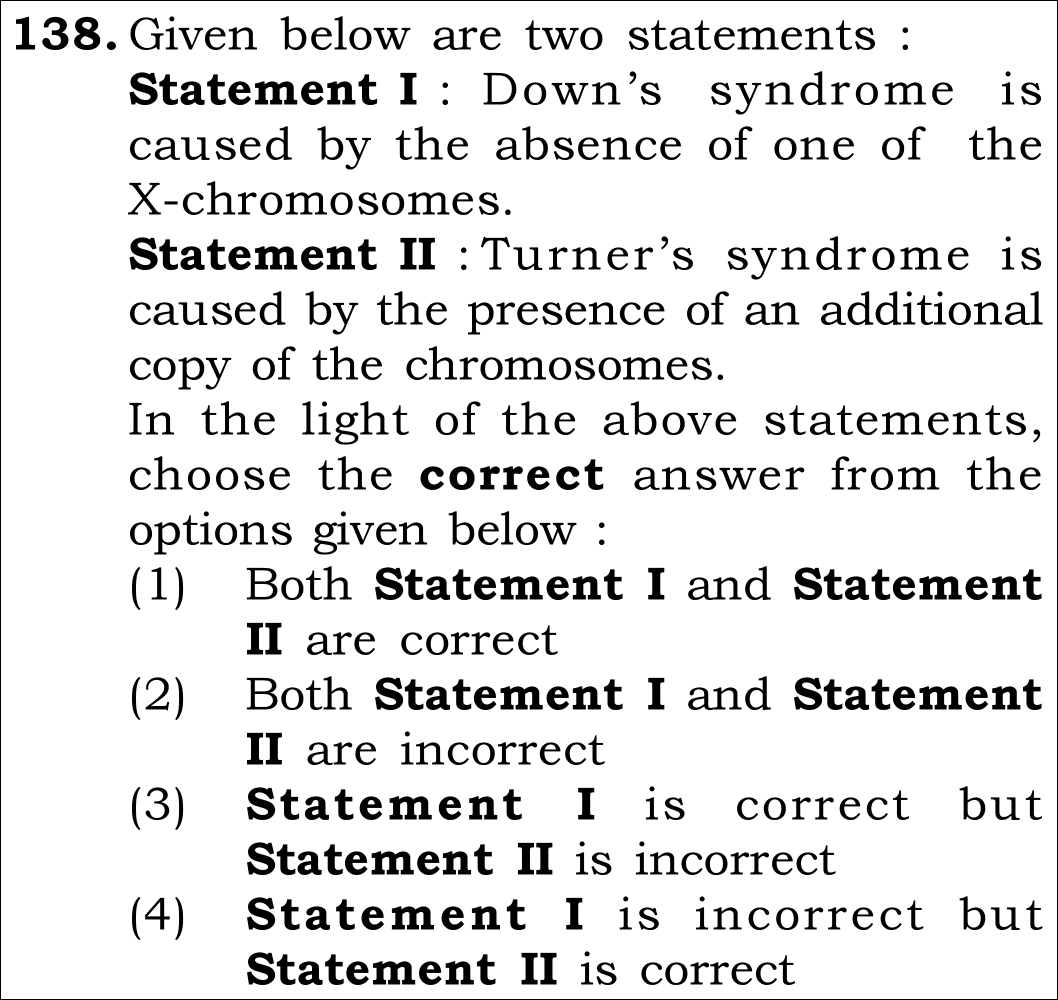
NEET 2026 · Q138 Medium
Official NEET 2026 Question 138 - Principles of Inheritance and Variation
1
2 ✓ Key
3
4
💡 Verified Solution & 30-Second Hack
✓
Verified Against NTA Final Answer Key
Option (2) : Both Statement I and Statement II are incorrect
📚 Principles of Inheritance and Variation Medium
📋 Given Parameters & Problem Setup
Statement I Down's syndrome is caused by the absence of one of the X-chromosomes.
Statement II Turner's syndrome is caused by the presence of an additional copy of the chromosomes.
⚡

The 30-Second Exam Hall Shortcut: ⚡ Chromosomal Disorder Diagnosis

⏱️ Save ~40 seconds

Down = Trisomy 21 (Autosomal Addition); Turner = 45,XO (Sex Chromosome Absence)!

1 Examine Statement I: Down's syndrome is caused by an extra copy of chromosome 21 (trisomy 21), NOT absence of an X-chromosome. Statement I is FALSE!
2 Examine Statement II: Turner's syndrome is caused by ABSENCE of an X-chromosome (45, XO monosomy), NOT addition of chromosomes. Statement II is FALSE!
3 Both Statement I and Statement II are incorrect.
4 Select Option (2) in under 10 seconds!
🛡️
Why You Can 100% Trust This Shortcut: NCERT Biology · Principles of Inheritance and Variation (Chromosomal Aneuploidy: Turner’s syndrome 45,XO sterile females).
📐

Step-by-Step Rigorous Workflow & Mathematical Proof

Step 1

Etiology of Down's Syndrome (Statement I)

Down's syndrome (first described by Langdon Down in 1866) is an autosomal aneuploidy caused by non-disjunction leading to trisomy of chromosome 21 (2n+1=472n+1 = 47). It does not involve sex chromosomes or the loss of an X-chromosome. Therefore, Statement I is definitively false.

Down’s Syndrome=45A+XX or XY(Trisomy of Chromosome 21)  ⟹  Statement I is FALSE\text{Down's Syndrome} = 45\text{A} + \text{XX or XY} \quad (\text{Trisomy of Chromosome 21}) \implies \text{Statement I is FALSE}
  • • Absence of an X chromosome causes Turner's syndrome, not Down's.
Step 2

Etiology of Turner's Syndrome (Statement II)

Turner's syndrome is a sex chromosomal monosomy caused by the absence of one X chromosome in females, resulting in the karyotype 44A+XO44\text{A} + \text{XO} (45 chromosomes). Statement II asserts that it is caused by the "presence of an additional copy of the chromosomes", which describes Klinefelter's (44A+XXY44\text{A} + \text{XXY}) or Down's, not Turner's. Hence, Statement II is false.

Turner’s Syndrome=44A+XO(Monosomy / Absence of one X-chromosome)  ⟹  Statement II is FALSE\text{Turner's Syndrome} = 44\text{A} + \text{XO} \quad (\mathbf{Monosomy\text{ / Absence of one X-chromosome}}) \implies \text{Statement II is FALSE}
  • • Females are sterile with rudimentary ovaries and lack secondary sexual characters.
Step 3

Synthesize Verdict

Because both statements swap and mischaracterize the underlying genetic lesions, both Statement I and Statement II are incorrect.

Both Statement I and Statement II are incorrect  ⟹  Option (2)\text{Both Statement I and Statement II are incorrect} \implies \text{Option (2)}
  • • Matches official NTA final answer key Option B / (2).
⭐

360° Option Elimination Engine Key Feature

Diagnose every choice: Know exactly why the right option works and why distractors fail.

4-Option Deep Scan
1 A
✗ Incorrect
Verdict & Scientific Reason:

Incorrect. Both statements contain glaring factual errors regarding chromosome numbers.

⚠️
Student Fallacy (Why candidates pick this trap): Assuming medical syndrome names validate the statements without checking mechanisms.
2 B
✓ 100% Correct
Verdict & Scientific Reason:

100% accurate. Down's is trisomy 21 (not X absence); Turner's is X monosomy (not chromosomal addition).

💡
Why this is airtight: None; mastered human cytogenetics.
3 C
✗ Incorrect
Verdict & Scientific Reason:

Incorrect. Down's syndrome is an autosomal disorder, not an X-chromosome deletion.

⚠️
Student Fallacy (Why candidates pick this trap): Confusing Down's syndrome with Turner's syndrome.
4 D
✗ Incorrect
Verdict & Scientific Reason:

Incorrect. Turner's syndrome involves chromosomal loss (45,XO45, XO), not addition.

⚠️
Student Fallacy (Why candidates pick this trap): Confusing Turner's syndrome with Klinefelter's syndrome (47,XXY47, XXY).
⚠️

NTA Trap Alert: The Syndromic Inversion Trap

NTA inverted the causes: Down's is addition (+21), Turner's is absence (-X). The examiner swapped "absence" into Down's and "additional copy" into Turner's.

🛡️ How to avoid the -1 mark: Lock in karyotypes: Down = 47 (+21); Turner = 45 (-X); Klinefelter = 47 (+X).
📖

Core NEET Syllabus Standard

NEET Biology Core Syllabus · Principles of Inheritance and Variation Standard Benchmark
Core Scientific Principle Tested:

"Down's syndrome is caused by trisomy of chromosome 21 (autosomal addition). Turner's syndrome is caused by monosomy of the X-chromosome (45, XO)."
Syllabus Focus: Chromosomal Disorders
✓ Core NEET UG Syllabus Anchor Syllabus & Academic Standards ↗
Down has Twenty-One in Three; Turner loses X and sits at Forty-Three plus Two minus One = Forty-Five, XO!
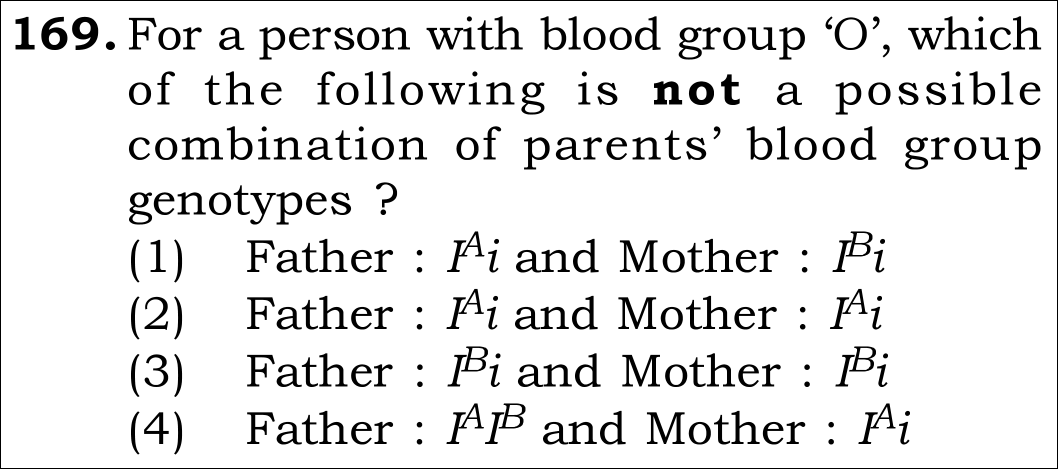
NEET 2026 · Q169 Medium
Official NEET 2026 Question 169 - Principles of Inheritance and Variation
1
2
3
4 ✓ Key
💡 Verified Solution & 30-Second Hack
✓
Verified Against NTA Final Answer Key
Option (4) : Father: I^A I^B, Mother: I^A i
📚 Principles of Inheritance and Variation Medium
📋 Given Parameters & Problem Setup
Offspring Blood Group Group 'O' (Genotype: ii)
Target Condition Parental combination that CANNOT produce this child
⚡

The 30-Second Exam Hall Shortcut: ⚡ The "AB Cannot Have O Child" Law

⏱️ Save ~45 seconds

A parent with blood group AB (I^A I^B) can NEVER produce a child with blood group O (ii)!

1 Target offspring has blood group O, meaning homozygous recessive genotype: ii.
2 To produce an ii child, BOTH father and mother MUST contribute at least one "i" allele.
3 Scan parental combinations for any parent who has ZERO "i" alleles.
4 In Option (4): Father has genotype I^A I^B. His gametes can ONLY be I^A or I^B; he can NEVER produce a gamete with "i".
5 Therefore, an I^A I^B father can NEVER have an "O" (ii) child!
6 Option (4) is immediately identified in 5 seconds.
🛡️
Why You Can 100% Trust This Shortcut: NCERT Biology · Principles of Inheritance and Variation (Sex Linkage & Recombination: Morgan’s Drosophila crosses show tight linkage).
📐

Step-by-Step Rigorous Workflow & Mathematical Proof

Step 1

Genetics of ABO Blood Group System

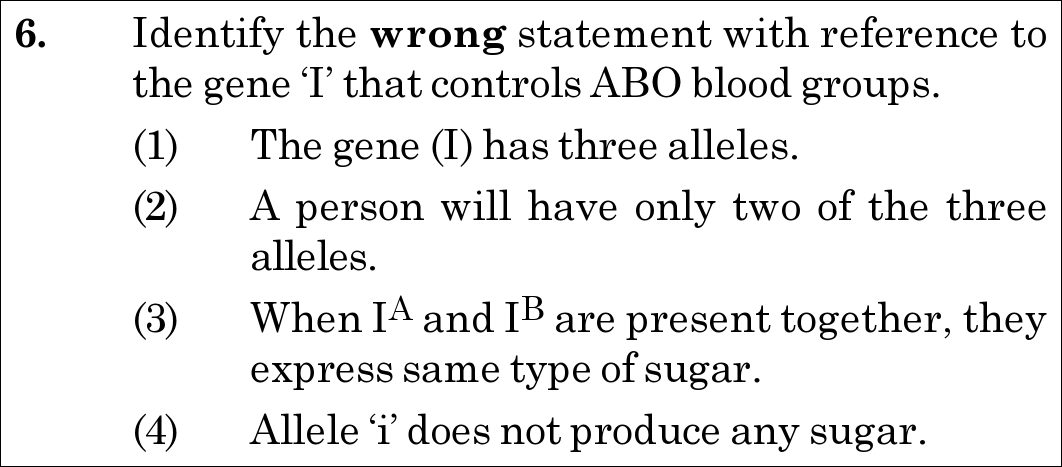
ABO blood groups are controlled by the gene I, which has three alleles: I^A, I^B, and i. I^A and I^B are codominant with each other and completely dominant over the recessive allele i.

Blood Group O  ⟹  Genotype: ii  ⟹  (One i from father)+(One i from mother)\text{Blood Group O} \implies \text{Genotype: } ii \implies (\text{One } i \text{ from father}) + (\text{One } i \text{ from mother})
  • • Any child with blood group O requires that both parents carry at least one recessive i allele.
Step 2

Evaluate Parental Combinations

Examine each given parental pair to check if both parents can produce an "i" gamete:

(1) Father: IAi, Mother: IBi  ⟹  i×i→ii(Possible: 25%)(2) Father: IAi, Mother: ii  ⟹  i×i→ii(Possible: 50%)(3) Father: ii, Mother: ii  ⟹  i×i→ii(Possible: 100%)(4)Father: IAIB, Mother: IAi  ⟹  Father can only donate IA or IB  ⟹  Child ii is IMPOSSIBLE!\begin{aligned} (1) & \text{ Father: } I^A i, \text{ Mother: } I^B i \implies i \times i \rightarrow ii \quad (\text{Possible: 25\%}) \\ (2) & \text{ Father: } I^A i, \text{ Mother: } ii \implies i \times i \rightarrow ii \quad (\text{Possible: 50\%}) \\ (3) & \text{ Father: } ii, \text{ Mother: } ii \implies i \times i \rightarrow ii \quad (\text{Possible: 100\%}) \\ (4) & \mathbf{\text{Father: } I^A I^B}, \text{ Mother: } I^A i \implies \text{Father can only donate } I^A \text{ or } I^B \implies \text{Child } \mathbf{ii} \text{ is } \mathbf{IMPOSSIBLE!} \end{aligned}
  • • Possible offspring of (4) are only: I^A I^A (A), I^A i (A), I^A I^B (AB), or I^B i (B). None can be O.
⭐

360° Option Elimination Engine Key Feature

Diagnose every choice: Know exactly why the right option works and why distractors fail.

4-Option Deep Scan
1 A
✗ Incorrect
Verdict & Scientific Reason:

Incorrect choice because both parents carry the i allele and can produce an ii (O) child with 25% probability.

⚠️
Student Fallacy (Why candidates pick this trap): Thinking parents with blood groups A and B cannot have an O child.
2 B
✗ Incorrect
Verdict & Scientific Reason:

Incorrect choice because father provides i (50% chance) and mother always provides i, yielding 50% blood group O children.

⚠️
Student Fallacy (Why candidates pick this trap): Failing to realize heterozygous A cross with O gives O.
3 C
✗ Incorrect
Verdict & Scientific Reason:

Incorrect choice because both parents are homozygous ii, producing 100% group O offspring.

⚠️
Student Fallacy (Why candidates pick this trap): Misunderstanding homozygous recessive crosses.
4 D
✓ 100% Correct
Verdict & Scientific Reason:

100% correct. An AB father (I^A I^B) has no i allele to transmit; hence producing an ii child is genetically impossible.

💡
Why this is airtight: None; rigorous application of Mendelian segregation.
⚠️

NTA Trap Alert: Confusing Phenotype with Genotype

Students sometimes write "Parent is A and parent is B, so child can only be AB". They forget that A can be I^A i and B can be I^B i. But blood group AB is ALWAYS I^A I^B without exception, leaving zero possibility for an i allele.

🛡️ How to avoid the -1 mark: Remember: Blood group AB has NO "i" allele. An AB parent can NEVER have an O child, and an O parent can NEVER have an AB child!
📖

Core NEET Syllabus Standard

NEET Biology Core Syllabus · Principles of Inheritance and Variation Standard Benchmark
Core Scientific Principle Tested:

"Blood group O requires two i alleles (ii); an individual with genotype I^A I^B cannot pass on an i allele."

Syllabus Focus: Multiple Alleles & ABO Blood Grouping
✓ Core NEET UG Syllabus Anchor Syllabus & Academic Standards ↗
AB parent has NO "i" to give = NO "O" child possible!
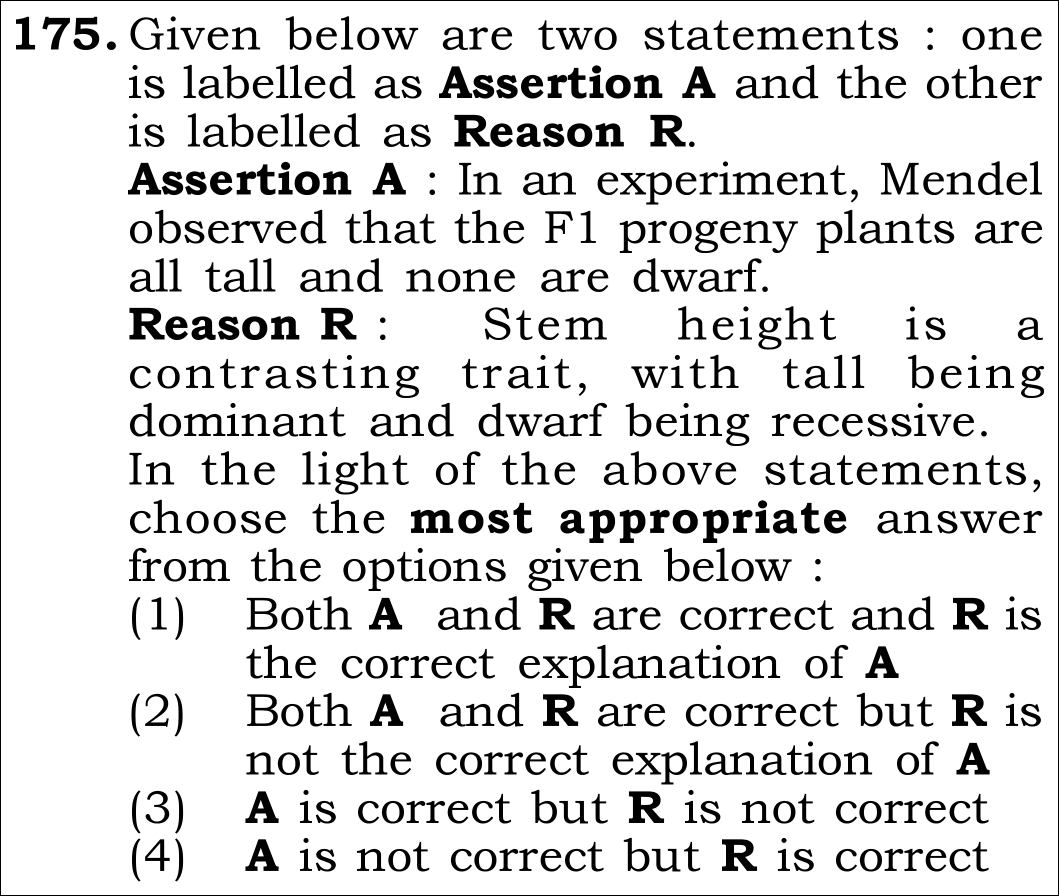
NEET 2026 · Q175 Easy
Official NEET 2026 Question 175 - Principles of Inheritance and Variation
1 ✓ Key
2
3
4
💡 Verified Solution & 30-Second Hack
✓
Verified Against NTA Final Answer Key
Option (1) : Both (A) and (R) are true and (R) is the correct explanation of (A)
📚 Principles of Inheritance and Variation Easy
📋 Given Parameters & Problem Setup
Cross True-breeding Tall (TT) × True-breeding Dwarf (tt)
Assertion (A) In a monohybrid cross between true-breeding tall and true-breeding dwarf pea plants, all F₁ progeny were tall.
Reason (R) The allele for tallness is dominant over the allele for dwarfness, expressing itself in heterozygous condition (Tt).
⚡

The 30-Second Exam Hall Shortcut: ⚡ Law of Dominance "Because" Check

⏱️ Save ~35 seconds

All F₁ are tall BECAUSE tall (T) dominates over dwarf (t) in heterozygotes!

1 Read Assertion (A): In cross TT × tt, all F₁ offspring are phenotypically tall -> TRUE (NCERT monohybrid cross).
2 Read Reason (R): Allele for tallness (T) is dominant over allele for dwarfness (t), expressing in heterozygous Tt -> TRUE (Mendel’s Law of Dominance).
3 Apply "BECAUSE": All F₁ progeny are tall BECAUSE the dominant tall allele masks the recessive dwarf allele in the heterozygous Tt genotype.
4 Reason (R) gives the exact genetic explanation for Assertion (A).
5 Pick Option (1) in under 15 seconds!
🛡️
Why You Can 100% Trust This Shortcut: NCERT Biology · Principles of Inheritance and Variation (Incomplete Dominance: Snapdragon Antirrhinum 1:2:1 red, pink, white ratio).
📐

Step-by-Step Rigorous Workflow & Mathematical Proof

Step 1

Mendel’s Monohybrid Cross (F₁ Generation)

When Mendel crossed true-breeding tall pea plants (TT) with true-breeding dwarf pea plants (tt), each parent produced only one type of gamete: T and t respectively. Fusion of these gametes produced F₁ progeny with uniform heterozygous genotype Tt, all exhibiting the tall phenotype.

P1(TT)×P2(tt)  ⟹  Gametes: T×t  ⟹  F1:Tt(100% Tall)P_1 (TT) \times P_2 (tt) \implies \text{Gametes: } T \times t \implies F_1: Tt \quad (\text{100\% Tall})
  • • Assertion (A) is completely true.
Step 2

Law of Dominance as the Mechanism

According to Mendel’s Law of Dominance: (i) Characters are controlled by discrete units called factors (genes). (ii) Factors occur in pairs. (iii) In a dissimilar pair of factors, one member of the pair dominates (dominant) the other (recessive). Because T completely dominates t in Tt, the dwarf trait is masked in F₁, perfectly explaining Assertion (A).

T (Dominant)>t (Recessive)  ⟹  Tt Phenotype=Tall  ⟹  (R) explains (A)T \text{ (Dominant)} > t \text{ (Recessive)} \implies Tt \text{ Phenotype} = \text{Tall} \implies (R) \text{ explains } (A)
  • • Recessive dwarf phenotype reappears only in F₂ in homozygous condition (tt).
⭐

360° Option Elimination Engine Key Feature

Diagnose every choice: Know exactly why the right option works and why distractors fail.

4-Option Deep Scan
1 A
✓ 100% Correct
Verdict & Scientific Reason:

100% correct. Dominance of the tall allele over the dwarf allele is the precise scientific explanation for the 100% tall F₁ generation.

💡
Why this is airtight: None; textbook Mendelian genetics.
2 B
✗ Incorrect
Verdict & Scientific Reason:

Incorrect. (R) is the exact biological cause of the phenotype described in (A).

⚠️
Student Fallacy (Why candidates pick this trap): Failing to recognize the causal relationship.
3 C
✗ Incorrect
Verdict & Scientific Reason:

Incorrect. Reason (R) is the universally accepted definition of complete dominance.

⚠️
Student Fallacy (Why candidates pick this trap): Doubting the dominance of the tall allele.
4 D
✗ Incorrect
Verdict & Scientific Reason:

Incorrect. Assertion (A) is a historic empirical result.

⚠️
Student Fallacy (Why candidates pick this trap): Thinking dwarf plants appeared in F₁.
⚠️

NTA Trap Alert: F₁ vs. F₂ Generation Confusion

Do not confuse F₁ with F₂. In F₁, ALL plants are tall (100% tall, 0% dwarf). The 3:1 phenotypic ratio only appears in the F₂ generation after selfing F₁ plants.

🛡️ How to avoid the -1 mark: Double check whether the statement refers to F₁ or F₂.
📖

Core NEET Syllabus Standard

NEET Biology Core Syllabus · Principles of Inheritance and Variation Standard Benchmark
Core Scientific Principle Tested:

"In a monohybrid cross, only the dominant trait is expressed in the F₁ generation due to masking of the recessive allele."

Syllabus Focus: Law of Dominance
✓ Core NEET UG Syllabus Anchor Syllabus & Academic Standards ↗
Dominant T hides recessive t: F₁ is 100% Tall!
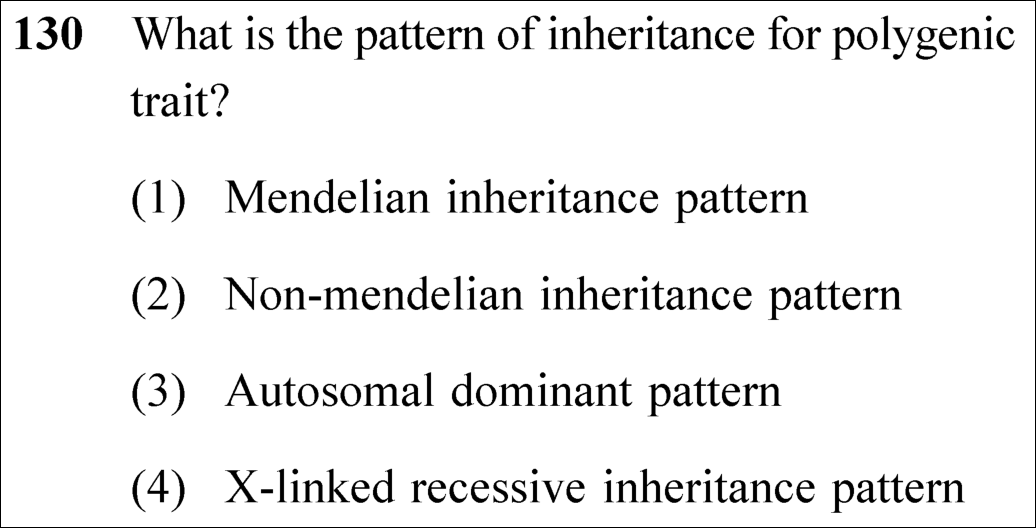
NEET 2025 · Q130 Easy
Official NEET 2025 Question 130 - Principles of Inheritance and Variation
1 Mendelian inheritance pattern
2 Non-mendelian inheritance pattern ✓ Key
3 Autosomal dominant pattern
4 X-linked recessive inheritance pattern
💡 Verified Solution & 30-Second Hack
✓
Verified Against NTA Final Answer Key
Option (2) : Non-mendelian inheritance pattern
📚 Principles of Inheritance and Variation Easy
📋 Given Parameters & Problem Setup
Target Trait Class Polygenic trait (quantitative trait, e.g., human skin colour, height)
Target Classification Pattern of inheritance
⚡

The 30-Second Exam Hall Shortcut: ⚡ Mendelian vs Non-Mendelian Fingerprint

⏱️ Save ~20 seconds

Mendelian = Monogenic qualitative traits (distinct discrete ratios 3:1, 9:3:3:1)! Polygenic = Multiple genes with additive continuous quantitative variation -> NON-MENDELIAN inheritance!

1 Distinguish Mendelian vs Non-Mendelian traits:
2 - Mendelian inheritance: Single gene controlling distinct alternate traits (e.g. Tall vs Dwarf) without environmental gradations.
3 - Polygenic inheritance: Traits controlled by three or more genes with cumulative/additive allele effects (e.g., AABBCC dark skin vs aabbcc light skin in human skin colour) producing a bell-shaped continuous phenotypic spectrum.
4 - Because it deviates from classical Mendelian segregation ratios, it is a Non-Mendelian inheritance pattern.
5 Select Option (2) Non-mendelian inheritance pattern!
🛡️
Why You Can 100% Trust This Shortcut: Polygenic Inheritance & Pleiotropy Distinctions (NCERT Biology · Principles of Inheritance and Variation).
📐

Step-by-Step Rigorous Workflow & Mathematical Proof

Step 1

Concept of Polygenic Inheritance

Gregor Mendel studied traits that had distinct alternate forms (e.g. purple vs white flowers, yellow vs green seeds). However, in nature, many traits exhibit continuous gradation rather than distinct all-or-none phenotypes:

  • • Traits that are generally controlled by three or more genes are called polygenic traits.
  • • Classic examples include human skin colour (controlled by three genes A, B, C as explained in NCERT), human height, and intelligence.
  • • Polygenic inheritance also takes into account the influence of the environment.
Step 2

Why Polygenic Inheritance is Non-Mendelian

Evaluating inheritance classifications:

  • • Mendelian inheritance is based on unit factors (genes) with dominant and recessive alleles yielding discrete qualitative phenotypic ratios (3:1 monohybrid, 9:3:3:1 dihybrid).
  • • Polygenic inheritance involves multiple loci exhibiting additive or quantitative effects, where the phenotype reflects the total number of dominant/contributing alleles, resulting in a continuous Gaussian distribution.
  • • Consequently, it represents an extension/deviation from classical Mendelian rules, categorized firmly as a Non-Mendelian inheritance pattern.
Step 3

Conclusion

Polygenic traits display a Non-Mendelian pattern of inheritance.

Polygenic Trait  ⟹  Non-Mendelian Inheritance Pattern\text{Polygenic Trait} \implies \text{Non-Mendelian Inheritance Pattern}
⭐

360° Option Elimination Engine Key Feature

Diagnose every choice: Know exactly why the right option works and why distractors fail.

4-Option Deep Scan
1 A
✗ Incorrect
Verdict & Scientific Reason:

Incorrect. Mendelian inheritance strictly describes single-gene, qualitative discrete traits.

⚠️
Student Fallacy (Why candidates pick this trap): Confusing all genetic inheritance with classical Mendelian ratios.
2 B
✓ 100% Correct
Verdict & Scientific Reason:

100% correct. Polygenic quantitative traits deviate from simple Mendelian single-gene ratios and are classified as Non-Mendelian.

💡
Why this is airtight: None; clear understanding of genetic paradigms.
3 C
✗ Incorrect
Verdict & Scientific Reason:

Incorrect. Autosomal dominant refers to single-gene monogenic conditions (e.g., Huntington chorea, myotonic dystrophy).

⚠️
Student Fallacy (Why candidates pick this trap): Confusing additive multi-gene alleles with single-gene dominance.
4 D
✗ Incorrect
Verdict & Scientific Reason:

Incorrect. X-linked recessive applies to single genes on the X chromosome (e.g., haemophilia, color blindness).

⚠️
Student Fallacy (Why candidates pick this trap): Confusing sex-linkage with polygenic inheritance.
⚠️

NTA Trap Alert: Qualitative vs Quantitative Inheritance

Mendel studied qualitative traits (discontinuous variation). Polygenic inheritance governs quantitative traits (continuous variation, multiple loci, additive alleles). Quantitative traits are inherently Non-Mendelian!

🛡️ How to avoid the -1 mark: Continuous variation / polygenic = Non-Mendelian.
📖

Core NEET Syllabus Standard

NEET Biology Core Syllabus · Principles of Inheritance and Variation Standard Benchmark
Core Scientific Principle Tested:

"Polygenic inheritance involves multiple genes showing additive effects and continuous variation, representing a non-Mendelian pattern."

Syllabus Focus: Polygenic Inheritance
✓ Core NEET UG Syllabus Anchor Syllabus & Academic Standards ↗
POLY-genes = Plenty of genes, Not simple Mendel (Non-Mendelian)!
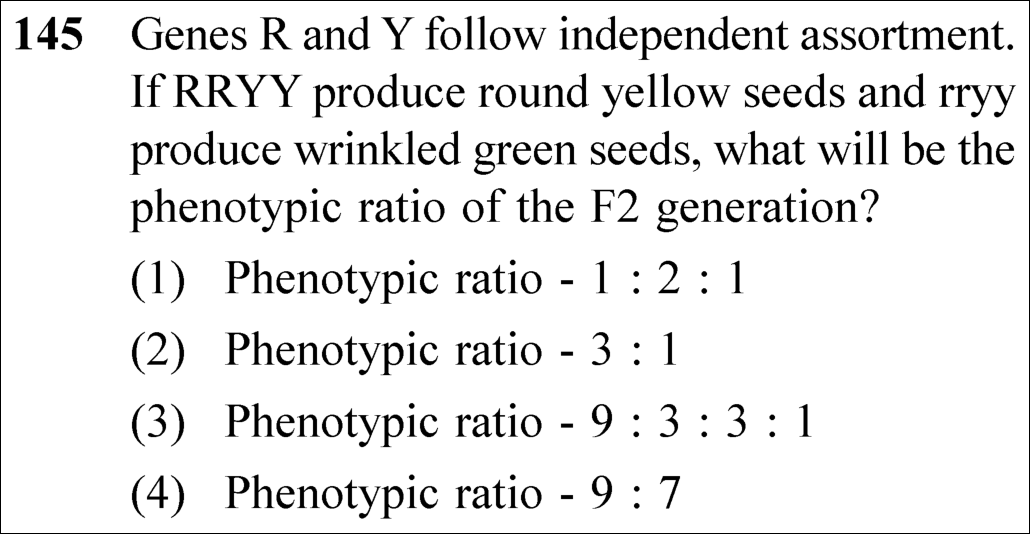
NEET 2025 · Q145 Easy
Official NEET 2025 Question 145 - Principles of Inheritance and Variation
1 Phenotypic ratio- 1:2: 1
2 Phenotypic ratio - 3: 1
3 Phenotypic ratio-9:3:3:1 ✓ Key
4 Phenotypic ratio - 9:7
💡 Verified Solution & 30-Second Hack
✓
Verified Against NTA Final Answer Key
Option (3) : Phenotypic ratio - 9 : 3 : 3 : 1
📚 Principles of Inheritance and Variation Easy
📋 Given Parameters & Problem Setup
Gene Loci R (seed shape: R round, r wrinkled) and Y (seed colour: Y yellow, y green)
Parents RRYY (Round Yellow) x rryy (Wrinkled Green)
Assortment Condition Independent assortment (unlinked genes)
Target Phenotypic ratio of the F2 generation
⚡

The 30-Second Exam Hall Shortcut: ⚡ Mendelian Dihybrid Ratio Fingerprint

⏱️ Save ~20 seconds

A standard dihybrid cross with independent assortment yields the classical 9 : 3 : 3 : 1 F2 phenotypic ratio (9 Round Yellow : 3 Round Green : 3 Wrinkled Yellow : 1 Wrinkled Green)!

1 Recall Mendel's law of independent assortment in dihybrid cross:
2 - Parents: RRYY x rryy -> F1 generation: RrYy (Round Yellow seeds).
3 - Self-pollination of F1: RrYy x RrYy.
4 - Phenotypes in F2: (3 Round : 1 Wrinkled) x (3 Yellow : 1 Green) = 9 Round Yellow : 3 Round Green : 3 Wrinkled Yellow : 1 Wrinkled Green.
5 Phenotypic ratio is 9 : 3 : 3 : 1!
6 Select Option (3)!
🛡️
Why You Can 100% Trust This Shortcut: Chromosomal Theory of Inheritance & Linkage (NCERT Biology · Principles of Inheritance and Variation: Sutton, Boveri, and Morgan).
📐

Step-by-Step Rigorous Workflow & Mathematical Proof

Step 1

Parental Cross and F1 Generation

Mendel crossed a pea plant homozygous for round yellow seeds with one having wrinkled green seeds:

  • • P generation: RRYYRRYY (Round, Yellow) ×\times rryyrryy (Wrinkled, Green).
  • • Gametes: RYRY and ryry.
  • • F1 generation: All RrYyRrYy individuals displaying the dominant phenotype (Round, Yellow seeds).
Step 2

Independent Assortment during Gametogenesis

Because genes R and Y assort independently:

  • • The F1 dihybrid (RrYyRrYy) produces 4 types of pollen grains and 4 types of eggs in equal proportions (25% each): RYRY, RyRy, rYrY, ryry.
  • • Random union of these gametes yields a 4×4=164 \times 4 = 16-box Punnett square in the F2 generation.
Step 3

Derivation of the F2 Phenotypic Ratio

Combining monohybrid independent probabilities:

  • • Round Yellow (R_Y_R\_Y\_): 34×34=916\frac{3}{4} \times \frac{3}{4} = \frac{9}{16}.
  • • Round Green (R_yyR\_yy): 34×14=316\frac{3}{4} \times \frac{1}{4} = \frac{3}{16}.
  • • Wrinkled Yellow (rrY_rrY\_): 14×34=316\frac{1}{4} \times \frac{3}{4} = \frac{3}{16}.
  • • Wrinkled Green (rryyrryy): 14×14=116\frac{1}{4} \times \frac{1}{4} = \frac{1}{16}.
Step 4

Conclusion

The F2 phenotypic ratio is 9 : 3 : 3 : 1, matching Option (3).

Phenotypic Ratio=9:3:3:1\text{Phenotypic Ratio} = 9 : 3 : 3 : 1
⭐

360° Option Elimination Engine Key Feature

Diagnose every choice: Know exactly why the right option works and why distractors fail.

4-Option Deep Scan
1 A
✗ Incorrect
Verdict & Scientific Reason:

Incorrect. 1:2:1 is the genotypic ratio of a monohybrid cross (or phenotypic ratio of incomplete dominance).

⚠️
Student Fallacy (Why candidates pick this trap): Confusing monohybrid genotypic ratio with dihybrid phenotypic ratio.
2 B
✗ Incorrect
Verdict & Scientific Reason:

Incorrect. 3:1 is the phenotypic ratio of a standard monohybrid cross.

⚠️
Student Fallacy (Why candidates pick this trap): Applying monohybrid ratio to a two-gene dihybrid cross.
3 C
✓ 100% Correct
Verdict & Scientific Reason:

100% correct. The canonical Mendelian dihybrid phenotypic ratio resulting from independent assortment.

💡
Why this is airtight: None; pristine genetic arithmetic.
4 D
✗ Incorrect
Verdict & Scientific Reason:

Incorrect. 9:7 is a modified ratio typical of complementary gene interaction, not unlinked independent assortment.

⚠️
Student Fallacy (Why candidates pick this trap): Confusing non-allelic gene interaction with independent assortment.
⚠️

NTA Trap Alert: Phenotypic vs Genotypic Dihybrid Ratios

The F2 PHENOTYPIC ratio is 9:3:3:1 (4 phenotypic classes). The F2 GENOTYPIC ratio is 1:2:1:2:4:2:1:2:1 (9 genotypic classes). Make sure you read which ratio is requested!

🛡️ How to avoid the -1 mark: Question asks for PHENOTYPIC ratio = 9 : 3 : 3 : 1.
📖

Core NEET Syllabus Standard

NEET Biology Core Syllabus · Principles of Inheritance and Variation Standard Benchmark
Core Scientific Principle Tested:

"In a dihybrid cross of independently assorting genes, the F2 generation exhibits a 9:3:3:1 phenotypic ratio."

Syllabus Focus: Inheritance of Two Genes · Law of Independent Assortment
✓ Core NEET UG Syllabus Anchor Syllabus & Academic Standards ↗
Dihybrid Phenotype = 9:3:3:1 (Mendel's Classic Double-Trait Signature)!
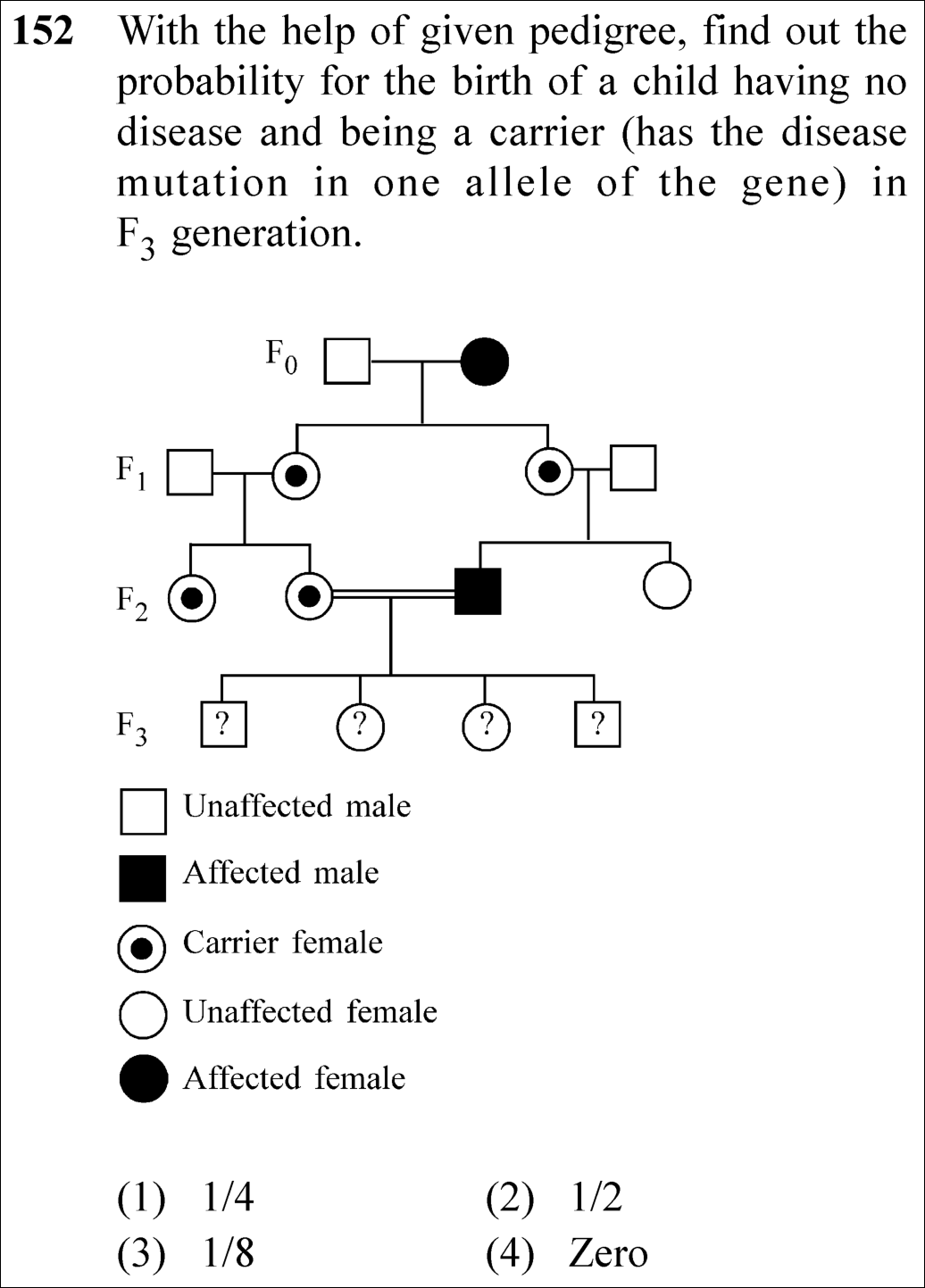
NEET 2025 · Q152 Medium
Official NEET 2025 Question 152 - Principles of Inheritance and Variation
1 ✓ Key
2
3
4
💡 Verified Solution & 30-Second Hack
✓
Verified Against NTA Final Answer Key
Option (1) : 1/4
📚 Principles of Inheritance and Variation Medium
📋 Given Parameters & Problem Setup
Mother in F2 Carrier female (XᴬXᵃ, circle with central dot)
Father in F2 Affected male (XᵃY, filled black square)
Target Condition in F3 Child having no disease AND being a carrier (mutation in one allele)
⚡

The 30-Second Exam Hall Shortcut: ⚡ Pedigree Punnett Cross Fingerprint

⏱️ Save ~40 seconds

Carrier mother (XᴬXᵃ) × Affected father (XᵃY) -> Zygotes: 1/4 XᴬXᵃ (carrier female, healthy), 1/4 XᵃXᵃ (affected female), 1/4 XᴬY (healthy male, non-carrier), 1/4 XᵃY (affected male)! Probability of healthy carrier child = 1/4!

1 Deduce the mode of inheritance from the pedigree:
2 - F0 affected female (XaXaX^a X^a) passes disease allele to all sons and makes all daughters carriers (XAXaX^A X^a).
3 - Carrier female (XAXaX^A X^a) in F1 mated to normal male (XAYX^A Y) produces an affected son (XaYX^a Y) in F2.
4 - Thus, the trait is classical X-linked recessive (e.g. Haemophilia or Colour blindness).
5 Identify parental genotypes mating to yield F3:
6 - Mother (F2): Carrier female = XAXaX^A X^a.
7 - Father (F2): Affected male = XaYX^a Y.
8 Perform the genetic cross: XAXa×XaYX^A X^a \times X^a Y:
9 - Gametes: Mother produces XAX^A (1/2) and XaX^a (1/2); Father produces XaX^a (1/2) and YY (1/2).
10 - Offspring distribution (total 4 equally probable classes):
11 XAXaX^A X^a: Carrier female, no disease (1/4).
12 XaXaX^a X^a: Affected female, has disease (1/4).
13 XAYX^A Y: Normal male, no disease, NOT a carrier (1/4).
14 XaYX^a Y: Affected male, has disease (1/4).
15 Who satisfies "child having no disease and being a carrier"? ONLY XAXaX^A X^a! Probability = 1/4 (Option 1)!
16 Select Option (1) 1/4!
🛡️
Why You Can 100% Trust This Shortcut: Mendelian vs Chromosomal Genetic Disorders (NCERT Biology · Principles of Inheritance and Variation: Aneuploidy, Down, Turner, Klinefelter).
📐

Step-by-Step Rigorous Workflow & Mathematical Proof

Step 1

Deciphering the Pedigree and Mode of Inheritance

Analyzing the transmission pattern across generations:

  • • In F0, an affected female (black circle, XaXaX^a X^a) mates with an unaffected male (empty square, XAYX^A Y). All daughters inherit one paternal XAX^A and one maternal XaX^a, making them obligate carrier females (circles with central dot, XAXaX^A X^a) in F1.
  • • In F1, a carrier female (XAXaX^A X^a) mates with an unaffected male (XAYX^A Y). They produce an affected son (XaYX^a Y) in F2. This confirms X-linked recessive inheritance beyond doubt.
  • • The consanguineous marriage in F2 involves a carrier female (XAXaX^A X^a) and an affected male (XaYX^a Y).
Step 2

Constructing the F2 × F2 Punnett Square for F3 Offspring

Determining all possible genotypic and phenotypic outcomes:

  • • Maternal gametes: XAX^A (50%50\%) and XaX^a (50%50\%).
  • • Paternal gametes: XaX^a (50%50\%) and YY (50%50\%).
  • • Cross outcomes (44 equally likely quadrants, each p=0.25p = 0.25):
  • • 1. XAXaX^A X^a: Phenotypically normal female, carries one mutated allele (Heterozygous carrier female).
  • • 2. XaXaX^a X^a: Phenotypically affected female (Homozygous mutant).
  • • 3. XAYX^A Y: Phenotypically normal male (Hemizygous wild-type, carries zero mutant alleles, cannot be a carrier).
  • • 4. XaYX^a Y: Phenotypically affected male (Hemizygous mutant).
Step 3

Evaluating the Probability Condition

The question specifically requires the birth of a child (of either sex) having: (i) NO disease, AND (ii) being a carrier (bearing the disease mutation in one allele).

P(Carrier child)=P(XAXa)=12×12=14P(\text{Carrier child}) = P(X^A X^a) = \frac{1}{2} \times \frac{1}{2} = \frac{1}{4}
Step 4

Conclusion

Out of all 4 possible zygotic combinations, exactly 1 corresponds to an unaffected carrier child (XAXaX^A X^a). The probability is 1/4.

Probability=14 (Option 1)\text{Probability} = \frac{1}{4} \text{ (Option 1)}
⭐

360° Option Elimination Engine Key Feature

Diagnose every choice: Know exactly why the right option works and why distractors fail.

4-Option Deep Scan
1 A
✓ 100% Correct
Verdict & Scientific Reason:

100% correct. Only the XᴬXᵃ genotype (1 out of 4 total offspring) is both disease-free and a carrier of one mutated allele.

💡
Why this is airtight: None; flawless pedigree probability calculation.
2 B
✗ Incorrect
Verdict & Scientific Reason:

Incorrect. 1/2 is the probability of a daughter being a carrier, but the question asks for the probability of a "child" (which includes sons and daughters).

⚠️
Student Fallacy (Why candidates pick this trap): Conditioning on female sex only instead of all children.
3 C
✗ Incorrect
Verdict & Scientific Reason:

Incorrect. Unnecessary multiplication by extra generation factors.

⚠️
Student Fallacy (Why candidates pick this trap): Over-multiplying parental probabilities.
4 D
✗ Incorrect
Verdict & Scientific Reason:

Incorrect. Carrier daughters are readily produced with 25% overall probability.

⚠️
Student Fallacy (Why candidates pick this trap): Assuming affected fathers cannot produce carrier daughters.
⚠️

NTA Trap Alert: Child vs Daughter Probability Trap

A classic genetics trap: If asked "probability of a DAUGHTER being a carrier", the answer is 1/2 (since among daughters, 1 is XᴬXᵃ and 1 is XᵃXᵃ). But when asked "probability of a CHILD being a carrier", all 4 children are considered, so probability is 1/4!

🛡️ How to avoid the -1 mark: Check the wording: "child" = divide by 4; "daughter" = divide by 2.
📖

Core NEET Syllabus Standard

NEET Biology Core Syllabus · Principles of Inheritance and Variation Standard Benchmark
Core Scientific Principle Tested:

"In an X-linked cross of XᴬXᵃ × XᵃY, the probability of an unaffected carrier child (XᴬXᵃ) is 1/4."

Syllabus Focus: Mendelian Disorders · Pedigree Analysis (Sex-Linked Recessive)
✓ Core NEET UG Syllabus Anchor Syllabus & Academic Standards ↗
1 in 4 is the Carrier Door: XᴬXᵃ = 1/4 total progeny!
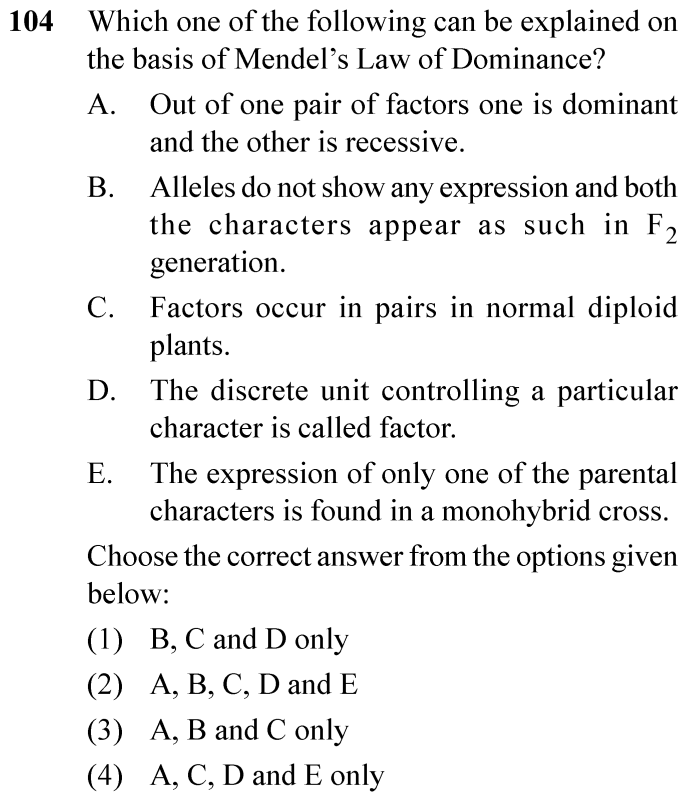
NEET 2024 · Q104 Medium
Official NEET 2024 Question 104 - Principles of Inheritance and Variation
1
2
3
4 ✓ Key
💡 Verified Solution & 30-Second Hack
✓
Verified Against NTA Final Answer Key
Option (4) : A, C, D and E only
📚 Principles of Inheritance and Variation Medium
📋 Given Parameters & Problem Setup
Principle Mendel's Law of Dominance
Candidate Statements A: Dominant/recessive pair; B: Non-blending in F2; C: Factors occur in pairs; D: Discrete factors; E: One parental character expressed in F1
⚡

The 30-Second Exam Hall Shortcut: ⚡ Dominance vs Segregation Dissection

⏱️ Save ~40 seconds

Statement B describes non-blending and recovery of both alleles in F2, which is the Law of Segregation (Purity of Gametes)! Statements A, C, D, and E are the exact postulates of the Law of Dominance!

1 Check Statement B: "Alleles do not show any expression and both characters appear as such in F2 generation" refers to non-blending / segregation.
2 Eliminate any option containing B: Option 1 (B, C, D), Option 2 (all), Option 3 (A, B, C) are all eliminated!
3 Only Option (4) A, C, D and E only remains!
4 Solved in under 10 seconds through systematic elimination!
🛡️
Why You Can 100% Trust This Shortcut: NCERT Biology · Principles of Inheritance and Variation (Law of Dominance Postulates)
📐

Step-by-Step Rigorous Workflow & Mathematical Proof

Step 1

Identify NCERT Postulates of the Law of Dominance

Mendel stated the Law of Dominance using three core assertions: (i) Characters are controlled by discrete units called factors (Statement D). (ii) Factors occur in pairs (Statement C). (iii) In a dissimilar pair of factors, one member dominates the other (Statement A). It also explains the expression of only one parental character in F1 (Statement E) and the 3:1 ratio in F2.

Step 2

Analyze Statement B

Statement B asserts that alleles do not show blending and both characters are recovered as such in F2. This is the definition and evidence for the Law of Segregation (purity of gametes), not the Law of Dominance.

Step 3

Formulate Correct Set

Statements A, C, D, and E belong to the Law of Dominance, making Option (4) the correct answer.

⭐

360° Option Elimination Engine Key Feature

Diagnose every choice: Know exactly why the right option works and why distractors fail.

4-Option Deep Scan
1 (1)
✗ Incorrect
Verdict & Scientific Reason:

Statement B represents the Law of Segregation, not the Law of Dominance.

⚠️
Student Fallacy (Why candidates pick this trap): Statement B represents the Law of Segregation, not the Law of Dominance.
2 (2)
✗ Incorrect
Verdict & Scientific Reason:

Includes Statement B which is attributed to the Law of Segregation.

⚠️
Student Fallacy (Why candidates pick this trap): Includes Statement B which is attributed to the Law of Segregation.
3 (3)
✗ Incorrect
Verdict & Scientific Reason:

Includes Statement B and omits valid postulates D and E.

⚠️
Student Fallacy (Why candidates pick this trap): Includes Statement B and omits valid postulates D and E.
4 (4)
✓ 100% Correct
Verdict & Scientific Reason:

Correctly identifies all statements representing postulates and explanations of the Law of Dominance while excluding segregation.

💡
Why this is airtight: None.
⚠️

NTA Trap Alert: Mixing Up the Two Mendelian Laws

Assuming all monohybrid cross observations are covered under the Law of Dominance.

🛡️ How to avoid the -1 mark: Remember: Non-blending and recovery of recessive trait in F2 proves the Law of Segregation (Alleles segregate during gamete formation).
📖

Core NEET Syllabus Standard

Biology Core Botany · Principles of Inheritance and Variation Standard Benchmark
Core Scientific Principle Tested:

"Law of Dominance: (i) Characters are controlled by discrete units called factors. (ii) Factors occur in pairs. (iii) In a dissimilar pair of factors one member of the pair dominates (dominant) the other (recessive)."

Syllabus Focus: Postulates of Mendel's Law of Dominance
✓ Core NEET UG Syllabus Anchor Syllabus & Academic Standards ↗
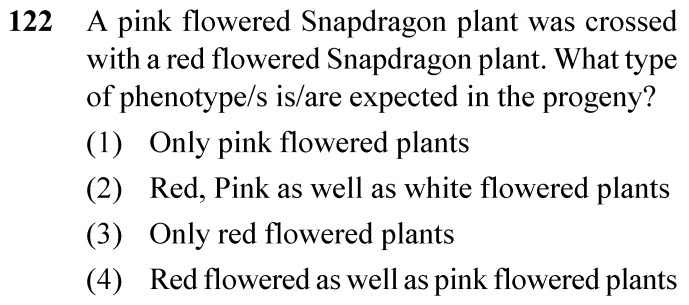
NEET 2024 · Q122 Easy
Official NEET 2024 Question 122 - Principles of Inheritance and Variation
1 Only pink flowered plants
2 Red, Pink as well as white flowered plants
3 Only red flowered plants
4 Red flowered as well as pink flowered plants ✓ Key
💡 Verified Solution & 30-Second Hack
✓
Verified Against NTA Final Answer Key
Option (4) : Red flowered as well as pink flowered plants
📚 Principles of Inheritance and Variation Easy
📋 Given Parameters & Problem Setup
Organism Snapdragon (Antirrhinum majus)
Cross Pink flowered plant (Rr) x Red flowered plant (RR)
⚡

The 30-Second Exam Hall Shortcut: ⚡ Incomplete Dominance Punnett Split

⏱️ Save ~25 seconds

Pink (Rr) x Red (RR) produces 50% RR (Red) and 50% Rr (Pink). Offspring will be Red flowered as well as pink flowered!

1 Identify genotypes from incomplete dominance rules:
2 - Red = RR
3 - Pink = Rr
4 - White = rr
5 Cross: Rr (gametes R, r) x RR (gametes R):
6 - R x R -> RR (Red)
7 - r x R -> Rr (Pink)
8 Ratio: 1 Red : 1 Pink (no white flowers).
9 Hence, the progeny has red flowered as well as pink flowered plants -> Option (4) / D.
🛡️
Why You Can 100% Trust This Shortcut: NCERT Biology · Principles of Inheritance and Variation (Incomplete Dominance in Antirrhinum)
📐

Step-by-Step Rigorous Workflow & Mathematical Proof

Step 1

Define Genotypes in Antirrhinum majus

Flower colour in snapdragon exhibits incomplete dominance where the heterozygous condition (Rr) yields an intermediate pink phenotype. Homozygous dominant (RR) produces red flowers, and homozygous recessive (rr) produces white flowers.

Step 2

Perform the Monohybrid Cross

Parent 1: Pink flowered = RrRr Parent 2: Red flowered = RRRR Gametes produced: - Pink parent: 50%  R50\%\; R, 50%  r50\%\; r - Red parent: 100%  R100\%\; R

Step 3

Determine Genotypic and Phenotypic Frequencies

Offspring Genotypes=12 RR+12 Rr\text{Offspring Genotypes} = \frac{1}{2}\,RR + \frac{1}{2}\,Rr - RRRR: Red flowered (50%50\%) - RrRr: Pink flowered (50%50\%) No white (rrrr) plants can be formed. The progeny consists of red flowered as well as pink flowered plants.

⭐

360° Option Elimination Engine Key Feature

Diagnose every choice: Know exactly why the right option works and why distractors fail.

4-Option Deep Scan
1 (1)
✗ Incorrect
Verdict & Scientific Reason:

Only pink flowers would result from a cross between pure Red (RR) and pure White (rr).

⚠️
Student Fallacy (Why candidates pick this trap): Only pink flowers would result from a cross between pure Red (RR) and pure White (rr).
2 (2)
✗ Incorrect
Verdict & Scientific Reason:

White flowered plants (rr) require an r allele from both parents, but the red parent (RR) donates only R alleles.

⚠️
Student Fallacy (Why candidates pick this trap): White flowered plants (rr) require an r allele from both parents, but the red parent (RR) donates only R alleles.
3 (3)
✗ Incorrect
Verdict & Scientific Reason:

The pink parent donates the r allele in 50% of its gametes, producing pink progeny.

⚠️
Student Fallacy (Why candidates pick this trap): The pink parent donates the r allele in 50% of its gametes, producing pink progeny.
4 (4)
✓ 100% Correct
Verdict & Scientific Reason:

The progeny shows a 1:1 ratio of Red (RR) and Pink (Rr) flowered individuals.

💡
Why this is airtight: None.
⚠️

NTA Trap Alert: Assuming F2 Monohybrid Selfing Ratio

Recalling the classic 1:2:1 ratio (Red:Pink:White) without noticing the cross is a backcross (Rr x RR), not a self-cross of pink (Rr x Rr).

🛡️ How to avoid the -1 mark: Always write down parental genotypes explicitly before calculating offspring proportions.
📖

Core NEET Syllabus Standard

Biology Core Botany · Principles of Inheritance and Variation Standard Benchmark
Core Scientific Principle Tested:

"In a cross between true-breeding red-flowered (RR) and true-breeding white-flowered plants (rr), the F1 (Rr) was pink... When pink (Rr) is crossed with red (RR), 50% are red (RR) and 50% are pink (Rr)."

Syllabus Focus: Inheritance of Flower Colour in Snapdragon (Antirrhinum majus)
✓ Core NEET UG Syllabus Anchor Syllabus & Academic Standards ↗
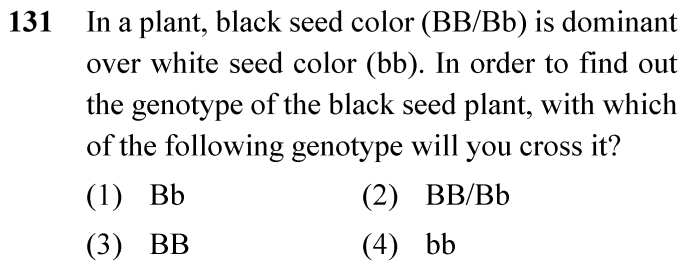
NEET 2024 · Q131 Easy
Official NEET 2024 Question 131 - Principles of Inheritance and Variation
1
2
3
4 ✓ Key
💡 Verified Solution & 30-Second Hack
✓
Verified Against NTA Final Answer Key
Option (4) : bb
📚 Principles of Inheritance and Variation Easy
📋 Given Parameters & Problem Setup
Dominant Trait Black seed color (BB or Bb)
Recessive Trait White seed color (bb)
Goal Determine the unknown genotype of a black seeded plant
⚡

The 30-Second Exam Hall Shortcut: ⚡ Test Cross Definition Rule

⏱️ Save ~20 seconds

To determine whether an individual showing a dominant phenotype is homozygous (BB) or heterozygous (Bb), cross it with the homozygous recessive parent (bb)! This is a Test Cross!

1 Recall test cross methodology:
2 - Cross unknown dominant (BBBB or BbBb) with homozygous recessive (bbbb).
3 - If all progeny are black (BbBb), the unknown is BBBB.
4 - If 50%50\% are black (BbBb) and 50%50\% are white (bbbb), the unknown is BbBb.
5 Hence, the tester genotype must be homozygous recessive: bb.
6 Select Option (4) / D.
🛡️
Why You Can 100% Trust This Shortcut: NCERT Biology · Principles of Inheritance and Variation (Test Cross Principle)
📐

Step-by-Step Rigorous Workflow & Mathematical Proof

Step 1

Define a Test Cross

In genetics, a test cross is the cross of an organism showing a dominant phenotype (whose genotype may be homozygous or heterozygous) with an organism that is homozygous recessive for the same trait.

Step 2

Evaluate Progeny Ratios

If the black seed plant is homozygous dominant (BBBB): BB×bb→100%  Bb  (all black)BB \times bb \rightarrow 100\%\; Bb\;(\text{all black}) If the black seed plant is heterozygous (BbBb): Bb×bb→50%  Bb  (black):50%  bb  (white)Bb \times bb \rightarrow 50\%\; Bb\;(\text{black}) : 50\%\; bb\;(\text{white}) Because the recessive parent donates only recessive alleles (bb), the phenotype of the progeny directly reveals the alleles donated by the unknown dominant parent.

Step 3

Select Matching Genotype

The genotype crossed with the black seeded plant is homozygous recessive (bbbb), which is Option (4).

⭐

360° Option Elimination Engine Key Feature

Diagnose every choice: Know exactly why the right option works and why distractors fail.

4-Option Deep Scan
1 (1)
✗ Incorrect
Verdict & Scientific Reason:

Crossing with heterozygous Bb will produce dominant phenotypes in both homozygous and heterozygous dominant unknowns, obscuring clean 1:1 discrimination.

⚠️
Student Fallacy (Why candidates pick this trap): Crossing with heterozygous Bb will produce dominant phenotypes in both homozygous and heterozygous dominant unknowns, obscuring clean 1:1 discrimination.
2 (2)
✗ Incorrect
Verdict & Scientific Reason:

An ambiguous or dominant genotype cannot serve as a diagnostic tester.

⚠️
Student Fallacy (Why candidates pick this trap): An ambiguous or dominant genotype cannot serve as a diagnostic tester.
3 (3)
✗ Incorrect
Verdict & Scientific Reason:

Crossing with homozygous dominant BB yields 100% black seeds regardless of whether the unknown is BB or Bb, giving no information.

⚠️
Student Fallacy (Why candidates pick this trap): Crossing with homozygous dominant BB yields 100% black seeds regardless of whether the unknown is BB or Bb, giving no information.
4 (4)
✓ 100% Correct
Verdict & Scientific Reason:

Homozygous recessive genotype (bb) allows direct phenotypic readout of the unknown dominant genotype (test cross).

💡
Why this is airtight: None.
⚠️

NTA Trap Alert: Backcross vs Testcross Ambiguity

Thinking any cross with a parent is sufficient; only the homozygous recessive parent definitively tests the unknown genotype.

🛡️ How to avoid the -1 mark: Remember: Test cross is strictly a cross with the homozygous recessive individual.
📖

Core NEET Syllabus Standard

Biology Core Botany · Principles of Inheritance and Variation Standard Benchmark
Core Scientific Principle Tested:

"To determine the genotype of a tall plant at F2, Mendel crossed the tall plant from F2 with a dwarf plant. This he called a test cross. In a typical test cross an organism showing a dominant phenotype is crossed with the recessive parent."

Syllabus Focus: Test Cross Determination of Dominant Genotype
✓ Core NEET UG Syllabus Anchor Syllabus & Academic Standards ↗
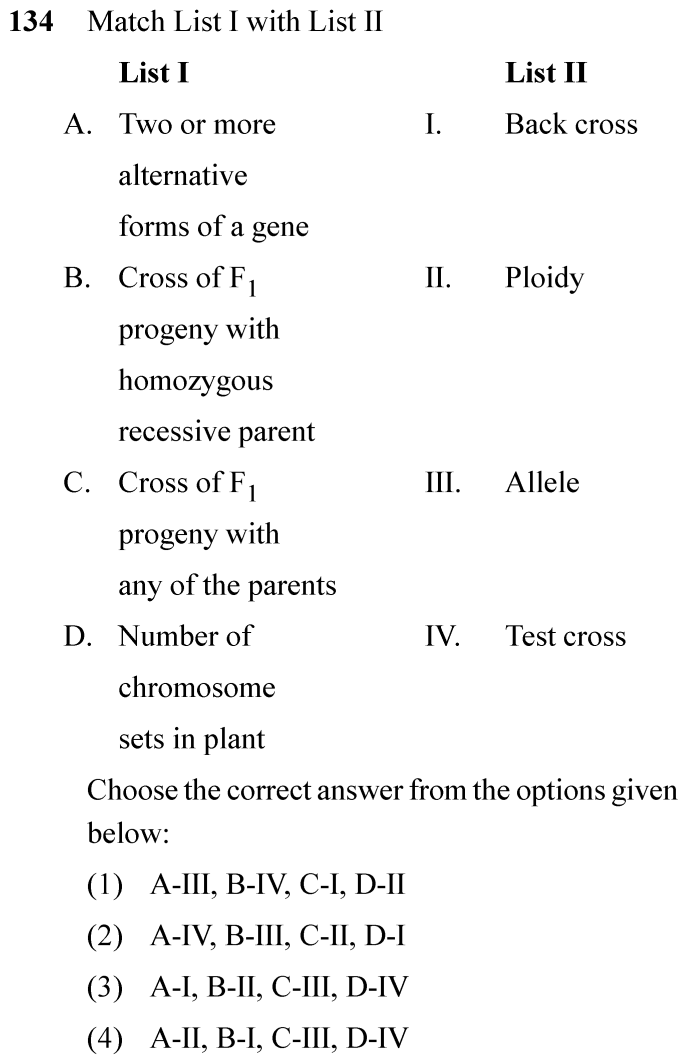
NEET 2024 · Q134 Easy
Official NEET 2024 Question 134 - Principles of Inheritance and Variation
1 ✓ Key
2
3
4
💡 Verified Solution & 30-Second Hack
✓
Verified Against NTA Final Answer Key
Option (1) : A-III, B-IV, C-I, D-II
📚 Principles of Inheritance and Variation Easy
📋 Given Parameters & Problem Setup
List I (Genetic Terms) A: Alternative forms of a gene; B: F1 progeny crossed with recessive parent; C: F1 progeny crossed with any of the parents; D: Number of chromosome sets
List II (Designations) I: Back cross; II: Ploidy; III: Allele; IV: Test cross
⚡

The 30-Second Exam Hall Shortcut: ⚡ Genetics Vocabulary Lock

⏱️ Save ~25 seconds

Alternative forms of gene = Allele (III); Cross with recessive parent = Test cross (IV); Cross with any parent = Back cross (I); Number of chromosome sets = Ploidy (II)!

1 A. Alternative forms of a gene -> III. Allele
2 B. F1 crossed with recessive parent -> IV. Test cross
3 C. F1 crossed with any parent -> I. Back cross
4 D. Number of chromosome sets in a cell -> II. Ploidy (haploid, diploid, polyploid)
5 Matching order: A-III, B-IV, C-I, D-II -> Option (1) / A.
🛡️
Why You Can 100% Trust This Shortcut: NCERT Biology · Principles of Inheritance and Variation (Mendelian Terminology)
📐

Step-by-Step Rigorous Workflow & Mathematical Proof

Step 1

Define Allele and Ploidy

Alleles are slightly different forms of the same gene occupying identical loci on homologous chromosomes (A -> III). Ploidy refers to the number of complete sets of chromosomes in a cell (e.g., haploidy, diploidy) (D -> II).

Step 2

Distinguish Test Cross from Back Cross

A back cross is any cross between an F1 individual and either of its parents (dominant or recessive) (C -> I). A test cross is specifically a cross between an F1 individual and its homozygous recessive parent, used to determine whether the F1 is homozygous or heterozygous (B -> IV).

Step 3

Assemble Combination

The resulting match is A-III, B-IV, C-I, D-II, which corresponds to Option (1).

⭐

360° Option Elimination Engine Key Feature

Diagnose every choice: Know exactly why the right option works and why distractors fail.

4-Option Deep Scan
1 (1)
✓ 100% Correct
Verdict & Scientific Reason:

Correctly matches all four genetic concepts with their rigorous formal definitions.

💡
Why this is airtight: None.
2 (2)
✗ Incorrect
Verdict & Scientific Reason:

Inverts the definitions of Test cross and Back cross.

⚠️
Student Fallacy (Why candidates pick this trap): Inverts the definitions of Test cross and Back cross.
3 (3)
✗ Incorrect
Verdict & Scientific Reason:

Mismatches allele with test cross.

⚠️
Student Fallacy (Why candidates pick this trap): Mismatches allele with test cross.
4 (4)
✗ Incorrect
Verdict & Scientific Reason:

Incorrectly assigns ploidy to alternative forms of a gene.

⚠️
Student Fallacy (Why candidates pick this trap): Incorrectly assigns ploidy to alternative forms of a gene.
⚠️

NTA Trap Alert: Test Cross vs Back Cross Inversion

Remembering that all test crosses are back crosses, but confusing which is restricted to the recessive parent.

🛡️ How to avoid the -1 mark: Test cross = strictly recessive parent (to TEST genotype); Back cross = back to ANY parent.
📖

Core NEET Syllabus Standard

Biology Core Botany · Principles of Inheritance and Variation Standard Benchmark
Core Scientific Principle Tested:

"Genes which code for a pair of contrasting traits are known as alleles, i.e., they are slightly different forms of the same gene... When F1 is crossed with the recessive parent it is called a test cross."

Syllabus Focus: Classical Genetic Terminology and Types of Crosses
✓ Core NEET UG Syllabus Anchor Syllabus & Academic Standards ↗
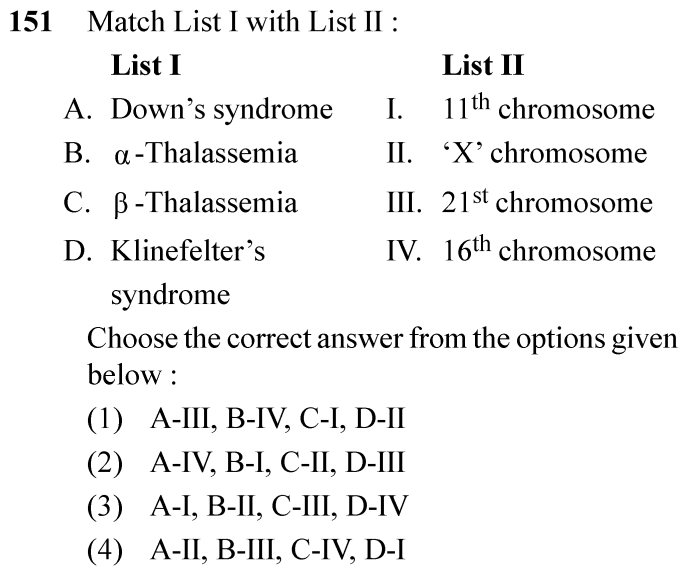
NEET 2024 · Q151 Easy
Official NEET 2024 Question 151 - Principles of Inheritance and Variation
1 ✓ Key
2
3
4
💡 Verified Solution & 30-Second Hack
✓
Verified Against NTA Final Answer Key
Option (1) : A-III, B-IV, C-I, D-II
📚 Principles of Inheritance and Variation Easy
📋 Given Parameters & Problem Setup
List I (Disorders) A: Down’s syndrome; B: α-Thalassemia; C: β-Thalassemia; D: Klinefelter’s syndrome
List II (Chromosomal Basis) I: 11th chromosome; II: ‘X’ chromosome; III: 21st chromosome; IV: 16th chromosome
⚡

The 30-Second Exam Hall Shortcut: ⚡ Chromosome Location Recall

⏱️ Save ~25 seconds

Down = Trisomy 21 (III); α-Thalassemia = Chromosome 16 (IV); β-Thalassemia = Chromosome 11 (I); Klinefelter = 47, XXY on sex chromosome X (II)! Match: A-III, B-IV, C-I, D-II!

1 A. Down’s syndrome: Trisomy of chromosome 21 (III).
2 B. α-Thalassemia: Controlled by two closely linked genes HBA1 and HBA2 on chromosome 16 (IV).
3 C. β-Thalassemia: Controlled by a single gene HBB on chromosome 11 (I).
4 D. Klinefelter’s syndrome: Karyotype 47, XXY caused by an additional X chromosome (II).
5 Order: A-III, B-IV, C-I, D-II -> Option (1) / A.
🛡️
Why You Can 100% Trust This Shortcut: NCERT Biology · Principles of Inheritance and Variation (Mendelian and Chromosomal Disorders)
📐

Step-by-Step Rigorous Workflow & Mathematical Proof

Step 1

Match Down’s Syndrome and Klinefelter’s Syndrome

Down’s syndrome is an aneuploid condition caused by the presence of an additional copy of chromosome number 21 (trisomy 21) (A -> III). Klinefelter’s syndrome is caused due to the presence of an additional copy of the X-chromosome resulting into a karyotype of 47, XXY (D -> II).

Step 2

Match α- and β-Thalassemia Chromosomes

Thalassemia is an autosome-linked recessive blood disease. α-Thalassemia is controlled by two closely linked genes HBA1 and HBA2 on chromosome 16 of each parent (B -> IV). β-Thalassemia is controlled by a single gene HBB on chromosome 11 of each parent (C -> I).

Step 3

Combine Pairs

The resulting mapping is A-III, B-IV, C-I, D-II, corresponding to Option (1).

⭐

360° Option Elimination Engine Key Feature

Diagnose every choice: Know exactly why the right option works and why distractors fail.

4-Option Deep Scan
1 (1)
✓ 100% Correct
Verdict & Scientific Reason:

Accurately pairs each genetic/chromosomal syndrome with its specific autosome or sex chromosome.

💡
Why this is airtight: None.
2 (2)
✗ Incorrect
Verdict & Scientific Reason:

Mismatches Down’s syndrome with chromosome 16 and Klinefelter’s with chromosome 21.

⚠️
Student Fallacy (Why candidates pick this trap): Mismatches Down’s syndrome with chromosome 16 and Klinefelter’s with chromosome 21.
3 (3)
✗ Incorrect
Verdict & Scientific Reason:

Mismatches Down’s with chromosome 11.

⚠️
Student Fallacy (Why candidates pick this trap): Mismatches Down’s with chromosome 11.
4 (4)
✗ Incorrect
Verdict & Scientific Reason:

Mismatches Down’s with the X chromosome.

⚠️
Student Fallacy (Why candidates pick this trap): Mismatches Down’s with the X chromosome.
⚠️

NTA Trap Alert: α vs β Thalassemia Chromosome Swap

Confusing chromosome 16 (alpha) with chromosome 11 (beta).

🛡️ How to avoid the -1 mark: Alphabetical memory hook: Alpha has two genes on 16; Beta has one gene on 11.
📖

Core NEET Syllabus Standard

Biology Core Zoology · Principles of Inheritance and Variation Standard Benchmark
Core Scientific Principle Tested:

"Down’s syndrome is caused by trisomy 21. Klinefelter’s syndrome is caused by an additional X chromosome (47, XXY). α-Thalassemia is controlled by genes on chromosome 16 while β-Thalassemia is controlled by a single gene on chromosome 11."

Syllabus Focus: Genetic Disorders and Associated Chromosomal Linkages
✓ Core NEET UG Syllabus Anchor Syllabus & Academic Standards ↗
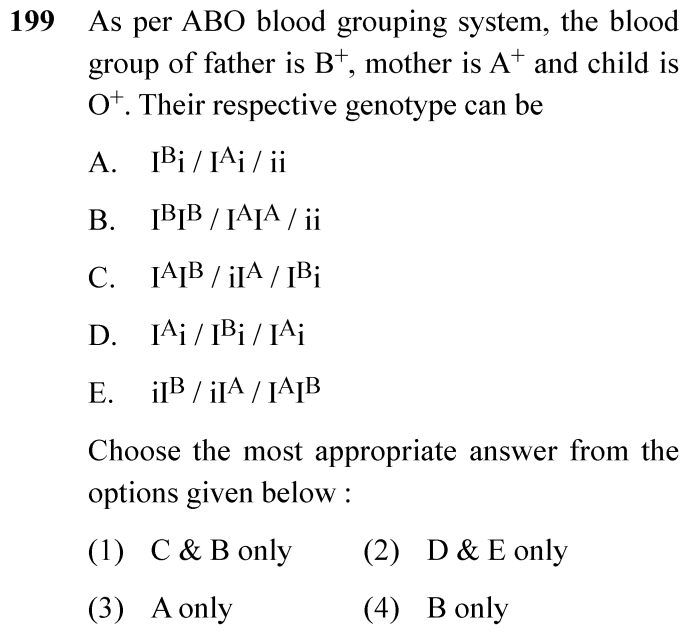
NEET 2024 · Q199 Easy
Official NEET 2024 Question 199 - Principles of Inheritance and Variation
1
2
3 ✓ Key
4
💡 Verified Solution & 30-Second Hack
✓
Verified Against NTA Final Answer Key
Option (3) : A only
📚 Principles of Inheritance and Variation Easy
📋 Given Parameters & Problem Setup
Father Blood Group B+
Mother Blood Group A+
Child Blood Group O+
⚡

The 30-Second Exam Hall Shortcut: ⚡ O-Child Obligate Allele Deduction

⏱️ Save ~20 seconds

A child with blood group O has genotype ii. Therefore, BOTH the B-father and A-mother must carry the recessive i allele: Father = I^B i, Mother = I^A i, Child = ii! Only Statement A is valid!

1 Analyse child genotype: Blood group O has only one possible genotype: ii (homozygous recessive).
2 Each parent must have contributed one recessive i allele to the child.
3 Father has blood group B -> Must be heterozygous: I^B i.
4 Mother has blood group A -> Must be heterozygous: I^A i.
5 Child has blood group O -> Must be: ii.
6 Respective genotypes: I^B i / I^A i / ii.
7 This corresponds uniquely to Statement A.
8 Select Option (3) / C (A only).
🛡️
Why You Can 100% Trust This Shortcut: NCERT Biology · Principles of Inheritance and Variation (ABO Blood Grouping and Codominance)
📐

Step-by-Step Rigorous Workflow & Mathematical Proof

Step 1

Review ABO Allelic Genetics

ABO blood groups are controlled by the gene II, which has three alleles: IAI^A, IBI^B, and ii. The alleles IAI^A and IBI^B are codominant with each other and both are completely dominant over the recessive allele ii.

Step 2

Deduce Child Genotype

A person with blood group O exhibits the phenotype of the recessive allele and must have the homozygous genotype: Child=ii\text{Child} = ii

Step 3

Deduce Parental Genotypes

For the child to receive one ii allele from the father and one ii allele from the mother, both parents must possess at least one ii allele: - Father (Blood group B): Can be IBIBI^B I^B or IBiI^B i. Since he must donate ii, his genotype is IBiI^B i. - Mother (Blood group A): Can be IAIAI^A I^A or IAiI^A i. Since she must donate ii, her genotype is IAiI^A i. Respective genotypes (Father / Mother / Child): IBi  /  IAi  /  iiI^B i \;/\; I^A i \;/\; ii

Step 4

Evaluate Given Statements

Only Statement A correctly represents IBi  /  IAi  /  iiI^B i \;/\; I^A i \;/\; ii. Thus, the answer is "A only", corresponding to Option (3).

⭐

360° Option Elimination Engine Key Feature

Diagnose every choice: Know exactly why the right option works and why distractors fail.

4-Option Deep Scan
1 (1)
✗ Incorrect
Verdict & Scientific Reason:

Statement B has homozygous parents which cannot produce an O group child; Statement C has non-standard genotypes.

⚠️
Student Fallacy (Why candidates pick this trap): Statement B has homozygous parents which cannot produce an O group child; Statement C has non-standard genotypes.
2 (2)
✗ Incorrect
Verdict & Scientific Reason:

Statement D lists mother as blood group B; Statement E has an AB child.

⚠️
Student Fallacy (Why candidates pick this trap): Statement D lists mother as blood group B; Statement E has an AB child.
3 (3)
✓ 100% Correct
Verdict & Scientific Reason:

Only Statement A correctly identifies the mandatory heterozygous parental genotypes (I^B i, I^A i) that produce an ii child.

💡
Why this is airtight: None.
4 (4)
✗ Incorrect
Verdict & Scientific Reason:

Parents with genotypes I^B I^B and I^A I^A can only produce AB children (I^A I^B).

⚠️
Student Fallacy (Why candidates pick this trap): Parents with genotypes I^B I^B and I^A I^A can only produce AB children (I^A I^B).
⚠️

NTA Trap Alert: Homozygous Parental Assumption

Assuming parents are pure-breeding homozygous (I^B I^B and I^A I^A).

🛡️ How to avoid the -1 mark: An O child immediately proves both dominant parents are obligate heterozygous carriers of the recessive i allele.
📖

Core NEET Syllabus Standard

Biology Core Zoology · Principles of Inheritance and Variation Standard Benchmark
Core Scientific Principle Tested:

"ABO blood groups are controlled by the gene I... There are six different combinations of these three alleles that are possible a total of six different genotypes of the human ABO blood types."

Syllabus Focus: ABO Blood Grouping: Multiple Alleles and Genotypic Deduction
✓ Core NEET UG Syllabus Anchor Syllabus & Academic Standards ↗
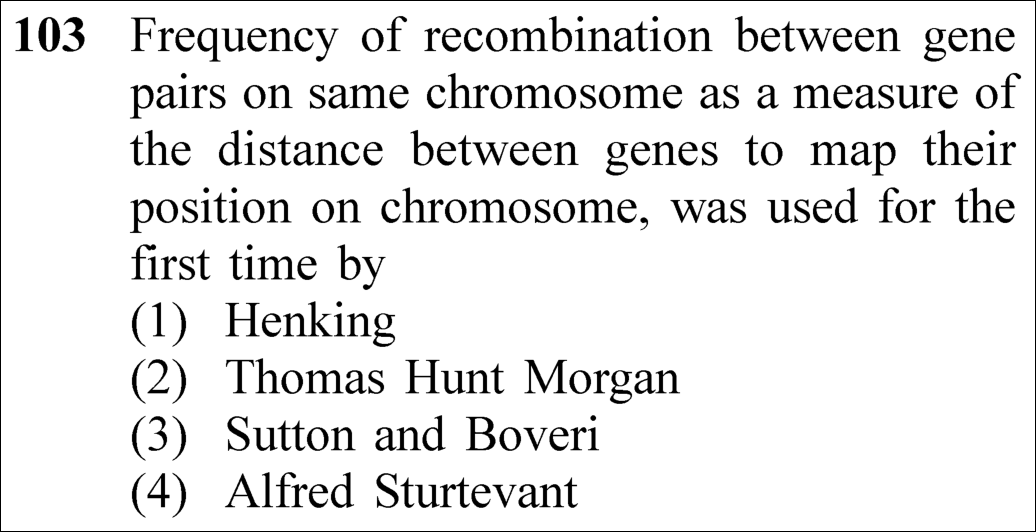
NEET 2023 · Q103 Easy
Official NEET 2023 Question 103 - Principles of Inheritance and Variation
1 Henking
2 Thomas Hunt Morgan
3 Sutton and Boveri
4 Alfred Sturtevant ✓ Key
💡 Verified Solution & 30-Second Hack
✓
Verified Against NTA Final Answer Key
Option (4) : Alfred Sturtevant
📚 Principles of Inheritance and Variation Easy
📋 Given Parameters & Problem Setup
Genetic Concept Chromosome mapping using recombination frequency
Relationship 1% recombination = 1 map unit (centiMorgan)
⚡

The 30-Second Exam Hall Shortcut: ⚡ Student of Morgan Anchor: Sturtevant = Genetic Maps

⏱️ Save ~20 seconds

T.H. Morgan established sex linkage and recombination in Drosophila, but it was his brilliant undergraduate student Alfred Sturtevant who first used recombination frequency to construct chromosome genetic maps!

1 Henking discovered the X-body in insects.
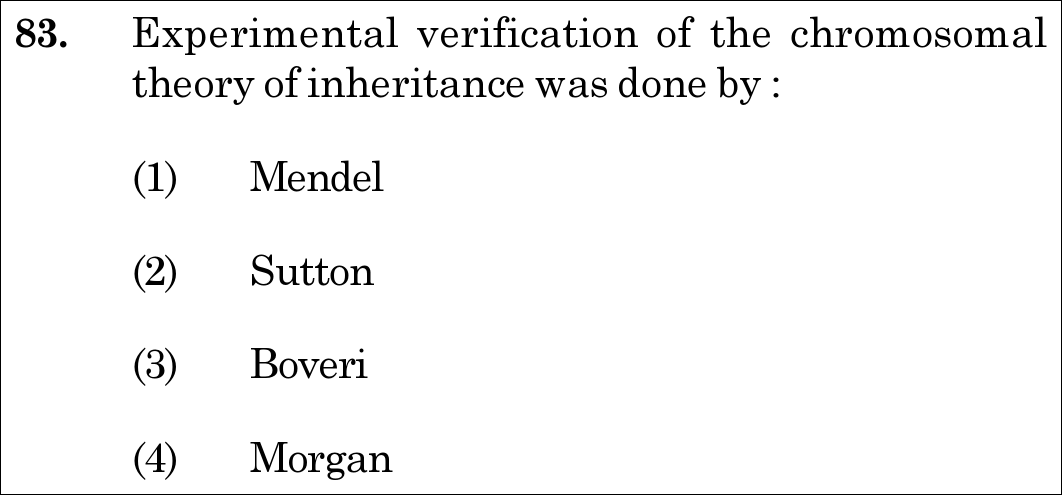
2 Sutton and Boveri formulated the Chromosomal Theory of Inheritance.
3 T.H. Morgan conducted experimental verification of linkage.
4 Alfred Sturtevant utilized recombination frequencies to generate genetic maps.
5 Match Option (4) directly.
🛡️
Why You Can 100% Trust This Shortcut: Canonical NCERT Genetics historical discovery chronology.
📐

Step-by-Step Rigorous Workflow & Mathematical Proof

Step 1

Concept of Genetic Mapping

Alfred Sturtevant (1913), a student of Thomas Hunt Morgan, reasoned that the frequency of recombination between two linked gene pairs is proportional to the physical distance separating them on the chromosome:

Map Distance (cM)=Recombination Frequency (%)=Total Recombinant OffspringTotal Offspring×100\text{Map Distance (cM)} = \text{Recombination Frequency (\%)} = \frac{\text{Total Recombinant Offspring}}{\text{Total Offspring}} \times 100
Step 2

Historical Attribution of Related Genetic Discoveries

Key genetic milestones in NCERT include:

Henking (1891):Observed X-body in insect spermatogenesisSutton & Boveri (1902):Chromosomal Theory of InheritanceT. H. Morgan (1910):Experimental proof of linkage in DrosophilaAlfred Sturtevant (1913):First chromosome map using recombination frequencies\begin{aligned} \text{Henking (1891):} & \quad \text{Observed X-body in insect spermatogenesis} \\[3pt] \text{Sutton \& Boveri (1902):} & \quad \text{Chromosomal Theory of Inheritance} \\[3pt] \text{T. H. Morgan (1910):} & \quad \text{Experimental proof of linkage in } \textit{Drosophila} \\[3pt] \text{\textbf{Alfred Sturtevant (1913):}} & \quad \text{\textbf{First chromosome map using recombination frequencies}} \end{aligned}
Step 3

Modern Significance

Sturtevant's genetic mapping principle served as the foundation for modern genome sequencing projects, including the Human Genome Project.

⭐

360° Option Elimination Engine Key Feature

Diagnose every choice: Know exactly why the right option works and why distractors fail.

4-Option Deep Scan
1 1
✗ Incorrect
Verdict & Scientific Reason:

Hermann Henking discovered the nuclear structure termed the "X-body" (X-chromosome) during insect spermatogenesis, not gene maps.

⚠️
Student Fallacy (Why candidates pick this trap): Confusing chromosome discovery with gene mapping.
2 2
✗ Incorrect
Verdict & Scientific Reason:

Morgan discovered linkage and crossing over, but his student Sturtevant constructed the first genetic map.

⚠️
Student Fallacy (Why candidates pick this trap): Attribute all Drosophila linkage discoveries to lab head Morgan instead of student Sturtevant.
3 3
✗ Incorrect
Verdict & Scientific Reason:

Walter Sutton and Theodor Boveri proposed the Chromosomal Theory of Inheritance by correlating Mendelian factors with chromosome segregation.

⚠️
Student Fallacy (Why candidates pick this trap): Confusing chromosomal theory with genetic distance measurement.
4 4
✓ 100% Correct
Verdict & Scientific Reason:

Alfred Sturtevant utilized recombination frequency as a measure of genetic distance to map gene positions on chromosomes.

💡
Why this is airtight: None; verbatim textbook fact.
⚠️

NTA Trap Alert: Morgan vs. Sturtevant Trap

Because T.H. Morgan is the father of experimental genetics, students impulsively select Morgan without reading the specific mention of chromosome mapping.

🛡️ How to avoid the -1 mark: Remember: Linkage = Morgan; Gene Mapping = Sturtevant.
📖

Core NEET Syllabus Standard

NCERT Biology · Principles of Inheritance and Variation Standard Benchmark
Core Scientific Principle Tested:

"Alfred Sturtevant used the frequency of recombination between gene pairs on the same chromosome as a measure of the distance between genes and mapped their position on the chromosome."

Syllabus Focus: Linkage and Recombination
✓ Core NEET UG Syllabus Anchor Syllabus & Academic Standards ↗
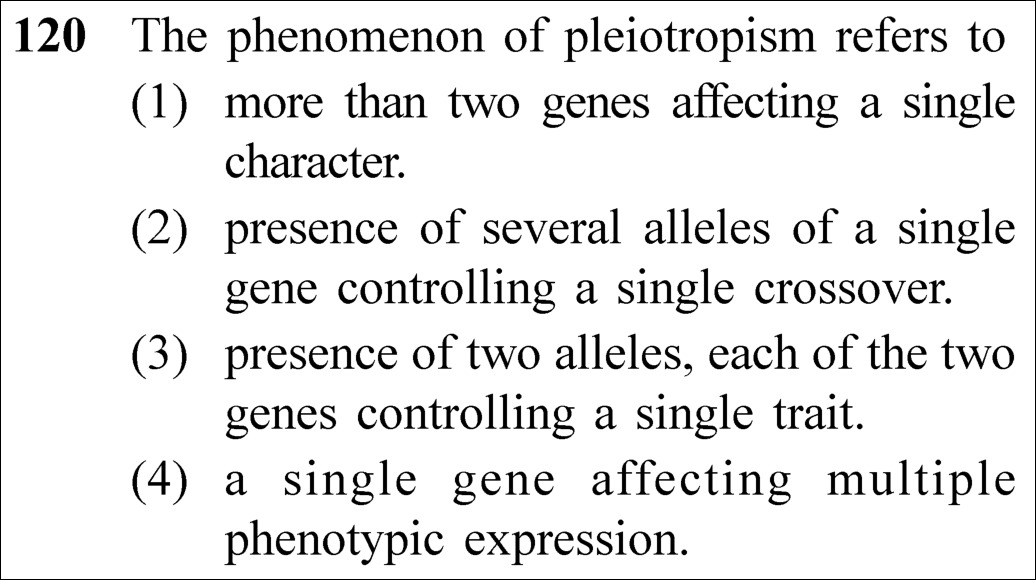
NEET 2023 · Q120 Easy
Official NEET 2023 Question 120 - Principles of Inheritance and Variation
1 more than two genes affecting a single character.
2 presence of several alleles of a single gene controlling a single crossover.
3 presence of two alleles, each of the two genes controlling a single trait.
4 a single gene affecting multiple phenotypic expression. ✓ Key
💡 Verified Solution & 30-Second Hack
✓
Verified Against NTA Final Answer Key
Option (4) : a single gene affecting multiple phenotypic expression.
📚 Principles of Inheritance and Variation Easy
📋 Given Parameters & Problem Setup
Genetic Phenomenon Pleiotropism / Pleiotropy
⚡

The 30-Second Exam Hall Shortcut: ⚡ Pleiotropy vs. Polygenic Inheritance Anchor

⏱️ Save ~20 seconds

Contrast the opposites: Polygenic = Many genes control 1 phenotype (e.g., human skin color). Pleiotropy = 1 single gene controls multiple phenotypes (e.g., phenylketonuria, starch grain size & seed shape in pea)!

1 Multiple alleles: More than two alleles governing a single character (e.g., ABO blood group).
2 Polygenic inheritance: Several genes collectively affecting a single continuous character.
3 Pleiotropy: A single gene product affecting multiple distinct phenotypic traits simultaneously.
4 Match Option (4) a single gene affecting multiple phenotypic expression.
🛡️
Why You Can 100% Trust This Shortcut: Canonical NCERT Genetics definitions of non-Mendelian inheritance patterns.
📐

Step-by-Step Rigorous Workflow & Mathematical Proof

Step 1

Definition of Pleiotropy

Pleiotropy is the phenomenon wherein a single gene influences multiple unrelated phenotypic traits:

Pleiotropic Gene⟶{Phenotypic Trait 1Phenotypic Trait 2Phenotypic Trait 3\text{\textbf{Pleiotropic Gene}} \longrightarrow \begin{cases} \text{Phenotypic Trait } 1 \\[2pt] \text{Phenotypic Trait } 2 \\[2pt] \text{Phenotypic Trait } 3 \end{cases}
Step 2

Biochemical Basis and Canonical Examples

The underlying mechanism in most cases is the effect of the gene product on a central metabolic pathway that contributes to different development systems:

Phenylketonuria (PKU):Mutation in PAH gene ⟶{Mental retardationReduction in hairSkin pigmentation changesPea Starch Branching (B/b):Controls both starch synthesis (size) AND seed shape (round/wrinkled)\begin{aligned} \text{\textbf{Phenylketonuria (PKU):}} & \quad \text{Mutation in PAH gene } \longrightarrow \begin{cases} \text{Mental retardation} \\[2pt] \text{Reduction in hair} \\[2pt] \text{Skin pigmentation changes} \end{cases} \\[4pt] \text{\textbf{Pea Starch Branching (B/b):}} & \quad \text{Controls both starch synthesis (size) AND seed shape (round/wrinkled)} \end{aligned}
Step 3

Verbatim NCERT Definition

NCERT defines pleiotropy: "There are instances where a single gene can exhibit multiple phenotypic expressions. Such a gene is called a pleiotropic gene."

⭐

360° Option Elimination Engine Key Feature

Diagnose every choice: Know exactly why the right option works and why distractors fail.

4-Option Deep Scan
1 1
✗ Incorrect
Verdict & Scientific Reason:

This describes polygenic inheritance (quantitative inheritance), not pleiotropy.

⚠️
Student Fallacy (Why candidates pick this trap): Confusing polygenic inheritance with pleiotropy.
2 2
✗ Incorrect
Verdict & Scientific Reason:

Nonsensical biological statement; multiple alleles govern traits, not crossover events.

⚠️
Student Fallacy (Why candidates pick this trap): Confusing multiple allelism with pleiotropy.
3 3
✗ Incorrect
Verdict & Scientific Reason:

Describes standard dihybrid or two-gene interaction (epistasis/complementary genes).

⚠️
Student Fallacy (Why candidates pick this trap): Confusing intergenic interactions with pleiotropy.
4 4
✓ 100% Correct
Verdict & Scientific Reason:

Accurate and verbatim NCERT definition of pleiotropism.

💡
Why this is airtight: None; textbook verbatim.
⚠️

NTA Trap Alert: Pleiotropy vs. Polygenic Inverse Trap

Pleiotropy and polygenic inheritance are exact inverses: Polygenic = Many genes → One trait; Pleiotropy = One gene → Many traits.

🛡️ How to avoid the -1 mark: Remember: "Plei-" means more (effects) from one gene. "Poly-" means many genes for one effect.
📖

Core NEET Syllabus Standard

NCERT Biology · Principles of Inheritance and Variation Standard Benchmark
Core Scientific Principle Tested:

"A single gene can exhibit multiple phenotypic expressions. Such a gene is called a pleiotropic gene."

Syllabus Focus: Pleiotropy
✓ Core NEET UG Syllabus Anchor Syllabus & Academic Standards ↗
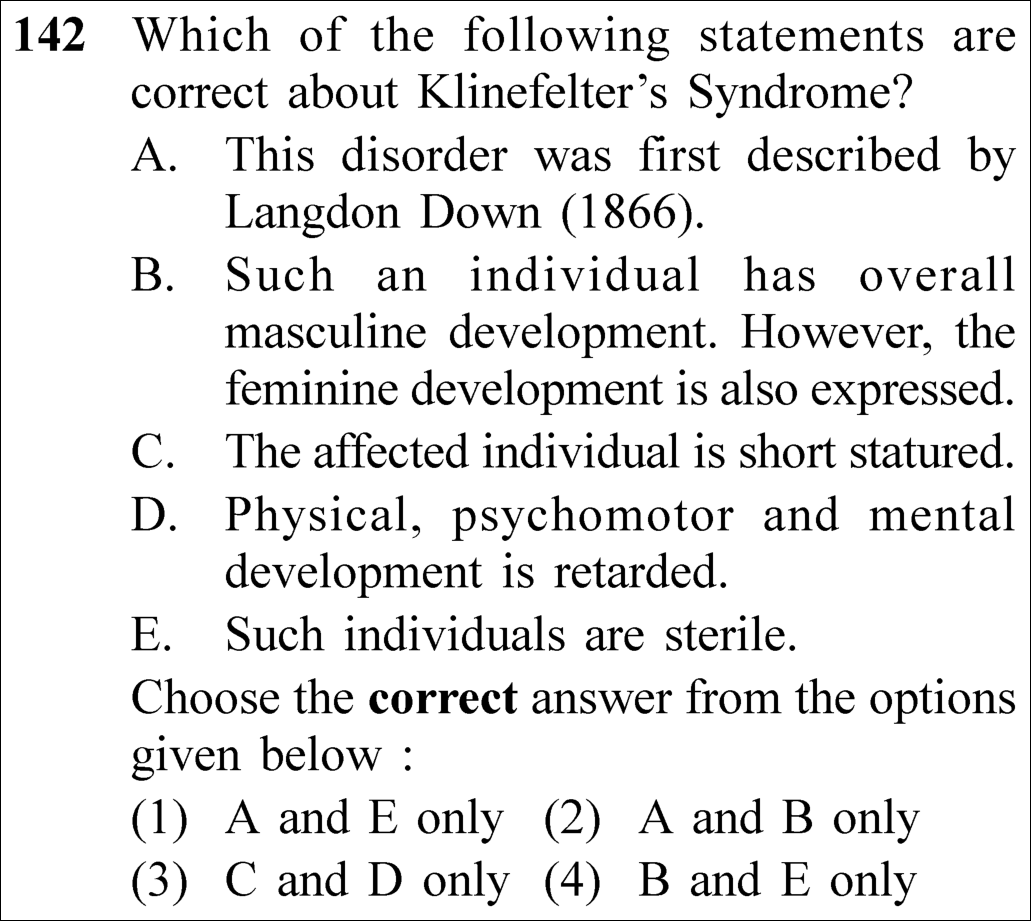
NEET 2023 · Q142 Easy
Official NEET 2023 Question 142 - Principles of Inheritance and Variation
1
2
3
4 ✓ Key
💡 Verified Solution & 30-Second Hack
✓
Verified Against NTA Final Answer Key
Option (4) : B and E only
📚 Principles of Inheritance and Variation Easy
📋 Given Parameters & Problem Setup
Disorder Klinefelter's Syndrome
Karyotype 47, XXY (Aneuploidy due to extra X chromosome)
⚡

The 30-Second Exam Hall Shortcut: ⚡ Klinefelter's Syndrome Diagnostic: Masculine + Gynaecomastia + Sterile

⏱️ Save ~25 seconds

Down's syndrome was discovered by Langdon Down, has short stature and psychomotor retardation (ruling out A, C, D). Klinefelter's (47, XXY) features overall masculine development with feminine gynaecomastia (B) and sterility (E)! Select Option (4) B and E only!

1 Statement A: Discovered by Langdon Down -> False (Langdon Down described Down's syndrome).
2 Statement B: Overall masculine with feminine development expressed (gynaecomastia) -> True.
3 Statement C: Short statured -> False (Klinefelter individuals are typically tall; short stature describes Turner's or Down's).
4 Statement D: Psychomotor and mental development retarded -> False (Down's syndrome symptom).
5 Statement E: Individuals are sterile -> True.
6 B and E only -> Select Option (4).
🛡️
Why You Can 100% Trust This Shortcut: Canonical NCERT Genetics human chromosomal aneuploidy profiles.
📐

Step-by-Step Rigorous Workflow & Mathematical Proof

Step 1

Cytogenetics of Klinefelter's Syndrome

Klinefelter's syndrome is caused by the presence of an additional copy of the X-chromosome resulting in a 47, XXY47,\, XXY karyotype:

Karyotype: 44+XXY=47 Chromosomes  ⟹  Male phenotype with gynaecomastia\text{Karyotype: } 44 + XXY = \mathbf{47\text{ Chromosomes}} \implies \text{Male phenotype with gynaecomastia}
Step 2

Clinical Features in NCERT

Analyzing the canonical textbook descriptions: - "Such an individual has overall masculine development, however, the feminine development (development of breast, i.e., Gynaecomastia) is also expressed." (Statement B is TRUE) - "Such individuals are sterile." (Statement E is TRUE)

Step 3

Elimination of Down's Syndrome Traits

Statements A, C, and D describe Down's syndrome (trisomy 21): - First described by Langdon Down (1866) (Down's syndrome). - Short statured with small round head (Down's syndrome). - Physical, psychomotor, and mental development is retarded (Down's syndrome).

⭐

360° Option Elimination Engine Key Feature

Diagnose every choice: Know exactly why the right option works and why distractors fail.

4-Option Deep Scan
1 1
✗ Incorrect
Verdict & Scientific Reason:

Statement A describes Down's syndrome, not Klinefelter's.

⚠️
Student Fallacy (Why candidates pick this trap): Attributing the discovery of Klinefelter's syndrome to Langdon Down.
2 2
✗ Incorrect
Verdict & Scientific Reason:

Statement A is false.

⚠️
Student Fallacy (Why candidates pick this trap): Overlooking that Down's syndrome was described by Langdon Down.
3 3
✗ Incorrect
Verdict & Scientific Reason:

Statements C and D are classical diagnostic symptoms of Down's syndrome.

⚠️
Student Fallacy (Why candidates pick this trap): Confusing trisomy 21 symptoms with sex chromosomal trisomy.
4 4
✓ 100% Correct
Verdict & Scientific Reason:

Both B and E are true and specific features of Klinefelter's syndrome (47, XXY).

💡
Why this is airtight: None; precise syndrome distinction.
⚠️

NTA Trap Alert: Down's vs. Klinefelter's Symptom Cross-Contamination Trap

NTA blended symptoms of Down's syndrome (Langdon Down, short stature, psychomotor retardation) with Klinefelter's syndrome. Fast readers mistake all genetic disorder descriptions as interchangeable.

🛡️ How to avoid the -1 mark: Klinefelter's = Tall masculine stature + Gynaecomastia + Sterile. Down's = Langdon Down + Short stature + Furrowed tongue + Psychomotor retardation.
📖

Core NEET Syllabus Standard

NCERT Biology · Principles of Inheritance and Variation Standard Benchmark
Core Scientific Principle Tested:

"Klinefelter's syndrome individuals have overall masculine development, feminine breast development (gynaecomastia), and are sterile."

Syllabus Focus: Chromosomal Disorders (Klinefelter's Syndrome)
✓ Core NEET UG Syllabus Anchor Syllabus & Academic Standards ↗
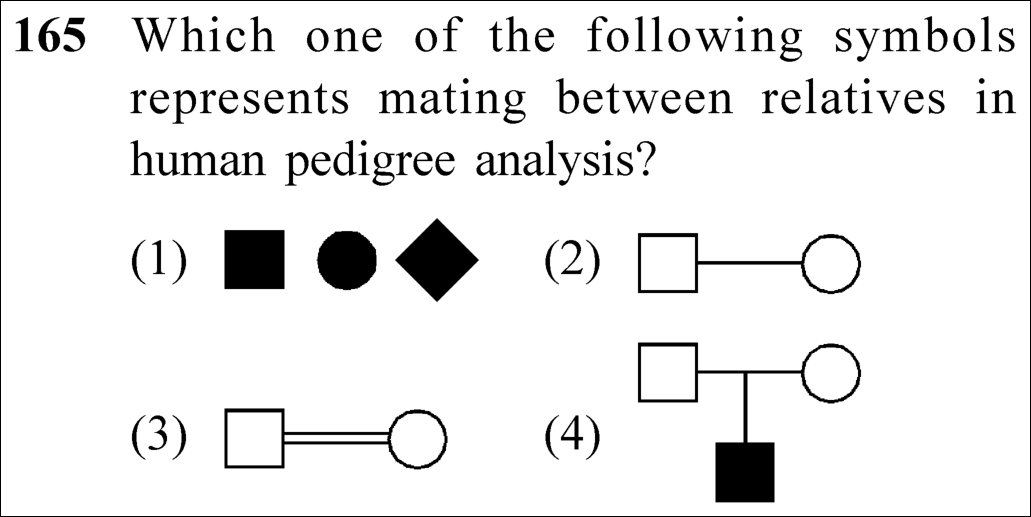
NEET 2023 · Q165 Easy
Official NEET 2023 Question 165 - Principles of Inheritance and Variation
1
2
3 ✓ Key
4
💡 Verified Solution & 30-Second Hack
✓
Verified Against NTA Final Answer Key
Option (3) : Square connected to circle by double horizontal line
📚 Principles of Inheritance and Variation Easy
📋 Given Parameters & Problem Setup
Genetic Convention Standard human pedigree analysis symbols
Biological Relationship Mating between relatives (Consanguineous mating)
⚡

The 30-Second Exam Hall Shortcut: ⚡ Pedigree Symbol Rule: Double Horizontal Bar = Consanguinity

⏱️ Save ~20 seconds

A single horizontal line connecting a square (male) and circle (female) denotes standard mating. A DOUBLE horizontal line denotes mating between relatives (consanguineous mating)! Match Option (3)!

1 Square = Male; Circle = Female; Diamond = Sex unspecified.
2 Shaded/filled symbol = Affected individual.
3 Single horizontal line between square and circle = Mating.
4 Double horizontal line between square and circle = Consanguineous mating (mating between relatives).
5 Match Option (3).
🛡️
Why You Can 100% Trust This Shortcut: Canonical NCERT Genetics international pedigree symbol standards.
📐

Step-by-Step Rigorous Workflow & Mathematical Proof

Step 1

Standard Pedigree Analysis Symbols in NCERT

Pedigree charts use standardized geometric symbols to represent familial relationships and phenotypic statuses:

□=Male◯=Female□−◯=Mating□=◯=Mating between relatives (Consanguineous mating)■ , \CIRCLE=Affected individuals\begin{aligned} \square & = \text{Male} \\[3pt] \bigcirc & = \text{Female} \\[3pt] \square - \bigcirc & = \text{Mating} \\[3pt] \mathbf{\square = \bigcirc} & = \mathbf{\text{Mating between relatives (Consanguineous mating)}} \\[3pt] \blacksquare\,, \,\CIRCLE & = \text{Affected individuals} \end{aligned}
Step 2

Verbatim NCERT Symbol Reference

Under "Symbols used in the Human Pedigree Analysis", NCERT explicitly diagrams a square joined to a circle by two parallel horizontal bars labeled: "Mating between relatives (consanguineous mating)".

Step 3

Evaluation of Distractor Options

Option (1) depicts shaded symbols (affected individuals). Option (2) depicts a single line (non-consanguineous mating). Option (4) depicts parents with an affected male offspring.

⭐

360° Option Elimination Engine Key Feature

Diagnose every choice: Know exactly why the right option works and why distractors fail.

4-Option Deep Scan
1 1
✗ Incorrect
Verdict & Scientific Reason:

Solid shading indicates individuals affected by the genetic disorder.

⚠️
Student Fallacy (Why candidates pick this trap): Confusing disease status with relationship symbols.
2 2
✗ Incorrect
Verdict & Scientific Reason:

A single horizontal bar represents standard (non-consanguineous) mating between unrelated individuals.

⚠️
Student Fallacy (Why candidates pick this trap): Missing the requirement for mating between relatives.
3 3
✓ 100% Correct
Verdict & Scientific Reason:

Verbatim NCERT convention: two parallel connecting lines indicate consanguineous mating between relatives.

💡
Why this is airtight: None; textbook verbatim recall.
4 4
✗ Incorrect
Verdict & Scientific Reason:

Represents a nuclear family lineage showing inheritance to male offspring.

⚠️
Student Fallacy (Why candidates pick this trap): Confusing parent-offspring descent lines with consanguinity.
⚠️

NTA Trap Alert: Single vs. Double Mating Line Trap

Students frequently mistake the single line (Option 2) for mating in general without noticing the critical specification "between relatives" (which requires the double line in Option 3).

🛡️ How to avoid the -1 mark: Single line = Unrelated mating. Double line = Consanguineous mating (relatives).
📖

Core NEET Syllabus Standard

NCERT Biology · Principles of Inheritance and Variation Standard Benchmark
Core Scientific Principle Tested:

"In human pedigree analysis, a double line connecting a male and female indicates mating between relatives (consanguineous mating)."

Syllabus Focus: Pedigree Analysis
✓ Core NEET UG Syllabus Anchor Syllabus & Academic Standards ↗
NEET 2023 · Q172 Easy
Official NEET 2023 Question 172 - Principles of Inheritance and Variation
1
2 ✓ Key
3
4
💡 Verified Solution & 30-Second Hack
✓
Verified Against NTA Final Answer Key
Option (2) : Down’s syndrome
📚 Principles of Inheritance and Variation Easy
📋 Given Parameters & Problem Setup
Phenotypic Marker Broad palm with single palm crease (Simian crease)
Etiology Chromosomal aneuploidy (Trisomy 21)
⚡

The 30-Second Exam Hall Shortcut: ⚡ Broad Palm with Single Crease = Down's Syndrome

⏱️ Save ~20 seconds

Verbatim NCERT clinical description of Down's syndrome (Trisomy 21): "The affected individual is short statured with small round head, furrowed tongue and partially open mouth. Palm is broad with characteristic palm crease!" Instant 5-second recall!

1 Thalassemia: Mendelian microcytic hypochromic hemolytic anemia.
2 Turner's syndrome (45, X0): Sterile female with webbed neck and rudimentary ovaries.
3 Klinefelter's syndrome (47, XXY): Sterile male with gynaecomastia.
4 Down's syndrome (Trisomy 21): Broad palm with single horizontal palmar crease (Simian crease).
5 Match Option (2) Down's syndrome.
🛡️
Why You Can 100% Trust This Shortcut: Canonical NCERT Genetics Down's syndrome morphological hallmarks.
📐

Step-by-Step Rigorous Workflow & Mathematical Proof

Step 1

Cytogenetics of Down's Syndrome

First described by Langdon Down in 1866, Down's syndrome is an autosomal aneuploidy caused by nondisjunction resulting in trisomy of chromosome 21 (2n+1=472n + 1 = 47):

Karyotype: 45 Autosomes+XX / XY=47 Chromosomes (Trisomy 21)\text{Karyotype: } 45\text{ Autosomes} + \text{XX / XY} = \mathbf{47\text{ Chromosomes (Trisomy 21)}}
Step 2

Verbatim NCERT Phenotypic Features

NCERT provides four unmistakable physical signs: 1. Short statured with small round head. 2. Furrowed tongue and partially open mouth. 3. Palm is broad with characteristic palm crease (Simian crease). 4. Physical, psychomotor, and mental development is retarded.

Step 3

Elimination of Other Genetic Disorders

Thalassemia affects globin chain synthesis. Turner's syndrome (45,XO45, XO) presents with short stature and webbed neck. Klinefelter's (47,XXY47, XXY) presents with tall stature and gynaecomastia.

⭐

360° Option Elimination Engine Key Feature

Diagnose every choice: Know exactly why the right option works and why distractors fail.

4-Option Deep Scan
1 1
✗ Incorrect
Verdict & Scientific Reason:

Thalassemia is an autosomal recessive hemoglobinopathy causing severe hemolytic anemia, without palm crease anomalies.

⚠️
Student Fallacy (Why candidates pick this trap): Confusing single-gene blood disorders with chromosomal syndromes.
2 2
✓ 100% Correct
Verdict & Scientific Reason:

Verbatim NCERT diagnostic symptom: broad palm with single transverse palmar crease characterizes Down's syndrome.

💡
Why this is airtight: None; textbook verbatim recall.
3 3
✗ Incorrect
Verdict & Scientific Reason:

Turner's syndrome is characterized by sterile female phenotype, webbed neck, and shield chest, not broad palm crease.

⚠️
Student Fallacy (Why candidates pick this trap): Confusing Turner's short stature with Down's palmar signs.
4 4
✗ Incorrect
Verdict & Scientific Reason:

Klinefelter's syndrome is characterized by tall stature, feminine fat distribution, and gynaecomastia.

⚠️
Student Fallacy (Why candidates pick this trap): Confusing aneuploidy phenotypes.
⚠️

NTA Trap Alert: Palm Crease vs. Webbed Neck Distinction Trap

Students frequently mix up the physical hallmarks of Down's syndrome (broad palm with single crease, furrowed tongue) with Turner's syndrome (webbed neck, rudimentary ovaries).

🛡️ How to avoid the -1 mark: Broad palm with single crease = Down's syndrome. Webbed neck = Turner's syndrome.
📖

Core NEET Syllabus Standard

NCERT Biology · Principles of Inheritance and Variation Standard Benchmark
Core Scientific Principle Tested:

"In Down's syndrome, the palm is broad with characteristic palm crease, along with a furrowed tongue and partially open mouth."

Syllabus Focus: Chromosomal Disorders (Down's Syndrome)
✓ Core NEET UG Syllabus Anchor Syllabus & Academic Standards ↗
NEET 2021 · Q126 Easy
Official NEET 2021 Question 126 - Principles of Inheritance and Variation
1 Bullet square
2 Punch square
3 Punnett square ✓ Key
4 Net square
💡 Verified Solution & 30-Second Hack
✓
Verified Against NTA Final Answer Key
Option (3) : Punnett square
📚 Principles of Inheritance and Variation Easy
📋 Given Parameters & Problem Setup
Diagram Purpose Calculate genotypes of gametes, zygotes, F1 and F2 offspring in a genetic cross
⚡

The 30-Second Exam Hall Shortcut: ⚡ Reginald C. Punnett = Punnett Square

⏱️ Save ~10 seconds

The graphical checkerboard diagram used to calculate and visualize all possible combinations of gametes and offspring genotypes in F1 and F2 generations was devised by the British geneticist Reginald C. Punnett   ⟹  \implies Punnett Square! Match Option (3)!

1 Diagrammatic grid representation of genetic crosses is known as a Punnett square.
2 Devised by British geneticist Reginald C. Punnett.
3 Horizontal and vertical rows represent gametes from male and female parents; internal squares show resulting zygote genotypes.
4 Match Option (3).
🛡️
Why You Can 100% Trust This Shortcut: Canonical NCERT Genetics on Mendelian Crosses and Punnett Square.
📐

Step-by-Step Rigorous Workflow & Mathematical Proof

Step 1

Definition and Historical Context

The production of gametes by parents, the formation of zygotes, and the resulting F1F_1 and F2F_2 generations can be systematically mapped using a checkerboard graphical representation:

Mendelian Checkerboard=Punnett Square (devised by Reginald C. Punnett)\text{Mendelian Checkerboard} = \mathbf{\text{Punnett Square (devised by Reginald C. Punnett)}}
Step 2

Structural Architecture of a Punnett Square

All possible types of gametes produced by the male parent are listed across the top, while gametes produced by the female parent are listed along the left side. Each internal cell represents the union of two haploid gametes, visually illustrating the resulting diploid zygotic genotypes and genotypic ratios.

⭐

360° Option Elimination Engine Key Feature

Diagnose every choice: Know exactly why the right option works and why distractors fail.

4-Option Deep Scan
1 1
✗ Incorrect
Verdict & Scientific Reason:

Fictitious distractor; no such genetic diagram exists.

⚠️
Student Fallacy (Why candidates pick this trap): Phonetic similarity to Punnett square.
2 2
✗ Incorrect
Verdict & Scientific Reason:

Fictitious distractor fabricated as an exam distractor.

⚠️
Student Fallacy (Why candidates pick this trap): Phonetic similarity.
3 3
✓ 100% Correct
Verdict & Scientific Reason:

The Punnett square is the standard textbook graphical representation devised by Reginald C. Punnett.

💡
Why this is airtight: None. Textbook definition.
4 4
✗ Incorrect
Verdict & Scientific Reason:

Fictitious distractor playing on the suffix "-net".

⚠️
Student Fallacy (Why candidates pick this trap): Misremembering the scientist's surname.
⚠️

NTA Trap Alert: Phonetic Word-Play Distractors

NTA created playful distractors: "Bullet square", "Punch square", and "Net square" alongside "Punnett square".

🛡️ How to avoid the -1 mark: Remember British geneticist: Reginald C. Punnett.
📖

Core NEET Syllabus Standard

NEET / NCERT Biology · Principles of Inheritance and Variation Standard Benchmark
Core Scientific Principle Tested:

"The production of gametes by the parents, the formation of the zygotes, the F1 and F2 plants can be understood from a diagram called Punnett Square as developed by a British geneticist, Reginald C. Punnett."

Syllabus Focus: Inheritance of One Gene: Punnett Square
✓ Core NEET UG Syllabus Anchor Syllabus & Academic Standards ↗
NEET 2021 · Q177 Easy
Official NEET 2021 Question 177 - Principles of Inheritance and Variation
1 50%
2 75%
3 25% ✓ Key
4 100%
💡 Verified Solution & 30-Second Hack
✓
Verified Against NTA Final Answer Key
Option (3) : 25%
📚 Principles of Inheritance and Variation Easy
📋 Given Parameters & Problem Setup
Parental Genotypes Both male and female are heterozygous carriers: Hb^A Hb^S × Hb^A Hb^S
Disorder Type Autosomal Recessive (Sickle Cell Anaemia)
Question Objective Calculate the percentage of diseased progeny
⚡

The 30-Second Exam Hall Shortcut: ⚡ "Carrier × Carrier = 1 Normal : 2 Carriers : 1 Diseased (25% Diseased)"

⏱️ Save ~25 seconds

Sickle cell anaemia is an autosomal recessive disorder. Heterozygous parents (HbAHbSHb^A Hb^S) are clinically unaffected carriers. Only homozygous mutant progeny (HbSHbSHb^S Hb^S) manifest the diseased phenotype: exactly 1 out of 4 progeny (25%)!

1 Recognize disease pattern: Sickle cell anaemia is strictly autosomal recessive.
2 Set up cross: HbAHbS×HbAHbSHb^A Hb^S \times Hb^A Hb^S.
3 Determine progeny genotypes: 1 HbAHbA1\,Hb^A Hb^A (Normal, 25%), 2 HbAHbS2\,Hb^A Hb^S (Carriers, 50%), 1 HbSHbS1\,Hb^S Hb^S (Diseased, 25%).
4 Diseased percentage = 25% -> Mark Option (3).
🛡️
Why You Can 100% Trust This Shortcut: NCERT Biology · Principles of Inheritance and Variation (Mendelian Disorders: Sickle-cell anaemia is an autosomal linked recessive trait that can be transmitted from parents to offspring when both partners are carrier/heterozygous (Hb^A Hb^S); 25% of offspring inherit the homozygous diseased genotype Hb^S Hb^S).
📐

Step-by-Step Rigorous Workflow & Mathematical Proof

Step 1

Genetics of Sickle Cell Anaemia

Sickle-cell anaemia is an autosomal recessive Mendelian disorder controlled by a single pair of alleles, HbAHb^A (normal β\beta-globin allele) and HbSHb^S (mutant β\beta-globin allele with a GAG →\to GUG transversion at codon 6, substituting glutamic acid with valine). - Normal homozygous (HbAHbAHb^A Hb^A): Completely unaffected (100% normal biconcave erythrocytes). - Heterozygous carriers (HbAHbSHb^A Hb^S): Phenotypically normal under routine atmospheric oxygen tensions; carry sickle-cell trait but do not suffer from anaemia. - Homozygous diseased (HbSHbSHb^S Hb^S): Express the full clinical syndrome of sickle cell anaemia with microvascular vaso-occlusion, acute sickle crises, and haemolytic anaemia.

Step 2

Punnett Square Derivation

Cross: Heterozygous male (HbAHbSHb^A Hb^S) ×\times Heterozygous female (HbAHbSHb^A Hb^S): HbAHbSHbAHbAHbA (25%)HbAHbS (25%)HbSHbAHbS (25%)HbSHbS (25%)\begin{array}{c|c|c} & Hb^A & Hb^S \\ \hline Hb^A & Hb^A Hb^A \, (25\%) & Hb^A Hb^S \, (25\%) \\ \hline Hb^S & Hb^A Hb^S \, (25\%) & Hb^S Hb^S \, (25\%) \\ \end{array} - Normal phenotype (disease-free): HbAHbAHb^A Hb^A (25%) + HbAHbSHb^A Hb^S (50%) = 75% - Diseased phenotype: HbSHbSHb^S Hb^S = 1/4=25%1/4 = 25\%.

P(Diseased Progeny)=P(HbSHbS)=12×12=14=25%P(\text{Diseased Progeny}) = P(Hb^S Hb^S) = \frac{1}{2} \times \frac{1}{2} = \frac{1}{4} = 25\%
⭐

360° Option Elimination Engine Key Feature

Diagnose every choice: Know exactly why the right option works and why distractors fail.

4-Option Deep Scan
1 1
✗ Incorrect
Verdict & Scientific Reason:

Incorrect. 50% represents the proportion of heterozygous carriers (HbAHbSHb^A Hb^S), who are clinically unaffected.

⚠️
Student Fallacy (Why candidates pick this trap): Confusing carrier frequency (50%) with diseased frequency (25%).
2 2
✗ Incorrect
Verdict & Scientific Reason:

Incorrect. 75% would be diseased if the condition were dominant, but sickle cell anaemia is autosomal recessive.

⚠️
Student Fallacy (Why candidates pick this trap): Treating the mutant allele as dominant, yielding 3:1 affected:unaffected.
3 3
✓ 100% Correct
Verdict & Scientific Reason:

Correct. Only the homozygous recessive genotype HbSHbSHb^S Hb^S manifests the diseased state (1/4=25%1/4 = 25\%).

💡
Why this is airtight: None. Candidate accurately executes Mendelian recessive probability.
4 4
✗ Incorrect
Verdict & Scientific Reason:

Incorrect. 100% diseased progeny only occurs when both parents are homozygous affected (HbSHbS×HbSHbSHb^S Hb^S \times Hb^S Hb^S).

⚠️
Student Fallacy (Why candidates pick this trap): Assuming sickle cell trait always results in affected offspring.
⚠️

NTA Trap Alert: Carrier vs Diseased Phenotype Trap

Many candidates conflate "having the mutant allele" (75% carry at least one HbSHb^S) with "being diseased" (only the 25% homozygous HbSHbSHb^S Hb^S are diseased). Heterozygotes have sickle cell trait but are NOT diseased.

🛡️ How to avoid the -1 mark: Read the prompt carefully: "diseased" requires homozygous recessive (HbSHbSHb^S Hb^S = 25%).
📖

Core NEET Syllabus Standard

NEET / NCERT Biology · Principles of Inheritance and Variation Standard Benchmark
Core Scientific Principle Tested:

"Sickle cell anaemia is an autosomal recessive disorder; a carrier × carrier cross produces 25% homozygous diseased progeny."

Syllabus Focus: Sickle-Cell Anaemia
✓ Core NEET UG Syllabus Anchor Syllabus & Academic Standards ↗
NEET 2020 · Q6 Easy
Official NEET 2020 Question 6 - Principles of Inheritance and Variation
1 The gene (I) has three alleles.
2 A person will have only two of the three alleles.
3 When IA and IB are present together, they express same type of sugar. ✓ Key
4 Allele 'i' does not produce any sugar.
💡 Verified Solution & 30-Second Hack
✓
Verified Against NTA Final Answer Key
Option (3) : When IA and IB are present together, they express same type of sugar.
📚 Principles of Inheritance and Variation Easy
📋 Given Parameters & Problem Setup
Gene Gene I (controls ABO Blood Groups)
Alleles I^A, I^B, and i
Question Objective Identify the WRONG statement regarding gene I
⚡

The 30-Second Exam Hall Shortcut: ⚡ "Codominance Means IA and IB Express DIFFERENT Sugars!"

⏱️ Save ~20 seconds

Allele I^A produces A-antigen sugar polymer, while allele I^B produces a distinct B-antigen sugar polymer. Because they are CODOMINANT, both alleles express their own DIFFERENT sugars simultaneously! Claiming they express the "same type of sugar" is factually FALSE. Select Option (3)!

1 Recall Landsteiner genetics: Gene I has 3 alleles (I^A, I^B, i). (Statement 1 is TRUE).
2 Any diploid human possesses only 2 alleles. (Statement 2 is TRUE).
3 Allele i produces no surface sugar polymer. (Statement 4 is TRUE).
4 In heterozygous I^A I^B individuals, both alleles are codominant: I^A produces A sugar and I^B produces B sugar (DIFFERENT sugars, not same!). Statement 3 is WRONG.
5 Option (3) is the false statement and therefore the correct answer.
🛡️
Why You Can 100% Trust This Shortcut: NCERT Biology · Principles of Inheritance and Variation (Co-dominance: ABO blood groups are controlled by the gene I. The alleles IA and IB produce a slightly different form of the sugar, while allele i does not produce any sugar. When IA and IB are present together that is in IAIB, they both express their own types of sugars: this is because of co-dominance).
📐

Step-by-Step Rigorous Workflow & Mathematical Proof

Step 1

Biochemical and Genetic Basis of ABO Blood Groups

The human ABO blood group system is governed by a single polymorphic gene, gene II, located on chromosome 9: - The plasma membrane of red blood cells contains protruding glycoprotein/glycolipid polymers based on a core H-antigen. - Three Alleles: Gene II exists as three distinct alleles in human populations: IAI^A, IBI^B, and ii. - Allele IAI^A: Codes for α\alpha-1,3-N-acetylgalactosaminyltransferase, which adds N-acetylgalactosamine (A-sugar antigen). - Allele IBI^B: Codes for α\alpha-1,3-galactosyltransferase, which adds galactose (B-sugar antigen, a distinctly different sugar). - Allele ii: Contains a single base deletion causing a frameshift, producing a truncated non-functional enzyme that does not produce any sugar.

{IA  ⟹  Sugar A (N-acetylgalactosamine)IB  ⟹  Sugar B (Galactose)IAIB  ⟹  Both different sugars expressed (Codominance)i  ⟹  No sugar added\begin{cases} I^A &\implies \text{Sugar A (N-acetylgalactosamine)} \\[3pt] I^B &\implies \text{Sugar B (Galactose)} \\[3pt] I^A I^B &\implies \mathbf{Both\,different\,sugars\,expressed\,(Codominance)} \\[3pt] i &\implies \text{No sugar added} \end{cases}
Step 2

Resolution of the Question

Statement (3) asserts that "When IAI^A and IBI^B are present together, they express same type of sugar." In reality, they express different types of sugars because of codominance. Therefore, statement (3) is false and represents the correct choice.

⭐

360° Option Elimination Engine Key Feature

Diagnose every choice: Know exactly why the right option works and why distractors fail.

4-Option Deep Scan
1 A
✗ Incorrect
Verdict & Scientific Reason:

This is a true statement illustrating multiple allelism (alleles IA, IB, and i exist in the human population).

⚠️
Student Fallacy (Why candidates pick this trap): Confusing alleles in a population (3) with alleles in an individual (2).
2 B
✗ Incorrect
Verdict & Scientific Reason:

This is a true statement because humans are diploid organisms carrying two homologous chromosomes.

⚠️
Student Fallacy (Why candidates pick this trap): Assuming multiple allelism means an individual can possess all three alleles.
3 C
✓ 100% Correct
Verdict & Scientific Reason:

Correct as the wrong statement. IA and IB express distinct, different sugars (sugar A and sugar B) independently.

💡
Why this is airtight: None. Candidate recalls the molecular definition of codominance.
4 D
✗ Incorrect
Verdict & Scientific Reason:

This is a true statement. Allele i is a recessive null allele producing no modified surface sugar.

⚠️
Student Fallacy (Why candidates pick this trap): Believing allele i produces an "O-type" unique sugar.
⚠️

NTA Trap Alert: Codominance vs Incomplete Dominance Misinterpretation Trap

In incomplete dominance, alleles blend into an intermediate phenotype. In codominance, both alleles express their *own, distinct, unblended* products simultaneously. They never express the "same" sugar.

🛡️ How to avoid the -1 mark: Remember: IA makes sugar A; IB makes sugar B. Different sugars, both fully expressed.
📖

Core NEET Syllabus Standard

NEET / NCERT Biology · Principles of Inheritance and Variation Standard Benchmark
Core Scientific Principle Tested:

"IA and IB alleles produce slightly different forms of sugar; when present together they express both different sugars."

Syllabus Focus: Codominance and Multiple Alleles
✓ Core NEET UG Syllabus Anchor Syllabus & Academic Standards ↗
NEET 2020 · Q8 Easy
Official NEET 2020 Question 8 - Principles of Inheritance and Variation
1 Haemophilia - Y linked
2 Phenylketonuria - Autosomal dominant trait
3 Sickle cell anaemia - Autosomal recessive trait, chromosome-11 ✓ Key
4 Thalassemia - X linked
💡 Verified Solution & 30-Second Hack
✓
Verified Against NTA Final Answer Key
Option (3) : Sickle cell anaemia - Autosomal recessive trait, chromosome-11
📚 Principles of Inheritance and Variation Easy
📋 Given Parameters & Problem Setup
Listed Disorders Haemophilia, Phenylketonuria, Sickle cell anaemia, Thalassemia
Question Objective Select the correct genetic match regarding inheritance pattern and chromosomal locus
⚡

The 30-Second Exam Hall Shortcut: ⚡ "Sickle Cell = Autosomal Recessive on Chromosome 11 (Beta-Globin Gene)!"

⏱️ Save ~25 seconds

Sickle cell anaemia is caused by a point mutation in the beta-globin gene located on chromosome 11, inherited as an autosomal recessive trait. Haemophilia is X-linked (not Y); PKU is autosomal recessive (not dominant); Thalassemia is autosomal (not X-linked). Pair (3) is 100% correct!

1 Check Haemophilia: X-linked recessive disorder (Queen Victoria pedigree), NOT Y-linked. Pair (1) is False.
2 Check Phenylketonuria (PKU): Autosomal RECESSIVE inborn error of metabolism (PAH gene deficiency), NOT dominant. Pair (2) is False.
3 Check Sickle cell anaemia: Autosomal recessive disorder located on chromosome 11 (HBB gene, codon 6 mutation). Pair (3) is TRUE!
4 Check Thalassemia: Autosomal recessive disorder (alpha on chr-16, beta on chr-11), NOT X-linked. Pair (4) is False.
5 Option (3) is the correct match.
🛡️
Why You Can 100% Trust This Shortcut: NCERT Biology · Principles of Inheritance and Variation (Mendelian Disorders: Sickle-cell anaemia is an autosome-linked recessive trait. The gene for beta-globin is located on chromosome 11. Haemophilia is a sex-linked recessive disease. Phenylketonuria is an autosomal recessive trait. Thalassemia is an autosome-linked recessive blood disease).
📐

Step-by-Step Rigorous Workflow & Mathematical Proof

Step 1

Comprehensive Review of Listed Mendelian Disorders

- 1. Haemophilia: A sex-linked (X-linked) recessive blood coagulation disorder involving Factor VIII (Haemophilia A) or Factor IX (Haemophilia B) deficiency. Because it is X-linked, it exhibits criss-cross inheritance and predominantly affects males. It is never Y-linked. - 2. Phenylketonuria (PKU): An autosomal recessive inborn error of phenylalanine metabolism caused by mutation in the gene encoding phenylalanine hydroxylase on chromosome 12. It is not an autosomal dominant trait. - 3. Sickle Cell Anaemia: An autosomal recessive haematological disorder caused by a single nucleotide transversion (GAG →\to GUG) at the sixth codon of the β\beta-globin gene located on autosomal chromosome 11, replacing glutamic acid with hydrophobic valine. - 4. Thalassemia: An autosomal recessive quantitative hemoglobinopathy caused by defective synthesis of α\alpha-globin chains (genes *HBA1* and *HBA2* on autosome chromosome 16) or β\beta-globin chains (gene *HBB* on autosome chromosome 11). It is completely autosomal, not sex-linked.

Sickle Cell Anaemia  ⟺  Autosomal Recessive[Chromosome 11]Haemophilia  ⟺  X-Linked Recessive[NOT Y-linked]Phenylketonuria  ⟺  Autosomal Recessive[NOT Dominant]Thalassemia  ⟺  Autosomal Recessive[Chromosomes 16 & 11]\begin{aligned} \text{Sickle Cell Anaemia} &\iff \mathbf{Autosomal\,Recessive} \quad [\text{Chromosome 11}] \\ \text{Haemophilia} &\iff \mathbf{X\text{-Linked Recessive}} \quad [\text{NOT Y-linked}] \\ \text{Phenylketonuria} &\iff \mathbf{Autosomal\,Recessive} \quad [\text{NOT Dominant}] \\ \text{Thalassemia} &\iff \mathbf{Autosomal\,Recessive} \quad [\text{Chromosomes 16 \& 11}] \end{aligned}
Step 2

Verification of Option (3)

Only pair (3) matches both the mode of inheritance (autosomal recessive) and the chromosomal assignment (chromosome-11) correctly.

⭐

360° Option Elimination Engine Key Feature

Diagnose every choice: Know exactly why the right option works and why distractors fail.

4-Option Deep Scan
1 A
✗ Incorrect
Verdict & Scientific Reason:

Incorrect. Haemophilia is an X-linked recessive disorder.

⚠️
Student Fallacy (Why candidates pick this trap): Confusing male-predominance with Y-chromosomal inheritance.
2 B
✗ Incorrect
Verdict & Scientific Reason:

Incorrect. Phenylketonuria is an autosomal recessive metabolic disorder.

⚠️
Student Fallacy (Why candidates pick this trap): Misting recessive inborn errors of metabolism for dominant traits.
3 C
✓ 100% Correct
Verdict & Scientific Reason:

Correct. Sickle cell anaemia is an autosomal recessive disorder linked to the beta-globin gene on chromosome 11.

💡
Why this is airtight: None. Candidate accurately recalls chromosomal loci of Mendelian disorders.
4 D
✗ Incorrect
Verdict & Scientific Reason:

Incorrect. Thalassemia is an autosomal recessive disorder, not X-linked.

⚠️
Student Fallacy (Why candidates pick this trap): Conflating blood disorders (haemophilia and thalassemia) under the X-linked umbrella.
⚠️

NTA Trap Alert: Blood Disorder Linkage Conflation Trap

Students frequently group Haemophilia, Sickle Cell, and Thalassemia together as "blood diseases" and confuse their genetic linkage. Haemophilia is X-linked; Sickle cell and Thalassemia are strictly autosomal.

🛡️ How to avoid the -1 mark: Remember: Haemophilia = X-linked. Sickle Cell & Thalassemia = Autosomal.
📖

Core NEET Syllabus Standard

NEET / NCERT Biology · Principles of Inheritance and Variation Standard Benchmark
Core Scientific Principle Tested:

"Sickle cell anaemia is an autosome-linked recessive trait controlled by a gene on chromosome 11."

Syllabus Focus: Mendelian Disorders
✓ Core NEET UG Syllabus Anchor Syllabus & Academic Standards ↗
NEET 2020 · Q61 Easy
Official NEET 2020 Question 61 - Principles of Inheritance and Variation
1
2
3 ✓ Key
4
💡 Verified Solution & 30-Second Hack
✓
Verified Against NTA Final Answer Key
Option (3) : 14
📚 Principles of Inheritance and Variation Easy
📋 Given Parameters & Problem Setup
Experimental Model Pisum sativum (Garden Pea)
Experimenter Gregor Johann Mendel
Question Objective Count of true-breeding varieties selected as pairs with contrasting traits
⚡

The 30-Second Exam Hall Shortcut: ⚡ "7 Characters = 14 True-Breeding Varieties (7 Pairs)!"

⏱️ 20 seconds

Mendel selected 7 characters, each having 2 contrasting traits. Thus, he selected 14 true-breeding pea plant varieties as 7 pairs! The question asks "How many true breeding pea plant varieties did Mendel select" -> 14! Mark Option (3) in 5 seconds.

1 Mendel studied 7 characters in garden pea.
2 Each character had 2 contrasting traits (e.g. tall vs dwarf, yellow vs green seeds).
3 Total number of true-breeding varieties = 7 × 2 = 14 varieties.
4 Select Option (3) 14.
🛡️
Why You Can 100% Trust This Shortcut: NCERT Biology · Principles of Inheritance and Variation (Mendel's Laws of Inheritance)
📐

Step-by-Step Rigorous Workflow & Mathematical Proof

Step 1

Examine NCERT Statement on Mendel's Varieties

NCERT states verbatim: "Mendel selected 14 true-breeding pea plant varieties, as pairs which were similar except for one character with contrasting traits."

Step 2

Understand the 7 Characters and 14 Traits

The 7 pairs of contrasting traits included: 1. Stem height (Tall / Dwarf) 2. Flower colour (Violet / White) 3. Flower position (Axial / Terminal) 4. Pod shape (Inflated / Constricted) 5. Pod colour (Green / Yellow) 6. Seed shape (Round / Wrinkled) 7. Seed colour (Yellow / Green).

Step 3

Distinguish Between Characters and Varieties

Number of characters = 7. Number of pairs of contrasting traits = 7. Total number of true-breeding plant varieties = 14.

Step 4

Conclude Correct Option

The question specifically asks for the number of true-breeding varieties, which is 14.

⭐

360° Option Elimination Engine Key Feature

Diagnose every choice: Know exactly why the right option works and why distractors fail.

4-Option Deep Scan
1 A
✗ Incorrect
Verdict & Scientific Reason:

Incorrect; 4 is not the number of varieties selected.

⚠️
Student Fallacy (Why candidates pick this trap): Random guess.
2 B
✗ Incorrect
Verdict & Scientific Reason:

Incorrect; 2 is the number of contrasting traits per character, not the total number of varieties.

⚠️
Student Fallacy (Why candidates pick this trap): Confusing traits per character with total varieties.
3 C
✓ 100% Correct
Verdict & Scientific Reason:

Factually exact; Mendel selected 14 true-breeding pea plant varieties (7 pairs).

💡
Why this is airtight: None; direct NCERT quotation.
4 D
✗ Incorrect
Verdict & Scientific Reason:

Incorrect; 8 is irrelevant to Mendel's variety count.

⚠️
Student Fallacy (Why candidates pick this trap): Guessing.
⚠️

NTA Trap Alert: 7 Characters vs 14 Varieties

If the question asks for CHARACTERS = 7. If it asks for VARIETIES (or traits) = 14.

🛡️ How to avoid the -1 mark: Read the noun: "How many varieties" = 14! "How many characters" = 7!
📖

Core NEET Syllabus Standard

Zoology · Principles of Inheritance and Variation Standard Benchmark
Core Scientific Principle Tested:

""

Syllabus Focus: Mendel's Selection of True-Breeding Pea Plant Varieties (14 Varieties / 7 Pairs)
✓ Core NEET UG Syllabus Anchor Syllabus & Academic Standards ↗
NEET 2020 · Q83 Easy
Official NEET 2020 Question 83 - Principles of Inheritance and Variation
1 Mendel
2 Sutton
3 Boveri
4 Morgan ✓ Key
💡 Verified Solution & 30-Second Hack
✓
Verified Against NTA Final Answer Key
Option (4) : Morgan
📚 Principles of Inheritance and Variation Easy
📋 Given Parameters & Problem Setup
Scientific Theory Chromosomal Theory of Inheritance
Scientific Achievement Experimental verification (using Drosophila melanogaster)
Question Objective Identify the scientist who provided experimental proof
⚡

The 30-Second Exam Hall Shortcut: ⚡ "Sutton & Boveri Proposed; Thomas Hunt Morgan EXPERIMENTALLY VERIFIED!"

⏱️ 20 seconds

Walter Sutton and Theodore Boveri proposed the Chromosomal Theory of Inheritance in 1902. Experimental verification of the theory was conducted by Thomas Hunt Morgan using fruit flies (Drosophila melanogaster), demonstrating linkage and sex-linkage! Mark Morgan (Option 4) in 5 seconds.

1 Sutton and Boveri: Proposed chromosomal theory of inheritance.
2 Thomas Hunt Morgan: Experimentally verified chromosomal theory using Drosophila melanogaster.
3 The question asks: "Experimental verification... was done by:".
4 Select Option (4) Morgan.
🛡️
Why You Can 100% Trust This Shortcut: NCERT Biology · Principles of Inheritance and Variation (Chromosomal Theory of Inheritance)
📐

Step-by-Step Rigorous Workflow & Mathematical Proof

Step 1

Formulation of Chromosomal Theory

In 1902, Walter Sutton and Theodore Boveri noted that the behavior of chromosomes was parallel to the behavior of genes and used chromosome movement during meiosis to explain Mendel's laws, proposing the Chromosomal Theory of Inheritance.

Step 2

Morgan's Experimental Verification

NCERT states verbatim: "Experimental verification of the chromosomal theory of inheritance by Thomas Hunt Morgan and his colleagues, led to discovering the basis for the variation that sexual reproduction produced."

Step 3

Choice of Drosophila melanogaster

Morgan worked with the tiny fruit fly, Drosophila melanogaster, because they could be grown on simple synthetic medium, completed their life cycle in two weeks, had high fecundity, clear sex dimorphism, and easily visible hereditary variations under low power microscopes.

Step 4

Conclude Morgan

Thomas Hunt Morgan (known as the Father of Experimental Genetics) uniquely performed the experimental verification.

⭐

360° Option Elimination Engine Key Feature

Diagnose every choice: Know exactly why the right option works and why distractors fail.

4-Option Deep Scan
1 A
✗ Incorrect
Verdict & Scientific Reason:

Incorrect; Gregor Mendel published the fundamental laws of inheritance in 1865 without knowledge of chromosomes or meiosis.

⚠️
Student Fallacy (Why candidates pick this trap): Defaulting to the Father of Genetics.
2 B
✗ Incorrect
Verdict & Scientific Reason:

Incorrect; Walter Sutton (along with Boveri) PROPOSED the chromosomal theory, but did not perform experimental laboratory verification on Drosophila.

⚠️
Student Fallacy (Why candidates pick this trap): Confusing theoretical formulation with experimental verification.
3 C
✗ Incorrect
Verdict & Scientific Reason:

Incorrect; Theodore Boveri co-formulated the theory theoretically alongside Sutton.

⚠️
Student Fallacy (Why candidates pick this trap): Flipping the co-proposer with the experimentalist.
4 D
✓ 100% Correct
Verdict & Scientific Reason:

Factually exact; Thomas Hunt Morgan carried out the experimental verification on Drosophila melanogaster.

💡
Why this is airtight: None; famous historical genetics milestone.
⚠️

NTA Trap Alert: Proposed (Sutton & Boveri) vs Verified (Morgan)

Sutton and Boveri PROPOSED the theory. Morgan EXPERIMENTALLY VERIFIED the theory using Drosophila.

🛡️ How to avoid the -1 mark: Look at the adjective: "Experimental verification" = T.H. Morgan!
📖

Core NEET Syllabus Standard

Zoology · Principles of Inheritance and Variation Standard Benchmark
Core Scientific Principle Tested:

""

Syllabus Focus: Experimental Verification of Chromosomal Theory by Thomas Hunt Morgan
✓ Core NEET UG Syllabus Anchor Syllabus & Academic Standards ↗

Solve 4 NEET Questions a Day — One per Subject

Cover all 1,140 official NEET questions in 285 days at your own pace. Progress is saved on your device. No login needed.