MyCompetitiveExams Logo MyCompetitiveExams
Search 1,140+ Questions
Chapters, formulas, speed tricks
→
⚡ Brahmastra NEET 2027
720 MARKS

Dynamic 180-question full-length simulator mixed dynamically from all 6 years for 2027 & 2026 aspirants.

Launch Brahmastra 2027 Test →
Start Practice →
100% Free · No Login Required
Q.162 Zoology ⭐ 360° Option Elimination Active
Vault ↗

NEET 2021 Zoology Question 162 Solution

Topic: Molecular Basis of Inheritance · Official NTA Booklet Code M1
NEET 2021 Zoology Question 162: Multifunctional Role of Prokaryotic RNA Polymerase with Sigma and Rho Factors

Question

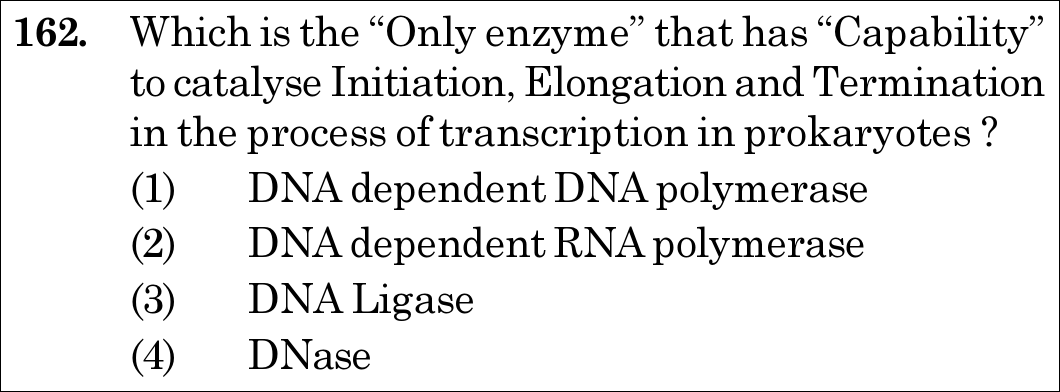
Which is the "Only enzyme" that has "Capability" to catalyse Initiation, Elongation and Termination in the process of transcription in prokaryotes?

  1. (1)DNA dependent DNA polymerase
  2. (2)DNA dependent RNA polymerase
  3. (3)DNA Ligase
  4. (4)DNase
✓
Verified Against NTA Final Answer Key
Option (2) : DNA dependent RNA polymerase
📚 Molecular Basis of Inheritance Easy
📋 Given Parameters & Problem Setup
Capability Criteria Only enzyme capable of catalysing Initiation, Elongation, and Termination of transcription in prokaryotes
Organism Context Prokaryotes (Bacteria)
⚡

The 30-Second Exam Hall Shortcut: ⚡ "RNA Polymerase: Elongates Alone, Initiates with σ, Terminates with ρ"

⏱️ Save ~25 seconds

In bacteria, a single DNA-dependent RNA polymerase catalyses all three steps of transcription: it catalyses elongation alone, and binds transiently to initiation factor (sigma, σ) to start, and termination factor (rho, ρ) to end. Match Option (2) in 5 seconds!

1 Recall transcription in bacteria: a single RNA polymerase synthesizes all types of RNA (mRNA, tRNA, rRNA).
2 RNA polymerase facilitates Initiation (via transient association with sigma factor), Elongation (core enzyme), and Termination (via transient association with rho factor).
3 Name of this enzyme: DNA dependent RNA polymerase.
4 Select Option (2).
🛡️
Why You Can 100% Trust This Shortcut: NCERT Biology · Molecular Basis of Inheritance (Transcription in prokaryotes: DNA-dependent RNA polymerase facilitates initiation, elongation and termination by associating with sigma and rho factors).
📐

Step-by-Step Rigorous Workflow & Mathematical Proof

Step 1

Mechanistic Steps of Prokaryotic Transcription

In prokaryotes, there is only a single DNA-dependent RNA polymerase responsible for transcribing all three types of RNA (mRNA, tRNA, rRNA): 1. Initiation: The core RNA polymerase enzyme (α2ββ′ω\alpha_2\beta\beta'\omega) associates transiently with the initiation factor, sigma (σ\sigma) factor, allowing it to recognize and bind the promoter sequence specifically. 2. Elongation: The core enzyme itself unwinds the DNA helix and polymerizes ribonucleoside triphosphates processively in the 5′→3′5' \rightarrow 3' direction. 3. Termination: Upon reaching the terminator region, the polymerase associates transiently with the termination factor, rho (ρ\rho) factor, which dissociates the nascent RNA and halts transcription.

DNA-dependent RNA Polymerase  ⟹  {Core +σ factor⟶InitiationCore enzyme alone⟶ElongationCore +ρ factor⟶Termination\text{DNA-dependent RNA Polymerase} \implies \begin{cases} \text{Core } + \sigma \text{ factor} & \longrightarrow \textbf{Initiation} \\[3pt] \text{Core enzyme alone} & \longrightarrow \textbf{Elongation} \\[3pt] \text{Core } + \rho \text{ factor} & \longrightarrow \textbf{Termination} \end{cases}
Step 2

Evaluation of Distractor Enzymes

- DNA dependent DNA polymerase: Catalyses semi-conservative DNA replication, not transcription. - DNA Ligase: Catalyses phosphodiester bond formation between Okazaki fragments or recombinant DNA ends. - DNase: Hydrolyses and degrades DNA strands.

⭐

360° Option Elimination Engine Key Feature

Diagnose every choice: Know exactly why the right option works and why distractors fail.

4-Option Deep Scan
1 1
✗ Incorrect
Verdict & Scientific Reason:

Incorrect. This enzyme catalyses DNA replication, not transcription of RNA from a DNA template.

⚠️
Student Fallacy (Why candidates pick this trap): Confusing DNA replication with RNA transcription.
2 2
✓ 100% Correct
Verdict & Scientific Reason:

Correct. In bacteria, DNA-dependent RNA polymerase is the sole enzyme that carries out elongation, while recruiting sigma and rho factors to execute initiation and termination.

💡
Why this is airtight: None. Textbook verbatim formulation.
3 3
✗ Incorrect
Verdict & Scientific Reason:

Incorrect. Ligase joins DNA fragments during replication and repair.

⚠️
Student Fallacy (Why candidates pick this trap): Confusing polymerases with ligases.
4 4
✗ Incorrect
Verdict & Scientific Reason:

Incorrect. DNase is a catabolic nuclease that breaks down DNA.

⚠️
Student Fallacy (Why candidates pick this trap): Complete misunderstanding of hydrolytic nucleases vs synthetic polymerases.
⚠️

NTA Trap Alert: Sigma/Rho Separate Enzyme Misconception

Some candidates think sigma and rho are separate independent enzymes that perform initiation and termination alone. NCERT explicitly clarifies that sigma and rho are non-catalytic protein factors that associate with RNA polymerase to confer initiation and termination capabilities.

🛡️ How to avoid the -1 mark: The catalytic enzyme is always RNA polymerase; sigma and rho are transient cofactors.
📖

Core NEET Syllabus Standard

NEET / NCERT Biology · Molecular Basis of Inheritance Standard Benchmark
Core Scientific Principle Tested:

"In bacteria, a single DNA-dependent RNA polymerase catalyses all three steps of transcription (initiation, elongation, and termination) with the help of sigma and rho factors."

Syllabus Focus: Transcription in Prokaryotes
✓ Core NEET UG Syllabus Anchor Syllabus & Academic Standards ↗

Ready to attempt under real exam pressure?

Test your speed and accuracy in the authentic 200-minute timed NTA simulator.

Launch NEET 2021 CBT Test →

Spotted a mistake in this solution? Report an error (support@mycompetitiveexams.com)

⚖️ Legal & Fair Dealing Notice: Sourced from publicly released NEET 2021 question papers and NEET answer keys for private study, research, and non-commercial educational practice under Fair Dealing (Section 52(1)(a) of the Indian Copyright Act, 1957). Not affiliated with or endorsed by NTA or NMC.

Solve 4 NEET Questions a Day — One per Subject

Cover all 1,140 official NEET questions in 285 days at your own pace. Progress is saved on your device. No login needed.