MyCompetitiveExams Logo MyCompetitiveExams
Search 1,140+ Questions
Chapters, formulas, speed tricks
→
⚡ Brahmastra NEET 2027
720 MARKS

Dynamic 180-question full-length simulator mixed dynamically from all 6 years for 2027 & 2026 aspirants.

Launch Brahmastra 2027 Test →
Start Practice →
100% Free · No Login Required
🌿 Botany 🔥 High-Yield Core Topic (~3–4 Qs/Year)

NEET Human Reproduction Previous Year Questions with Solutions

Complete repository of official NTA NEET questions for Human Reproduction from 2020 to 2026. Every question includes 30-second elimination tricks, step-by-step NCERT solutions, option-by-option traps, and official answer keys.

23 Questions 6 Exam Years (2026, 2025, 2024, 2023, 2021, 2020) 14 Easy · 9 Medium · 0 Challenging
NEET 2026 · Q143 Easy
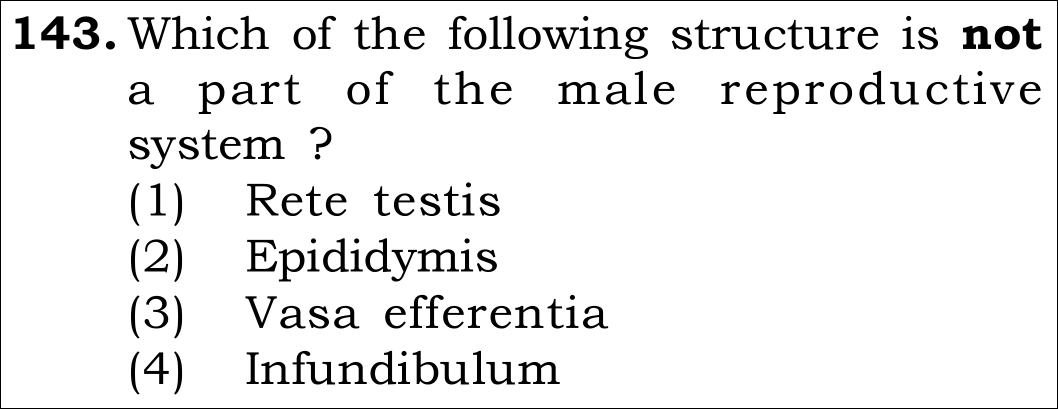
Official NEET 2026 Question 143 - Human Reproduction
1 Rete testis
2 Epididymis
3 Vasa efferentia
4 Infundibulum ✓ Key
💡 Verified Solution & 30-Second Hack
✓
Verified Against NTA Final Answer Key
Option (4) : Infundibulum
📚 Human Reproduction Easy
📋 Given Parameters & Problem Setup
Evaluation Goal Identify structure that is NOT a part of the male reproductive system
Candidate Anatomical Structures Rete testis, Epididymis, Vasa efferentia, Infundibulum
⚡

The 30-Second Exam Hall Shortcut: ⚡ Female Fallopian Duct Spotter

⏱️ Save ~40 seconds

Infundibulum is the funnel-shaped entrance to the Fallopian Tube (Female)!

1 Recall male accessory ducts in sequence: Seminiferous tubules -> Rete testis -> Vasa efferentia -> Epididymis -> Vas deferens.
2 Options (1), (2), and (3) are all male accessory reproductive ducts.
3 Infundibulum is the funnel-shaped part of the female oviduct closest to the ovary (bearing fimbriae).
4 Therefore, Infundibulum is NOT part of the male system.
5 Select Option (4) in under 5 seconds!
🛡️
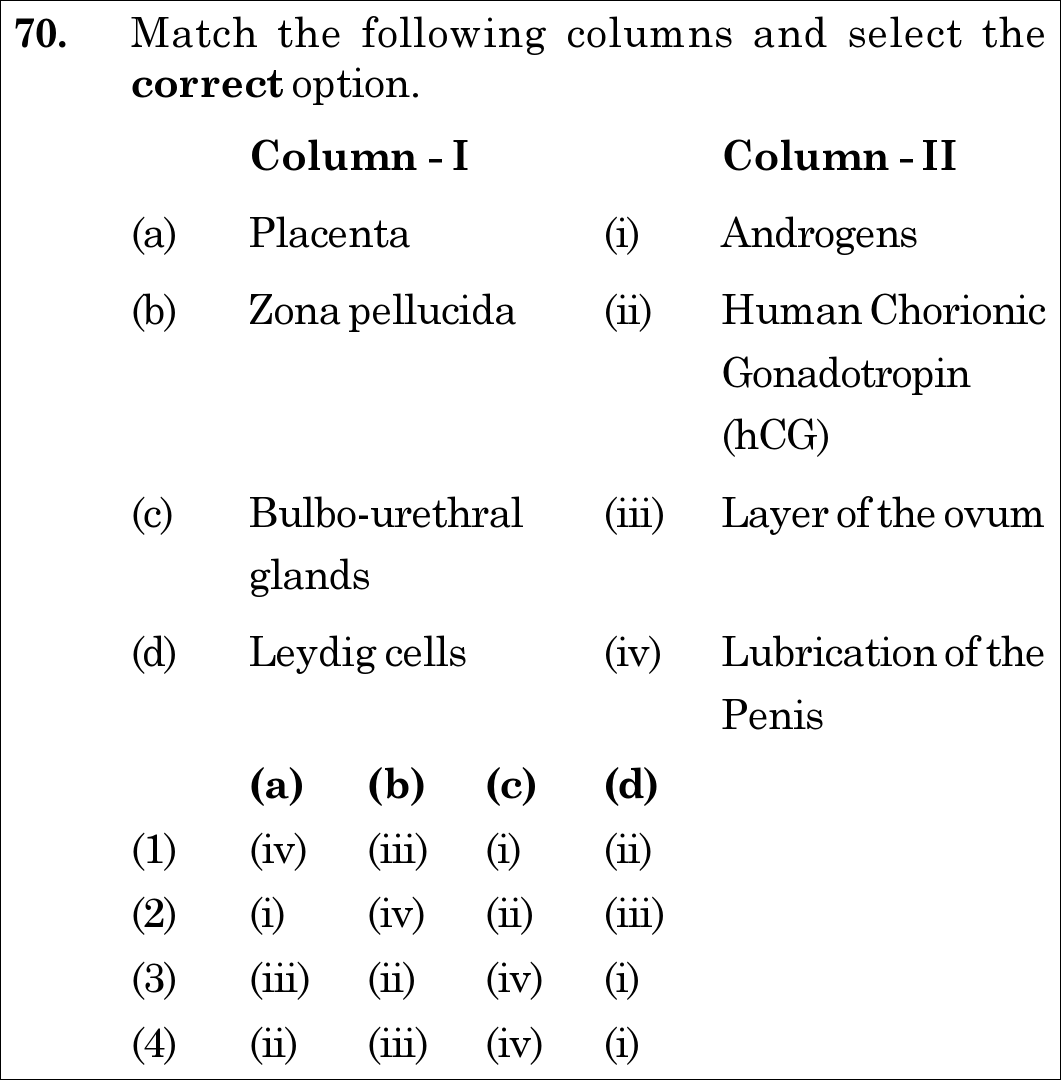
Why You Can 100% Trust This Shortcut: NCERT Biology · Human Reproduction (Male Reproductive System: Leydig cells produce androgens under LH stimulation).
📐

Step-by-Step Rigorous Workflow & Mathematical Proof

Step 1

Anatomy of the Male Reproductive Duct System

The male sex accessory ducts include the rete testis, vasa efferentia, epididymis, and vas deferens. Sperm generated in seminiferous tubules pass sequentially through these ducts to mature and undergo transport.

Male Ducts=Seminiferous Tubules→Rete Testis→Vasa Efferentia→Epididymis→Vas Deferens\text{Male Ducts} = \text{Seminiferous Tubules} \rightarrow \mathbf{Rete\text{ Testis}} \rightarrow \mathbf{Vasa\text{ Efferentia}} \rightarrow \mathbf{Epididymis} \rightarrow \text{Vas Deferens}
  • • Options (1), (2), and (3) belong to the male reproductive system.
Step 2

Anatomy of the Female Oviduct (Fallopian Tube)

Each Fallopian tube is 10–12 cm long and consists of three distinct segments: (1) Infundibulum (the funnel-shaped opening closest to the ovary, featuring finger-like fimbriae that collect the ovum after ovulation), (2) Ampulla (the wider middle region where fertilization occurs), and (3) Isthmus (the narrow terminal lumen joining the uterus).

Oviduct (Female)=Infundibulum (with fimbriae)→Ampulla→Isthmus\text{Oviduct (Female)} = \mathbf{Infundibulum\text{ (with fimbriae)}} \rightarrow \text{Ampulla} \rightarrow \text{Isthmus}
  • • Infundibulum is exclusively a female reproductive structure.
Step 3

Conclusion

Infundibulum is part of the female reproductive system, and therefore not part of the male reproductive system.

Not male structure=Infundibulum  ⟹  Option (4)\text{Not male structure} = \mathbf{Infundibulum} \implies \text{Option (4)}
  • • Matches official NTA final answer key Option D / (4).
⭐

360° Option Elimination Engine Key Feature

Diagnose every choice: Know exactly why the right option works and why distractors fail.

4-Option Deep Scan
1 A
✗ Incorrect
Verdict & Scientific Reason:

Incorrect. Rete testis is an essential male duct network located inside the mediastinum testis.

⚠️
Student Fallacy (Why candidates pick this trap): Failing to read the negative condition in the stem.
2 B
✗ Incorrect
Verdict & Scientific Reason:

Incorrect. Epididymis is the coiled male duct where spermatozoa undergo functional maturation and storage.

⚠️
Student Fallacy (Why candidates pick this trap): Misclassifying a prominent male organ.
3 C
✗ Incorrect
Verdict & Scientific Reason:

Incorrect. Vasa efferentia conduct sperm from rete testis to epididymis in the male system.

⚠️
Student Fallacy (Why candidates pick this trap): Confusing male vasa efferentia with female structures.
4 D
✓ 100% Correct
Verdict & Scientific Reason:

100% accurate. Infundibulum is the proximal funnel-shaped portion of the female Fallopian tube.

💡
Why this is airtight: None; sharp anatomical distinction.
⚠️

NTA Trap Alert: Duct Nomenclature Precision

Male ducts: Vasa efferentia, Vas deferens, Epididymis, Rete testis. Female ducts: Infundibulum, Ampulla, Isthmus, Uterus, Vagina.

🛡️ How to avoid the -1 mark: Associate Infundibulum with Fimbriae: both are female funnel parts collecting eggs!
📖

Core NEET Syllabus Standard

NEET Biology Core Syllabus · Human Reproduction Standard Benchmark
Core Scientific Principle Tested:

"The male accessory ducts are rete testis, vasa efferentia, epididymis, and vas deferens. Infundibulum is a component of the female Fallopian tube."
Syllabus Focus: Male and Female Reproductive Systems
✓ Core NEET UG Syllabus Anchor Syllabus & Academic Standards ↗
Rete, Vasa, Epididymis are for the Guy; Infundibulum and Fimbriae catch Eggs floating by!
NEET 2026 · Q145 Medium
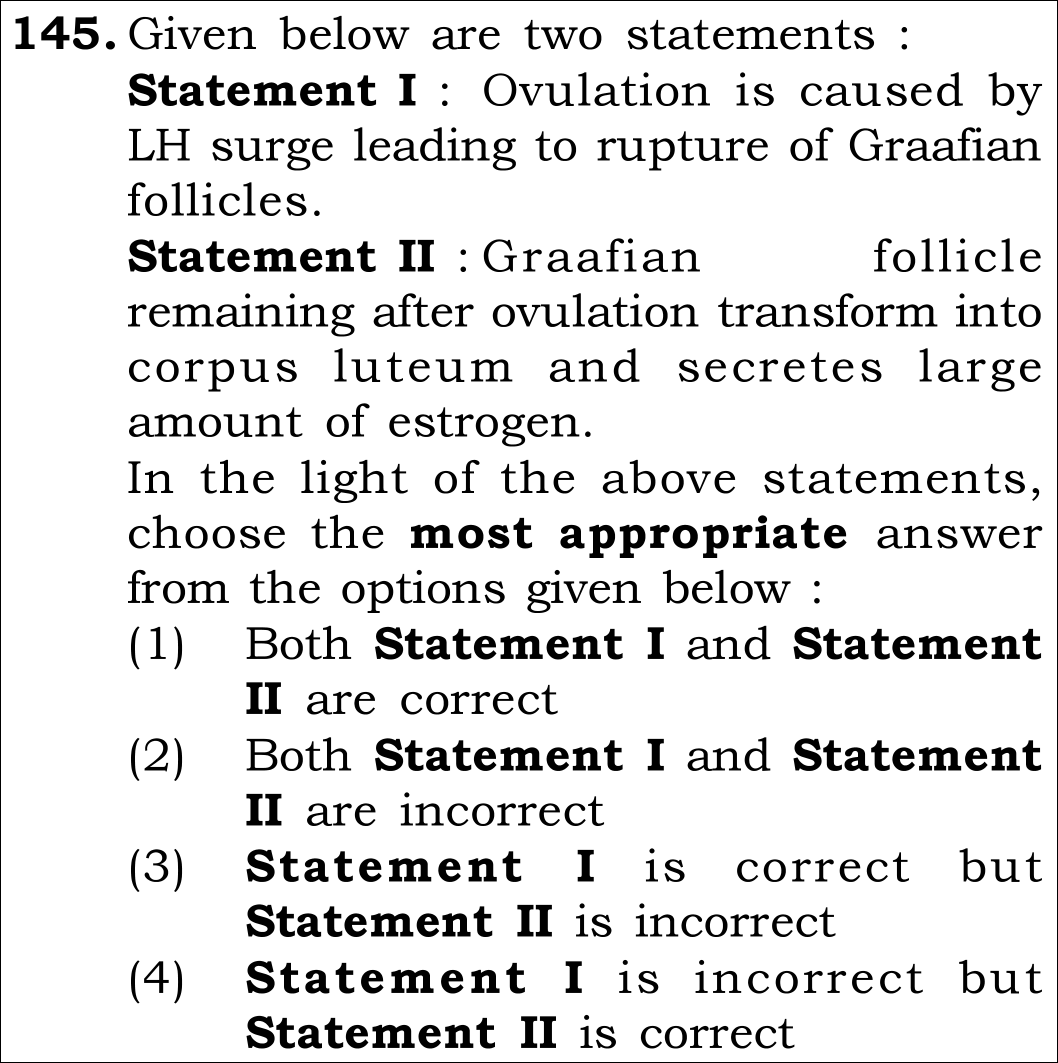
Official NEET 2026 Question 145 - Human Reproduction
1 Both Statement I and Statement II are correct
2 Both Statement I and Statement II are incorrect
3 Statement I is correct but Statement II is incorrect ✓ Key
4 Statement I is incorrect but Statement II is correct
💡 Verified Solution & 30-Second Hack
✓
Verified Against NTA Final Answer Key
Option (3) : Statement I is correct but Statement II is incorrect
📚 Human Reproduction Medium
📋 Given Parameters & Problem Setup
Statement I Ovulation is caused by LH surge leading to rupture of Graafian follicles.
Statement II Graafian follicle remaining after ovulation transform into corpus luteum and secretes large amount of estrogen.
⚡

The 30-Second Exam Hall Shortcut: ⚡ Corpus Luteum Hormone Rule

⏱️ Save ~40 seconds

LH Surge triggers Ovulation (True); Corpus Luteum secretes PROGESTERONE, not estrogen (Statement II is False)!

1 Evaluate Statement I: Rapid mid-cycle secretion of Luteinizing Hormone (LH surge) triggers rupture of the mature Graafian follicle and release of the ovum. -> Statement I is TRUE.
2 Evaluate Statement II: The ruptured follicle transforms into the corpus luteum, which secretes large amounts of PROGESTERONE (essential for maintaining the endometrium), NOT large amounts of estrogen. -> Statement II is FALSE!
3 Conclusion: Statement I is correct but Statement II is incorrect.
4 Select Option (3) in under 10 seconds!
🛡️
Why You Can 100% Trust This Shortcut: NCERT Biology · Human Reproduction (Luteal Phase: Corpus luteum secretes progesterone essential for endometrium maintenance).
📐

Step-by-Step Rigorous Workflow & Mathematical Proof

Step 1

Analyze Statement I: Mechanism of Ovulation

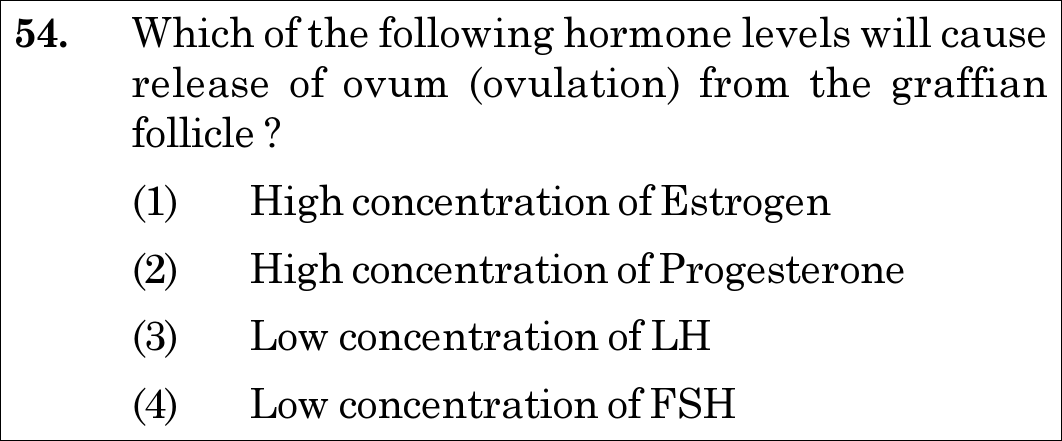
Both LH and FSH attain a peak level in the middle of the menstrual cycle (around day 14). Rapid secretion of LH leading to its maximum concentration (termed the LH surge) induces rupture of the mature tertiary Graafian follicle and release of the secondary oocyte into the peritoneal cavity.

LH Surge (Day 14)⟶Rupture of Graafian Follicle⟶Ovulation [Statement I is TRUE]\text{LH Surge (Day 14)} \longrightarrow \text{Rupture of Graafian Follicle} \longrightarrow \mathbf{Ovulation\text{ [Statement I is TRUE]}}
  • • Statement I is factually and physiologically accurate.
Step 2

Analyze Statement II: Endocrine Secretion of Corpus Luteum

Following ovulation, the remaining granulosa and theca cells of the ruptured Graafian follicle undergo luteinization under LH stimulation to form a yellow endocrine body, the corpus luteum. The corpus luteum secretes large quantities of PROGESTERONE, which maintains the secretory endometrium for implantation.

Corpus Luteum→SecretesLarge amounts of Progesterone  (NOT large amounts of estrogen)\text{Corpus Luteum} \xrightarrow{\text{Secretes}} \mathbf{Large\text{ amounts of Progesterone}} \; (\text{NOT large amounts of estrogen})
  • • While a minor amount of estrogen is produced, progesterone is the primary, defining hormone.
  • • Stating that it "secretes large amount of estrogen" is a classic NTA trap and is incorrect.
Step 3

Determine the Correct Option

Statement I is correct, but Statement II is incorrect. This corresponds to Option (3).

Statement I is correct but Statement II is incorrect  ⟹  Option (3)\text{Statement I is correct but Statement II is incorrect} \implies \text{Option (3)}
  • • Matches official NTA final answer key Option C / (3).
⭐

360° Option Elimination Engine Key Feature

Diagnose every choice: Know exactly why the right option works and why distractors fail.

4-Option Deep Scan
1 A
✗ Incorrect
Verdict & Scientific Reason:

Incorrect. Fails to catch that corpus luteum predominantly secretes progesterone, not estrogen.

⚠️
Student Fallacy (Why candidates pick this trap): Overlooking the specific hormone of the luteal phase.
2 B
✗ Incorrect
Verdict & Scientific Reason:

Incorrect. Statement I is a fundamental medical truth (LH surge causes ovulation).

⚠️
Student Fallacy (Why candidates pick this trap): Doubting LH surge mechanism.
3 C
✓ 100% Correct
Verdict & Scientific Reason:

100% accurate. Statement I is correct, while Statement II erroneously claims large estrogen secretion instead of progesterone.

💡
Why this is airtight: None; mastered ovarian cycle endocrinology.
4 D
✗ Incorrect
Verdict & Scientific Reason:

Completely inverted.

⚠️
Student Fallacy (Why candidates pick this trap): Total conceptual reversal.
⚠️

NTA Trap Alert: Follicular vs Luteal Hormone Trap

Growing ovarian follicles secrete ESTROGEN (proliferative phase); Corpus luteum secretes PROGESTERONE (secretory/luteal phase). NTA regularly swaps these two phases.

🛡️ How to avoid the -1 mark: Follicle = Estrogen; Corpus Luteum = Progesterone!
📖

Core NEET Syllabus Standard

NEET Biology Core Syllabus · Human Reproduction Standard Benchmark
Core Scientific Principle Tested:

"Ovulation is triggered by the mid-cycle LH surge. The resulting corpus luteum secretes high levels of progesterone to maintain pregnancy."

Syllabus Focus: Menstrual Cycle
✓ Core NEET UG Syllabus Anchor Syllabus & Academic Standards ↗
Follicles emit Estrogen to build the nest; Corpus Luteum pumps Progesterone so the embryo can rest!
NEET 2026 · Q166 Easy
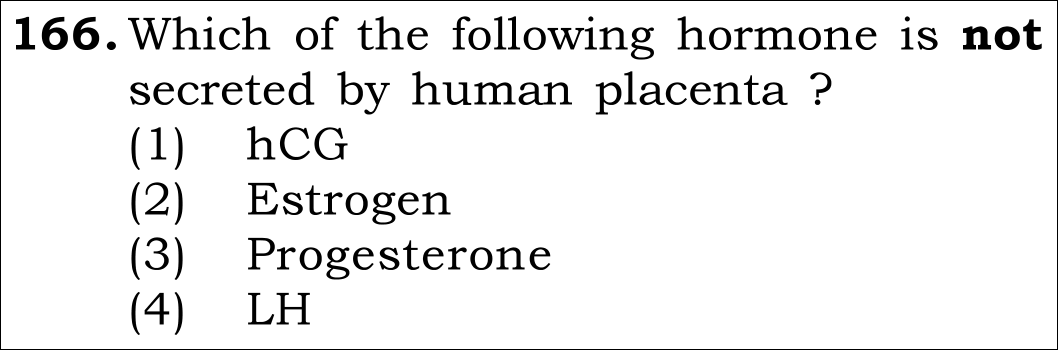
Official NEET 2026 Question 166 - Human Reproduction
1 hCG
2 Estrogen
3 Progesterone
4 LH ✓ Key
💡 Verified Solution & 30-Second Hack
✓
Verified Against NTA Final Answer Key
Option (4) : LH (Luteinizing hormone)
📚 Human Reproduction Easy
📋 Given Parameters & Problem Setup
Endocrine Structure Human Placenta
Criterion Hormone NOT secreted by human placenta
Given Options hCG, hPL, Estrogen, LH
⚡

The 30-Second Exam Hall Shortcut: ⚡ Placental vs. Pituitary Hormone Sieve

⏱️ Save ~35 seconds

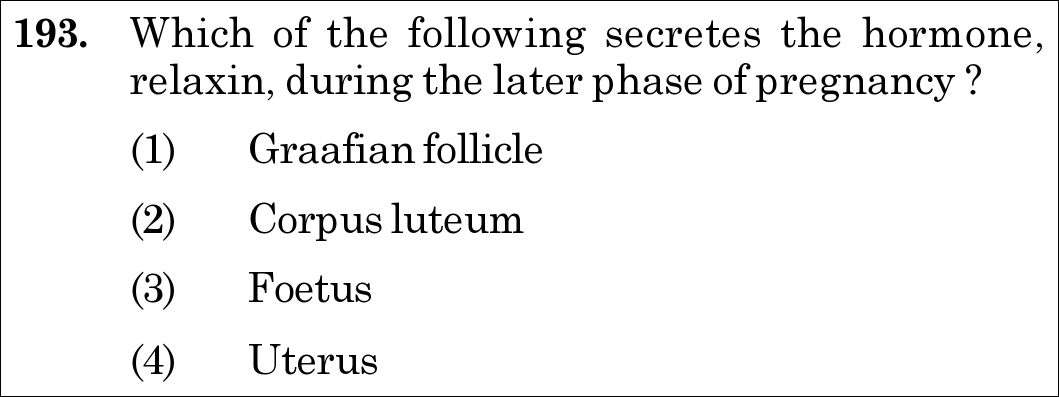
Placenta secretes hCG, hPL, Estrogen, Progesterone, Relaxin. LH comes from ANTERIOR PITUITARY!

1 Recall placental endocrine products: hCG (human chorionic gonadotropin), hPL (human placental lactogen), estrogens, and progestogens.
2 LH (Luteinizing Hormone) is a gonadotropin synthesized and secreted exclusively by the anterior pituitary gland (adenohypophysis).
3 hCG mimics LH action on the corpus luteum, but placenta does NOT secrete LH itself.
4 Identify LH as Option (4).
5 Pick Option (4) in under 10 seconds!
🛡️
Why You Can 100% Trust This Shortcut: NCERT Biology · Human Reproduction (Fertilization & Blastocyst Implantation: Trophoblast attaches to endometrium).
📐

Step-by-Step Rigorous Workflow & Mathematical Proof

Step 1

Endocrine Role of the Human Placenta

Placenta acts as an endocrine tissue and produces several hormones like human chorionic gonadotropin (hCG), human placental lactogen (hPL), estrogens, progestogens, and in the later phase of pregnancy, a hormone called relaxin is also secreted by the ovary/placenta.

Placenta→hCG, hPL, Estrogens, Progestogens, Relaxin\text{Placenta} \rightarrow \text{hCG, hPL, Estrogens, Progestogens, Relaxin}
  • • Hormones like hCG, hPL and relaxin are produced in women only during pregnancy.
Step 2

Origin of Luteinizing Hormone (LH)

Luteinizing hormone (LH) is a pituitary gonadotropin secreted by gonadotroph cells of the anterior pituitary gland under the stimulation of hypothalamic GnRH. It is never synthesized or secreted by placental trophoblasts.

Hypothalamus (GnRH)→Anterior Pituitary→SecretesLH≠Placenta\text{Hypothalamus (GnRH)} \rightarrow \text{Anterior Pituitary} \xrightarrow{\text{Secretes}} \mathbf{LH} \neq \text{Placenta}
  • • hCG shares structural homology with LH and binds LH receptors to maintain the corpus luteum, but LH itself is strictly of pituitary origin.
⭐

360° Option Elimination Engine Key Feature

Diagnose every choice: Know exactly why the right option works and why distractors fail.

4-Option Deep Scan
1 A
✗ Incorrect
Verdict & Scientific Reason:

Incorrect choice because hCG IS secreted by the syncytiotrophoblast of the human placenta (basis of pregnancy urine test).

⚠️
Student Fallacy (Why candidates pick this trap): Missing the "NOT" in the question stem.
2 B
✗ Incorrect
Verdict & Scientific Reason:

Incorrect choice because hPL IS secreted by the human placenta to stimulate mammary development and regulate fetal glucose metabolism.

⚠️
Student Fallacy (Why candidates pick this trap): Overlooking that "placental" is literally in the name of hPL.
3 C
✗ Incorrect
Verdict & Scientific Reason:

Incorrect choice because estrogens ARE abundantly produced by the feto-placental unit during gestation.

⚠️
Student Fallacy (Why candidates pick this trap): Thinking estrogens are solely produced by ovarian follicles.
4 D
✓ 100% Correct
Verdict & Scientific Reason:

100% correct. LH is secreted by the anterior pituitary, NOT by the human placenta.

💡
Why this is airtight: None; clear endocrine localization.
⚠️

NTA Trap Alert: hCG vs. LH Confusion

Because hCG mimics the luteotropic action of LH to keep the corpus luteum alive, students sometimes confuse the two and think LH is produced by the placenta. Placenta produces hCG, NOT LH.

🛡️ How to avoid the -1 mark: Remember: "P" in hPL = Placenta; "C" in hCG = Chorion/Placenta; "LH" = Anterior Pituitary.
📖

Core NEET Syllabus Standard

NEET Biology Core Syllabus · Human Reproduction Standard Benchmark
Core Scientific Principle Tested:

"Placenta produces hCG, hPL, estrogens, and progestogens; LH is produced by the anterior pituitary."

Syllabus Focus: Pregnancy and Embryonic Development
✓ Core NEET UG Syllabus Anchor Syllabus & Academic Standards ↗
Placenta makes hCG & hPL; Pituitary alone produces LH!
NEET 2026 · Q173 Easy
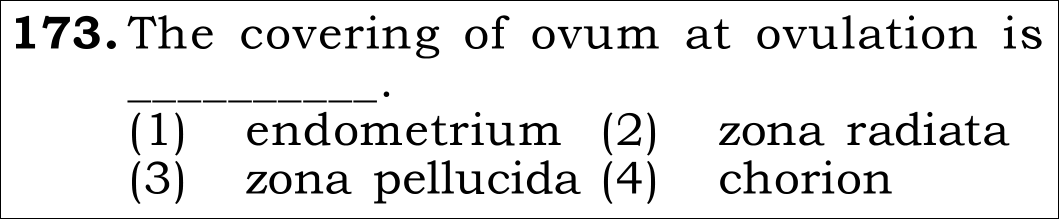
Official NEET 2026 Question 173 - Human Reproduction
1 endometrium
2 zona radiata
3 zona pellucida ✓ Key
4 chorion
💡 Verified Solution & 30-Second Hack
✓
Verified Against NTA Final Answer Key
Option (3) : Zona pellucida
📚 Human Reproduction Easy
📋 Given Parameters & Problem Setup
Cell Stage Secondary Oocyte at Ovulation
Nature of Membrane Non-cellular (acellular) glycoprotein coat secreted by oocyte itself
⚡

The 30-Second Exam Hall Shortcut: ⚡ Acellular Glycoprotein Trigger

⏱️ Save ~35 seconds

Non-cellular glycoprotein layer secreted by oocyte = ZONA PELLUCIDA!

1 Look at the defining keywords: "non-cellular glycoprotein coat".
2 Zona pellucida is the acellular translucent glycoprotein layer secreted directly by the secondary oocyte.
3 Corona radiata consists of living follicular/granulosa cells arranged radially.
4 Theca interna is an ovarian follicle stromal layer that produces androgens.
5 Vitelline membrane is the plasma membrane of the egg.
6 Match Option (3) Zona pellucida in under 10 seconds!
🛡️
Why You Can 100% Trust This Shortcut: NCERT Biology · Human Reproduction (Parturition Reflex: Neuroendocrine reflex triggers oxytocin release from maternal pituitary).
📐

Step-by-Step Rigorous Workflow & Mathematical Proof

Step 1

Structure of the Ovulated Secondary Oocyte

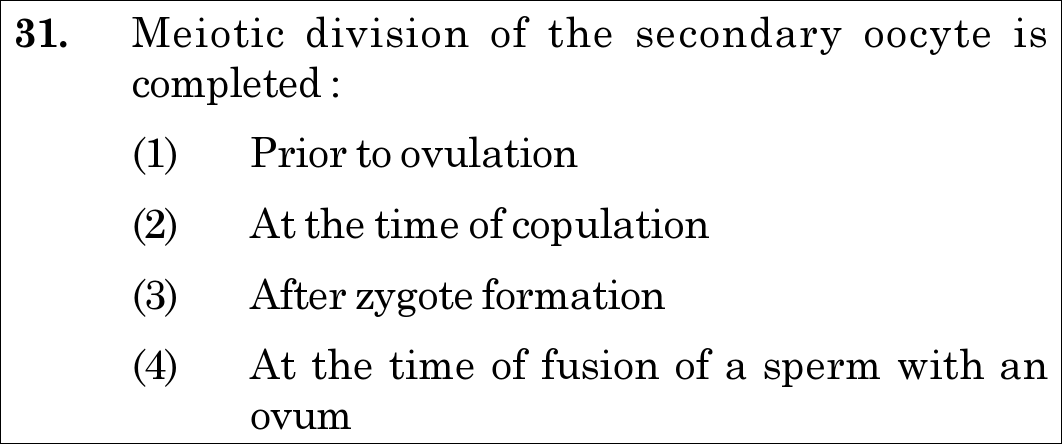
During oogenesis, the primary oocyte completes its first meiotic division within the tertiary follicle to form a secondary oocyte and a tiny first polar body. The secondary oocyte forms a new acellular glycoprotein membrane around itself called zona pellucida.

Secondary Oocyte→SecretesZonaPellucida(AcellularGlycoproteinEnvelope)\text{Secondary Oocyte} \xrightarrow{\text{Secretes}} \mathbf{Zona Pellucida (Acellular Glycoprotein Envelope)}
  • • Zona pellucida contains sperm-binding glycoproteins ZP1, ZP2, and ZP3.
Step 2

Function During Fertilization

Outside the zona pellucida lies the corona radiata, formed of radially elongated follicle/granulosa cells. During fertilization, sperm acrosomal enzymes (hyaluronidase and acrosin) penetrate the corona radiata and digest the zona pellucida. Contact of one sperm induces a cortical reaction in the zona pellucida, blocking polyspermy.

Sperm Contact→Cortical Granule Exocytosis→Hardening of Zona Pellucida (Blocks Polyspermy)\text{Sperm Contact} \rightarrow \text{Cortical Granule Exocytosis} \rightarrow \text{Hardening of Zona Pellucida (Blocks Polyspermy)}
  • • Prevents polyspermy and ectopic implantation in the fallopian tube.
⭐

360° Option Elimination Engine Key Feature

Diagnose every choice: Know exactly why the right option works and why distractors fail.

4-Option Deep Scan
1 A
✗ Incorrect
Verdict & Scientific Reason:

Incorrect. Corona radiata is a cellular layer formed of radially arranged granulosa cells, not an acellular glycoprotein coat.

⚠️
Student Fallacy (Why candidates pick this trap): Confusing the cellular outer corona radiata with the acellular inner zona pellucida.
2 B
✗ Incorrect
Verdict & Scientific Reason:

Incorrect. Theca interna is a cellular vascular layer of the Graafian follicle that stays behind in the ovary after ovulation to form the corpus luteum.

⚠️
Student Fallacy (Why candidates pick this trap): Confusing follicular wall layers with oocyte coats.
3 C
✓ 100% Correct
Verdict & Scientific Reason:

100% correct. Zona pellucida is the non-cellular glycoprotein coat secreted around the secondary oocyte.

💡
Why this is airtight: None; classic reproductive biology fact.
4 D
✗ Incorrect
Verdict & Scientific Reason:

Incorrect. The vitelline membrane represents the plasma membrane / oolemma of the egg, not the specialized non-cellular coat described.

⚠️
Student Fallacy (Why candidates pick this trap): Confusing plasma membrane with the outer zona pellucida.
⚠️

NTA Trap Alert: Cellular vs. Non-Cellular Egg Layers

Examiners test whether you know which layer is cellular and which is non-cellular. Zona pellucida is NON-CELLULAR (glycoprotein); Corona radiata is CELLULAR (follicle cells).

🛡️ How to avoid the -1 mark: Remember: Zona = Zone (clear, non-cellular ring); Corona = Crown of cells.
📖

Core NEET Syllabus Standard

NEET Biology Core Syllabus · Human Reproduction Standard Benchmark
Core Scientific Principle Tested:

"The secondary oocyte forms a new non-cellular membrane called zona pellucida surrounding it."

Syllabus Focus: Gametogenesis & Ovulation
✓ Core NEET UG Syllabus Anchor Syllabus & Academic Standards ↗
Zona = Zero cells (Non-cellular glycoprotein coat)!
NEET 2025 · Q110 Easy
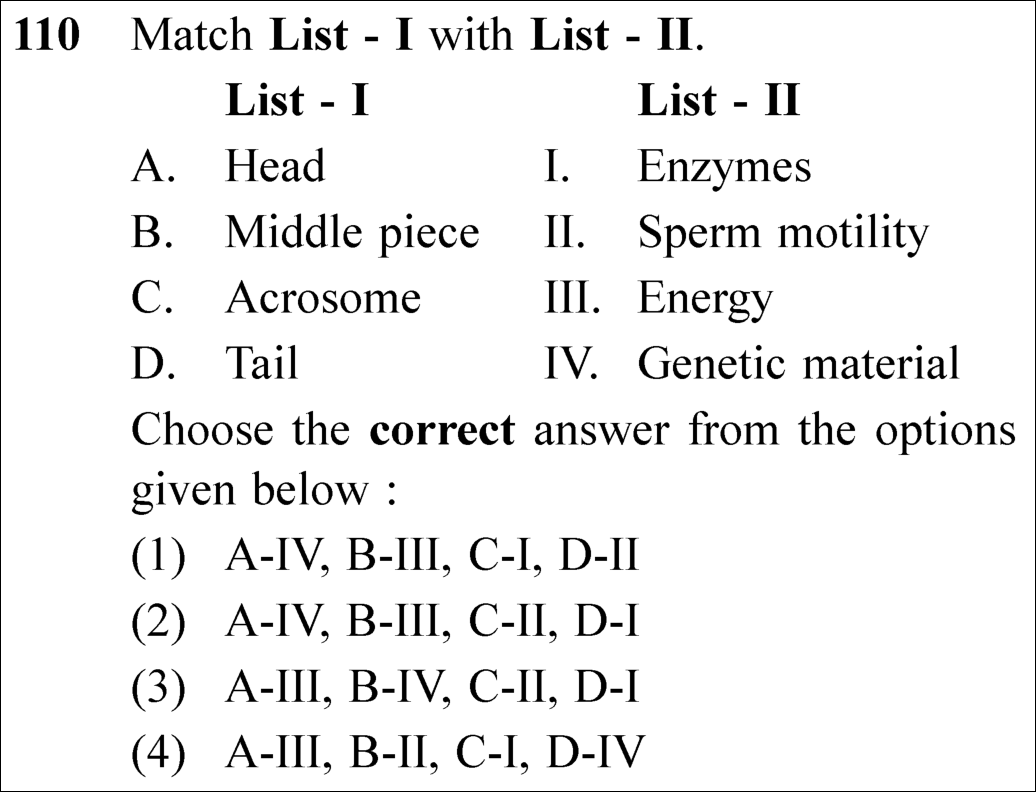
Official NEET 2025 Question 110 - Human Reproduction
1 ✓ Key
2
3
4
💡 Verified Solution & 30-Second Hack
✓
Verified Against NTA Final Answer Key
Option (1) : A-IV, B-III, C-I, D-II
📚 Human Reproduction Easy
📋 Given Parameters & Problem Setup
List - I (Structures) A. Head, B. Middle piece, C. Acrosome, D. Tail
List - II (Functions/Contents) I. Enzymes, II. Sperm motility, III. Energy, IV. Genetic material
⚡

The 30-Second Exam Hall Shortcut: ⚡ Sperm Anatomy Match Fingerprint

⏱️ Save ~30 seconds

Head = Nucleus (Genetic material, IV); Middle piece = Mitochondria (Energy, III); Acrosome = Cap with hyaluronidase (Enzymes, I); Tail = Flagellum (Motility, II)!

1 Quick match the canonical sperm regions:
2 - Head: Contains elongated haploid nucleus carrying Genetic material (A -> IV).
3 - Middle piece: Contains spiral mitochondria providing Energy (ATP) for movement (B -> III).
4 - Acrosome: Filled with lytic Enzymes (sperm lysins) that penetrate ovum (C -> I).
5 - Tail: Whip-like axoneme that drives Sperm motility (D -> II).
6 Unique combination: A-IV, B-III, C-I, D-II -> Option (1)!
7 Solved in under 10 seconds!
🛡️
Why You Can 100% Trust This Shortcut: Gametogenesis & Spermatogenesis vs Oogenesis (NCERT Biology · Human Reproduction).
📐

Step-by-Step Rigorous Workflow & Mathematical Proof

Step 1

Structural Architecture of a Human Sperm

A human sperm is a microscopic structure composed of four distinct anatomical regions enclosed by a plasma membrane:

  • • Head: Contains an elongated haploid nucleus holding the paternal Genetic material (DNA/chromosomes). Hence, A matches IV.
  • • Middle piece: Possesses numerous spirally arranged mitochondria (nebenkern) that produce ATP/Energy for the movement of the tail. Hence, B matches III.
  • • Acrosome: An anterior cap-like structure derived from the Golgi apparatus, filled with hydrolytic Enzymes (hyaluronidase, corona penetrating enzyme, acrosin) that facilitate penetration of the zona pellucida of the ovum. Hence, C matches I.
  • • Tail: A long flagellum consisting of an axial filament that facilitates vigorous Sperm motility, essential for traveling through the female reproductive tract to reach the ampullary region. Hence, D matches II.
Step 2

Formulation of the Correct Matching Code

Assembling the individual pairings:

  • • A -> IV (Head - Genetic material)
  • • B -> III (Middle piece - Energy)
  • • C -> I (Acrosome - Enzymes)
  • • D -> II (Tail - Sperm motility)
Step 3

Conclusion

The unambiguous combination is A-IV, B-III, C-I, D-II, corresponding to Option (1).

Code=A-IV, B-III, C-I, D-II (Option 1)\text{Code} = \text{A-IV, B-III, C-I, D-II (Option 1)}
⭐

360° Option Elimination Engine Key Feature

Diagnose every choice: Know exactly why the right option works and why distractors fail.

4-Option Deep Scan
1 A
✓ 100% Correct
Verdict & Scientific Reason:

100% correct. Matches all four functional anatomical regions of the sperm with textbook accuracy.

💡
Why this is airtight: None; pristine knowledge of sperm histology.
2 B
✗ Incorrect
Verdict & Scientific Reason:

Incorrect. Swaps acrosome with tail (acrosome does not provide motility; tail contains no enzymes).

⚠️
Student Fallacy (Why candidates pick this trap): Careless reading of C and D.
3 C
✗ Incorrect
Verdict & Scientific Reason:

Incorrect. Assigns energy to the head and genetic material to the middle piece.

⚠️
Student Fallacy (Why candidates pick this trap): Confusing head nucleus with middle piece mitochondria.
4 D
✗ Incorrect
Verdict & Scientific Reason:

Incorrect. Scrambles energy, motility, and genetic material.

⚠️
Student Fallacy (Why candidates pick this trap): Random choice without verifying pairings.
⚠️

NTA Trap Alert: Swapping Acrosome with Head Contents

Students sometimes confuse the head generally (which carries genetic material) with the acrosome specifically (the cap containing digestive enzymes). Middle piece always houses mitochondria for energy.

🛡️ How to avoid the -1 mark: Head = DNA (Genetic); Acrosome = Enzymes; Middle piece = Mitochondria (Energy); Tail = Motility.
📖

Core NEET Syllabus Standard

NEET Biology Core Syllabus · Human Reproduction Standard Benchmark
Core Scientific Principle Tested:

"The sperm head contains genetic material, the acrosome contains enzymes for fertilization, the middle piece generates energy, and the tail provides motility."

Syllabus Focus: Gametogenesis · Microscopic Structure of Sperm
✓ Core NEET UG Syllabus Anchor Syllabus & Academic Standards ↗
H-G, M-E, A-Enz, T-M: Head=Gene, Mid=Energy, Acrosome=Enzyme, Tail=Motility!
NEET 2025 · Q123 Medium
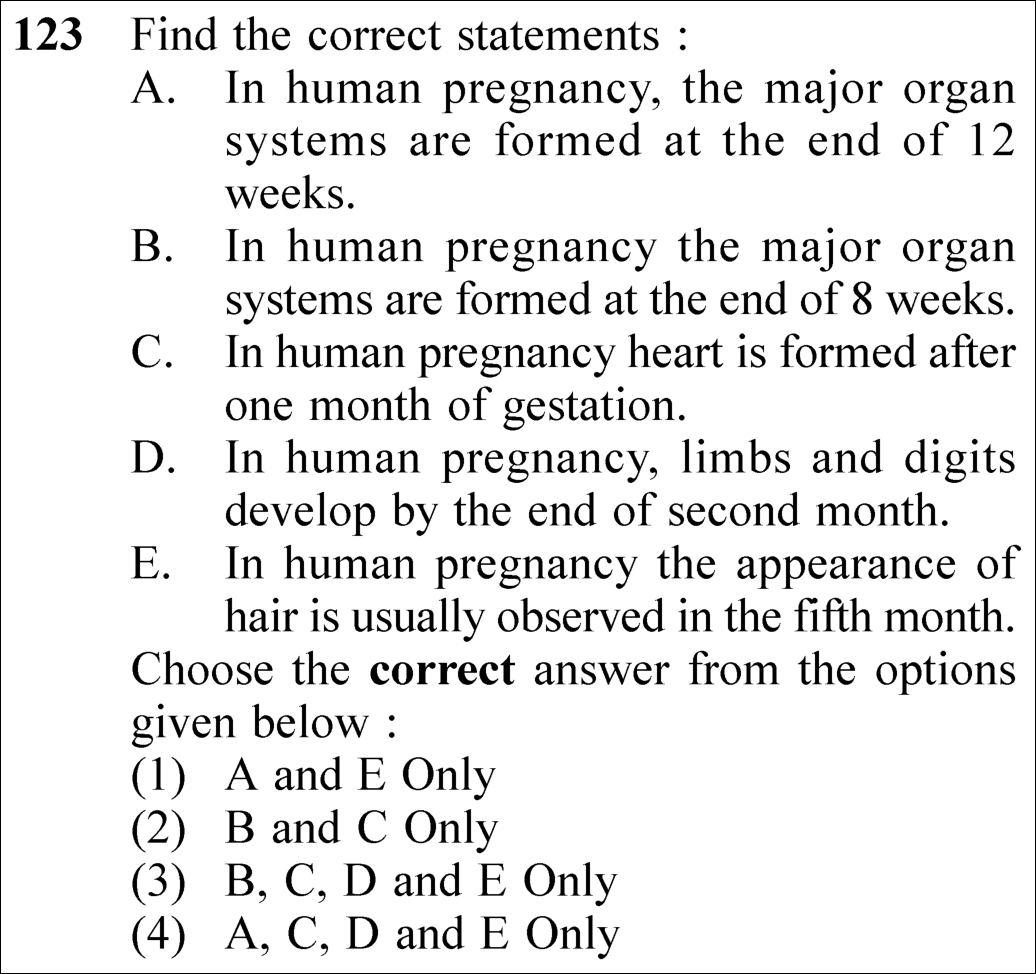
Official NEET 2025 Question 123 - Human Reproduction
1
2
3
4 ✓ Key
💡 Verified Solution & 30-Second Hack
✓
Verified Against NTA Final Answer Key
Option (4) : A, C, D and E Only
📚 Human Reproduction Medium
📋 Given Parameters & Problem Setup
Statement A Major organ systems formed at the end of 12 weeks.
Statement B Major organ systems formed at the end of 8 weeks.
Statement C Heart is formed after one month of gestation.
Statement D Limbs and digits develop by the end of second month.
Statement E Appearance of hair is usually observed in the fifth month.
⚡

The 30-Second Exam Hall Shortcut: ⚡ Gestational Milestones Fingerprint

⏱️ Save ~30 seconds

1 month = Heart (C); 2 months = Limbs & Digits (D); 12 weeks (3 months) = Major organ systems & external genitalia (A true, B false); 5th month = First movement & Hair on head (E)! Statements A, C, D, and E are CORRECT!

1 Check each gestational milestone against NCERT timeline:
2 - C: After 1 month -> Embryo heart is formed. [CORRECT]
3 - D: End of 2nd month -> Foetus develops limbs and digits. [CORRECT]
4 - A: End of 12 weeks (first trimester) -> Most major organ systems formed (limbs, external genitalia). [CORRECT]
5 - B: Major organ systems at 8 weeks? False, that is at 12 weeks! [INCORRECT]
6 - E: Fifth month -> First fetal movement and appearance of hair on the head. [CORRECT]
7 Statements A, C, D, and E Only are correct (Option 4)!
8 Select Option (4)!
🛡️
Why You Can 100% Trust This Shortcut: Human Fertilization & Polyspermy Prevention (NCERT Biology · Human Reproduction: Cortical reaction and zona pellucida hardening).
📐

Step-by-Step Rigorous Workflow & Mathematical Proof

Step 1

Review of NCERT Embryonic Gestational Milestones

Human gestation lasts 9 months (3 trimesters / ~38 weeks). NCERT documents the following precise developmental milestones:

  • • After 1 month of pregnancy: The embryo's heart is formed. The first sign of growing foetus may be noticed by listening to the heart sound carefully through the stethoscope. Hence, Statement C is correct.
  • • By the end of the second month of pregnancy (8 weeks): The foetus develops limbs and digits. Hence, Statement D is correct.
  • • By the end of 12 weeks (first trimester): Most of the major organ systems are formed, for example, the limbs and external genital organs are well-developed. Hence, Statement A is correct, and Statement B (which claims 8 weeks) is incorrect.
  • • During the fifth month: The first movements of the foetus and appearance of hair on the head are usually observed. Hence, Statement E is correct.
  • • By the end of 24 weeks (second trimester): The body is covered with fine hair, eye-lids separate, and eyelashes are formed.
  • • By the end of 9 months: The foetus is fully developed and is ready for delivery.
Step 2

Synthesis of Truth Values

Evaluating all five candidate statements:

  • • A: Correct (12 weeks = major organ systems).
  • • B: Incorrect (contradicts 12 weeks milestone).
  • • C: Correct (1 month = heart formed).
  • • D: Correct (end of 2nd month = limbs and digits).
  • • E: Correct (5th month = hair on head observed).
Step 3

Conclusion

Statements A, C, D, and E Only are correct. This corresponds unambiguously to Option (4).

Correct Statements={A,C,D,E}  ⟹  Option (4)\text{Correct Statements} = \{A, C, D, E\} \implies \text{Option (4)}
⭐

360° Option Elimination Engine Key Feature

Diagnose every choice: Know exactly why the right option works and why distractors fail.

4-Option Deep Scan
1 A
✗ Incorrect
Verdict & Scientific Reason:

Incorrect. Omit statements C and D, both of which are true canonical facts.

⚠️
Student Fallacy (Why candidates pick this trap): Overlooking early first-trimester embryonic milestones.
2 B
✗ Incorrect
Verdict & Scientific Reason:

Incorrect. Includes false statement B (major organs form at 12 weeks, not 8 weeks) and omits A, D, and E.

⚠️
Student Fallacy (Why candidates pick this trap): Confusing 8 weeks (limbs/digits) with 12 weeks (major organ systems).
3 C
✗ Incorrect
Verdict & Scientific Reason:

Incorrect. Incorrectly incorporates statement B instead of statement A.

⚠️
Student Fallacy (Why candidates pick this trap): Failing to eliminate the false 8-week claim.
4 D
✓ 100% Correct
Verdict & Scientific Reason:

100% correct. Perfectly identifies all four valid embryological milestones and excludes false statement B.

💡
Why this is airtight: None; master-level familiarity with gestation chronology.
⚠️

NTA Trap Alert: 8 Weeks vs 12 Weeks Milestone Confusion

At 8 weeks (end of 2nd month), limbs and digits develop. At 12 weeks (end of 1st trimester), major organ systems and external genitalia are formed! Statements A and B are mutually contradictory; only A is correct!

🛡️ How to avoid the -1 mark: Remember: 8 weeks = Digits; 12 weeks = Organ systems!
📖

Core NEET Syllabus Standard

NEET Biology Core Syllabus · Human Reproduction Standard Benchmark
Core Scientific Principle Tested:

"Heart forms at 1 month, limbs/digits by 2 months, major organ systems by 12 weeks, and head hair during 5th month."

Syllabus Focus: Pregnancy and Embryonic Development · Timeline of Foetal Development
✓ Core NEET UG Syllabus Anchor Syllabus & Academic Standards ↗
1-Heart, 2-Digits, 12w-Organs, 5m-Hair: A, C, D, E are spot on!
NEET 2025 · Q138 Medium
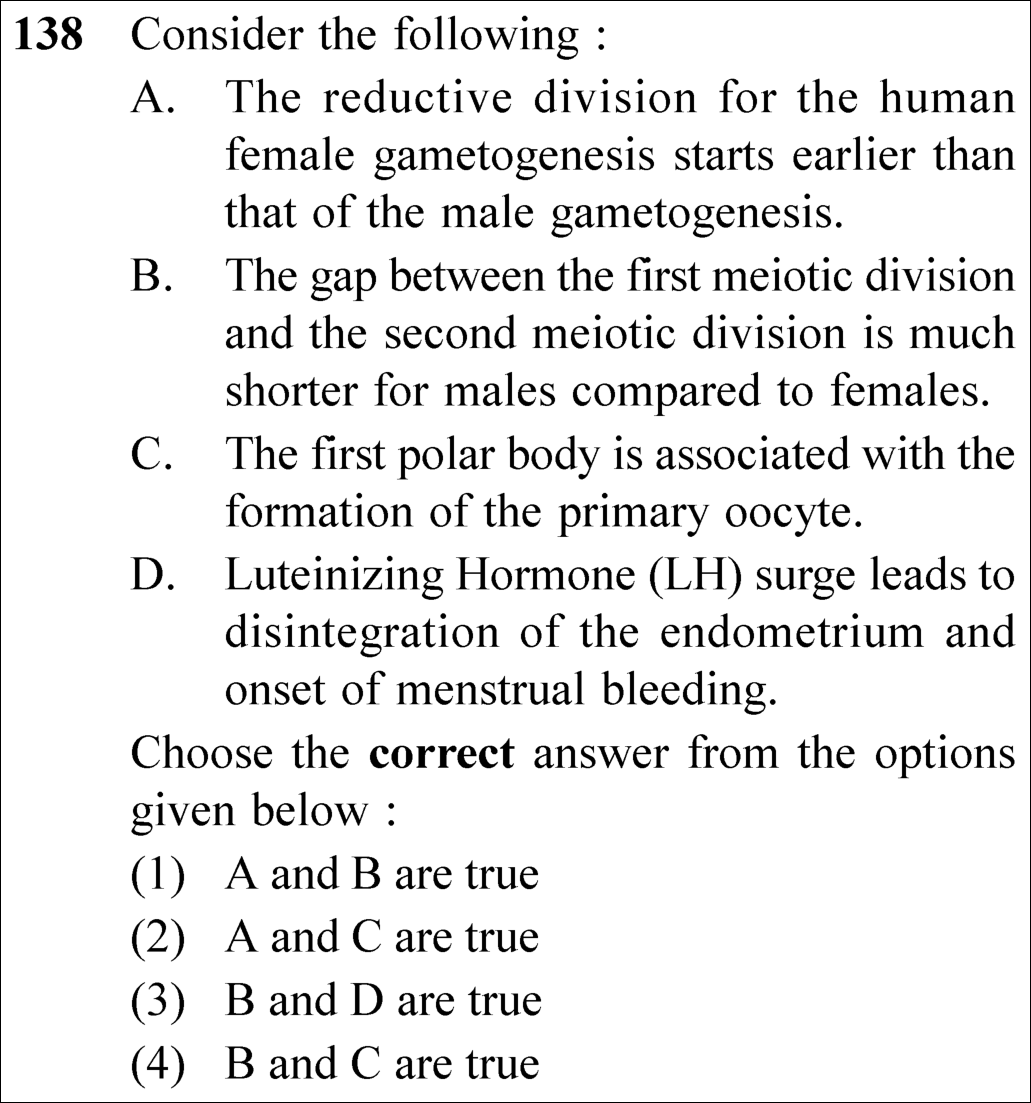
Official NEET 2025 Question 138 - Human Reproduction
1 A and B are true ✓ Key
2 A and C are true
3 Band D are true
4 Band C are true
💡 Verified Solution & 30-Second Hack
✓
Verified Against NTA Final Answer Key
Option (1) : A and B are true
📚 Human Reproduction Medium
📋 Given Parameters & Problem Setup
Statement A The reductive division for human female gametogenesis starts earlier than that of male gametogenesis.
Statement B The gap between the first meiotic division and second meiotic division is much shorter for males compared to females.
Statement C The first polar body is associated with the formation of the primary oocyte.
Statement D Luteinizing Hormone (LH) surge leads to disintegration of the endometrium and onset of menstrual bleeding.
⚡

The 30-Second Exam Hall Shortcut: ⚡ Gametogenesis Timing Diagnostic

⏱️ Save ~35 seconds

Female meiosis begins in embryonic life (foetus) vs male meiosis at puberty -> A is TRUE! Male Meiosis-I to II takes mere hours, whereas female takes decades (birth to puberty/fertilisation) -> B is TRUE! First polar body accompanies SECONDARY oocyte (C false)! LH surge triggers OVULATION, not menstruation (D false)! A and B are true!

1 Analyze each statement meticulously:
2 - Statement A: Oogenesis (reductive division / meiosis I) is initiated during the embryonic development stage before birth! Spermatogenesis begins only at puberty (13–14 years). Thus, female reductive division starts years earlier! [TRUE]
3 - Statement B: In males, secondary spermatocytes immediately undergo Meiosis II without interphase pause (gap is hours). In females, Meiosis I completes just before ovulation (puberty, 12–50 years after initiation!), and Meiosis II halts at Metaphase II until fertilization! The gap is incomparably shorter in males. [TRUE]
4 - Statement C: Meiosis I produces the SECONDARY oocyte and the first polar body (not primary oocyte). [FALSE]
5 - Statement D: LH surge induces ovulation (rupture of Graafian follicle), whereas endometrial disintegration is caused by progesterone withdrawal. [FALSE]
6 Conclusion: A and B are true!
7 Select Option (1)!
🛡️
Why You Can 100% Trust This Shortcut: Oogenesis Hormonal Milieu & Follicular Development (NCERT Biology · Human Reproduction: Primary to Graafian follicle).
📐

Step-by-Step Rigorous Workflow & Mathematical Proof

Step 1

Comparative Chronology of Meiosis in Gametogenesis (Statements A & B)

Spermatogenesis and oogenesis exhibit profound temporal differences:

  • • Initiation: Oogenesis is initiated during the embryonic development stage when a couple of million gamete mother cells (oogonia) are formed within each foetal ovary; no more oogonia are formed and added after birth. Primary oocytes enter prophase-I of meiosis-I and get temporarily arrested. In contrast, spermatogenesis starts only at puberty due to the significant increase in the secretion of GnRH. Therefore, reductive division begins much earlier in females. Statement A is TRUE.
  • • Inter-meiotic Interval (Gap): In males, primary spermatocytes complete Meiosis I to form secondary spermatocytes, which immediately undergo Meiosis II to form spermatids (duration is just hours to days). In females, Meiosis I completes only at puberty inside the tertiary follicle (a gap of 12 to 50 years!), and Meiosis II is arrested at Metaphase II until sperm entry at fertilization. Hence, the gap between meiosis I and II is vastly shorter in males. Statement B is TRUE.
Step 2

Origin of Polar Bodies and Primary Oocyte (Statement C)

Cytoplasmic division during female meiosis:

  • • Oogonia divide mitotically to form primary oocytes (which are diploid and arrested in prophase I).
  • • The first meiotic division of the primary oocyte is unequal, resulting in the formation of a large haploid secondary oocyte and a tiny first polar body.
  • • Thus, the first polar body is associated with the formation of the secondary oocyte, NOT the primary oocyte. Statement C is FALSE.
Step 3

Physiological Action of the LH Surge (Statement D)

Hormonal events of the menstrual cycle:

  • • Both LH and FSH attain a peak level in the middle of the cycle (about 14th day). Rapid secretion of LH leading to its maximum level during the mid-cycle called LH surge induces rupture of Graafian follicle and thereby the release of ovum (ovulation).
  • • Menstrual flow and endometrial sloughing result from the degeneration of the corpus luteum and subsequent precipitous drop in progesterone levels, not from the LH surge. Statement D is FALSE.
Step 4

Conclusion

Statements A and B are true, while C and D are false. This matches Option (1).

True Statements=A and B (Option 1)\text{True Statements} = A \text{ and } B \text{ (Option 1)}
⭐

360° Option Elimination Engine Key Feature

Diagnose every choice: Know exactly why the right option works and why distractors fail.

4-Option Deep Scan
1 A
✓ 100% Correct
Verdict & Scientific Reason:

100% correct. Accurately verifies that female meiosis initiates earlier (fetal life) and male inter-meiotic interval is much shorter.

💡
Why this is airtight: None; exceptional mastery of human gametogenesis.
2 B
✗ Incorrect
Verdict & Scientific Reason:

Incorrect. Statement C is false because the first polar body forms alongside the secondary oocyte.

⚠️
Student Fallacy (Why candidates pick this trap): Confusing primary oocyte with secondary oocyte.
3 C
✗ Incorrect
Verdict & Scientific Reason:

Incorrect. Statement D is false because LH surge causes ovulation, not menstrual bleeding.

⚠️
Student Fallacy (Why candidates pick this trap): Confusing the mid-cycle ovulatory LH peak with menses.
4 D
✗ Incorrect
Verdict & Scientific Reason:

Incorrect. Incorporates false statement C and omits true statement A.

⚠️
Student Fallacy (Why candidates pick this trap): Believing primary oocytes possess polar bodies.
⚠️

NTA Trap Alert: LH Surge Function vs Menstruation Trigger

The LH surge triggers OVULATION at day 14! Menstruation occurs 14 days later (day 28) triggered by PROGESTERONE WITHDRAWAL when the corpus luteum degenerates. Never credit LH surge with endometrial sloughing!

🛡️ How to avoid the -1 mark: LH Surge = Ovulation. Progesterone Drop = Menstruation.
📖

Core NEET Syllabus Standard

NEET Biology Core Syllabus · Human Reproduction Standard Benchmark
Core Scientific Principle Tested:

"Oogenesis initiates in fetal development while spermatogenesis begins at puberty; first meiotic division produces secondary oocyte and first polar body; LH surge causes ovulation."

Syllabus Focus: Gametogenesis & Menstrual Cycle
✓ Core NEET UG Syllabus Anchor Syllabus & Academic Standards ↗
A & B are biological Truth: A-Embryo start (Female), B-Brief gap (Male)!
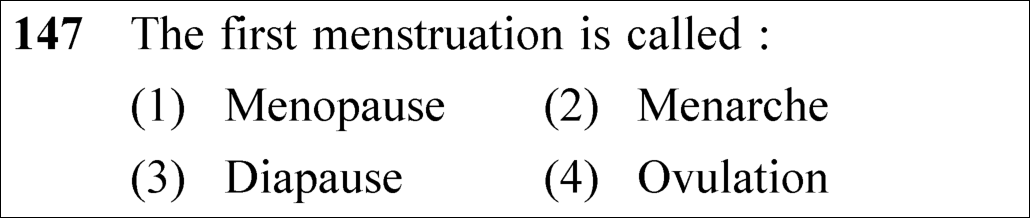
NEET 2025 · Q147 Easy
Official NEET 2025 Question 147 - Human Reproduction
1 Menopause
2 Menarche ✓ Key
3 Diapause
4 Ovulation
💡 Verified Solution & 30-Second Hack
✓
Verified Against NTA Final Answer Key
Option (2) : Menarche
📚 Human Reproduction Easy
📋 Given Parameters & Problem Setup
Event The first occurrence of menstruation in human females
Target Term Scientific / physiological terminology
⚡

The 30-Second Exam Hall Shortcut: ⚡ Reproductive Milestones Fingerprint

⏱️ Save ~10 seconds

The FIRST menstruation at puberty = MENARCHE! The permanent CESSATION of menstruation around age 50 = MENOPAUSE! First = Menarche!

1 Recall NCERT Section 3.4.1 (Menstrual Cycle):
2 - "The first menstruation begins at puberty and is called menarche."
3 - "In human beings, menstrual cycles cease around 50 years of age; that is termed as menopause."
4 - "Diapause" is a stage of suspended development in zooplankton.
5 - "Ovulation" is the release of secondary oocyte from mature Graafian follicle.
6 First menstruation = Menarche!
7 Select Option (2) Menarche!
🛡️
Why You Can 100% Trust This Shortcut: Menstrual Cycle Hormonal Control & LH Surge (NCERT Biology · Human Reproduction: Ovulation triggered by LH peak at mid-cycle).
📐

Step-by-Step Rigorous Workflow & Mathematical Proof

Step 1

Definition of Menstrual Milestones

The reproductive life of human females is demarcated by two canonical physiological milestones:

  • • Menarche: The very first menstrual bleeding marking the onset of puberty (typically between ages 11–14). It signifies the activation of the hypothalamic-pituitary-ovarian axis.
  • • Menopause: The permanent cessation of menstrual cycles and ovarian follicular activity, occurring naturally around 45–50 years of age.
Step 2

Evaluation of Distractor Terms

Distinguishing unrelated biological phenomena:

  • • Diapause: A stage of suspended physiological development or metabolic dormancy exhibited by many zooplankton species in lakes and ponds to avoid unfavorable conditions.
  • • Ovulation: The mid-cycle process occurring under the influence of the LH surge where the mature Graafian follicle ruptures to release the secondary oocyte into the peritoneal cavity.
Step 3

Conclusion

The first menstruation is scientifically designated as Menarche, matching Option (2).

First Menstruation=Menarche (Option 2)\text{First Menstruation} = \text{Menarche (Option 2)}
⭐

360° Option Elimination Engine Key Feature

Diagnose every choice: Know exactly why the right option works and why distractors fail.

4-Option Deep Scan
1 A
✗ Incorrect
Verdict & Scientific Reason:

Incorrect. Menopause is the permanent cessation of menstruation, not its inception.

⚠️
Student Fallacy (Why candidates pick this trap): Confusing the beginning of menstrual life with its end.
2 B
✓ 100% Correct
Verdict & Scientific Reason:

100% correct. Direct verbatim textbook definition: "The first menstruation begins at puberty and is called menarche."

💡
Why this is airtight: None; basic terminology recall.
3 C
✗ Incorrect
Verdict & Scientific Reason:

Incorrect. Diapause is metabolic dormancy in zooplankton, entirely unrelated to human reproductive physiology.

⚠️
Student Fallacy (Why candidates pick this trap): Confusing ecological dormancy with human reproductive terms.
4 D
✗ Incorrect
Verdict & Scientific Reason:

Incorrect. Ovulation is the release of the egg/secondary oocyte from the ovary, not the menstrual bleeding flow.

⚠️
Student Fallacy (Why candidates pick this trap): Confusing ovum release with menstruation.
⚠️

NTA Trap Alert: Menarche vs Menopause

Men-ARCHE has root "arche" meaning "beginning/origin" (like archeology). Meno-PAUSE means "pause/stop". Never confuse the start with the end!

🛡️ How to avoid the -1 mark: Arche = Start (Menarche); Pause = Stop (Menopause).
📖

Core NEET Syllabus Standard

NEET Biology Core Syllabus · Human Reproduction Standard Benchmark
Core Scientific Principle Tested:

"Menarche is the first menstruation beginning at puberty in human females."

Syllabus Focus: Menstrual Cycle · Menarche and Menopause
✓ Core NEET UG Syllabus Anchor Syllabus & Academic Standards ↗
M-Arche = Marching into puberty (First period); M-Pause = Pausing forever!
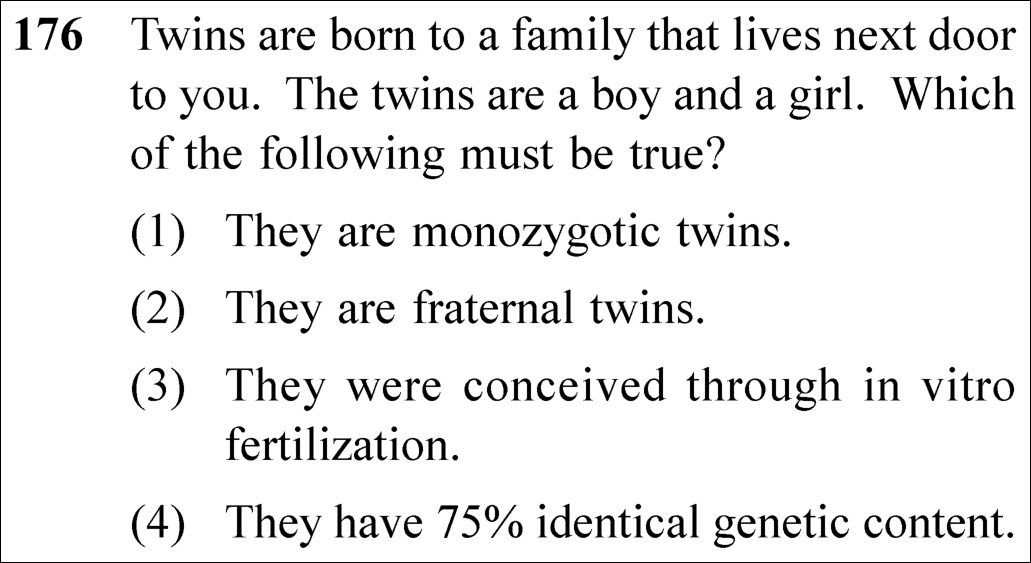
NEET 2025 · Q176 Easy
Official NEET 2025 Question 176 - Human Reproduction
1
2 ✓ Key
3
4
💡 Verified Solution & 30-Second Hack
✓
Verified Against NTA Final Answer Key
Option (2) : They are fraternal twins.
📚 Human Reproduction Easy
📋 Given Parameters & Problem Setup
Birth Event Twins born to neighboring family
Sex of Twins One boy (male, XY) and one girl (female, XX)
Target Deduction Statement that MUST be true
⚡

The 30-Second Exam Hall Shortcut: ⚡ Twin Genetics Fingerprint

⏱️ Save ~15 seconds

Identical (monozygotic) twins share 100% DNA and are ALWAYS the SAME SEX! Different sexes (boy + girl) can ONLY arise from two separate eggs fertilized by two separate sperms -> FRATERNAL (dizygotic) TWINS!

1 Analyze the genetic basis of monozygotic vs dizygotic twins:
2 - Monozygotic (identical) twins: Single ovum + single sperm -> 1 zygote -> splits into 2 embryos. Genotypes are 100% identical; therefore, they are always the same sex (both boys or both girls).
3 - Dizygotic (fraternal) twins: Two independent ova released simultaneously + fertilized by two different spermatozoa (one carrying Y chromosome, one carrying X chromosome) -> two independent zygotes.
4 - Because the twins are of opposite sex (a boy and a girl), they CANNOT be monozygotic.
5 - Therefore, they MUST be fraternal (dizygotic) twins!
6 Select Option (2) They are fraternal twins!
🛡️
Why You Can 100% Trust This Shortcut: Mendelian Inheritance & Sex Determination Mechanisms (NCERT Biology · Principles of Inheritance and Variation: XX-XY vs ZZ-ZW).
📐

Step-by-Step Rigorous Workflow & Mathematical Proof

Step 1

Embryological and Genetic Basis of Twinning

Multiple gestations in humans occur via two distinct physiological mechanisms:

  • • Monozygotic (Identical) Twins: Arise from the cleavage and separation of a single blastocyst derived from a single fertilization event (one sperm + one ovum). Because they inherit identical nuclear genomes, monozygotic twins are invariably concordant for chromosomal sex (strictly both XX or both XY).
  • • Dizygotic (Fraternal) Twins: Arise when two separate primary follicles mature and ovulate simultaneously (polyovulation). Each ovum is fertilized by an independent sperm cell, producing two genetically distinct zygotes.
Step 2

Deduction from the Given Phenotype (Boy and Girl)

Analyzing the sex chromosomes of the newborn twins:

  • • The boy twin possesses an XYXY chromosomal constitution (formed by union of an XX-bearing ovum and a YY-bearing sperm).
  • • The girl twin possesses an XXXX chromosomal constitution (formed by union of an XX-bearing ovum and an XX-bearing sperm).
  • • Because they have different sex chromosome karyotypes, they could not have arisen from the cleavage of a single zygote.
  • • They must have developed from two distinct zygotes produced by two separate fertilization events. Thus, they are fraternal twins.
Step 3

Evaluation of Other Distractors

Why the remaining options are incorrect:

  • • Option (1): They are monozygotic twins -> Impossible for opposite-sex twins.
  • • Option (3): Conceived through IVF -> Fraternal twins occur frequently through natural polyovulation; IVF is not mandatory.
  • • Option (4): Have 75% identical genetic content -> Fraternal twins share, on average, 50% of their segregating genetic material, identical to ordinary siblings.
Step 4

Conclusion

The deduction that must be true is that they are fraternal twins, matching Option (2).

Boy (XY)+Girl (XX)  ⟹  Two Zygotes  ⟹  Fraternal (Dizygotic) Twins\text{Boy (XY)} + \text{Girl (XX)} \implies \text{Two Zygotes} \implies \text{Fraternal (Dizygotic) Twins}
⭐

360° Option Elimination Engine Key Feature

Diagnose every choice: Know exactly why the right option works and why distractors fail.

4-Option Deep Scan
1 A
✗ Incorrect
Verdict & Scientific Reason:

Incorrect. Monozygotic twins always share the exact same chromosomal sex.

⚠️
Student Fallacy (Why candidates pick this trap): Believing identical twins can be of different sexes.
2 B
✓ 100% Correct
Verdict & Scientific Reason:

100% correct. Opposite-sex twins must arise from two independent fertilization events (dizygotic/fraternal).

💡
Why this is airtight: None; pristine developmental genetic logic.
3 C
✗ Incorrect
Verdict & Scientific Reason:

Incorrect. Fraternal twins are naturally conceived in ~1 out of 80 human births without IVF.

⚠️
Student Fallacy (Why candidates pick this trap): Assuming multiple births only occur through assisted reproduction.
4 D
✗ Incorrect
Verdict & Scientific Reason:

Incorrect. Fraternal twins are genetic siblings sharing an average of 50% identical alleles, not 75%.

⚠️
Student Fallacy (Why candidates pick this trap): Miscalculating coefficient of kinship in dizygotic twins.
⚠️

NTA Trap Alert: Opposite Sex Twins Rule

Whenever you see a boy and a girl twin in a genetics question, rule out Monozygotic immediately! Identical twins MUST have identical sex (both XX or both XY).

🛡️ How to avoid the -1 mark: Boy + Girl twins = ALWAYS Fraternal / Dizygotic.
📖

Core NEET Syllabus Standard

NEET Biology Core Syllabus · Human Reproduction / Principles of Inheritance Standard Benchmark
Core Scientific Principle Tested:

"Twins of differing biological sexes (male and female) are necessarily dizygotic (fraternal) twins derived from two distinct fertilizations."

Syllabus Focus: Fertilization & Sex Determination in Humans
✓ Core NEET UG Syllabus Anchor Syllabus & Academic Standards ↗
Different Sex = Different Zygotes (Fraternal Twins)!
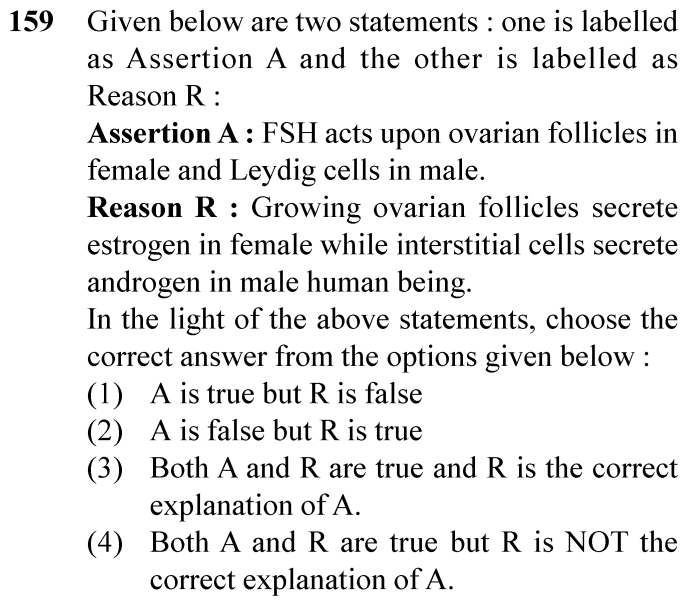
NEET 2024 · Q159 Medium
Official NEET 2024 Question 159 - Human Reproduction
1 A is true but R is false
2 A is false but R is true ✓ Key
3 Both A and R are true and R is the correct explanation of A.
4 Both A and R are true but R is NOT the correct explanation of A.
💡 Verified Solution & 30-Second Hack
✓
Verified Against NTA Final Answer Key
Option (2) : A is false but R is true
📚 Human Reproduction Medium
📋 Given Parameters & Problem Setup
Assertion A FSH acts upon ovarian follicles in female and Leydig cells in male.
Reason R Growing ovarian follicles secrete estrogen in female while interstitial cells secrete androgen in male human being.
⚡

The 30-Second Exam Hall Shortcut: ⚡ Gonadotropin Male Target Trap

⏱️ Save ~25 seconds

LH acts on Leydig cells (L-L) to stimulate androgens! FSH acts on Sertoli cells in males (not Leydig cells!). Assertion A is completely FALSE! Reason R is TRUE!

1 Check Assertion A: In females, FSH stimulates follicular growth. But in males, LH (ICSH) acts on Leydig cells, while FSH acts on Sertoli cells! Assertion A is FALSE!
2 Check Reason R: Growing ovarian follicles secrete estrogen in females, and interstitial (Leydig) cells secrete androgens in males. Reason R is TRUE!
3 A is false but R is true -> Option (2) / B.
🛡️
Why You Can 100% Trust This Shortcut: NCERT Biology · Human Reproduction (Hormonal Control of Male and Female Reproductive Systems)
📐

Step-by-Step Rigorous Workflow & Mathematical Proof

Step 1

Evaluate Assertion A (Target Specificity of FSH and LH)

In males, Luteinizing Hormone (LH) acts at the Leydig cells (interstitial cells) and stimulates synthesis and secretion of androgens. Follicle Stimulating Hormone (FSH) acts on the Sertoli cells and stimulates secretion of some factors which help in the process of spermiogenesis. Claiming FSH acts upon Leydig cells is factually false. Thus, Assertion A is false.

Step 2

Evaluate Reason R (Endocrine Secretions)

Growing ovarian follicles actively synthesize and secrete estrogens in females under FSH stimulation. In males, the interstitial cells of Leydig secrete androgens (principally testosterone). Thus, Reason R is a true statement.

Step 3

Determine Answer Option

Assertion A is false but Reason R is true, matching Option (2).

⭐

360° Option Elimination Engine Key Feature

Diagnose every choice: Know exactly why the right option works and why distractors fail.

4-Option Deep Scan
1 (1)
✗ Incorrect
Verdict & Scientific Reason:

Assertion A is false and Reason R is true.

⚠️
Student Fallacy (Why candidates pick this trap): Assertion A is false and Reason R is true.
2 (2)
✓ 100% Correct
Verdict & Scientific Reason:

FSH acts on Sertoli cells (not Leydig cells) in males; follicular estrogen and Leydig androgen secretion are factually correct.

💡
Why this is airtight: None.
3 (3)
✗ Incorrect
Verdict & Scientific Reason:

Assertion A is false.

⚠️
Student Fallacy (Why candidates pick this trap): Assertion A is false.
4 (4)
✗ Incorrect
Verdict & Scientific Reason:

Assertion A is false.

⚠️
Student Fallacy (Why candidates pick this trap): Assertion A is false.
⚠️

NTA Trap Alert: LH vs FSH in Males

Assuming FSH controls all testicular cells or controls Leydig cells.

🛡️ How to avoid the -1 mark: Mnemonic: LH = Leydig cells (producing testosterone); FSH = Sertoli cells (nurturing spermiogenesis).
📖

Core NEET Syllabus Standard

Biology Core Zoology · Human Reproduction Standard Benchmark
Core Scientific Principle Tested:

"LH acts at the Leydig cells and stimulates synthesis and secretion of androgens... FSH acts on the Sertoli cells and stimulates secretion of some factors which help in the process of spermiogenesis."

Syllabus Focus: Differential Target Organs of Gonadotropins (LH and FSH)
✓ Core NEET UG Syllabus Anchor Syllabus & Academic Standards ↗
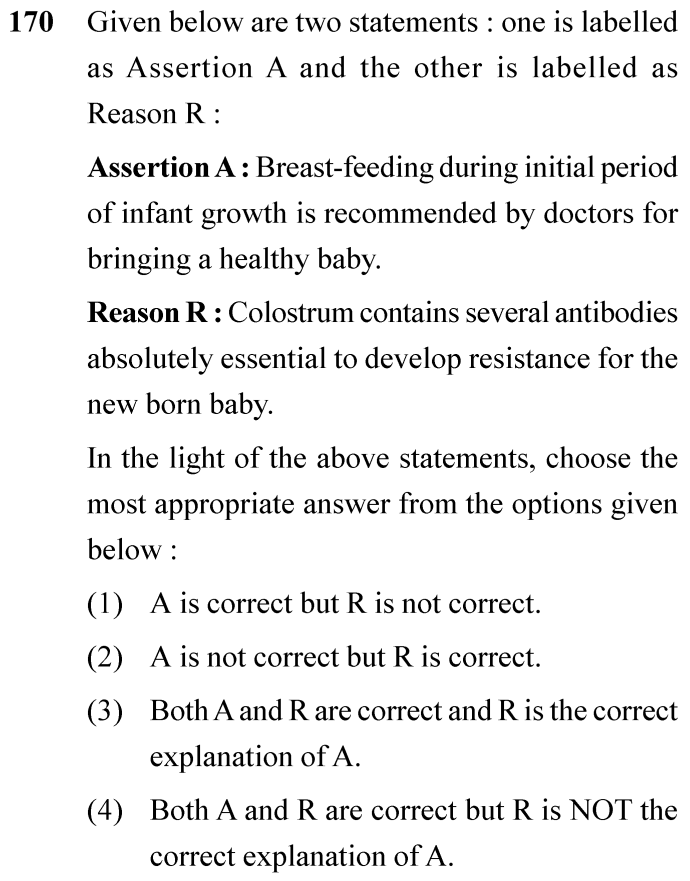
NEET 2024 · Q170 Easy
Official NEET 2024 Question 170 - Human Reproduction
1
2
3 ✓ Key
4
💡 Verified Solution & 30-Second Hack
✓
Verified Against NTA Final Answer Key
Option (3) : Both A and R are correct and R is the correct explanation of A.
📚 Human Reproduction Easy
📋 Given Parameters & Problem Setup
Assertion A Breast-feeding during initial period of infant growth is recommended by doctors for bringing a healthy baby.
Reason R Colostrum contains several antibodies absolutely essential to develop resistance for the new born baby.
⚡

The 30-Second Exam Hall Shortcut: ⚡ Colostrum and Passive Immunity Link

⏱️ Save ~20 seconds

Colostrum secreted during initial days of lactation is rich in IgA antibodies, conferring essential passive immunity to the infant. Both statements are true and Reason R perfectly explains Assertion A!

1 Assertion A: Doctors universally recommend breast-feeding during initial months for newborn health -> TRUE.
2 Reason R: The yellowish milk (colostrum) contains abundant secretory IgA antibodies essential to provide passive immunity and resistance to infections -> TRUE.
3 Does R explain A? Yes, the presence of protective maternal antibodies in colostrum is precisely why doctors recommend breast-feeding.
4 Select Option (3) / C.
🛡️
Why You Can 100% Trust This Shortcut: NCERT Biology · Human Reproduction (Parturition and Lactation)
📐

Step-by-Step Rigorous Workflow & Mathematical Proof

Step 1

Evaluate Assertion A (Pediatric Recommendation)

The mammary glands of the female undergo differentiation during pregnancy and start producing milk towards the end of pregnancy by the process called lactation. Breast-feeding during the initial period of infant growth is strongly recommended by physicians for bringing up a healthy baby. Assertion A is true.

Step 2

Evaluate Reason R (Immunological Basis of Colostrum)

The milk produced during the initial few days of lactation is called colostrum. It contains several antibodies (particularly secretory IgAIgA) absolutely essential to develop passive immunity and systemic resistance in the newborn baby whose immune system is still immature. Reason R is true.

Step 3

Establish Causal Explanation

The protective immunological defense conferred by colostrum antibodies is the exact physiological rationale why breast-feeding is recommended. Thus, Reason R is the correct explanation of Assertion A.

⭐

360° Option Elimination Engine Key Feature

Diagnose every choice: Know exactly why the right option works and why distractors fail.

4-Option Deep Scan
1 (1)
✗ Incorrect
Verdict & Scientific Reason:

Reason R is factually correct and scientifically validated.

⚠️
Student Fallacy (Why candidates pick this trap): Reason R is factually correct and scientifically validated.
2 (2)
✗ Incorrect
Verdict & Scientific Reason:

Assertion A is correct.

⚠️
Student Fallacy (Why candidates pick this trap): Assertion A is correct.
3 (3)
✓ 100% Correct
Verdict & Scientific Reason:

Both statements are true and Reason R provides the exact immunological justification for Assertion A.

💡
Why this is airtight: None.
4 (4)
✗ Incorrect
Verdict & Scientific Reason:

Reason R directly and causally explains Assertion A.

⚠️
Student Fallacy (Why candidates pick this trap): Reason R directly and causally explains Assertion A.
⚠️

NTA Trap Alert: IgA vs IgG Confusion

Confusing antibodies crossing placenta (IgG) with antibodies present in colostrum (IgA).

🛡️ How to avoid the -1 mark: Remember: IgG crosses placenta; IgA is secreted in colostrum/milk.
📖

Core NEET Syllabus Standard

Biology Core Zoology · Human Reproduction Standard Benchmark
Core Scientific Principle Tested:

"The milk produced during the initial few days of lactation is called colostrum which contains several antibodies absolutely essential to develop resistance for the new-born baby. Breast-feeding during the initial period of infant growth is recommended by doctors for bringing up a healthy baby."

Syllabus Focus: Colostrum Antibodies (IgA) and Infant Immune Protection
✓ Core NEET UG Syllabus Anchor Syllabus & Academic Standards ↗
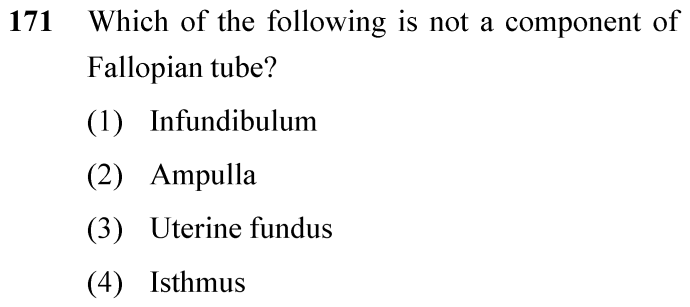
NEET 2024 · Q171 Easy
Official NEET 2024 Question 171 - Human Reproduction
1 Infundibulum
2 Ampulla
3 Uterine fundus ✓ Key
4 Isthmus
💡 Verified Solution & 30-Second Hack
✓
Verified Against NTA Final Answer Key
Option (3) : Uterine fundus
📚 Human Reproduction Easy
📋 Given Parameters & Problem Setup
Organ Fallopian tube (Oviduct)
Question Which of the following is NOT a component of Fallopian tube
⚡

The 30-Second Exam Hall Shortcut: ⚡ Oviduct Tripartite Structure

⏱️ Save ~15 seconds

The Fallopian tube consists of three parts: Infundibulum, Ampulla, and Isthmus! Uterine fundus is the dome-shaped upper part of the UTERUS, not the Fallopian tube!

1 Recall components of the Fallopian tube (10-12 cm long):
2 Infundibulum: Funnel-shaped part closer to ovary with fimbriae.
3 Ampulla: Wider middle portion where fertilization typically occurs.
4 Isthmus: Narrow terminal part connecting to uterus.
5 Uterine fundus is a distinct anatomical region of the uterus.
6 Select Option (3) / C.
🛡️
Why You Can 100% Trust This Shortcut: NCERT Biology · Human Reproduction (The Female Reproductive System)
📐

Step-by-Step Rigorous Workflow & Mathematical Proof

Step 1

Review Fallopian Tube Anatomy

Each fallopian tube (oviduct) is about 10-12 cm long and extends from the periphery of each ovary to the uterus. The part closer to the ovary is the funnel-shaped infundibulum. The edges of the infundibulum possess finger-like projections called fimbriae. The infundibulum leads to a wider part of the oviduct called ampulla. The last part of the oviduct, isthmus, has a narrow lumen and it joins the uterus.

Step 2

Identify Uterine Regions

The uterus is hollow, pear-shaped and consists of three anatomical regions: fundus (upper dome-shaped region), body/corpus (main central portion), and cervix (lower narrow canal opening into vagina).

Step 3

Conclude Non-Component

Uterine fundus belongs to the uterus, not the fallopian tube.

⭐

360° Option Elimination Engine Key Feature

Diagnose every choice: Know exactly why the right option works and why distractors fail.

4-Option Deep Scan
1 (1)
✗ Incorrect
Verdict & Scientific Reason:

Infundibulum is the proximal funnel-shaped segment of the fallopian tube.

⚠️
Student Fallacy (Why candidates pick this trap): Infundibulum is the proximal funnel-shaped segment of the fallopian tube.
2 (2)
✗ Incorrect
Verdict & Scientific Reason:

Ampulla is the wide middle segment of the fallopian tube.

⚠️
Student Fallacy (Why candidates pick this trap): Ampulla is the wide middle segment of the fallopian tube.
3 (3)
✓ 100% Correct
Verdict & Scientific Reason:

Uterine fundus is part of the uterus, not a component of the fallopian tube.

💡
Why this is airtight: None.
4 (4)
✗ Incorrect
Verdict & Scientific Reason:

Isthmus is the narrow distal segment of the fallopian tube joining the uterine cavity.

⚠️
Student Fallacy (Why candidates pick this trap): Isthmus is the narrow distal segment of the fallopian tube joining the uterine cavity.
⚠️

NTA Trap Alert: Isthmus Location Overlap

Thinking isthmus belongs only to the thyroid or uterus.

🛡️ How to avoid the -1 mark: The fallopian tube ends in the isthmus; uterine fundus is entirely separate.
📖

Core NEET Syllabus Standard

Biology Core Zoology · Human Reproduction Standard Benchmark
Core Scientific Principle Tested:

"Each fallopian tube is about 10-12 cm long... The part closer to the ovary is the funnel-shaped infundibulum... leads to a wider part called ampulla. The last part of the oviduct, isthmus has a narrow lumen and it joins the uterus."

Syllabus Focus: Anatomy of the Fallopian Tube (Oviduct) vs Uterus
✓ Core NEET UG Syllabus Anchor Syllabus & Academic Standards ↗
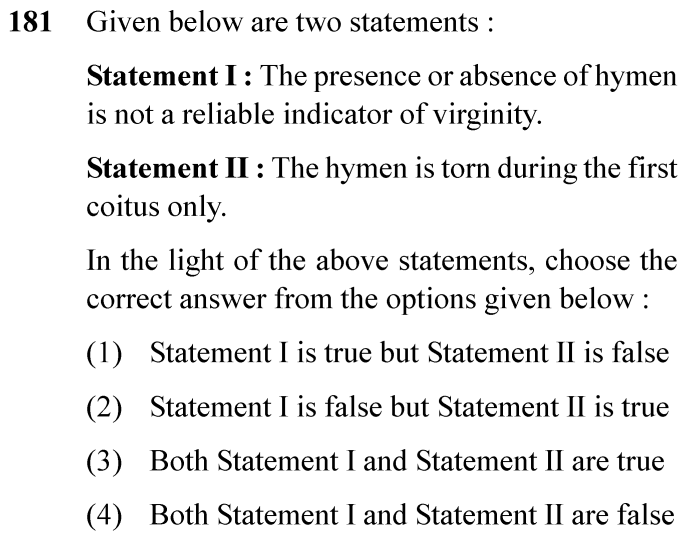
NEET 2024 · Q181 Easy
Official NEET 2024 Question 181 - Human Reproduction
1 Statement I is true but Statement II is false ✓ Key
2 Statement I is false but Statement II is true
3 Both Statement I and Statement II are true
4 Both Statement I and Statement II are false
💡 Verified Solution & 30-Second Hack
✓
Verified Against NTA Final Answer Key
Option (1) : Statement I is true but Statement II is false
📚 Human Reproduction Easy
📋 Given Parameters & Problem Setup
Statement I The presence or absence of hymen is not a reliable indicator of virginity.
Statement II The hymen is torn during the first coitus only.
⚡

The 30-Second Exam Hall Shortcut: ⚡ NCERT Social Biology Fact

⏱️ Save ~20 seconds

The hymen can be torn by sudden falls, cycling, horseback riding, or sports, and may persist even after coitus! Statement II is false; Statement I is true!

1 Evaluate Statement I: "The presence or absence of hymen is not a reliable indicator of virginity or sexual experience" -> NCERT verbatim TRUE.
2 Evaluate Statement II: "The hymen is torn during the first coitus only" -> FALSE! NCERT explicitly notes the hymen can be broken by active sports, horseback riding, insertion of tampons, or remain intact even after coitus.
3 Conclusion: Statement I is true but Statement II is false -> Option (1) / A.
🛡️
Why You Can 100% Trust This Shortcut: NCERT Biology · Human Reproduction (Female External Genitalia and Hymen)
📐

Step-by-Step Rigorous Workflow & Mathematical Proof

Step 1

Evaluate Statement I (Clinical Validity of Hymen)

NCERT states: "The presence or absence of hymen is not a reliable indicator of virginity or sexual experience." Statement I is true.

Step 2

Evaluate Statement II (Causes of Hymen Rupture)

The hymen is often torn during the first coitus (intercourse). However, it can also be broken by a sudden fall or jolt, insertion of a vaginal tampon, active participation in some sports like horseback riding, cycling, etc. In some women the hymen persists even after coitus. Therefore, asserting it is torn during the first coitus "only" is medically and factually incorrect. Statement II is false.

Step 3

Select Matching Option

Statement I is true but Statement II is false, matching Option (1).

⭐

360° Option Elimination Engine Key Feature

Diagnose every choice: Know exactly why the right option works and why distractors fail.

4-Option Deep Scan
1 (1)
✓ 100% Correct
Verdict & Scientific Reason:

Statement I correctly reflects medical science and NCERT text; Statement II falsely claims the hymen is torn only during coitus.

💡
Why this is airtight: None.
2 (2)
✗ Incorrect
Verdict & Scientific Reason:

Statement I is true and Statement II is false.

⚠️
Student Fallacy (Why candidates pick this trap): Statement I is true and Statement II is false.
3 (3)
✗ Incorrect
Verdict & Scientific Reason:

Statement II is false.

⚠️
Student Fallacy (Why candidates pick this trap): Statement II is false.
4 (4)
✗ Incorrect
Verdict & Scientific Reason:

Statement I is factually correct.

⚠️
Student Fallacy (Why candidates pick this trap): Statement I is factually correct.
⚠️

NTA Trap Alert: Word "Only" as a High-Alert Qualifier

Overlooking the restrictive word "only" in Statement II.

🛡️ How to avoid the -1 mark: Extreme qualifiers like "only", "always", and "never" frequently signal biological oversimplifications and false assertions.
📖

Core NEET Syllabus Standard

Biology Core Zoology · Human Reproduction Standard Benchmark
Core Scientific Principle Tested:

"The hymen is often torn during the first coitus... However, it can also be broken by a sudden fall or jolt, insertion of a vaginal tampon, active participation in sports like horse riding, cycling... In fact, the presence or absence of hymen is not a reliable indicator of virginity or sexual experience."

Syllabus Focus: Female External Genitalia: Biology and Misconceptions Regarding the Hymen
✓ Core NEET UG Syllabus Anchor Syllabus & Academic Standards ↗
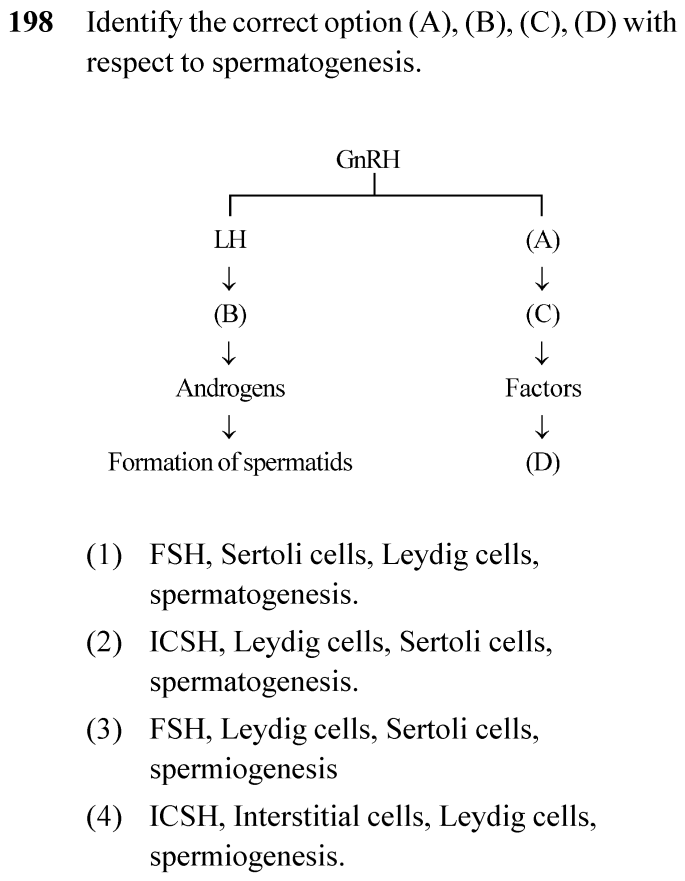
NEET 2024 · Q198 Medium
Official NEET 2024 Question 198 - Human Reproduction
1 FSH, Sertoli cells, Leydig cells, spermatogenesis.
2 ICSH, Leydig cells, Sertoli cells, spermatogenesis.
3 FSH, Leydig cells, Sertoli cells, spermiogenesis ✓ Key
4 ICSH, Interstitial cells, Leydig cells, spermiogenesis.
💡 Verified Solution & 30-Second Hack
✓
Verified Against NTA Final Answer Key
Option (3) : FSH, Leydig cells, Sertoli cells, spermiogenesis
📚 Human Reproduction Medium
📋 Given Parameters & Problem Setup
Flowchart Hormonal regulation of male spermatogenesis starting from GnRH
Labels to Identify (A), (B), (C), (D)
⚡

The 30-Second Exam Hall Shortcut: ⚡ Male Hormonal Axis Flowchart Lock

⏱️ Save ~30 seconds

GnRH -> LH + (A=FSH). LH -> (B=Leydig cells) -> Androgens. FSH -> (C=Sertoli cells) -> Factors -> (D=spermiogenesis)! Sequence: FSH, Leydig cells, Sertoli cells, spermiogenesis!

1 Analyse the branch under GnRH:
2 - Left branch: LH -> acts on Leydig cells (B) -> secretes Androgens -> spermatogenesis.
3 - Right branch: GnRH stimulates release of FSH (A).
4 - FSH acts on Sertoli cells (C) -> stimulates secretion of factors.
5 - These factors help in the maturation of spermatids into spermatozoa, which is SPERMIOGENESIS (D).
6 Matches: A = FSH, B = Leydig cells, C = Sertoli cells, D = spermiogenesis.
7 Select Option (3) / C.
🛡️
Why You Can 100% Trust This Shortcut: NCERT Biology · Human Reproduction (Hormonal Regulation of Spermatogenesis)
📐

Step-by-Step Rigorous Workflow & Mathematical Proof

Step 1

Review the Hypothalamic-Pituitary-Gonadal Axis in Males

Spermatogenesis starts at the age of puberty due to significant increase in the secretion of gonadotropin releasing hormone (GnRH). GnRH acts at the anterior pituitary gland and stimulates secretion of two gonadotropins: luteinizing hormone (LH) and follicle stimulating hormone (FSH, Label A).

Step 2

Trace LH and FSH Target Actions

LH acts at the Leydig cells (interstitial cells, Label B) and stimulates synthesis and secretion of androgens. Androgens, in turn, stimulate the process of spermatogenesis. FSH acts on the Sertoli cells (Label C) and stimulates secretion of some factors.

Step 3

Identify the Terminal Process (D)

The factors secreted by Sertoli cells under FSH influence are required specifically for the transformation of non-motile spermatids into functional spermatozoa, a process termed spermiogenesis (Label D).

⭐

360° Option Elimination Engine Key Feature

Diagnose every choice: Know exactly why the right option works and why distractors fail.

4-Option Deep Scan
1 (1)
✗ Incorrect
Verdict & Scientific Reason:

Inverts Leydig and Sertoli cells.

⚠️
Student Fallacy (Why candidates pick this trap): Inverts Leydig and Sertoli cells.
2 (2)
✗ Incorrect
Verdict & Scientific Reason:

ICSH is another name for LH; the other gonadotropin branch is FSH.

⚠️
Student Fallacy (Why candidates pick this trap): ICSH is another name for LH; the other gonadotropin branch is FSH.
3 (3)
✓ 100% Correct
Verdict & Scientific Reason:

Accurately identifies (A) FSH, (B) Leydig cells, (C) Sertoli cells, and (D) spermiogenesis.

💡
Why this is airtight: None.
4 (4)
✗ Incorrect
Verdict & Scientific Reason:

Incorrect gonadotropin and cell identification.

⚠️
Student Fallacy (Why candidates pick this trap): Incorrect gonadotropin and cell identification.
⚠️

NTA Trap Alert: Spermatogenesis vs Spermiogenesis

Selecting "spermatogenesis" instead of "spermiogenesis" for step D.

🛡️ How to avoid the -1 mark: NCERT states explicitly: "FSH acts on the Sertoli cells and stimulates secretion of some factors which help in the process of spermiogenesis."
📖

Core NEET Syllabus Standard

Biology Core Zoology · Human Reproduction Standard Benchmark
Core Scientific Principle Tested:

"GnRH stimulates secretion of two gonadotropins - LH and FSH. LH acts at the Leydig cells and stimulates synthesis of androgens... FSH acts on the Sertoli cells and stimulates secretion of some factors which help in the process of spermiogenesis."

Syllabus Focus: Hormonal Control Cascade of Spermatogenesis and Spermiogenesis
✓ Core NEET UG Syllabus Anchor Syllabus & Academic Standards ↗
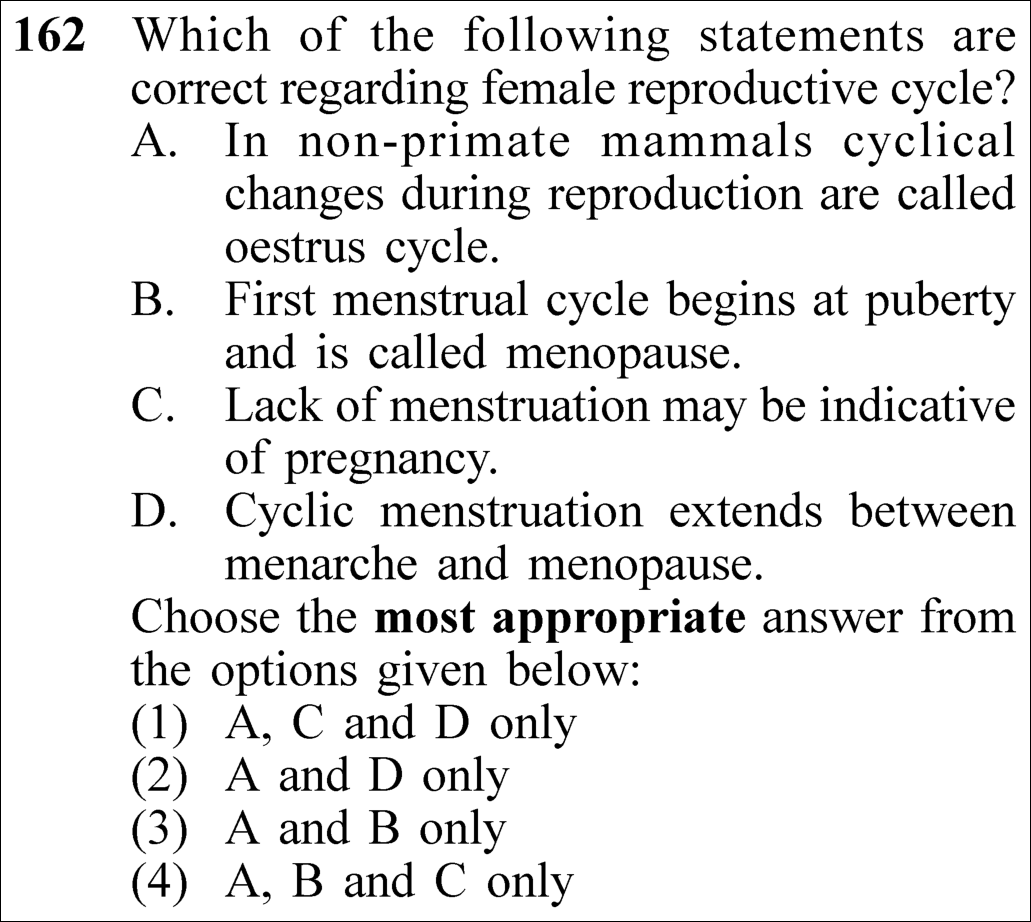
NEET 2023 · Q162 Easy
Official NEET 2023 Question 162 - Human Reproduction
1 A, C and D only ✓ Key
2 A and D only
3 A and B only
4 A, B and C only
💡 Verified Solution & 30-Second Hack
✓
Verified Against NTA Final Answer Key
Option (1) : A, C and D only
📚 Human Reproduction Easy
📋 Given Parameters & Problem Setup
Statements 4 statements (A-D) on oestrus cycle, menarche, menopause, and menstruation
⚡

The 30-Second Exam Hall Shortcut: ⚡ Menopause vs. Menarche Error Spotter: B is False!

⏱️ Save ~25 seconds

Spot the single false statement: The first menstrual cycle at puberty is called MENARCHE, NOT menopause (menopause is the permanent cessation around 50 years of age). Thus Statement B is completely false, leaving A, C, and D only! Select Option (1)!

1 Statement A: In non-primates cyclical reproductive changes are called oestrus cycle -> True.
2 Statement B: First menstrual cycle at puberty is called menopause -> False (It is called menarche).
3 Statement C: Lack of menstruation may be indicative of pregnancy -> True.
4 Statement D: Cyclic menstruation extends between menarche and menopause -> True.
5 Since only B is false, A, C and D only are correct -> Option (1).
🛡️
Why You Can 100% Trust This Shortcut: Canonical NCERT Human Reproduction ovarian and uterine cycle definitions.
📐

Step-by-Step Rigorous Workflow & Mathematical Proof

Step 1

Evaluation of Statement A (Oestrus Cycle)

Cyclical reproductive changes in placental mammals are categorized into two major patterns based on taxonomic orders: - In non-primate mammals (cows, sheep, rats, deers, dogs, tiger): oestrus cycle. - In primates (monkeys, apes, humans): menstrual cycle. Statement A is TRUE.

Non-primate Mammalian Cycle≡Oestrus Cycle  ⟹  Statement A is TRUE\text{Non-primate Mammalian Cycle} \equiv \text{\textbf{Oestrus Cycle}} \implies \text{Statement A is } \mathbf{\text{TRUE}}
Step 2

Evaluation of Statement B (Menarche vs. Menopause)

The onset of menstruation at puberty in human females is termed menarche, whereas the permanent cessation of reproductive cycling around age 50 is termed menopause: Statement B claims the first menstrual cycle is called menopause, which is blatantly FALSE.

Onset at Puberty=Menarche≠Menopause (Cessation)  ⟹  Statement B is FALSE\text{Onset at Puberty} = \mathbf{\text{Menarche}} \quad \neq \quad \text{Menopause (Cessation)} \implies \text{Statement B is } \mathbf{\text{FALSE}}
Step 3

Evaluation of Statements C and D (Menstrual Regularity and Span)

NCERT states verbatim: - "Lack of menstruation may be indicative of pregnancy." (Statement C is TRUE) - "Cyclic menstruation is an indicator of normal reproductive phase and extends between menarche and menopause." (Statement D is TRUE) Therefore, Statements A, C, and D are correct.

⭐

360° Option Elimination Engine Key Feature

Diagnose every choice: Know exactly why the right option works and why distractors fail.

4-Option Deep Scan
1 1
✓ 100% Correct
Verdict & Scientific Reason:

Statements A, C, and D are fully verified textbook facts, while Statement B contains the erroneous substitution of menopause for menarche.

💡
Why this is airtight: None; textbook verbatim precision.
2 2
✗ Incorrect
Verdict & Scientific Reason:

Omits valid statement C (lack of menstruation is a classic presumptive sign of pregnancy).

⚠️
Student Fallacy (Why candidates pick this trap): Thinking lack of menstruation cannot be cited due to stress/poor health exceptions.
3 3
✗ Incorrect
Verdict & Scientific Reason:

Includes false statement B.

⚠️
Student Fallacy (Why candidates pick this trap): Confusing menarche with menopause.
4 4
✗ Incorrect
Verdict & Scientific Reason:

Includes false statement B and excludes valid statement D.

⚠️
Student Fallacy (Why candidates pick this trap): Overlooking the definition error in B.
⚠️

NTA Trap Alert: Menarche vs. Menopause Vocabulary Trap

Menarche is the beginning (puberty), while Menopause is the end (pause of menstruation). Fast readers glance at the prefix "Meno-" and assume Statement B is valid.

🛡️ How to avoid the -1 mark: Remember: "Arche" = Beginning (Menarche at puberty). "Pause" = Stop (Menopause at ~50 yrs).
📖

Core NEET Syllabus Standard

NCERT Biology · Human Reproduction Standard Benchmark
Core Scientific Principle Tested:

"The first menstruation begins at puberty and is called menarche. Menstrual cycles cease around 50 years of age, termed menopause. Cyclic menstruation extends between menarche and menopause."

Syllabus Focus: Menstrual Cycle
✓ Core NEET UG Syllabus Anchor Syllabus & Academic Standards ↗
NEET 2023 · Q166 Easy
Official NEET 2023 Question 166 - Human Reproduction
1 Statement I incorrect but Statement II is true.
2 Both Statement I and Statement II are true. ✓ Key
3 Both Statement I and Statement II are false.
4 Statement I is correct but Statement II is false.
💡 Verified Solution & 30-Second Hack
✓
Verified Against NTA Final Answer Key
Option (2) : Both Statement I and Statement II are true.
📚 Human Reproduction Easy
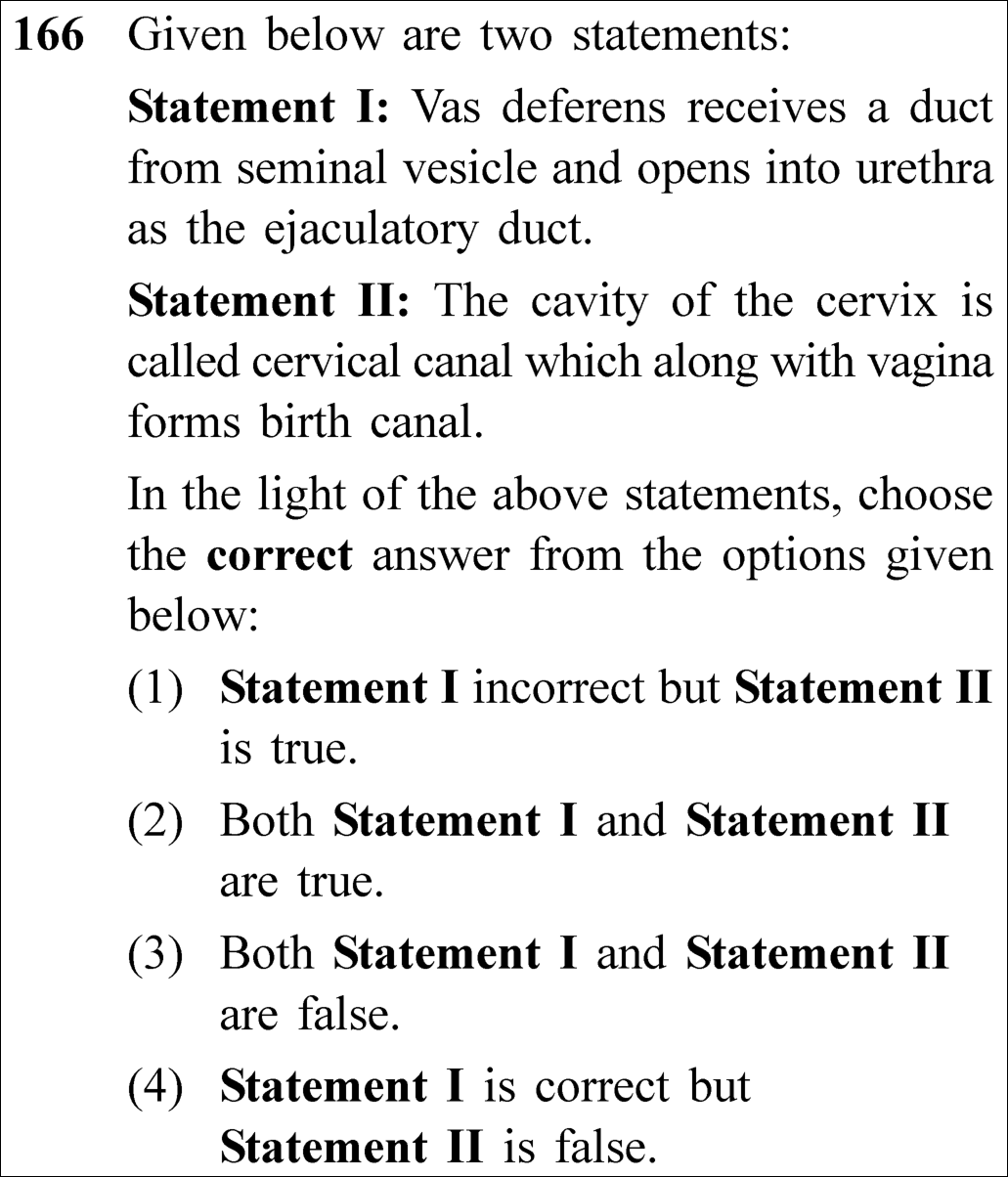
📋 Given Parameters & Problem Setup
Statement I Vas deferens receives duct from seminal vesicle and opens into urethra as ejaculatory duct.
Statement II Cervical canal along with vagina forms birth canal.
⚡

The 30-Second Exam Hall Shortcut: ⚡ Reproductive Duct System Dual Check

⏱️ Save ~20 seconds

Both statements are verbatim sentences from NCERT Human Reproduction! Vas deferens + seminal vesicle duct = ejaculatory duct; Cervical canal + vagina = birth canal. Both are true!

1 Check Statement I: Vas deferens joins seminal vesicle duct to form the ejaculatory duct entering the prostatic urethra -> True.
2 Check Statement II: Cervical canal plus vagina forms the parturient birth canal -> True.
3 Both Statement I and Statement II are true.
4 Match Option (2).
🛡️
Why You Can 100% Trust This Shortcut: Canonical NCERT Human Reproduction male and female genital duct anatomy.
📐

Step-by-Step Rigorous Workflow & Mathematical Proof

Step 1

Evaluation of Statement I (Male Ejaculatory Duct Formation)

The vas deferens ascends from the scrotum, enters the pelvic cavity through the inguinal canal, loops over the urinary bladder, and unites with the duct of the seminal vesicle to form the common ejaculatory duct:

Vas deferens+Seminal vesicle duct⟶Ejaculatory duct (opens into prostatic urethra)\text{Vas deferens} + \text{Seminal vesicle duct} \longrightarrow \mathbf{\text{Ejaculatory duct (opens into prostatic urethra)}}
Step 2

Evaluation of Statement II (Parturition Birth Canal)

In the human female reproductive tract, the narrow spindle-shaped lumen traversing the cervix connects the uterine body to the vagina:

Birth Canal=Cervical Canal+Vagina\mathbf{\text{Birth Canal}} = \text{Cervical Canal} + \text{Vagina}
Step 3

Verbatim NCERT Reference

NCERT states verbatim: - "It [vas deferens] receives a duct from seminal vesicle and opens into urethra as the ejaculatory duct." (Statement I is TRUE) - "The cavity of the cervix is called cervical canal which along with vagina forms the birth canal." (Statement II is TRUE)

⭐

360° Option Elimination Engine Key Feature

Diagnose every choice: Know exactly why the right option works and why distractors fail.

4-Option Deep Scan
1 1
✗ Incorrect
Verdict & Scientific Reason:

Statement I is factually correct regarding male genital duct anatomy.

⚠️
Student Fallacy (Why candidates pick this trap): Doubting whether the ejaculatory duct traverses the prostate to enter the urethra.
2 2
✓ 100% Correct
Verdict & Scientific Reason:

Both statements are verbatim excerpts from NCERT Human Reproduction.

💡
Why this is airtight: None; textbook verbatim precision.
3 3
✗ Incorrect
Verdict & Scientific Reason:

Both statements are indisputable anatomical truths.

⚠️
Student Fallacy (Why candidates pick this trap): Unwarranted skepticism.
4 4
✗ Incorrect
Verdict & Scientific Reason:

Statement II is factually correct: cervical canal and vagina together constitute the birth canal.

⚠️
Student Fallacy (Why candidates pick this trap): Thinking the uterus itself is part of the birth canal proper.
⚠️

NTA Trap Alert: Uterus vs. Cervix in Birth Canal Composition

Students frequently assume the entire uterus plus vagina forms the birth canal. Anatomically, only the dilated cervical canal and vagina constitute the birth canal through which the fetus is expelled.

🛡️ How to avoid the -1 mark: Remember formula: Birth Canal = Cervical Canal + Vagina.
📖

Core NEET Syllabus Standard

NCERT Biology · Human Reproduction Standard Benchmark
Core Scientific Principle Tested:

"Vas deferens receives duct from seminal vesicle forming the ejaculatory duct; Cervical canal along with vagina forms the birth canal."

Syllabus Focus: The Male and Female Reproductive Systems
✓ Core NEET UG Syllabus Anchor Syllabus & Academic Standards ↗
NEET 2023 · Q168 Medium
Official NEET 2023 Question 168 - Human Reproduction
1 A is false but R is true.
2 Both A and R are true and R is the correct explanation of A.
3 Both A and R are true but R is NOT the correct explanation of A. ✓ Key
4 A is true but R is false.
💡 Verified Solution & 30-Second Hack
✓
Verified Against NTA Final Answer Key
Option (3) : Both A and R are true but R is NOT the correct explanation of A.
📚 Human Reproduction Medium
📋 Given Parameters & Problem Setup
Assertion (A) Endometrium is necessary for implantation of blastocyst.
Reason (R) In absence of fertilization, corpus luteum degenerates that causes disintegration of endometrium.
⚡

The 30-Second Exam Hall Shortcut: ⚡ Implantation Requirement vs. Menstruation Disintegration Trap

⏱️ Save ~25 seconds

Assertion is TRUE (endometrium provides the vascular bed for blastocyst implantation). Reason is TRUE (corpus luteum degeneration in unfertilized cycles causes endometrial sloughing). But Reason describes the failure/absence of pregnancy; it does NOT explain why endometrium is necessary for implantation! Select Option (3)!

1 Assertion: Endometrium is essential for blastocyst implantation and pregnancy -> True.
2 Reason: Lack of fertilization causes luteolysis, dropping progesterone and sloughing the endometrium -> True.
3 Test explanation: Does the sloughing of endometrium in non-pregnant cycles explain WHY the endometrium is required for implantation in pregnant cycles? No, it explains menstruation!
4 Select Option (3) Both A and R are true but R is NOT the correct explanation of A.
🛡️
Why You Can 100% Trust This Shortcut: Canonical NCERT Human Reproduction ovarian-uterine synchronization logic.
📐

Step-by-Step Rigorous Workflow & Mathematical Proof

Step 1

Evaluation of Assertion A (Implantation Biology)

Following fertilization and cleavage in the fallopian tube, the blastocyst reaches the uterine cavity. The trophoblast layer attaches to the glandular, highly vascularized uterine endometrium, embedding the embryo in the process known as implantation:

Blastocyst (Trophoblast)→ImplantationEndometrium  ⟹  Assertion A is TRUE\text{Blastocyst (Trophoblast)} \xrightarrow{\text{Implantation}} \text{Endometrium} \implies \text{Assertion A is } \mathbf{\text{TRUE}}
Step 2

Evaluation of Reason R (Luteolysis and Menstruation)

In an unfertilized ovarian cycle, declining LH levels lead to the regression of the corpus luteum into a fibrotic scar (corpus albicans). The subsequent collapse of circulating progesterone withdraws hormonal support, causing spiral arteriolar spasm, necrosis, and menstrual disintegration of the stratum functionale:

No Fertilisation  ⟹  Luteolysis   ⟹  Progesterone ↓  ⟹  Endometrium Disintegration  ⟹  Reason R is TRUE\text{No Fertilisation} \implies \text{Luteolysis } \implies \text{Progesterone } \downarrow \implies \text{Endometrium Disintegration} \implies \text{Reason R is } \mathbf{\text{TRUE}}
Step 3

Causal Linkage Evaluation

Assertion states that the endometrium is necessary for implantation. The biological explanation for this is that the endometrium provides the rich vascular supply, decidual reaction, and placental anchorage required to sustain fetal development. Reason explains why menstruation occurs in the *absence* of pregnancy. Thus, R does NOT explain A.

⭐

360° Option Elimination Engine Key Feature

Diagnose every choice: Know exactly why the right option works and why distractors fail.

4-Option Deep Scan
1 1
✗ Incorrect
Verdict & Scientific Reason:

Assertion is factually true: implantation cannot occur without a receptive endometrium.

⚠️
Student Fallacy (Why candidates pick this trap): Doubting whether endometrium is necessary for implantation.
2 2
✗ Incorrect
Verdict & Scientific Reason:

Reason does not provide the causal physiological basis for Assertion.

⚠️
Student Fallacy (Why candidates pick this trap): Assuming any two true statements related to the endometrium must explain each other.
3 3
✓ 100% Correct
Verdict & Scientific Reason:

Both statements are accurate NCERT physiological facts, but Reason describes menstrual shedding rather than the implantation mechanism.

💡
Why this is airtight: None; rigorous causal discrimination.
4 4
✗ Incorrect
Verdict & Scientific Reason:

Reason is factually true: luteolysis directly triggers endometrial disintegration.

⚠️
Student Fallacy (Why candidates pick this trap): Doubting the role of corpus luteum in maintaining the endometrium.
⚠️

NTA Trap Alert: Topic Association vs. True Causality Trap

Both Assertion and Reason mention "endometrium", so students assume Reason automatically explains Assertion. One describes pregnancy (implantation), while the other describes failure of pregnancy (menstruation).

🛡️ How to avoid the -1 mark: Ask: "Does Reason explain WHY Assertion happens?" Here, luteolysis does not explain why an embryo needs the endometrium.
📖

Core NEET Syllabus Standard

NCERT Biology · Human Reproduction Standard Benchmark
Core Scientific Principle Tested:

"The endometrium is necessary for implantation of the blastocyst and other events of pregnancy. In absence of fertilisation, corpus luteum degenerates causing disintegration of endometrium."

Syllabus Focus: Implantation & Menstrual Cycle
✓ Core NEET UG Syllabus Anchor Syllabus & Academic Standards ↗
NEET 2021 · Q163 Easy
Official NEET 2021 Question 163 - Human Reproduction
1 Corona radiata
2 Vitelline membrane
3 Perivitelline space
4 Zona pellucida ✓ Key
💡 Verified Solution & 30-Second Hack
✓
Verified Against NTA Final Answer Key
Option (4) : Zona pellucida
📚 Human Reproduction Easy
📋 Given Parameters & Problem Setup
Event Sperm binding during mammalian fertilization
Candidate Egg Layers/Spaces (1) Corona radiata, (2) Vitelline membrane, (3) Perivitelline space, (4) Zona pellucida
⚡

The 30-Second Exam Hall Shortcut: ⚡ "Sperm Receptors (ZP3) Live in the Zona Pellucida"

⏱️ Save ~20 seconds

During mammalian fertilization, capacitated sperm binds specifically to species-specific glycoprotein receptors (ZP3) on the Zona Pellucida. This binding induces the acrosome reaction and blocks polyspermy! Match Option (4) in 5 seconds!

1 Recall the primary mammalian egg envelopes from outer to inner: Corona radiata → Zona pellucida → Perivitelline space → Vitelline membrane (oolemma).
2 The acrosome reaction and initial species-specific receptor-ligand docking occurs on the Zona pellucida (ZP3 glycoprotein).
3 Select Option (4).
🛡️
Why You Can 100% Trust This Shortcut: NCERT Biology · Human Reproduction (Fertilization: sperm comes in contact with the zona pellucida layer of the ovum and induces changes in the membrane that block the entry of additional sperms).
📐

Step-by-Step Rigorous Workflow & Mathematical Proof

Step 1

Anatomy of the Human Ovum at Fertilization

At the time of ovulation and subsequent fertilization in the ampulla of the fallopian tube, the secondary oocyte is surrounded by three structural barriers: 1. Corona radiata: An outer cellular coat composed of follicular granulosa cells cemented by hyaluronic acid. 2. Zona pellucida: A thick, non-cellular, transparent glycoprotein coat secreted by the oocyte and surrounding follicle cells. 3. Perivitelline space: Fluid-filled space separating the zona pellucida from the underlying vitelline membrane (plasma membrane/oolemma).

Egg Envelopes (Outside-in):Corona Radiata⟶Zona Pellucida (Sperm Receptors)⟶Perivitelline Space⟶Oolemma\text{Egg Envelopes (Outside-in)}: \text{Corona Radiata} \longrightarrow \mathbf{Zona\ Pellucida\ (Sperm\ Receptors)} \longrightarrow \text{Perivitelline Space} \longrightarrow \text{Oolemma}
Step 2

Molecular Sperm Binding Mechanism

The zona pellucida is composed of four primary glycoproteins: ZP1, ZP2, ZP3, and ZP4. ZP3 functions as the primary sperm receptor: - Proteins on the sperm head plasma membrane specifically bind ZP3. - This binding triggers an influx of Ca2+Ca^{2+} into the sperm, initiating the acrosome reaction. - Hydrolytic enzymes (acrosin, hyaluronidase) digest a path through the zona pellucida. - Upon entry of the first sperm, cortical granules release enzymes into the perivitelline space that alter the zona pellucida (zona reaction or cortical reaction), destroying remaining ZP3 receptors to permanently block polyspermy.

⭐

360° Option Elimination Engine Key Feature

Diagnose every choice: Know exactly why the right option works and why distractors fail.

4-Option Deep Scan
1 1
✗ Incorrect
Verdict & Scientific Reason:

Incorrect. The corona radiata is dispersed enzymatically by sperm hyaluronidase; it does not contain specific sperm docking receptors.

⚠️
Student Fallacy (Why candidates pick this trap): Believing the outermost cellular layer must hold the specific receptors.
2 2
✗ Incorrect
Verdict & Scientific Reason:

Incorrect. The vitelline membrane (oolemma) fuses with the sperm membrane only after the sperm has already bound and penetrated the zona pellucida.

⚠️
Student Fallacy (Why candidates pick this trap): Confusing primary sperm binding with subsequent membrane fusion.
3 3
✗ Incorrect
Verdict & Scientific Reason:

Incorrect. The perivitelline space is a fluid-filled cavity, not a membrane receptor surface.

⚠️
Student Fallacy (Why candidates pick this trap): Equating the cavity into which the polar body is extruded with the receptor surface.
4 4
✓ 100% Correct
Verdict & Scientific Reason:

Correct. The zona pellucida contains the definitive ZP3 glycoprotein receptors responsible for species-specific sperm binding and induction of the acrosome reaction.

💡
Why this is airtight: None. Directly verified NCERT fact.
⚠️

NTA Trap Alert: Corona Radiata vs Zona Pellucida Barrier Trap

Students frequently assume sperm binds first to the corona radiata because it is encountered first. However, the sperm merely pushes through corona radiata cells via hyaluronidase, and true molecular receptor binding occurs on the zona pellucida.

🛡️ How to avoid the -1 mark: Remember: Zona pellucida = ZP3 receptors = acrosome reaction + polyspermy block.
📖

Core NEET Syllabus Standard

NEET / NCERT Biology · Human Reproduction Standard Benchmark
Core Scientific Principle Tested:

"Sperm binding to glycoprotein receptors on the zona pellucida induces the acrosome reaction and prevents entry of multiple sperms."

Syllabus Focus: Fertilization and Polyspermy Block
✓ Core NEET UG Syllabus Anchor Syllabus & Academic Standards ↗
NEET 2021 · Q189 Medium
Official NEET 2021 Question 189 - Human Reproduction
1 Increase in estrogen and progesterone ratio
2 Synthesis of prostaglandins
3 Release of Oxytocin
4 Release of Prolactin ✓ Key
💡 Verified Solution & 30-Second Hack
✓
Verified Against NTA Final Answer Key
Option (4) : Release of Prolactin
📚 Human Reproduction Medium
📋 Given Parameters & Problem Setup
Physiological Process Initiation of Parturition (Childbirth / Labor)
Question Objective Identify the factor that is NOT an important component of parturition initiation
⚡

The 30-Second Exam Hall Shortcut: ⚡ "Prolactin is for LACTATION (Milk Synthesis), NOT Parturition (Labor)!"

⏱️ Save ~25 seconds

Parturition (labor) is triggered by the foetal ejection reflex, oxytocin, prostaglandins, and an increased estrogen/progesterone ratio. Prolactin acts AFTER delivery to stimulate milk synthesis by mammary alveoli for lactation. Prolactin plays NO role in initiating parturition! Select Option (4).

1 Separate childbirth (parturition) from nursing (lactation).
2 Parturition triggers: Oxytocin (uterine contractions), Prostaglandins (myometrial contraction & cervical softening), Estrogen/Progesterone ratio shift (upregulates oxytocin receptors).
3 Prolactin function: Synthesizes milk in mammary glands AFTER delivery (lactation).
4 Option (4) is not a component of initiating parturition.
🛡️
Why You Can 100% Trust This Shortcut: NCERT Biology · Human Reproduction (Parturition and Lactation: Parturition is induced by a complex neuroendocrine mechanism involving oxytocin, prostaglandins, and maternal hormones. Mammary glands produce milk towards the end of pregnancy by the process called lactation, mediated by prolactin).
📐

Step-by-Step Rigorous Workflow & Mathematical Proof

Step 1

Neuroendocrine Induction of Human Parturition

Parturition (the process of delivering the foetus through labor) is governed by an integrated neuroendocrine mechanism known as the foetal ejection reflex: - Signals for parturition originate from the fully developed foetus and placenta, inducing mild uterine contractions. - (1) Estrogen-to-Progesterone Ratio: In late pregnancy, placental estrogen synthesis rises while local progesterone dominance declines. This high estrogen/progesterone ratio upregulates oxytocin receptors on myometrial smooth muscle cells and promotes gap junction formation between myocytes. - (3) Oxytocin Release: Maternal posterior pituitary secretes oxytocin, which acts directly on the myometrium to cause vigorous contractions. - (2) Prostaglandin Synthesis: Uterine decidua and fetal membranes synthesize prostaglandins (PGF2αPGF_{2\alpha} and PGE2PGE_2), which further amplify uterine contractions and soften/dilate the cervix in a positive feedback loop (Ferguson reflex).

Step 2

Physiological Action of Prolactin

Prolactin (PRL) is an anterior pituitary peptide hormone that stimulates the differentiation of mammary alveolar epithelium and drives milk synthesis during the puerperium (lactation). During pregnancy, high circulating levels of placental steroids (estrogen and progesterone) block the lactogenic action of prolactin on the breasts. Following parturition and placental expulsion, steroid levels plummet, disinhibiting prolactin to initiate copious milk production. Prolactin has zero stimulatory effect on myometrial contraction or labor initiation.

⭐

360° Option Elimination Engine Key Feature

Diagnose every choice: Know exactly why the right option works and why distractors fail.

4-Option Deep Scan
1 1
✗ Incorrect
Verdict & Scientific Reason:

Incorrect. An increased estrogen-to-progesterone ratio is critical for increasing uterine excitability and oxytocin receptor expression.

⚠️
Student Fallacy (Why candidates pick this trap): Believing progesterone remains dominant during labor, unaware that functional progesterone withdrawal initiates labor.
2 2
✗ Incorrect
Verdict & Scientific Reason:

Incorrect. Prostaglandins are potent myometrial contractors and cervical ripeners directly involved in parturition.

⚠️
Student Fallacy (Why candidates pick this trap): Failing to realize that prostaglandins act synergistically with oxytocin.
3 3
✗ Incorrect
Verdict & Scientific Reason:

Incorrect. Oxytocin is the primary hormone driving strong labor contractions (foetal ejection reflex).

⚠️
Student Fallacy (Why candidates pick this trap): Denying the central role of the classic "birth hormone".
4 4
✓ 100% Correct
Verdict & Scientific Reason:

Correct as the non-component. Prolactin regulates milk synthesis (lactation), playing no role in the initiation of uterine labor contractions.

💡
Why this is airtight: None. Candidate distinguishes labor hormones from milk production hormones.
⚠️

NTA Trap Alert: Oxytocin (Birth & Ejection) vs Prolactin (Synthesis) Trap

Students frequently mix up oxytocin and prolactin. Oxytocin acts in BOTH parturition (labor contractions) and lactation (milk ejection / let-down). Prolactin acts ONLY in lactation (milk synthesis), never in parturition.

🛡️ How to avoid the -1 mark: Remember: Oxytocin pushes the baby OUT; Prolactin makes milk inside mammary glands.
📖

Core NEET Syllabus Standard

NEET / NCERT Biology · Human Reproduction Standard Benchmark
Core Scientific Principle Tested:

"Parturition is triggered by oxytocin, prostaglandins, and estrogen/progesterone shifts; prolactin regulates milk synthesis during lactation."

Syllabus Focus: Parturition and Lactation
✓ Core NEET UG Syllabus Anchor Syllabus & Academic Standards ↗
NEET 2021 · Q193 Medium
Official NEET 2021 Question 193 - Human Reproduction
1 Graafian follicle
2 Corpus luteum ✓ Key
3 Foetus
4 Uterus
💡 Verified Solution & 30-Second Hack
✓
Verified Against NTA Final Answer Key
Option (2) : Corpus luteum
📚 Human Reproduction Medium
📋 Given Parameters & Problem Setup
Hormone Relaxin
Time Window Later phase of pregnancy (Gestation)
Question Objective Identify the maternal endocrine tissue secreting relaxin
⚡

The 30-Second Exam Hall Shortcut: ⚡ "Corpus Luteum of the Ovary Secretes Relaxin in Late Pregnancy!"

⏱️ Save ~20 seconds

NCERT states verbatim: "In the later phase of pregnancy, a hormone called relaxin is also secreted by the ovary." Within the maternal ovary, the persistent endocrine glandular tissue responsible for relaxin secretion is the Corpus Luteum of pregnancy! Mark Option (2) in under 15 seconds.

1 Recall NCERT statement on pregnancy hormones: "In the later phase of pregnancy, a hormone called relaxin is also secreted by the ovary."
2 Identify the active ovarian endocrine structure during pregnancy: The Corpus Luteum (persisting through gestation).
3 Contrast with other tissues: Graafian follicle ovulates in early non-pregnant cycle; Uterus and Foetus do not secrete relaxin.
4 Match with Option (2).
🛡️
Why You Can 100% Trust This Shortcut: NCERT Biology · Human Reproduction (Pregnancy and Embryonic Development: In the later phase of pregnancy, a hormone called relaxin is also secreted by the ovary. Relaxin is produced by the corpus luteum of the ovary to soften pelvic ligaments).
📐

Step-by-Step Rigorous Workflow & Mathematical Proof

Step 1

Endocrine Milieu of Human Pregnancy and Relaxin Function

During human pregnancy, the placenta acts as a temporary endocrine gland producing hormones essential for fetal maintenance: human chorionic gonadotropin (hCG), human placental lactogen (hPL), estrogens, and progesterone. - In the later phase of pregnancy, a peptide hormone called relaxin is secreted by the maternal ovary, specifically by the corpus luteum (and in minor amounts by the placenta/decidua). - Physiological Action: Relaxin loosens and relaxes the fibrous pubic symphysis (interpubic fibrocartilage) and softens the cervix, expanding the pelvic outlet to facilitate unimpeded passage of the foetus during parturition.

Step 2

Evaluation of Non-Secreting Alternatives

- Graafian follicle: Matures during the follicular phase of the non-pregnant menstrual cycle and ruptures at ovulation; it does not exist in late pregnancy. - Foetus: Does not secrete maternal relaxin to prepare maternal pelvic ligaments. - Uterus (Myometrium/Endometrium): Acts as the target organ responding to oxytocin, prostaglandins, and relaxin, not the source designated in NCERT.

⭐

360° Option Elimination Engine Key Feature

Diagnose every choice: Know exactly why the right option works and why distractors fail.

4-Option Deep Scan
1 1
✗ Incorrect
Verdict & Scientific Reason:

Incorrect. Graafian follicles are pre-ovulatory ovarian follicles; during pregnancy, high progesterone blocks folliculogenesis.

⚠️
Student Fallacy (Why candidates pick this trap): Confusing pre-ovulatory follicles with post-ovulatory endocrine tissues.
2 2
✓ 100% Correct
Verdict & Scientific Reason:

Correct. The corpus luteum of the ovary secretes relaxin in late pregnancy to relax pelvic ligaments.

💡
Why this is airtight: None. Candidate accurately pairs relaxin with the ovarian corpus luteum.
3 3
✗ Incorrect
Verdict & Scientific Reason:

Incorrect. The fetus secretes ACTH and cortisol to trigger the fetal ejection reflex, not relaxin.

⚠️
Student Fallacy (Why candidates pick this trap): Assuming fetal signals include pelvic-softening hormones.
4 4
✗ Incorrect
Verdict & Scientific Reason:

Incorrect. The uterus is the mechanical and target muscular organ, not the primary endocrine source of relaxin.

⚠️
Student Fallacy (Why candidates pick this trap): Confusing the responsive target organ (cervix/pelvis) with the endocrine source (ovary/corpus luteum).
⚠️

NTA Trap Alert: Corpus Luteum Degeneration Myth Trap

Many students believe the corpus luteum degenerates into a corpus albicans after 3 months of pregnancy. While the placenta assumes primary progesterone synthesis, the corpus luteum of pregnancy persists and continues to secrete relaxin into late pregnancy.

🛡️ How to avoid the -1 mark: Remember: Relaxin is ovarian -> Corpus luteum is the ovarian endocrine tissue in pregnancy.
📖

Core NEET Syllabus Standard

NEET / NCERT Biology · Human Reproduction Standard Benchmark
Core Scientific Principle Tested:

"In the later phase of pregnancy, relaxin is secreted by the ovary (corpus luteum)."

Syllabus Focus: Hormones of Pregnancy
✓ Core NEET UG Syllabus Anchor Syllabus & Academic Standards ↗
NEET 2020 · Q31 Easy
Official NEET 2020 Question 31 - Human Reproduction
1 Prior to ovulation
2 At the time of copulation
3 After zygote formation
4 At the time of fusion of a sperm with an ovum ✓ Key
💡 Verified Solution & 30-Second Hack
✓
Verified Against NTA Final Answer Key
Option (4) : At the time of fusion of a sperm with an ovum
📚 Human Reproduction Easy
📋 Given Parameters & Problem Setup
Cellular Event Completion of meiotic division of secondary oocyte (Meiosis II)
Question Objective Identify the exact physiological timing of this division
⚡

The 30-Second Exam Hall Shortcut: ⚡ "Meiosis II Completes ONLY Upon Sperm Entry into the Secondary Oocyte!"

⏱️ Save ~20 seconds

The human secondary oocyte is arrested at Metaphase II. It completes Meiosis II ONLY when a sperm penetrates the zona pellucida and fuses with the oolemma, triggering calcium influx and releasing the second polar body! Select Option (4) in 5 seconds.

1 Recall meiotic arrests in human oogenesis: - Meiosis I starts in fetal life and arrests at Diplotene of Prophase I (completed prior to ovulation inside Graafian follicle). - Meiosis II begins at ovulation but arrests at Metaphase II.
2 Recall trigger for completing Meiosis II: The entry/fusion of a spermatozoon breaking the metaphase arrest factor.
3 Result of completion: Formation of a haploid ootid (ovum) and a tiny second polar body.
4 Timing: "At the time of fusion of a sperm with an ovum".
5 Select Option (4).
🛡️
Why You Can 100% Trust This Shortcut: NCERT Biology · Human Reproduction (Fertilisation and Implantation: The entry of the sperm induces the completion of the meiotic division of the secondary oocyte. The second meiotic division is also unequal and results in the formation of a second polar body and a haploid ovum (ootid)).
📐

Step-by-Step Rigorous Workflow & Mathematical Proof

Step 1

Chronology and Arrest States in Human Oogenesis

Human female gametogenesis exhibits two prolonged developmental arrests: 1. First Meiotic Arrest: Primary oocytes enter meiosis I during fetal gestation and remain arrested at the diplotene stage of prophase I until puberty. 2. Resumption at Puberty: Each menstrual cycle, the pre-ovulatory LH surge triggers completion of meiosis I, producing a large haploid secondary oocyte (nn) and a small first polar body. 3. Second Meiotic Arrest (Metaphase II): The secondary oocyte promptly enters meiosis II, but arrest occurs at metaphase II mediated by cytostatic factor (CSF) and maturation-promoting factor (MPF). 4. Ovulation: The secondary oocyte is ovulated into the fallopian tube in this arrested metaphase II condition.

Secondary Oocyte (Arrested at Metaphase II)→Sperm Penetration / FusionCompletion of Meiosis II  ⟹  Haploid Ovum+2nd Polar Body\text{Secondary Oocyte} \, (\text{Arrested at Metaphase II}) \xrightarrow{\mathbf{Sperm\,Penetration\,/\,Fusion}} \mathbf{Completion\,of\,Meiosis\,II} \implies \text{Haploid Ovum} + 2^{\text{nd}} \text{ Polar Body}
Step 2

Mechanisms Triggered by Sperm Entry

When the fertilizing spermatozoon binds to the oolemma and fuses with the egg plasma membrane, a wave of intracellular calcium (Ca2+Ca^{2+}) release activates the anaphase-promoting complex/cyclosome (APC/C). This degrades cyclin B, breaking the metaphase II arrest. Meiosis II is completed, extruding the second polar body and forming the mature haploid female pronucleus.

⭐

360° Option Elimination Engine Key Feature

Diagnose every choice: Know exactly why the right option works and why distractors fail.

4-Option Deep Scan
1 A
✗ Incorrect
Verdict & Scientific Reason:

Incorrect. Meiosis I completes prior to ovulation, but meiosis II completes only upon fertilization.

⚠️
Student Fallacy (Why candidates pick this trap): Confusing the completion of Meiosis I (prior to ovulation) with Meiosis II.
2 B
✗ Incorrect
Verdict & Scientific Reason:

Incorrect. Insemination/copulation simply deposits semen into the vagina; it does not induce meiotic resumption.

⚠️
Student Fallacy (Why candidates pick this trap): Confusing coitus with gamete fusion.
3 C
✗ Incorrect
Verdict & Scientific Reason:

Incorrect. The zygote forms *after* meiosis II completes and pronuclei fuse (syngamy).

⚠️
Student Fallacy (Why candidates pick this trap): Inverting the chronological order of fertilization events.
4 D
✓ 100% Correct
Verdict & Scientific Reason:

Correct. Verbatim NCERT principle: Sperm entry/fusion induces the completion of meiosis II.

💡
Why this is airtight: None. Direct recall of fertilization physiology.
⚠️

NTA Trap Alert: Meiosis I vs Meiosis II Completion Timing Trap

Candidates regularly confuse the two meiotic completions: Meiosis I finishes *just before ovulation* inside the mature tertiary/Graafian follicle. Meiosis II finishes *in the fallopian tube* only when a sperm fuses with the egg.

🛡️ How to avoid the -1 mark: Remember: Meiosis I = Ovulation trigger; Meiosis II = Sperm entry trigger.
📖

Core NEET Syllabus Standard

NEET / NCERT Biology · Human Reproduction Standard Benchmark
Core Scientific Principle Tested:

"Entry of sperm induces completion of the second meiotic division of the secondary oocyte."

Syllabus Focus: Oogenesis and Fertilisation
✓ Core NEET UG Syllabus Anchor Syllabus & Academic Standards ↗
NEET 2020 · Q54 Medium
Official NEET 2020 Question 54 - Human Reproduction
1 High concentration of Estrogen ✓ Key
2 High concentration of Progesterone
3 Low concentration of LH
4 Low concentration of FSH
💡 Verified Solution & 30-Second Hack
✓
Verified Against NTA Final Answer Key
Option (1) : High concentration of Estrogen
📚 Human Reproduction Medium
📋 Given Parameters & Problem Setup
Event Release of ovum (ovulation) from mature Graafian follicle
Question Objective Identify which hormone level in the given options causes/triggers ovulation
⚡

The 30-Second Exam Hall Shortcut: ⚡ "Estrogen Peak Triggers the Mid-Cycle LH Surge Leading to Ovulation!"

⏱️ 30 seconds

Developing follicles secrete increasing amounts of Estrogen. A high concentration of Estrogen exerts positive feedback on the pituitary, causing the LH surge which ruptures the Graafian follicle (ovulation). Progesterone is low pre-ovulation, and LH must be HIGH, not low! Mark Option (1) in 10 seconds.

1 Ovulation requires a surge of LH (LH surge at mid-cycle day 14).
2 Options (3) and (4) propose LOW concentrations of LH and FSH (blatantly incorrect).
3 Progesterone is secreted by corpus luteum AFTER ovulation (Option 2 is incorrect).
4 High concentration of Estrogen secreted by maturing follicle triggers the LH surge and ovulation.
5 Select Option (1).
🛡️
Why You Can 100% Trust This Shortcut: NCERT Biology · Human Reproduction (Menstrual Cycle: Hormonal Control of Ovulation)
📐

Step-by-Step Rigorous Workflow & Mathematical Proof

Step 1

Follicular Phase and Estrogen Secretion

During the follicular phase of the menstrual cycle, primary follicles grow into mature Graafian follicles under the stimulation of gonadotropins (LH and FSH). The growing follicles secrete increasing levels of Estrogen.

Step 2

Estrogen Peak and Positive Feedback

Around day 12-14, the concentration of Estrogen reaches a critical peak (high concentration of Estrogen). Unlike low estrogen which exerts negative feedback, this sustained high level of estrogen switches to POSITIVE feedback on the anterior pituitary and hypothalamus.

Step 3

Induction of LH Surge and Ovulation

The positive feedback of high estrogen induces rapid secretion of LH leading to its maximum level during mid-cycle (LH surge). LH surge induces rupture of the mature Graafian follicle and release of the ovum (ovulation).

Step 4

Evaluate the Alternatives

Option (2) proposes high progesterone: Progesterone is very low prior to ovulation and rises only during the luteal phase. Options (3) and (4) state low LH and low FSH, whereas LH is at its highest peak. Thus, Option (1) is the only physiologically sound answer among the choices.

⭐

360° Option Elimination Engine Key Feature

Diagnose every choice: Know exactly why the right option works and why distractors fail.

4-Option Deep Scan
1 A
✓ 100% Correct
Verdict & Scientific Reason:

Physiologically accurate; high estrogen peak from the mature follicle is the primary endocrine trigger that induces the pre-ovulatory LH surge causing ovulation.

💡
Why this is airtight: None; standard endocrine regulatory mechanism of human reproduction.
2 B
✗ Incorrect
Verdict & Scientific Reason:

Incorrect; progesterone is secreted by the corpus luteum AFTER ovulation has occurred, maintaining the endometrium during the luteal phase.

⚠️
Student Fallacy (Why candidates pick this trap): Confusing pre-ovulatory follicular hormones with post-ovulatory luteal hormones.
3 C
✗ Incorrect
Verdict & Scientific Reason:

Incorrect; ovulation requires a high maximum level of LH (the LH surge), not low LH.

⚠️
Student Fallacy (Why candidates pick this trap): Misreading "low concentration of LH" as "high concentration of LH".
4 D
✗ Incorrect
Verdict & Scientific Reason:

Incorrect; FSH also shows a modest peak around mid-cycle, and low FSH does not trigger ovulation.

⚠️
Student Fallacy (Why candidates pick this trap): Assuming gonadotropins decline prior to follicle rupture.
⚠️

NTA Trap Alert: Looking for "High LH" in Options

Students expect "High LH" as the answer. But when NTA offers "Low concentration of LH" alongside "High concentration of Estrogen", the correct answer is High concentration of Estrogen because estrogen peak drives the LH surge!

🛡️ How to avoid the -1 mark: Read adjectives carefully! Never pick "Low concentration of LH" just because you see the letters "LH"!
📖

Core NEET Syllabus Standard

Zoology · Human Reproduction Standard Benchmark
Core Scientific Principle Tested:

""

Syllabus Focus: Hormonal Surge Triggering Ovulation: Estrogen Peak and LH Surge
✓ Core NEET UG Syllabus Anchor Syllabus & Academic Standards ↗
NEET 2020 · Q70 Easy
Official NEET 2020 Question 70 - Human Reproduction
1 (iv) (iii) (i) (ii)
2 (i) (iv) (ii) (iii)
3 (iii) (ii) (iv) (i)
4 (ii) (iii) (iv) (i) ✓ Key
💡 Verified Solution & 30-Second Hack
✓
Verified Against NTA Final Answer Key
Option (4) : (a)-(ii), (b)-(iii), (c)-(iv), (d)-(i)
📚 Human Reproduction Easy
📋 Given Parameters & Problem Setup
Column I (Anatomical Structures) (a) Placenta, (b) Zona pellucida, (c) Bulbo-urethral glands, (d) Leydig cells
Column II (Roles/Products) (i) Androgens, (ii) hCG, (iii) Layer of the ovum, (iv) Lubrication of the penis
⚡

The 30-Second Exam Hall Shortcut: ⚡ "Placenta = hCG; Zona = Ovum coat; Bulbo-urethral = Lubrication; Leydig = Androgens!"

⏱️ 25 seconds

Placenta produces hCG during pregnancy (a->ii). Zona pellucida is the acellular glycoprotein coat of the ovum (b->iii). Bulbo-urethral (Cowper's) glands lubricate the penis (c->iv). Leydig cells secrete androgens/testosterone (d->i). Combination is (ii), (iii), (iv), (i) -> Option 4 in 10 seconds!

1 Placenta acts as an endocrine tissue producing human chorionic gonadotropin (hCG) -> (a)-(ii).
2 Zona pellucida is the primary glycoprotein envelope/layer of the ovum -> (b)-(iii).
3 Bulbo-urethral glands secrete mucus for lubrication of the penis -> (c)-(iv).
4 Leydig (interstitial) cells synthesize and secrete testicular androgens -> (d)-(i).
5 Match: (a)-(ii), (b)-(iii), (c)-(iv), (d)-(i) -> Option 4.
🛡️
Why You Can 100% Trust This Shortcut: NCERT Biology · Human Reproduction (Male & Female Reproductive Systems, Pregnancy)
📐

Step-by-Step Rigorous Workflow & Mathematical Proof

Step 1

Match Placenta

Placenta acts as an endocrine tissue producing hormones essential for maintaining pregnancy, including human chorionic gonadotropin (hCG), human placental lactogen (hPL), estrogens, and progestogens. Thus, (a) matches (ii).

Step 2

Match Zona Pellucida

Zona pellucida is a non-cellular, translucent glycoprotein layer surrounding the mammalian ovum/secondary oocyte, which induces the acrosome reaction upon sperm contact and blocks polyspermy. Thus, (b) matches (iii).

Step 3

Match Bulbo-urethral Glands

Bulbo-urethral (Cowper's) glands are paired male accessory sex glands whose secretions help in the lubrication of the penis during copulation. Thus, (c) matches (iv).

Step 4

Match Leydig Cells

Leydig cells (interstitial cells) are located in the interstitial spaces between seminiferous tubules in the testes; they synthesize and secrete testicular hormones called androgens (primarily testosterone). Thus, (d) matches (i).

⭐

360° Option Elimination Engine Key Feature

Diagnose every choice: Know exactly why the right option works and why distractors fail.

4-Option Deep Scan
1 A
✗ Incorrect
Verdict & Scientific Reason:

Incorrect; assigns lubrication of penis to placenta and hCG to Leydig cells.

⚠️
Student Fallacy (Why candidates pick this trap): Gross misalignment of male and female reproductive roles.
2 B
✗ Incorrect
Verdict & Scientific Reason:

Incorrect; claims placenta secretes androgens and zona pellucida lubricates the penis.

⚠️
Student Fallacy (Why candidates pick this trap): Arbitrary column guessing.
3 C
✗ Incorrect
Verdict & Scientific Reason:

Incorrect; misassigns hCG to zona pellucida and placenta to ovum layer.

⚠️
Student Fallacy (Why candidates pick this trap): Swapping placenta and zona pellucida.
4 D
✓ 100% Correct
Verdict & Scientific Reason:

Accurate pairing across all four reproductive structures and their physiological roles.

💡
Why this is airtight: None; textbook reproductive anatomy.
⚠️

NTA Trap Alert: Male vs Female Accessory Organs

Bulbo-urethral glands (Cowper's) are MALE accessory glands for lubrication. Bartholin's glands are the female counterparts.

🛡️ How to avoid the -1 mark: Remember: Bulbo-urethral = Lubrication of Penis; Leydig = Androgens; Placenta = hCG!
📖

Core NEET Syllabus Standard

Zoology · Human Reproduction Standard Benchmark
Core Scientific Principle Tested:

""

Syllabus Focus: Functions of Placenta, Zona Pellucida, Bulbo-urethral Glands & Leydig Cells
✓ Core NEET UG Syllabus Anchor Syllabus & Academic Standards ↗

Solve 4 NEET Questions a Day — One per Subject

Cover all 1,140 official NEET questions in 285 days at your own pace. Progress is saved on your device. No login needed.