MyCompetitiveExams Logo MyCompetitiveExams
Search 1,140+ Questions
Chapters, formulas, speed tricks
→
⚡ Brahmastra NEET 2027
720 MARKS

Dynamic 180-question full-length simulator mixed dynamically from all 6 years for 2027 & 2026 aspirants.

Launch Brahmastra 2027 Test →
Start Practice →
100% Free · No Login Required
🌿 Botany 🔥 High-Yield Core Topic (~3–4 Qs/Year)

NEET Cell: The Unit of Life Previous Year Questions with Solutions

Complete repository of official NTA NEET questions for Cell: The Unit of Life from 2020 to 2026. Every question includes 30-second elimination tricks, step-by-step NCERT solutions, option-by-option traps, and official answer keys.

25 Questions 6 Exam Years (2026, 2025, 2024, 2023, 2021, 2020) 22 Easy · 3 Medium · 0 Challenging
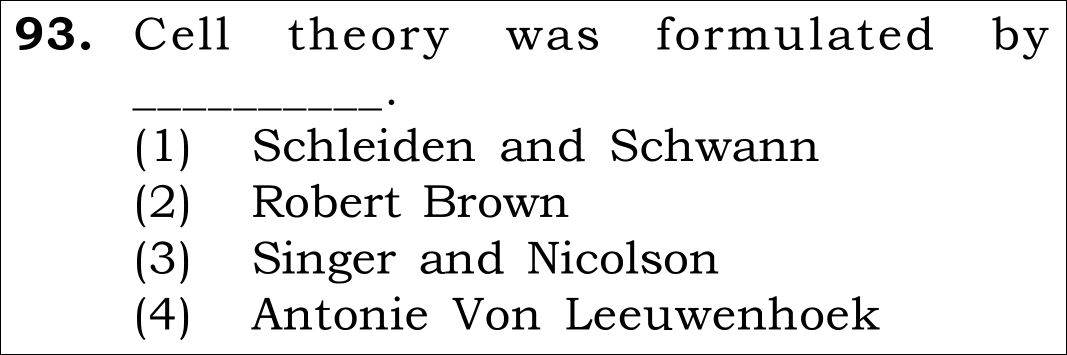
NEET 2026 · Q93 Easy
Official NEET 2026 Question 93 - Cell: The Unit of Life
1 Schleiden and Schwann ✓ Key
2 Robert Brown
3 Singer and Nicolson
4 Antonie Von Leeuwenhoek
💡 Verified Solution & 30-Second Hack
✓
Verified Against NTA Final Answer Key
Option (1) : Schleiden and Schwann
📚 Cell: The Unit of Life Easy
📋 Given Parameters & Problem Setup
Concept Formulation of the classical Cell Theory
Historical Timeline 1838 (Schleiden, Botanist) & 1839 (Schwann, Zoologist)
⚡

The 30-Second Exam Hall Shortcut: ⚡ Cell Theory Formulation Duo

⏱️ Save ~40 seconds

Schleiden (Botanist) + Schwann (Zoologist) = Cell Theory!

1 Matthias Schleiden (1838, German botanist) proposed all plants are composed of cells.
2 Theodor Schwann (1839, British zoologist) studied animal and plant tissues and formulated cell theory.
3 Together, Schleiden and Schwann formulated the classical Cell Theory.
4 Option (1) is Schleiden and Schwann! Instant pick in 5 seconds!
🛡️
Why You Can 100% Trust This Shortcut: NCERT Cell Biology verbatim: Schleiden and Schwann together formulated the cell theory.
📐

Step-by-Step Rigorous Workflow & Mathematical Proof

Step 1

Historical Contributions of Schleiden and Schwann

1. Matthias Schleiden (1838), a German botanist, examined a large number of plants and observed that all plants are composed of different kinds of cells which form the tissues of the plant. 2. Theodor Schwann (1839), a British zoologist, studied different types of animal cells and reported that cells had a thin outer layer (plasma membrane). He also concluded that the presence of a cell wall is a unique character of plant cells. 3. Based on these unified observations, Schleiden and Schwann jointly formulated the Cell Theory: all living organisms are composed of cells and products of cells.

Cell Theory≡Schleiden (1838)+Schwann (1839)\text{Cell Theory} \equiv \text{Schleiden (1838)} + \text{Schwann (1839)}
  • • Their theory originally did not explain how new cells were formed.
Step 2

Evaluate Other Scientists in the Options

1. Robert Brown (1831): Discovered and named the cell nucleus. 2. Singer and Nicolson (1972): Proposed the Fluid Mosaic Model of the cell membrane. 3. Antonie van Leeuwenhoek (1674): First saw and described live cells (bacteria, protozoa, sperm) under a simple microscope.

Nucleus: Robert Brown;Fluid Mosaic: Singer & Nicolson;Live cell: Leeuwenhoek\text{Nucleus: Robert Brown}; \quad \text{Fluid Mosaic: Singer \& Nicolson}; \quad \text{Live cell: Leeuwenhoek}
  • • Option (1) is the unique correct match.
Step 3

Conclusion

Cell theory was formulated by Schleiden and Schwann.

Matches Option (1)\text{Matches Option (1)}
  • • Matches Option (1).
⭐

360° Option Elimination Engine Key Feature

Diagnose every choice: Know exactly why the right option works and why distractors fail.

4-Option Deep Scan
1 A
✓ 100% Correct
Verdict & Scientific Reason:

Exact historical and scientific attribution matching NCERT Cell Biology.

💡
Why this is airtight: None; foundational biological milestone.
2 B
✗ Incorrect
Verdict & Scientific Reason:

Incorrect. Robert Brown discovered the cell nucleus in 1831.

⚠️
Student Fallacy (Why candidates pick this trap): Confusing the discovery of the nucleus with the formulation of cell theory.
3 C
✗ Incorrect
Verdict & Scientific Reason:

Incorrect. Singer and Nicolson proposed the fluid mosaic model of biological membranes in 1972.

⚠️
Student Fallacy (Why candidates pick this trap): Confusing membrane structure with cell theory.
4 D
✗ Incorrect
Verdict & Scientific Reason:

Incorrect. Leeuwenhoek first observed live micro-organisms under a microscope.

⚠️
Student Fallacy (Why candidates pick this trap): Confusing the first observation of live cells with the formulation of cell theory.
⚠️

NTA Trap Alert: Confusing Formulation with Expansion (Virchow)

Schleiden and Schwann FORMULATED cell theory, but did not explain how new cells arise. Rudolf Virchow (1855) later modified and completed it with "Omnis cellula-e cellula". The question asks who formulated it: Schleiden and Schwann.

🛡️ How to avoid the -1 mark: Formulated = Schleiden and Schwann; Finalized with cell division = Rudolf Virchow.
📖

Core NEET Syllabus Standard

NEET Biology Core Syllabus · Cell: The Unit of Life Standard Benchmark
Core Scientific Principle Tested:

"Schleiden and Schwann jointly formulated the cell theory stating that all living things consist of cells."
Syllabus Focus: What is a cell and Cell Theory
✓ Core NEET UG Syllabus Anchor Syllabus & Academic Standards ↗
Schleiden for plants, Schwann for beasts: Together they gave Cell Theory its feast!
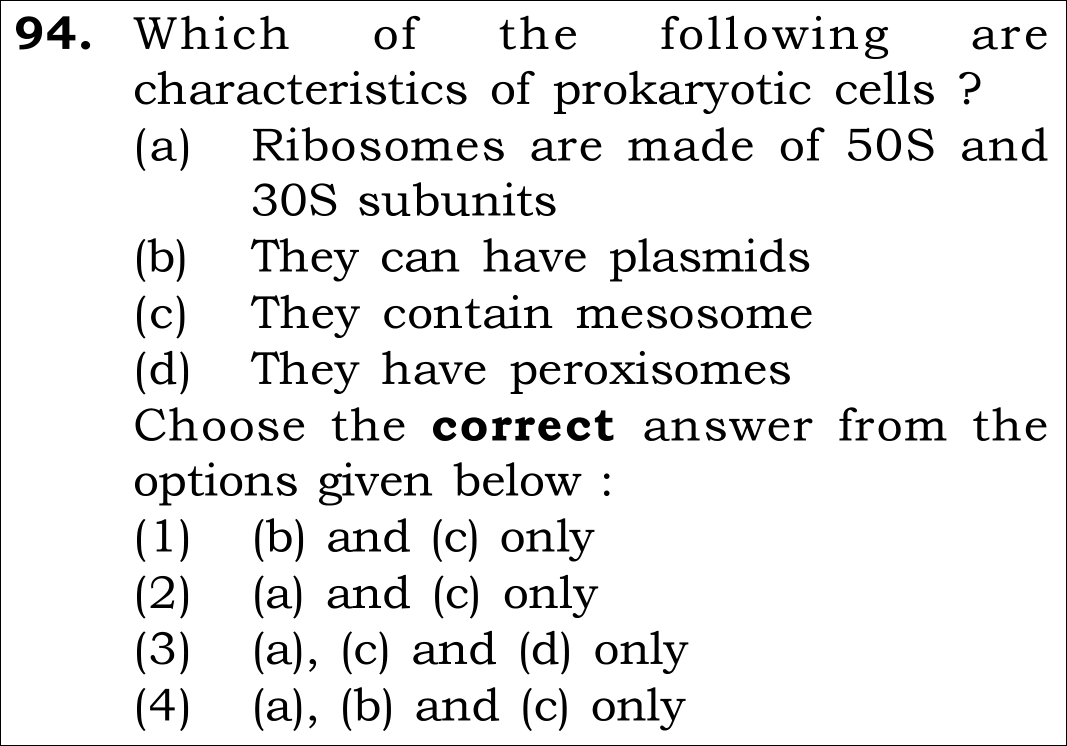
NEET 2026 · Q94 Medium
Official NEET 2026 Question 94 - Cell: The Unit of Life
1 (b) and (c) only
2 (a) and (c) only
3 (a), (c) and (d) only
4 (a), (b) and (c) only ✓ Key
💡 Verified Solution & 30-Second Hack
✓
Verified Against NTA Final Answer Key
Option (4) : (a), (b) and (c) only
📚 Cell: The Unit of Life Medium
📋 Given Parameters & Problem Setup
Feature (a) Ribosomes are made of 50S and 30S subunits
Feature (b) They can have plasmids
Feature (c) They contain mesosome
Feature (d) They have peroxisomes
⚡

The 30-Second Exam Hall Shortcut: ⚡ No Membrane-Bound Organelles in Prokaryotes!

⏱️ Save ~50 seconds

Peroxisome is a membrane-bound eukaryotic organelle -> Statement (d) is FALSE!

1 Check (d): Prokaryotes NEVER have membrane-bound organelles (no mitochondria, no ER, no peroxisomes). Statement (d) is FALSE!
2 Eliminate every option containing (d): Option (3) is out!
3 Check (a): Prokaryotic 70S ribosomes consist of 50S and 30S subunits -> TRUE.
4 Check (b): Bacteria frequently harbor small circular extrachromosomal plasmid DNA -> TRUE.
5 Check (c): Mesosomes are infoldings of plasma membrane in bacteria -> TRUE.
6 Statements (a), (b), and (c) are all true -> Option (4) wins in 15 seconds!
🛡️
Why You Can 100% Trust This Shortcut: Prokaryotes lack membrane-bound microbodies; peroxisomes, lysosomes, and mitochondria are exclusively eukaryotic.
📐

Step-by-Step Rigorous Workflow & Mathematical Proof

Step 1

Evaluate Statement (a): Prokaryotic Ribosomes

Prokaryotic ribosomes are of the 70S type. They are composed of two distinct subunits: a large 50S subunit and a small 30S subunit, which together sediment at 70S.

70S Ribosome=50S (large subunit)+30S (small subunit)70\text{S Ribosome} = 50\text{S (large subunit)} + 30\text{S (small subunit)}
  • • Statement (a) is correct.
Step 2

Evaluate Statement (b): Plasmids

In addition to the genomic DNA (single circular chromosome in nucleoid), many bacteria possess small circular self-replicating extrachromosomal double-stranded DNA molecules called plasmids. Plasmids confer unique phenotypic characters like antibiotic resistance.

Plasmid≡Extrachromosomal circular dsDNA\text{Plasmid} \equiv \text{Extrachromosomal circular dsDNA}
  • • Statement (b) is correct.
Step 3

Evaluate Statement (c): Mesosomes

A characteristic feature of prokaryotes is the mesosome, formed by the extension and infolding of the plasma membrane into the cell (in the form of vesicles, tubules, and lamellae). Mesosomes function in cell wall formation, DNA replication, and cellular respiration.

Mesosome≡Plasma membrane invagination in prokaryotes\text{Mesosome} \equiv \text{Plasma membrane invagination in prokaryotes}
  • • Statement (c) is correct.
Step 4

Evaluate Statement (d): Peroxisomes

Peroxisomes are single-membrane-bound microbodies containing catalase and urate oxidase, involved in lipid metabolism and photorespiration. Prokaryotes lack all membrane-bound cell organelles, including peroxisomes.

Peroxisomes≡Membrane-bound eukaryotic microbody (Absent in Prokaryotes)\text{Peroxisomes} \equiv \text{Membrane-bound eukaryotic microbody (Absent in Prokaryotes)}
  • • Statement (d) is incorrect.
  • • Therefore, (a), (b), and (c) only are characteristics of prokaryotic cells.
⭐

360° Option Elimination Engine Key Feature

Diagnose every choice: Know exactly why the right option works and why distractors fail.

4-Option Deep Scan
1 A
✗ Incorrect
Verdict & Scientific Reason:

Incomplete. Omits statement (a), which is completely true for prokaryotes (50S + 30S = 70S).

⚠️
Student Fallacy (Why candidates pick this trap): Doubting whether ribosomes are composed of 50S and 30S subunits.
2 B
✗ Incorrect
Verdict & Scientific Reason:

Incomplete. Omits statement (b) regarding the presence of plasmids.

⚠️
Student Fallacy (Why candidates pick this trap): Forgetting that bacteria frequently contain plasmids.
3 C
✗ Incorrect
Verdict & Scientific Reason:

Incorrect. Falsely includes peroxisomes, which are membrane-bound organelles absent in prokaryotes.

⚠️
Student Fallacy (Why candidates pick this trap): Believing prokaryotes possess microbodies like peroxisomes.
4 D
✓ 100% Correct
Verdict & Scientific Reason:

Exact match: Prokaryotes have 70S ribosomes (50S+30S), plasmids, and mesosomes, but lack peroxisomes.

💡
Why this is airtight: None; precise cytology knowledge.
⚠️

NTA Trap Alert: Including Membrane-Bound Microbodies in Bacteria

Students frequently forget that microbodies (peroxisomes, glyoxysomes) are membrane-bound eukaryotic organelles. Bacteria have NO membrane-bound organelles whatsoever!

🛡️ How to avoid the -1 mark: The Golden Rule of Prokaryotes: Zero membrane-bound organelles (No nucleus, No mitochondria, No peroxisomes).
📖

Core NEET Syllabus Standard

NEET Biology Core Syllabus · Cell: The Unit of Life Standard Benchmark
Core Scientific Principle Tested:

"Prokaryotic cells have 70S ribosomes (50S + 30S), plasmids, and mesosomes, but lack membrane-bound organelles like peroxisomes."

Syllabus Focus: Prokaryotic cell envelope, mesosomes, ribosomes, and inclusion bodies
✓ Core NEET UG Syllabus Anchor Syllabus & Academic Standards ↗
Prokaryotes: 50S+30S, Plasmids, Mesosomes in place; but Peroxisomes have no prokaryotic space!
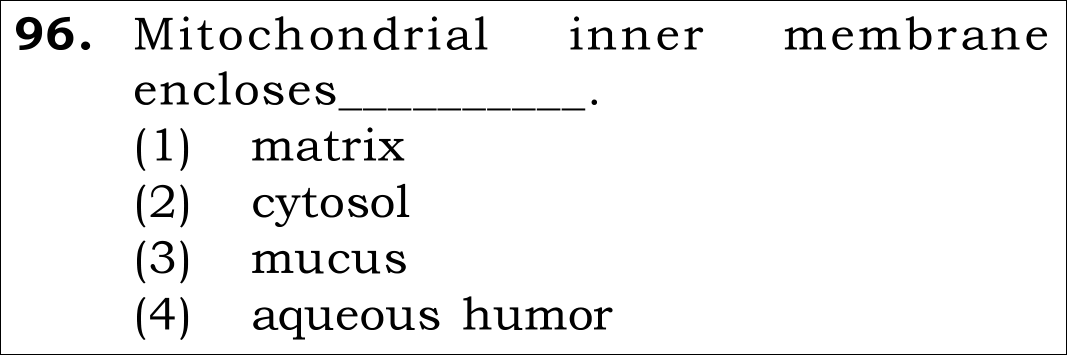
NEET 2026 · Q96 Easy
Official NEET 2026 Question 96 - Cell: The Unit of Life
1 matrix ✓ Key
2 cytosol
3 mucus
4 aqueous humor
💡 Verified Solution & 30-Second Hack
✓
Verified Against NTA Final Answer Key
Option (1) : matrix
📚 Cell: The Unit of Life Easy
📋 Given Parameters & Problem Setup
Organelle Mitochondrion (Powerhouse of the cell)
Structure Space enclosed by the mitochondrial inner membrane
⚡

The 30-Second Exam Hall Shortcut: ⚡ Mitochondrial Anatomy at a Glance

⏱️ Save ~40 seconds

Inner membrane wraps the MATRIX; Stroma is in chloroplast; Cytosol is in cytoplasm!

1 Mitochondria are double-membrane-bound organelles.
2 Outer membrane is smooth; inner membrane forms deep infoldings (cristae).
3 The dense, homogeneous aqueous lumen enclosed by the inner membrane is called the MATRIX.
4 The matrix contains Krebs cycle enzymes, 70S ribosomes, and circular dsDNA.
5 Option (1) is Matrix! Pick Option (1) in 5 seconds!
🛡️
Why You Can 100% Trust This Shortcut: NCERT Cell Biology verbatim: The inner compartment is filled with a dense homogeneous substance called the matrix.
📐

Step-by-Step Rigorous Workflow & Mathematical Proof

Step 1

Mitochondrial Double-Membrane Compartmentalization

Each mitochondrion is a double-membrane-bound structure with an outer membrane and an inner membrane dividing its lumen into two aqueous compartments: 1. The intermembrane space: The narrow region situated between the outer and inner membranes. 2. The inner compartment: The central space enclosed by the convoluted inner membrane, which is packed with a dense homogeneous proteinaceous ground substance known as the MATRIX.

Inner Membrane Enclosure≡Mitochondrial Matrix\text{Inner Membrane Enclosure} \equiv \text{Mitochondrial Matrix}
  • • Matrix contains enzymes of the TCA cycle (citric acid cycle), mitochondrial circular DNA, RNA molecules, and 70S ribosomes.
Step 2

Evaluate Distractor Options

1. Cytosol: The soluble fluid portion of the cell cytoplasm outside all organelles. 2. Mucus: Viscous slippery secretion produced by goblet cells and mucous membranes in animal tissues. 3. Aqueous humor: The clear fluid filling the space in the front of the eyeball between the lens and the cornea.

Cytosol, Mucus, Aqueous humor are completely unrelated to mitochondrial internal lumen\text{Cytosol, Mucus, Aqueous humor are completely unrelated to mitochondrial internal lumen}
  • • Option (1) is the only scientifically valid organelle term.
Step 3

Conclusion

Mitochondrial inner membrane encloses the matrix.

Matches Option (1)\text{Matches Option (1)}
  • • Matches Option (1).
⭐

360° Option Elimination Engine Key Feature

Diagnose every choice: Know exactly why the right option works and why distractors fail.

4-Option Deep Scan
1 A
✓ 100% Correct
Verdict & Scientific Reason:

Exact anatomical definition of the inner mitochondrial lumen.

💡
Why this is airtight: None; elementary cell biology.
2 B
✗ Incorrect
Verdict & Scientific Reason:

Incorrect. Cytosol is the main fluid of the cytoplasm, outside the mitochondrion.

⚠️
Student Fallacy (Why candidates pick this trap): Confusing intra-organellar matrix with extra-organellar cytosol.
3 C
✗ Incorrect
Verdict & Scientific Reason:

Incorrect. Mucus is an extracellular animal fluid secreted by mucous glands.

⚠️
Student Fallacy (Why candidates pick this trap): Absurd distractor.
4 D
✗ Incorrect
Verdict & Scientific Reason:

Incorrect. Aqueous humor is ocular fluid in the anterior chamber of the eye.

⚠️
Student Fallacy (Why candidates pick this trap): Absurd physiological distractor.
⚠️

NTA Trap Alert: Confusing Matrix (Mitochondria) with Stroma (Chloroplast)

Both mitochondria and chloroplasts are double-membrane organelles: Mitochondria enclose the MATRIX; Chloroplasts enclose the STROMA.

🛡️ How to avoid the -1 mark: M = Mitochondria / Matrix; C = Chloroplast / Chlorophyll / (Stroma).
📖

Core NEET Syllabus Standard

NEET Biology Core Syllabus · Cell: The Unit of Life Standard Benchmark
Core Scientific Principle Tested:

"The inner membrane of mitochondria encloses the matrix where Krebs cycle enzymes reside."

Syllabus Focus: Mitochondria - Structure, membranes, and matrix
✓ Core NEET UG Syllabus Anchor Syllabus & Academic Standards ↗
Mighty Mitochondria makes Matrix its home; Chloroplast holds the Stroma under its dome!
NEET 2026 · Q97 Easy
Official NEET 2026 Question 97 - Cell: The Unit of Life
1
2 ✓ Key
3
4
💡 Verified Solution & 30-Second Hack
✓
Verified Against NTA Final Answer Key
Option (2) : A-II, B-IV, C-I, D-III
📚 Cell: The Unit of Life Easy
📋 Given Parameters & Problem Setup
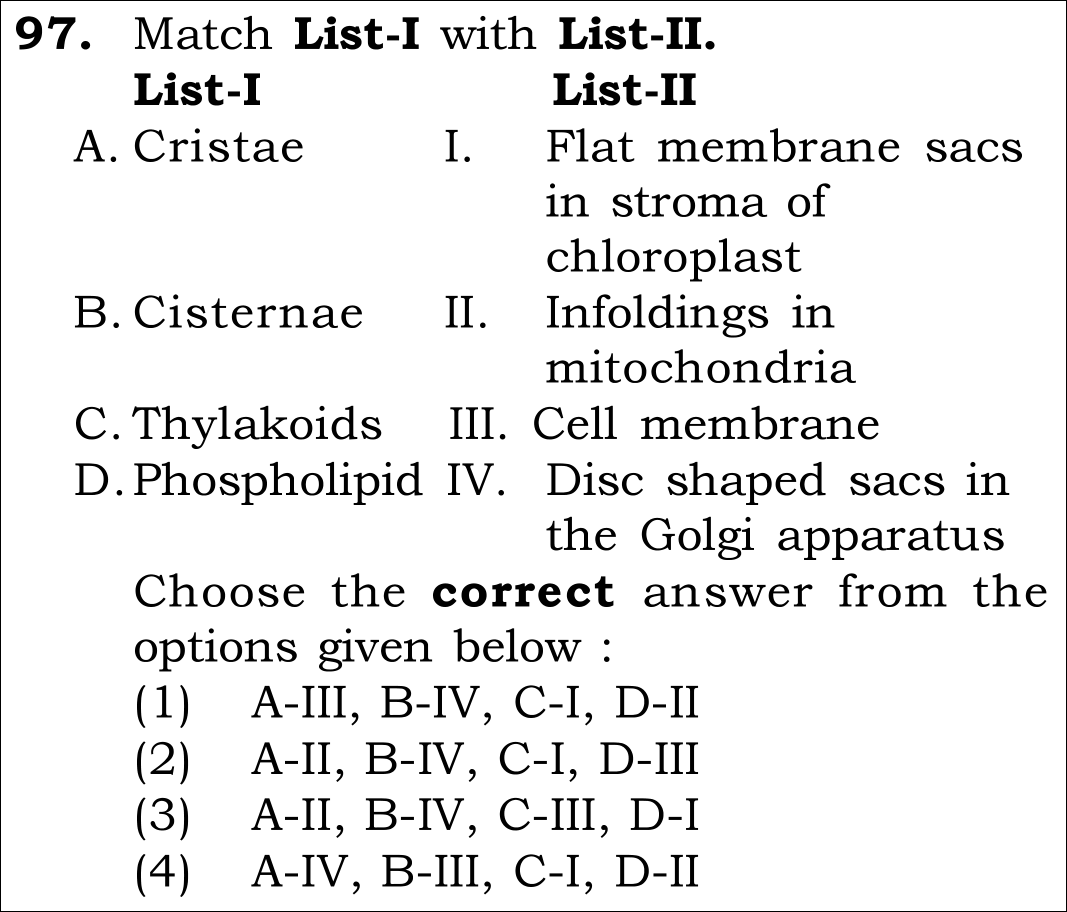
List-I A. Cristae, B. Cisternae, C. Thylakoids, D. Phospholipid
List-II I. Flat membrane sacs in stroma of chloroplast, II. Infoldings in mitochondria, III. Cell membrane, IV. Disc shaped sacs in the Golgi apparatus
⚡

The 30-Second Exam Hall Shortcut: ⚡ Organellar Infolding & Sac Fingerprint

⏱️ Save ~45 seconds

Cristae = Mitochondria (A-II); Cisternae = Golgi (B-IV) -> Locks Option (2) in 10 seconds!

1 A. Cristae: Infoldings of the inner membrane of mitochondria to increase surface area -> A-II.
2 This immediately eliminates Options (1) and (4)!
3 B. Cisternae: Flattened disc-shaped concentric sacs in Golgi apparatus -> B-IV.
4 C. Thylakoids: Flattened membranous sacs in the stroma of chloroplasts (site of light reactions) -> C-I.
5 D. Phospholipid: Bilayer building block of the cell membrane (fluid mosaic) -> D-III.
6 Sequence: A-II, B-IV, C-I, D-III -> Option (2) is 100% verified!
🛡️
Why You Can 100% Trust This Shortcut: Direct verbatim alignment with NCERT Cell Biology sections on Mitochondria, Golgi apparatus, Plastids, and Plasma membrane.
📐

Step-by-Step Rigorous Workflow & Mathematical Proof

Step 1

Match Cristae (Item A)

The inner membrane of mitochondria forms a number of infoldings called cristae (sing. crista) towards the matrix. Cristae increase the surface area available for ATP synthesis and electron transport chain complexes.

Cristae⟶II. Infoldings in mitochondria\text{Cristae} \longrightarrow \text{II. Infoldings in mitochondria}
  • • Match: A -> II.
Step 2

Match Cisternae (Item B)

The Golgi apparatus consists of many flat, disc-shaped sacs or cisternae of 0.5 µm to 1.0 µm diameter, stacked parallel to each other with distinct cis (forming) and trans (maturing) faces.

Cisternae⟶IV. Disc shaped sacs in the Golgi apparatus\text{Cisternae} \longrightarrow \text{IV. Disc shaped sacs in the Golgi apparatus}
  • • Match: B -> IV.
Step 3

Match Thylakoids (Item C)

In the stroma of chloroplasts, a number of organized flattened membranous sacs are present, called thylakoids. Thylakoids are arranged in stacks like piles of coins called grana.

Thylakoids⟶I. Flat membrane sacs in stroma of chloroplast\text{Thylakoids} \longrightarrow \text{I. Flat membrane sacs in stroma of chloroplast}
  • • Match: C -> I.
Step 4

Match Phospholipid (Item D)

Phospholipids form the foundational continuous bimolecular lipid bilayer of the cell membrane, with hydrophilic polar heads pointing outward and hydrophobic fatty acid tails pointing inward.

Phospholipid⟶III. Cell membrane\text{Phospholipid} \longrightarrow \text{III. Cell membrane}
  • • Match: D -> III.
  • • Full Match: A-II, B-IV, C-I, D-III (Option 2).
⭐

360° Option Elimination Engine Key Feature

Diagnose every choice: Know exactly why the right option works and why distractors fail.

4-Option Deep Scan
1 A
✗ Incorrect
Verdict & Scientific Reason:

Incorrect. Assigns cell membrane to cristae and infoldings in mitochondria to phospholipids.

⚠️
Student Fallacy (Why candidates pick this trap): Swapping roman numerals II and III.
2 B
✓ 100% Correct
Verdict & Scientific Reason:

Exact match with textbook definitions of cellular membranes and organelles.

💡
Why this is airtight: None; flawless cytology knowledge.
3 C
✗ Incorrect
Verdict & Scientific Reason:

Incorrect. Assigns cell membrane to thylakoids and chloroplast sacs to phospholipids.

⚠️
Student Fallacy (Why candidates pick this trap): Swapping thylakoids and phospholipids.
4 D
✗ Incorrect
Verdict & Scientific Reason:

Incorrect. Assigns Golgi sacs to cristae.

⚠️
Student Fallacy (Why candidates pick this trap): Confusing cristae with cisternae.
⚠️

NTA Trap Alert: Confusing Cristae with Cisternae

The names sound very similar: Cristae are in MITOCHONDRIA (folds); Cisternae are in GOLGI (stacked flattened discs).

🛡️ How to avoid the -1 mark: Remember: Cristae has "T" for miTochondria; Cisternae has "G" sound for Golgi!
📖

Core NEET Syllabus Standard

NEET Biology Core Syllabus · Cell: The Unit of Life Standard Benchmark
Core Scientific Principle Tested:

"Organelles possess distinct specialized membranes: Cristae (mitochondria), Cisternae (Golgi), Thylakoids (chloroplast), Phospholipids (plasma membrane)."

Syllabus Focus: Endomembrane system, mitochondria, and plastid ultrastructure
✓ Core NEET UG Syllabus Anchor Syllabus & Academic Standards ↗
Cristae fold Mitochondria; Cisternae stack Golgi high; Thylakoid lights Chloroplast; Phospholipids line cell sky!
NEET 2026 · Q98 Easy
Official NEET 2026 Question 98 - Cell: The Unit of Life
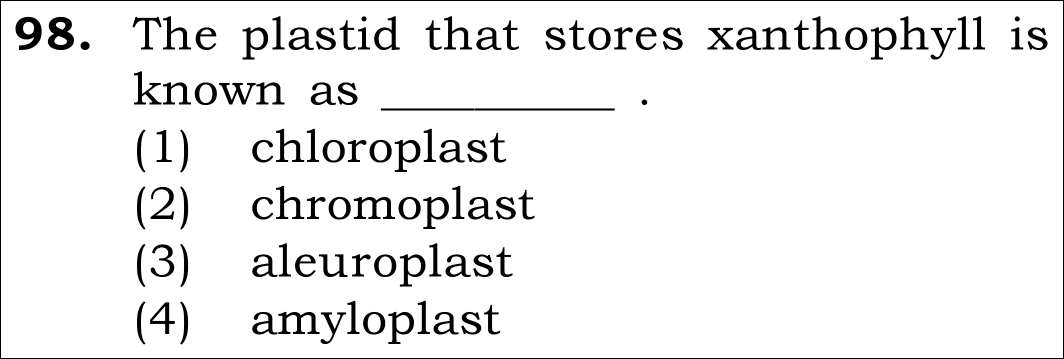
1 chloroplast
2 chromoplast ✓ Key
3 aleuroplast
4 amyloplast
💡 Verified Solution & 30-Second Hack
✓
Verified Against NTA Final Answer Key
Option (2) : chromoplast
📚 Cell: The Unit of Life Easy
📋 Given Parameters & Problem Setup
Pigment Stored Xanthophyll (yellow fat-soluble carotenoid pigment)
Target Organelle Type of plastid that stores xanthophyll
⚡

The 30-Second Exam Hall Shortcut: ⚡ Chroma = Color (Yellow, Orange, Red)

⏱️ Save ~40 seconds

Chromoplasts store fat-soluble carotene & xanthophyll pigments to give flowers/fruits vibrant color!

1 Recall plastid classification based on pigments: Chloroplasts, Chromoplasts, and Leucoplasts.
2 Chloroplasts store chlorophyll (green).
3 Leucoplasts are colourless and store starch (amyloplast), oil (elaioplast), or protein (aleuroplast).
4 Chromoplasts store fat-soluble carotenoids: carotene and XANTHOPHYLL (yellow-orange-red).
5 Option (2) is Chromoplast! Pick Option (2) in 5 seconds!
🛡️
Why You Can 100% Trust This Shortcut: NCERT Cell Biology verbatim: In chromoplasts fat soluble carotenoid pigments like carotene, xanthophylls and others are present.
📐

Step-by-Step Rigorous Workflow & Mathematical Proof

Step 1

Classify Plastids Based on Pigment Content

Plastids are found in all plant cells and euglenoids. Based on the presence or absence of specific pigments, Schimper classified plastids into three types: 1. Chloroplasts: Contain chlorophyll and carotenoid pigments for photosynthesis. 2. Chromoplasts: Contain fat-soluble carotenoid pigments such as carotene and xanthophylls, imparting yellow, orange, or red color to petals, pericarp, and ripening fruits. 3. Leucoplasts: Colourless plastids of varied shapes and sizes that store nutrients.

Chromoplast≡Plastid containing Carotene and Xanthophyll\text{Chromoplast} \equiv \text{Plastid containing Carotene and Xanthophyll}
  • • Xanthophyll is an oxygenated carotenoid (yellow pigment).
Step 2

Evaluate the Sub-types of Leucoplasts

Leucoplasts store reserve foods and do NOT store pigments: - Amyloplasts: Store carbohydrates (starch, e.g., potato tuber). - Elaioplasts: Store oils and fats. - Aleuroplasts: Store proteins (aleurone grains).

Amyloplast: Starch;Aleuroplast: Protein;Elaioplast: Fat\text{Amyloplast: Starch}; \quad \text{Aleuroplast: Protein}; \quad \text{Elaioplast: Fat}
  • • Amyloplast and aleuroplast are non-pigmented nutrient storage plastids.
Step 3

Conclusion

The plastid that stores xanthophyll is known as chromoplast.

Matches Option (2)\text{Matches Option (2)}
  • • Matches Option (2).
⭐

360° Option Elimination Engine Key Feature

Diagnose every choice: Know exactly why the right option works and why distractors fail.

4-Option Deep Scan
1 A
✗ Incorrect
Verdict & Scientific Reason:

Incorrect. While chloroplasts have accessory carotenoids, the specialized plastid dedicated to storing high concentrations of xanthophylls and carotenes to color plant organs is the chromoplast.

⚠️
Student Fallacy (Why candidates pick this trap): Assuming all plant pigments are stored in chloroplasts.
2 B
✓ 100% Correct
Verdict & Scientific Reason:

Exact match with NCERT definition of chromoplasts as repositories for fat-soluble carotene and xanthophyll pigments.

💡
Why this is airtight: None; textbook precision.
3 C
✗ Incorrect
Verdict & Scientific Reason:

Incorrect. Aleuroplasts are colourless leucoplasts that store proteins.

⚠️
Student Fallacy (Why candidates pick this trap): Confusing protein-storing aleuroplast with pigment-bearing plastid.
4 D
✗ Incorrect
Verdict & Scientific Reason:

Incorrect. Amyloplasts store carbohydrates/starch.

⚠️
Student Fallacy (Why candidates pick this trap): Confusing starch storage with xanthophyll storage.
⚠️

NTA Trap Alert: Confusing Leucoplast Storage Types with Chromoplasts

Students frequently memorize amyloplast (starch), elaioplast (oil), and aleuroplast (protein), and panic when asked about xanthophyll. Xanthophyll is a PIGMENT, so it belongs to CHROMOPLAST (chromo = color)!

🛡️ How to avoid the -1 mark: Chromo means color. Xanthophyll is yellow pigment, so it resides in Chromoplast.
📖

Core NEET Syllabus Standard

NEET Biology Core Syllabus · Cell: The Unit of Life Standard Benchmark
Core Scientific Principle Tested:

"Chromoplasts contain fat-soluble carotenoids (carotene and xanthophylls) providing yellow, orange, and red pigmentation."

Syllabus Focus: Plastids - Chloroplasts, chromoplasts, and leucoplasts
✓ Core NEET UG Syllabus Anchor Syllabus & Academic Standards ↗
Chroma means Color (Yellow Xanthophyll); Amyl means Starch; Aleuro means Protein!
NEET 2026 · Q108 Easy
Official NEET 2026 Question 108 - Cell: The Unit of Life
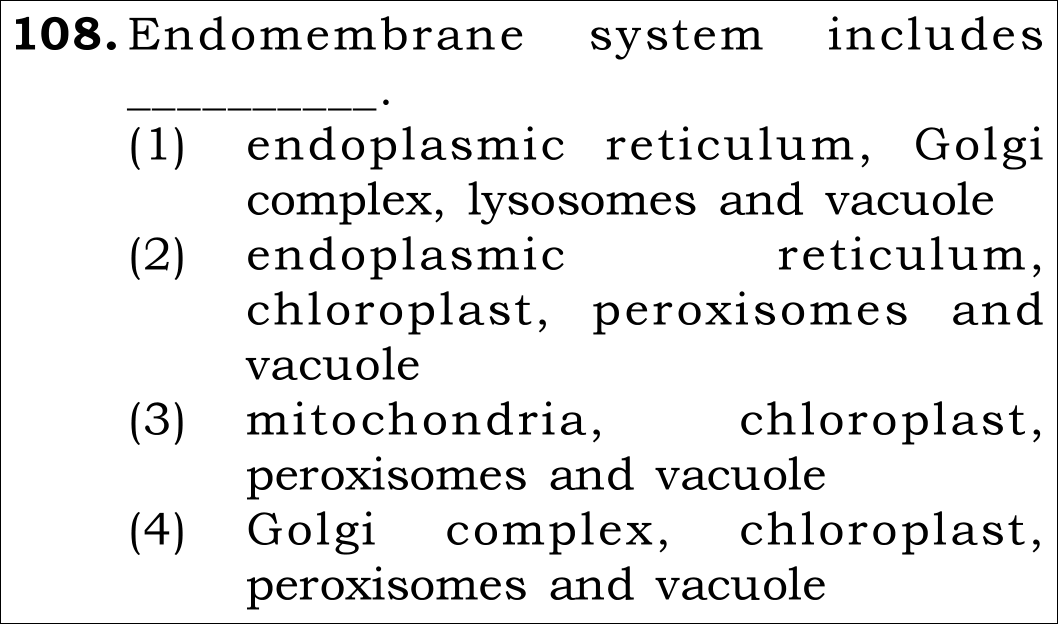
1 endoplasmic reticulum, Golgi complex, lysosomes and vacuole ✓ Key
2 endoplasmic reticulum, chloroplast, peroxisomes and vacuole
3 mitochondria, chloroplast, peroxisomes and vacuole
4 Golgi complex, chloroplast, peroxisomes and vacuole
💡 Verified Solution & 30-Second Hack
✓
Verified Against NTA Final Answer Key
Option (1) : endoplasmic reticulum, Golgi complex, lysosomes and vacuole
📚 Cell: The Unit of Life Easy
📋 Given Parameters & Problem Setup
System Endomembrane system of eukaryotic cells
Defining Criterion Coordinated vesicular and secretory functions
⚡

The 30-Second Exam Hall Shortcut: ⚡ GERL + V Rule

⏱️ Save ~35 seconds

Endomembrane System = GERL-V (Golgi, ER, Lysosome, Vacuole)!

1 Recall that the endomembrane system includes organelles whose functions are coordinated: ER, Golgi complex, lysosomes, and vacuoles.
2 Mitochondria, chloroplasts, and peroxisomes are strictly EXCLUDED because their functions are uncoordinated with the secretory pathway.
3 Scan the options for the one WITHOUT chloroplast, mitochondria, or peroxisome.
4 Option (1) has exclusively ER, Golgi, lysosomes, and vacuole!
5 Pick Option (1) in 5 seconds flat!
🛡️
Why You Can 100% Trust This Shortcut: NCERT Cell Biology verbatim: The endomembrane system includes endoplasmic reticulum (ER), golgi complex, lysosomes and vacuoles.
📐

Step-by-Step Rigorous Workflow & Mathematical Proof

Step 1

Definition of Endomembrane System

While each membranous organelle in a eukaryotic cell is distinct in structure and biochemistry, several organelles function in close coordination in the synthesis, processing, packaging, and vesicular transport of biomolecules. Together, these form the endomembrane system.

Endomembrane System={ER,  Golgi Complex,  Lysosomes,  Vacuoles}\text{Endomembrane System} = \{\text{ER}, \; \text{Golgi Complex}, \; \text{Lysosomes}, \; \text{Vacuoles}\}
  • • Endoplasmic reticulum: Synthesizes proteins and lipids.
  • • Golgi complex: Modifies, sorts, and packages materials into vesicles.
  • • Lysosomes: Carry out intracellular digestion using hydrolytic enzymes.
  • • Vacuoles: Store water, sap, excretory products, and osmotic solutes.
Step 2

Why Mitochondria, Chloroplasts, and Peroxisomes are Excluded

Organelles such as mitochondria and chloroplasts (which are semiautonomous and have their own circular DNA and 70S ribosomes) and peroxisomes carry out metabolic reactions (cellular respiration, photosynthesis, photorespiration/peroxide degradation) that are not coordinated with vesicular secretory transport. Hence, they are excluded.

{Mitochondria,  Chloroplast,  Peroxisome}∉Endomembrane System\{\text{Mitochondria}, \; \text{Chloroplast}, \; \text{Peroxisome}\} \notin \text{Endomembrane System}
  • • Options (2), (3), and (4) all contain chloroplasts and peroxisomes, invalidating them immediately.
Step 3

Select the Matching Option

Option (1) contains solely the four canonical members: endoplasmic reticulum, Golgi complex, lysosomes, and vacuole.

Correct Match=Option (1)\text{Correct Match} = \text{Option (1)}
  • • Matches official NTA final answer key Option A / (1).
⭐

360° Option Elimination Engine Key Feature

Diagnose every choice: Know exactly why the right option works and why distractors fail.

4-Option Deep Scan
1 A
✓ 100% Correct
Verdict & Scientific Reason:

Accurate. Exact four components mandated by NCERT textbook.

💡
Why this is airtight: None; standard direct recall.
2 B
✗ Incorrect
Verdict & Scientific Reason:

Incorrect. Chloroplast and peroxisomes are not part of the endomembrane system.

⚠️
Student Fallacy (Why candidates pick this trap): Treating all double-membrane or single-membrane organelles as endomembrane.
3 C
✗ Incorrect
Verdict & Scientific Reason:

Incorrect. Mitochondria, chloroplast, and peroxisomes are all outside the endomembrane system.

⚠️
Student Fallacy (Why candidates pick this trap): Confusing metabolic organelles with secretory/vesicular pathway.
4 D
✗ Incorrect
Verdict & Scientific Reason:

Incorrect. Includes non-endomembrane chloroplast and peroxisomes.

⚠️
Student Fallacy (Why candidates pick this trap): Failure to eliminate chloroplast and peroxisomes.
⚠️

NTA Trap Alert: Peroxisome & Semiautonomous Organelle Inclusion

Students frequently assume that because peroxisomes and lysosomes are both microbodies or single-membrane vesicles, peroxisomes must belong to the endomembrane system. NCERT explicitly clarifies that peroxisomes are NOT part of it.

🛡️ How to avoid the -1 mark: Use the mnemonic "GERL in a Vacuole": Golgi, ER, Lysosome, Vacuole.
📖

Core NEET Syllabus Standard

NEET Biology Core Syllabus · Cell: The Unit of Life Standard Benchmark
Core Scientific Principle Tested:

"The endomembrane system coordinates the endoplasmic reticulum, Golgi complex, lysosomes, and vacuoles due to interdependent functional cooperation."

Syllabus Focus: Endomembrane System
✓ Core NEET UG Syllabus Anchor Syllabus & Academic Standards ↗
GERL-V: Golgi, ER, Lysosome, Vacuole work as a team; Mitochondria & Peroxisomes run their own scheme!
NEET 2026 · Q123 Easy
Official NEET 2026 Question 123 - Cell: The Unit of Life
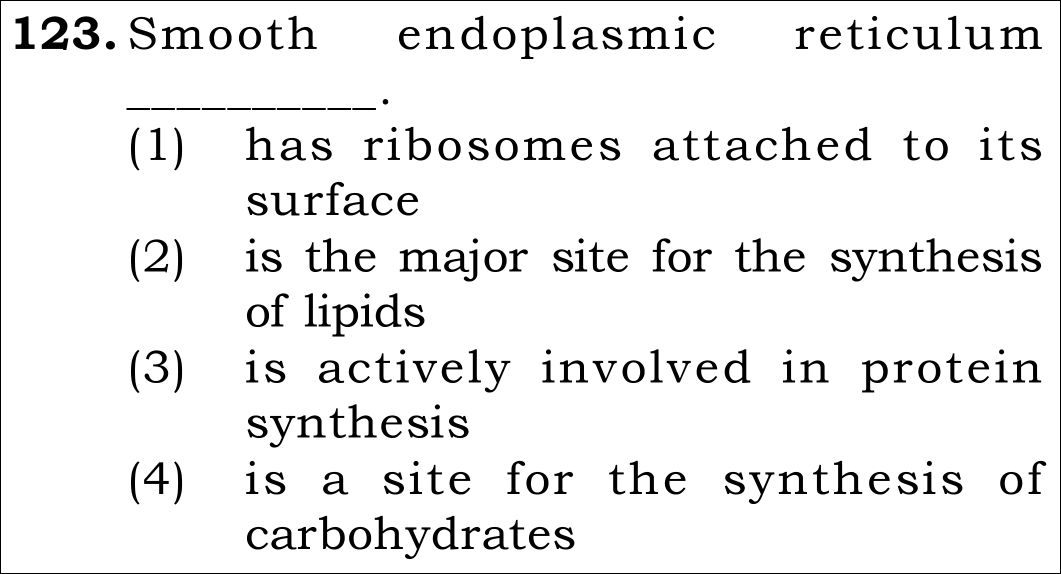
1 has ribosomes attached to its surface
2 is the major site for the synthesis of lipids ✓ Key
3 is actively involved in protein synthesis
4 is a site for the synthesis of carbohydrates
💡 Verified Solution & 30-Second Hack
✓
Verified Against NTA Final Answer Key
Option (2) : is the major site for the synthesis of lipids
📚 Cell: The Unit of Life Easy
📋 Given Parameters & Problem Setup
Organelle Smooth Endoplasmic Reticulum (SER)
Morphology Agranular membrane network devoid of ribosomes
⚡

The 30-Second Exam Hall Shortcut: ⚡ SER vs RER Golden Distinction

⏱️ Save ~40 seconds

RER = Ribosomes = Protein synthesis; SER = Smooth = Lipid & Steroid synthesis!

1 Recall canonical roles from NCERT Cell Biology:
2 Rough ER (RER) has ribosomes on its surface -> active in protein synthesis and secretion.
3 Smooth ER (SER) lacks ribosomes -> major site for lipid synthesis (and lipid-like steroid hormones).
4 Option (2) states: "is the major site for the synthesis of lipids".
5 Mark Option (2) in 3 seconds!
🛡️
Why You Can 100% Trust This Shortcut: NCERT Biology · Cell: The Unit of Life (Endoplasmic Reticulum: Smooth ER is the primary site for lipid and steroidal hormone synthesis).
📐

Step-by-Step Rigorous Workflow & Mathematical Proof

Step 1

Morphological Distinction of Endoplasmic Reticulum

The endoplasmic reticulum (ER) forms an extensive interconnected network of branching tubules and flattened cisternae in the eukaryotic cytoplasm. When ribosomes are studded along the cytoplasmic surface, it is termed Rough ER (RER); when ribosomes are absent, it is termed Smooth ER (SER).

SER=Agranular ER (Lacks attached ribosomes)\text{SER} = \text{Agranular ER (Lacks attached ribosomes)}
  • • Continuous with the outer nuclear membrane via RER.
Step 2

Physiological Function of SER

The biochemical machinery embedded within SER membranes catalyzes phospholipid, cholesterol, and fatty acid biosynthesis. In animal endocrine cells (e.g. adrenal cortex, gonads), SER synthesizes lipid-like steroid hormones (androgens, estrogens, progesterone). Furthermore, in liver hepatocytes, SER mediates xenobiotic detoxification.

SER→Biochemical functionMajor site for the synthesis of lipids and steroidal hormones\text{SER} \xrightarrow{\text{Biochemical function}} \mathbf{Major\text{ site for the synthesis of lipids and steroidal hormones}}
  • • NCERT verbatim: "The smooth endoplasmic reticulum is the major site for synthesis of lipid. In animal cells lipid-like steroidal hormones are synthesised in SER."
Step 3

Evaluate Options

Option (1) describes RER. Option (2) accurately describes SER. Option (3) describes RER. Option (4) is incorrect (carbohydrate polymers are synthesized in Golgi or plastids). Option (2) is correct.

Correct Option=Option (2)\text{Correct Option} = \text{Option (2)}
  • • Matches official NTA final answer key Option B / (2).
⭐

360° Option Elimination Engine Key Feature

Diagnose every choice: Know exactly why the right option works and why distractors fail.

4-Option Deep Scan
1 A
✗ Incorrect
Verdict & Scientific Reason:

Incorrect. Ribosomes are attached to Rough ER (RER), not Smooth ER.

⚠️
Student Fallacy (Why candidates pick this trap): Swapping RER with SER.
2 B
✓ 100% Correct
Verdict & Scientific Reason:

100% accurate. Canonical NCERT text describing SER function.

💡
Why this is airtight: None; standard direct recall.
3 C
✗ Incorrect
Verdict & Scientific Reason:

Incorrect. Protein synthesis is carried out on ribosomes of RER and free cytosolic polyribosomes.

⚠️
Student Fallacy (Why candidates pick this trap): Confusing protein synthesis with lipid synthesis.
4 D
✗ Incorrect
Verdict & Scientific Reason:

Incorrect. Complex polysaccharide synthesis and glycosylation primarily occur in the Golgi apparatus or chloroplasts.

⚠️
Student Fallacy (Why candidates pick this trap): Confusing lipid synthesis with carbohydrate production.
⚠️

NTA Trap Alert: Overlooking Steroid Hormones in SER

Questions sometimes ask where testosterone, estrogen, or cortisol are synthesized. Because they are steroids (lipids), they are synthesized in the SER!

🛡️ How to avoid the -1 mark: Remember: Smooth = Slippery Lipids and Steroid Hormones.
📖

Core NEET Syllabus Standard

NEET Biology Core Syllabus · Cell: The Unit of Life Standard Benchmark
Core Scientific Principle Tested:

"Smooth endoplasmic reticulum (SER) is devoid of ribosomes and acts as the major cellular site for the synthesis of lipids and steroidal hormones."

Syllabus Focus: Endoplasmic Reticulum
✓ Core NEET UG Syllabus Anchor Syllabus & Academic Standards ↗
RER has Ribosomes for Ribonucleic Protein; SER is Smooth for Steroids and Lipid sheen!
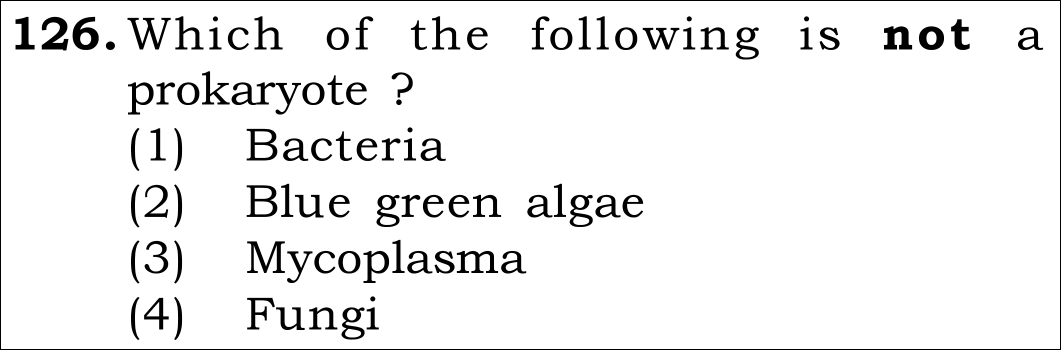
NEET 2026 · Q126 Easy
Official NEET 2026 Question 126 - Cell: The Unit of Life
1 Bacteria
2 Blue green algae
3 Mycoplasma
4 Fungi ✓ Key
💡 Verified Solution & 30-Second Hack
✓
Verified Against NTA Final Answer Key
Option (4) : Fungi
📚 Cell: The Unit of Life Easy
📋 Given Parameters & Problem Setup
Criterion Organism that is NOT a prokaryote (i.e. is a Eukaryote)
Candidate Groups (1) Bacteria, (2) Blue green algae, (3) Mycoplasma, (4) Fungi
⚡

The 30-Second Exam Hall Shortcut: ⚡ Monera vs Fungi Test

⏱️ Save ~40 seconds

Kingdom Monera = Prokaryotes; Kingdom Fungi = EUKARYOTES!

1 Identify prokaryotic kingdoms: In Whittaker’s Five Kingdom system, ONLY Kingdom Monera consists of prokaryotes.
2 Evaluate: Bacteria (Monera - prokaryote), Blue-green algae / Cyanobacteria (Monera - prokaryote), Mycoplasma (Monera - prokaryote lacking cell wall).
3 Evaluate Fungi: Fungi possess a true membrane-bound nucleus, 80S cytosolic ribosomes, mitochondria, and chitinous cell walls -> EUKARYOTIC!
4 Therefore, Fungi is NOT a prokaryote.
5 Select Option (4) in under 5 seconds!
🛡️
Why You Can 100% Trust This Shortcut: NCERT Biological Classification & Cell Biology: Fungi are multicellular/unicellular eukaryotes.
📐

Step-by-Step Rigorous Workflow & Mathematical Proof

Step 1

Definition of Prokaryote and Eukaryote

Prokaryotes lack a membrane-delimited nucleus (their genetic material is an unclad circular naked DNA nucleoid) and lack membrane-bound cytoplasmic organelles (mitochondria, chloroplasts, Golgi, ER). In contrast, eukaryotes possess a double-membraned nucleus and compartmentalized membrane-bound organelles.

Prokaryote=No nuclear membrane, no membrane-bound organelles\text{Prokaryote} = \text{No nuclear membrane, no membrane-bound organelles}
  • • All prokaryotes belong to Kingdom Monera.
Step 2

Analyze Options (1), (2), and (3)

Bacteria, Blue-green algae (cyanobacteria, like Nostoc and Anabaena), and Mycoplasma (PPLO) are all definitive members of Kingdom Monera and are typical prokaryotic organisms.

{Bacteria,  Blue green algae,  Mycoplasma}⊂Kingdom Monera (Prokaryota)\{\text{Bacteria}, \; \text{Blue green algae}, \; \text{Mycoplasma}\} \subset \text{Kingdom Monera (Prokaryota)}
  • • All three are prokaryotes.
Step 3

Analyze Option (4): Fungi

Fungi (e.g. Yeast, Rhizopus, Agaricus) constitute a separate eukaryotic kingdom of heterotrophic organisms characterized by chitinous cell walls, true nuclei, linear chromatin organized with histones, and 80S cytosolic ribosomes.

Fungi∈Eukaryota  ⟹  Fungi is NOT a prokaryote\text{Fungi} \in \mathbf{Eukaryota} \implies \text{Fungi is NOT a prokaryote}
  • • Matches official NTA final answer key Option D / (4).
⭐

360° Option Elimination Engine Key Feature

Diagnose every choice: Know exactly why the right option works and why distractors fail.

4-Option Deep Scan
1 A
✗ Incorrect
Verdict & Scientific Reason:

Incorrect. Bacteria are the classic representative prokaryotes (Kingdom Monera).

⚠️
Student Fallacy (Why candidates pick this trap): Misunderstanding prokaryotic definition.
2 B
✗ Incorrect
Verdict & Scientific Reason:

Incorrect. Blue-green algae are cyanobacteria (photosynthetic prokaryotes with 70S ribosomes and peptidoglycan cell walls).

⚠️
Student Fallacy (Why candidates pick this trap): Deceived by the word "algae" into thinking they are eukaryotic green algae.
3 C
✗ Incorrect
Verdict & Scientific Reason:

Incorrect. Mycoplasma are the smallest living prokaryotes, lacking a cell wall.

⚠️
Student Fallacy (Why candidates pick this trap): Confusing wall-less nature with eukaryotic organization.
4 D
✓ 100% Correct
Verdict & Scientific Reason:

100% accurate. Fungi are eukaryotic organisms possessing true nuclei and membrane-bound organelles.

💡
Why this is airtight: None; immediate kingdom recognition.
⚠️

NTA Trap Alert: The "Blue-Green Algae" Misnomer Trap

Students often assume "Blue green algae" are eukaryotic algae like Spirogyra. Blue-green algae are actually Cyanobacteria, which are strictly PROKARYOTES!

🛡️ How to avoid the -1 mark: Remember: Blue-green algae = Cyanobacteria = Monera = Prokaryote; Fungi = Eukaryote.
📖

Core NEET Syllabus Standard

NEET Biology Core Syllabus · Cell: The Unit of Life Standard Benchmark
Core Scientific Principle Tested:

"Prokaryotes encompass bacteria, blue-green algae, mycoplasma, and PPLO. Fungi are eukaryotes."

Syllabus Focus: Prokaryotic and Eukaryotic Cells
✓ Core NEET UG Syllabus Anchor Syllabus & Academic Standards ↗
Monera has the Prokaryote run; Fungi is Eukaryotic having fun!
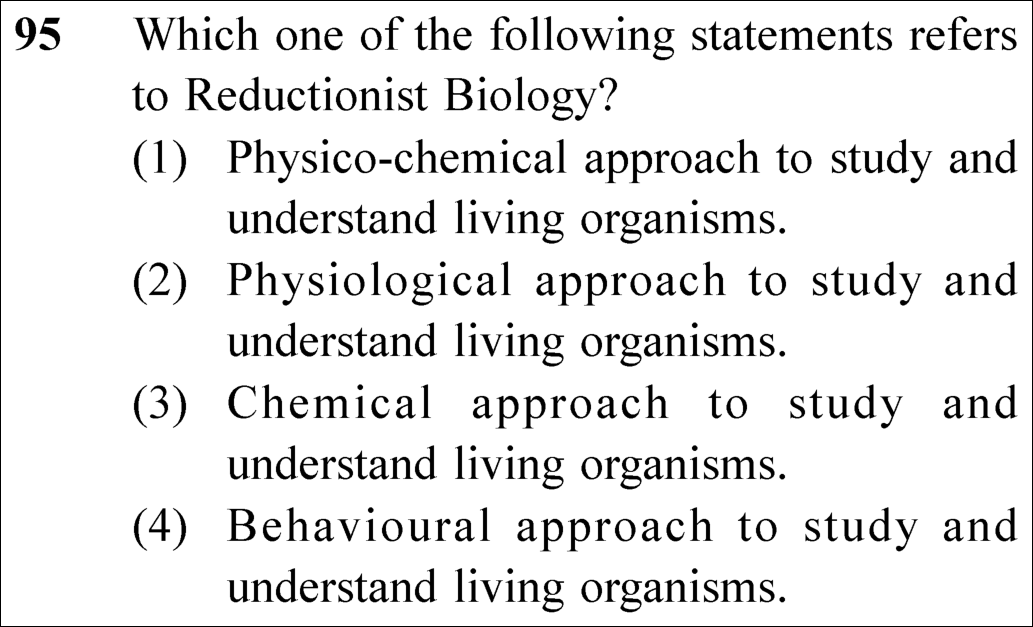
NEET 2025 · Q95 Easy
Official NEET 2025 Question 95 - Cell: The Unit of Life
1 Physico-chemical approach to study and understand living organisms. ✓ Key
2 Physiological approach to study and understand living organisms.
3 Chemical approach to study and understand living organisms.
4 Behavioural approach to study and understand living organisms.
💡 Verified Solution & 30-Second Hack
✓
Verified Against NTA Final Answer Key
Option (1) : Physico-chemical approach to study and understand living organisms.
📚 Cell: The Unit of Life Easy
📋 Given Parameters & Problem Setup
Target Concept Reductionist Biology
Source Context NCERT Biology Unit 3 Opening Overview
⚡

The 30-Second Exam Hall Shortcut: ⚡ NCERT Unit Foreword Verbatim Quote

⏱️ Save ~20 seconds

NCERT Unit 3 foreword explicitly states verbatim: "This physico-chemical approach to study and understand living organisms is called ‘Reductionist Biology’!" ⟹ Physico-chemical approach!

1 Recall definition of Reductionism in biological sciences:
2 Reductionist biology seeks to explain complex biological phenomena by breaking them down into their underlying physical and chemical components (biochemical pathways, molecular genetics, biophysics).
3 NCERT Unit 3 opening page states verbatim: "This physico-chemical approach to study and understand living organisms is called ‘Reductionist Biology’."
4 Select Option (1) in under 5 seconds!
🛡️
Why You Can 100% Trust This Shortcut: NCERT Biology Unit 3 (Cell: Structure and Functions) Foreword verbatim.
📐

Step-by-Step Rigorous Workflow & Mathematical Proof

Step 1

Definition of Reductionist Biology in NCERT Curriculum

In the introductory overview to Unit 3 (Cell: Structure and Functions), the philosophy of modern biological research is described:

Reductionist Biology=Physico-chemical approach to study and understand living organisms\text{Reductionist Biology} = \text{Physico-chemical approach to study and understand living organisms}
  • • Living processes are analyzed in terms of the properties of individual molecules, reaction kinetics, chemical thermodynamics, and atomic interactions.
Step 2

Evaluate the Alternatives

Contrast reductionism with other biological frameworks:

Physiological = Systemic/organismic,Behavioural = Ethological\text{Physiological = Systemic/organismic}, \quad \text{Behavioural = Ethological}
  • • Physiological approaches study functioning at the tissue, organ, or systemic level (holistic/integrative biology).
  • • Behavioural approaches study ethology and organismal interactions.
  • • The canonical definition of reductionist biology specifically combines physical and chemical methodologies: "Physico-chemical approach".
  • • Matches Option (1) verbatim.
⭐

360° Option Elimination Engine Key Feature

Diagnose every choice: Know exactly why the right option works and why distractors fail.

4-Option Deep Scan
1 A
✓ 100% Correct
Verdict & Scientific Reason:

100% correct. Verbatim definition from NCERT Unit 3 introduction.

💡
Why this is airtight: None; exact textbook recall.
2 B
✗ Incorrect
Verdict & Scientific Reason:

Incorrect. Physiology is holistic organ-level study, not reductionism.

⚠️
Student Fallacy (Why candidates pick this trap): Confusing physiological with physico-chemical.
3 C
✗ Incorrect
Verdict & Scientific Reason:

Incorrect. Incomplete; NCERT specifies "physico-chemical".

⚠️
Student Fallacy (Why candidates pick this trap): Omitting the physical component.
4 D
✗ Incorrect
Verdict & Scientific Reason:

Incorrect. Refers to ethology or animal psychology.

⚠️
Student Fallacy (Why candidates pick this trap): Selecting unrelated biological field.
⚠️

NTA Trap Alert: Skipping the Unit Overview Pages in NCERT

NTA frequently designs questions directly from the introductory preamble pages of NCERT units (e.g. Unit 3). Students who only read the main chapters miss these verbatim philosophical definitions!

🛡️ How to avoid the -1 mark: Always read the 1-page Unit introduction summaries in NCERT!
📖

Core NEET Syllabus Standard

NEET Biology Core Syllabus · Cell: The Unit of Life Standard Benchmark
Core Scientific Principle Tested:

"Reductionist biology is the physico-chemical approach to understanding living organisms."

Syllabus Focus: Introduction to Cell Biology & Reductionism
✓ Core NEET UG Syllabus Anchor Syllabus & Academic Standards ↗
Reduction = Physics + Chemistry applied to life ⟹ Physico-chemical approach (Option 1)!
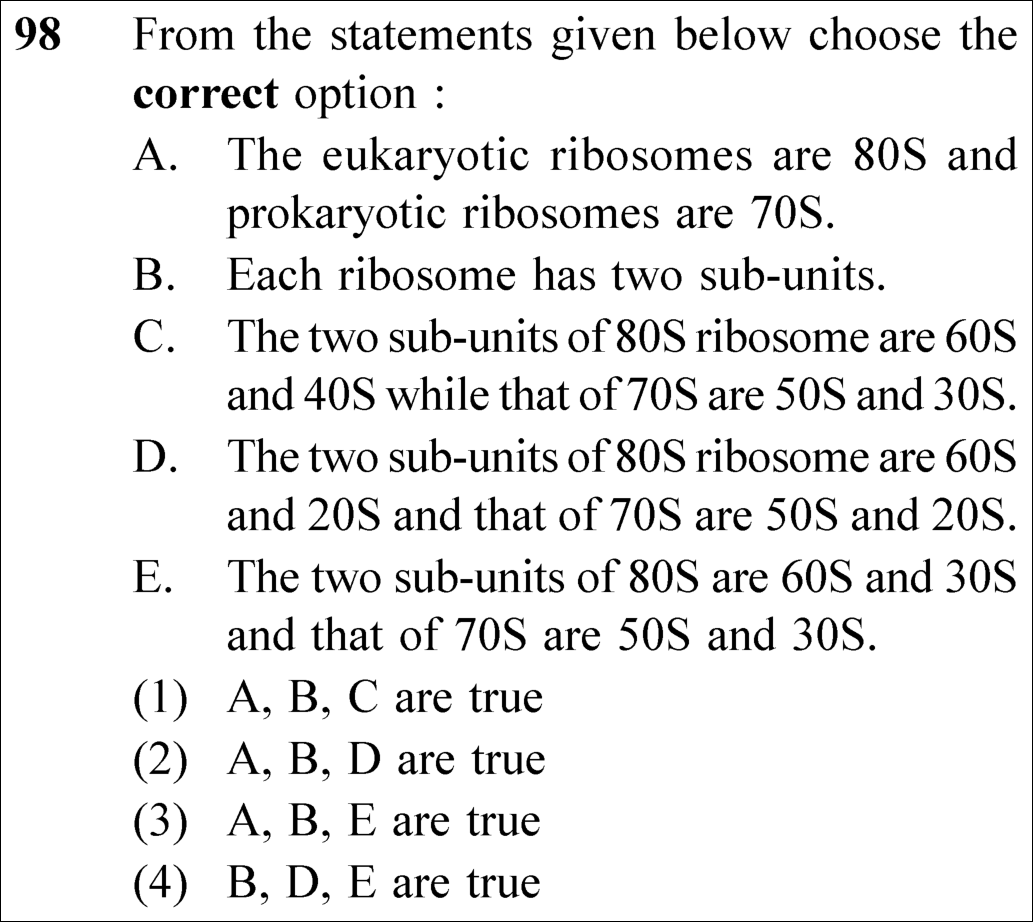
NEET 2025 · Q98 Easy
Official NEET 2025 Question 98 - Cell: The Unit of Life
1 ✓ Key
2
3
4
💡 Verified Solution & 30-Second Hack
✓
Verified Against NTA Final Answer Key
Option (1) : A, B, C are true
📚 Cell: The Unit of Life Easy
📋 Given Parameters & Problem Setup
Statement A The eukaryotic ribosomes are 80S and prokaryotic ribosomes are 70S. (True)
Statement B Each ribosome has two sub-units. (True: one large, one small)
Statement C The two sub-units of 80S ribosome are 60S and 40S while that of 70S are 50S and 30S. (True)
Statement D The two sub-units of 80S ribosome are 60S and 20S... (False)
Statement E The two sub-units of 80S are 60S and 30S... (False)
⚡

The 30-Second Exam Hall Shortcut: ⚡ Svedberg Subunit Arithmetic Check

⏱️ Save ~25 seconds

80S = 60S (large) + 40S (small)! 70S = 50S (large) + 30S (small)! Statements A, B, and C are completely accurate! Statements D and E feature false subunit arithmetic! ⟹ A, B, C are true!

1 Check Statement A: Cytoplasmic eukaryotic ribosomes are 80S; prokaryotic ribosomes are 70S (also in chloroplasts/mitochondria). Statement A is TRUE.
2 Check Statement B: Every ribosome consists of two unequal ribonucleoprotein subunits (one large, one small). Statement B is TRUE.
3 Check Statement C: 80S dissociates into 60S and 40S subunits; 70S dissociates into 50S and 30S subunits. Statement C is TRUE.
4 Check Statements D and E: They list erroneous subunit combinations (60S/20S or 60S/30S). Both D and E are FALSE.
5 Conclusion: A, B, C are true.
6 Select Option (1) in under 10 seconds!
🛡️
Why You Can 100% Trust This Shortcut: Ribosomal Subunits & Sedimentation Coefficients (NCERT Biology · Cell: The Unit of Life: Prokaryotic 70S vs Eukaryotic 80S).
📐

Step-by-Step Rigorous Workflow & Mathematical Proof

Step 1

Review Ribosome Classification and Svedberg Units

Ribosomes are granular ribonucleoprotein particles discovered by George Palade (1953). The sedimentation coefficient 'S' (Svedberg unit) measures sedimentation rate during ultracentrifugation, reflecting density and size:

Prokaryotic Ribosome=70S,Eukaryotic Ribosome=80S\text{Prokaryotic Ribosome} = 70S, \quad \text{Eukaryotic Ribosome} = 80S
  • • Statement A is completely TRUE.
Step 2

Structural Composition into Subunits

Each functional ribosome consists of two non-identical subunits that associate in the presence of magnesium ions (Mg²⁺):

80S=60S (large)+40S (small),70S=50S (large)+30S (small)80S = 60S \text{ (large)} + 40S \text{ (small)}, \quad 70S = 50S \text{ (large)} + 30S \text{ (small)}
  • • Statement B is TRUE (each ribosome has two subunits).
  • • Statement C is TRUE (80S has 60S + 40S; 70S has 50S + 30S).
  • • Svedberg units are not additive because sedimentation rate depends on surface area and molecular friction as well as mass.
Step 3

Evaluate Statements D and E

Statements D and E propose incorrect subunit values:

80S≠60S+20Sand80S≠60S+30S80S \neq 60S + 20S \quad \text{and} \quad 80S \neq 60S + 30S
  • • Statements D and E are unequivocally FALSE.
  • • Therefore, A, B, C are true, matching Option (1).
⭐

360° Option Elimination Engine Key Feature

Diagnose every choice: Know exactly why the right option works and why distractors fail.

4-Option Deep Scan
1 A
✓ 100% Correct
Verdict & Scientific Reason:

100% correct. Direct canonical facts on 70S and 80S ribosomes and their constituent subunits.

💡
Why this is airtight: None; flawless recall of cell biology.
2 B
✗ Incorrect
Verdict & Scientific Reason:

Incorrect. Statement D is false.

⚠️
Student Fallacy (Why candidates pick this trap): Believing small subunit of 80S is 20S.
3 C
✗ Incorrect
Verdict & Scientific Reason:

Incorrect. Statement E is false.

⚠️
Student Fallacy (Why candidates pick this trap): Believing small subunit of 80S is 30S.
4 D
✗ Incorrect
Verdict & Scientific Reason:

Incorrect. Statements D and E are false, and A is omitted.

⚠️
Student Fallacy (Why candidates pick this trap): Multiple errors.
⚠️

NTA Trap Alert: Treating Svedberg Units as Ordinary Additive Numbers

Students often expect 60 + 40 = 100S or 50 + 30 = 80S. But Svedberg unit (S) is a sedimentation rate coefficient, not a simple mass addition! 60S + 40S forms an 80S ribosome, and 50S + 30S forms a 70S ribosome!

🛡️ How to avoid the -1 mark: Remember: 70S = 50S + 30S; 80S = 60S + 40S!
📖

Core NEET Syllabus Standard

NEET Biology Core Syllabus · Cell: The Unit of Life Standard Benchmark
Core Scientific Principle Tested:

"Prokaryotes have 70S (50S+30S); Eukaryotes have 80S (60S+40S)."

Syllabus Focus: Ribosomes: Structure and Subunits
✓ Core NEET UG Syllabus Anchor Syllabus & Academic Standards ↗
Even numbers for Eukaryotes: 40, 60, 80! Odd numbers for Prokaryotes: 30, 50, 70 ⟹ A, B, C true!
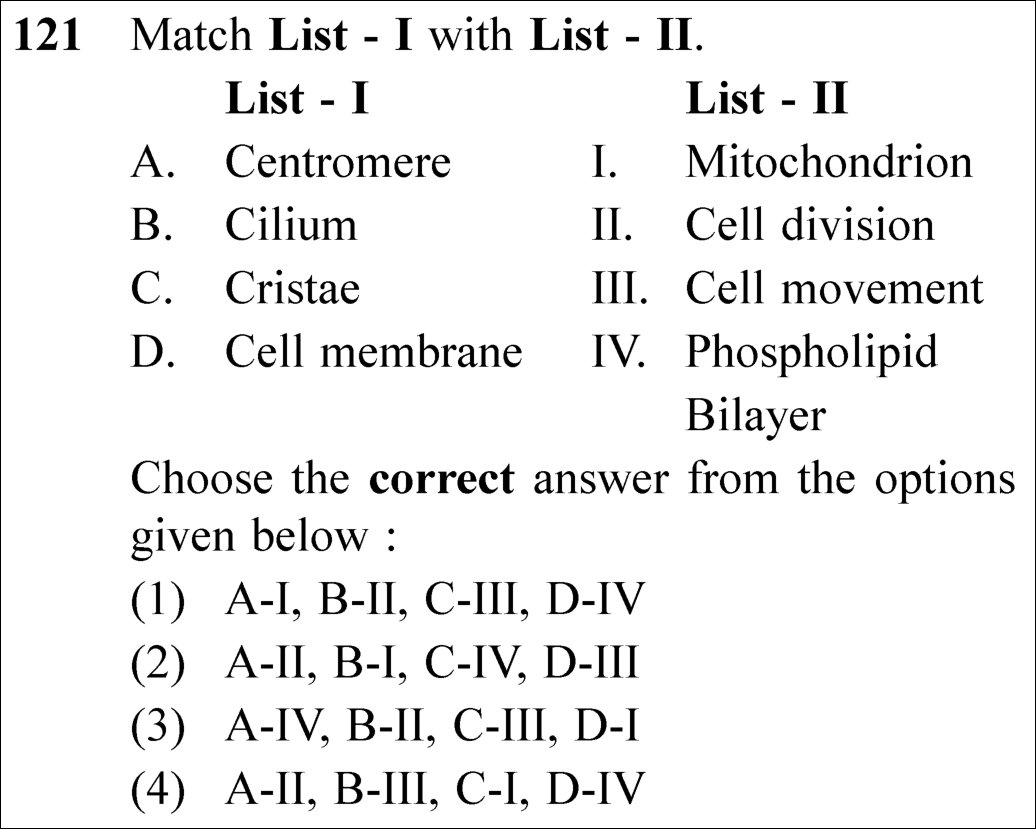
NEET 2025 · Q121 Easy
Official NEET 2025 Question 121 - Cell: The Unit of Life
1
2
3
4 ✓ Key
💡 Verified Solution & 30-Second Hack
✓
Verified Against NTA Final Answer Key
Option (4) : A-II, B-III, C-I, D-IV
📚 Cell: The Unit of Life Easy
📋 Given Parameters & Problem Setup
List - I (Cellular Structures) A. Centromere, B. Cilium, C. Cristae, D. Cell membrane
List - II (Associations / Functions) I. Mitochondrion, II. Cell division, III. Cell movement, IV. Phospholipid Bilayer
⚡

The 30-Second Exam Hall Shortcut: ⚡ Cell Biology Match Fingerprint

⏱️ Save ~30 seconds

Centromere = Spindle attachment in Cell division (II); Cilium = 9+2 axoneme for Cell movement (III); Cristae = Infoldings of Mitochondrion (I); Cell membrane = Phospholipid Bilayer (IV)!

1 Perform instant one-to-one pairings from NCERT:
2 - Centromere: Primary constriction holding sister chromatids; kinetochores attach spindle fibres during Cell division (A -> II).
3 - Cilium: Microtubular hair-like projection causing locomotion of cell or fluid (B -> III).
4 - Cristae: Shelf-like infoldings of inner mitochondrial membrane increasing surface area in Mitochondrion (C -> I).
5 - Cell membrane: Singer-Nicolson fluid mosaic model consisting of a Phospholipid Bilayer (D -> IV).
6 Unique combination: A-II, B-III, C-I, D-IV -> Option (4)!
7 Solved in 5 seconds!
🛡️
Why You Can 100% Trust This Shortcut: Eukaryotic Endomembrane System Components (NCERT Biology · Cell: The Unit of Life: ER, Golgi, Lysosomes, Vacuoles).
📐

Step-by-Step Rigorous Workflow & Mathematical Proof

Step 1

Anatomy of the Paired Structures

Examine each cellular component and its definitive physiological/structural hallmark:

  • • A. Centromere: Every chromosome essentially has a primary constriction called the centromere on the sides of which disc-shaped structures called kinetochores are present. These serve as the sites of attachment of spindle fibres during cell division (mitosis and meiosis) to direct chromosome segregation. Hence, A matches II.
  • • B. Cilium: Cilia are small hair-like structures which work like oars, causing the movement of either the cell or the surrounding fluid (cell movement/motility). Hence, B matches III.
  • • C. Cristae: The inner membrane of a mitochondrion forms a number of infoldings called cristae towards the matrix, which increase the surface area for ATP-generating electron transport complexes. Hence, C matches I.
  • • D. Cell membrane: The basic framework of the plasma membrane is a quasi-fluid bimolecular layer of amphipathic phospholipids (phospholipid bilayer) with embedded proteins. Hence, D matches IV.
Step 2

Assembling the Matching Matrix

Combining the verified associations:

  • • A -> II (Cell division)
  • • B -> III (Cell movement)
  • • C -> I (Mitochondrion)
  • • D -> IV (Phospholipid Bilayer)
Step 3

Conclusion

The correct matching option is A-II, B-III, C-I, D-IV, exactly matching Option (4).

Matching: A-II,  B-III,  C-I,  D-IV\text{Matching: } A\text{-II}, \; B\text{-III}, \; C\text{-I}, \; D\text{-IV}
⭐

360° Option Elimination Engine Key Feature

Diagnose every choice: Know exactly why the right option works and why distractors fail.

4-Option Deep Scan
1 A
✗ Incorrect
Verdict & Scientific Reason:

Incorrect. Assigns mitochondrion to centromere and cell division to cilium.

⚠️
Student Fallacy (Why candidates pick this trap): Complete confusion between organellar terms.
2 B
✗ Incorrect
Verdict & Scientific Reason:

Incorrect. Links cilium to mitochondrion and cristae to phospholipid bilayer.

⚠️
Student Fallacy (Why candidates pick this trap): Misassigning cristae to membrane lipids.
3 C
✗ Incorrect
Verdict & Scientific Reason:

Incorrect. Links centromere to phospholipid bilayer and cell membrane to mitochondrion.

⚠️
Student Fallacy (Why candidates pick this trap): Gross misalignment of fundamental cell components.
4 D
✓ 100% Correct
Verdict & Scientific Reason:

100% correct. Correctly associates all 4 cellular structures with their textbook characteristics.

💡
Why this is airtight: None; pristine cytology recall.
⚠️

NTA Trap Alert: Cristae vs Cisternae

Do not confuse CRISTAE (infoldings of the inner membrane of mitochondria) with CISTERNAE (flattened disc-shaped sacs of the Golgi apparatus or endoplasmic reticulum)!

🛡️ How to avoid the -1 mark: Cristae = Mitochondria (respiration); Cisternae = Golgi apparatus (packaging).
📖

Core NEET Syllabus Standard

NEET Biology Core Syllabus · Cell: The Unit of Life Standard Benchmark
Core Scientific Principle Tested:

"Centromere coordinates chromosome segregation during cell division, cilia mediate motility, cristae expand inner mitochondrial membrane area, and cell membranes are phospholipid bilayers."

Syllabus Focus: Cell Organelles · Structure and Function
✓ Core NEET UG Syllabus Anchor Syllabus & Academic Standards ↗
C-Division (Centromere), C-Motion (Cilium), C-Mito (Cristae), C-Bilayer (Cell membrane)!
NEET 2025 · Q128 Easy
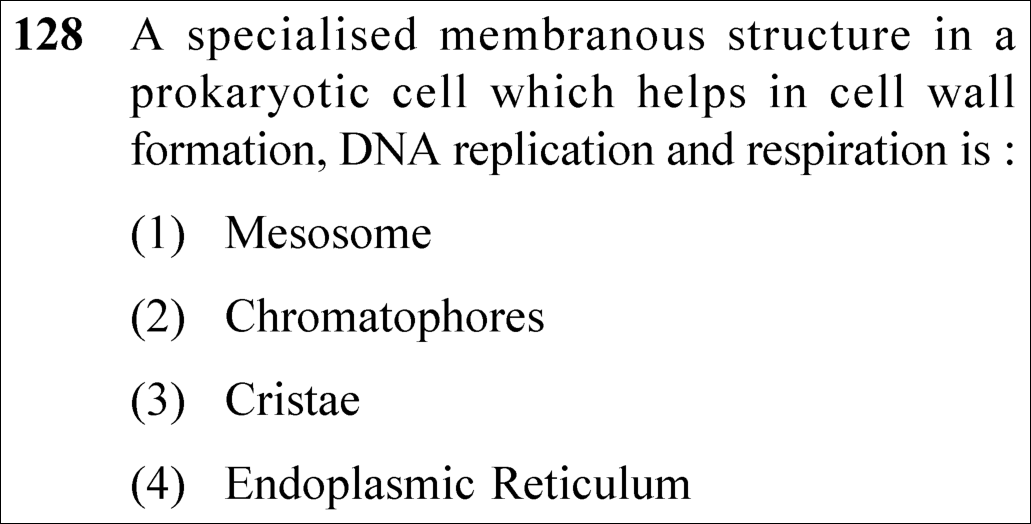
Official NEET 2025 Question 128 - Cell: The Unit of Life
1 Mesosome ✓ Key
2 Chromatophores
3 Cristae
4 Endoplasmic Reticulum
💡 Verified Solution & 30-Second Hack
✓
Verified Against NTA Final Answer Key
Option (1) : Mesosome
📚 Cell: The Unit of Life Easy
📋 Given Parameters & Problem Setup
Cell Type Prokaryotic cell (Bacteria)
Structure Nature Specialised membranous structure formed by plasma membrane extension
Functions Cell wall formation, DNA replication, and respiration
⚡

The 30-Second Exam Hall Shortcut: ⚡ Prokaryotic Mesosome Fingerprint

⏱️ Save ~20 seconds

Prokaryotic plasma membrane invagination that helps in cell wall formation, DNA replication, and cellular respiration = MESOSOME (analogous to eukaryotic mitochondria)!

1 Recall NCERT Section "Cell Envelope and its Modifications":
2 - "A special membranous structure is the mesosome which is formed by the extensions of plasma membrane into the cell."
3 - "They help in cell wall formation, DNA replication and distribution to daughter cells. They also help in respiration, secretion processes, to increase the surface area of the plasma membrane and enzymatic content."
4 - Matches MESOSOME verbatim!
5 Select Option (1) Mesosome!
🛡️
Why You Can 100% Trust This Shortcut: Fluid Mosaic Model of Plasma Membrane (NCERT Biology · Cell: The Unit of Life: Singer and Nicolson quasifluid lipid bilayer).
📐

Step-by-Step Rigorous Workflow & Mathematical Proof

Step 1

Definition and Morphology of Mesosomes

In prokaryotes, membrane-bound organelles (like mitochondria, Golgi apparatus, ER) are absent. Instead, extensions of the plasma membrane invaginate into the cytoplasm to form specialised membranous structures called mesosomes:

  • • These extensions can be in the form of vesicles, tubules, and lamellae.
  • • They are characteristic features of prokaryotes (predominantly Gram-positive bacteria).
Step 2

Multiple Physiological Functions of Mesosomes

According to NCERT, mesosomes perform vital coordinated cellular roles:

  • • 1. Cell wall synthesis: Assist in synthesizing and assembling peptidoglycan layers.
  • • 2. DNA replication and segregation: Help in anchoring the bacterial chromosome during binary fission and distributing replicated DNA to daughter cells.
  • • 3. Respiration: Carry respiratory electron transport chains and dehydrogenases (functioning analogous to mitochondrial cristae).
  • • 4. Secretion processes and surface area enhancement for enzymatic activities.
Step 3

Elimination of Distractors

Evaluating the other options:

  • • Chromatophores: Pigment-containing membrane extensions in photosynthetic prokaryotes (e.g. cyanobacteria).
  • • Cristae: Infoldings of the inner membrane of mitochondria in eukaryotic cells.
  • • Endoplasmic Reticulum: A eukaryotic endomembrane network, completely absent in prokaryotes.
Step 4

Conclusion

The prokaryotic membranous structure responsible for cell wall synthesis, DNA replication, and respiration is the Mesosome.

Prokaryotic Structure=Mesosome\text{Prokaryotic Structure} = \text{Mesosome}
⭐

360° Option Elimination Engine Key Feature

Diagnose every choice: Know exactly why the right option works and why distractors fail.

4-Option Deep Scan
1 A
✓ 100% Correct
Verdict & Scientific Reason:

100% correct. Direct verbatim NCERT description of mesosomal functions.

💡
Why this is airtight: None; textbook mastery.
2 B
✗ Incorrect
Verdict & Scientific Reason:

Incorrect. Chromatophores contain photosynthetic pigments in photosynthetic prokaryotes, not respiratory/DNA machinery.

⚠️
Student Fallacy (Why candidates pick this trap): Confusing photosynthetic prokaryotic membranes with respiratory mesosomes.
3 C
✗ Incorrect
Verdict & Scientific Reason:

Incorrect. Cristae are eukaryotic mitochondrial structures, absent in prokaryotes.

⚠️
Student Fallacy (Why candidates pick this trap): Selecting a eukaryotic organelle component for a prokaryotic question.
4 D
✗ Incorrect
Verdict & Scientific Reason:

Incorrect. Endoplasmic reticulum is strictly eukaryotic and absent in all prokaryotes.

⚠️
Student Fallacy (Why candidates pick this trap): Overlooking the fundamental prokaryotic premise.
⚠️

NTA Trap Alert: Prokaryotic vs Eukaryotic Respiratory Membranes

Eukaryotes use mitochondrial cristae for respiration. Prokaryotes lack mitochondria, so they use plasma membrane invaginations known as MESOSOMES. Do not pick Cristae for a prokaryotic cell!

🛡️ How to avoid the -1 mark: Prokaryote + Respiration/DNA replication = Mesosome.
📖

Core NEET Syllabus Standard

NEET Biology Core Syllabus · Cell: The Unit of Life Standard Benchmark
Core Scientific Principle Tested:

"Mesosomes are plasma membrane extensions in prokaryotes that assist in cell wall formation, DNA replication, and respiration."

Syllabus Focus: Prokaryotic Cells · Cell Envelope and its Modifications
✓ Core NEET UG Syllabus Anchor Syllabus & Academic Standards ↗
MESOSOME = Membrane Extension Serving Organelle-like Metabolism (Wall, DNA, Respiration)!
NEET 2025 · Q140 Medium
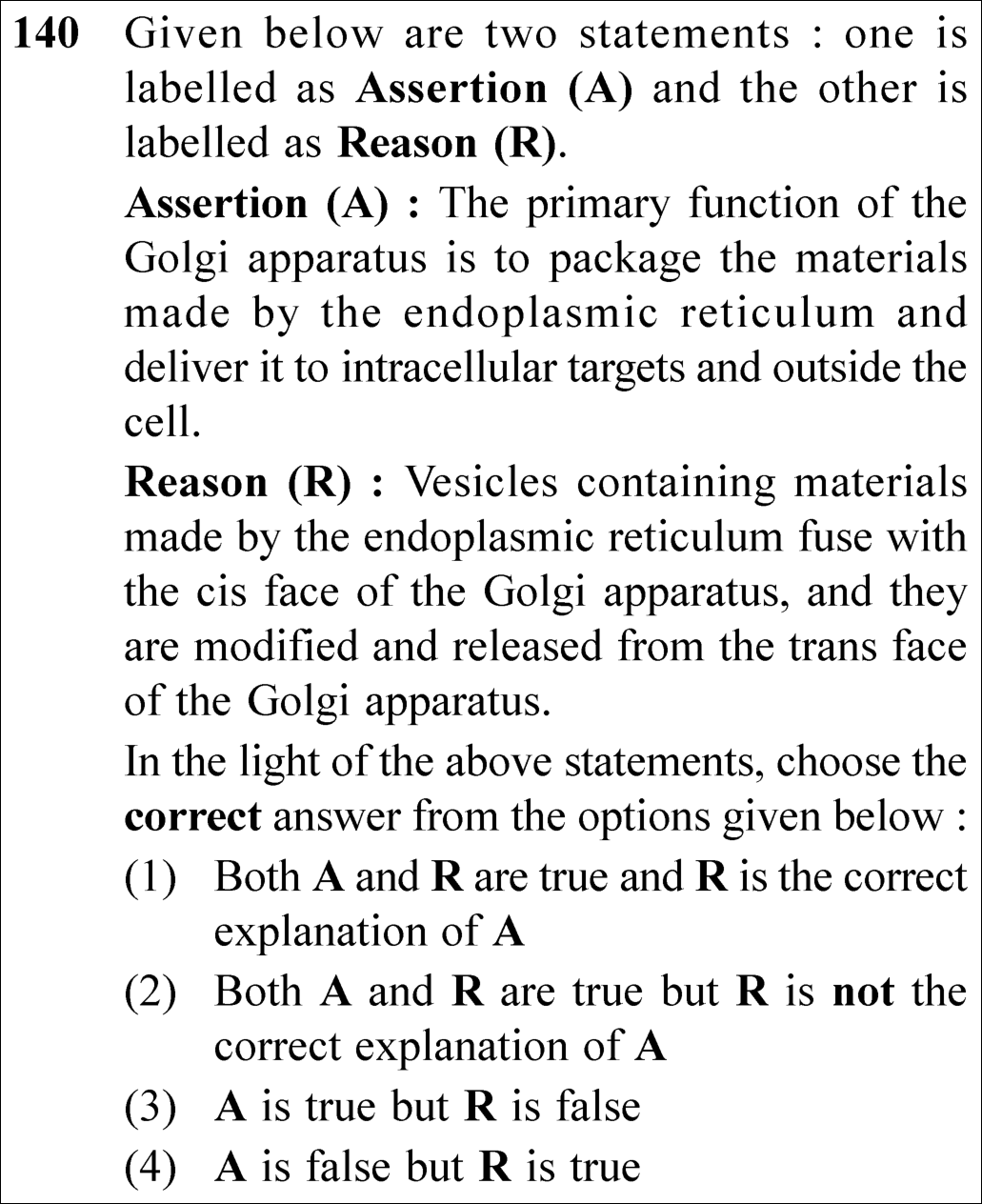
Official NEET 2025 Question 140 - Cell: The Unit of Life
1 Both A and R are true and R is the correct explanation of A ✓ Key
2 Both A and R are true but R is not the correct explanation of A
3 A is true but R is false
4 A is false but R is true
💡 Verified Solution & 30-Second Hack
✓
Verified Against NTA Final Answer Key
Option (1) : Both A and R are true and R is the correct explanation of A
📚 Cell: The Unit of Life Medium
📋 Given Parameters & Problem Setup
Assertion (A) The primary function of Golgi apparatus is to package materials made by ER and deliver them to intracellular targets and outside the cell.
Reason (R) Vesicles containing materials made by ER fuse with cis face of Golgi apparatus, are modified and released from trans face.
⚡

The 30-Second Exam Hall Shortcut: ⚡ Golgi Polar Packaging Fingerprint

⏱️ Save ~30 seconds

Assertion is TRUE (Golgi packages ER products for delivery)! Reason is TRUE (Cis face receives transition vesicles, trans face discharges mature secretory vesicles)! R explains HOW Golgi performs packaging! Both true & R explains A!

1 Analyze Assertion (A):
2 - "The Golgi apparatus principally performs the function of packaging materials, to be delivered either to the intra-cellular targets or secreted outside the cell." -> NCERT verbatim TRUE!
3 Analyze Reason (R):
4 - "Materials to be packaged in the form of vesicles from the ER fuse with the cis face of the golgi apparatus and move towards the maturing face (trans face)... and released from trans face." -> NCERT verbatim TRUE!
5 Check explanation link:
6 - Why is Golgi's primary function packaging and trafficking ER products? Because ER vesicles fuse with the cis face, undergo maturation/glycosylation, and bud off the trans face to reach their target destinations!
7 Conclusion: Both A and R are true and R is the correct explanation of A.
8 Select Option (1)!
🛡️
Why You Can 100% Trust This Shortcut: Golgi Apparatus Polar Cis vs Trans Organization (NCERT Biology · Cell: The Unit of Life: Cis forming face, trans maturing face).
📐

Step-by-Step Rigorous Workflow & Mathematical Proof

Step 1

Analysis of Assertion (A)

The endomembrane system functions as an integrated secretory conduit:

  • • Proteins and lipids synthesized in the rough and smooth endoplasmic reticulum (RER and SER) must be post-translationally modified, sorted, and routed.
  • • The Golgi apparatus principally performs the function of packaging these materials into membrane-bound vesicles, targeting them either to specific intracellular destinations (e.g., lysosomes) or secreting them extracellularly via exocytosis.
  • • Therefore, Assertion (A) is completely TRUE.
Step 2

Analysis of Reason (R)

Structural and functional polarity of Golgi cisternae:

  • • Golgi cisternae are concentrically arranged near the nucleus with distinct polarity: a convex forming face (*cis* face) and a concave maturing face (*trans* face).
  • • Vesicles transport synthesized proteins/lipids from the ER and fuse with the *cis* face.
  • • As these cargo molecules transit through the medial cisternae, they undergo crucial biochemical modifications (e.g., glycosylation into glycoproteins and glycolipids).
  • • Finally, the modified molecules are pinched off in secretory vesicles from the *trans* face.
  • • Therefore, Reason (R) is completely TRUE.
Step 3

Causal Correlation

Reason (R) describes the exact mechanistic basis of how the Golgi apparatus functions as the cell's packaging and distribution center for ER products. Hence, Reason (R) is the correct explanation of Assertion (A).

ER→vesiclescis-Golgi→modificationtrans-Golgi→deliveryTarget\text{ER} \xrightarrow{\text{vesicles}} \text{cis-Golgi} \xrightarrow{\text{modification}} \text{trans-Golgi} \xrightarrow{\text{delivery}} \text{Target}
⭐

360° Option Elimination Engine Key Feature

Diagnose every choice: Know exactly why the right option works and why distractors fail.

4-Option Deep Scan
1 A
✓ 100% Correct
Verdict & Scientific Reason:

100% correct. Accurately identifies both statements as true and establishes the cause-and-effect relationship.

💡
Why this is airtight: None; textbook mastery of the endomembrane system.
2 B
✗ Incorrect
Verdict & Scientific Reason:

Incorrect. The mechanism of cis-to-trans transit in R directly explains how packaging and routing in A occur.

⚠️
Student Fallacy (Why candidates pick this trap): Failing to see that transit mechanism explains packaging function.
3 C
✗ Incorrect
Verdict & Scientific Reason:

Incorrect. Reason R is a verbatim NCERT description.

⚠️
Student Fallacy (Why candidates pick this trap): Doubting the cis/trans polarity of Golgi apparatus.
4 D
✗ Incorrect
Verdict & Scientific Reason:

Incorrect. Assertion A is a foundational biological truth.

⚠️
Student Fallacy (Why candidates pick this trap): Denying the packaging role of Golgi.
⚠️

NTA Trap Alert: Cis vs Trans Face Polarity

Remember the direction: CIS face = Forming / receiving face (faces ER); TRANS face = Maturing / shipping face (faces plasma membrane). Cargo always moves Cis -> Trans!

🛡️ How to avoid the -1 mark: C comes before T: Cis receives, Trans transmits.
📖

Core NEET Syllabus Standard

NEET Biology Core Syllabus · Cell: The Unit of Life Standard Benchmark
Core Scientific Principle Tested:

"Golgi apparatus packages ER-derived materials by receiving them at the cis face, modifying them, and dispatching them from the trans face."

Syllabus Focus: Endomembrane System · Golgi Apparatus
✓ Core NEET UG Syllabus Anchor Syllabus & Academic Standards ↗
CIS receives from ER, TRANS ships to the world: Perfect Explanation!
NEET 2024 · Q112 Easy
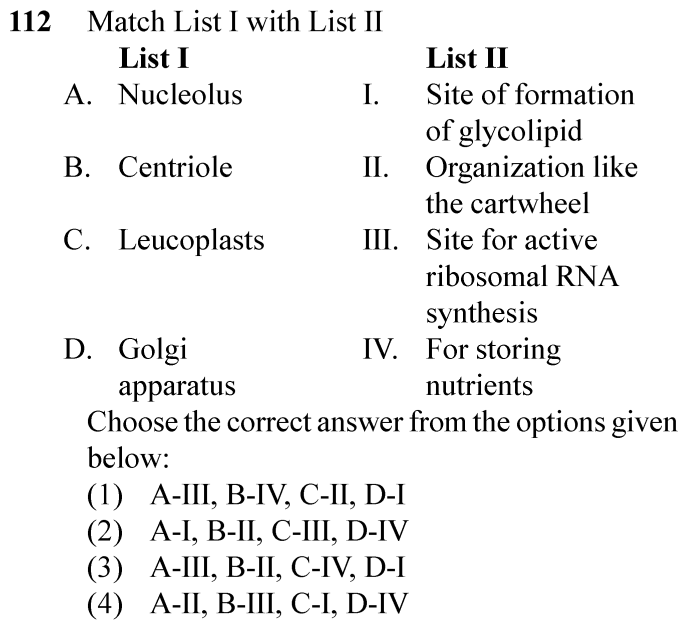
Official NEET 2024 Question 112 - Cell: The Unit of Life
1
2
3 ✓ Key
4
💡 Verified Solution & 30-Second Hack
✓
Verified Against NTA Final Answer Key
Option (3) : A-III, B-II, C-IV, D-I
📚 Cell: The Unit of Life Easy
📋 Given Parameters & Problem Setup
List I (Cellular Structures) A: Nucleolus; B: Centriole; C: Leucoplasts; D: Golgi apparatus
List II (Functions / Structural Features) I: Site of formation of glycolipids; II: Cartwheel appearance; III: Site of active ribosomal RNA synthesis; IV: Store nutrients
⚡

The 30-Second Exam Hall Shortcut: ⚡ Organelle Landmark Association

⏱️ Save ~25 seconds

Nucleolus = rRNA synthesis (III), Centriole = 9+0 cartwheel (II), Leucoplast = storage (IV), Golgi = glycolipids/glycoproteins (I). Match: A-III, B-II, C-IV, D-I!

1 A. Nucleolus: non-membrane bound site for active rRNA synthesis (III).
2 B. Centriole: exhibits distinct 9+0 peripheral triplet "cartwheel" organization (II).
3 C. Leucoplasts: colourless plastids that store nutrients (amyloplasts, elaioplasts, aleuroplasts) (IV).
4 D. Golgi apparatus: major site of glycosylation forming glycolipids and glycoproteins (I).
5 Matching order: A-III, B-II, C-IV, D-I -> Option (3) / C.
🛡️
Why You Can 100% Trust This Shortcut: NCERT Biology · Cell: The Unit of Life (Endomembrane System and Cytoskeleton)
📐

Step-by-Step Rigorous Workflow & Mathematical Proof

Step 1

Match Nucleolus Function

The nucleolus is a dense membraneless region in the nucleoplasm that serves as the site of active ribosomal RNA (rRNA) synthesis (A -> III).

Step 2

Match Centriole Ultrastructure

Centrioles are cylindrical structures made of nine evenly spaced peripheral triplets of tubulin fibrils, arranged like a cartwheel (9+0 pattern) (B -> II).

Step 3

Match Leucoplast and Golgi Functions

Leucoplasts are colourless plastids specialized for nutrient storage (C -> IV). Golgi apparatus packages and modifies proteins, serving as the critical site for the formation of glycoproteins and glycolipids (D -> I).

⭐

360° Option Elimination Engine Key Feature

Diagnose every choice: Know exactly why the right option works and why distractors fail.

4-Option Deep Scan
1 (1)
✗ Incorrect
Verdict & Scientific Reason:

Assigns cartwheel appearance to nucleolus.

⚠️
Student Fallacy (Why candidates pick this trap): Assigns cartwheel appearance to nucleolus.
2 (2)
✗ Incorrect
Verdict & Scientific Reason:

Mismatches centriole with nutrient storage.

⚠️
Student Fallacy (Why candidates pick this trap): Mismatches centriole with nutrient storage.
3 (3)
✓ 100% Correct
Verdict & Scientific Reason:

Accurately pairs all four organelles/structures with their structural features and functions.

💡
Why this is airtight: None.
4 (4)
✗ Incorrect
Verdict & Scientific Reason:

Mismatches nucleolus with glycolipid formation.

⚠️
Student Fallacy (Why candidates pick this trap): Mismatches nucleolus with glycolipid formation.
⚠️

NTA Trap Alert: Centrosome vs Centriole Confusion

Forgetting the 9+0 cartwheel structure of centrioles.

🛡️ How to avoid the -1 mark: Remember that both centrioles in a centrosome lie perpendicular to each other, each possessing a cartwheel-like organization.
📖

Core NEET Syllabus Standard

Biology Core Botany · Cell: The Unit of Life Standard Benchmark
Core Scientific Principle Tested:

"Nucleolus is a site for active ribosomal RNA synthesis. Both the centrioles in a centrosome lie perpendicular to each other in which each has an organisation like the cartwheel. Golgi apparatus is the important site of formation of glycoproteins and glycolipids."

Syllabus Focus: Organelle Structure and Characteristic Biomolecular Roles
✓ Core NEET UG Syllabus Anchor Syllabus & Academic Standards ↗
NEET 2024 · Q137 Easy
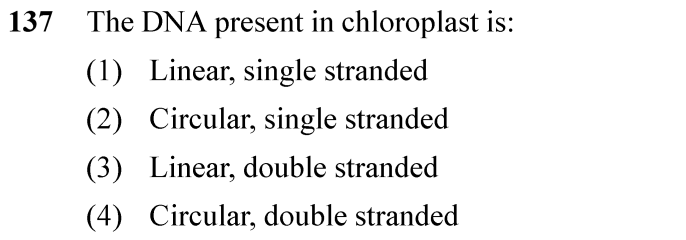
Official NEET 2024 Question 137 - Cell: The Unit of Life
1 Linear, single stranded
2 Circular, single stranded
3 Linear, double stranded
4 Circular, double stranded ✓ Key
💡 Verified Solution & 30-Second Hack
✓
Verified Against NTA Final Answer Key
Option (4) : Circular, double stranded
📚 Cell: The Unit of Life Easy
📋 Given Parameters & Problem Setup
Organelle Chloroplast
Biomolecule Chloroplast DNA (cpDNA / plastome)
⚡

The 30-Second Exam Hall Shortcut: ⚡ Organellar DNA Rule (Prokaryotic Signature)

⏱️ Save ~15 seconds

Both Chloroplast and Mitochondria DNA are CIRCULAR and DOUBLE-STRANDED (dsDNA), reflecting their endosymbiotic prokaryotic origin!

1 Recall organellar DNA characteristics in NCERT:
2 - Chloroplast stroma contains small, double-stranded circular DNA molecules.
3 - Mitochondria also contain a single circular double-stranded DNA molecule.
4 - Conformation: Circular, double stranded.
5 Select Option (4) / D.
🛡️
Why You Can 100% Trust This Shortcut: NCERT Biology · Cell: The Unit of Life (Plastids and Chloroplast DNA)
📐

Step-by-Step Rigorous Workflow & Mathematical Proof

Step 1

Review Chloroplast Ultrastructure and Contents

The stroma of the chloroplast contains enzymes required for the synthesis of carbohydrates and proteins. It also contains small, double-stranded circular DNA molecules and ribosomes.

Step 2

Endosymbiotic Evolutionary Context

Plastids and mitochondria evolved from endosymbiotic prokaryotes. As in bacteria, their genetic material consists of closed circular double-stranded DNA (dsDNA), distinct from the linear chromatin of the eukaryotic nucleus.

Step 3

Conclude Molecular Conformation

Chloroplast DNA is circular and double stranded, matching Option (4).

⭐

360° Option Elimination Engine Key Feature

Diagnose every choice: Know exactly why the right option works and why distractors fail.

4-Option Deep Scan
1 (1)
✗ Incorrect
Verdict & Scientific Reason:

Chloroplast DNA is double-stranded and circular, not single-stranded linear.

⚠️
Student Fallacy (Why candidates pick this trap): Chloroplast DNA is double-stranded and circular, not single-stranded linear.
2 (2)
✗ Incorrect
Verdict & Scientific Reason:

Plastid genomes are double-stranded duplexes.

⚠️
Student Fallacy (Why candidates pick this trap): Plastid genomes are double-stranded duplexes.
3 (3)
✗ Incorrect
Verdict & Scientific Reason:

Nuclear chromosomes are linear double-stranded DNA; organellar genomes are circular.

⚠️
Student Fallacy (Why candidates pick this trap): Nuclear chromosomes are linear double-stranded DNA; organellar genomes are circular.
4 (4)
✓ 100% Correct
Verdict & Scientific Reason:

Chloroplasts possess small, circular, double-stranded DNA molecules in their stroma.

💡
Why this is airtight: None.
⚠️

NTA Trap Alert: Linear Nuclear vs Circular Organellar DNA

Assuming eukaryotic cells have only linear double-stranded DNA throughout.

🛡️ How to avoid the -1 mark: Eukaryotic nuclear DNA is linear dsDNA; mitochondrial and chloroplast DNA is circular dsDNA.
📖

Core NEET Syllabus Standard

Biology Core Botany · Cell: The Unit of Life Standard Benchmark
Core Scientific Principle Tested:

"The stroma of the chloroplast contains enzymes required for the synthesis of carbohydrates and proteins. It also contains small, double-stranded circular DNA molecules and ribosomes."

Syllabus Focus: Plastid Semiautonomy: Conformation of Chloroplast DNA
✓ Core NEET UG Syllabus Anchor Syllabus & Academic Standards ↗
NEET 2024 · Q169 Easy
Official NEET 2024 Question 169 - Cell: The Unit of Life
1
2 ✓ Key
3
4
💡 Verified Solution & 30-Second Hack
✓
Verified Against NTA Final Answer Key
Option (2) : A-II, B-I, C-IV, D-III
📚 Cell: The Unit of Life Easy
📋 Given Parameters & Problem Setup
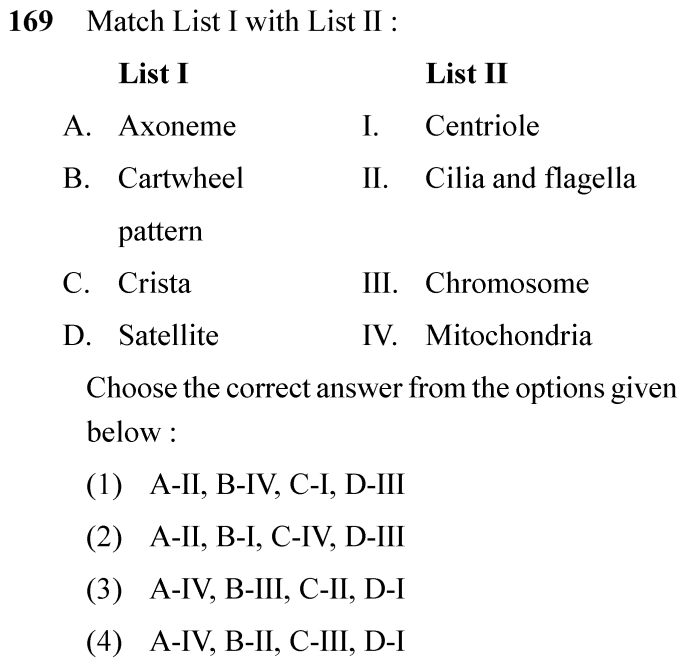
List I (Structural Features) A: Axoneme; B: Cartwheel pattern; C: Crista; D: Satellite
List II (Cellular Structures) I: Centriole; II: Cilia and flagella; III: Chromosome; IV: Mitochondria
⚡

The 30-Second Exam Hall Shortcut: ⚡ Cytological Landmark Matching

⏱️ Save ~25 seconds

Axoneme = Core of cilia & flagella (9+2) (II); Cartwheel = Centriole (9+0) (I); Cristae = Infoldings of mitochondria (IV); Satellite = Chromosome secondary constriction (III)! Match: A-II, B-I, C-IV, D-III!

1 A. Axoneme: The core of cilia and flagella containing microtubules (II).
2 B. Cartwheel pattern: Structural organization of centriole triplets (I).
3 C. Crista: Infoldings of inner mitochondrial membrane (IV).
4 D. Satellite: Terminal small chromosomal fragment beyond non-staining secondary constriction (III).
5 Matching order: A-II, B-I, C-IV, D-III -> Option (2) / B.
🛡️
Why You Can 100% Trust This Shortcut: NCERT Biology · Cell: The Unit of Life (Organelles and Chromosome Structure)
📐

Step-by-Step Rigorous Workflow & Mathematical Proof

Step 1

Match Ciliary and Centriolar Cytoskeletal Structures

The core of cilium or flagellum is called axoneme, possessing nine doublets of radially arranged peripheral microtubules and a pair of centrally located microtubules (9+29+2 array) (A -> II). The central hub and radial spokes of a centriole give it a cartwheel appearance (B -> I).

Step 2

Match Mitochondria and Chromosome Specializations

The inner membrane of a mitochondrion forms a number of infoldings called cristae towards the matrix to increase surface area (C -> IV). A few chromosomes have non-staining secondary constrictions at a constant location, giving the appearance of a small fragment called satellite (SAT chromosome) (D -> III).

Step 3

Confirm Final Option

A-II, B-I, C-IV, D-III matches Option (2).

⭐

360° Option Elimination Engine Key Feature

Diagnose every choice: Know exactly why the right option works and why distractors fail.

4-Option Deep Scan
1 (1)
✗ Incorrect
Verdict & Scientific Reason:

Mismatches Cartwheel with Mitochondria.

⚠️
Student Fallacy (Why candidates pick this trap): Mismatches Cartwheel with Mitochondria.
2 (2)
✓ 100% Correct
Verdict & Scientific Reason:

Accurately pairs all four micro-anatomical structures with their respective cell components.

💡
Why this is airtight: None.
3 (3)
✗ Incorrect
Verdict & Scientific Reason:

Mismatches Axoneme with Mitochondria.

⚠️
Student Fallacy (Why candidates pick this trap): Mismatches Axoneme with Mitochondria.
4 (4)
✗ Incorrect
Verdict & Scientific Reason:

Mismatches Axoneme with Mitochondria and Cartwheel with Cilia.

⚠️
Student Fallacy (Why candidates pick this trap): Mismatches Axoneme with Mitochondria and Cartwheel with Cilia.
⚠️

NTA Trap Alert: Axoneme vs Centriole Pattern

Swapping axoneme (9+2 in cilia/flagella) with cartwheel (9+0 in centrioles).

🛡️ How to avoid the -1 mark: Remember: Cilia/flagella have an AXONEME core; Centrioles display the CARTWHEEL pattern.
📖

Core NEET Syllabus Standard

Biology Core Zoology · Cell: The Unit of Life Standard Benchmark
Core Scientific Principle Tested:

"The core of cilium/flagellum called axoneme possesses 9+2 array... The centrioles have an organisation like the cartwheel... The inner mitochondrial membrane forms infoldings called cristae... Sometimes chromosomes have non-staining secondary constrictions forming a satellite."

Syllabus Focus: Ultrastructural Markers: Axoneme, Cartwheel, Cristae, and Satellites
✓ Core NEET UG Syllabus Anchor Syllabus & Academic Standards ↗
NEET 2024 · Q188 Medium
Official NEET 2024 Question 188 - Cell: The Unit of Life
1 ✓ Key
2
3
4
💡 Verified Solution & 30-Second Hack
✓
Verified Against NTA Final Answer Key
Option (1) : Statement I is correct but Statement II is incorrect
📚 Cell: The Unit of Life Medium
📋 Given Parameters & Problem Setup
Statement I Mitochondria and chloroplasts are both double membrane bound organelles.
Statement II Inner membrane of mitochondria is relatively less permeable, as compared to chloroplast.
⚡

The 30-Second Exam Hall Shortcut: ⚡ Organelle Double Membrane Permeability Rule

⏱️ Save ~25 seconds

Both mitochondria and chloroplasts are double-membrane bound (Statement I is TRUE). NCERT explicitly states under chloroplasts that OF THE TWO, the INNER chloroplast membrane is relatively less permeable (Statement II is INCORRECT)!

1 Statement I: Mitochondria and chloroplasts are both double membrane bound organelles -> Factually TRUE and textbook fundamental.
2 Statement II: Compares inner membrane permeability of mitochondria to chloroplast. NCERT states under plastids: "Like mitochondria, the chloroplasts are also double membrane bound. Of the two, the inner chloroplast membrane is relatively less permeable." Statement II misquotes/twists this comparison by asserting mitochondrial inner membrane is less permeable compared to chloroplast -> INCORRECT.
3 Conclusion: Statement I is correct but Statement II is incorrect -> Option (1) / A.
🛡️
Why You Can 100% Trust This Shortcut: NCERT Biology · Cell: The Unit of Life (Mitochondria and Chloroplast Membrane Architecture)
📐

Step-by-Step Rigorous Workflow & Mathematical Proof

Step 1

Evaluate Statement I (Double-Membrane Organization)

Both mitochondria and chloroplasts are semi-autonomous cell organelles enclosed by a double-membrane envelope consisting of an outer membrane and an inner membrane separated by an intermembrane space. Statement I is correct.

Step 2

Evaluate Statement II (Comparative Membrane Permeability)

In NCERT under Chloroplasts, the text states: "Like mitochondria, the chloroplasts are also double membrane bound. Of the two, the inner chloroplast membrane is relatively less permeable." This comparison is between the inner and outer membranes of the chloroplast itself. Statement II incorrectly frames this as a cross-organellar comparison between mitochondria and chloroplasts, making it factually incorrect.

Step 3

Select Resulting Option

Statement I is correct but Statement II is incorrect, matching Option (1).

⭐

360° Option Elimination Engine Key Feature

Diagnose every choice: Know exactly why the right option works and why distractors fail.

4-Option Deep Scan
1 (1)
✓ 100% Correct
Verdict & Scientific Reason:

Statement I is factually correct; Statement II distorts the NCERT comparative description of inner vs outer plastid membranes.

💡
Why this is airtight: None.
2 (2)
✗ Incorrect
Verdict & Scientific Reason:

Statement I is true.

⚠️
Student Fallacy (Why candidates pick this trap): Statement I is true.
3 (3)
✗ Incorrect
Verdict & Scientific Reason:

Statement II is incorrect.

⚠️
Student Fallacy (Why candidates pick this trap): Statement II is incorrect.
4 (4)
✗ Incorrect
Verdict & Scientific Reason:

Statement I is a fundamental biological fact.

⚠️
Student Fallacy (Why candidates pick this trap): Statement I is a fundamental biological fact.
⚠️

NTA Trap Alert: Contextual Misinterpretation of "Of the Two"

Assuming "of the two" refers to mitochondria vs chloroplasts rather than outer membrane vs inner membrane of the chloroplast.

🛡️ How to avoid the -1 mark: In NCERT, "of the two" refers specifically to the outer and inner membranes of the chloroplast.
📖

Core NEET Syllabus Standard

Biology Core Zoology · Cell: The Unit of Life Standard Benchmark
Core Scientific Principle Tested:

"Like mitochondria, the chloroplasts are also double membrane bound. Of the two, the inner chloroplast membrane is relatively less permeable."

Syllabus Focus: Double Membrane Envelope and Comparative Permeability of Organellar Membranes
✓ Core NEET UG Syllabus Anchor Syllabus & Academic Standards ↗
NEET 2023 · Q155 Easy
Official NEET 2023 Question 155 - Cell: The Unit of Life
1 Transportation
2 Nuclear division
3 Protein synthesis
4 Motility ✓ Key
💡 Verified Solution & 30-Second Hack
✓
Verified Against NTA Final Answer Key
Option (4) : Motility
📚 Cell: The Unit of Life Easy
📋 Given Parameters & Problem Setup
Cellular Structure Cytoskeleton (microfilaments, microtubules, intermediate filaments)
Task Identify canonical function
⚡

The 30-Second Exam Hall Shortcut: ⚡ Cytoskeleton Triad: Mechanical Support, Motility, Shape

⏱️ Save ~20 seconds

Verbatim NCERT sentence under Cytoskeleton: "An elaborate network of filamentous proteinaceous structures... involved in many functions such as mechanical support, motility, maintenance of the shape of the cell!" Match Option (4) Motility!

1 Cytoskeleton consists of microtubules (tubulin), microfilaments (actin), and intermediate filaments.
2 NCERT explicit functional triad: (1) Mechanical support, (2) Motility, (3) Maintenance of cell shape.
3 Cilia, flagella, and amoeboid pseudopodial movement are cytoskeletal motility mechanisms.
4 Match Option (4) Motility.
🛡️
Why You Can 100% Trust This Shortcut: Canonical NCERT Cell Biology cytoskeletal functional triad.
📐

Step-by-Step Rigorous Workflow & Mathematical Proof

Step 1

Definition and Composition of Cytoskeleton

The cytoskeleton is an elaborate eukaryotic network of proteinaceous filaments extending throughout the cytoplasm:

Cytoskeleton=Microfilaments (Actin)+Microtubules (Tubulin)+Intermediate Filaments\text{Cytoskeleton} = \text{Microfilaments (Actin)} + \text{Microtubules (Tubulin)} + \text{Intermediate Filaments}
Step 2

Verbatim NCERT Functional Roles

NCERT states verbatim: "The cytoskeleton in a cell are involved in many functions such as mechanical support, motility, maintenance of the shape of the cell."

Step 3

Evaluation of Distractor Functions

Transportation across membranes is handled by carrier proteins and vesicles; nuclear division (karyokinesis) is a broad cell division process of which spindle assembly is just one tool; protein synthesis is carried out by ribosomes, not the cytoskeleton.

⭐

360° Option Elimination Engine Key Feature

Diagnose every choice: Know exactly why the right option works and why distractors fail.

4-Option Deep Scan
1 1
✗ Incorrect
Verdict & Scientific Reason:

Intercellular and transmembrane transport is carried out by membrane transporters and vascular conduits.

⚠️
Student Fallacy (Why candidates pick this trap): Confusing motor protein cargo transport with the canonical primary textbook role.
2 2
✗ Incorrect
Verdict & Scientific Reason:

Nuclear division involves chromatin segregation and nuclear envelope reconstitution, not the sole job of the cytoskeleton.

⚠️
Student Fallacy (Why candidates pick this trap): Extrapolating the mitotic spindle to mean all of nuclear division.
3 3
✗ Incorrect
Verdict & Scientific Reason:

Protein synthesis (translation) is performed by ribosomes, mRNA, and tRNAs.

⚠️
Student Fallacy (Why candidates pick this trap): Confusing proteinaceous composition with protein synthesis.
4 4
✓ 100% Correct
Verdict & Scientific Reason:

Verbatim NCERT function: cytoskeleton directly drives cellular motility (ciliary/flagellar motion and amoeboid streaming).

💡
Why this is airtight: None; textbook verbatim.
⚠️

NTA Trap Alert: Cytoskeleton Triad Identification Trap

Students frequently fail to recognize "motility" as a cytoskeletal function because they only associate the cytoskeleton with static structural support.

🛡️ How to avoid the -1 mark: Remember the NCERT triad: Support, Motility, Shape.
📖

Core NEET Syllabus Standard

NCERT Biology · Cell: The Unit of Life Standard Benchmark
Core Scientific Principle Tested:

"The cytoskeleton in a cell are involved in many functions such as mechanical support, motility, maintenance of the shape of the cell."

Syllabus Focus: Cytoskeleton
✓ Core NEET UG Syllabus Anchor Syllabus & Academic Standards ↗
NEET 2023 · Q184 Easy
Official NEET 2023 Question 184 - Cell: The Unit of Life
1 A, D and E only
2 B and D only
3 A, C and E only ✓ Key
4 A and D only
💡 Verified Solution & 30-Second Hack
✓
Verified Against NTA Final Answer Key
Option (3) : A, C and E only
📚 Cell: The Unit of Life Easy
📋 Given Parameters & Problem Setup
Organelles Mitochondria (A), Endoplasmic Reticulum (B), Chloroplasts (C), Golgi complex (D), Peroxisomes (E)
Criterion Organelles that are NOT considered part of the endomembrane system
⚡

The 30-Second Exam Hall Shortcut: ⚡ Endomembrane System Quartet: "GERL + Vacuole"

⏱️ Save ~20 seconds

The endomembrane system includes Golgi, ER, Lysosomes, and Vacuoles because their functions are coordinated. Mitochondria (A), Chloroplasts (C), and Peroxisomes (E) are explicitly NOT part of the endomembrane system! Match Option (3) A, C and E only!

1 Recall the 4 organelles in the endomembrane system: ER, Golgi complex, Lysosomes, Vacuoles.
2 Identify the non-members: Mitochondria (A), Chloroplasts (C), Peroxisomes (E).
3 Their functions are semi-autonomous or not coordinated with ER/Golgi transport.
4 Match Option (3) A, C and E only.
🛡️
Why You Can 100% Trust This Shortcut: Canonical NCERT Cell Biology endomembrane system functional coordination criteria.
📐

Step-by-Step Rigorous Workflow & Mathematical Proof

Step 1

Definition of the Endomembrane System

The endomembrane system comprises membrane-bound organelles whose metabolic pathways and vesicular transport functions are coordinated in a continuum:

Endomembrane System=ER+Golgi Complex+Lysosomes+Vacuoles\text{\textbf{Endomembrane System}} = \mathbf{\text{ER}} + \mathbf{\text{Golgi Complex}} + \text{Lysosomes} + \text{Vacuoles}
Step 2

Verbatim NCERT Exclusion Rule

NCERT states verbatim: "While each of the membranous organelles is distinct in terms of its structure and function, many of these are considered together as an endomembrane system because their functions are coordinated. The endomembrane system include endoplasmic reticulum (ER), golgi complex, lysosomes and vacuoles. Since the functions of the mitochondria, chloroplast and peroxisomes are not coordinated with the above components, these are not considered as part of the endomembrane system."

Step 3

Conclusion

Mitochondria (A), Chloroplasts (C), and Peroxisomes (E) are not part of the system. This corresponds uniquely to Option (3).

⭐

360° Option Elimination Engine Key Feature

Diagnose every choice: Know exactly why the right option works and why distractors fail.

4-Option Deep Scan
1 1
✗ Incorrect
Verdict & Scientific Reason:

Golgi complex (D) is a quintessential core component of the endomembrane system.

⚠️
Student Fallacy (Why candidates pick this trap): Falsely excluding the Golgi complex.
2 2
✗ Incorrect
Verdict & Scientific Reason:

ER (B) and Golgi (D) ARE part of the endomembrane system; the question asks which are NOT.

⚠️
Student Fallacy (Why candidates pick this trap): Selecting the components that ARE part of the system instead of those that are NOT.
3 3
✓ 100% Correct
Verdict & Scientific Reason:

Exact match with NCERT: Mitochondria (A), Chloroplasts (C), and Peroxisomes (E) are NOT part of the endomembrane system.

💡
Why this is airtight: None; textbook verbatim match.
4 4
✗ Incorrect
Verdict & Scientific Reason:

Includes Golgi complex (D) and omits Chloroplasts and Peroxisomes.

⚠️
Student Fallacy (Why candidates pick this trap): Misremembering the coordination grouping.
⚠️

NTA Trap Alert: Inclusion vs. Exclusion Query Trap

Students who know the endomembrane system well often reflexively look for ER and Golgi (B and D) and select Option 2, overlooking the negative prompt "NOT considered".

🛡️ How to avoid the -1 mark: Underline "NOT considered": Members = ER, Golgi, Lysosome, Vacuole. Non-members = Mitochondria, Chloroplast, Peroxisome.
📖

Core NEET Syllabus Standard

NCERT Biology · Cell: The Unit of Life Standard Benchmark
Core Scientific Principle Tested:

"Since the functions of mitochondria, chloroplast and peroxisomes are not coordinated with ER, Golgi, lysosomes and vacuoles, these are not considered as part of the endomembrane system."

Syllabus Focus: Endomembrane System
✓ Core NEET UG Syllabus Anchor Syllabus & Academic Standards ↗
NEET 2021 · Q104 Easy
Official NEET 2021 Question 104 - Cell: The Unit of Life
1 Metacentric ✓ Key
2 Telocentric
3 Sub-metacentric
4 Acrocentric
💡 Verified Solution & 30-Second Hack
✓
Verified Against NTA Final Answer Key
Option (1) : Metacentric
📚 Cell: The Unit of Life Easy
📋 Given Parameters & Problem Setup
Centromere Position Middle of two equal arms
Resulting Morphology Chromosome with two equal arms (V-shaped during anaphase)
⚡

The 30-Second Exam Hall Shortcut: ⚡ Centromere in the Middle = "Meta"centric (V-shaped)

⏱️ Save ~20 seconds

A chromosome having its centromere located exactly at the center between two equal-length arms is a metacentric chromosome (forming a V shape at anaphase). Sub-metacentric = unequal arms (L); Acrocentric = near end (J); Telocentric = terminal (I). Match Option (1)!

1 Metacentric: Centromere in middle   ⟹  \implies two equal arms (p=qp = q, V-shape).
2 Sub-metacentric: Centromere slightly away from middle   ⟹  \implies one shorter (pp) and one longer (qq) arm (L-shape).
3 Acrocentric: Centromere close to end   ⟹  \implies extremely short and very long arm (J-shape).
4 Telocentric: Centromere at terminal tip   ⟹  \implies single arm appearance (I-shape).
5 Match Option (1).
🛡️
Why You Can 100% Trust This Shortcut: Canonical NCERT Cell Biology taxonomy on Chromosome Types.
📐

Step-by-Step Rigorous Workflow & Mathematical Proof

Step 1

Morphological Classification of Chromosomes

Based on the relative position of the primary constriction (centromere), eukaryotic chromosomes are classified into four distinct types:

Metacentric:Centromere at median position   ⟹  Two equal arms (p=q)Sub-metacentric:Centromere sub-median   ⟹  One shorter (p) and one longer (q) armAcrocentric:Centromere sub-terminal   ⟹  One extremely short and one very long armTelocentric:Centromere terminal   ⟹  Centromere at the very tip\begin{aligned} \text{\textbf{Metacentric:}} & \quad \text{Centromere at median position } \implies \text{Two equal arms } (p = q) \\[4pt] \text{\textbf{Sub-metacentric:}} & \quad \text{Centromere sub-median } \implies \text{One shorter } (p) \text{ and one longer } (q) \text{ arm} \\[4pt] \text{\textbf{Acrocentric:}} & \quad \text{Centromere sub-terminal } \implies \text{One extremely short and one very long arm} \\[4pt] \text{\textbf{Telocentric:}} & \quad \text{Centromere terminal } \implies \text{Centromere at the very tip} \end{aligned}
Step 2

Anaphase Configuration Diagnostic

During anaphase separation, centromeric spindle attachment creates distinctive shapes: - Metacentric: V-shaped. - Sub-metacentric: L-shaped. - Acrocentric: J-shaped. - Telocentric: I-shaped. Since the question specifies two equal arms with a central centromere, it corresponds unequivocally to metacentric.

⭐

360° Option Elimination Engine Key Feature

Diagnose every choice: Know exactly why the right option works and why distractors fail.

4-Option Deep Scan
1 1
✓ 100% Correct
Verdict & Scientific Reason:

Metacentric chromosome has the centromere precisely in the middle forming two equal arms.

💡
Why this is airtight: None. Textbook definition.
2 2
✗ Incorrect
Verdict & Scientific Reason:

Telocentric chromosome has a terminal centromere situated at the very end of the chromosome arm.

⚠️
Student Fallacy (Why candidates pick this trap): Confusing terminal (telomeric) position with central (median) position.
3 3
✗ Incorrect
Verdict & Scientific Reason:

Sub-metacentric chromosome has the centromere located slightly away from the center, producing unequal arms.

⚠️
Student Fallacy (Why candidates pick this trap): Assuming sub-metacentric means "nearly equal" arms.
4 4
✗ Incorrect
Verdict & Scientific Reason:

Acrocentric chromosome has the centromere close to one end, giving one extremely short and one very long arm.

⚠️
Student Fallacy (Why candidates pick this trap): Overlooking the "equal arms" stipulation in the problem statement.
⚠️

NTA Trap Alert: Metacentric vs Sub-metacentric Arm Length Criterion

NTA specifies "two equal arms". Any displacement from the middle makes the arms unequal (short arm p and long arm q), converting it to sub-metacentric.

🛡️ How to avoid the -1 mark: Equal arms = Metacentric (Middle = Meta).
📖

Core NEET Syllabus Standard

NEET / NCERT Biology · Cell: The Unit of Life Standard Benchmark
Core Scientific Principle Tested:

"A metacentric chromosome has a middle centromere forming two equal arms of the chromosome."

Syllabus Focus: Nucleus and Chromosome Morphology
✓ Core NEET UG Syllabus Anchor Syllabus & Academic Standards ↗
NEET 2021 · Q108 Easy
Official NEET 2021 Question 108 - Cell: The Unit of Life
1 Mature sieve tube elements possess a conspicuous nucleus and usual cytoplasmic organelles. ✓ Key
2 Microbodies are present both in plant and animal cells.
3 The perinuclear space forms a barrier between the materials present inside the nucleus and that of the cytoplasm.
4 Nuclear pores act as passages for proteins and RNA molecules in both directions between nucleus and cytoplasm.
💡 Verified Solution & 30-Second Hack
✓
Verified Against NTA Final Answer Key
Option (1) : Mature sieve tube elements possess a conspicuous nucleus and usual cytoplasmic organelles.
📚 Cell: The Unit of Life Easy
📋 Given Parameters & Problem Setup
Target Identify the INCORRECT statement among the four choices
⚡

The 30-Second Exam Hall Shortcut: ⚡ Sieve Tubes are Enucleated at Maturity (Controlled by Companion Cell)!

⏱️ Save ~25 seconds

A mature sieve tube element lacks a nucleus and has only peripheral cytoplasm and a large central vacuole! Its functions are governed by the nucleus of the adjacent companion cell. Claiming it possesses a "conspicuous nucleus" is false and thus the right answer! Match Option (1)!

1 Check Statement (1): "Mature sieve tube elements possess a conspicuous nucleus..." — Factually FALSE; sieve tube elements lose their nucleus upon functional maturation.
2 Check Statement (2): Microbodies (peroxisomes, glyoxysomes) are membrane-bound vesicles present in both plant and animal cells — TRUE.
3 Check Statement (3): Perinuclear space (10−50 nm10-50\text{ nm}) acts as a barrier between nucleoplasm and cytoplasm — TRUE.
4 Check Statement (4): Nuclear pores facilitate bidirectional transport of RNA and proteins — TRUE.
5 The incorrect statement is (1).
🛡️
Why You Can 100% Trust This Shortcut: Canonical NCERT Cell Biology & Plant Anatomy on Sieve Elements.
📐

Step-by-Step Rigorous Workflow & Mathematical Proof

Step 1

Cytological Specialization of Sieve Tube Elements

Sieve tube elements are elongated, conducting cells of the phloem in angiosperms. To minimize resistance to the bulk flow of organic sap (sucrose), they undergo selective autophagy during differentiation:

Step 2

Organelle Loss and Enucleation

At functional maturity: - They lack a nucleus (enucleated). - They possess a thin peripheral layer of cytoplasm and a large central vacuole. - Their metabolic functions and pressure gradients are controlled by the prominent nucleus of adjacent companion cells connected via plasmodesmata.

Mature Sieve Element  ⟹  {Nucleus:Absent (enucleated)Cytoplasm:Peripheral parietal layerControl:Maintained by companion cell nucleus\text{Mature Sieve Element} \implies \begin{cases} \text{Nucleus:} & \mathbf{\text{Absent (enucleated)}} \\[3pt] \text{Cytoplasm:} & \text{Peripheral parietal layer} \\[3pt] \text{Control:} & \text{Maintained by companion cell nucleus} \end{cases}
Step 3

Verification of Valid Statements

Evaluating statements 2, 3, and 4 confirms they are all textbook-accurate statements: - Microbodies occur in both plants and animals. - The space between the two nuclear membranes is the perinuclear space (10−50 nm10-50\text{ nm}). - Nuclear pores are octagonal protein complexes providing bidirectional movement of macromolecules.

⭐

360° Option Elimination Engine Key Feature

Diagnose every choice: Know exactly why the right option works and why distractors fail.

4-Option Deep Scan
1 1
✓ 100% Correct
Verdict & Scientific Reason:

This statement is FALSE (and hence the correct answer). Mature sieve tube elements lack a nucleus and most standard organelles.

💡
Why this is airtight: None. Directly flags the glaring textbook contradiction.
2 2
✗ Incorrect
Verdict & Scientific Reason:

This statement is TRUE. Microbodies are ubiquitous membrane-bound vesicular structures containing enzymes present in both plant and animal cells.

⚠️
Student Fallacy (Why candidates pick this trap): Thinking microbodies are unique to plants (confusing them with glyoxysomes exclusively).
3 3
✗ Incorrect
Verdict & Scientific Reason:

This statement is TRUE. The lumen between the outer and inner nuclear membranes acts as an isolating physical barrier.

⚠️
Student Fallacy (Why candidates pick this trap): Over-scrutinizing the word "barrier" and assuming it implies complete impermeability.
4 4
✗ Incorrect
Verdict & Scientific Reason:

This statement is TRUE. Nuclear pore complexes mediate bidirectional nucleocytoplasmic transport.

⚠️
Student Fallacy (Why candidates pick this trap): Assuming nuclear export is unidirectional (only RNA out, never proteins in).
⚠️

NTA Trap Alert: Confusing Sieve Tube Element with Companion Cell

Companion cells have dense cytoplasm and a conspicuous nucleus, whereas sieve tube elements are enucleated. Students often attribute companion cell cytology to sieve tube elements.

🛡️ How to avoid the -1 mark: Remember: Mature mammalian RBCs and mature angiosperm sieve tube elements are the two famous living enucleated cells in the NCERT syllabus!
📖

Core NEET Syllabus Standard

NEET / NCERT Biology · Cell: The Unit of Life Standard Benchmark
Core Scientific Principle Tested:

"A mature sieve tube element possesses a peripheral cytoplasm and a large vacuole but lacks a nucleus."

Syllabus Focus: Nucleus, Cell Organelles, and Vascular Tissue Anatomy
✓ Core NEET UG Syllabus Anchor Syllabus & Academic Standards ↗
NEET 2021 · Q116 Easy
Official NEET 2021 Question 116 - Cell: The Unit of Life
1 (iv) (iii) (ii) (i)
2 (i) (iv) (iii) (ii)
3 (iii) (iv) (i) (ii) ✓ Key
4 (ii) (iii) (iv) (i)
💡 Verified Solution & 30-Second Hack
✓
Verified Against NTA Final Answer Key
Option (3) : (a)-(iii), (b)-(iv), (c)-(i), (d)-(ii)
📚 Cell: The Unit of Life Easy
📋 Given Parameters & Problem Setup
List I (a) Cristae, (b) Thylakoids, (c) Centromere, (d) Cisternae
List II (i) Primary constriction in chromosome, (ii) Disc-shaped sacs in Golgi apparatus, (iii) Infoldings in mitochondria, (iv) Flattened membranous sacs in stroma of plastids
⚡

The 30-Second Exam Hall Shortcut: ⚡ Fast Pairing: Cristae = Mitochondria (iii) & Thylakoids = Plastids (iv)

⏱️ Save ~25 seconds

Cristae are mitochondrial inner membrane infoldings (a-iii); Thylakoids are flattened membranous sacs in chloroplast stroma (b-iv); Centromere is chromosomal primary constriction (c-i); Cisternae are Golgi stacks (d-ii). Look for (a)-(iii), (b)-(iv)   ⟹  \implies Option (3) is unique!

1 Cristae: Infoldings of the inner mitochondrial membrane   ⟹  \implies (a)-(iii).
2 Thylakoids: Flattened membranous sacs arranged in stroma of plastids   ⟹  \implies (b)-(iv).
3 Centromere: Primary constriction where kinetochores attach   ⟹  \implies (c)-(i).
4 Cisternae: Parallel disc-shaped flattened sacs in Golgi apparatus   ⟹  \implies (d)-(ii).
5 Match Option (3).
🛡️
Why You Can 100% Trust This Shortcut: Canonical NCERT Cell: The Unit of Life organelle cytology.
📐

Step-by-Step Rigorous Workflow & Mathematical Proof

Step 1

Morphological Matching of Organelle Structures

Analyzing the specific cytological descriptions defined in cell biology:

(a) Cristae⟷(iii) Infoldings in inner membrane of mitochondria (increase surface area)(b) Thylakoids⟷(iv) Flattened membranous sacs in the stroma of plastids (chloroplasts)(c) Centromere⟷(i) Primary constriction held on chromosome(d) Cisternae⟷(ii) Concentric disc-shaped sacs in Golgi apparatus\begin{aligned} \text{(a) Cristae} & \longleftrightarrow \text{(iii) Infoldings in inner membrane of mitochondria (increase surface area)} \\[3pt] \text{(b) Thylakoids} & \longleftrightarrow \text{(iv) Flattened membranous sacs in the stroma of plastids (chloroplasts)} \\[3pt] \text{(c) Centromere} & \longleftrightarrow \text{(i) Primary constriction held on chromosome} \\[3pt] \text{(d) Cisternae} & \longleftrightarrow \text{(ii) Concentric disc-shaped sacs in Golgi apparatus} \end{aligned}
Step 2

Elimination Process

Matching (a)-(iii) immediately eliminates Options (1), (2), and (4). Verifying (b)-(iv), (c)-(i), and (d)-(ii) confirms Option (3) is 100% uniquely valid.

⭐

360° Option Elimination Engine Key Feature

Diagnose every choice: Know exactly why the right option works and why distractors fail.

4-Option Deep Scan
1 1
✗ Incorrect
Verdict & Scientific Reason:

Mismatches Cristae with plastids and Thylakoids with mitochondria.

⚠️
Student Fallacy (Why candidates pick this trap): Swapping mitochondrial cristae with plastid thylakoids.
2 2
✗ Incorrect
Verdict & Scientific Reason:

Mismatches Cristae with chromosome centromere.

⚠️
Student Fallacy (Why candidates pick this trap): Confusing primary constriction with cristae.
3 3
✓ 100% Correct
Verdict & Scientific Reason:

All four organelle structures are mapped perfectly to their canonical textbook morphological definitions.

💡
Why this is airtight: None. Accurate pairing.
4 4
✗ Incorrect
Verdict & Scientific Reason:

Confuses Cristae with Golgi cisternae.

⚠️
Student Fallacy (Why candidates pick this trap): Mixing up the phonetically similar terms Cristae and Cisternae.
⚠️

NTA Trap Alert: Cristae vs Cisternae Phonetic Confusion

Cristae and Cisternae sound similar. Cristae are infoldings of mitochondria; Cisternae are flattened stacks of the Golgi apparatus.

🛡️ How to avoid the -1 mark: Mnemonic: Cristae = Crests/Infoldings in Mitochondria; Cisternae = Cisterns/Tanks in Golgi.
📖

Core NEET Syllabus Standard

NEET / NCERT Biology · Cell: The Unit of Life Standard Benchmark
Core Scientific Principle Tested:

"Cristae are mitochondrial inner membrane infoldings; thylakoids are plastid membranous sacs; centromere is chromosomal constriction; cisternae are Golgi sacs."

Syllabus Focus: Mitochondria, Plastids, Golgi Apparatus, and Chromosomes
✓ Core NEET UG Syllabus Anchor Syllabus & Academic Standards ↗
NEET 2021 · Q170 Easy
Official NEET 2021 Question 170 - Cell: The Unit of Life
1 Endoplasmic reticulum, Mitochondria, Ribosomes and Lysosomes
2 Endoplasmic reticulum, Golgi complex, Lysosomes and Vacuoles ✓ Key
3 Golgi complex, Mitochondria, Ribosomes and Lysosomes
4 Golgi complex, Endoplasmic reticulum, Mitochondria and Lysosomes
💡 Verified Solution & 30-Second Hack
✓
Verified Against NTA Final Answer Key
Option (2) : Endoplasmic reticulum, Golgi complex, Lysosomes and Vacuoles
📚 Cell: The Unit of Life Easy
📋 Given Parameters & Problem Setup
System Endomembrane System of Eukaryotic Cells
Criterion Organelles whose functions are coordinated
Question Objective Identify the four canonical organelles constituting the endomembrane system
⚡

The 30-Second Exam Hall Shortcut: ⚡ "GERL-V Mnemonic: Golgi, ER, Lysosome, Vacuole = Endomembrane System"

⏱️ Save ~25 seconds

The endomembrane system comprises exactly four coordinated organelles: Endoplasmic reticulum (ER), Golgi complex, Lysosomes, and Vacuoles. Mitochondria, Chloroplasts, and Peroxisomes are NEVER included because their functions are uncoordinated with this pathway.

1 Recall NCERT exclusion rule: Mitochondria, chloroplasts, and peroxisomes are NOT part of the endomembrane system.
2 Scan options to eliminate Mitochondria: - Option (1) has Mitochondria -> Eliminate - Option (3) has Mitochondria -> Eliminate - Option (4) has Mitochondria -> Eliminate.
3 Only Option (2) contains no mitochondria and lists ER, Golgi, Lysosomes, Vacuoles.
4 Select Option (2) instantly in 5 seconds!
🛡️
Why You Can 100% Trust This Shortcut: NCERT Biology · Cell: The Unit of Life (Endomembrane System: The endomembrane system includes endoplasmic reticulum (ER), golgi complex, lysosomes and vacuoles because their functions are coordinated).
📐

Step-by-Step Rigorous Workflow & Mathematical Proof

Step 1

Definition of the Endomembrane System

While each membranous organelle in a eukaryotic cell is morphologically and biochemically distinct, four organelles are grouped together as the endomembrane system because their physiological activities are tightly coordinated along the biosynthetic-secretory pathway: - Endoplasmic Reticulum (ER): Synthesizes polypeptides (RER) and lipids/steroids (SER), packaged into transport vesicles. - Golgi Complex: Receives transport vesicles on its *cis* face, modifies/glycosylates proteins, and sorts them from the *trans* face. - Lysosomes: Bud off from Golgi cisternae containing acid hydrolases for intracellular degradation. - Vacuoles: Membrane-bound storage chambers surrounded by the tonoplast that maintain cellular turgidity and sequester waste products.

Endomembrane System={ER, Golgi Complex, Lysosomes, Vacuoles}\textbf{Endomembrane System} = \{ \text{ER}, \, \text{Golgi Complex}, \, \text{Lysosomes}, \, \text{Vacuoles} \}
Step 2

Canonical Exclusions

Mitochondria, chloroplasts, and peroxisomes are membrane-bound, but their biogenesis, protein targeting, and metabolic functions are not coordinated with the ER-Golgi vesicular transport network. Furthermore, mitochondria and chloroplasts are semi-autonomous endosymbiotic organelles possessing their own circular DNA and 70S ribosomes. Ribosomes are non-membrane bound ribonucleoprotein complexes.

⭐

360° Option Elimination Engine Key Feature

Diagnose every choice: Know exactly why the right option works and why distractors fail.

4-Option Deep Scan
1 1
✗ Incorrect
Verdict & Scientific Reason:

Incorrect. Mitochondria are excluded from the endomembrane system, and ribosomes are non-membranous.

⚠️
Student Fallacy (Why candidates pick this trap): Assuming all internal cellular organelles belong to the endomembrane system.
2 2
✓ 100% Correct
Verdict & Scientific Reason:

Correct. Perfectly matches the four coordinated organelles defined by NCERT.

💡
Why this is airtight: None. Candidate applies the GERL-V rule.
3 3
✗ Incorrect
Verdict & Scientific Reason:

Incorrect due to the presence of Mitochondria and Ribosomes.

⚠️
Student Fallacy (Why candidates pick this trap): Failing to eliminate non-coordinated mitochondria.
4 4
✗ Incorrect
Verdict & Scientific Reason:

Incorrect because Mitochondria are included instead of Vacuoles.

⚠️
Student Fallacy (Why candidates pick this trap): Ignoring that mitochondrial functions are not coordinated with ER/Golgi trafficking.
⚠️

NTA Trap Alert: The Semi-Autonomous Mitochondria Inclusion Trap

NTA purposefully places "Mitochondria" in 3 out of the 4 options (Options 1, 3, and 4) to exploit candidates who loosely think "any membrane-bound organelle inside the cytoplasm is part of the endomembrane system".

🛡️ How to avoid the -1 mark: Use mitochondrial elimination: the presence of "Mitochondria" immediately disqualifies an option.
📖

Core NEET Syllabus Standard

NEET / NCERT Biology · Cell: The Unit of Life Standard Benchmark
Core Scientific Principle Tested:

"The endomembrane system consists of ER, Golgi complex, lysosomes, and vacuoles because their functions are coordinated."

Syllabus Focus: Endomembrane System
✓ Core NEET UG Syllabus Anchor Syllabus & Academic Standards ↗
NEET 2020 · Q16 Easy
Official NEET 2020 Question 16 - Cell: The Unit of Life
1 They are not bound by any membrane.
2 These are involved in ingestion of food particles. ✓ Key
3 They lie free in the cytoplasm.
4 These represent reserve material in cytoplasm.
💡 Verified Solution & 30-Second Hack
✓
Verified Against NTA Final Answer Key
Option (2) : These are involved in ingestion of food particles.
📚 Cell: The Unit of Life Easy
📋 Given Parameters & Problem Setup
Cellular Structure Inclusion bodies in prokaryotic cells
Question Objective Identify the INCORRECT statement
⚡

The 30-Second Exam Hall Shortcut: ⚡ "Inclusion Bodies are STORAGE Granules, NOT Phagocytic Ingestion Vesicles!"

⏱️ Save ~20 seconds

Inclusion bodies in prokaryotes store reserve nutrients non-membranously (phosphate granules, cyanophycean granules, glycogen granules) floating freely in the cytoplasm. Bacteria lack endocytosis; inclusion bodies NEVER ingest food! Statement (2) is false. Select Option (2).

1 Recall NCERT characteristics of inclusion bodies: - Reserve material in prokaryotic cells is stored in cytoplasm in the form of inclusion bodies. - They are NOT bound by any membrane system. - They lie free in the cytoplasm (e.g. phosphate granules, cyanophycean granules, glycogen granules). - Gas vacuoles are found in photosynthetic bacteria.
2 Check statement (2): "These are involved in ingestion of food particles" -> Completely false (bacteria have rigid peptidoglycan walls and cannot ingest particles via phagocytosis).
3 Statement (2) is incorrect and is the required answer.
🛡️
Why You Can 100% Trust This Shortcut: NCERT Biology · Cell: The Unit of Life (Prokaryotic Cells: Reserve material in prokaryotic cells are stored in the cytoplasm in the form of inclusion bodies. These are not bound by any membrane system and lie free in the cytoplasm, e.g., phosphate granules, cyanophycean granules and glycogen granules).
📐

Step-by-Step Rigorous Workflow & Mathematical Proof

Step 1

Morphological Nature and Role of Prokaryotic Inclusion Bodies

Prokaryotic cells (bacteria and cyanobacteria) lack membrane-delimited organelles. Metabolic reserves are stockpiled in specialized dense aggregations known as inclusion bodies: - Reserve Storage: They represent non-living deposits of reserve materials accumulated during nutrient excess to support the cell during starvation. - *Phosphate granules (volutin):* Store inorganic polyphosphate. - *Cyanophycean granules:* Store protein reserves (arginine-aspartate polymers). - *Glycogen granules:* Store carbohydrates. - Membrane-less Structure: They are not surrounded by any unit lipid bilayer membrane; they lie free in the cytoplasmic cytosol.

Inclusion Bodies  ⟹  {Non-membrane bound(Lie free in cytoplasm)Reserve Material(Phosphate, Cyanophycean, Glycogen granules)Food IngestionABSENT (Bacteria lack phagocytosis)\textbf{Inclusion Bodies} \implies \begin{cases} \mathbf{Non\text{-}membrane\,bound} & \text{(Lie free in cytoplasm)} \\[3pt] \mathbf{Reserve\,Material} & \text{(Phosphate, Cyanophycean, Glycogen granules)} \\[3pt] \mathbf{Food\,Ingestion} & \mathbf{ABSENT\,(Bacteria\,lack\,phagocytosis)} \end{cases}
Step 2

Why Statement (2) is Biologically False

Prokaryotes are enveloped by a rigid peptidoglycan cell wall and absorb nutrients strictly via transmembrane transport systems (permeases, active transport, group translocation). Phagocytosis or particulate food ingestion does not occur in prokaryotes; food vacuoles are eukaryotic adaptations (e.g. *Amoeba*).

⭐

360° Option Elimination Engine Key Feature

Diagnose every choice: Know exactly why the right option works and why distractors fail.

4-Option Deep Scan
1 A
✗ Incorrect
Verdict & Scientific Reason:

This is a true statement. Inclusion bodies lack any surrounding membrane.

⚠️
Student Fallacy (Why candidates pick this trap): Thinking all cellular storage bodies have single membranes like peroxisomes or vacuoles.
2 B
✓ 100% Correct
Verdict & Scientific Reason:

Correct as the false statement. Inclusion bodies store reserves, playing zero role in ingestion.

💡
Why this is airtight: None. Candidate recognizes that bacteria do not ingest food particles.
3 C
✗ Incorrect
Verdict & Scientific Reason:

This is a true statement. Inclusion bodies float freely in the cytosol.

⚠️
Student Fallacy (Why candidates pick this trap): Assuming inclusion bodies are anchored to mesosomes.
4 D
✗ Incorrect
Verdict & Scientific Reason:

This is a true statement. Storing reserve polymers is their defining biological function.

⚠️
Student Fallacy (Why candidates pick this trap): Failing to remember the textbook function of inclusion bodies.
⚠️

NTA Trap Alert: Food Vacuoles vs Inclusion Bodies Confusion Trap

Candidates confuse eukaryotic food vacuoles (in *Amoeba*, which ingest food particles via phagocytosis) with prokaryotic inclusion bodies (which are inert non-membranous chemical reserve deposits).

🛡️ How to avoid the -1 mark: Remember: Inclusion bodies = Storage granules in bacteria; Ingestion = Eukaryotic food vacuoles.
📖

Core NEET Syllabus Standard

NEET / NCERT Biology · Cell: The Unit of Life Standard Benchmark
Core Scientific Principle Tested:

"Inclusion bodies store reserve materials in prokaryotes without membranes; they do not ingest food particles."

Syllabus Focus: Prokaryotic Inclusion Bodies
✓ Core NEET UG Syllabus Anchor Syllabus & Academic Standards ↗
NEET 2020 · Q17 Easy
Official NEET 2020 Question 17 - Cell: The Unit of Life
1 Endoplasmic reticulum
2 Peroxisomes
3 Golgi bodies ✓ Key
4 Polysomes
💡 Verified Solution & 30-Second Hack
✓
Verified Against NTA Final Answer Key
Option (3) : Golgi bodies
📚 Cell: The Unit of Life Easy
📋 Given Parameters & Problem Setup
Macromolecules Glycoproteins and Glycolipids
Cellular Context Eukaryotic Cells
Question Objective Identify the principal organellar site of their formation
⚡

The 30-Second Exam Hall Shortcut: ⚡ "Golgi Bodies = Glycosylation Central (Glycoproteins + Glycolipids)!"

⏱️ Save ~20 seconds

The Golgi apparatus is the primary post-translational processing organelle where proteins and lipids undergo glycosylation to form glycoproteins and glycolipids! Golgi bodies are the site of glycoprotein and glycolipid formation. Select Option (3) in 5 seconds.

1 Recall NCERT Golgi functions: - Packaging materials into secretory vesicles. - Modification of proteins received from RER. - Important site of formation of glycoproteins and glycolipids.
2 Contrast with other organelles: ER synthesizes basic polypeptide chains and lipids; Golgi adds the carbohydrate oligosaccharide moieties.
3 Select Option (3): Golgi bodies.
🛡️
Why You Can 100% Trust This Shortcut: NCERT Biology · Cell: The Unit of Life (Endomembrane System - Golgi apparatus: Golgi apparatus is the important site of formation of glycoproteins and glycolipids).
📐

Step-by-Step Rigorous Workflow & Mathematical Proof

Step 1

Biosynthetic and Glycosylation Functions of the Golgi Apparatus

First observed by Camillo Golgi in 1898, the Golgi complex consists of stacked, curved cisternae arranged concentrically near the nucleus with a convex *cis* (forming) face and a concave *trans* (maturing) face: - Post-Translational Glycosylation: Proteins translated on rough endoplasmic reticulum (RER) ribosomes and lipids synthesized in smooth endoplasmic reticulum (SER) bud off as transport vesicles that fuse with the *cis* cisternae. - As these precursors migrate through medial to *trans* cisternae, resident glycosyltransferase enzymes attach carbohydrate oligosaccharides to: 1. Polypeptides via N-linked and O-linked glycosylation, forming Glycoproteins. 2. Sphingolipids and glycerol-lipids, forming Glycolipids. - NCERT explicitly designates the Golgi apparatus as the important site of formation of glycoproteins and glycolipids.

{Proteins from RER+Oligosaccharides→Golgi BodiesGlycoproteinsLipids from SER+Oligosaccharides→Golgi BodiesGlycolipids\begin{cases} \text{Proteins from RER} + \text{Oligosaccharides} \xrightarrow{\mathbf{Golgi\,Bodies}} \mathbf{Glycoproteins} \\[3pt] \text{Lipids from SER} + \text{Oligosaccharides} \xrightarrow{\mathbf{Golgi\,Bodies}} \mathbf{Glycolipids} \end{cases}
Step 2

Evaluation of Alternative Organelles

- Endoplasmic reticulum: Site of initial protein synthesis (RER) and steroid/phospholipid synthesis (SER), but the terminal completion of glycoproteins and glycolipids is the hallmark role of the Golgi. - Peroxisomes: Microbodies performing hydrogen peroxide metabolism (catalase) and photorespiration in plants. - Polysomes: Clusters of ribosomes simultaneously translating a single mRNA strand into polypeptides.

⭐

360° Option Elimination Engine Key Feature

Diagnose every choice: Know exactly why the right option works and why distractors fail.

4-Option Deep Scan
1 A
✗ Incorrect
Verdict & Scientific Reason:

Incorrect. While initial protein/lipid backbones originate in the ER, the definitive formation of glycoproteins and glycolipids occurs in Golgi bodies.

⚠️
Student Fallacy (Why candidates pick this trap): Failing to distinguish between synthesis of core proteins (ER) and final glycosylation (Golgi).
2 B
✗ Incorrect
Verdict & Scientific Reason:

Incorrect. Peroxisomes catabolize fatty acids and decompose H2O2.

⚠️
Student Fallacy (Why candidates pick this trap): Confusing microbodies with secretor organelles.
3 C
✓ 100% Correct
Verdict & Scientific Reason:

Correct. Verbatim NCERT principle: Golgi apparatus is the important site of formation of glycoproteins and glycolipids.

💡
Why this is airtight: None. Direct recall of cell biology functional mapping.
4 D
✗ Incorrect
Verdict & Scientific Reason:

Incorrect. Polysomes synthesize linear polypeptides only; they cannot perform lipid or carbohydrate glycosylation.

⚠️
Student Fallacy (Why candidates pick this trap): Confusing ribosome translation with post-translational modification.
⚠️

NTA Trap Alert: ER vs Golgi Glycosylation Attribution Trap

Candidates know ER synthesizes proteins and lipids, so they mistakenly choose Endoplasmic Reticulum. NCERT specifically reserves the phrase "important site of formation of glycoproteins and glycolipids" for the Golgi apparatus.

🛡️ How to avoid the -1 mark: Remember: G = Golgi = Glycoproteins & Glycolipids.
📖

Core NEET Syllabus Standard

NEET / NCERT Biology · Cell: The Unit of Life Standard Benchmark
Core Scientific Principle Tested:

"Golgi apparatus is the important site of formation of glycoproteins and glycolipids."

Syllabus Focus: Golgi Apparatus Functions
✓ Core NEET UG Syllabus Anchor Syllabus & Academic Standards ↗

Solve 4 NEET Questions a Day — One per Subject

Cover all 1,140 official NEET questions in 285 days at your own pace. Progress is saved on your device. No login needed.