MyCompetitiveExams Logo MyCompetitiveExams
Search 1,140+ Questions
Chapters, formulas, speed tricks
→
⚡ Brahmastra NEET 2027
720 MARKS

Dynamic 180-question full-length simulator mixed dynamically from all 6 years for 2027 & 2026 aspirants.

Launch Brahmastra 2027 Test →
Start Practice →
100% Free · No Login Required
Q.156 Zoology ⭐ 360° Option Elimination Active
Vault ↗

NEET 2021 Zoology Question 156 Solution

Topic: Molecular Basis of Inheritance · Official NTA Booklet Code M1
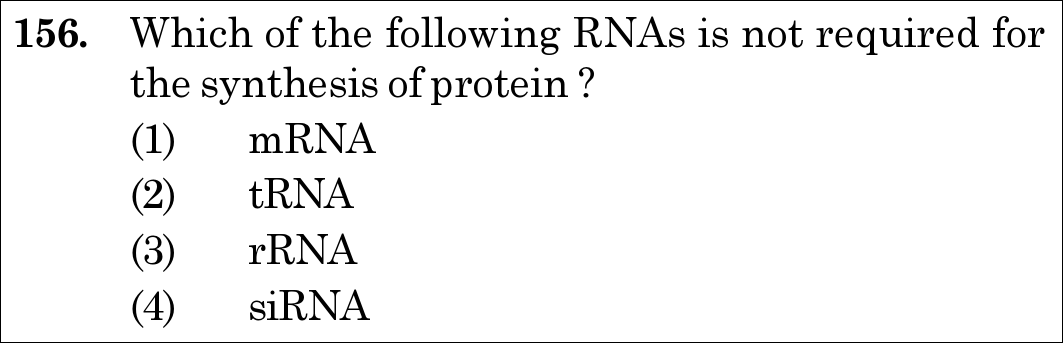
NEET 2021 Zoology Question 156: Roles of Major RNA Types in Protein Synthesis vs Gene Silencing

Question

Which of the following RNAs is not required for the synthesis of protein?

  1. (1)mRNA
  2. (2)tRNA
  3. (3)rRNA
  4. (4)siRNA
✓
Verified Against NTA Final Answer Key
Option (4) : siRNA
📚 Molecular Basis of Inheritance Easy
📋 Given Parameters & Problem Setup
Candidate RNA Types (1) mRNA, (2) tRNA, (3) rRNA, (4) siRNA
Biological Process Synthesis of protein (Translation)
⚡

The 30-Second Exam Hall Shortcut: ⚡ "m, t, and r-RNA Build Proteins; siRNA Silences Genes (RNAi)"

⏱️ Save ~20 seconds

The central translation machinery requires mRNA (template), tRNA (adapter), and rRNA (catalytic ribosome). siRNA (small interfering RNA) is a post-transcriptional gene-silencing agent in RNA interference (RNAi) that destroys mRNA to PREVENT protein synthesis! Match Option (4) instantly!

1 Recall the 3 canonical RNAs required for translation: mRNA, tRNA, rRNA.
2 Identify siRNA: small interfering RNA involved in RNA interference / silencing, not the ribosomal translation apparatus.
3 Select Option (4).
🛡️
Why You Can 100% Trust This Shortcut: NCERT Biology · Molecular Basis of Inheritance & Biotechnology (Translation requires mRNA, tRNA, rRNA; siRNA functions in RNA interference).
📐

Step-by-Step Rigorous Workflow & Mathematical Proof

Step 1

The Essential Triad of RNAs in Translation

Protein synthesis (translation) in all living cells relies directly on three specialized classes of non-coding and coding RNAs: 1. mRNA (messenger RNA): Transcribes genetic information from DNA and provides the linear template of triplet codons. 2. tRNA (transfer RNA / adapter RNA): Reads codons via its anticodon loop and delivers specific amino acids to the growing polypeptide chain. 3. rRNA (ribosomal RNA): Forms the structural framework of the ribosome and acts as a ribozyme (e.g. 23S rRNA in bacteria) to catalyse peptide bond formation.

Protein Synthesis=mRNA⏟Genetic Template+tRNA⏟Aminoacyl Adapter+rRNA⏟Ribozyme Catalyst\text{Protein Synthesis} = \underbrace{\text{mRNA}}_{\text{Genetic Template}} + \underbrace{\text{tRNA}}_{\text{Aminoacyl Adapter}} + \underbrace{\text{rRNA}}_{\text{Ribozyme Catalyst}}
Step 2

Function of siRNA in Eukaryotic Cells

siRNA (small interfering RNA): Short 20–25 base-pair double-stranded RNA molecules that participate in the RNA interference (RNAi) pathway. When loaded into the RISC (RNA-Induced Silencing Complex), siRNA binds to complementary target mRNA molecules and cleaves them, blocking translation rather than aiding it. Therefore, siRNA is not an enzyme or component required for protein synthesis.

⭐

360° Option Elimination Engine Key Feature

Diagnose every choice: Know exactly why the right option works and why distractors fail.

4-Option Deep Scan
1 1
✗ Incorrect
Verdict & Scientific Reason:

Incorrect. mRNA carries the primary coding sequence that dictates amino acid order.

⚠️
Student Fallacy (Why candidates pick this trap): None; mRNA is universally recognized as the genetic template for translation.
2 2
✗ Incorrect
Verdict & Scientific Reason:

Incorrect. tRNA is the essential adapter molecule matching codons to cognate amino acids.

⚠️
Student Fallacy (Why candidates pick this trap): Overlooking the adapter hypothesis formulated by Francis Crick.
3 3
✗ Incorrect
Verdict & Scientific Reason:

Incorrect. rRNA is the catalytic component of peptidyl transferase in the ribosome.

⚠️
Student Fallacy (Why candidates pick this trap): Treating rRNA merely as passive ribosomal scaffold rather than a functional ribozyme.
4 4
✓ 100% Correct
Verdict & Scientific Reason:

Correct. siRNA is an effector of RNA interference (RNAi) used in gene silencing and antiviral defense, not translation.

💡
Why this is airtight: None. This correctly discriminates regulatory non-coding RNAs from translation machinery.
⚠️

NTA Trap Alert: Confusing Translation with Gene Regulation

Students see the letters "RNA" and assume all RNAs listed in NCERT contribute positively to protein synthesis.

🛡️ How to avoid the -1 mark: Remember that siRNA and miRNA act as silencers that inhibit protein expression.
📖

Core NEET Syllabus Standard

NEET / NCERT Biology · Molecular Basis of Inheritance Standard Benchmark
Core Scientific Principle Tested:

"mRNA, tRNA, and rRNA are the three functional RNAs required for protein synthesis; siRNA functions in RNA interference."

Syllabus Focus: Types of RNA and Translation Mechanism
✓ Core NEET UG Syllabus Anchor Syllabus & Academic Standards ↗

Ready to attempt under real exam pressure?

Test your speed and accuracy in the authentic 200-minute timed NTA simulator.

Launch NEET 2021 CBT Test →

Spotted a mistake in this solution? Report an error (support@mycompetitiveexams.com)

⚖️ Legal & Fair Dealing Notice: Sourced from publicly released NEET 2021 question papers and NEET answer keys for private study, research, and non-commercial educational practice under Fair Dealing (Section 52(1)(a) of the Indian Copyright Act, 1957). Not affiliated with or endorsed by NTA or NMC.

Solve 4 NEET Questions a Day — One per Subject

Cover all 1,140 official NEET questions in 285 days at your own pace. Progress is saved on your device. No login needed.