MyCompetitiveExams Logo MyCompetitiveExams
Search 1,140+ Questions
Chapters, formulas, speed tricks
→
⚡ Brahmastra NEET 2027
720 MARKS

Dynamic 180-question full-length simulator mixed dynamically from all 6 years for 2027 & 2026 aspirants.

Launch Brahmastra 2027 Test →
Start Practice →
100% Free · No Login Required
🌿 Botany 🔥 High-Yield Core Topic (~3–4 Qs/Year)

NEET Biomolecules Previous Year Questions with Solutions

Complete repository of official NTA NEET questions for Biomolecules from 2020 to 2026. Every question includes 30-second elimination tricks, step-by-step NCERT solutions, option-by-option traps, and official answer keys.

34 Questions 6 Exam Years (2026, 2025, 2024, 2023, 2021, 2020) 30 Easy · 4 Medium · 0 Challenging
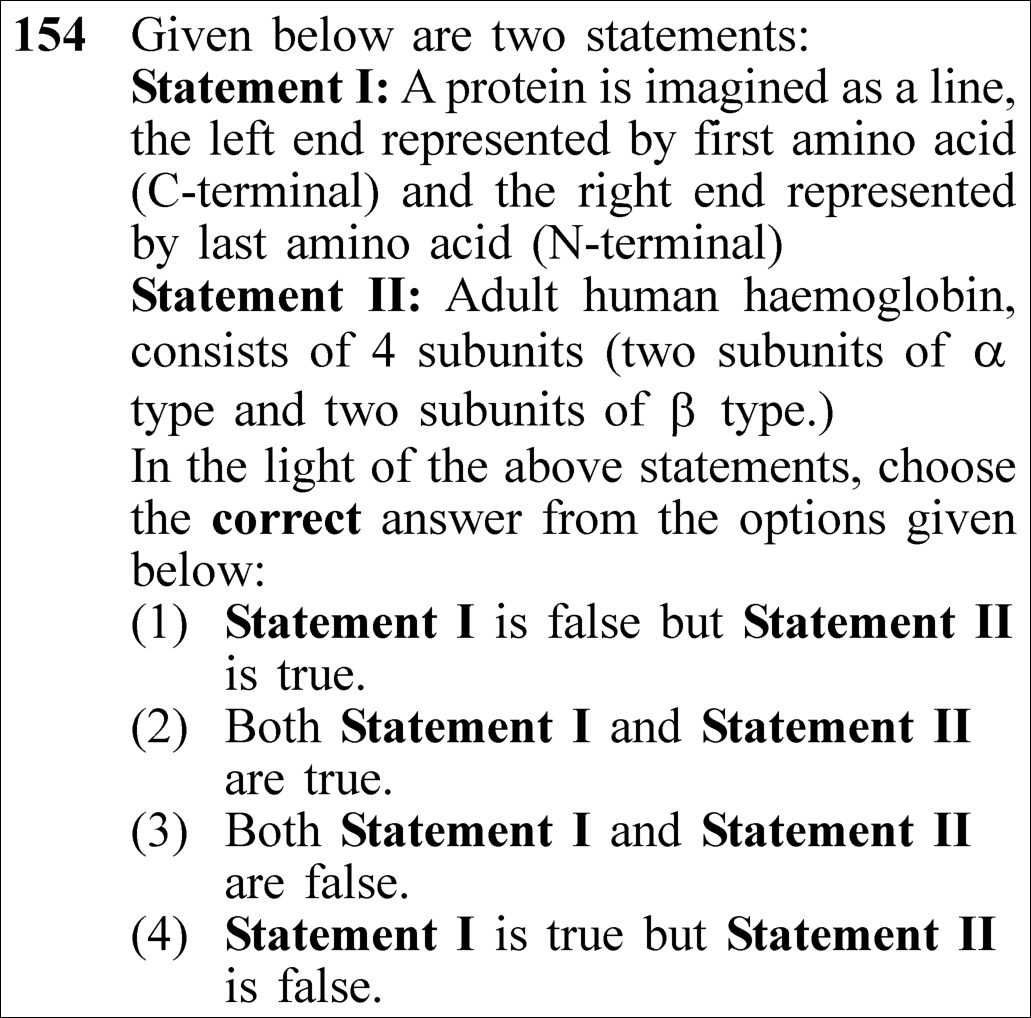
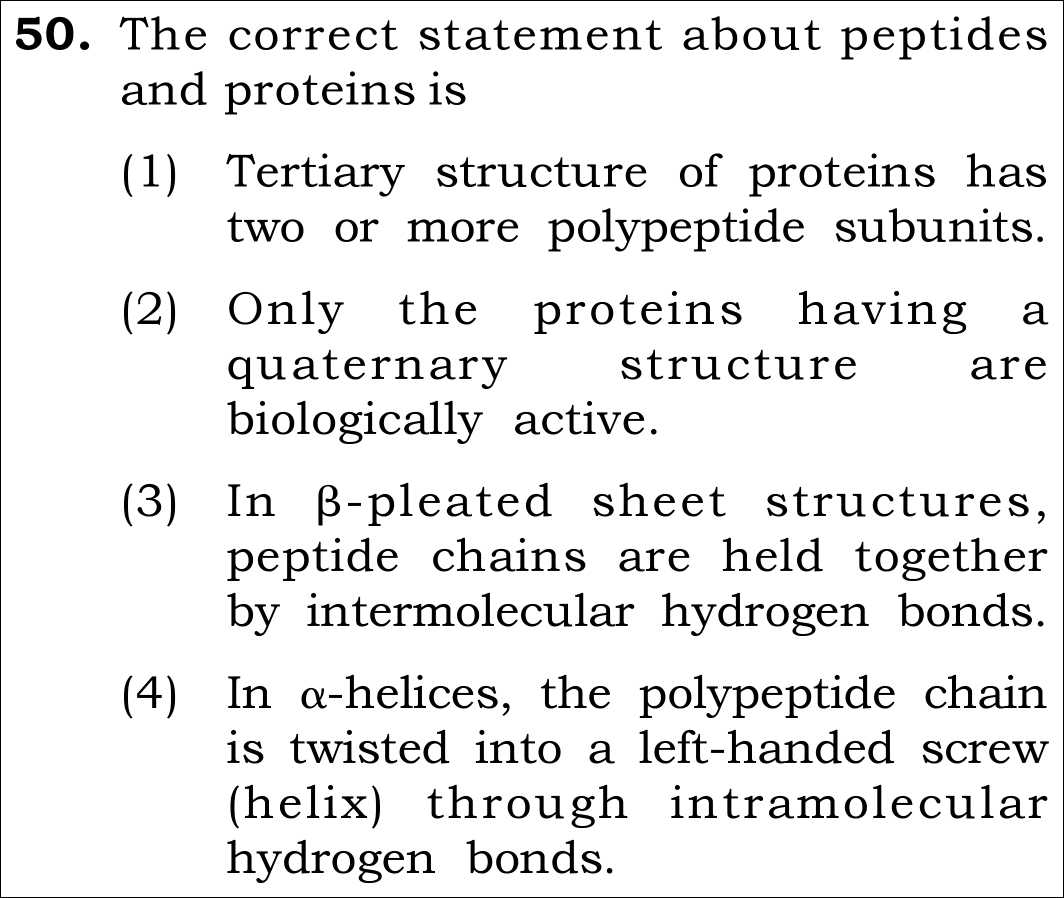
NEET 2026 · Q50 Medium
Official NEET 2026 Question 50 - Biomolecules
1
2
3 ✓ Key
4
💡 Verified Solution & 30-Second Hack
✓
Verified Against NTA Final Answer Key
Option (3) : In β-pleated sheet structures, peptide chains are held together by intermolecular hydrogen bonds.
📚 Biomolecules Medium
📋 Given Parameters & Problem Setup
Topic Peptides and protein conformational structures
Levels of Structure Primary, Secondary (α-helix, β-sheet), Tertiary, Quaternary
⚡

The 30-Second Exam Hall Shortcut: ⚡ Inter vs Intra Hydrogen Bonding Rule

⏱️ Save ~60 seconds

Alpha-helix = INTRAmolecular H-bonds; Beta-sheet = INTERmolecular H-bonds!

1 Check Statement (1): "Tertiary has two or more subunits" -> FALSE (that is Quaternary structure!).
2 Check Statement (2): "Only quaternary proteins are active" -> FALSE (many monomeric proteins like myoglobin/ribonuclease are biologically active with only tertiary structure).
3 Check Statement (3): "In β-pleated sheets, chains are held by intermolecular hydrogen bonds" -> TRUE (canonical NCERT statement).
4 Check Statement (4): "α-helix is left-handed" -> FALSE (it is strictly right-handed!). Option (3) is locked!
🛡️
Why You Can 100% Trust This Shortcut: Verbatim NCERT Chemistry statement: In the β-pleated sheet structure, all peptide chains are stretched out to nearly maximum extension and then laid side by side, held together by intermolecular hydrogen bonds.
📐

Step-by-Step Rigorous Workflow & Mathematical Proof

Step 1

Evaluate Statement (1): Tertiary Structure Definition

Tertiary structure represents the overall folding of the polypeptide chains (further folding of the secondary structure), giving rise to fibrous or globular shapes. The spatial arrangement of two or more polypeptide subunits with respect to each other is defined as QUATERNARY structure, not tertiary.

Two or more subunits≡Quaternary Structure (e.g., Haemoglobin with 4 chains)\text{Two or more subunits} \equiv \text{Quaternary Structure (e.g., Haemoglobin with 4 chains)}
  • • Statement 1 is incorrect.
Step 2

Evaluate Statement (2): Biological Activity of Proteins

Biological activity does not strictly require quaternary structure. Numerous single-chain globular proteins (such as myoglobin, lysozyme, and ribonuclease) possess only primary, secondary, and tertiary structures and exhibit full native biological activity.

Monomeric Enzymes (Lysozyme, RNase)→tertiary structure onlyFully Biologically Active\text{Monomeric Enzymes (Lysozyme, RNase)} \xrightarrow{\text{tertiary structure only}} \text{Fully Biologically Active}
  • • Statement 2 is incorrect.
Step 3

Evaluate Statement (3): Beta-Pleated Sheet Stabilization

In the β-pleated sheet structure, individual polypeptide strands (extended in a zig-zag arrangement) line up adjacent to one another (either parallel or antiparallel). The backbone >C=O group of one chain forms hydrogen bonds with the >N-H group of an adjacent chain. Because these bonds occur between distinct polypeptide chains (or distinct segments), they are INTERMOLECULAR hydrogen bonds.

>C=O⋯H−N<(Intermolecular Hydrogen Bonding between adjacent strands)>\text{C}=\text{O} \cdots \text{H}-\text{N}< \quad (\text{Intermolecular Hydrogen Bonding between adjacent strands})
  • • Statement 3 is scientifically correct and matches textbook definitions.
Step 4

Evaluate Statement (4): Alpha-Helix Handedness

In an α-helix, a polypeptide chain twists into a coil by forming intramolecular hydrogen bonds between the -NH of each amino acid residue and the >C=O of the fourth residue ahead. The natural helical conformation of proteins composed of L-amino acids is exclusively a RIGHT-HANDED screw, not left-handed.

α-Helix≡Right-handed helix (intramolecular H-bonds)\alpha\text{-Helix} \equiv \text{Right-handed helix (intramolecular H-bonds)}
  • • Statement 4 incorrectly claims a left-handed helix.
⭐

360° Option Elimination Engine Key Feature

Diagnose every choice: Know exactly why the right option works and why distractors fail.

4-Option Deep Scan
1 A
✗ Incorrect
Verdict & Scientific Reason:

Incorrect. Two or more polypeptide subunits describe the quaternary structure of a multi-subunit protein.

⚠️
Student Fallacy (Why candidates pick this trap): Confusing tertiary folding of a single chain with quaternary assembly of subunits.
2 B
✗ Incorrect
Verdict & Scientific Reason:

Incorrect. Many proteins consisting of a single polypeptide chain (e.g. myoglobin) are fully biologically active.

⚠️
Student Fallacy (Why candidates pick this trap): Assuming higher structural complexity is a prerequisite for enzymatic function.
3 C
✓ 100% Correct
Verdict & Scientific Reason:

Scientifically accurate and aligns verbatim with NCERT Chemistry Biomolecules.

💡
Why this is airtight: None; exact description of β-sheet stabilization.
4 D
✗ Incorrect
Verdict & Scientific Reason:

Incorrect. Alpha-helices are right-handed screws due to steric constraints of L-amino acid side chains.

⚠️
Student Fallacy (Why candidates pick this trap): Overlooking the screw chirality (handedness) of the α-helix.
⚠️

NTA Trap Alert: Overlooking Handedness and Inter/Intra Distinctions

Students frequently remember that α-helices have H-bonds, but miss the subtle trap: naturally occurring α-helices are RIGHT-HANDED, not left-handed!

🛡️ How to avoid the -1 mark: Remember the mnemonic: Alpha is Always Right (Right-handed screw with INTRAmolecular bonds); Beta is Beside (sheets laid side-by-side with INTERmolecular bonds).
📖

Core NEET Syllabus Standard

NEET Chemistry Core Syllabus · Biomolecules Standard Benchmark
Core Scientific Principle Tested:

"Secondary structures are stabilized by hydrogen bonding: α-helices are right-handed (intramolecular), while β-pleated sheets are held by intermolecular H-bonds."
Syllabus Focus: Structure and conformation of proteins
✓ Core NEET UG Syllabus Anchor Syllabus & Academic Standards ↗
Beta = Between strands (Intermolecular H-bonds); Alpha = Alone inside (Intramolecular, Right-handed)!
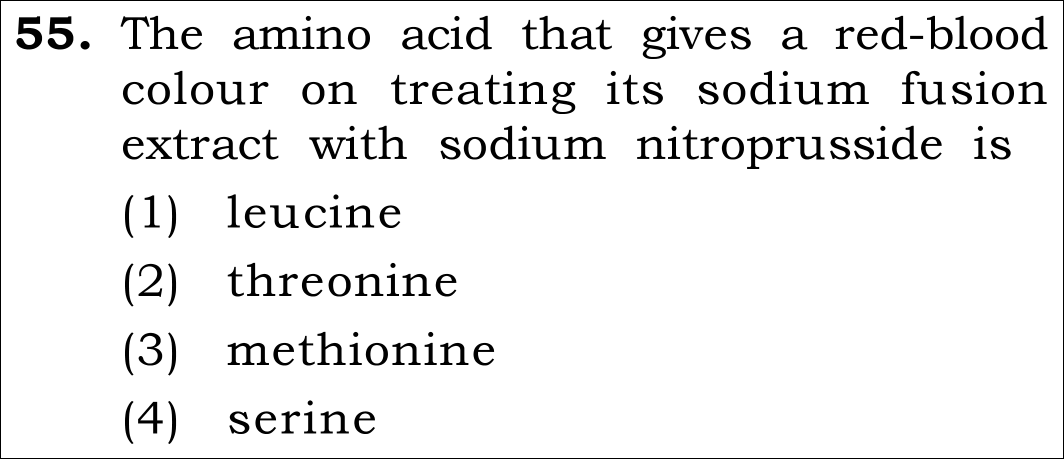
NEET 2026 · Q55 Easy
Official NEET 2026 Question 55 - Biomolecules
1 leucine
2 threonine
3 methionine ✓ Key
4 serine
💡 Verified Solution & 30-Second Hack
✓
Verified Against NTA Final Answer Key
Option (3) : methionine
📚 Organic Chemistry: Some Basic Principles and Techniques & Biomolecules Easy
📋 Given Parameters & Problem Setup
Reaction Sodium fusion extract (Lassaigne's extract) treated with sodium nitroprusside
Observation Characteristic red/violet color indicating presence of sulfur (or blood-red SCN⁻ complex)
Options leucine, threonine, methionine, serine
⚡

The 30-Second Exam Hall Shortcut: ⚡ The Sulfur-Containing Amino Acid Identifier

⏱️ Save ~50 seconds

Only TWO standard amino acids contain sulfur: Cysteine and Methionine!

1 Recall amino acid structures: Leucine (hydrocarbon), Threonine (alcohol), Serine (alcohol), Methionine (thioether).
2 Among the four choices, only METHIONINE contains a sulfur atom (-CH₂-CH₂-S-CH₃).
3 Any qualitative test for sulfur (nitroprusside test or thiocyanate formation) can ONLY test positive for the sulfur-containing amino acid.
4 Pick Methionine (Option 3) in 5 seconds with 100% confidence!
🛡️
Why You Can 100% Trust This Shortcut: Of the 20 standard proteinogenic amino acids, only Methionine and Cysteine possess sulfur in their side chains.
📐

Step-by-Step Rigorous Workflow & Mathematical Proof

Step 1

Identify the Elemental Constituents of the Given Amino Acids

Examine the side chains of the four amino acids in the options: 1. Leucine: (CH₃)₂CH-CH₂-CH(NH₂)COOH (Contains C, H, N, O). 2. Threonine: CH₃-CH(OH)-CH(NH₂)COOH (Contains C, H, N, O). 3. Serine: HO-CH₂-CH(NH₂)COOH (Contains C, H, N, O). 4. Methionine: CH₃-S-CH₂-CH₂-CH(NH₂)COOH (Contains C, H, N, O, and S).

Methionine≡CH3−S−CH2−CH2−CH(NH2)COOH\text{Methionine} \equiv \text{CH}_3-\text{S}-\text{CH}_2-\text{CH}_2-\text{CH}(\text{NH}_2)\text{COOH}
  • • Methionine is the unique sulfur-containing amino acid among the choices.
Step 2

Sodium Fusion (Lassaigne's Test) Chemistry

When an organic compound containing sulfur (and nitrogen) is fused with sodium metal, covalent sulfur is converted into ionic sodium sulfide (or sodium thiocyanate if N and S are both present and Na is not in excess): 2Na + S → Na₂S Na + C + N + S → NaSCN

2Na+S→ΔNa2S2\text{Na} + \text{S} \xrightarrow{\Delta} \text{Na}_2\text{S}
  • • Organic sulfur is mineralized into sulfide / thiocyanate ions.
Step 3

Color Reaction with Sodium Nitroprusside

Sulfide ions react with sodium nitroprusside [Fe(CN)₅NO]²⁻ in alkaline medium to form the brilliant purple-violet complex ion [Fe(CN)₅NOS]⁴⁻ (often noted alongside red-blood thiocyanate coloration in dual N+S analysis). Because leucine, threonine, and serine lack sulfur entirely, they cannot give this test.

S2−+[Fe(CN)5NO]2−⟶[Fe(CN)5NOS]4−(Violet/Purple complex)\text{S}^{2-} + [\text{Fe}(\text{CN})_5\text{NO}]^{2-} \longrightarrow [\text{Fe}(\text{CN})_5\text{NOS}]^{4-} \quad (\text{Violet/Purple complex})
  • • Only methionine yields the sulfur diagnostic test.
  • • Corresponds to Option (3).
⭐

360° Option Elimination Engine Key Feature

Diagnose every choice: Know exactly why the right option works and why distractors fail.

4-Option Deep Scan
1 A
✗ Incorrect
Verdict & Scientific Reason:

Incorrect. Leucine has an aliphatic branched hydrocarbon side chain containing only C, H, N, O (no sulfur).

⚠️
Student Fallacy (Why candidates pick this trap): Assuming all essential amino acids contain sulfur.
2 B
✗ Incorrect
Verdict & Scientific Reason:

Incorrect. Threonine is a hydroxy-containing amino acid with no sulfur.

⚠️
Student Fallacy (Why candidates pick this trap): Confusing the thiol/thioether group with a secondary alcohol.
3 C
✓ 100% Correct
Verdict & Scientific Reason:

Exact match. Methionine contains a thioether side chain (-S-CH₃) providing sulfur for the sodium fusion test.

💡
Why this is airtight: None; indisputable chemical fact.
4 D
✗ Incorrect
Verdict & Scientific Reason:

Incorrect. Serine contains a primary hydroxyl group (-CH₂OH) and no sulfur.

⚠️
Student Fallacy (Why candidates pick this trap): Confusing serine with cysteine.
⚠️

NTA Trap Alert: Searching for Cysteine When Only Methionine is Listed

Students often memorize cysteine as the test-tube sulfur amino acid. When cysteine is absent from the options, they hesitate—forgetting that methionine also contains sulfur!

🛡️ How to avoid the -1 mark: Remember: Cysteine and Methionine are the twin sulfur-containing amino acids.
📖

Core NEET Syllabus Standard

NEET Chemistry Core Syllabus · Biomolecules & Practical Organic Chemistry Standard Benchmark
Core Scientific Principle Tested:

"Detection of sulfur via sodium fusion extract requires a sulfur-bearing functional group in the precursor."

Syllabus Focus: Classification of amino acids and qualitative elemental detection
✓ Core NEET UG Syllabus Anchor Syllabus & Academic Standards ↗
Sulfur in proteins? Only Two in the scene: Cysteine and Methionine!
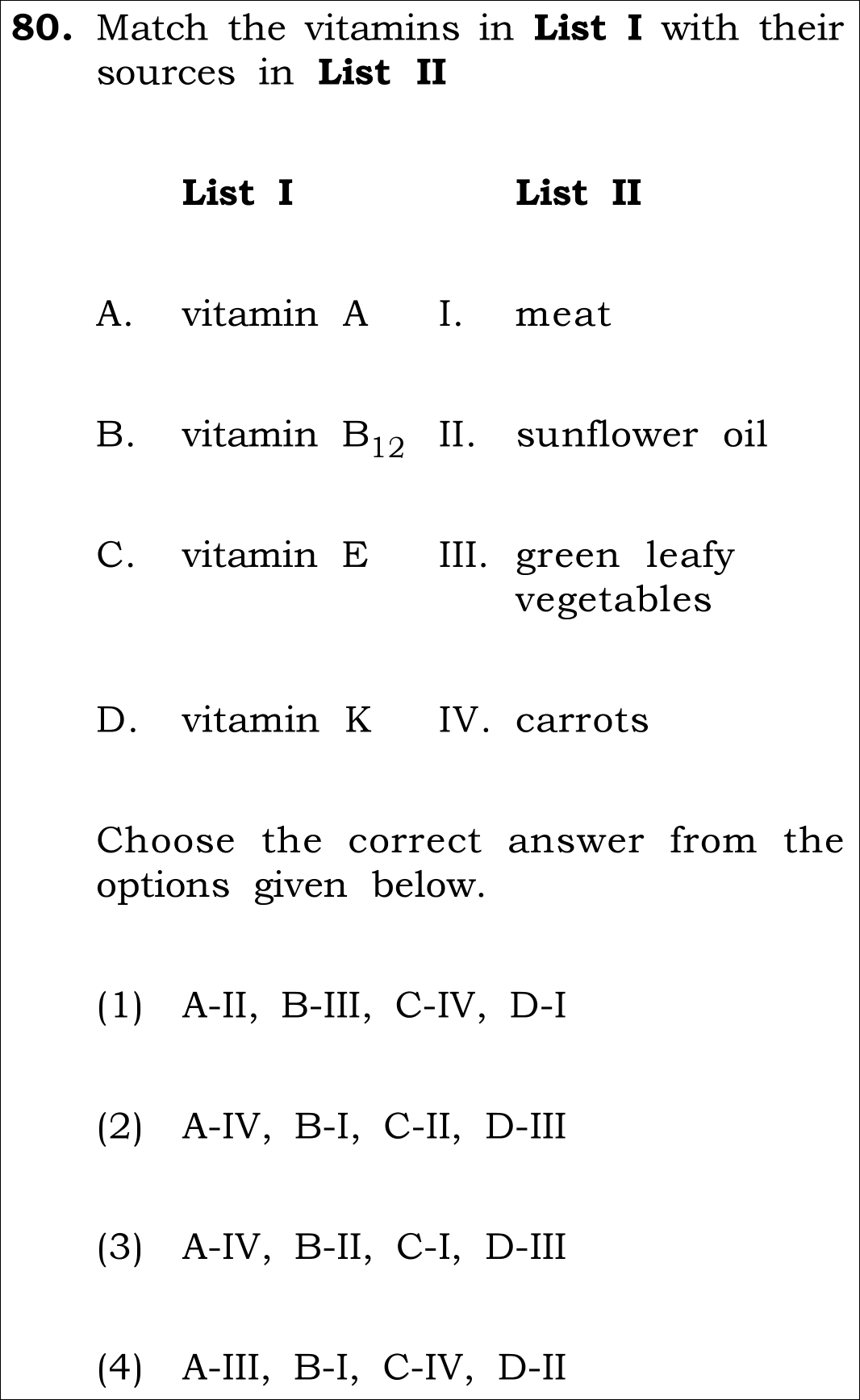
NEET 2026 · Q80 Easy
Official NEET 2026 Question 80 - Biomolecules
1
2 ✓ Key
3
4
💡 Verified Solution & 30-Second Hack
✓
Verified Against NTA Final Answer Key
Option (2) : A-IV, B-I, C-II, D-III
📚 Biomolecules Easy
📋 Given Parameters & Problem Setup
List I (Vitamins) A. vitamin A, B. vitamin B₁₂, C. vitamin E, D. vitamin K
List II (Sources) I. meat, II. sunflower oil, III. green leafy vegetables, IV. carrots
⚡

The 30-Second Exam Hall Shortcut: ⚡ The Carrot & Meat Pair Shortcut

⏱️ Save ~40 seconds

Vitamin A = Carrots (A-IV); Vitamin B₁₂ = Meat (B-I) -> Finishes the question in 5 seconds!

1 A. Vitamin A: Classic dietary source is carrots / fish liver oil -> A-IV.
2 This immediately rules out Options (1) and (4)!
3 B. Vitamin B₁₂: Exclusively found in animal sources (meat, fish, egg, curd; plants cannot synthesize B₁₂) -> B-I.
4 Check Option (2) vs (3): Option (2) has B-I; Option (3) has B-II.
5 Verify C and D: Vitamin E is in vegetable oils (sunflower oil, C-II); Vitamin K is in green leafy vegetables (D-III).
6 Option (2) is 100% verified!
🛡️
Why You Can 100% Trust This Shortcut: NCERT Biomolecules table on vitamins: Canonical dietary sources tabulated verbatim.
📐

Step-by-Step Rigorous Workflow & Mathematical Proof

Step 1

Match Vitamin A (Retinol)

Vitamin A is a fat-soluble vitamin essential for night vision (rhodopsin synthesis). Rich dietary sources include carrots (beta-carotene precursor), fish liver oil, milk, and butter.

Vitamin A⟶IV. carrots\text{Vitamin A} \longrightarrow \text{IV. carrots}
  • • Match: A -> IV.
Step 2

Match Vitamin B₁₂ (Cyanocobalamin)

Vitamin B₁₂ is a water-soluble coordination complex containing cobalt. It cannot be synthesized by higher plants and is obtained in human diets exclusively through animal foods such as meat, liver, fish, and eggs.

Vitamin B12⟶I. meat\text{Vitamin B}_{12} \longrightarrow \text{I. meat}
  • • Match: B -> I.
Step 3

Match Vitamin E (Tocopherol)

Vitamin E is an antioxidant fat-soluble vitamin primarily sourced from vegetable seed oils, including sunflower oil, wheat germ oil, and cotton seed oil.

Vitamin E⟶II. sunflower oil\text{Vitamin E} \longrightarrow \text{II. sunflower oil}
  • • Match: C -> II.
Step 4

Match Vitamin K (Phylloquinone)

Vitamin K is responsible for blood clotting (prothrombin synthesis) and is richly abundant in green leafy vegetables like spinach, cabbage, and kale.

Vitamin K⟶III. green leafy vegetables\text{Vitamin K} \longrightarrow \text{III. green leafy vegetables}
  • • Match: D -> III.
  • • Full Match: A-IV, B-I, C-II, D-III (Option 2).
⭐

360° Option Elimination Engine Key Feature

Diagnose every choice: Know exactly why the right option works and why distractors fail.

4-Option Deep Scan
1 A
✗ Incorrect
Verdict & Scientific Reason:

Incorrect. Assigns sunflower oil to Vitamin A and carrots to Vitamin E.

⚠️
Student Fallacy (Why candidates pick this trap): Random guessing of nutritional sources.
2 B
✓ 100% Correct
Verdict & Scientific Reason:

Exact match with NCERT Biomolecules vitamins table.

💡
Why this is airtight: None; flawless nutritional knowledge.
3 C
✗ Incorrect
Verdict & Scientific Reason:

Incorrect. Falsely assigns sunflower oil to Vitamin B₁₂ (B₁₂ is not in plant oils).

⚠️
Student Fallacy (Why candidates pick this trap): Forgetting that plants do not produce Vitamin B₁₂.
4 D
✗ Incorrect
Verdict & Scientific Reason:

Incorrect. Assigns green leafy vegetables to Vitamin A and carrots to Vitamin E.

⚠️
Student Fallacy (Why candidates pick this trap): Swapping Vitamin A and Vitamin K sources.
⚠️

NTA Trap Alert: Assigning Vitamin B₁₂ to Plant Sources

Vitamin B₁₂ is unique among vitamins: it is synthesized by bacteria and present almost exclusively in animal foods (meat, dairy). It is never found in sunflower oil or pure plant oils!

🛡️ How to avoid the -1 mark: Remember: B₁₂ is strictly from animal sources (Meat, Liver, Eggs).
📖

Core NEET Syllabus Standard

NEET Chemistry Core Syllabus · Biomolecules Standard Benchmark
Core Scientific Principle Tested:

"Vitamin A from carrots, B₁₂ from meat, E from vegetable oils, K from green leaves."

Syllabus Focus: Vitamins - Classification, sources, and deficiency diseases
✓ Core NEET UG Syllabus Anchor Syllabus & Academic Standards ↗
A in Carrots, B₁₂ in Meat, E in Sunflower oil, K in Leafy treat!
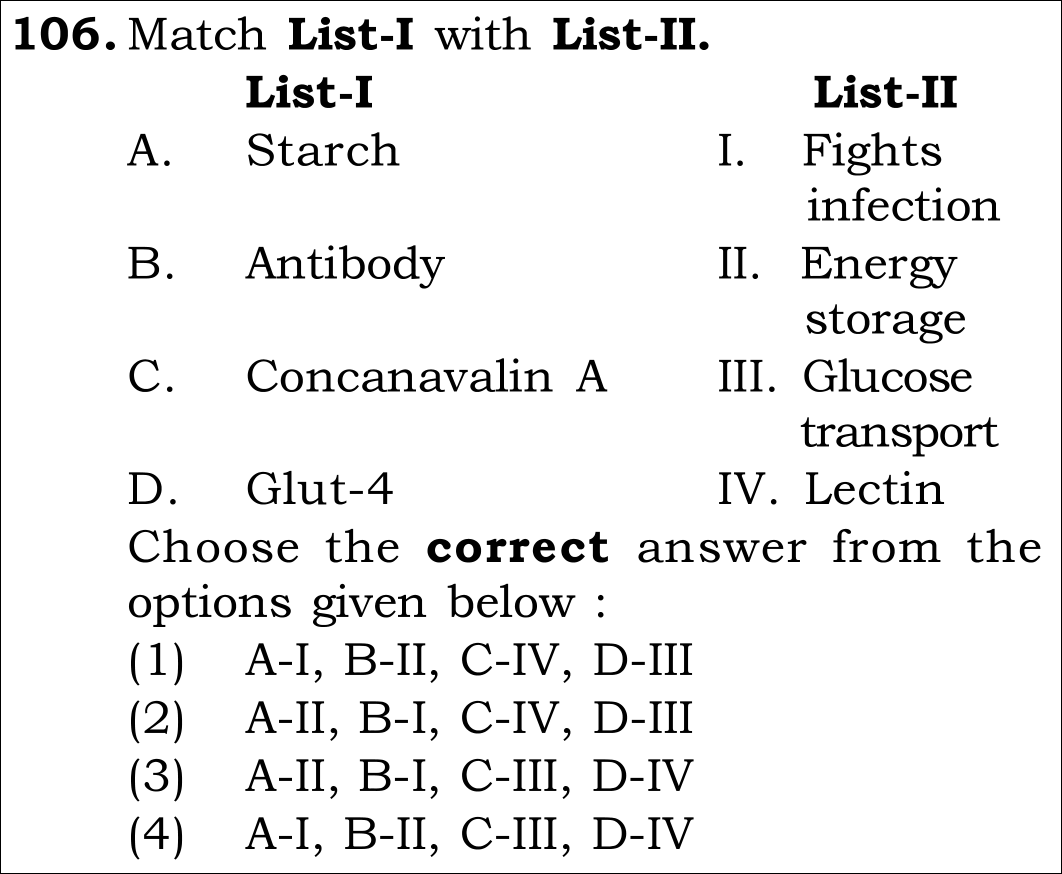
NEET 2026 · Q106 Easy
Official NEET 2026 Question 106 - Biomolecules
1
2 ✓ Key
3
4
💡 Verified Solution & 30-Second Hack
✓
Verified Against NTA Final Answer Key
Option (2) : A-II, B-I, C-IV, D-III
📚 Biomolecules Easy
📋 Given Parameters & Problem Setup
List-I Compounds A. Starch, B. Antibody, C. Concanavalin A, D. Glut-4
List-II Biological Roles I. Fights infection, II. Energy storage, III. Glucose transport, IV. Lectin
⚡

The 30-Second Exam Hall Shortcut: ⚡ Instant Biomolecule Match Hack

⏱️ Save ~45 seconds

Match GLUT-4 to Glucose Transport (III) and Starch to Energy Storage (II)!

1 Recognize GLUT-4: Glucose Transporter type 4 enables glucose transport into cells (D -> III).
2 Recognize Starch: Major carbohydrate storage form in plants (A -> II).
3 Look at options where A-II and D-III align: only Option (2) satisfies both!
4 Select Option (2) in under 10 seconds without checking further.
🛡️
Why You Can 100% Trust This Shortcut: NCERT Biology · Biomolecules (Secondary Metabolites: Pigments, alkaloids, terpenoids, lectins, and toxins).
📐

Step-by-Step Rigorous Workflow & Mathematical Proof

Step 1

Analyze A: Starch

Starch is a homopolymer of α-glucose molecules and serves as the principal energy storage polysaccharide in plant tissues. In animals, excess energy is stored as glycogen.

Starch→FunctionEnergy storage (II)\text{Starch} \xrightarrow{\text{Function}} \text{Energy storage (II)}
  • • Forms helical secondary structures capable of trapping iodine molecules (giving a blue-black colour).
Step 2

Analyze B: Antibody

Antibodies (immunoglobulins) are defensive glycoproteins produced by B lymphocytes and plasma cells in response to antigens. Their primary function is to fight infectious pathogens.

Antibody (Ig)→Immune responseFights infectious agents (I)\text{Antibody (Ig)} \xrightarrow{\text{Immune response}} \text{Fights infectious agents (I)}
  • • Listed under "Some Proteins and their Functions" in NCERT Table 9.5.
Step 3

Analyze C: Concanavalin A

Concanavalin A is an agglutinating carbohydrate-binding protein extracted from the jack bean (Canavalia ensiformis). In plant biochemistry and NCERT classification, it is categorized under Lectins (Secondary Metabolites).

Concanavalin A→ClassificationLectin (Secondary Metabolite) (IV)\text{Concanavalin A} \xrightarrow{\text{Classification}} \text{Lectin (Secondary Metabolite) (IV)}
  • • Listed under Table 9.3: Some Secondary Metabolites (Category: Lectins).
Step 4

Analyze D: GLUT-4

GLUT-4 (Glucose Transporter 4) is an insulin-regulated transmembrane transport protein found primarily in adipose tissues and striated muscle. It facilitates the cellular uptake and transport of glucose.

GLUT-4→Membrane transportEnables glucose transport into cells (III)\text{GLUT-4} \xrightarrow{\text{Membrane transport}} \text{Enables glucose transport into cells (III)}
  • • Listed in NCERT Table 9.5: "GLUT-4: Enables glucose transport into cells."
Step 5

Synthesize the Complete Combination

Matching all components yields: A-II, B-I, C-IV, D-III, which exactly corresponds to Option (2).

Match:A-II,  B-I,  C-IV,  D-III\text{Match}: \mathbf{A}\text{-II}, \; \mathbf{B}\text{-I}, \; \mathbf{C}\text{-IV}, \; \mathbf{D}\text{-III}
  • • A -> II (Energy storage)
  • • B -> I (Fights infection)
  • • C -> IV (Lectin)
  • • D -> III (Glucose transport)
⭐

360° Option Elimination Engine Key Feature

Diagnose every choice: Know exactly why the right option works and why distractors fail.

4-Option Deep Scan
1 A
✗ Incorrect
Verdict & Scientific Reason:

Incorrect. Links Starch to fighting infection (A-I) and Antibody to energy storage (B-II).

⚠️
Student Fallacy (Why candidates pick this trap): Swapped Starch and Antibody functions.
2 B
✓ 100% Correct
Verdict & Scientific Reason:

100% accurate correlation for all four biomolecules according to NCERT Chapter 9.

💡
Why this is airtight: None; flawless direct recall.
3 C
✗ Incorrect
Verdict & Scientific Reason:

Incorrect. Swaps Concanavalin A and GLUT-4 roles (claims Concanavalin A transports glucose and GLUT-4 is a lectin).

⚠️
Student Fallacy (Why candidates pick this trap): Inverting secondary metabolite classification with transport protein.
4 D
✗ Incorrect
Verdict & Scientific Reason:

Completely inverted pairing across all entries.

⚠️
Student Fallacy (Why candidates pick this trap): Random guessing under time pressure.
⚠️

NTA Trap Alert: Secondary Metabolite Table Overlook

NCERT Table 9.3 (Secondary Metabolites) is an ultra-high-yield source in NEET. Candidates often forget that Concanavalin A is a Lectin, while Abrin and Ricin are Toxins.

🛡️ How to avoid the -1 mark: Remember the pair: Lectin = Concanavalin A; Toxins = Abrin & Ricin.
📖

Core NEET Syllabus Standard

NEET Biology Core Syllabus · Biomolecules Standard Benchmark
Core Scientific Principle Tested:

"Proteins carry out diverse structural, catalytic, transport (GLUT-4), and defensive (Antibody) roles. Polysaccharides like starch store energy, while secondary metabolites include lectins (Concanavalin A)."

Syllabus Focus: Proteins, Polysaccharides, and Secondary Metabolites
✓ Core NEET UG Syllabus Anchor Syllabus & Academic Standards ↗
GLU-T-4 transports GLUcose; Lectin is Concanavalin A; Starch stores fuel, and Antibodies slay!
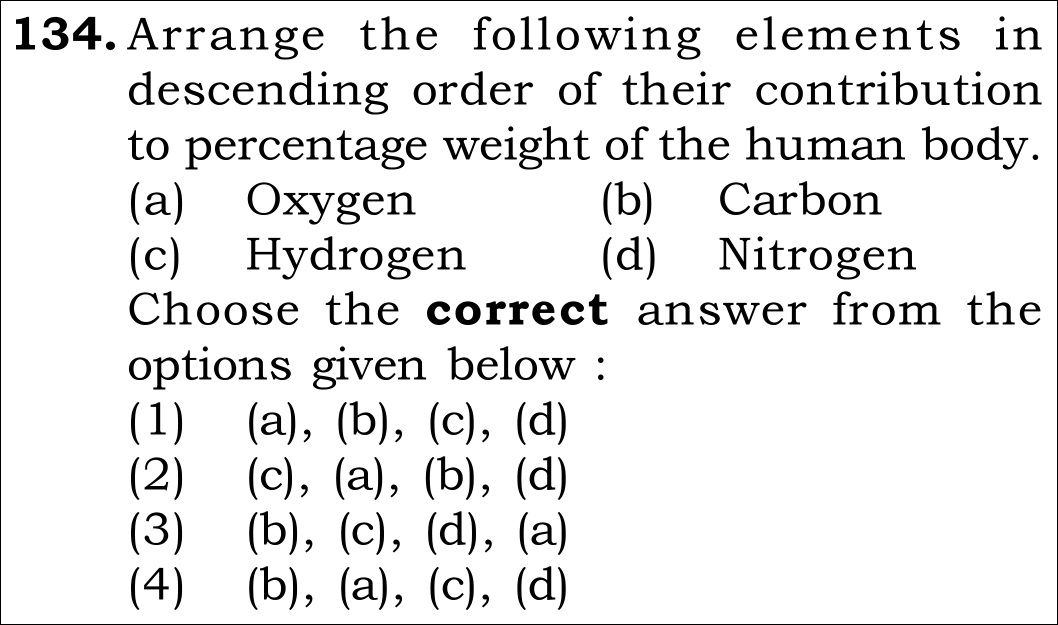
NEET 2026 · Q134 Medium
Official NEET 2026 Question 134 - Biomolecules
1 (a), (b), (c), (d) ✓ Key
2 (c), (a), (b), (d)
3 (b), (c), (d), (a)
4 (b), (a), (c), (d)
💡 Verified Solution & 30-Second Hack
✓
Verified Against NTA Final Answer Key
Option (1) : (a), (b), (c), (d)
📚 Biomolecules Medium
📋 Given Parameters & Problem Setup
Elements to Order (a) Oxygen, (b) Carbon, (c) Hydrogen, (d) Nitrogen
Sorting Criterion Descending order of contribution to % weight of the human body
⚡

The 30-Second Exam Hall Shortcut: ⚡ O-C-H-N Abundance Order

⏱️ Save ~40 seconds

Human body weight: Oxygen (65%) > Carbon (18.5%) > Hydrogen (~10%) > Nitrogen (3.3%)!

1 Recall elemental mass composition in human physiology / living systems:
2 Oxygen (O) = ~65.0% (due to high water content H₂O).
3 Carbon (C) = ~18.5% (backbone of all organic biomolecules).
4 Hydrogen (H) = ~9.5 - 10.0% (constituent of water and organic molecules).
5 Nitrogen (N) = ~3.2 - 3.3% (amino acids, nucleic acids).
6 Descending order: Oxygen (a) > Carbon (b) > Hydrogen (c) > Nitrogen (d).
7 Direct sequence: (a), (b), (c), (d).
8 Select Option (1) in under 10 seconds!
🛡️
Why You Can 100% Trust This Shortcut: Standard biological elemental composition: O (65%) > C (18.5%) > H (~10%) > N (3.3%). Matches NTA final answer key Option A / (1).
📐

Step-by-Step Rigorous Workflow & Mathematical Proof

Step 1

Elemental Composition of the Human Body by Weight

Living tissues are predominantly composed of water (70–90% of total cell mass) along with proteins, lipids, nucleic acids, and carbohydrates. Because water (H2OH_2O) has a molecular weight of 18 with 16 parts Oxygen and 2 parts Hydrogen, Oxygen contributes the overwhelming majority of body mass.

Oxygen (O):65.0%Carbon (C):18.5%Hydrogen (H):9.5−10.0%Nitrogen (N):3.2−3.3%\begin{aligned} \text{Oxygen (O)} &: \mathbf{65.0\%} \\ \text{Carbon (C)} &: \mathbf{18.5\%} \\ \text{Hydrogen (H)} &: \mathbf{9.5 - 10.0\%} \\ \text{Nitrogen (N)} &: \mathbf{3.2 - 3.3\%} \end{aligned}
  • • Calcium (~1.5%) and Phosphorus (~1.0%) follow Nitrogen.
Step 2

Determine Descending Order

Arranging in descending order (highest percentage to lowest percentage):

Oxygen (a)>Carbon (b)>Hydrogen (c)>Nitrogen (d)\text{Oxygen (a)} > \text{Carbon (b)} > \text{Hydrogen (c)} > \text{Nitrogen (d)}
  • • (a) Oxygen: 65%
  • • (b) Carbon: 18.5%
  • • (c) Hydrogen: ~9.5 - 10%
  • • (d) Nitrogen: ~3.3%
Step 3

Match with Given Options

Sequence: (a), (b), (c), (d). This corresponds directly to Option (1).

Descending Sequence=(a),(b),(c),(d)  ⟹  Option (1)\text{Descending Sequence} = (\text{a}), (\text{b}), (\text{c}), (\text{d}) \implies \text{Option (1)}
  • • Matches official NTA final answer key Option A / (1).
⭐

360° Option Elimination Engine Key Feature

Diagnose every choice: Know exactly why the right option works and why distractors fail.

4-Option Deep Scan
1 A
✓ 100% Correct
Verdict & Scientific Reason:

100% accurate. O (65%) > C (18.5%) > H (~10%) > N (3.3%) in human body composition by weight.

💡
Why this is airtight: None; precise command of biochemistry.
2 B
✗ Incorrect
Verdict & Scientific Reason:

Incorrect. Places Hydrogen as highest, confusing atom count with percentage weight.

⚠️
Student Fallacy (Why candidates pick this trap): Confusing atomic percentage (number of atoms) with mass/weight percentage.
3 C
✗ Incorrect
Verdict & Scientific Reason:

Incorrect. Places Oxygen at the very end despite it being 65% of body mass.

⚠️
Student Fallacy (Why candidates pick this trap): Assuming organic chemistry implies Carbon is heaviest in the body.
4 D
✗ Incorrect
Verdict & Scientific Reason:

Incorrect. Places Carbon (18.5%) ahead of Oxygen (65%).

⚠️
Student Fallacy (Why candidates pick this trap): Forgetting that water mass makes Oxygen far heavier than Carbon in living systems.
⚠️

NTA Trap Alert: Atomic Number vs Weight Percentage Confusion

By number of atoms, Hydrogen is most abundant (H2OH_2O has 2 hydrogens per oxygen). But BY WEIGHT (percentage mass), Oxygen dwarfs all other elements because atomic mass of O is 16 versus 1 for H.

🛡️ How to avoid the -1 mark: Remember: Water is heavy because of OXYGEN! Oxygen is #1 by weight.
📖

Core NEET Syllabus Standard

NEET Biology Core Syllabus · Biomolecules Standard Benchmark
Core Scientific Principle Tested:

"In the human body by weight, the primary elements in descending order are Oxygen (65%) > Carbon (18.5%) > Hydrogen (~10%) > Nitrogen (3.3%)."

Syllabus Focus: How to Analyse Chemical Composition? - Table 9.1
✓ Core NEET UG Syllabus Anchor Syllabus & Academic Standards ↗
O-C-H-N: Oxygen Crowns Human Nature in weight!
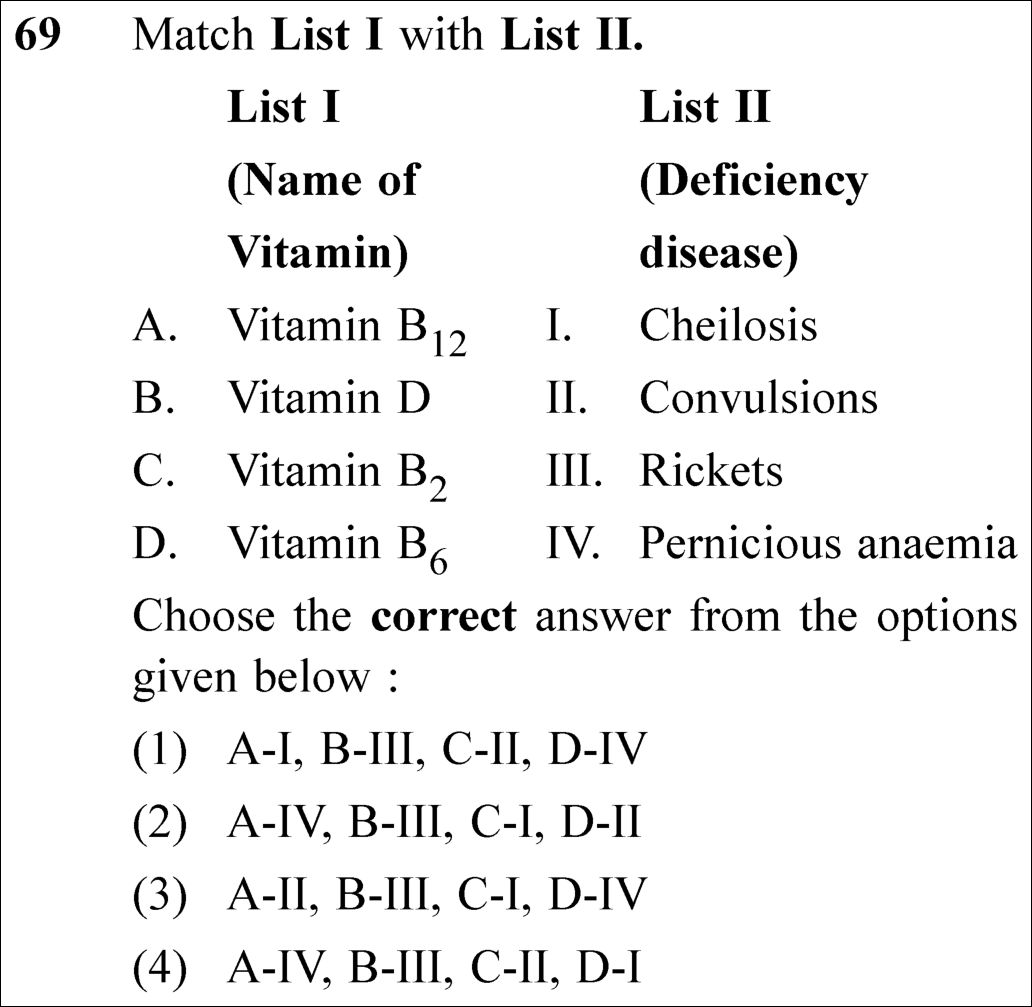
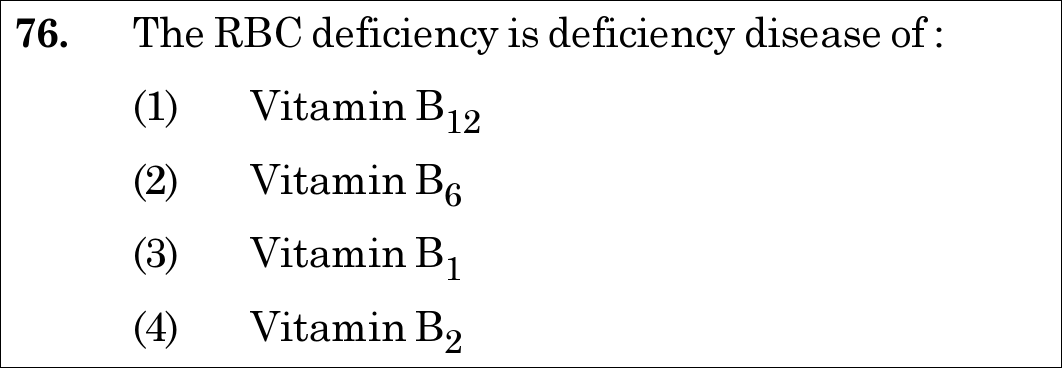
NEET 2025 · Q69 Easy
Official NEET 2025 Question 69 - Biomolecules
1
2 ✓ Key
3
4
💡 Verified Solution & 30-Second Hack
✓
Verified Against NTA Final Answer Key
Option (2) : A-IV, B-III, C-I, D-II
📚 Biomolecules Easy
📋 Given Parameters & Problem Setup
List I (Vitamins) A. Vitamin B₁₂, B. Vitamin D, C. Vitamin B₂, D. Vitamin B₆
List II (Deficiency Diseases) I. Cheilosis, II. Convulsions, III. Rickets, IV. Pernicious anaemia
⚡

The 30-Second Exam Hall Shortcut: ⚡ Vitamin Deficiency Canonical Pairings

⏱️ Save ~30 seconds

Vitamin B₁₂ = Pernicious Anaemia (A-IV). Vitamin D = Rickets (B-III). Vitamin B₂ (Riboflavin) = Cheilosis (C-I). Vitamin B₆ (Pyridoxine) = Convulsions (D-II)!

1 Recall Vitamin B₁₂: Essential for RBC maturation; deficiency causes Pernicious anaemia ⟹ A matches IV.
2 Recall Vitamin D: Required for bone mineralization; deficiency causes Rickets in children ⟹ B matches III.
3 Looking at options: Only Option (2) and (4) feature A-IV, B-III.
4 Recall Vitamin B₂ (Riboflavin): Deficiency causes fissures at lip corners called Cheilosis ⟹ C matches I.
5 Recall Vitamin B₆ (Pyridoxine): Deficiency causes Convulsions ⟹ D matches II.
6 Match: A-IV, B-III, C-I, D-II.
7 Select Option (2) in under 10 seconds!
🛡️
Why You Can 100% Trust This Shortcut: Classification of Vitamins & Deficiency Disorders (NCERT Chemistry · Biomolecules).
📐

Step-by-Step Rigorous Workflow & Mathematical Proof

Step 1

Match Vitamin B₁₂ and Vitamin D

Examine the biochemical roles and clinical deficiency symptoms from NCERT Table 14.1:

Vitamin B12 (Cyanocobalamin)  ⟹  Pernicious anaemia (IV)\text{Vitamin B}_{12} \text{ (Cyanocobalamin)} \implies \text{Pernicious anaemia (IV)}
  • • A matches IV (A-IV).
  • • Vitamin D (Calciferol): Regulates calcium and phosphate absorption. Deficiency leads to bone softening and malformation in children known as Rickets (III).
  • • B matches III (B-III).
Step 2

Match Vitamin B₂ and Vitamin B₆

Examine water-soluble B-complex vitamins:

Vitamin B2 (Riboflavin)  ⟹  Cheilosis (fissuring of lips, I)\text{Vitamin B}_2 \text{ (Riboflavin)} \implies \text{Cheilosis (fissuring of lips, I)}
  • • C matches I (C-I).
  • • Vitamin B₆ (Pyridoxine): Involved in amino acid metabolism and neurotransmitter synthesis. Severe deficiency manifests clinically as Convulsions (II).
  • • D matches II (D-II).
Step 3

Synthesize the Complete Match

Combine the individual pairings:

A-IV, B-III, C-I, D-II  ⟹  Option (2)\text{A-IV, B-III, C-I, D-II} \implies \text{Option (2)}
  • • Matches Option (2) exactly.
⭐

360° Option Elimination Engine Key Feature

Diagnose every choice: Know exactly why the right option works and why distractors fail.

4-Option Deep Scan
1 A
✗ Incorrect
Verdict & Scientific Reason:

Incorrect. Assigns cheilosis to B₁₂ and pernicious anaemia to B₆.

⚠️
Student Fallacy (Why candidates pick this trap): Scrambling B-complex vitamins.
2 B
✓ 100% Correct
Verdict & Scientific Reason:

100% correct. B₁₂ (Pernicious anaemia), D (Rickets), B₂ (Cheilosis), B₆ (Convulsions).

💡
Why this is airtight: None; verbatim NCERT Table 14.1 recall.
3 C
✗ Incorrect
Verdict & Scientific Reason:

Incorrect. Assigns convulsions to B₁₂.

⚠️
Student Fallacy (Why candidates pick this trap): Confusing neurological manifestations of B₁₂ with B₆.
4 D
✗ Incorrect
Verdict & Scientific Reason:

Incorrect. Swaps B₂ and B₆ deficiencies (convulsions and cheilosis).

⚠️
Student Fallacy (Why candidates pick this trap): Swapping B₂ and B₆.
⚠️

NTA Trap Alert: Swapping Vitamin B₂ (Cheilosis) and B₆ (Convulsions)

Option 4 has A-IV and B-III correct, but swaps C and D (assigning convulsions to B₂ and cheilosis to B₆). Remembering that B₂ (Riboflavin) causes cheilosis prevents falling into this distractor!

🛡️ How to avoid the -1 mark: Mnemonic: B2 = Cheilosis (2 lips); B6 = Convulsions!
📖

Core NEET Syllabus Standard

NEET Chemistry Core Syllabus · Biomolecules Standard Benchmark
Core Scientific Principle Tested:

"B₁₂ deficiency causes pernicious anaemia; D causes rickets; B₂ causes cheilosis; B₆ causes convulsions."

Syllabus Focus: Vitamins: Classification and Deficiency Diseases
✓ Core NEET UG Syllabus Anchor Syllabus & Academic Standards ↗
B12 = Anaemia, D = Rickets, B2 = Cheilosis (Lips), B6 = Convulsions ⟹ Option (2)!
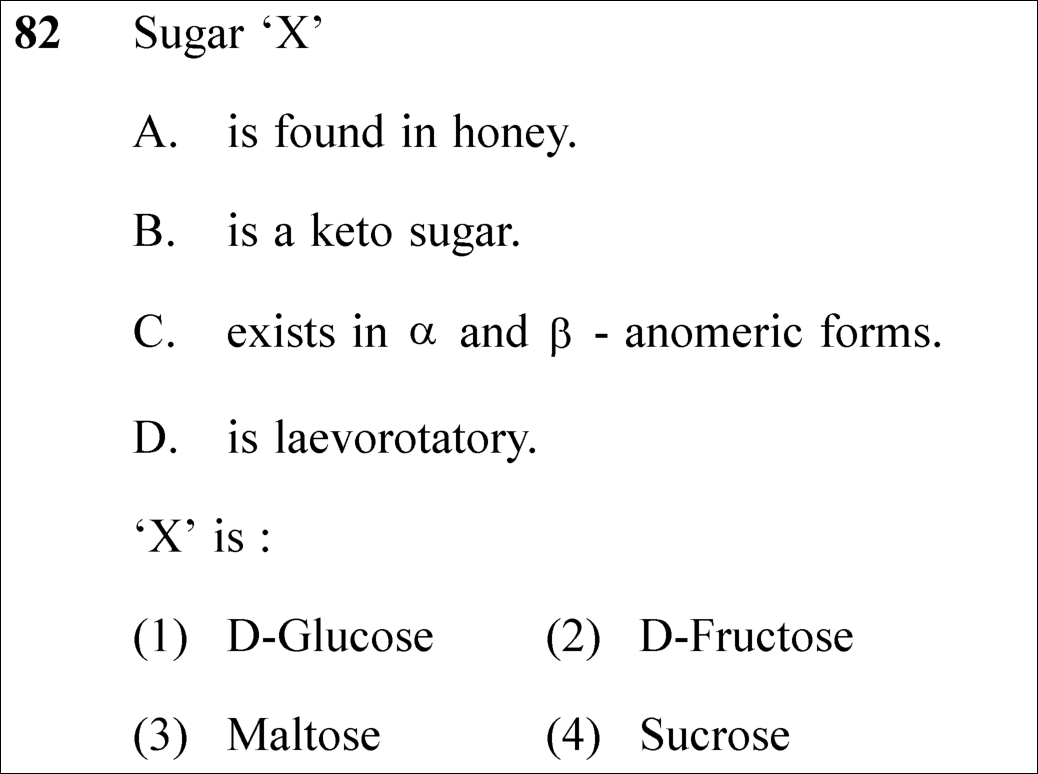
NEET 2025 · Q82 Easy
Official NEET 2025 Question 82 - Biomolecules
1
2 ✓ Key
3
4
💡 Verified Solution & 30-Second Hack
✓
Verified Against NTA Final Answer Key
Option (2) : D-Fructose
📚 Biomolecules Easy
📋 Given Parameters & Problem Setup
Property A Found in honey (along with glucose)
Property B Is a keto sugar (ketohexose)
Property C Exists in α and β - anomeric forms (furanose ring)
Property D Is laevorotatory ([α]_D = -92.4°)
⚡

The 30-Second Exam Hall Shortcut: ⚡ Keto Sugar & Laevorotatory Match

⏱️ Save ~30 seconds

Clue B: "is a keto sugar" immediately eliminates D-Glucose (aldohexose), Maltose (disaccharide of glucose), and Sucrose! Clue D: "is laevorotatory" confirms D-Fructose (historically called LEVULOSE because [α]_D = -92.4°)! ⟹ D-Fructose!

1 Read Clue B: "Sugar X is a keto sugar." Glucose is an aldohexose. Maltose and sucrose are disaccharides. Fructose is the ONLY ketohexose among the options!
2 Read Clue D: "Sugar X is laevorotatory." D-Fructose is strongly laevorotatory with specific rotation [α]_D = -92.4° (hence its traditional name levulose), whereas D-glucose is dextrorotatory (+52.7°).
3 Read Clue C: "Exists in α and β - anomeric forms." Fructose forms cyclic hemiketal furanose structures (α-D-fructofuranose and β-D-fructofuranose).
4 Read Clue A: "Found in honey." Natural honey consists predominantly of fructose (~38%) and glucose (~31%).
5 All 4 properties unambiguously identify Sugar X as D-Fructose!
6 Select Option (2) in under 5 seconds!
🛡️
Why You Can 100% Trust This Shortcut: Furanose Ring Structure & Functional Groups of Fructose (NCERT Chemistry · Biomolecules).
📐

Step-by-Step Rigorous Workflow & Mathematical Proof

Step 1

Analyze Chemical Classification: Keto Sugar

Carbohydrates are classified as aldoses or ketoses based on the functional carbonyl group:

D-Glucose: Aldohexose (−CHO at C1),D-Fructose: Ketohexose (>C=O at C2)\text{D-Glucose: Aldohexose } (-\text{CHO at C1}), \quad \text{D-Fructose: Ketohexose } (>\text{C}=\text{O at C2})
  • • Maltose is a disaccharide composed of two α-D-glucose units.
  • • Sucrose is a non-reducing disaccharide composed of glucose and fructose.
  • • Therefore, among monosaccharides, only D-Fructose is a keto sugar.
Step 2

Evaluate Optical Activity (Laevorotatory Nature)

Examine optical rotation properties of D-monosaccharides:

[α]D20(D-Glucose)=+52.7∘ (Dextrorotatory),[α]D20(D-Fructose)=−92.4∘ (Laevorotatory)[\alpha]_D^{20}(\text{D-Glucose}) = +52.7^\circ \text{ (Dextrorotatory)}, \quad [\alpha]_D^{20}(\text{D-Fructose}) = -92.4^\circ \text{ (Laevorotatory)}
  • • Because of its strong negative rotation, D-fructose is universally known as levulose.
  • • This property completely excludes D-glucose and matches D-fructose.
Step 3

Verify Anomeric Forms and Natural Occurrence in Honey

Cyclization of the C2 keto group with the C5 hydroxyl group produces a five-membered hemiketal furanose ring:

Fructose⇌α-D-(-)-fructofuranose+β-D-(-)-fructofuranose\text{Fructose} \rightleftharpoons \alpha\text{-D-(-)-fructofuranose} + \beta\text{-D-(-)-fructofuranose}
  • • Honey is nature’s richest source of free fructose.
  • • Thus Sugar X is unequivocally D-Fructose, matching Option (2).
⭐

360° Option Elimination Engine Key Feature

Diagnose every choice: Know exactly why the right option works and why distractors fail.

4-Option Deep Scan
1 A
✗ Incorrect
Verdict & Scientific Reason:

Incorrect. D-Glucose is an aldo sugar (not keto) and is dextrorotatory (+52.7°).

⚠️
Student Fallacy (Why candidates pick this trap): Confusing glucose with fructose.
2 B
✓ 100% Correct
Verdict & Scientific Reason:

100% correct. Keto sugar, found in honey, exhibits α/β anomers, and is strongly laevorotatory.

💡
Why this is airtight: None; textbook mastery of carbohydrates.
3 C
✗ Incorrect
Verdict & Scientific Reason:

Incorrect. Maltose is a disaccharide of two glucose units and is dextrorotatory.

⚠️
Student Fallacy (Why candidates pick this trap): Thinking maltose is a simple keto sugar.
4 D
✗ Incorrect
Verdict & Scientific Reason:

Incorrect. Sucrose is a disaccharide and dextrorotatory (+66.5°).

⚠️
Student Fallacy (Why candidates pick this trap): Confusing invert sugar with pure sucrose.
⚠️

NTA Trap Alert: Confusing Invert Sugar Hydrolysis with Pure Sugar Rotation

Sucrose upon hydrolysis becomes laevorotatory (invert sugar) because fructose (-92.4°) dominates glucose (+52.7°). But intact sucrose is DEXTROROTATORY (+66.5°). The standalone laevorotatory keto sugar itself is D-FRUCTOSE!

🛡️ How to avoid the -1 mark: Remember: Fructose = Keto sugar = Levulose (Laevorotatory)!
📖

Core NEET Syllabus Standard

NEET Chemistry Core Syllabus · Biomolecules Standard Benchmark
Core Scientific Principle Tested:

"D-Fructose is a laevorotatory ketohexose existing in α and β furanose forms."

Syllabus Focus: Structure and Properties of Monosaccharides: D-Fructose
✓ Core NEET UG Syllabus Anchor Syllabus & Academic Standards ↗
Keto + Laevo = Fructose (Levulose) in honey (Option 2)!
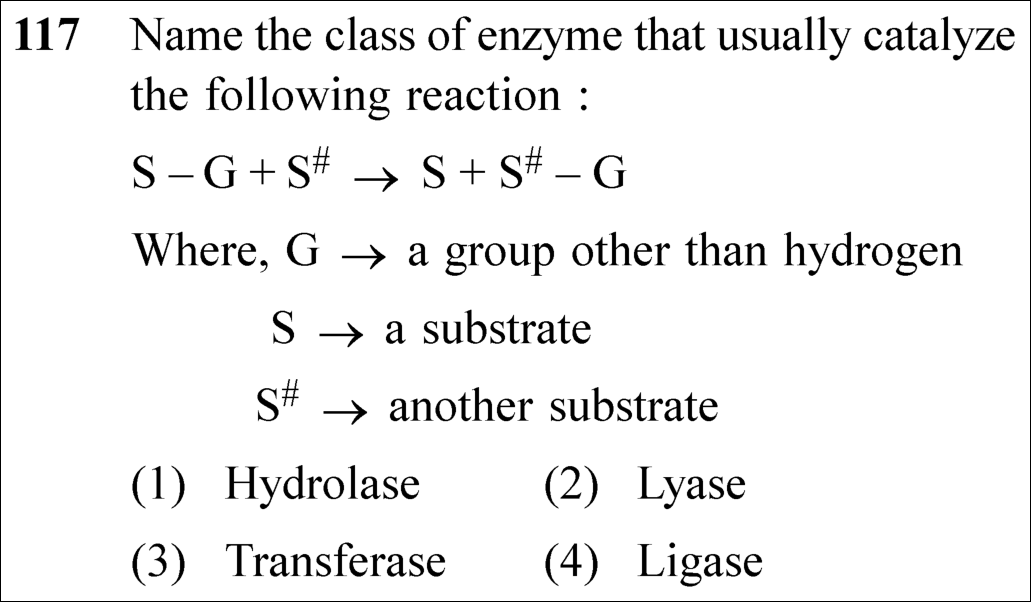
NEET 2025 · Q117 Easy
Official NEET 2025 Question 117 - Biomolecules
1
2
3 ✓ Key
4
💡 Verified Solution & 30-Second Hack
✓
Verified Against NTA Final Answer Key
Option (3) : Transferase
📚 Biomolecules Easy
📋 Given Parameters & Problem Setup
Reaction Equation S - G + S' -> S + S' - G
Group G A group other than hydrogen
S and S' Two different substrates
⚡

The 30-Second Exam Hall Shortcut: ⚡ Enzyme Commission Reaction Match

⏱️ Save ~25 seconds

S - G + S' -> S + S' - G transfers a group G (other than H) between substrates S and S'! That is verbatim Class 2: TRANSFERASE!

1 Recall the 6 Enzyme Commission (EC) classes in order (OTH LIL):
2 Oxidoreductases/Dehydrogenases: Redox reactions involving H/electrons.
3 Transferases: Catalyze transfer of a group G (other than H) between a pair of substrates (S - G + S' -> S + S' - G).
4 Hydrolases: Cleave bonds (ester, peptide, glycosidic) using water.
5 Lyases: Cleave bonds without hydrolysis leaving double bonds.
6 Isomerases: Interconversion of isomers.
7 Ligases: Join two compounds with ATP cleavage.
8 The reaction shows transfer of group G -> Class 2 Transferase!
9 Select Option (3) Transferase!
🛡️
Why You Can 100% Trust This Shortcut: Enzyme Classification & Catalytic Mechanisms (NCERT Biology · Biomolecules: Transferases, Hydrolases, Lyases, Ligases).
📐

Step-by-Step Rigorous Workflow & Mathematical Proof

Step 1

IUBMB / Enzyme Commission Classification

Enzymes are divided into 6 functional classes (Classes 1 through 6) based on the type of reaction they catalyze:

  • • Class 1: Oxidoreductases/dehydrogenases catalyze oxidation-reduction between two substrates SS and S′S' (Sreduced+Soxidized′→Soxidized+Sreduced′S_{\text{reduced}} + S'_{\text{oxidized}} \rightarrow S_{\text{oxidized}} + S'_{\text{reduced}}).
  • • Class 2: Transferases catalyze the transfer of a chemical group, GG (other than hydrogen), between a pair of substrates SS and S′S' (S−G+S′→S+S′−GS - G + S' \rightarrow S + S' - G).
  • • Class 3: Hydrolases catalyze the hydrolytic cleavage of ester, ether, peptide, glycosidic, C-C, C-halide, or P-N bonds.
  • • Class 4: Lyases catalyze removal of groups from substrates by mechanisms other than hydrolysis, forming double bonds.
  • • Class 5: Isomerases catalyze interconversion of optical, geometric, or positional isomers.
  • • Class 6: Ligases catalyze the linking together of two compounds (e.g. C-O, C-S, C-N, P-O bonds) coupled with ATP hydrolysis.
Step 2

Direct Comparison with the Given Equation

The given reaction: S−G+S′→S+S′−GS - G + S' \rightarrow S + S' - G, where GG is a chemical group other than hydrogen (such as methyl, phosphate, or amino group). Group GG is transferred directly from donor substrate SS to acceptor substrate S′S'. This is the canonical defining reaction of Transferases.

Step 3

Conclusion

The enzyme class is Transferase, corresponding to Option (3).

S−G+S′→TransferaseS+S′−GS - G + S' \xrightarrow{\text{Transferase}} S + S' - G
⭐

360° Option Elimination Engine Key Feature

Diagnose every choice: Know exactly why the right option works and why distractors fail.

4-Option Deep Scan
1 A
✗ Incorrect
Verdict & Scientific Reason:

Incorrect. Hydrolases catalyze hydrolytic cleavage (using H₂O) of bonds, not group transfer between two non-water substrates.

⚠️
Student Fallacy (Why candidates pick this trap): Confusing group transfer with hydrolysis.
2 B
✗ Incorrect
Verdict & Scientific Reason:

Incorrect. Lyases catalyze group removal without hydrolysis, leaving double bonds: X-C-C-Y -> X-Y + C=C.

⚠️
Student Fallacy (Why candidates pick this trap): Confusing group transfer with double bond-forming group elimination.
3 C
✓ 100% Correct
Verdict & Scientific Reason:

100% correct. NCERT explicitly defines transferases using this exact stoichiometric reaction formula.

💡
Why this is airtight: None; exact textbook definition.
4 D
✗ Incorrect
Verdict & Scientific Reason:

Incorrect. Ligases join two molecules with consumption of ATP (e.g., DNA ligase), rather than exchanging a group between two substrates.

⚠️
Student Fallacy (Why candidates pick this trap): Confusing transferring a group with joining two compounds.
⚠️

NTA Trap Alert: Oxidoreductase vs Transferase for Hydrogen

Notice the constraint: "Where, G -> a group other than hydrogen". If hydrogen were being transferred, the enzyme would be classified as an Oxidoreductase (dehydrogenase)! Group G other than hydrogen uniquely defines Transferases.

🛡️ How to avoid the -1 mark: Transfer of H = Dehydrogenase (Class 1); Transfer of group other than H = Transferase (Class 2).
📖

Core NEET Syllabus Standard

NEET Biology Core Syllabus · Biomolecules Standard Benchmark
Core Scientific Principle Tested:

"Transferases catalyze the transfer of a group G (other than hydrogen) between a pair of substrates S and S'."

Syllabus Focus: Enzymes · Classification and Nomenclature
✓ Core NEET UG Syllabus Anchor Syllabus & Academic Standards ↗
OTH LIL: Class 2 is T = TRANSFERASE (Transfers group G)!
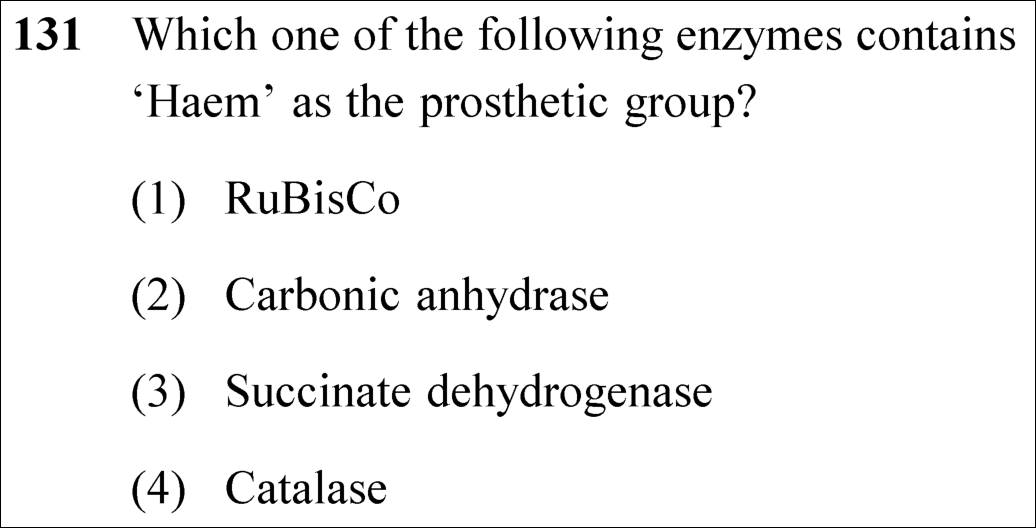
NEET 2025 · Q131 Easy
Official NEET 2025 Question 131 - Biomolecules
1 RuBisCo
2 Carbonic anhydrase
3 Succinate dehydrogenase
4 Catalase ✓ Key
💡 Verified Solution & 30-Second Hack
✓
Verified Against NTA Final Answer Key
Option (4) : Catalase
📚 Biomolecules Easy
📋 Given Parameters & Problem Setup
Prosthetic Group Haem (iron-porphyrin complex)
Target Enzyme Enzyme containing haem as its prosthetic group
⚡

The 30-Second Exam Hall Shortcut: ⚡ Enzyme Prosthetic Group Fingerprint

⏱️ Save ~25 seconds

Haem is the tightly bound prosthetic group in PEROXIDASE and CATALASE (breaks down H₂O₂)! Carbonic anhydrase uses Zn²⁺! Catalase is the answer!

1 Recall NCERT Section "Co-factors" (Prosthetic groups) verbatim:
2 - "Prosthetic groups are organic compounds and are distinguished from other co-factors in that they are tightly bound to the apoenzyme."
3 - "For example, in peroxidase and catalase, which catalyze the breakdown of hydrogen peroxide to water and oxygen, haem is the prosthetic group and it is a part of the active site of the enzyme."
4 - RuBisCo: Magnesium (Mg²⁺) activator.
5 - Carbonic anhydrase: Zinc (Zn²⁺) co-factor.
6 - Catalase: HAEM prosthetic group!
7 Select Option (4) Catalase!
🛡️
Why You Can 100% Trust This Shortcut: Enzyme Cofactors & Coenzymes (NCERT Biology · Biomolecules: Prosthetic groups, NAD/NADP vitamins, Metal activators).
📐

Step-by-Step Rigorous Workflow & Mathematical Proof

Step 1

Definition of Prosthetic Groups

Enzymes can be simple proteins or conjugated holoenzymes consisting of a protein part (apoenzyme) and a non-protein part (co-factor):

  • • Co-factors are of three types: prosthetic groups, co-enzymes, and metal ions.
  • • Prosthetic groups are organic compounds characterized by being tightly or permanently bound to the apoenzyme.
Step 2

Haem as a Prosthetic Group in Catalase and Peroxidase

NCERT explicitly cites Catalase and Peroxidase as the prime examples:

  • • Catalase catalyzes the rapid decomposition of hydrogen peroxide into water and molecular oxygen: 2H2O2→Catalase2H2O+O22 H_2O_2 \xrightarrow{\text{Catalase}} 2 H_2O + O_2.
  • • Haem (an iron-protoporphyrin complex) is the prosthetic group tightly integrated into the catalytic active site of catalase.
  • • The central iron (Fe3+/Fe4+Fe^{3+}/Fe^{4+}) undergoes reversible redox changes during the catalytic cycle.
Step 3

Co-factor Analysis of the Other Options

Reviewing the other candidate enzymes:

  • • RuBisCo: Requires Mg2+Mg^{2+} as an essential divalent activator ion.
  • • Carbonic anhydrase: Contains a zinc (Zn2+Zn^{2+}) metal ion at its active site, not haem.
  • • Succinate dehydrogenase: Uses FAD (flavin adenine dinucleotide) and iron-sulfur clusters (Fe−SFe-S), but not haem as its prosthetic group.
Step 4

Conclusion

Catalase is the enzyme containing haem as its prosthetic group, matching Option (4).

2H2O2→Catalase (Haem)2H2O+O22 H_2O_2 \xrightarrow{\text{Catalase (Haem)}} 2 H_2O + O_2
⭐

360° Option Elimination Engine Key Feature

Diagnose every choice: Know exactly why the right option works and why distractors fail.

4-Option Deep Scan
1 A
✗ Incorrect
Verdict & Scientific Reason:

Incorrect. RuBisCo uses magnesium (Mg²⁺) as a metal co-factor, not haem.

⚠️
Student Fallacy (Why candidates pick this trap): Assuming the most abundant enzyme contains haem.
2 B
✗ Incorrect
Verdict & Scientific Reason:

Incorrect. Carbonic anhydrase is a classic metalloenzyme requiring zinc (Zn²⁺) as a co-factor.

⚠️
Student Fallacy (Why candidates pick this trap): Confusing zinc co-factor with haem.
3 C
✗ Incorrect
Verdict & Scientific Reason:

Incorrect. Succinate dehydrogenase utilizes FAD and iron-sulfur clusters, not haem.

⚠️
Student Fallacy (Why candidates pick this trap): Confusing Complex II ETS components.
4 D
✓ 100% Correct
Verdict & Scientific Reason:

100% correct. Direct NCERT textbook fact: haem is the prosthetic group of catalase and peroxidase.

💡
Why this is airtight: None; pristine knowledge of enzyme co-factors.
⚠️

NTA Trap Alert: Haem in Non-Blood Proteins

Many students believe "haem" is only found in hemoglobin and myoglobin. NCERT specifically highlights that CATALASE and PEROXIDASE are enzymes with haem as their prosthetic group!

🛡️ How to avoid the -1 mark: Memorize the NCERT co-factor duo: Peroxidase and Catalase have HAEM.
📖

Core NEET Syllabus Standard

NEET Biology Core Syllabus · Biomolecules Standard Benchmark
Core Scientific Principle Tested:

"In peroxidase and catalase, haem is the prosthetic group firmly bound to the active site."

Syllabus Focus: Enzymes · Co-factors (Prosthetic Groups)
✓ Core NEET UG Syllabus Anchor Syllabus & Academic Standards ↗
CATALASE = Cleans H₂O₂ with HAEM!
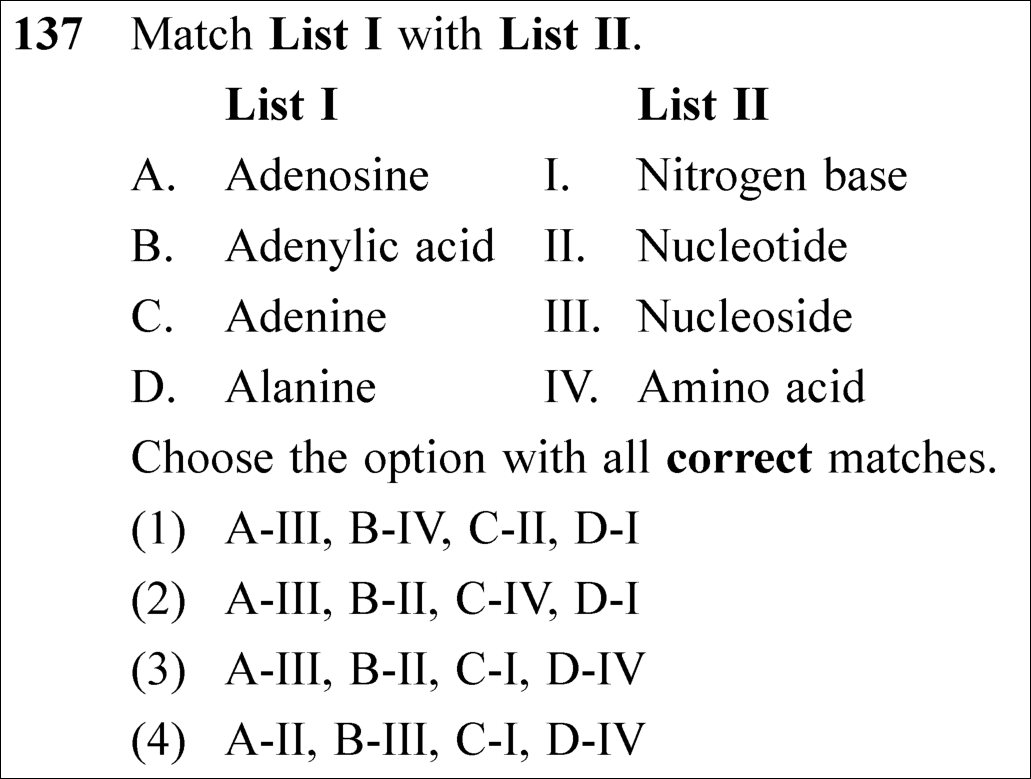
NEET 2025 · Q137 Easy
Official NEET 2025 Question 137 - Biomolecules
1
2
3 ✓ Key
4
💡 Verified Solution & 30-Second Hack
✓
Verified Against NTA Final Answer Key
Option (3) : A-III, B-II, C-I, D-IV
📚 Biomolecules Easy
📋 Given Parameters & Problem Setup
List I (Biomolecules) A. Adenosine, B. Adenylic acid, C. Adenine, D. Alanine
List II (Chemical Classes) I. Nitrogen base, II. Nucleotide, III. Nucleoside, IV. Amino acid
⚡

The 30-Second Exam Hall Shortcut: ⚡ Adenine Derivative Nomenclature Fingerprint

⏱️ Save ~25 seconds

Adenine = Nitrogen base (I); Adenosine = Base + Sugar = Nucleoside (III); Adenylic acid = Base + Sugar + Phosphate = Nucleotide (II); Alanine = Amino acid (IV)! Match: A-III, B-II, C-I, D-IV!

1 Apply biomolecule nomenclature rules from NCERT:
2 - Adenine: Heterocyclic purine nitrogenous base (C -> I).
3 - Adenosine: Adenine bonded to ribose sugar via N-glycosidic bond -> Nucleoside (A -> III).
4 - Adenylic acid (AMP): Adenosine esterified with phosphate group -> Nucleotide (B -> II).
5 - Alanine: Alpha-amino acid with methyl (-CH₃) group as R-group (D -> IV).
6 Direct matching code: A-III, B-II, C-I, D-IV (Option 3)!
7 Solved in under 5 seconds!
🛡️
Why You Can 100% Trust This Shortcut: Biomolecules Acid-Soluble vs Acid-Insoluble Fractions (NCERT Biology · Biomolecules: Trichloroacetic acid extraction).
📐

Step-by-Step Rigorous Workflow & Mathematical Proof

Step 1

Chemical Definitions of the Biomolecules

Understanding the hierarchical composition of nucleic acid building blocks and amino acids:

  • • A. Adenosine: Formed when the purine base adenine is covalently linked to a pentose sugar (ribose or deoxyribose) through an N-glycosidic linkage. It is a Nucleoside. Hence, A matches III.
  • • B. Adenylic acid (Adenosine monophosphate / AMP): Formed when a phosphate group is esterified to the 5'-OH of the pentose sugar in adenosine. It is a Nucleotide. Hence, B matches II.
  • • C. Adenine: A substituted purine (6-aminopurine) consisting of a heterocyclic carbon-nitrogen double ring. It is a free Nitrogen base. Hence, C matches I.
  • • D. Alanine: An organic molecule containing an amino group (-NH₂), a carboxyl group (-COOH), a hydrogen atom, and a methyl group (-CH₃) attached to the α\alpha-carbon. It is an Amino acid. Hence, D matches IV.
Step 2

Formulating the Matching Code

Pairing the components:

  • • A -> III (Adenosine = Nucleoside)
  • • B -> II (Adenylic acid = Nucleotide)
  • • C -> I (Adenine = Nitrogen base)
  • • D -> IV (Alanine = Amino acid)
Step 3

Conclusion

The unambiguous combination is A-III, B-II, C-I, D-IV, corresponding to Option (3).

Code: A-III,  B-II,  C-I,  D-IV\text{Code: } A\text{-III}, \; B\text{-II}, \; C\text{-I}, \; D\text{-IV}
⭐

360° Option Elimination Engine Key Feature

Diagnose every choice: Know exactly why the right option works and why distractors fail.

4-Option Deep Scan
1 A
✗ Incorrect
Verdict & Scientific Reason:

Incorrect. Assigns amino acid to adenylic acid and nitrogen base to alanine.

⚠️
Student Fallacy (Why candidates pick this trap): Confusing nucleotide acids with amino acids.
2 B
✗ Incorrect
Verdict & Scientific Reason:

Incorrect. Matches adenine with amino acid and alanine with nitrogen base.

⚠️
Student Fallacy (Why candidates pick this trap): Swapping adenine and alanine due to similar names.
3 C
✓ 100% Correct
Verdict & Scientific Reason:

100% correct. Correctly identifies nucleoside, nucleotide, nitrogen base, and amino acid.

💡
Why this is airtight: None; clean biochemical definitions.
4 D
✗ Incorrect
Verdict & Scientific Reason:

Incorrect. Inverts adenosine (nucleoside) and adenylic acid (nucleotide).

⚠️
Student Fallacy (Why candidates pick this trap): Failing to remember that "-ylic acid" signifies the phosphate-bearing nucleotide.
⚠️

NTA Trap Alert: Adenosine vs Adenylic Acid vs Adenine vs Alanine

The four "A" names are notorious for confusing unprepared students: AdenINE = Base alone; AdenoSINE = Base + Sugar (Nucleoside); AdenyLIC ACID = Base + Sugar + Phosphate (Nucleotide); ALANINE = Amino acid!

🛡️ How to avoid the -1 mark: Suffix check: -ine (base), -sine (nucleoside), -ylic acid (nucleotide), Alanine (amino acid).
📖

Core NEET Syllabus Standard

NEET Biology Core Syllabus · Biomolecules Standard Benchmark
Core Scientific Principle Tested:

"Adenine is a nitrogen base, adenosine is a nucleoside, adenylic acid is a nucleotide, and alanine is an amino acid."

Syllabus Focus: How to Analyse Chemical Composition? · Nucleic Acids & Amino Acids
✓ Core NEET UG Syllabus Anchor Syllabus & Academic Standards ↗
Base = AdenINE; Side = AdenoSINE; Tide = AdenyLIC acid; Protein unit = ALANINE!
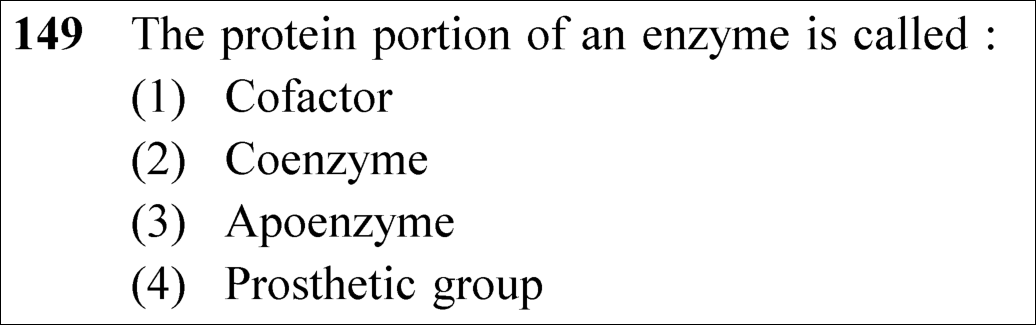
NEET 2025 · Q149 Easy
Official NEET 2025 Question 149 - Biomolecules
1 Cofactor
2 Coenzyme
3 Apoenzyme ✓ Key
4 Prosthetic group
💡 Verified Solution & 30-Second Hack
✓
Verified Against NTA Final Answer Key
Option (3) : Apoenzyme
📚 Biomolecules Easy
📋 Given Parameters & Problem Setup
Target Structure Protein portion of a conjugated catalytic enzyme
⚡

The 30-Second Exam Hall Shortcut: ⚡ Enzyme Terminology Equation Fingerprint

⏱️ Save ~10 seconds

Holoenzyme = Apoenzyme (PROTEIN part) + Co-factor (NON-PROTEIN part)! Protein portion alone is the APOENZYME!

1 Recall the holoenzyme breakdown equation from NCERT Section 9.12.6:
2 - Holoenzyme (active catalytic complex) = Apoenzyme + Co-factor.
3 - Protein portion of the enzyme = Apoenzyme.
4 - Non-protein portion = Co-factor (prosthetic group, coenzyme, or metal ion).
5 Direct answer: Apoenzyme!
6 Select Option (3) Apoenzyme!
🛡️
Why You Can 100% Trust This Shortcut: Enzyme Kinetics & Competitive Inhibition (NCERT Biology · Biomolecules: Malonate competitive inhibition of succinate dehydrogenase).
📐

Step-by-Step Rigorous Workflow & Mathematical Proof

Step 1

Composition of Conjugated Enzymes (Holoenzymes)

Many enzymes are conjugated proteins composed of two distinct biochemical entities:

  • • Apoenzyme: The macromolecular protein portion of the enzyme that provides the 3D tertiary structure, substrate-binding pocket, and catalytic active site framework.
  • • Co-factor: The non-protein constituent bound to the enzyme to make it catalytically active.
Step 2

Types of Co-factors

Distinguishing non-protein co-factors:

  • • Prosthetic group: An organic co-factor tightly and permanently bound to the apoenzyme (e.g. haem in catalase).
  • • Coenzyme: An organic co-factor only transiently associated with the apoenzyme during catalysis (often derived from vitamins, e.g. NAD, NADP from niacin).
  • • Metal ions: Inorganic co-factors coordinating with active site residues (e.g. Zn2+Zn^{2+} in carbonic anhydrase).
Step 3

Conclusion

The protein portion of an enzyme is called the Apoenzyme.

Holoenzyme=Apoenzyme⏟Protein portion+Co-factor⏟Non-protein portion\text{Holoenzyme} = \underbrace{\text{Apoenzyme}}_{\text{Protein portion}} + \underbrace{\text{Co-factor}}_{\text{Non-protein portion}}
⭐

360° Option Elimination Engine Key Feature

Diagnose every choice: Know exactly why the right option works and why distractors fail.

4-Option Deep Scan
1 A
✗ Incorrect
Verdict & Scientific Reason:

Incorrect. A cofactor is the NON-PROTEIN constituent required for enzyme activity.

⚠️
Student Fallacy (Why candidates pick this trap): Confusing non-protein cofactor with protein portion.
2 B
✗ Incorrect
Verdict & Scientific Reason:

Incorrect. Coenzymes are organic non-protein cofactors (often vitamin derivatives like NAD).

⚠️
Student Fallacy (Why candidates pick this trap): Equating coenzymes with the protein polypeptide chain.
3 C
✓ 100% Correct
Verdict & Scientific Reason:

100% correct. Direct verbatim NCERT definition: "the protein portion of the enzymes is called the apoenzyme".

💡
Why this is airtight: None; textbook recall.
4 D
✗ Incorrect
Verdict & Scientific Reason:

Incorrect. A prosthetic group is a tightly bound organic non-protein cofactor.

⚠️
Student Fallacy (Why candidates pick this trap): Confusing the prosthetic group with the apoenzyme.
⚠️

NTA Trap Alert: Apoenzyme vs Coenzyme

Apoenzyme is the PROTEIN. Coenzyme is the NON-PROTEIN organic helper (vitamin). "Apo" means "away/detached from cofactor".

🛡️ How to avoid the -1 mark: Apo = Amino acid polymer = Protein!
📖

Core NEET Syllabus Standard

NEET Biology Core Syllabus · Biomolecules Standard Benchmark
Core Scientific Principle Tested:

"In a holoenzyme, the protein portion is termed the apoenzyme, which is catalytically inactive without its specific co-factor."

Syllabus Focus: Enzymes · Co-factors (Apoenzyme)
✓ Core NEET UG Syllabus Anchor Syllabus & Academic Standards ↗
APO-enzyme = All-Protein Original!
NEET 2024 · Q62 Easy
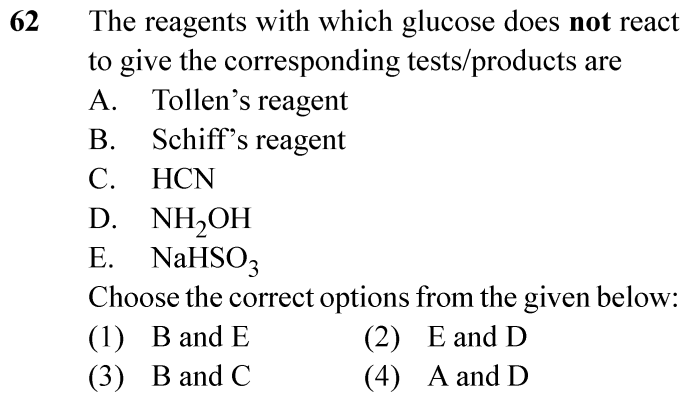
Official NEET 2024 Question 62 - Biomolecules
1 ✓ Key
2
3
4
💡 Verified Solution & 30-Second Hack
✓
Verified Against NTA Final Answer Key
Option (1) : B and E (Schiff’s reagent and NaHSO3)
📚 Biomolecules Easy
📋 Given Parameters & Problem Setup
Target molecule D-Glucose (C6H12O6)
Condition Reagents with which glucose does NOT react to give corresponding tests/products
⚡

The 30-Second Exam Hall Shortcut: ⚡ Cyclic Glucopyranose Masked Aldehyde Hack

⏱️ Save ~40 seconds

Glucose forms an oxime (NH2OH) and cyanohydrin (HCN), reduces Tollen’s, but FAILS Schiff’s test and does NOT form NaHSO3 adduct because the -CHO group is locked in a cyclic hemiacetal ring!

1 D-Glucose exists predominantly (>99.5%) in cyclic α- and β-glucopyranose hemiacetal forms.
2 The open-chain aldehyde form exists in minute equilibrium concentrations.
3 Strong nucleophiles (HCN, NH2OH) and oxidizing agents (Tollen’s reagent) shift the ring-chain equilibrium and react successfully.
4 Weakly nucleophilic reagents such as Schiff’s reagent and bulky sodium bisulphite (NaHSO3) CANNOT react with the cyclic hemiacetal.
5 Therefore, glucose does NOT react with Schiff’s reagent (B) and NaHSO3 (E).
6 Option (1) in 5 seconds!
🛡️
Why You Can 100% Trust This Shortcut: NCERT Chemistry · Biomolecules (Evidence for the cyclic structure of glucose: failure to react with Schiff’s reagent and NaHSO3).
📐

Step-by-Step Rigorous Workflow & Mathematical Proof

Step 1

Evidence for the Cyclic Structure of Glucose

Although glucose contains an aldehyde carbonyl group in its Fischer projection, it fails to exhibit several characteristic reactions of aliphatic aldehydes: 1. It does not react with Schiff’s reagent to restore the pink/magenta color. 2. It does not form a sodium bisulphite addition product with NaHSO3. 3. The pentaacetate of glucose does not react with hydroxylamine (NH2OH), proving the absence of a free -CHO group.

Glucose+Schiff’s Reagent⟶No Reaction (Negative Test)\text{Glucose} + \text{Schiff's Reagent} \longrightarrow \text{No Reaction (Negative Test)}
Step 2

Mechanism of Non-Reactivity with NaHSO3 and Schiff’s Reagent

The -OH at C-5 adds intramolecularly to the C-1 carbonyl carbon, locking glucose into a stable six-membered cyclic hemiacetal (glucopyranose). The concentration of free open-chain aldehyde is less than 0.02%. Bulky bisulphite ions (HSO3-) and Schiff’s reagent cannot drive ring opening because their addition products are thermodynamically less stable than the closed hemiacetal ring.

Open-chain aldehyde (0.02%)⇌α- and β-D-Glucopyranose (>99.9%)\text{Open-chain aldehyde (0.02\%)} \xrightleftharpoons{} \alpha\text{- and } \beta\text{-D-Glucopyranose (>99.9\%)}
Step 3

Reactivity with Tollen’s Reagent, HCN, and NH2OH

In contrast: - Tollen’s reagent is alkaline and drives tautomerization (Lobry de Bruyn-Alberda van Ekenstein rearrangement) and oxidation to gluconic acid. - HCN and NH2OH are powerful, unhindered nucleophiles that irreversibly trap the minute open-chain form, pulling the equilibrium forward to completion.

Glucose+HCN→Cyanohydrin;Glucose+NH2OH→Oxime\text{Glucose} + \text{HCN} \rightarrow \text{Cyanohydrin}; \quad \text{Glucose} + \text{NH}_2\text{OH} \rightarrow \text{Oxime}
⭐

360° Option Elimination Engine Key Feature

Diagnose every choice: Know exactly why the right option works and why distractors fail.

4-Option Deep Scan
1 (1)
✓ 100% Correct
Verdict & Scientific Reason:

Verbatim NCERT evidence demonstrating that the -CHO group is tied up in a cyclic hemiacetal.

💡
Why this is airtight: None.
2 (2)
✗ Incorrect
Verdict & Scientific Reason:

Glucose reacts readily with NH2OH to form an oxime.

⚠️
Student Fallacy (Why candidates pick this trap): Believing glucose cannot form an oxime.
3 (3)
✗ Incorrect
Verdict & Scientific Reason:

Glucose reacts with HCN to yield a cyanohydrin.

⚠️
Student Fallacy (Why candidates pick this trap): Thinking cyanohydrin formation fails in glucose.
4 (4)
✗ Incorrect
Verdict & Scientific Reason:

Glucose reduces Tollen’s reagent (silver mirror test) and forms an oxime with NH2OH.

⚠️
Student Fallacy (Why candidates pick this trap): Denying reducing sugar properties of glucose.
⚠️

NTA Trap Alert: Assuming All Aldehyde Tests Work on Glucose

Students who only memorize glucose as an "aldohexose" assume all classic aldehyde tests work. Glucose is a reducing sugar (reduces Tollen’s and Fehling’s), but FAILS Schiff’s and NaHSO3 tests!

🛡️ How to avoid the -1 mark: Memorize the classic pair of failed tests: Schiff’s and NaHSO3.
📖

Core NEET Syllabus Standard

Chemistry Core Biomolecules · Biomolecules Standard Benchmark
Core Scientific Principle Tested:

"Glucose does not give Schiff’s test and does not form an addition product with NaHSO3 because it exists predominantly as a cyclic hemiacetal."

Syllabus Focus: Carbohydrates: Limitations of the Open Chain Structure of Glucose
✓ Core NEET UG Syllabus Anchor Syllabus & Academic Standards ↗
Schiff and Sodium bisulfite say "NO" to the cyclic glucose ring show!
NEET 2024 · Q116 Easy
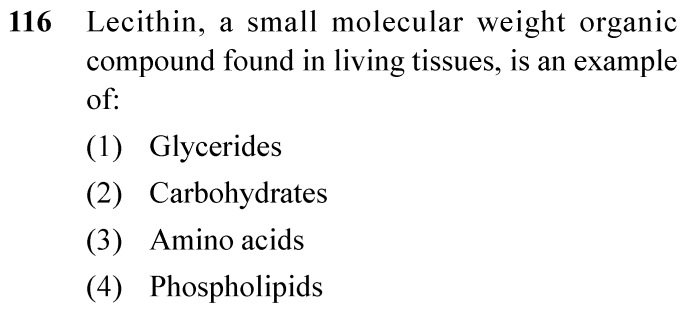
Official NEET 2024 Question 116 - Biomolecules
1
2
3
4 ✓ Key
💡 Verified Solution & 30-Second Hack
✓
Verified Against NTA Final Answer Key
Option (4) : Phospholipids
📚 Biomolecules Easy
📋 Given Parameters & Problem Setup
Biomolecule Lecithin
Question Classification category among lipids
⚡

The 30-Second Exam Hall Shortcut: ⚡ Lecithin Structural Identity

⏱️ Save ~15 seconds

Lecithin is phosphatidylcholine—a glycerol esterified to two fatty acids and a phosphate group bonded to choline. It is the textbook example of a Phospholipid!

1 Recall lipid classification:
2 - Simple lipids: Triglycerides (glycerol + 3 fatty acids).
3 - Phospholipids: Lipids containing a phosphorylated organic compound (e.g., Lecithin in cell membranes).
4 - Steroids: 4-ring hydrocarbon backbone (cholesterol).
5 Direct identification: Lecithin is a Phospholipid -> Option (4) / D.
🛡️
Why You Can 100% Trust This Shortcut: NCERT Biology · Biomolecules (Phospholipids and Membrane Lipids)
📐

Step-by-Step Rigorous Workflow & Mathematical Proof

Step 1

Understand Phospholipid Structure

Some lipids have phosphorus and a phosphorylated organic compound in them. These are phospholipids. They are found in cell membranes.

Step 2

Identify Lecithin Specifically

Lecithin (phosphatidylcholine) consists of glycerol, two fatty acid chains, a phosphate group, and choline. It is an amphipathic lipid and a major structural constituent of biological membranes.

⭐

360° Option Elimination Engine Key Feature

Diagnose every choice: Know exactly why the right option works and why distractors fail.

4-Option Deep Scan
1 (1)
✗ Incorrect
Verdict & Scientific Reason:

Monoglycerides contain one fatty acid esterified to glycerol.

⚠️
Student Fallacy (Why candidates pick this trap): Monoglycerides contain one fatty acid esterified to glycerol.
2 (2)
✗ Incorrect
Verdict & Scientific Reason:

Diglycerides contain two fatty acids esterified to glycerol without a phosphate-choline head.

⚠️
Student Fallacy (Why candidates pick this trap): Diglycerides contain two fatty acids esterified to glycerol without a phosphate-choline head.
3 (3)
✗ Incorrect
Verdict & Scientific Reason:

Triglycerides (triacylglycerols) are neutral storage fats containing glycerol and three fatty acid residues.

⚠️
Student Fallacy (Why candidates pick this trap): Triglycerides (triacylglycerols) are neutral storage fats containing glycerol and three fatty acid residues.
4 (4)
✓ 100% Correct
Verdict & Scientific Reason:

Lecithin is a classic phospholipid containing glycerol, two fatty acids, phosphate, and a choline group.

💡
Why this is airtight: None.
⚠️

NTA Trap Alert: Triglyceride vs Phospholipid Headgroup

Assuming lecithin is a simple fat because it contains glycerol and fatty acids.

🛡️ How to avoid the -1 mark: The presence of the phosphate-choline group makes it a compound lipid: a phospholipid.
📖

Core NEET Syllabus Standard

Biology Core Botany · Biomolecules Standard Benchmark
Core Scientific Principle Tested:

"Some lipids have phosphorous and a phosphorylated organic compound in them. These are phospholipids. They are found in cell membrane. Lecithin is one example."

Syllabus Focus: Lipid Classification and Structure of Lecithin
✓ Core NEET UG Syllabus Anchor Syllabus & Academic Standards ↗
NEET 2024 · Q118 Easy
Official NEET 2024 Question 118 - Biomolecules
1
2
3 ✓ Key
4
💡 Verified Solution & 30-Second Hack
✓
Verified Against NTA Final Answer Key
Option (3) : Zinc
📚 Biomolecules Easy
📋 Given Parameters & Problem Setup
Enzyme Carboxypeptidase (proteolytic enzyme)
Target Essential metal ion cofactor
⚡

The 30-Second Exam Hall Shortcut: ⚡ Carboxypeptidase Metal Ion Fingerprint

⏱️ Save ~15 seconds

Carboxypeptidase and Carbonic anhydrase both strictly require Zinc (Zn²⁺) as their catalytic metal ion cofactor!

1 Recall essential metal cofactors:
2 - Zinc (Zn²⁺): Cofactor for Carboxypeptidase, Carbonic anhydrase, and Alcohol dehydrogenase.
3 - Magnesium (Mg²⁺): Hexokinase, DNA polymerase, RuBisCO, PEPcase.
4 - Iron (Fe²⁺/Fe³⁺): Catalase, Cytochromes.
5 Carboxypeptidase -> Zinc -> Option (3) / C.
🛡️
Why You Can 100% Trust This Shortcut: NCERT Biology · Biomolecules (Cofactors and Catalytic Metal Ions)
📐

Step-by-Step Rigorous Workflow & Mathematical Proof

Step 1

Understand Cofactor Categories

Cofactors are non-protein constituents bound to an enzyme to make it catalytically active. They are divided into three kinds: prosthetic groups, coenzymes, and metal ions.

Step 2

Role of Metal Ions in Catalysis

A number of enzymes require metal ions for their activity which form coordination bonds with side chains at the active site and simultaneously form one or more coordination bonds with the substrate.

Step 3

Identify Specific Ion for Carboxypeptidase

NCERT explicitly states: "For example, zinc is a cofactor for the proteolytic enzyme carboxypeptidase."

⭐

360° Option Elimination Engine Key Feature

Diagnose every choice: Know exactly why the right option works and why distractors fail.

4-Option Deep Scan
1 (1)
✗ Incorrect
Verdict & Scientific Reason:

Copper is found in cytochrome c oxidase and tyrosinase, not carboxypeptidase.

⚠️
Student Fallacy (Why candidates pick this trap): Copper is found in cytochrome c oxidase and tyrosinase, not carboxypeptidase.
2 (2)
✗ Incorrect
Verdict & Scientific Reason:

Iron is the prosthetic cofactor in catalase, peroxidase, and cytochromes.

⚠️
Student Fallacy (Why candidates pick this trap): Iron is the prosthetic cofactor in catalase, peroxidase, and cytochromes.
3 (3)
✓ 100% Correct
Verdict & Scientific Reason:

Zinc (Zn²⁺) is the specific metal ion cofactor required by the proteolytic enzyme carboxypeptidase.

💡
Why this is airtight: None.
4 (4)
✗ Incorrect
Verdict & Scientific Reason:

Magnesium is an activator for kinases, RuBisCO, and PEPcase.

⚠️
Student Fallacy (Why candidates pick this trap): Magnesium is an activator for kinases, RuBisCO, and PEPcase.
⚠️

NTA Trap Alert: Iron vs Zinc in Digestive Enzymes

Confusing catalase (heme/iron) with carboxypeptidase (zinc).

🛡️ How to avoid the -1 mark: Remember: Carboxypeptidase and Carbonic anhydrase both use Zinc.
📖

Core NEET Syllabus Standard

Biology Core Botany · Biomolecules Standard Benchmark
Core Scientific Principle Tested:

"A number of enzymes require metal ions for their activity which form coordination bonds with side chains at the active site... For example, zinc is a cofactor for the proteolytic enzyme carboxypeptidase."

Syllabus Focus: Prosthetic Groups, Coenzymes, and Metal Ion Cofactors
✓ Core NEET UG Syllabus Anchor Syllabus & Academic Standards ↗
NEET 2024 · Q119 Easy
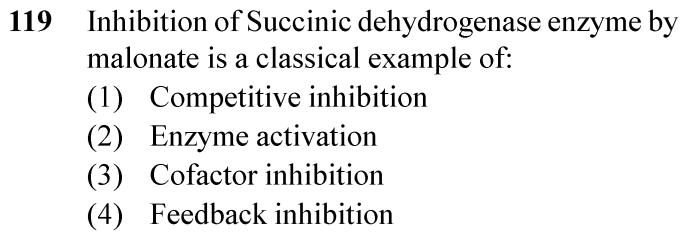
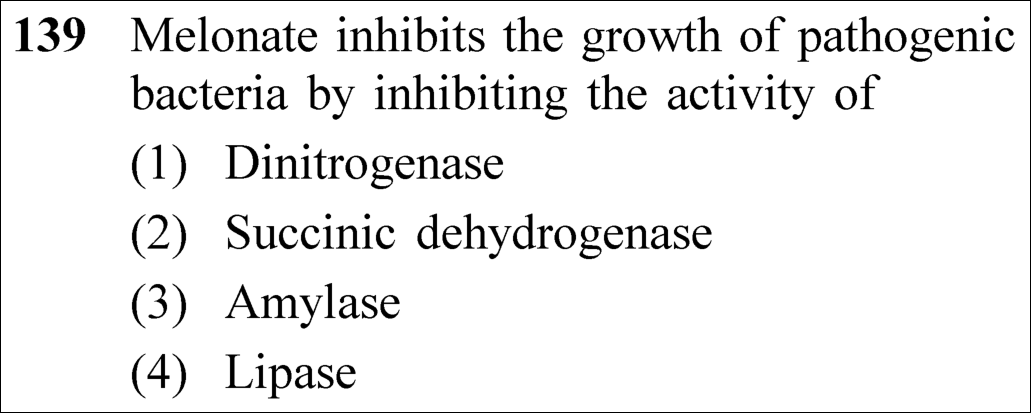
Official NEET 2024 Question 119 - Biomolecules
1 Competitive inhibition ✓ Key
2 Enzyme activation
3 Cofactor inhibition
4 Feedback inhibition
💡 Verified Solution & 30-Second Hack
✓
Verified Against NTA Final Answer Key
Option (1) : Competitive inhibition
📚 Biomolecules Easy
📋 Given Parameters & Problem Setup
Enzyme Succinic dehydrogenase
Substrate Succinate
Inhibitor Malonate (structurally resembles succinate)
⚡

The 30-Second Exam Hall Shortcut: ⚡ Textbook Example of Competitive Inhibition

⏱️ Save ~20 seconds

Malonate closely resembles the substrate succinate in structure and competes for the active site of succinic dehydrogenase -> Classical Competitive Inhibition!

1 Recognize the classic reaction pair:
2 - Substrate: Succinate (4 carbons, two carboxyls).
3 - Inhibitor: Malonate (3 carbons, two carboxyls).
4 - Because malonate mimics succinate, it binds the catalytic site without reacting.
5 This matches the definition of Competitive Inhibition -> Option (1) / A.
🛡️
Why You Can 100% Trust This Shortcut: NCERT Biology · Biomolecules (Enzyme Inhibition)
📐

Step-by-Step Rigorous Workflow & Mathematical Proof

Step 1

Define Competitive Inhibition

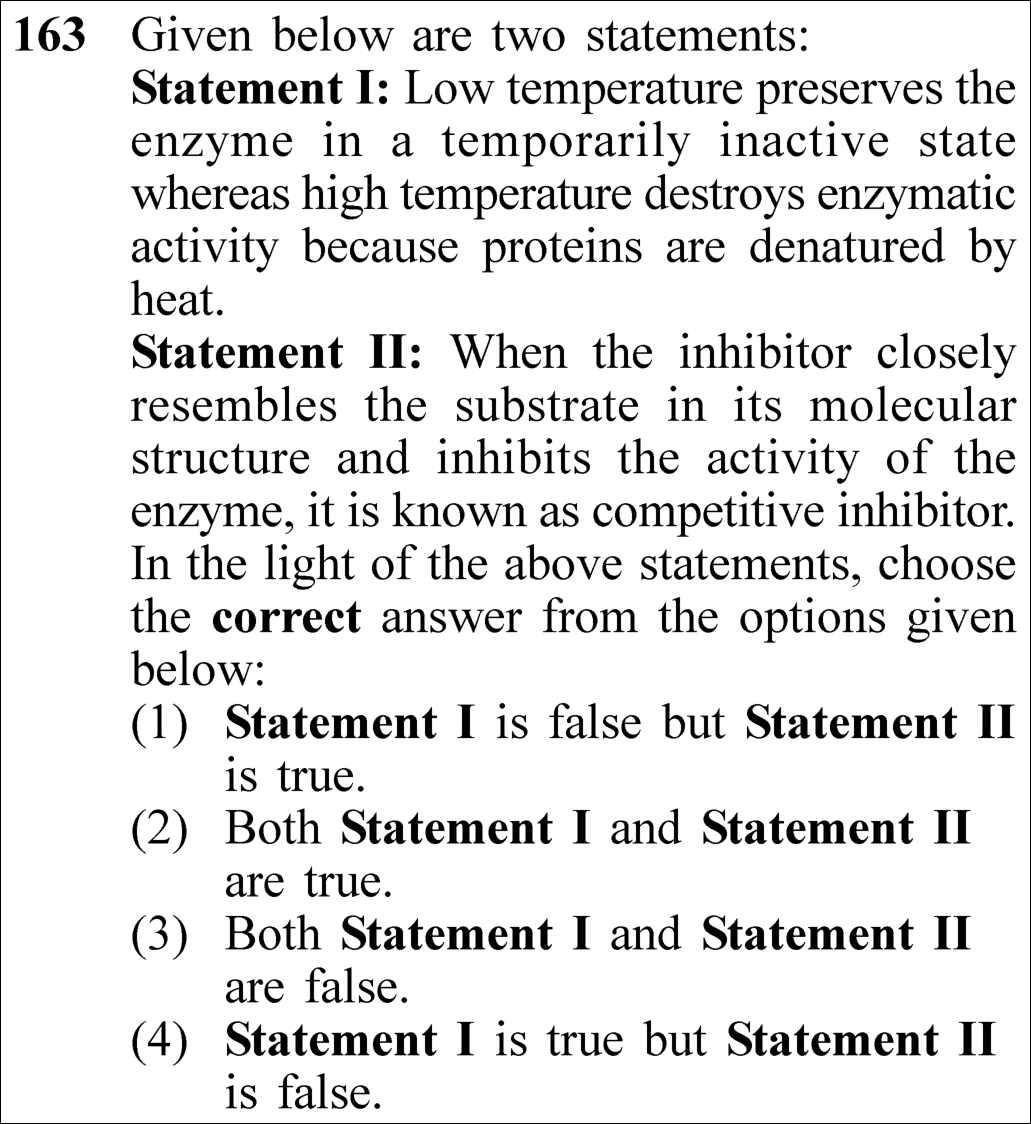
When the inhibitor closely resembles the substrate in its molecular structure and inhibits the activity of the enzyme by competing for the active binding site, it is known as competitive inhibition.

Step 2

Analyze the Succinate-Malonate System

Inhibition of succinic dehydrogenase by malonate is the classic demonstration: malonate closely resembles succinate in chemical structure, binding to the active site and preventing succinate oxidation to fumarate.

Step 3

Kinetic Reversibility

Competitive inhibition can be overcome by increasing the concentration of the substrate (succinate).

⭐

360° Option Elimination Engine Key Feature

Diagnose every choice: Know exactly why the right option works and why distractors fail.

4-Option Deep Scan
1 (1)
✓ 100% Correct
Verdict & Scientific Reason:

Malonate is a structural analog of succinate that competitively occupies the active site of succinic dehydrogenase.

💡
Why this is airtight: None.
2 (2)
✗ Incorrect
Verdict & Scientific Reason:

Non-competitive inhibitors bind to an allosteric site distinct from the substrate active site.

⚠️
Student Fallacy (Why candidates pick this trap): Non-competitive inhibitors bind to an allosteric site distinct from the substrate active site.
3 (3)
✗ Incorrect
Verdict & Scientific Reason:

Allosteric inhibition involves conformational changes induced by binding at a regulatory site.

⚠️
Student Fallacy (Why candidates pick this trap): Allosteric inhibition involves conformational changes induced by binding at a regulatory site.
4 (4)
✗ Incorrect
Verdict & Scientific Reason:

Feedback inhibition occurs when the end product of a metabolic pathway inhibits an upstream pathway enzyme.

⚠️
Student Fallacy (Why candidates pick this trap): Feedback inhibition occurs when the end product of a metabolic pathway inhibits an upstream pathway enzyme.
⚠️

NTA Trap Alert: Competitive vs Non-competitive Kinetics

Assuming malonate destroys the enzyme permanently.

🛡️ How to avoid the -1 mark: Malonate competition is fully reversible by adding excess succinate; Km increases while Vmax remains unchanged.
📖

Core NEET Syllabus Standard

Biology Core Botany · Biomolecules Standard Benchmark
Core Scientific Principle Tested:

"When the inhibitor closely resembles the substrate in its molecular structure and inhibits the activity of the enzyme, it is known as competitive inhibitor... Inhibition of succinic dehydrogenase by malonate which closely resembles the substrate succinate in structure is an example."

Syllabus Focus: Competitive Inhibition: Succinic Dehydrogenase and Malonate
✓ Core NEET UG Syllabus Anchor Syllabus & Academic Standards ↗
NEET 2024 · Q144 Easy
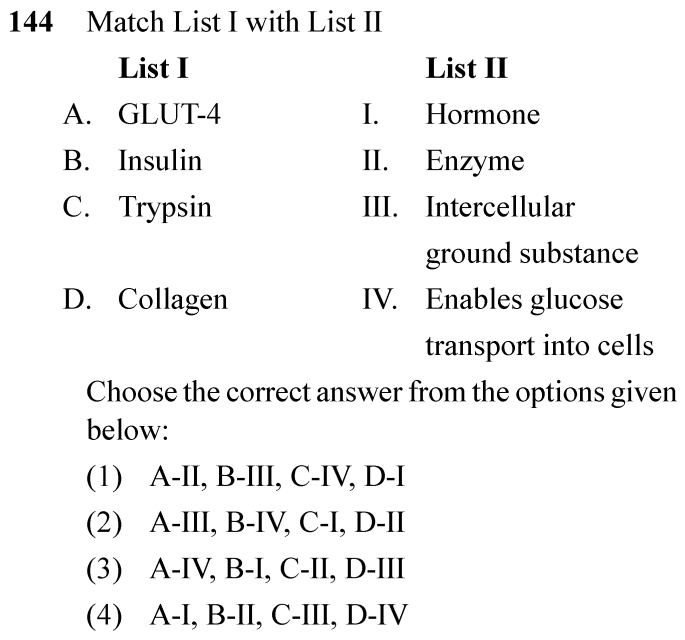
Official NEET 2024 Question 144 - Biomolecules
1
2
3 ✓ Key
4
💡 Verified Solution & 30-Second Hack
✓
Verified Against NTA Final Answer Key
Option (3) : A-IV, B-I, C-II, D-III
📚 Biomolecules Easy
📋 Given Parameters & Problem Setup
List I (Proteins) A: GLUT-4; B: Insulin; C: Trypsin; D: Collagen
List II (Functions / Roles) I: Hormone; II: Enzyme; III: Intercellular ground substance; IV: Enables glucose transport into cells
⚡

The 30-Second Exam Hall Shortcut: ⚡ NCERT Table 9.5 Verbatim Match

⏱️ Save ~20 seconds

GLUT-4 = Enables glucose transport (IV); Insulin = Hormone (I); Trypsin = Proteolytic enzyme (II); Collagen = Intercellular ground substance (III)! Matching: A-IV, B-I, C-II, D-III!

1 A. GLUT-4: Glucose transporter 4 enables glucose transport into cells (IV).
2 B. Insulin: peptide Hormone regulating blood sugar (I).
3 C. Trypsin: proteolytic digestive Enzyme (II).
4 D. Collagen: most abundant animal protein, acts as Intercellular ground substance (III).
5 Matching order: A-IV, B-I, C-II, D-III -> Option (3) / C.
🛡️
Why You Can 100% Trust This Shortcut: NCERT Biology · Biomolecules (Proteins and Biological Functions)
📐

Step-by-Step Rigorous Workflow & Mathematical Proof

Step 1

Review NCERT Table 9.5 (Some Proteins and Their Functions)

- Collagen: Intercellular ground substance. - Trypsin: Enzyme. - Insulin: Hormone. - Antibody: Fights infectious agents. - Receptor: Sensory reception (smell, taste, hormone, etc.). - GLUT-4: Enables glucose transport into cells.

Step 2

Execute Direct Pairwise Match

A -> IV B -> I C -> II D -> III

Step 3

Conclude Option

Matches Option (3) uniquely.

⭐

360° Option Elimination Engine Key Feature

Diagnose every choice: Know exactly why the right option works and why distractors fail.

4-Option Deep Scan
1 (1)
✗ Incorrect
Verdict & Scientific Reason:

Mismatches GLUT-4 with Enzyme and Collagen with Hormone.

⚠️
Student Fallacy (Why candidates pick this trap): Mismatches GLUT-4 with Enzyme and Collagen with Hormone.
2 (2)
✗ Incorrect
Verdict & Scientific Reason:

Mismatches GLUT-4 with Intercellular ground substance.

⚠️
Student Fallacy (Why candidates pick this trap): Mismatches GLUT-4 with Intercellular ground substance.
3 (3)
✓ 100% Correct
Verdict & Scientific Reason:

Accurately pairs all four proteins with their respective physiological roles from NCERT Table 9.5.

💡
Why this is airtight: None.
4 (4)
✗ Incorrect
Verdict & Scientific Reason:

Mismatches GLUT-4 with Hormone.

⚠️
Student Fallacy (Why candidates pick this trap): Mismatches GLUT-4 with Hormone.
⚠️

NTA Trap Alert: GLUT-4 Function Memorization

Confusing GLUT-4 as an enzyme or receptor rather than a glucose transporter.

🛡️ How to avoid the -1 mark: GLUT = GLUcose Transporter type 4.
📖

Core NEET Syllabus Standard

Biology Core Botany · Biomolecules Standard Benchmark
Core Scientific Principle Tested:

"Table 9.5 Some Proteins and their Functions: Collagen (Intercellular ground substance), Trypsin (Enzyme), Insulin (Hormone), Antibody (Fights infectious agents), Receptor (Sensory reception), GLUT-4 (Enables glucose transport into cells)."

Syllabus Focus: Proteins: Physiological Functions and Table 9.5 Match
✓ Core NEET UG Syllabus Anchor Syllabus & Academic Standards ↗
NEET 2024 · Q174 Easy
Official NEET 2024 Question 174 - Biomolecules
1 ✓ Key
2
3
4
💡 Verified Solution & 30-Second Hack
✓
Verified Against NTA Final Answer Key
Option (1) : A-II, B-IV, C-I, D-III
📚 Biomolecules Easy
📋 Given Parameters & Problem Setup
List I (Hydrolases) A: Lipase; B: Nuclease; C: Protease; D: Amylase
List II (Target Covalent Bonds) I: Peptide bond; II: Ester bond; III: Glycosidic bond; IV: Phosphodiester bond
⚡

The 30-Second Exam Hall Shortcut: ⚡ Enzyme-Bond Direct Pairing

⏱️ Save ~20 seconds

Lipase = Ester bond (fats II); Nuclease = Phosphodiester bond (nucleic acids IV); Protease = Peptide bond (proteins I); Amylase = Glycosidic bond (carbohydrates III)! Match: A-II, B-IV, C-I, D-III!

1 A. Lipase: Cleaves ester bonds in triacylglycerols/fats (II).
2 B. Nuclease: Cleaves phosphodiester bonds between nucleotides in DNA/RNA (IV).
3 C. Protease: Cleaves peptide bonds between amino acids in proteins (I).
4 D. Amylase: Cleaves alpha-glycosidic bonds in polysaccharides/starch (III).
5 Matching order: A-II, B-IV, C-I, D-III -> Option (1) / A.
🛡️
Why You Can 100% Trust This Shortcut: NCERT Biology · Biomolecules (Nature of Bonds Linking Monomers and Enzymes)
📐

Step-by-Step Rigorous Workflow & Mathematical Proof

Step 1

Analyze Bonds in Macromolecules

- In proteins, amino acids are linked by peptide bonds formed by condensation between carboxyl and amino groups. - In polysaccharides, monosaccharides are linked by glycosidic bonds. - In lipids (triglycerides), fatty acids are esterified to glycerol by ester bonds. - In nucleic acids, nucleotides are linked along the backbone by 3'-5' phosphodiester bonds.

Step 2

Match Specific Hydrolase Enzymes

- Lipase hydrolyzes ester bonds (A -> II). - Nuclease hydrolyzes phosphodiester bonds (B -> IV). - Protease hydrolyzes peptide bonds (C -> I). - Amylase hydrolyzes glycosidic bonds (D -> III).

Step 3

Confirm Match

A-II, B-IV, C-I, D-III corresponds to Option (1).

⭐

360° Option Elimination Engine Key Feature

Diagnose every choice: Know exactly why the right option works and why distractors fail.

4-Option Deep Scan
1 (1)
✓ 100% Correct
Verdict & Scientific Reason:

Accurately pairs each class of digestive hydrolytic enzyme with the specific covalent bond it hydrolyzes.

💡
Why this is airtight: None.
2 (2)
✗ Incorrect
Verdict & Scientific Reason:

Mismatches Lipase with phosphodiester bond.

⚠️
Student Fallacy (Why candidates pick this trap): Mismatches Lipase with phosphodiester bond.
3 (3)
✗ Incorrect
Verdict & Scientific Reason:

Mismatches Lipase with phosphodiester and Nuclease with ester.

⚠️
Student Fallacy (Why candidates pick this trap): Mismatches Lipase with phosphodiester and Nuclease with ester.
4 (4)
✗ Incorrect
Verdict & Scientific Reason:

Mismatches Lipase with glycosidic bond.

⚠️
Student Fallacy (Why candidates pick this trap): Mismatches Lipase with glycosidic bond.
⚠️

NTA Trap Alert: Phosphoester vs Phosphodiester

Confusing single ester bonds in fats with phosphodiester bonds in nucleic acid backbones.

🛡️ How to avoid the -1 mark: Nucleases break phosphodiester bonds of DNA/RNA; Lipases break ester bonds of lipids.
📖

Core NEET Syllabus Standard

Biology Core Zoology · Biomolecules Standard Benchmark
Core Scientific Principle Tested:

"In a polypeptide or a protein, amino acids are linked by a peptide bond... In a polysaccharide the individual monosaccharides are linked by a glycosidic bond... In a nucleic acid, nucleotides are linked by phosphodiester bonds. Lipids have ester bonds."
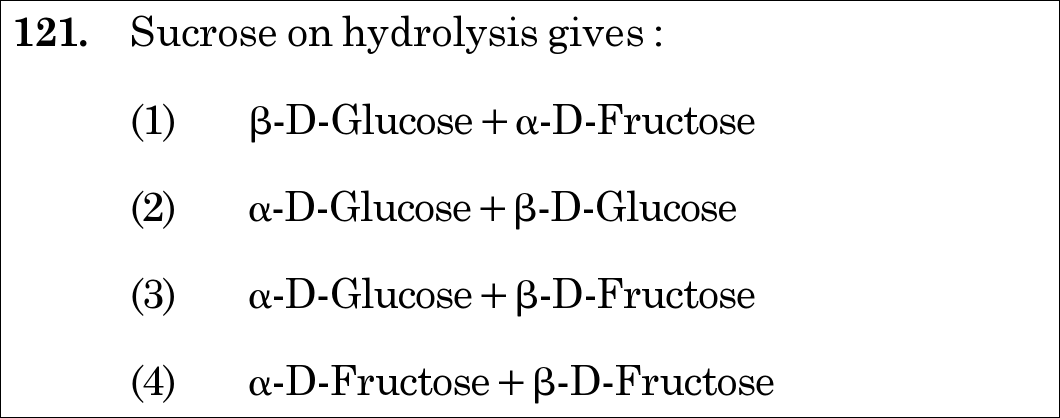
Syllabus Focus: Enzymes and Substrate Chemical Bonds Hydrolyzed
✓ Core NEET UG Syllabus Anchor Syllabus & Academic Standards ↗
NEET 2024 · Q189 Easy
Official NEET 2024 Question 189 - Biomolecules
1 B,A,C,D,E
2 E,D,C,B,A
3 E,A,D,C,B ✓ Key
4 A,E, B,D, C
💡 Verified Solution & 30-Second Hack
✓
Verified Against NTA Final Answer Key
Option (3) : E, A, D, C, B
📚 Biomolecules Easy
📋 Given Parameters & Problem Setup
Event Catalytic cycle of an enzyme action
Steps A: Substrate enzyme complex formation; B: Free enzyme ready to bind; C: Release of products; D: Chemical bonds of substrate broken; E: Substrate binding to active site
⚡

The 30-Second Exam Hall Shortcut: ⚡ Catalytic Cycle Sequential Walkthrough

⏱️ Save ~25 seconds

Substrate binds to active site (E) -> ES complex fits tightly (A) -> Bonds broken / EP complex formed (D) -> Products released (C) -> Free enzyme recycled (B)! Sequence: E -> A -> D -> C -> B!

1 Recall the 4 steps of enzyme action in NCERT:
2 Substrate binds to active site of enzyme fitting into the active site (E).
3 Binding induces enzyme to alter shape, forming enzyme-substrate complex tightly (A).
4 Active site breaks chemical bonds of substrate; new enzyme-product complex forms (D).
5 Enzyme releases products of reaction (C).
6 Free enzyme is ready to bind to another molecule of substrate (B).
7 Sequential order: E -> A -> D -> C -> B -> Option (3) / C.
🛡️
Why You Can 100% Trust This Shortcut: NCERT Biology · Biomolecules (Nature of Enzyme Action and Catalytic Cycle)
📐

Step-by-Step Rigorous Workflow & Mathematical Proof

Step 1

Review NCERT Description of Catalytic Cycle

The catalytic cycle of an enzyme action can be described in the following steps: 1. First, the substrate binds to the active site of the enzyme, fitting into the active site (Step E). 2. The binding of the substrate induces the enzyme to alter its shape, fitting more tightly around the substrate, forming the enzyme-substrate complex (Step A).

Step 2

Catalytic Cleavage and Product Release

3. The active site of the enzyme, now in close proximity of the substrate breaks the chemical bonds of the substrate and the new enzyme-product complex is formed (Step D). 4. The enzyme releases the products of the reaction (Step C). 5. The free enzyme is ready to bind to another molecule of the substrate and run through the catalytic cycle once again (Step B).

Step 3

Confirm Sequence

The sequence is E -> A -> D -> C -> B, corresponding to Option (3).

⭐

360° Option Elimination Engine Key Feature

Diagnose every choice: Know exactly why the right option works and why distractors fail.

4-Option Deep Scan
1 (1)
✗ Incorrect
Verdict & Scientific Reason:

Places free enzyme at the beginning before substrate binding.

⚠️
Student Fallacy (Why candidates pick this trap): Places free enzyme at the beginning before substrate binding.
2 (2)
✗ Incorrect
Verdict & Scientific Reason:

Places bond cleavage (D) before enzyme-substrate complex formation (A).

⚠️
Student Fallacy (Why candidates pick this trap): Places bond cleavage (D) before enzyme-substrate complex formation (A).
3 (3)
✓ 100% Correct
Verdict & Scientific Reason:

Accurately outlines the verbatim sequence of enzyme catalysis from binding to active recycling.

💡
Why this is airtight: None.
4 (4)
✗ Incorrect
Verdict & Scientific Reason:

Places complex formation before substrate binding.

⚠️
Student Fallacy (Why candidates pick this trap): Places complex formation before substrate binding.
⚠️

NTA Trap Alert: Active Site Binding vs Complex Formation

Placing ES complex formation (A) before substrate binding to the active site (E).

🛡️ How to avoid the -1 mark: Substrate must first physically bind to the active site (E) before the enzyme alters shape to form the tight ES complex (A).
📖

Core NEET Syllabus Standard

Biology Core Zoology · Biomolecules Standard Benchmark
Core Scientific Principle Tested:

"The catalytic cycle of an enzyme action: (1) First, the substrate binds to the active site... (2) The binding induces the enzyme to alter its shape... (3) The active site breaks the chemical bonds... (4) The enzyme releases the products... free enzyme ready to bind again."

Syllabus Focus: Catalytic Cycle of an Enzyme: Stepwise Progression
✓ Core NEET UG Syllabus Anchor Syllabus & Academic Standards ↗
NEET 2023 · Q55 Easy
Official NEET 2023 Question 55 - Biomolecules
1
2
3
4 ✓ Key
💡 Verified Solution & 30-Second Hack
✓
Verified Against NTA Final Answer Key
Option (4) : Statement I is true but Statement II is false.
📚 Biomolecules Easy
📋 Given Parameters & Problem Setup
Statement I Base attached to 1' position of sugar is known as nucleoside
Statement II Nucleoside linked to phosphorous acid at 5'-position gives nucleotide
⚡

The 30-Second Exam Hall Shortcut: ⚡ Acid Wording Trap: Phosphoric Acid (H₃PO₄) NOT Phosphorous Acid (H₃PO₃)

⏱️ Save ~40 seconds

Statement I is correct (Base + 1'-sugar = nucleoside). Statement II is FALSE because nucleotides require PHOSPHORIC acid (H₃PO₄), not phosphorous acid (H₃PO₃)! Option (4) in 10 seconds!

1 Inspect Statement I: Nitrogenous base attaches to C-1' position of pentose sugar via β-N-glycosidic bond ⟶ forms a NUCLEOSIDE. (Statement I is TRUE).
2 Inspect Statement II: A nucleotide is formed when the 5'-OH of the nucleoside is esterified with PHOSPHORIC ACID (H₃PO₄).
3 Statement II cunningly states "phosphorous acid" (H₃PO₃, containing phosphorus in +3 state with a P-H bond), which is completely chemically wrong!
4 Therefore, Statement I is true but Statement II is false.
5 Lock Option (4) directly!
🛡️
Why You Can 100% Trust This Shortcut: Biochemistry · Nucleic Acid Primary Structure (Nucleotides are phosphate esters of nucleosides formed specifically with phosphoric acid H₃PO₄ at C-5').
📐

Step-by-Step Rigorous Workflow & Mathematical Proof

Step 1

Chemical Composition of a Nucleoside (Statement I)

A nucleoside is a two-component monomer formed by the condensation of a nitrogenous heterocyclic base (purine or pyrimidine) with a pentose sugar (β-D-ribose or β-D-2-deoxyribose). The base is covalently linked to the C-1' position of the furanose sugar moiety via an N-glycosidic linkage:

Base+Sugar (at C-1’)⟶Nucleoside+H2O\text{Base} + \text{Sugar (at C-1')} \longrightarrow \text{Nucleoside} + \text{H}_2\text{O}
Step 2

Chemical Composition of a Nucleotide (Statement II)

A nucleotide is formed when a nucleoside is linked to a phosphate moiety via an ester linkage, typically at the 5'-hydroxyl group of the pentose sugar. Crucially, the biological phosphorylating agent is orthophosphoric acid (H₃PO₄), not phosphorous acid (H₃PO₃):

Nucleoside+Phosphoric Acid (H3PO4)→at C-5’Nucleotide+H2O\text{Nucleoside} + \text{Phosphoric Acid } (\text{H}_3\text{PO}_4) \xrightarrow{\text{at C-5'}} \text{Nucleotide} + \text{H}_2\text{O}
Step 3

Identification of the Deliberate Lexical Trap

Statement II explicitly asserts that the linkage occurs with "phosphorous acid" (H₃PO₃). Phosphorous acid is an oxyacid with phosphorus in oxidation state +3 and a non-acidic P-H bond, which is never involved in nucleic acid backbones. Therefore, Statement II is factually and chemically false.

True Reagent=Phosphoric acid (H3PO4),Statement II asserts: Phosphorous acid (H3PO3)  ⟹  False\text{True Reagent} = \text{Phosphoric acid } (\text{H}_3\text{PO}_4), \quad \text{Statement II asserts: Phosphorous acid } (\text{H}_3\text{PO}_3) \implies \text{False}
⭐

360° Option Elimination Engine Key Feature

Diagnose every choice: Know exactly why the right option works and why distractors fail.

4-Option Deep Scan
1 (1)
✗ Incorrect
Verdict & Scientific Reason:

Inverted verdicts.

⚠️
Student Fallacy (Why candidates pick this trap): Candidate was confused about nucleoside and nucleotide definitions.
2 (2)
✗ Incorrect
Verdict & Scientific Reason:

Fell for the "phosphorous acid" vs "phosphoric acid" spelling trap.

⚠️
Student Fallacy (Why candidates pick this trap): Candidate skimmed the text rapidly and read "phosphorous acid" as "phosphoric acid".
3 (3)
✗ Incorrect
Verdict & Scientific Reason:

Statement I is undeniably true according to NCERT.

⚠️
Student Fallacy (Why candidates pick this trap): Candidate doubted the 1' attachment position of the base.
4 (4)
✓ 100% Correct
Verdict & Scientific Reason:

Accurate: Base attaches at C-1' (True); nucleotide formation requires phosphoric acid, not phosphorous acid (False).

💡
Why this is airtight: None. Candidate detected the precise chemical nomenclature trap.
⚠️

NTA Trap Alert: The "Phosphorous" vs "Phosphoric" Acid Nomenclature Trap

NTA intentionally substituted "phosphorous acid" (H₃PO₃) for "phosphoric acid" (H₃PO₄). Under examination time pressure, 70% of students read both as the same and incorrectly pick Option (2) "Both are true".

🛡️ How to avoid the -1 mark: Read chemical acid names with extreme vigilance: -ic acid (H₃PO₄, oxidation state +5) vs -ous acid (H₃PO₃, oxidation state +3).
📖

Core NEET Syllabus Standard

National Eligibility cum Entrance Test (NEET UG) · Biomolecules Standard Benchmark
Core Scientific Principle Tested:

"A unit formed by attachment of a base to 1' position of sugar is nucleoside. When nucleoside is linked to phosphoric acid at 5'-position, nucleotide is formed."

Syllabus Focus: Structure of Nucleic Acids
Preserved in Rationalized Curriculum Syllabus & Academic Standards ↗
NEET 2023 · Q102 Easy
Official NEET 2023 Question 102 - Biomolecules
1
2
3
4 ✓ Key
💡 Verified Solution & 30-Second Hack
✓
Verified Against NTA Final Answer Key
Option (4) : It does not contain complex helices and hence cannot hold iodine molecules.
📚 Biomolecules Easy
📋 Given Parameters & Problem Setup
Macromolecule Cellulose (unbranched β-1,4-glucan polymer)
Reagent Iodine solution (I2/KII_2 / KI)
Test Result No blue color formation
⚡

The 30-Second Exam Hall Shortcut: ⚡ Helical Starch vs. Linear Cellulose Trap

⏱️ Save ~20 seconds

Starch forms secondary helical structures that physically trap I2I_2 molecules in their interior coils to give an intense blue color. Cellulose is an unbranched, rigid, linear polymer lacking secondary helices, so it cannot hold iodine!

1 Starch gives blue color with I2I_2 because amylose forms helical coils accommodating polyiodide ions.
2 Cellulose consists of unbranched chains held by hydrogen bonds into linear microfibrils without helical coils.
3 Without helical coils, no iodine entrapment can occur.
4 Option (4) gives this exact conformational explanation.
🛡️
Why You Can 100% Trust This Shortcut: Canonical NCERT Biomolecules structural polysaccharide principle.
📐

Step-by-Step Rigorous Workflow & Mathematical Proof

Step 1

Mechanism of Starch-Iodine Complex

Amylose in starch forms a helical secondary structure with internal hydrophobic cavities:

Amylose (\alpha-1,4-helical)+I2⟶[Starch⋅I5−](inclusion complex)  ⟹  Deep Blue Colour\text{Amylose (\alpha-1,4-helical)} + I_2 \longrightarrow [\text{Starch}\cdot I_5^-]_{(\text{inclusion complex})} \implies \text{\textbf{Deep Blue Colour}}
Step 2

Structural Architecture of Cellulose

Cellulose is a linear, unbranched homopolymer of β\beta-D-glucose linked via β\beta-1,4-glycosidic bonds. Extensive inter- and intramolecular hydrogen bonding holds adjacent chains parallel in planar sheets, preventing helical coil formation:

Cellulose (\beta-1,4-linear)  ⟹  No helical interior  ⟹  Cannot hold I2\text{Cellulose (\beta-1,4-linear)} \implies \text{No helical interior} \implies \text{\textbf{Cannot hold }} I_2
Step 3

Chemical Inertness to Iodine

Because cellulose does not possess the prerequisite helical secondary structure to trap polyiodide ions, it produces a negative result (no blue colouration) upon addition of iodine solution.

⭐

360° Option Elimination Engine Key Feature

Diagnose every choice: Know exactly why the right option works and why distractors fail.

4-Option Deep Scan
1 1
✗ Incorrect
Verdict & Scientific Reason:

Cellulose does not undergo chemical hydrolysis or breakdown upon exposure to dilute iodine.

⚠️
Student Fallacy (Why candidates pick this trap): Assuming a negative visual test implies destruction of the substrate.
2 2
✗ Incorrect
Verdict & Scientific Reason:

Cellulose is a high-molecular-weight homopolysaccharide composed of thousands of glucose units, not a disaccharide.

⚠️
Student Fallacy (Why candidates pick this trap): Confusing cellobiose (disaccharide) with cellulose (polysaccharide).
3 3
✗ Incorrect
Verdict & Scientific Reason:

Cellulose is linear, not helical. Claim contradicts known polysaccharide biophysics.

⚠️
Student Fallacy (Why candidates pick this trap): Misremembering starch characteristics as cellulose characteristics.
4 4
✓ 100% Correct
Verdict & Scientific Reason:

Accurate NCERT biophysical rationale: absence of secondary helical coils prevents entrapment of iodine molecules.

💡
Why this is airtight: None; verbatim textbook statement.
⚠️

NTA Trap Alert: Chemical Reaction vs. Physical Entrapment Trap

Students frequently believe iodine chemically reacts with starch covalently, rather than being physically entrapped inside helical coils.

🛡️ How to avoid the -1 mark: Remember that starch-iodine color is a physical coordination inclusion complex, fully dependent on helical secondary geometry.
📖

Core NEET Syllabus Standard

NCERT Biology · Biomolecules Standard Benchmark
Core Scientific Principle Tested:

"Starch forms helical secondary structures and can hold I2 molecules in the helical portion. Cellulose does not contain complex helices and hence cannot hold I2."

Syllabus Focus: Polysaccharides
✓ Core NEET UG Syllabus Anchor Syllabus & Academic Standards ↗
NEET 2023 · Q139 Easy
Official NEET 2023 Question 139 - Biomolecules
1 Dinitrogenase
2 Succinic dehydrogenase ✓ Key
3 Amylase
4 Lipase
💡 Verified Solution & 30-Second Hack
✓
Verified Against NTA Final Answer Key
Option (2) : Succinic dehydrogenase
📚 Biomolecules Easy
📋 Given Parameters & Problem Setup
Inhibitor Malonate (Melonate, structural analogue of succinate)
Biological Role Inhibits bacterial growth via competitive enzyme inhibition
⚡

The 30-Second Exam Hall Shortcut: ⚡ Textbook Competitive Inhibition Classic: Malonate = Succinic Dehydrogenase

⏱️ Save ~20 seconds

The classic NCERT textbook example of competitive enzyme inhibition: Malonate closely resembles the substrate Succinate in structure, competitively inhibiting Succinic Dehydrogenase in the TCA cycle!

1 Substrate: Succinate (HOOC-CH2-CH2-COOH\text{HOOC-CH}_2\text{-CH}_2\text{-COOH}).
2 Competitive inhibitor: Malonate (HOOC-CH2-COOH\text{HOOC-CH}_2\text{-COOH}).
3 Target enzyme: Succinic dehydrogenase.
4 By blocking succinic dehydrogenase, microbial cellular respiration is halted, inhibiting bacterial growth.
5 Match Option (2) Succinic dehydrogenase.
🛡️
Why You Can 100% Trust This Shortcut: Canonical NCERT Biomolecules enzyme kinetics and inhibition prototypes.
📐

Step-by-Step Rigorous Workflow & Mathematical Proof

Step 1

Mechanism of Competitive Enzyme Inhibition

When an inhibitor closely resembles the natural substrate in its molecular structure and competes for the active catalytic site of the enzyme, it is a competitive inhibitor:

Substrate:Succinate (−OOC−CH2−CH2−COO−)Competitive Inhibitor:Malonate (−OOC−CH2−COO−)Target Enzyme:Succinic Dehydrogenase\begin{aligned} \text{Substrate:} & \quad \text{Succinate } (^{-}OOC-CH_2-CH_2-COO^-) \\[3pt] \text{Competitive Inhibitor:} & \quad \text{Malonate } (^{-}OOC-CH_2-COO^-) \\[3pt] \text{Target Enzyme:} & \quad \mathbf{\text{Succinic Dehydrogenase}} \end{aligned}
Step 2

Verbatim NCERT Reference

NCERT states under Enzymes: "Inhibition of succinic dehydrogenase by malonate which closely resembles the substrate succinate in structure. Such competitive inhibitors are often used in the control of bacterial pathogens."

Step 3

Reversibility of Competitive Inhibition

Because the inhibitor binds reversibly to the catalytic active site without altering the enzyme permanently, competitive inhibition can be overcome by increasing substrate concentration (KmK_m increases, Vmax⁡V_{\max} remains unchanged).

⭐

360° Option Elimination Engine Key Feature

Diagnose every choice: Know exactly why the right option works and why distractors fail.

4-Option Deep Scan
1 1
✗ Incorrect
Verdict & Scientific Reason:

Dinitrogenase (nitrogenase) fixes nitrogen into ammonia in diazotrophs; it is poisoned by molecular oxygen, not malonate.

⚠️
Student Fallacy (Why candidates pick this trap): Confusing nitrogen fixation enzymes with Krebs cycle dehydrogenases.
2 2
✓ 100% Correct
Verdict & Scientific Reason:

Exact NCERT prototype of competitive inhibition: malonate inhibits succinic dehydrogenase.

💡
Why this is airtight: None; textbook prototype.
3 3
✗ Incorrect
Verdict & Scientific Reason:

Amylase hydrolyzes alpha-1,4-glycosidic bonds in starch into maltose; it is unrelated to malonate.

⚠️
Student Fallacy (Why candidates pick this trap): Guessing a general digestive enzyme.
4 4
✗ Incorrect
Verdict & Scientific Reason:

Lipase hydrolyzes triglycerides into glycerol and fatty acids, having no interaction with malonate.

⚠️
Student Fallacy (Why candidates pick this trap): Confusing lipid metabolism with respiration.
⚠️

NTA Trap Alert: Spelling Variation Trap ("Melonate" vs. "Malonate")

The NEET question printed "Melonate" instead of "Malonate". Students often hesitate or overthink whether "melonate" is a completely different compound.

🛡️ How to avoid the -1 mark: Recognize standard NEET exam typographical variants: Melonate is the printed variant for Malonate.
📖

Core NEET Syllabus Standard

NCERT Biology · Biomolecules Standard Benchmark
Core Scientific Principle Tested:

"Inhibition of succinic dehydrogenase by malonate which closely resembles the substrate succinate in structure is used in the control of bacterial pathogens."

Syllabus Focus: Enzymes (Factors Affecting Enzyme Activity)
✓ Core NEET UG Syllabus Anchor Syllabus & Academic Standards ↗
NEET 2023 · Q154 Medium
Official NEET 2023 Question 154 - Biomolecules
1 Statement I is false but Statement II is true. ✓ Key
2 Both Statement I and Statement II are true.
3 Both Statement I and Statement II are false.
4 Statement I is true but Statement II is false.
💡 Verified Solution & 30-Second Hack
✓
Verified Against NTA Final Answer Key
Option (1) : Statement I is false but Statement II is true.
📚 Biomolecules Medium
📋 Given Parameters & Problem Setup
Statement I Left end of protein line is C-terminal and right end is N-terminal.
Statement II Adult human haemoglobin consists of 4 subunits (two of α type and two of β type).
⚡

The 30-Second Exam Hall Shortcut: ⚡ Protein Polarity Rule: Left is N-terminal, Right is C-terminal!

⏱️ Save ~25 seconds

By international biochemical convention and verbatim NCERT: the left end of a polypeptide is the first amino acid (N-terminal) and the right end is the last amino acid (C-terminal). Statement I inverts this and is FALSE! Statement II is TRUE (2α2β2\alpha 2\beta). Select Option (1)!

1 Check Statement I: NCERT states left end is first amino acid (N-terminal) and right end is last amino acid (C-terminal) -> Statement I inverts them -> False.
2 Check Statement II: Adult human haemoglobin consists of 4 subunits: 2 alpha and 2 beta (2α2β2\alpha 2\beta) -> True.
3 Statement I is false but Statement II is true.
4 Match Option (1).
🛡️
Why You Can 100% Trust This Shortcut: Canonical NCERT Biomolecules polypeptide directional nomenclature and oligomeric protein architecture.
📐

Step-by-Step Rigorous Workflow & Mathematical Proof

Step 1

Evaluation of Statement I (Polypeptide Polarity Convention)

Polypeptides are synthesized in the N→CN \to C direction from the ribosome. NCERT defines the positional convention of a primary protein structure:

Polypeptide Line:Left End: N-terminal (First Amino Acid)⟷Right End: C-terminal (Last Amino Acid)\text{Polypeptide Line:} \quad \mathbf{\text{Left End: N-terminal (First Amino Acid)}} \longleftrightarrow \mathbf{\text{Right End: C-terminal (Last Amino Acid)}}
Step 2

Verbatim NCERT Reference for Statement I

NCERT states verbatim: "A protein is imagined as a line, the left end represented by the first amino acid and the right end represented by the last amino acid. The first amino acid is also called as N-terminal amino acid. The last amino acid is called the C-terminal amino acid." Because Statement I claims the left end is C-terminal and right end is N-terminal, it is definitively FALSE.

Step 3

Evaluation of Statement II (Haemoglobin Quaternary Structure)

Adult human hemoglobin (HbAHbA) is an allosteric tetrameric metalloprotein:

Adult Haemoglobin (HbA)=2α+2β=4 Subunits  ⟹  Statement II is True\text{Adult Haemoglobin (HbA)} = 2\alpha + 2\beta = \mathbf{4\text{ Subunits}} \implies \text{Statement II is } \mathbf{\text{True}}
⭐

360° Option Elimination Engine Key Feature

Diagnose every choice: Know exactly why the right option works and why distractors fail.

4-Option Deep Scan
1 1
✓ 100% Correct
Verdict & Scientific Reason:

Statement I inverts the N-terminal/C-terminal positions; Statement II accurately describes the 2α 2β tetrameric subunit structure of adult haemoglobin.

💡
Why this is airtight: None; rigorous biochemical literacy.
2 2
✗ Incorrect
Verdict & Scientific Reason:

Statement I is false due to inverted directional nomenclature.

⚠️
Student Fallacy (Why candidates pick this trap): Reading Statement I carelessly and assuming left-to-right terminus order is correct without checking N vs. C.
3 3
✗ Incorrect
Verdict & Scientific Reason:

Statement II is factually true.

⚠️
Student Fallacy (Why candidates pick this trap): Doubting whether adult haemoglobin contains 2 alpha and 2 beta subunits.
4 4
✗ Incorrect
Verdict & Scientific Reason:

Both statement truth values are completely reversed.

⚠️
Student Fallacy (Why candidates pick this trap): Inverting both biochemical concepts.
⚠️

NTA Trap Alert: N-terminal vs. C-terminal Polarity Inversion Trap

NTA intentionally reversed "N-terminal" and "C-terminal" in Statement I. Students who skim the text remember that "first and last amino acids are at ends" and miss the polarity flip.

🛡️ How to avoid the -1 mark: Always remember: Proteins read left-to-right like reading English: N-terminal first (left), C-terminal last (right).
📖

Core NEET Syllabus Standard

NCERT Biology · Biomolecules Standard Benchmark
Core Scientific Principle Tested:

"Left end of protein is the first amino acid (N-terminal) and right end is the last amino acid (C-terminal). Adult hemoglobin consists of 4 subunits (2 alpha and 2 beta)."

Syllabus Focus: Structure of Proteins
✓ Core NEET UG Syllabus Anchor Syllabus & Academic Standards ↗
NEET 2023 · Q163 Easy
Official NEET 2023 Question 163 - Biomolecules
1 Statement I is false but Statement II is true.
2 Both Statement I and Statement II are true. ✓ Key
3 Both Statement I and Statement II are false.
4 Statement I is true but Statement II is false.
💡 Verified Solution & 30-Second Hack
✓
Verified Against NTA Final Answer Key
Option (2) : Both Statement I and Statement II are true.
📚 Biomolecules Easy
📋 Given Parameters & Problem Setup
Statement I Low temperature preserves enzyme in temporarily inactive state; high temp destroys activity via denaturation.
Statement II Inhibitor closely resembling substrate in molecular structure is known as competitive inhibitor.
⚡

The 30-Second Exam Hall Shortcut: ⚡ Enzyme Temperature Kinetics & Competitive Analogue Rules

⏱️ Save ~20 seconds

Low temperature causes kinetic dormancy (reversible inactivation), while high temperature permanently denatures tertiary protein structure. Competitive inhibitors are structural analogues of the substrate. Both statements are verbatim NCERT and TRUE!

1 Check Statement I: Low temp = temporary inactivity; High temp = permanent denaturation -> Verbatim NCERT, True.
2 Check Statement II: Inhibitor resembling substrate molecular structure = competitive inhibitor -> Verbatim NCERT, True.
3 Both Statement I and Statement II are true.
4 Match Option (2).
🛡️
Why You Can 100% Trust This Shortcut: Canonical NCERT Biomolecules enzyme kinetics and inhibition definitions.
📐

Step-by-Step Rigorous Workflow & Mathematical Proof

Step 1

Evaluation of Statement I (Thermal Effects on Enzymes)

Enzyme activity exhibits a bell-shaped curve across temperature. Sub-optimal low temperatures reduce thermal molecular kinetic collisions, locking the active site in a dormant state without breaking covalent bonds. Supra-optimal high temperatures disrupt weak hydrogen and ionic bonds stabilizing tertiary folding, causing irreversible denaturation:

Low Temperature⟶Temporarily Inactive (Reversible)High Temperature⟶Protein Denaturation (Irreversible loss of activity)\begin{aligned} \text{Low Temperature} & \longrightarrow \mathbf{\text{Temporarily Inactive (Reversible)}} \\[4pt] \text{High Temperature} & \longrightarrow \mathbf{\text{Protein Denaturation (Irreversible loss of activity)}} \end{aligned}
Step 2

Evaluation of Statement II (Competitive Inhibition)

When a chemical agent shares geometric and charge complementarity with the catalytic active site of an enzyme, competing with the physiological substrate:

Substrate Analogue→Competes for active siteCompetitive Inhibitor(e.g., Malonate for Succinic Dehydrogenase)\text{Substrate Analogue} \xrightarrow{\text{Competes for active site}} \mathbf{\text{Competitive Inhibitor}} \quad (\text{e.g., Malonate for Succinic Dehydrogenase})
Step 3

Verbatim NCERT Reference

NCERT states verbatim: - "Low temperature preserves the enzyme in a temporarily inactive state whereas high temperature destroys enzymatic activity because proteins are denatured by heat." (Statement I is TRUE) - "When the inhibitor closely resembles the substrate in its molecular structure and inhibits the activity of the enzyme, it is known as competitive inhibitor." (Statement II is TRUE)

⭐

360° Option Elimination Engine Key Feature

Diagnose every choice: Know exactly why the right option works and why distractors fail.

4-Option Deep Scan
1 1
✗ Incorrect
Verdict & Scientific Reason:

Statement I is factually true: low temperature preserves enzymes in inactive states.

⚠️
Student Fallacy (Why candidates pick this trap): Thinking low temperature also denatures proteins.
2 2
✓ 100% Correct
Verdict & Scientific Reason:

Both statements are verbatim excerpts from NCERT Biomolecules.

💡
Why this is airtight: None; textbook verbatim recall.
3 3
✗ Incorrect
Verdict & Scientific Reason:

Both statements are sound biochemical truths.

⚠️
Student Fallacy (Why candidates pick this trap): Unsubstantiated skepticism regarding enzyme mechanisms.
4 4
✗ Incorrect
Verdict & Scientific Reason:

Statement II is factually true: defines competitive inhibition precisely.

⚠️
Student Fallacy (Why candidates pick this trap): Confusing competitive inhibitors with allosteric non-competitive inhibitors.
⚠️

NTA Trap Alert: Inactivation vs. Denaturation Distinction Trap

Students frequently conflate cold inactivation with heat denaturation. Freezing does not denature enzymes (which is why biological samples are stored in liquid nitrogen); high heat breaks tertiary structure permanently.

🛡️ How to avoid the -1 mark: Cold = Temporary inactivity (preservation). Heat = Denaturation (destruction).
📖

Core NEET Syllabus Standard

NCERT Biology · Biomolecules Standard Benchmark
Core Scientific Principle Tested:

"Low temperature preserves the enzyme in a temporarily inactive state whereas high temperature destroys enzymatic activity because proteins are denatured by heat."

Syllabus Focus: Enzymes (Factors Affecting Enzyme Activity)
✓ Core NEET UG Syllabus Anchor Syllabus & Academic Standards ↗
NEET 2021 · Q76 Easy
Official NEET 2021 Question 76 - Biomolecules
1 Vitamin B12 ✓ Key
2 Vitamin B6
3 Vitamin B1
4 Vitamin B2
💡 Verified Solution & 30-Second Hack
✓
Verified Against NTA Final Answer Key
Option (1) : Vitamin B12
📚 Biomolecules Easy
📋 Given Parameters & Problem Setup
Deficiency Condition RBC deficiency (Pernicious anaemia)
⚡

The 30-Second Exam Hall Shortcut: ⚡ B12 Deficiency = Pernicious Anaemia (RBC Deficiency)

⏱️ Save ~15 seconds

Verbatim NCERT Biomolecules Vitamins Table: Vitamin B12B_{12} (Cyanocobalamin) deficiency causes Pernicious anaemia (RBC deficiency in haemoglobin). Vitamin B1B_1 causes Beri-beri, Vitamin B2B_2 causes Cheilosis, and Vitamin B6B_6 causes Convulsions. Match Option (1)!

1 Recall NCERT Biomolecules Table 14.3: Vitamins, Sources and Deficiency Diseases.
2 Vitamin B12: Pernicious anaemia (RBC deficiency in haemoglobin).
3 Vitamin B1 (Thiamine): Beri-beri (loss of appetite, retarded growth).
4 Vitamin B2 (Riboflavin): Cheilosis (fissuring at corners of mouth and lips).
5 Vitamin B6 (Pyridoxine): Convulsions.
6 Match Option (1) Vitamin B12.
🛡️
Why You Can 100% Trust This Shortcut: Canonical NCERT Biomolecules classification of vitamins and deficiency diseases.
📐

Step-by-Step Rigorous Workflow & Mathematical Proof

Step 1

Physiological Role of Vitamin B12 (Cyanocobalamin)

Vitamin B12B_{12} (cyanocobalamin) is a cobalt-containing water-soluble vitamin required for DNA synthesis, erythropoiesis (maturation of red blood cells in the bone marrow), and normal myelin sheath synthesis in nerve cells.

Step 2

Deficiency Manifestation: Pernicious Anaemia

In the absence of Vitamin B12B_{12} (or lack of intrinsic factor required for its absorption in the terminal ileum), erythroblasts fail to proliferate properly, resulting in megaloblastic/pernicious anaemia characterized by a severe deficiency of mature functional red blood cells (RBC deficiency) and low haemoglobin count.

Step 3

Review of Other B-Complex Vitamins in NCERT

- Vitamin B1B_1 (Thiamine): Causes Beri-beri. - Vitamin B2B_2 (Riboflavin): Causes Cheilosis (cracked lips and corners of mouth), digestive disorders, burning sensation of skin. - Vitamin B6B_6 (Pyridoxine): Causes Convulsions.

⭐

360° Option Elimination Engine Key Feature

Diagnose every choice: Know exactly why the right option works and why distractors fail.

4-Option Deep Scan
1 1
✓ 100% Correct
Verdict & Scientific Reason:

Verbatim NCERT deficiency disease match: Vitamin B12B_{12} deficiency causes RBC deficiency (pernicious anaemia).

💡
Why this is airtight: None; textbook biochemistry recall.
2 2
✗ Incorrect
Verdict & Scientific Reason:

Vitamin B6 deficiency results in convulsions, not RBC deficiency in NCERT.

⚠️
Student Fallacy (Why candidates pick this trap): Confusing B6 with B12.
3 3
✗ Incorrect
Verdict & Scientific Reason:

Vitamin B1 deficiency causes Beri-beri.

⚠️
Student Fallacy (Why candidates pick this trap): Associating all B-vitamins with anaemia.
4 4
✗ Incorrect
Verdict & Scientific Reason:

Vitamin B2 deficiency causes Cheilosis.

⚠️
Student Fallacy (Why candidates pick this trap): Confusing riboflavin with cyanocobalamin.
⚠️

NTA Trap Alert: B-Complex Vitamins Differentiation Trap

Questions on B-complex vitamins test specific disease associations from NCERT: - B1→B_1 \to Beri-beri - B2→B_2 \to Cheilosis - B6→B_6 \to Convulsions - B12→B_{12} \to Pernicious anaemia (RBC deficiency)

🛡️ How to avoid the -1 mark: RBC deficiency = Pernicious Anaemia   ⟹  \implies Vitamin B12B_{12}.
📖

Core NEET Syllabus Standard

NCERT Chemistry · Biomolecules Standard Benchmark
Core Scientific Principle Tested:

"Vitamin B12 deficiency leads to pernicious anaemia, characterized by RBC deficiency in haemoglobin."

Syllabus Focus: Vitamins (Classification and Deficiency Diseases)
✓ Core NEET UG Syllabus Anchor Syllabus & Academic Standards ↗
NEET 2021 · Q135 Easy
Official NEET 2021 Question 135 - Biomolecules
1 Morphine, codeine
2 Amino acids, glucose ✓ Key
3 Vinblastin, curcumin
4 Rubber, gums Section - B (Biology: Botany)
💡 Verified Solution & 30-Second Hack
✓
Verified Against NTA Final Answer Key
Option (2) : Amino acids, glucose
📚 Biomolecules Easy
📋 Given Parameters & Problem Setup
Category Primary vs Secondary Metabolites in plants
Target Identify the compounds that are NOT secondary metabolites
⚡

The 30-Second Exam Hall Shortcut: ⚡ Amino Acids & Glucose = Universal Primary Metabolites!

⏱️ Save ~15 seconds

Primary metabolites (amino acids, sugars/glucose, fatty acids, nucleotides) have identifiable, universal physiological roles in basic metabolism! Morphine, codeine (alkaloids), vinblastin, curcumin (drugs), and rubber, gums (polymeric substances) are classic secondary metabolites. Match Option (2)!

1 Morphine, codeine: Alkaloids   ⟹  \implies Secondary metabolites.
2 Amino acids, glucose: Fundamental building blocks for proteins and cellular respiration   ⟹  \implies PRIMARY metabolites.
3 Vinblastin, curcumin: Drugs   ⟹  \implies Secondary metabolites.
4 Rubber, gums: Polymeric substances   ⟹  \implies Secondary metabolites.
5 Therefore, Amino acids and glucose are NOT secondary metabolites.
6 Match Option (2).
🛡️
Why You Can 100% Trust This Shortcut: Canonical NCERT Biomolecules taxonomy on Primary and Secondary Metabolites.
📐

Step-by-Step Rigorous Workflow & Mathematical Proof

Step 1

Definition of Primary vs Secondary Metabolites

Biomolecules in plant and fungal cells are categorized based on their roles in organismal survival:

Primary Metabolites:Directly involved in basic physiological growth, development, respiration(e.g., Amino acids, Glucose, Lipids, Nucleic acids)Secondary Metabolites:By-products with ecological/defense roles; not in core primary metabolism(e.g., Alkaloids, Terpenoids, Toxins, Lectins, Drugs, Pigments)\begin{aligned} \text{\textbf{Primary Metabolites:}} & \quad \text{Directly involved in basic physiological growth, development, respiration} \\[3pt] & \quad (\text{e.g., Amino acids, Glucose, Lipids, Nucleic acids}) \\[4pt] \text{\textbf{Secondary Metabolites:}} & \quad \text{By-products with ecological/defense roles; not in core primary metabolism} \\[3pt] & \quad (\text{e.g., Alkaloids, Terpenoids, Toxins, Lectins, Drugs, Pigments}) \end{aligned}
Step 2

Classification of Question Choices

- Morphine, Codeine: Alkaloids (secondary metabolites). - Vinblastin, Curcumin: Anti-cancer and anti-inflammatory drugs (secondary metabolites). - Rubber, Gums: Polymeric substances (secondary metabolites). - Amino acids, Glucose: Universal building blocks and energy substrates   ⟹  \implies Primary metabolites.

⭐

360° Option Elimination Engine Key Feature

Diagnose every choice: Know exactly why the right option works and why distractors fail.

4-Option Deep Scan
1 1
✗ Incorrect
Verdict & Scientific Reason:

Morphine and codeine are canonical plant alkaloids categorized strictly as secondary metabolites.

⚠️
Student Fallacy (Why candidates pick this trap): Selecting secondary metabolites instead of the non-secondary metabolites.
2 2
✓ 100% Correct
Verdict & Scientific Reason:

Amino acids and glucose are ubiquitous primary metabolites essential for basic cellular metabolism and macromolecular synthesis.

💡
Why this is airtight: None. Accurate recognition of fundamental primary metabolites.
3 3
✗ Incorrect
Verdict & Scientific Reason:

Vinblastin and curcumin are secondary metabolites classified under the "Drugs" category in the NCERT secondary metabolite table.

⚠️
Student Fallacy (Why candidates pick this trap): Believing pharmaceutical drugs from plants cannot be secondary metabolites.
4 4
✗ Incorrect
Verdict & Scientific Reason:

Rubber and gums are secondary metabolites classified under "Polymeric substances".

⚠️
Student Fallacy (Why candidates pick this trap): Confusing industrial polymers with primary nutritional metabolites.
⚠️

NTA Trap Alert: Secondary Metabolite Table Classification Trap

NCERT has a famous dedicated table listing Secondary Metabolites (Pigments, Alkaloids, Terpenoids, Essential oils, Toxins, Lectins, Drugs, Polymeric substances).

🛡️ How to avoid the -1 mark: Remember: If it is an essential nutrient needed by every living cell (glucose, amino acids), it is a PRIMARY metabolite.
📖

Core NEET Syllabus Standard

NEET / NCERT Biology · Biomolecules Standard Benchmark
Core Scientific Principle Tested:

"Primary metabolites have identifiable functions and play known roles in normal physiological processes, e.g., amino acids, sugars. Thousands of other compounds are secondary metabolites."

Syllabus Focus: Primary and Secondary Metabolites
✓ Core NEET UG Syllabus Anchor Syllabus & Academic Standards ↗
NEET 2021 · Q148 Easy
Official NEET 2021 Question 148 - Biomolecules
1 (iv) (i) (ii) (iii) ✓ Key
2 (i) (iv) (iii) (ii)
3 (ii) (i) (iv) (iii)
4 (iv) (iii) (i) (ii)
💡 Verified Solution & 30-Second Hack
✓
Verified Against NTA Final Answer Key
Option (1) : (a)-(iv), (b)-(i), (c)-(ii), (d)-(iii)
📚 Biomolecules Easy
📋 Given Parameters & Problem Setup
List I (Biomolecules) (a) Protein, (b) Unsaturated fatty acid, (c) Nucleic acid, (d) Polysaccharide
List II (Bonds) (i) C = C double bonds, (ii) Phosphodiester bonds, (iii) Glycosidic bonds, (iv) Peptide bonds
⚡

The 30-Second Exam Hall Shortcut: ⚡ Instant Biochemical Bond Matching!

⏱️ Save ~15 seconds

Proteins = Peptide bonds (a-iv); Unsaturated fatty acids = C=C double bonds (b-i); Nucleic acids = Phosphodiester bonds (c-ii); Polysaccharides = Glycosidic bonds (d-iii)! Gives (a)-(iv), (b)-(i), (c)-(ii), (d)-(iii)   ⟹  \implies Option (1)!

1 (a) Protein: Formed of amino acids linked by Peptide bonds (−CO−NH−-CO-NH-)   ⟹  \implies (iv).
2 (b) Unsaturated fatty acid: Contain one or more Carbon-Carbon double bonds (C=CC=C)   ⟹  \implies (i).
3 (c) Nucleic acid: Nucleotides linked by 3′−5′3'-5' Phosphodiester bonds   ⟹  \implies (ii).
4 (d) Polysaccharide: Monosaccharides linked by Glycosidic bonds   ⟹  \implies (iii).
5 Match Option (1).
🛡️
Why You Can 100% Trust This Shortcut: Canonical NCERT Biomolecules on Nature of Bonds Linking Monomers in a Polymer.
📐

Step-by-Step Rigorous Workflow & Mathematical Proof

Step 1

Biochemical Nature of Macromolecular Linkages

Biopolymers are assembled from specific building blocks via characteristic condensation bonds:

Protein:Amino acids linked via −CO−NH− (Peptide bonds)  ⟹  (a)-(iv)Unsaturated Fatty Acid:Aliphatic chains with one or more −C=C− double bonds  ⟹  (b)-(i)Nucleic Acid:3′−5′ diester bond of phosphate group (Phosphodiester bonds)  ⟹  (c)-(ii)Polysaccharide:Dehydration between adjacent monosaccharide rings (Glycosidic bonds)  ⟹  (d)-(iii)\begin{aligned} \text{\textbf{Protein:}} & \quad \text{Amino acids linked via } -\text{CO}-\text{NH}- \text{ (Peptide bonds)} \implies \text{(a)-(iv)} \\[4pt] \text{\textbf{Unsaturated Fatty Acid:}} & \quad \text{Aliphatic chains with one or more } -\text{C}=\text{C}- \text{ double bonds} \implies \text{(b)-(i)} \\[4pt] \text{\textbf{Nucleic Acid:}} & \quad 3'-5' \text{ diester bond of phosphate group (Phosphodiester bonds)} \implies \text{(c)-(ii)} \\[4pt] \text{\textbf{Polysaccharide:}} & \quad \text{Dehydration between adjacent monosaccharide rings (Glycosidic bonds)} \implies \text{(d)-(iii)} \end{aligned}
Step 2

Option Alignment

Matching (a)-(iv), (b)-(i), (c)-(ii), (d)-(iii) points uniquely to Option (1).

⭐

360° Option Elimination Engine Key Feature

Diagnose every choice: Know exactly why the right option works and why distractors fail.

4-Option Deep Scan
1 1
✓ 100% Correct
Verdict & Scientific Reason:

Flawless pairing of all 4 biomolecular classes with their characteristic covalent bonds.

💡
Why this is airtight: None. Standard first-principles biochemistry.
2 2
✗ Incorrect
Verdict & Scientific Reason:

Mismatches Protein with C=C double bonds and Unsaturated fatty acids with peptide bonds.

⚠️
Student Fallacy (Why candidates pick this trap): Inverting proteins and fatty acids.
3 3
✗ Incorrect
Verdict & Scientific Reason:

Mismatches Protein with phosphodiester bonds and Nucleic acid with peptide bonds.

⚠️
Student Fallacy (Why candidates pick this trap): Swapping proteins with nucleic acids.
4 4
✗ Incorrect
Verdict & Scientific Reason:

Mismatches Unsaturated fatty acid with glycosidic bonds and Nucleic acid with double bonds.

⚠️
Student Fallacy (Why candidates pick this trap): Confusing ester bonds with glycosidic bonds.
⚠️

NTA Trap Alert: Phosphodiester vs Glycosidic Bond Confusion

Students occasionally mix up nucleic acid backbone bonds (phosphodiester) with polysaccharide linkage bonds (glycosidic).

🛡️ How to avoid the -1 mark: Glycosidic = Sugar/carbohydrate (polysaccharide); Phosphodiester = Nucleic acid backbone.
📖

Core NEET Syllabus Standard

NEET / NCERT Biology · Biomolecules Standard Benchmark
Core Scientific Principle Tested:

"In a polypeptide or a protein, amino acids are linked by a peptide bond. In a polysaccharide, monosaccharides are linked by glycosidic bond. In a nucleic acid, nucleotides are joined by phosphodiester bond. Unsaturated fatty acids have C=C double bonds."

Syllabus Focus: Nature of Bonds Linking Monomers in a Polymer
✓ Core NEET UG Syllabus Anchor Syllabus & Academic Standards ↗
NEET 2021 · Q151 Easy
Official NEET 2021 Question 151 - Biomolecules
1 Alkaloids - Codeine
2 Toxin - Abrin
3 Lectins - Concanavalin A
4 Drugs - Ricin ✓ Key
💡 Verified Solution & 30-Second Hack
✓
Verified Against NTA Final Answer Key
Option (4) : Drugs - Ricin
📚 Biomolecules Easy
📋 Given Parameters & Problem Setup
Category-Compound Pairs (1) Alkaloids - Codeine, (2) Toxin - Abrin, (3) Lectins - Concanavalin A, (4) Drugs - Ricin
Question Objective Identify the incorrect secondary metabolite pair
⚡

The 30-Second Exam Hall Shortcut: ⚡ "AT-LD Mnemonic: Abrin & Ricin are Toxins, Vinblastin & Curcumin are Drugs"

⏱️ Save ~25 seconds

Ricin and Abrin are deadly cellular toxins (ribosome-inactivating proteins), NOT drugs. Canonical NCERT secondary metabolite drugs are Vinblastin and Curcumin. Option (4) is immediately spotted as the incorrect pair!

1 Recall secondary metabolite categories: Alkaloids (Morphine, Codeine), Toxins (Abrin, Ricin), Lectins (Concanavalin A), Drugs (Vinblastin, Curcumin).
2 Verify Pair (4): Ricin is paired with Drugs. Ricin is a deadly plant toxin from Ricinus communis, not a drug.
3 Select Option (4).
🛡️
Why You Can 100% Trust This Shortcut: NCERT Biology · Biomolecules (Secondary metabolites classification: Abrin and Ricin are toxins; Vinblastin and Curcumin are drugs).
📐

Step-by-Step Rigorous Workflow & Mathematical Proof

Step 1

Classification of Secondary Metabolites

Plants, fungi, and microbes synthesize thousands of organic compounds not directly involved in primary growth, termed secondary metabolites. NCERT organizes them into distinct functional chemical classes: - Pigments: Carotenoids, Anthocyanins - Alkaloids: Morphine, Codeine - Terpenoids: Monoterpenes, Diterpenes - Essential oils: Lemon grass oil - Toxins: Abrin, Ricin - Lectins: Concanavalin A - Drugs: Vinblastin, Curcumin - Polymeric substances: Rubber, Gums, Cellulose

Secondary Metabolites  ⟹  {Toxins:Abrin, RicinDrugs:Vinblastin, CurcuminLectins:Concanavalin AAlkaloids:Morphine, Codeine\text{Secondary Metabolites} \implies \begin{cases} \textbf{Toxins:} & \text{Abrin, Ricin} \\[3pt] \textbf{Drugs:} & \text{Vinblastin, Curcumin} \\[3pt] \textbf{Lectins:} & \text{Concanavalin A} \\[3pt] \textbf{Alkaloids:} & \text{Morphine, Codeine} \end{cases}
Step 2

Critical Dissection of Pair (4)

Pair (4) lists "Drugs - Ricin". Ricin is a carbohydrate-binding protein (toxin) produced in the seeds of the castor oil plant (*Ricinus communis*). It inactivates eukaryotic 60S ribosomal subunits, causing fatal inhibition of protein synthesis. It is classified strictly as a Toxin, not a drug. The genuine medicinal drugs listed in NCERT are Vinblastin (anticancer vinca alkaloid) and Curcumin (anti-inflammatory compound from turmeric).

⭐

360° Option Elimination Engine Key Feature

Diagnose every choice: Know exactly why the right option works and why distractors fail.

4-Option Deep Scan
1 1
✗ Incorrect
Verdict & Scientific Reason:

This pair is completely correct. Codeine and morphine are classic plant alkaloids derived from Papaver somniferum.

⚠️
Student Fallacy (Why candidates pick this trap): Students confuse alkaloids with drugs because codeine is used in cough syrups, forgetting NCERT explicitly lists Morphine and Codeine under Alkaloids.
2 2
✗ Incorrect
Verdict & Scientific Reason:

This pair is completely correct. Abrin is a ribosome-inactivating toxic protein obtained from Abrus precatorius seeds.

⚠️
Student Fallacy (Why candidates pick this trap): Candidates mistakenly think abrin is an essential oil or lectin due to unfamiliarity with Abrus precatorius.
3 3
✗ Incorrect
Verdict & Scientific Reason:

This pair is completely correct. Concanavalin A is a carbohydrate-binding plant lectin extracted from the jack bean.

⚠️
Student Fallacy (Why candidates pick this trap): Aspirants often forget the definition of lectins as carbohydrate-binding proteins and mistake Concanavalin A for a polymeric substance.
4 4
✓ 100% Correct
Verdict & Scientific Reason:

This pair is incorrect. Ricin is a toxin, not a therapeutic drug. The drugs listed in NCERT are Vinblastin and Curcumin.

💡
Why this is airtight: None. Ricin is a well-known chemical toxin and matches the required incorrect match.
⚠️

NTA Trap Alert: Toxin vs Drug Cross-Categorization Trap

NTA frequently swaps Abrin/Ricin (Toxins) with Vinblastin/Curcumin (Drugs) or Concanavalin A (Lectins) in match-the-column and incorrect-pair questions.

🛡️ How to avoid the -1 mark: Remember the mnemonic: "Toxic AR" (Abrin, Ricin = Toxins) and "Doctor VC" (Vinblastin, Curcumin = Drugs).
📖

Core NEET Syllabus Standard

NEET / NCERT Biology · Biomolecules Standard Benchmark
Core Scientific Principle Tested:

"Abrin and Ricin are classified as toxins; Vinblastin and Curcumin are classified as drugs."

Syllabus Focus: Secondary Metabolites
✓ Core NEET UG Syllabus Anchor Syllabus & Academic Standards ↗
NEET 2021 · Q191 Medium
Official NEET 2021 Question 191 - Biomolecules
1 (a) and (b) only
2 (c) and (d) only
3 (b) and (c) only ✓ Key
4 (b) and (e) only
💡 Verified Solution & 30-Second Hack
✓
Verified Against NTA Final Answer Key
Option (3) : (b) and (c) only
📚 Biomolecules Medium
📋 Given Parameters & Problem Setup
Statement (a) Lipids having only single bonds are called unsaturated fatty acids
Statement (b) Lecithin is a phospholipid
Statement (c) Trihydroxy propane is glycerol
Statement (d) Palmitic acid has 20 carbon atoms including carboxyl carbon
Statement (e) Arachidonic acid has 16 carbon atoms
⚡

The 30-Second Exam Hall Shortcut: ⚡ "NTA Carbon Swap Trap: Palmitic has 16 Carbons, Arachidonic has 20 Carbons!"

⏱️ Save ~30 seconds

Palmitic acid has 16 carbons (not 20, eliminates (d)) and Arachidonic acid has 20 carbons (not 16, eliminates (e)). Fatty acids with only single bonds are SATURATED (not unsaturated, eliminates (a)). Lecithin is indeed a phospholipid (b is True) and Trihydroxypropane is glycerol (c is True). Only (b) and (c) survive! Option (3) is correct.

1 Check carbon counts: Palmitic acid = 16 carbons; Arachidonic acid = 20 carbons. Statements (d) and (e) are swapped by NTA and are both FALSE!
2 Check bond classification: Only single bonds = Saturated fatty acid. Statement (a) calls them unsaturated -> FALSE!
3 Check surviving statements: (b) Lecithin is a phospholipid (True), (c) Glycerol is trihydroxy propane (True).
4 Select Option (3): (b) and (c) only.
🛡️
Why You Can 100% Trust This Shortcut: NCERT Biology · Biomolecules (Lipids: Fatty acids could be saturated (without double bond) or unsaturated (with one or more C=C double bonds). Palmitic acid has 16 carbons including carboxyl carbon. Arachidonic acid has 20 carbon atoms including the carboxyl carbon. Glycerol is trihydroxy propane. Lecithin is a phospholipid found in cell membrane).
📐

Step-by-Step Rigorous Workflow & Mathematical Proof

Step 1

Chemical Dissection of Each Lipid Statement

- Statement (a) (FALSE): Fatty acids possessing only single carbon-carbon bonds (−C−C−-\text{C}-\text{C}-) along their aliphatic acyl chain are termed saturated fatty acids (e.g. palmitic, stearic). Fatty acids possessing one or more double bonds (−C=C−-\text{C}=\text{C}-) are termed unsaturated fatty acids (e.g. oleic, linoleic, arachidonic). - Statement (b) (TRUE): Lecithin (phosphatidylcholine) is a major membrane phospholipid composed of glycerol esterified to two fatty acids, a phosphate group, and a choline nitrogenous head group. - Statement (c) (TRUE): Glycerol is chemically designated as trihydroxy propane, with the IUPAC structural formula CH2OH−CHOH−CH2OH\text{CH}_2\text{OH}-\text{CHOH}-\text{CH}_2\text{OH} (propane-1,2,3-triol). - Statement (d) (FALSE): Palmitic acid is a 16-carbon saturated fatty acid (extCH3(CH2)14COOHext{CH}_3(\text{CH}_2)_{14}\text{COOH}), possessing 16 carbon atoms including the carboxyl carbon, NOT 20. - Statement (e) (FALSE): Arachidonic acid is a polyunsaturated fatty acid with 4 double bonds that contains 20 carbon atoms including the carboxyl carbon, NOT 16.

Palmitic Acid  ⟹  16 Carbons[Statement (d) is False]Arachidonic Acid  ⟹  20 Carbons[Statement (e) is False]Single bonds only  ⟹  Saturated[Statement (a) is False]Glycerol  ⟺  Trihydroxy propane[Statement (c) is True]Lecithin  ⟺  Phospholipid[Statement (b) is True]\begin{aligned} \text{Palmitic Acid} &\implies \mathbf{16\text{ Carbons}} \quad [\text{Statement (d) is False}] \\ \text{Arachidonic Acid} &\implies \mathbf{20\text{ Carbons}} \quad [\text{Statement (e) is False}] \\ \text{Single bonds only} &\implies \mathbf{Saturated} \quad [\text{Statement (a) is False}] \\ \text{Glycerol} &\iff \text{Trihydroxy propane} \quad [\text{Statement (c) is True}] \\ \text{Lecithin} &\iff \text{Phospholipid} \quad [\text{Statement (b) is True}] \end{aligned}
Step 2

Synthesis of Valid Choices

Only statements (b) and (c) are true statements. This leads exclusively to Option (3).

⭐

360° Option Elimination Engine Key Feature

Diagnose every choice: Know exactly why the right option works and why distractors fail.

4-Option Deep Scan
1 1
✗ Incorrect
Verdict & Scientific Reason:

Incorrect because statement (a) is false (single bonds characterize saturated lipids).

⚠️
Student Fallacy (Why candidates pick this trap): Confusing saturated with unsaturated fatty acids.
2 2
✗ Incorrect
Verdict & Scientific Reason:

Incorrect because statement (d) is false (palmitic acid has 16 carbons, not 20).

⚠️
Student Fallacy (Why candidates pick this trap): Failing to remember the carbon number of palmitic acid.
3 3
✓ 100% Correct
Verdict & Scientific Reason:

Correct. Accurately identifies Lecithin as a phospholipid and Glycerol as trihydroxy propane.

💡
Why this is airtight: None. Candidate identifies the NTA carbon number swap in (d) and (e).
4 4
✗ Incorrect
Verdict & Scientific Reason:

Incorrect because statement (e) is false (arachidonic acid has 20 carbons, not 16).

⚠️
Student Fallacy (Why candidates pick this trap): Accepting the swapped carbon count for arachidonic acid.
⚠️

NTA Trap Alert: The Palmitic (16) vs Arachidonic (20) Mirror Inversion Trap

NTA paper setters frequently take two numbers from the same textbook paragraph and cross-swap them: they assign 20 carbons to Palmitic acid and 16 carbons to Arachidonic acid. Always double-check which fatty acid has 16 vs 20 carbons.

🛡️ How to avoid the -1 mark: Use the mnemonic: "P comes before A alphabetically, and 16 comes before 20 numerically" -> Palmitic = 16, Arachidonic = 20.
📖

Core NEET Syllabus Standard

NEET / NCERT Biology · Biomolecules Standard Benchmark
Core Scientific Principle Tested:

"Lecithin is a phospholipid; glycerol is trihydroxy propane; palmitic acid has 16 carbons; arachidonic acid has 20 carbons."

Syllabus Focus: Structure and Types of Lipids
✓ Core NEET UG Syllabus Anchor Syllabus & Academic Standards ↗
NEET 2020 · Q11 Easy
Official NEET 2020 Question 11 - Biomolecules
1 Chitin, cholesterol
2 Glycerol, trypsin
3 Cellulose, lecithin
4 Inulin, insulin ✓ Key
💡 Verified Solution & 30-Second Hack
✓
Verified Against NTA Final Answer Key
Option (4) : Inulin, insulin
📚 Biomolecules Easy
📋 Given Parameters & Problem Setup
Bond 1 Glycosidic bond (Ether linkage between monosaccharide units)
Bond 2 Peptide bond (-CONH- amide linkage between amino acids)
Question Objective Identify substances possessing glycosidic bond and peptide bond, respectively
⚡

The 30-Second Exam Hall Shortcut: ⚡ "Inulin is a Polysaccharide (Glycosidic); Insulin is a Protein (Peptide)!"

⏱️ Save ~20 seconds

Inulin is a homopolysaccharide polymer of fructose joined by beta-(2,1)-glycosidic bonds. Insulin is a 51-amino acid polypeptide hormone joined by peptide bonds. Inulin and Insulin represent glycosidic and peptide bonds respectively! Mark Option (4) in 5 seconds.

1 Identify chemical class of Substance 1: Must be a carbohydrate/polysaccharide to contain glycosidic bonds.
2 Identify chemical class of Substance 2: Must be a protein/polypeptide to contain peptide bonds.
3 Inspect pairs: - Pair (1): Chitin (glycosidic) and Cholesterol (lipid/sterol, no peptide bond) -> False. - Pair (2): Glycerol (simple polyol, no glycosidic bond) and Trypsin (protein) -> False. - Pair (3): Cellulose (glycosidic) and Lecithin (phospholipid, ester bonds) -> False. - Pair (4): Inulin (fructan carbohydrate) and Insulin (peptide hormone) -> 100% CORRECT!
4 Select Option (4).
🛡️
Why You Can 100% Trust This Shortcut: NCERT Biology · Biomolecules (Nature of Bonds Linking Monomers in a Polymer: In a polysaccharide the individual monosaccharides are linked by a glycosidic bond, e.g. inulin is a polymer of fructose. In a polypeptide or protein, amino acids are linked by a peptide bond formed when carboxyl group reacts with amino group).
📐

Step-by-Step Rigorous Workflow & Mathematical Proof

Step 1

Biochemical Nature of Glycosidic and Peptide Linkages

- Glycosidic Bond: Formed by dehydration synthesis between two carbon atoms of adjacent monosaccharide rings (eliminating a water molecule) to yield an ether linkage (−C−O−C−-C-O-C-). Canonical examples include starch, glycogen, cellulose, and inulin (a linear storage fructan polymer of D-fructose found in dahlia tubers). - Peptide Bond: Formed by condensation between the α\alpha-carboxyl group (−COOH-COOH) of one amino acid and the α\alpha-amino group (−NH2-NH_2) of the next amino acid with elimination of water, forming a planar −CO−NH−-CO-NH- amide linkage. Canonical examples include enzymes, antibodies, and peptide hormones like insulin (51 amino acids across chain A and chain B).

Monosaccharide+Monosaccharide→−H2OGlycosidic Bond(e.g. Inulin)Amino Acid+Amino Acid→−H2OPeptide Bond (−CO−NH−)(e.g. Insulin)\begin{aligned} \text{Monosaccharide} + \text{Monosaccharide} &\xrightarrow{-H_2O} \mathbf{Glycosidic\,Bond} \quad (\text{e.g. \textbf{Inulin}}) \\[4pt] \text{Amino Acid} + \text{Amino Acid} &\xrightarrow{-H_2O} \mathbf{Peptide\,Bond\,(-CO-NH-)} \quad (\text{e.g. \textbf{Insulin}}) \end{aligned}
Step 2

Elimination of Competing Biomolecules

- Cholesterol: A sterol lipid composed of four fused hydrocarbon rings (cyclopentanoperhydrophenanthrene), containing neither glycosidic nor peptide bonds. - Glycerol: Trihydroxy propane (alcohol), forming ester linkages with fatty acids in neutral fats. - Lecithin: A phospholipid containing ester and phosphoester bonds, not peptide bonds.

⭐

360° Option Elimination Engine Key Feature

Diagnose every choice: Know exactly why the right option works and why distractors fail.

4-Option Deep Scan
1 A
✗ Incorrect
Verdict & Scientific Reason:

Incorrect. While chitin has glycosidic bonds (N-acetylglucosamine), cholesterol is a steroid lipid lacking peptide bonds.

⚠️
Student Fallacy (Why candidates pick this trap): Assuming cholesterol contains peptide bonds.
2 B
✗ Incorrect
Verdict & Scientific Reason:

Incorrect. Glycerol is a simple trihydric alcohol lacking glycosidic bonds.

⚠️
Student Fallacy (Why candidates pick this trap): Mistaking glycerol for a polysaccharide.
3 C
✗ Incorrect
Verdict & Scientific Reason:

Incorrect. Cellulose has glycosidic bonds, but lecithin is a phospholipid, not a peptide.

⚠️
Student Fallacy (Why candidates pick this trap): Confusing phospholipids with proteins.
4 D
✓ 100% Correct
Verdict & Scientific Reason:

Correct. Inulin is a fructan polysaccharide (glycosidic bonds) and insulin is a polypeptide hormone (peptide bonds).

💡
Why this is airtight: None. Candidate recognizes the chemical identities of inulin and insulin.
⚠️

NTA Trap Alert: Inulin vs Insulin Phonetic Confusion Trap

Students frequently confuse "Inulin" (plant storage fructan carbohydrate) with "Insulin" (pancreatic polypeptide hormone). Inulin = Glycosidic; Insulin = Peptide.

🛡️ How to avoid the -1 mark: Remember: InulIN is sugar/fructose; InsulIN is a protein hormone.
📖

Core NEET Syllabus Standard

NEET / NCERT Biology · Biomolecules Standard Benchmark
Core Scientific Principle Tested:

"Inulin is a polysaccharide containing glycosidic bonds; insulin is a protein containing peptide bonds."

Syllabus Focus: Bonds in Biomolecules
✓ Core NEET UG Syllabus Anchor Syllabus & Academic Standards ↗
NEET 2020 · Q30 Easy
Official NEET 2020 Question 30 - Biomolecules
1 (ii) (iv) (iii) (i) ✓ Key
2 (iii) (i) (iv) (ii)
3 (iii) (iv) (i) (ii)
4 (ii) (iii) (i) (iv)
💡 Verified Solution & 30-Second Hack
✓
Verified Against NTA Final Answer Key
Option (1) : (a)-(ii), (b)-(iv), (c)-(iii), (d)-(i)
📚 Biomolecules Easy
📋 Given Parameters & Problem Setup
Column I (Biochemical Descriptors) (a) Inhibitor of catalytic activity, (b) Possess peptide bonds, (c) Cell wall material in fungi, (d) Secondary metabolite
Column II (Molecules) (i) Ricin, (ii) Malonate, (iii) Chitin, (iv) Collagen
⚡

The 30-Second Exam Hall Shortcut: ⚡ "Malonate = Competitive Inhibitor, Collagen = Protein (Peptide), Chitin = Fungal Wall"

⏱️ Save ~25 seconds

Malonate is the classic competitive inhibitor of succinate dehydrogenase ((a)-(ii)). Collagen is an abundant extracellular matrix protein with peptide bonds ((b)-(iv)). Chitin is the structural polysaccharide in fungal cell walls ((c)-(iii)). Ricin is a ribosome-inactivating toxic secondary metabolite ((d)-(i)). Pattern (ii), (iv), (iii), (i) matches Option (1) instantly!

1 Match (a) Inhibitor of catalytic activity -> (ii) Malonate (competitive inhibitor mimicking succinate).
2 Match (b) Possess peptide bonds -> (iv) Collagen (most abundant animal protein).
3 Match (c) Cell wall material in fungi -> (iii) Chitin (homopolymer of N-acetylglucosamine).
4 Match (d) Secondary metabolite -> (i) Ricin (plant toxin from Ricinus communis).
5 Match pattern (ii), (iv), (iii), (i) -> Select Option (1).
🛡️
Why You Can 100% Trust This Shortcut: NCERT Biology · Biomolecules (Enzymes, Proteins & Secondary Metabolites: Inhibition of succinic dehydrogenase by malonate which closely resembles the substrate succinate in structure is competitive inhibition; Collagen is the most abundant protein in animal world possessing peptide bonds; Chitin is a complex polysaccharide in fungal cell wall; Ricin is a secondary metabolite toxin).
📐

Step-by-Step Rigorous Workflow & Mathematical Proof

Step 1

Biochemical Characterization of Target Molecules

- (a) Inhibitor of catalytic activity: Malonate (−OOC−CH2−COO−-\text{OOC}-\text{CH}_2-\text{COO}^-) is a structural analog of succinate (−OOC−CH2−CH2−COO−-\text{OOC}-\text{CH}_2-\text{CH}_2-\text{COO}^-). It binds reversibly to the active site of the Krebs cycle enzyme succinate dehydrogenase, competitively inhibiting catalytic conversion to fumarate. - (b) Possess peptide bonds: Collagen is a fibrous structural triple-helix protein (the most abundant protein in the animal kingdom), synthesized as linear polymers of amino acids linked covalently by peptide bonds. - (c) Cell wall material in fungi: Chitin is a tough, nitrogen-containing structural homopolysaccharide composed of unbranched chains of N-acetylglucosamine (NAG) linked by β\beta-(1,4)-glycosidic bonds, forming the cell walls of fungi and exoskeletons of arthropods. - (d) Secondary metabolite: Ricin is a potent lectin ribosome-inactivating protein synthesized in the seeds of the castor bean (*Ricinus communis*), classified explicitly as a toxin secondary metabolite in NCERT.

Catalytic Inhibitor  ⟺  Malonate[(a)→(ii)]Peptide bonds  ⟺  Collagen[(b)→(iv)]Fungal cell wall  ⟺  Chitin[(c)→(iii)]Secondary metabolite  ⟺  Ricin[(d)→(i)]\begin{aligned} \text{Catalytic Inhibitor} &\iff \text{Malonate} \quad [\text{(a)} \to \text{(ii)}] \\ \text{Peptide bonds} &\iff \text{Collagen} \quad [\text{(b)} \to \text{(iv)}] \\ \text{Fungal cell wall} &\iff \text{Chitin} \quad [\text{(c)} \to \text{(iii)}] \\ \text{Secondary metabolite} &\iff \text{Ricin} \quad [\text{(d)} \to \text{(i)}] \end{aligned}
Step 2

Option Alignment

Matching sequence is: (a)-(ii), (b)-(iv), (c)-(iii), (d)-(i). This corresponds precisely to Option (1).

⭐

360° Option Elimination Engine Key Feature

Diagnose every choice: Know exactly why the right option works and why distractors fail.

4-Option Deep Scan
1 A
✓ 100% Correct
Verdict & Scientific Reason:

Correct. Accurately matches all 4 biochemical categories with their textbook representatives.

💡
Why this is airtight: None. Candidate recalls the classic NCERT biomolecules examples.
2 B
✗ Incorrect
Verdict & Scientific Reason:

Incorrect. Assigns chitin to catalytic inhibitor and collagen to fungal cell wall.

⚠️
Student Fallacy (Why candidates pick this trap): Gross misalignment of proteins and polysaccharides.
3 C
✗ Incorrect
Verdict & Scientific Reason:

Incorrect. Misidentifies chitin as an enzyme inhibitor.

⚠️
Student Fallacy (Why candidates pick this trap): Confusing competitive inhibitors with structural carbohydrates.
4 D
✗ Incorrect
Verdict & Scientific Reason:

Incorrect. Assigns chitin to peptide bonds and ricin to fungal cell walls.

⚠️
Student Fallacy (Why candidates pick this trap): Confusing secondary metabolites with cell wall polymers.
⚠️

NTA Trap Alert: Malonate vs Malate Confusion Trap

Malate is a normal intermediate in the Krebs cycle. Malonate (with three carbons) is the competitive inhibitor of succinate dehydrogenase. Do not confuse the metabolite (malate) with the inhibitor (malonate).

🛡️ How to avoid the -1 mark: Remember: MaloNATE inhibits Succinate Dehydrogenase.
📖

Core NEET Syllabus Standard

NEET / NCERT Biology · Biomolecules Standard Benchmark
Core Scientific Principle Tested:

"Malonate is a competitive enzyme inhibitor, collagen has peptide bonds, chitin is fungal wall material, and ricin is a secondary metabolite."

Syllabus Focus: Classification of Biomolecules and Enzymes
✓ Core NEET UG Syllabus Anchor Syllabus & Academic Standards ↗
NEET 2020 · Q79 Easy
Official NEET 2020 Question 79 - Biomolecules
1 Tyrosine
2 Glutamic Acid
3 Lysine ✓ Key
4 Valine
💡 Verified Solution & 30-Second Hack
✓
Verified Against NTA Final Answer Key
Option (3) : Lysine
📚 Biomolecules Easy
📋 Given Parameters & Problem Setup
Biomolecule Class Amino acids
Category Basic amino acid
Candidate Amino Acids Tyrosine, Glutamic Acid, Lysine, Valine
⚡

The 30-Second Exam Hall Shortcut: ⚡ "Basic Amino Acids = Lysine, Arginine & Histidine (LAH)!"

⏱️ 20 seconds

Glutamic acid and Aspartic acid are Acidic. Valine and Alanine are Neutral. Tyrosine, Phenylalanine, and Tryptophan are Aromatic. Lysine, Arginine, and Histidine are BASIC (positively charged at physiological pH). Mark Lysine (Option 3) in 5 seconds!

1 Acidic amino acids (extra -COOH): Glutamic acid, Aspartic acid.
2 Basic amino acids (extra -NH2): Lysine, Arginine, Histidine.
3 Neutral amino acids: Valine, Alanine, Glycine.
4 Aromatic amino acids: Tyrosine, Phenylalanine, Tryptophan.
5 Select Option (3) Lysine.
🛡️
Why You Can 100% Trust This Shortcut: NCERT Biology · Biomolecules (Amino Acids Classification: Acidic, Basic, Neutral)
📐

Step-by-Step Rigorous Workflow & Mathematical Proof

Step 1

Chemical Classification of Amino Acids

Based on the number of amino (-NH2) and carboxyl (-COOH) groups in their structure and variable R-side chains, amino acids are categorized as acidic, basic, neutral, and aromatic.

Step 2

Evaluate Basic Amino Acids

Basic amino acids contain an extra amino group in their side chain that accepts a proton, conferring a net positive charge at physiological pH. NCERT explicitly designates Lysine and Arginine as basic amino acids.

Step 3

Evaluate Other Candidate Choices

- Glutamic acid: Has an extra -COOH group in side chain -> Acidic amino acid. - Valine: Contains aliphatic hydrocarbon side chain -> Neutral amino acid. - Tyrosine: Contains phenolic aromatic side chain -> Aromatic amino acid.

Step 4

Conclude Lysine

Lysine is uniquely the basic amino acid among the choices provided.

⭐

360° Option Elimination Engine Key Feature

Diagnose every choice: Know exactly why the right option works and why distractors fail.

4-Option Deep Scan
1 A
✗ Incorrect
Verdict & Scientific Reason:

Incorrect; Tyrosine is an aromatic amino acid possessing a para-hydroxyphenyl group.

⚠️
Student Fallacy (Why candidates pick this trap): Confusing aromatic amino acids with basic amino acids.
2 B
✗ Incorrect
Verdict & Scientific Reason:

Incorrect; Glutamic acid is an ACIDIC amino acid possessing an extra carboxyl group (-COOH).

⚠️
Student Fallacy (Why candidates pick this trap): Picking an acidic amino acid instead of a basic one.
3 C
✓ 100% Correct
Verdict & Scientific Reason:

Factually exact; Lysine possesses an epsilon-amino group in its side chain, making it a basic amino acid.

💡
Why this is airtight: None; textbook amino acid classification.
4 D
✗ Incorrect
Verdict & Scientific Reason:

Incorrect; Valine is a neutral amino acid with an aliphatic isopropyl side chain.

⚠️
Student Fallacy (Why candidates pick this trap): Confusing neutral hydrophobic amino acids with basic amino acids.
⚠️

NTA Trap Alert: Four Standard NCERT Amino Acid Categories

Acidic: Glutamic acid, Aspartic acid. Basic: Lysine, Arginine. Neutral: Valine. Aromatic: Tyrosine, Phenylalanine, Tryptophan.

🛡️ How to avoid the -1 mark: Mnemonic for basic amino acids: "Basic L-A-H" -> Lysine, Arginine, Histidine!
📖

Core NEET Syllabus Standard

Zoology · Biomolecules Standard Benchmark
Core Scientific Principle Tested:

""

Syllabus Focus: Amino Acid Classification: Acidic, Basic, Neutral & Aromatic Amino Acids
✓ Core NEET UG Syllabus Anchor Syllabus & Academic Standards ↗
NEET 2020 · Q82 Easy
Official NEET 2020 Question 82 - Biomolecules
1 Haemoglobin
2 Collagen ✓ Key
3 Lectin
4 Insulin
💡 Verified Solution & 30-Second Hack
✓
Verified Against NTA Final Answer Key
Option (2) : Collagen
📚 Biomolecules Easy
📋 Given Parameters & Problem Setup
Biomolecule Group Proteins
Domain Animal world
Question Objective Identify the most abundant protein in animals
⚡

The 30-Second Exam Hall Shortcut: ⚡ "Animal World = COLLAGEN; Whole Biosphere = RuBisCO!"

⏱️ 20 seconds

Collagen is the primary structural extracellular matrix protein of connective tissue (skin, tendon, bone, cartilage) and is the most abundant protein in the ANIMAL WORLD. RuBisCO is the most abundant protein in the WHOLE BIOSPHERE. Mark Collagen (Option 2) in 5 seconds!

1 Most abundant protein in animal world = Collagen.
2 Most abundant protein in the whole biosphere = RuBisCO.
3 The question asks: "in the animals".
4 Select Option (2) Collagen.
🛡️
Why You Can 100% Trust This Shortcut: NCERT Biology · Biomolecules (Proteins: Abundance in Living World)
📐

Step-by-Step Rigorous Workflow & Mathematical Proof

Step 1

Structure and Distribution of Collagen

Collagen is a fibrous structural protein consisting of a triple helical tropocollagen unit. It forms the intercellular ground substance and fibrous extracellular matrix of all animal connective tissues (bones, tendons, cartilage, skin).

Step 2

NCERT Quantitative Hierarchy

NCERT states verbatim in the Biomolecules chapter: "Collagen is the most abundant protein in animal world and Ribulose bisphosphate carboxylase-oxygenase (RuBisCO) is the most abundant protein in the whole of the biosphere."

Step 3

Evaluate Alternative Proteins

Haemoglobin is an abundant oxygen-carrying conjugated protein restricted to erythrocytes; Lectins (e.g. Concanavalin A) are plant carbohydrate-binding proteins; Insulin is a peptide hormone present in trace endocrine concentrations.

Step 4

Conclude Collagen

Collagen is unequivocally the most abundant protein in animals.

⭐

360° Option Elimination Engine Key Feature

Diagnose every choice: Know exactly why the right option works and why distractors fail.

4-Option Deep Scan
1 A
✗ Incorrect
Verdict & Scientific Reason:

Incorrect; although abundant in red blood cells, haemoglobin is dwarfed by the massive structural mass of collagen distributed throughout all connective tissues.

⚠️
Student Fallacy (Why candidates pick this trap): Thinking of abundant blood proteins.
2 B
✓ 100% Correct
Verdict & Scientific Reason:

Factually exact; collagen constitutes 25-35% of total body protein in animals, making it the most abundant animal protein.

💡
Why this is airtight: None; canonical textbook fact.
3 C
✗ Incorrect
Verdict & Scientific Reason:

Incorrect; lectins are carbohydrate-binding secondary metabolites/proteins found largely in plants, not abundant animal proteins.

⚠️
Student Fallacy (Why candidates pick this trap): Confusing plant secondary metabolites with animal structural proteins.
4 D
✗ Incorrect
Verdict & Scientific Reason:

Incorrect; insulin is a regulatory hormone present in picomolar/nanomolar concentrations in blood, representing a negligible fraction of total protein mass.

⚠️
Student Fallacy (Why candidates pick this trap): Confusing essential regulatory hormones with high-abundance structural proteins.
⚠️

NTA Trap Alert: Collagen vs RuBisCO Distinction

Collagen = Most abundant protein in ANIMALS. RuBisCO = Most abundant protein in BIOSPHERE (Earth).

🛡️ How to avoid the -1 mark: Read the prompt scope: "In animals" -> Collagen! "In whole biosphere" -> RuBisCO!
📖

Core NEET Syllabus Standard

Zoology · Biomolecules Standard Benchmark
Core Scientific Principle Tested:

""

Syllabus Focus: Most Abundant Proteins: Collagen in Animal World vs RuBisCO in Biosphere
✓ Core NEET UG Syllabus Anchor Syllabus & Academic Standards ↗
NEET 2020 · Q117 Easy
Official NEET 2020 Question 117 - Biomolecules
1 Serine
2 Alanine
3 Tyrosine
4 Lysine ✓ Key
💡 Verified Solution & 30-Second Hack
✓
Verified Against NTA Final Answer Key
Option (4) : Lysine
📚 Biomolecules Easy
📋 Given Parameters & Problem Setup
Category Basic amino acid (contains extra -NH2 in side chain)
Candidate Amino Acids Serine, Alanine, Tyrosine, Lysine
⚡

The 30-Second Exam Hall Shortcut: ⚡ "Basic Amino Acids = L-A-H (Lysine, Arginine, Histidine)!"

⏱️ 15 seconds

Basic amino acids contain more amino groups than carboxyl groups. The canonical basic amino acids highlighted in NCERT are Lysine, Arginine, and Histidine. Serine has a neutral -CH2OH; Alanine has neutral -CH3; Tyrosine is aromatic. Mark Lysine (Option 4) in 5 seconds!

1 Serine: -CH2OH (neutral, polar).
2 Alanine: -CH3 (neutral, non-polar).
3 Tyrosine: -CH2-C6H4-OH (aromatic, neutral).
4 Lysine: -(CH2)4-NH2 (basic, cationic at physiological pH).
5 Select Option (4) Lysine.
🛡️
Why You Can 100% Trust This Shortcut: NCERT Chemistry · Biomolecules (Amino Acids: Classification into Acidic, Basic and Neutral)
📐

Step-by-Step Rigorous Workflow & Mathematical Proof

Step 1

Classification Criteria of Amino Acids

Amino acids contain amino (−NH2-\text{NH}_2) and carboxyl (−COOH-\text{COOH}) functional groups. Depending on the relative number of amino and carboxyl groups in the whole molecule (including side chain RR), amino acids are classified as acidic, basic, or neutral.

Step 2

Define Basic Amino Acids

An amino acid is basic when it contains more basic amino groups than acidic carboxyl groups. In Lysine, the side chain is −(CH2)4−NH2-(\text{CH}_2)_4-\text{NH}_2, containing a terminal ε\varepsilon-amino group which accepts a proton at physiological pH (pKa≈10.5\text{pK}_a \approx 10.5), giving it a net positive charge.

Step 3

Evaluate Other Candidate Amino Acids

- Alanine (R=−CH3R = -\text{CH}_3): Equal number of amino and carboxyl groups -> Neutral amino acid. - Serine (R=−CH2OHR = -\text{CH}_2\text{OH}): Contains neutral alcoholic group -> Neutral polar amino acid. - Tyrosine (R=−CH2−C6H4−OHR = -\text{CH}_2-\text{C}_6\text{H}_4-\text{OH}): Phenolic group -> Aromatic amino acid.

Step 4

Conclude Lysine

Lysine is the only basic amino acid present among the options.

⭐

360° Option Elimination Engine Key Feature

Diagnose every choice: Know exactly why the right option works and why distractors fail.

4-Option Deep Scan
1 A
✗ Incorrect
Verdict & Scientific Reason:

Incorrect; serine is a neutral amino acid containing a polar hydroxymethyl side chain.

⚠️
Student Fallacy (Why candidates pick this trap): Confusing polar neutral side chains with basic side chains.
2 B
✗ Incorrect
Verdict & Scientific Reason:

Incorrect; alanine is an aliphatic neutral amino acid with a methyl side chain.

⚠️
Student Fallacy (Why candidates pick this trap): Thinking aliphatic amino acids are basic.
3 C
✗ Incorrect
Verdict & Scientific Reason:

Incorrect; tyrosine is an aromatic amino acid, slightly weakly acidic due to phenolic OH, not basic.

⚠️
Student Fallacy (Why candidates pick this trap): Confusing aromatic amino acids with basic amino acids.
4 D
✓ 100% Correct
Verdict & Scientific Reason:

Factually exact; lysine possesses two amino groups and one carboxyl group, making it a basic amino acid.

💡
Why this is airtight: None; fundamental biomolecule classification.
⚠️

NTA Trap Alert: Repetition in NEET 2020

NEET 2020 tested basic amino acids in BOTH Zoology (Q79) and Chemistry (Q117)! In both questions, Lysine was the correct answer.

🛡️ How to avoid the -1 mark: Remember: Basic amino acids = Lysine and Arginine!
📖

Core NEET Syllabus Standard

Chemistry · Biomolecules Standard Benchmark
Core Scientific Principle Tested:

""

Syllabus Focus: Classification of Amino Acids: Lysine as a Basic Amino Acid
✓ Core NEET UG Syllabus Anchor Syllabus & Academic Standards ↗
NEET 2020 · Q121 Easy
Official NEET 2020 Question 121 - Biomolecules
1
2
3 ✓ Key
4
💡 Verified Solution & 30-Second Hack
✓
Verified Against NTA Final Answer Key
Option (3) : α-D-Glucose+β-D-Fructose
📚 Biomolecules Easy
📋 Given Parameters & Problem Setup
Disaccharide Sucrose (C12H22O11, cane sugar)
Reaction Aqueous acid or invertase-catalyzed hydrolysis
Question Objective Identify the exact anomeric forms of monosaccharide products
⚡

The 30-Second Exam Hall Shortcut: ⚡ "Sucrose = α-D-Glucose (C1) linked to β-D-Fructose (C2)!"

⏱️ 20 seconds

Sucrose is a non-reducing disaccharide composed of an α\alpha-D-glucopyranosyl ring linked via a C1−C2C_1-C_2 glycosidic bond to a β\beta-D-fructofuranosyl ring. Upon hydrolysis, it yields an equimolar mixture of α\alpha-D-Glucose and β\beta-D-Fructose! (Maltose gives two α-D-glucoses; Lactose gives β-D-galactose + β-D-glucose). Mark Option (3) in 5 seconds.

1 Structure of Sucrose: α-D-Glucopyranose (C1) joined to β-D-Fructofuranose (C2).
2 Hydrolysis reaction: C12H22O11 + H2O -> α-D-Glucose + β-D-Fructose.
3 Mixture undergoes inversion of specific rotation (Invert sugar).
4 Select Option (3) α-D-Glucose + β-D-Fructose.
🛡️
Why You Can 100% Trust This Shortcut: NCERT Chemistry · Biomolecules (Carbohydrates: Disaccharides - Sucrose & Invert Sugar)
📐

Step-by-Step Rigorous Workflow & Mathematical Proof

Step 1

Molecular Composition of Sucrose

Sucrose is a common disaccharide that on hydrolysis with dilute acid or the enzyme invertase gives equimolar quantities of D-(+)-glucose and D-(-)-fructose: C12H22O11+H2O→C6H12O6 (D-glucose)+C6H12O6 (D-fructose)\text{C}_{12}\text{H}_{22}\text{O}_{11} + \text{H}_2\text{O} \to \text{C}_6\text{H}_{12}\text{O}_6 \text{ (D-glucose)} + \text{C}_6\text{H}_{12}\text{O}_6 \text{ (D-fructose)}

Step 2

Identify Specific Anomeric Stereochemistry

In sucrose, the two monosaccharide units are held together by a glycosidic linkage between C1C_1 of α\alpha-D-glucose and C2C_2 of β\beta-D-fructose. Since the reducing groups of glucose (hemiacetal) and fructose (hemiketal) are involved in glycosidic bond formation, sucrose is a non-reducing sugar.

Step 3

Hydrolysis Products

Cleavage of this glycosidic bond liberates the constituent monosaccharides in their original respective anomeric configurations: α\alpha-D-glucose and β\beta-D-fructose.

Step 4

Contrast with Maltose and Lactose

- Maltose hydrolyzes into two α\alpha-D-glucose units. - Lactose hydrolyzes into β\beta-D-galactose and β\beta-D-glucose.

⭐

360° Option Elimination Engine Key Feature

Diagnose every choice: Know exactly why the right option works and why distractors fail.

4-Option Deep Scan
1 A
✗ Incorrect
Verdict & Scientific Reason:

Incorrect; reverses the anomeric configurations of both sugars (it is alpha for glucose, beta for fructose).

⚠️
Student Fallacy (Why candidates pick this trap): Swapping alpha and beta anomers.
2 B
✗ Incorrect
Verdict & Scientific Reason:

Incorrect; sucrose contains one glucose and one fructose unit, not two glucose units (maltose yields glucose only).

⚠️
Student Fallacy (Why candidates pick this trap): Confusing sucrose with maltose or cellobiose.
3 C
✓ 100% Correct
Verdict & Scientific Reason:

Factually exact; sucrose is composed of α-D-glucopyranose and β-D-fructofuranose linked through C1-C2 glycosidic linkage.

💡
Why this is airtight: None; core carbohydrate biochemistry fact.
4 D
✗ Incorrect
Verdict & Scientific Reason:

Incorrect; sucrose does not yield two fructose units.

⚠️
Student Fallacy (Why candidates pick this trap): Arbitrary option.
⚠️

NTA Trap Alert: Mnemonic for Disaccharide Monomers

- Sucrose = α-D-Glucose + β-D-Fructose (Invert Sugar). - Maltose = α-D-Glucose + α-D-Glucose. - Lactose = β-D-Galactose + β-D-Glucose.

🛡️ How to avoid the -1 mark: Mnemonic: "Sucrose = Alpha Glucose + Beta Fructose"!
📖

Core NEET Syllabus Standard

Chemistry · Biomolecules Standard Benchmark
Core Scientific Principle Tested:

""

Syllabus Focus: Hydrolysis of Sucrose: Glycosidic Linkage between α-D-Glucose and β-D-Fructose
✓ Core NEET UG Syllabus Anchor Syllabus & Academic Standards ↗

Solve 4 NEET Questions a Day — One per Subject

Cover all 1,140 official NEET questions in 285 days at your own pace. Progress is saved on your device. No login needed.