MyCompetitiveExams Logo MyCompetitiveExams
Search 1,140+ Questions
Chapters, formulas, speed tricks
→
⚡ Brahmastra NEET 2027
720 MARKS

Dynamic 180-question full-length simulator mixed dynamically from all 6 years for 2027 & 2026 aspirants.

Launch Brahmastra 2027 Test →
Start Practice →
100% Free · No Login Required
🌿 Botany 🔥 High-Yield Core Topic (~3–4 Qs/Year)

NEET Sexual Reproduction in Flowering Plants Previous Year Questions with Solutions

Complete repository of official NTA NEET questions for Sexual Reproduction in Flowering Plants from 2020 to 2026. Every question includes 30-second elimination tricks, step-by-step NCERT solutions, option-by-option traps, and official answer keys.

21 Questions 6 Exam Years (2026, 2025, 2024, 2023, 2021, 2020) 17 Easy · 4 Medium · 0 Challenging
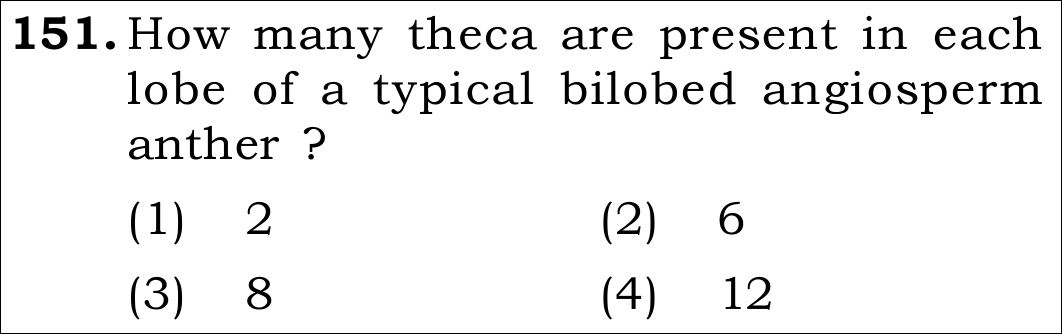
NEET 2026 · Q151 Easy
Official NEET 2026 Question 151 - Sexual Reproduction in Flowering Plants
1 2 ✓ Key
2 6
3 8
4 12
💡 Verified Solution & 30-Second Hack
✓
Verified Against NTA Final Answer Key
Option (1) : Two
📚 Sexual Reproduction in Flowering Plants Easy
📋 Given Parameters & Problem Setup
Organ Angiosperm Anther
Morphological Nature Bilobed and Dithecous
Target Scope Number of theca present in EACH lobe
⚡

The 30-Second Exam Hall Shortcut: ⚡ Root Word Decoder ("Di-thecous")

⏱️ Save ~30 seconds

Dithecous = "Di" (Two) Theca per lobe!

1 Read carefully: Question asks for number of theca in EACH LOBE (not entire anther).
2 Recall canonical botanical definition: A typical angiosperm anther is bilobed (2 lobes).
3 Each lobe is dithecous, meaning it possesses 2 theca (separated by a longitudinal groove).
4 Therefore, each lobe has exactly 2 theca.
5 Match Option (1) = Two.
🛡️
Why You Can 100% Trust This Shortcut: NCERT Biology · Sexual Reproduction in Flowering Plants (Structure of Stamen: Microsporangium surrounded by 4 wall layers).
📐

Step-by-Step Rigorous Workflow & Mathematical Proof

Step 1

Anatomy of Angiosperm Anther

A typical angiosperm anther is a bilobed structure with each lobe having two theca (chambers), making it dithecous. Often a longitudinal groove runs lengthwise separating the two theca.

Typical Anther=2 Lobes,Each Lobe=2 Theca (Dithecous)\text{Typical Anther} = 2 \text{ Lobes}, \quad \text{Each Lobe} = 2 \text{ Theca (Dithecous)}
  • • Bilobed structure with a total of 4 microsporangia located at the corners (tetrasporangiate).
Step 2

Per-Lobe Count vs. Whole-Anther Count

The question specifically asks: "How many theca are present in each lobe?". In each lobe, there are 2 theca. Across both lobes combined, the whole anther contains 4 theca / 4 microsporangia.

Per Lobe=2 theca  ⟹  Option (1)\text{Per Lobe} = 2 \text{ theca} \implies \text{Option (1)}
  • • Watch out for the whole-anther trap (4 theca) versus per-lobe count (2 theca).
⭐

360° Option Elimination Engine Key Feature

Diagnose every choice: Know exactly why the right option works and why distractors fail.

4-Option Deep Scan
1 A
✓ 100% Correct
Verdict & Scientific Reason:

100% scientifically accurate. Each anther lobe is dithecous, meaning it contains exactly two theca.

💡
Why this is airtight: None; textbook definition.
2 B
✗ Incorrect
Verdict & Scientific Reason:

Incorrect. Four is the total number of theca/microsporangia in the ENTIRE bilobed anther, not in each individual lobe.

⚠️
Student Fallacy (Why candidates pick this trap): Rushing and confusing total anther count (4) with per-lobe count (2).
3 C
✗ Incorrect
Verdict & Scientific Reason:

Incorrect. An anther lobe with one theca is monothecous, which is an exception found in family Malvaceae (e.g., Hibiscus), not typical angiosperms.

⚠️
Student Fallacy (Why candidates pick this trap): Confusing exceptional monothecous anthers with standard dithecous angiosperm anthers.
4 D
✗ Incorrect
Verdict & Scientific Reason:

Incorrect. No normal angiosperm anther lobe possesses three theca.

⚠️
Student Fallacy (Why candidates pick this trap): Arbitrary guess.
⚠️

NTA Trap Alert: Whole Anther vs. Single Lobe Trap

The word "each lobe" is the key discriminator. Students reading hurriedly see "tetrasporangiate = 4" and immediately bubble 4, forgetting that 4 theca are distributed across 2 lobes (2 per lobe).

🛡️ How to avoid the -1 mark: Circle "EACH LOBE" on the question paper before selecting an answer.
📖

Core NEET Syllabus Standard

NEET Biology Core Syllabus · Sexual Reproduction in Flowering Plants Standard Benchmark
Core Scientific Principle Tested:

"A typical angiosperm anther is bilobed with each lobe having two theca, i.e., they are dithecous."
Syllabus Focus: Stamen, Microsporangium and Pollen Grain
✓ Core NEET UG Syllabus Anchor Syllabus & Academic Standards ↗
DI-thecous = DI (2) theca in each lobe!
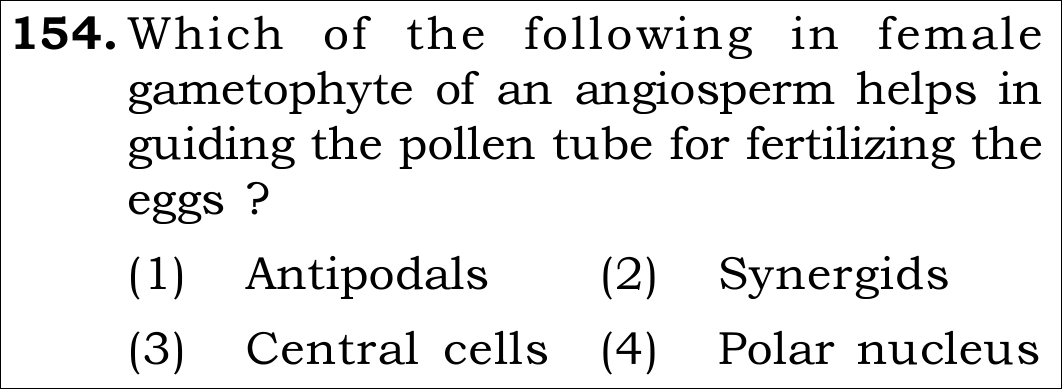
NEET 2026 · Q154 Easy
Official NEET 2026 Question 154 - Sexual Reproduction in Flowering Plants
1 Antipodals
2 Synergids ✓ Key
3 Central cells
4 Polar nucleus
💡 Verified Solution & 30-Second Hack
✓
Verified Against NTA Final Answer Key
Option (2) : Synergids
📚 Sexual Reproduction in Flowering Plants Easy
📋 Given Parameters & Problem Setup
Structure Female Gametophyte (Embryo Sac)
Cellular Feature Special cellular thickenings (Filiform Apparatus)
Biological Role Guiding the pollen tube into the ovule / embryo sac
⚡

The 30-Second Exam Hall Shortcut: ⚡ Filiform Apparatus Trigger

⏱️ Save ~30 seconds

Special thickenings to guide pollen tube = Filiform apparatus of SYNERGIDS!

1 Recognize diagnostic phrase: "special cellular thickenings that guide the pollen tube".
2 Identify structure: Filiform apparatus located at micropylar tip of synergids.
3 Match cell type: Synergids.
4 Antipodal cells are chalazal; egg cell is fertilized by male gamete; central cell forms endosperm.
5 Select Option (2) Synergids in 5 seconds.
🛡️
Why You Can 100% Trust This Shortcut: NCERT Biology · Sexual Reproduction in Flowering Plants (Female Gametophyte: Monosporic 7-celled, 8-nucleate embryo sac).
📐

Step-by-Step Rigorous Workflow & Mathematical Proof

Step 1

Structure of the Egg Apparatus

Three cells are grouped together at the micropylar end and constitute the egg apparatus. The egg apparatus, in turn, consists of two synergids and one egg cell.

Egg Apparatus=2 Synergids+1 Egg Cell\text{Egg Apparatus} = 2 \text{ Synergids} + 1 \text{ Egg Cell}
  • • Located at the micropylar pole of the 7-celled, 8-nucleate female gametophyte.
Step 2

Filiform Apparatus Mechanism

The synergids have special cellular thickenings at the micropylar tip called filiform apparatus, which play an important role in guiding the pollen tubes into the synergid.

Synergids→Micropylar ThickeningsFiliform Apparatus→Chemotropic GuidancePollen Tube Entry\text{Synergids} \xrightarrow{\text{Micropylar Thickenings}} \text{Filiform Apparatus} \xrightarrow{\text{Chemotropic Guidance}} \text{Pollen Tube Entry}
  • • One synergid degenerates as the pollen tube enters and discharges its two male gametes.
⭐

360° Option Elimination Engine Key Feature

Diagnose every choice: Know exactly why the right option works and why distractors fail.

4-Option Deep Scan
1 A
✗ Incorrect
Verdict & Scientific Reason:

Incorrect. Antipodal cells (three in number) are located at the chalazal end and degenerate before or soon after fertilization; they do not guide pollen tubes.

⚠️
Student Fallacy (Why candidates pick this trap): Confusing chalazal antipodals with micropylar synergids.
2 B
✓ 100% Correct
Verdict & Scientific Reason:

100% correct. Synergids possess the filiform apparatus that guides the pollen tube into the embryo sac.

💡
Why this is airtight: None; canonical NCERT fact.
3 C
✗ Incorrect
Verdict & Scientific Reason:

Incorrect. The egg cell is the female gamete that fuses with a male gamete to form the zygote; it lacks filiform apparatus thickenings.

⚠️
Student Fallacy (Why candidates pick this trap): Assuming the egg cell itself directly guides the pollen tube.
4 D
✗ Incorrect
Verdict & Scientific Reason:

Incorrect. The large central cell contains two polar nuclei and undergoes triple fusion to form the primary endosperm nucleus (PEN).

⚠️
Student Fallacy (Why candidates pick this trap): Confusing central cell with egg apparatus components.
⚠️

NTA Trap Alert: Egg Cell vs. Synergid Confusion

Students sometimes think the egg cell attracts the pollen tube directly. In reality, the helper synergids produce chemotropic attractants and possess the physical filiform guide.

🛡️ How to avoid the -1 mark: Remember: Synergids are the "helpers" (synergy = cooperation); they guide the pollen tube so the egg can be fertilized.
📖

Core NEET Syllabus Standard

NEET Biology Core Syllabus · Sexual Reproduction in Flowering Plants Standard Benchmark
Core Scientific Principle Tested:

"The synergids have special cellular thickenings at the micropylar tip called filiform apparatus that guide the pollen tube."

Syllabus Focus: Megasporogenesis & Female Gametophyte
✓ Core NEET UG Syllabus Anchor Syllabus & Academic Standards ↗
SYNergids SYNC and guide the pollen tube!
NEET 2026 · Q155 Easy
Official NEET 2026 Question 155 - Sexual Reproduction in Flowering Plants
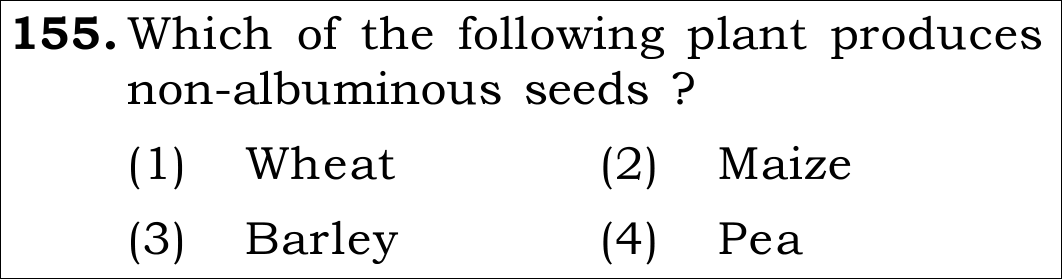
1 Wheat
2 Maize
3 Barley
4 Pea ✓ Key
💡 Verified Solution & 30-Second Hack
✓
Verified Against NTA Final Answer Key
Option (4) : Pea
📚 Sexual Reproduction in Flowering Plants Easy
📋 Given Parameters & Problem Setup
Classification Criterion Presence or absence of residual endosperm in mature seed
Category Non-albuminous (Exalbuminous) Seed
⚡

The 30-Second Exam Hall Shortcut: ⚡ NCERT Seed Dichotomy Rule

⏱️ Save ~25 seconds

Non-albuminous (Exalbuminous) = Pea, Groundnut, Beans (Legumes)!

1 Recall definition: Non-albuminous seeds have no residual endosperm as it is completely consumed during embryo development.
2 NCERT canonical examples of non-albuminous seeds: Pea, Groundnut, Beans.
3 Albuminous seeds retain endosperm: Castor, Wheat, Maize, Barley, Sunflower.
4 Scan options: Castor (Albuminous), Maize (Albuminous), Wheat (Albuminous), Pea (Non-albuminous).
5 Instantly choose Option (4): Pea.
🛡️
Why You Can 100% Trust This Shortcut: NCERT Biology · Sexual Reproduction in Flowering Plants (Endosperm Development: Free-nuclear endosperm before cellularization).
📐

Step-by-Step Rigorous Workflow & Mathematical Proof

Step 1

Definition of Non-Albuminous (Exalbuminous) Seeds

Non-albuminous seeds have no residual endosperm as it is completely consumed during embryo development (e.g., pea, groundnut, beans). Food reserves are stored in swollen, fleshy cotyledons.

Endosperm Consumed Completely  ⟹  Non-albuminous (Exalbuminous)(Pea, Groundnut)\text{Endosperm Consumed Completely} \implies \text{Non-albuminous (Exalbuminous)} \quad (\text{Pea, Groundnut})
  • • Cotyledons store nutrients for the future germinating seedling.
Step 2

Definition of Albuminous (Endospermic) Seeds

Albuminous seeds retain a part of endosperm as it is not completely used up during embryo development (e.g., wheat, maize, barley, castor, sunflower).

Residual Endosperm Persists  ⟹  Albuminous(Castor, Maize, Wheat)\text{Residual Endosperm Persists} \implies \text{Albuminous} \quad (\text{Castor, Maize, Wheat})
  • • Castor is a dicot but albuminous; maize and wheat are monocots and albuminous.
⭐

360° Option Elimination Engine Key Feature

Diagnose every choice: Know exactly why the right option works and why distractors fail.

4-Option Deep Scan
1 A
✗ Incorrect
Verdict & Scientific Reason:

Incorrect. Castor is an albuminous (endospermic) seed; it retains a prominent nutritive endosperm despite being a dicot.

⚠️
Student Fallacy (Why candidates pick this trap): Assuming all dicots are non-albuminous, forgetting that castor is a classic albuminous dicot.
2 B
✗ Incorrect
Verdict & Scientific Reason:

Incorrect. Maize is a monocotyledonous albuminous seed with a large starchy endosperm separated by an aleurone layer.

⚠️
Student Fallacy (Why candidates pick this trap): Overlooking that cereal grains are rich in persistent endosperm.
3 C
✗ Incorrect
Verdict & Scientific Reason:

Incorrect. Wheat seeds are albuminous caryopses with prominent starchy endosperm.

⚠️
Student Fallacy (Why candidates pick this trap): Failing to categorize cereal grains as albuminous.
4 D
✓ 100% Correct
Verdict & Scientific Reason:

100% correct. Pea seeds consume their endosperm completely during embryogenesis, storing reserves in cotyledons (non-albuminous).

💡
Why this is airtight: None; textbook exemplar.
⚠️

NTA Trap Alert: Castor Dicot Exception Trap

Many students memorize "monocots = albuminous, dicots = non-albuminous". Castor is a dicot, but it is ALBUMINOUS. Pea is the true non-albuminous seed here.

🛡️ How to avoid the -1 mark: Memorize the NCERT non-albuminous triad: Pea, Groundnut, Gram/Bean (PG-B).
📖

Core NEET Syllabus Standard

NEET Biology Core Syllabus · Sexual Reproduction in Flowering Plants Standard Benchmark
Core Scientific Principle Tested:

"Non-albuminous seeds have no residual endosperm as it is completely consumed during embryo development (e.g., pea, groundnut)."

Syllabus Focus: Seed Development & Structure
✓ Core NEET UG Syllabus Anchor Syllabus & Academic Standards ↗
No Albumen in Pea-Pods: Peas Eat All their endosperm!
NEET 2026 · Q156 Easy
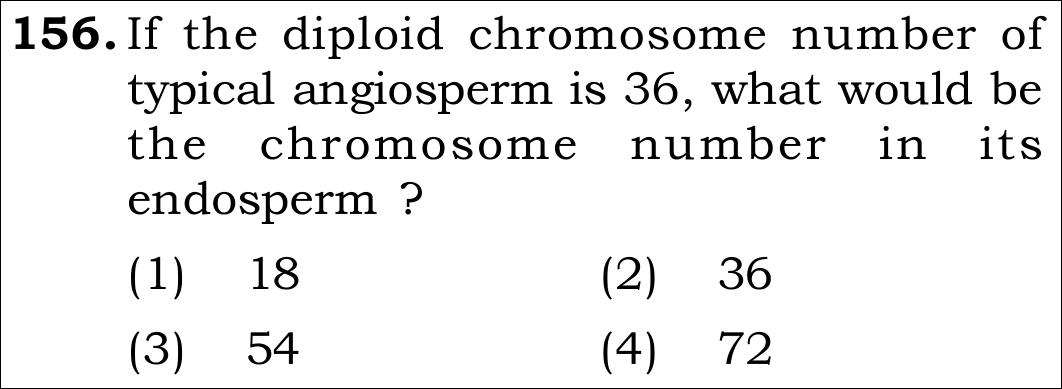
Official NEET 2026 Question 156 - Sexual Reproduction in Flowering Plants
1 18
2 36
3 54 ✓ Key
4 72
💡 Verified Solution & 30-Second Hack
✓
Verified Against NTA Final Answer Key
Option (3) : 54
📚 Sexual Reproduction in Flowering Plants Easy
📋 Given Parameters & Problem Setup
Plant Type Angiosperm
Diploid Number (2n) 36
Target Structure Endosperm Chromosome Number
⚡

The 30-Second Exam Hall Shortcut: ⚡ 3-Halves Ploidy Formula

⏱️ Save ~30 seconds

Endosperm = 3n = (3/2) × 2n = 1.5 × 36 = 54!

1 Recall angiosperm ploidy rules: Vegetative/sporophytic body is diploid (2n = 36).
2 Find haploid genome number: n = 36 / 2 = 18.
3 In angiosperms, endosperm is formed by triple fusion (1 male gamete n + 2 polar nuclei 2n = 3n).
4 Calculate: Endosperm = 3n = 3 × 18 = 54.
5 Match Option (3) = 54 instantly.
🛡️
Why You Can 100% Trust This Shortcut: NCERT Biology · Sexual Reproduction in Flowering Plants (Double Fertilization: Syngamy produces zygote, triple fusion produces PEN).
📐

Step-by-Step Rigorous Workflow & Mathematical Proof

Step 1

Determine Haploid Number (n)

Given that the diploid number of chromosomes (2n) of the angiospermic plant is 36, the haploid number (n) present in gametes is half of this value.

2n=36  ⟹  n=362=182n = 36 \implies n = \frac{36}{2} = 18
  • • Haploid number n = 18 applies to male gametes, egg cell, synergids, and antipodals.
Step 2

Triple Fusion and Endosperm Ploidy

In angiosperms, double fertilization involves triple fusion where one haploid male gamete (n) fuses with two haploid polar nuclei (or one secondary diploid nucleus 2n) to produce the triploid primary endosperm nucleus (PEN).

PEN Ploidy=n+n+n=3n=3×18=54\text{PEN Ploidy} = n + n + n = 3n = 3 \times 18 = 54
  • • In gymnosperms, endosperm is haploid (n = 18); in angiosperms, it is triploid (3n = 54).
⭐

360° Option Elimination Engine Key Feature

Diagnose every choice: Know exactly why the right option works and why distractors fail.

4-Option Deep Scan
1 A
✗ Incorrect
Verdict & Scientific Reason:

Incorrect. 18 is the haploid number (n), characteristic of gametes, synergids, and antipodals, or gymnosperm endosperm.

⚠️
Student Fallacy (Why candidates pick this trap): Confusing angiosperm endosperm (3n) with haploid gametes or gymnosperm endosperm (n).
2 B
✗ Incorrect
Verdict & Scientific Reason:

Incorrect. 36 is the diploid number (2n), characteristic of root, stem, leaf, integuments, and zygote.

⚠️
Student Fallacy (Why candidates pick this trap): Assuming endosperm has regular somatic diploid ploidy (2n).
3 C
✓ 100% Correct
Verdict & Scientific Reason:

100% mathematically and biologically correct. Angiosperm endosperm is triploid: 3n = 3 × 18 = 54.

💡
Why this is airtight: None; straightforward calculation.
4 D
✗ Incorrect
Verdict & Scientific Reason:

Incorrect. 72 would represent tetraploid (4n), which does not correspond to standard angiosperm endosperm.

⚠️
Student Fallacy (Why candidates pick this trap): Arbitrary multiplication by 4.
⚠️

NTA Trap Alert: Gymnosperm vs. Angiosperm Endosperm Ploidy Trap

In gymnosperms, endosperm is formed before fertilization and is haploid (n). In angiosperms, it is formed after double fertilization (triple fusion) and is triploid (3n).

🛡️ How to avoid the -1 mark: Always check if the question specifies "angiosperm" -> Endosperm is ALWAYS 3n.
📖

Core NEET Syllabus Standard

NEET Biology Core Syllabus · Sexual Reproduction in Flowering Plants Standard Benchmark
Core Scientific Principle Tested:

"Triple fusion results in a triploid (3n) primary endosperm nucleus."

Syllabus Focus: Double Fertilization & Endosperm
✓ Core NEET UG Syllabus Anchor Syllabus & Academic Standards ↗
Triple Fusion = 3 × n = 3 × 18 = 54!
NEET 2025 · Q102 Easy
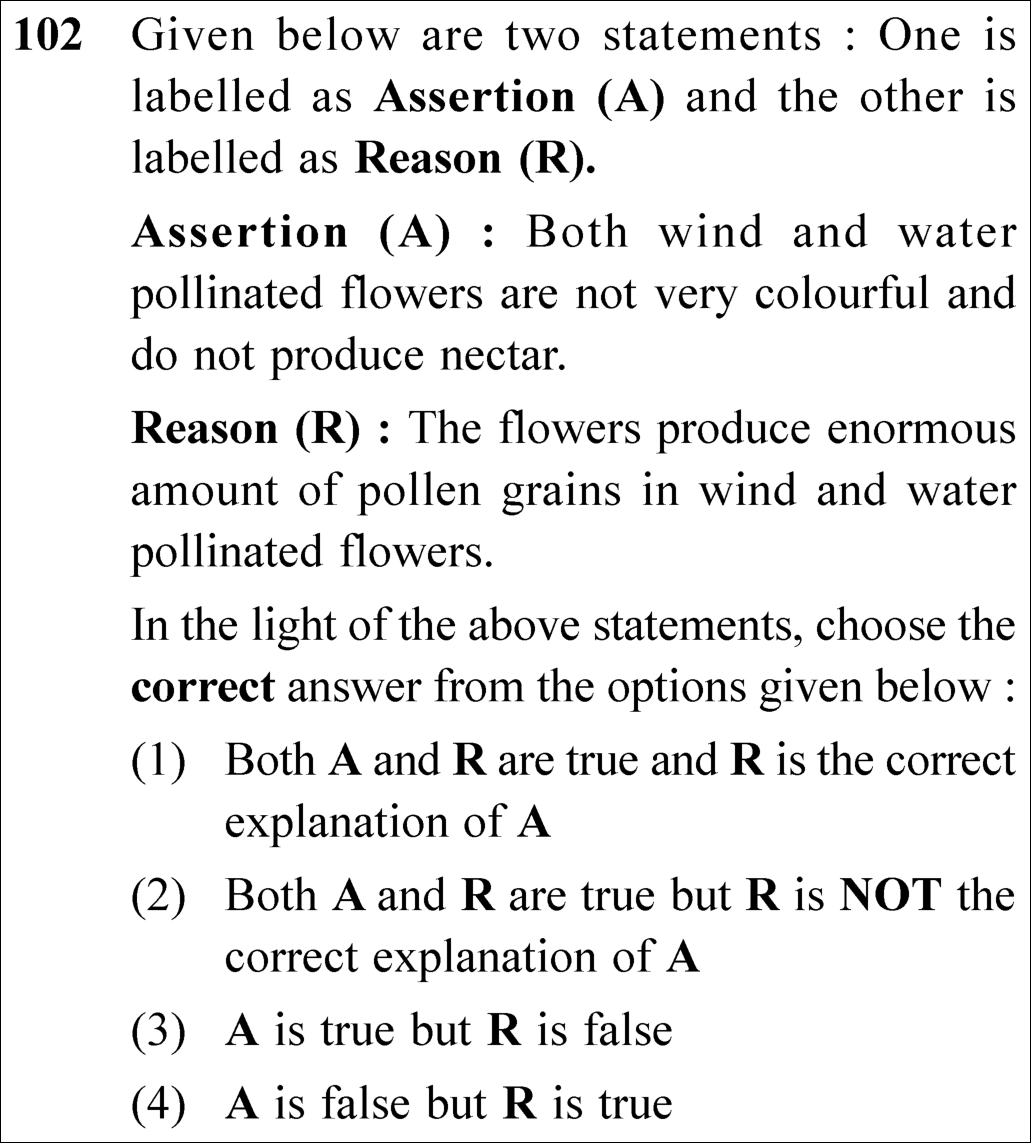
Official NEET 2025 Question 102 - Sexual Reproduction in Flowering Plants
1 Both A and R are true and R is the correct explanation of A
2 Both A and R are true but R is NOT the correct explanation of A ✓ Key
3 A is true but R is false
4 A is false but R is true
💡 Verified Solution & 30-Second Hack
✓
Verified Against NTA Final Answer Key
Option (2) : Both A and R are true but R is NOT the correct explanation of A
📚 Sexual Reproduction in Flowering Plants Easy
📋 Given Parameters & Problem Setup
Assertion (A) Both wind and water pollinated flowers are not very colourful and do not produce nectar.
Reason (R) The flowers produce enormous amount of pollen grains in wind and water pollinated flowers.
⚡

The 30-Second Exam Hall Shortcut: ⚡ Abiotic Pollination Logic Test

⏱️ Save ~35 seconds

Assertion is TRUE (wind and water do not have eyes or tongues, so no bright petals or sweet nectar are needed)! Reason is TRUE (wind/water transport is random and wasteful, so flowers produce enormous pollen to compensate)! But enormous pollen does NOT explain why flowers lack color/nectar! ⟹ Both true, R NOT explanation (Option 2)!

1 Evaluate Assertion (A): Wind-pollinated (anemophilous) and water-pollinated (hydrophilous) flowers rely on non-living physical currents. They do not need to attract animal pollinators, so investing energy in colorful petals, fragrance, or sugary nectar is unnecessary. Assertion (A) is TRUE.
2 Evaluate Reason (R): Abiotic pollination is directional and passive; vast quantities of pollen are lost during dispersal. To compensate for this high probability of loss, flowers produce immense numbers of pollen grains per ovule. Reason (R) is TRUE.
3 Evaluate Causal Relationship: Flowers lack nectar and color because abiotic agents DO NOT NEED ATTRACTION. Enormous pollen production compensates for WASTAGE during flight/floating. The reason for lack of color is absence of animal pollinators, not pollen quantity!
4 Therefore, Both A and R are true, but R is NOT the correct explanation of A.
5 Select Option (2) in under 15 seconds!
🛡️
Why You Can 100% Trust This Shortcut: Anatropous Ovule Anatomy & Megasporogenesis (NCERT Biology · Sexual Reproduction in Flowering Plants).
📐

Step-by-Step Rigorous Workflow & Mathematical Proof

Step 1

Evaluate Assertion (A): Floral Reductions in Abiotic Pollination

Analyze evolutionary energy allocation in anemophilous and hydrophilous angiosperms:

Abiotic Pollination  ⟹  No biotic vectors to attract  ⟹  Absence of bright petals and nectar\text{Abiotic Pollination} \implies \text{No biotic vectors to attract} \implies \text{Absence of bright petals and nectar}
  • • NCERT states verbatim: "Both wind and water pollinated flowers are not very colourful and do not produce nectar."
  • • Assertion (A) is completely TRUE.
Step 2

Evaluate Reason (R): Pollen Compensation for High Wastage

Analyze the reproductive efficiency of wind and water transport:

Passive abiotic transport  ⟹  High probability of loss  ⟹  Enormous pollen grain production\text{Passive abiotic transport} \implies \text{High probability of loss} \implies \text{Enormous pollen grain production}
  • • NCERT states verbatim: "To compensate for this uncertainties and associated loss of pollen grains, the flowers produce enormous amount of pollen when compared to the number of ovules available for pollination."
  • • Reason (R) is completely TRUE.
Step 3

Assess Causal Linkage Between A and R

Determine if R explains A:

True explanation of A: Flowers do not require insect/bird attractants\text{True explanation of A: Flowers do not require insect/bird attractants}
  • • The true cause of absent color/nectar is the lack of a need to attract biotic pollinators.
  • • The true purpose of high pollen output is to overcome statistical wastage in abiotic currents.
  • • While both statements are independently true facts, Reason R does not provide the causal mechanism for Assertion A.
  • • Matches Option (2).
⭐

360° Option Elimination Engine Key Feature

Diagnose every choice: Know exactly why the right option works and why distractors fail.

4-Option Deep Scan
1 A
✗ Incorrect
Verdict & Scientific Reason:

Incorrect. R explains pollen abundance, not the absence of color and nectar.

⚠️
Student Fallacy (Why candidates pick this trap): Assuming any two true related statements explain each other.
2 B
✓ 100% Correct
Verdict & Scientific Reason:

100% correct. Both are established NCERT truths, but R does not causally explain A.

💡
Why this is airtight: None; rigorous logical analysis of Assertion-Reasoning.
3 C
✗ Incorrect
Verdict & Scientific Reason:

Incorrect. R is true (enormous pollen is produced).

⚠️
Student Fallacy (Why candidates pick this trap): Believing wind-pollinated flowers produce few pollen grains.
4 D
✗ Incorrect
Verdict & Scientific Reason:

Incorrect. A is true.

⚠️
Student Fallacy (Why candidates pick this trap): Thinking wind-pollinated flowers have nectar.
⚠️

NTA Trap Alert: Automatic "R Explains A" Assumption

Students frequently assume that if both statements are in the same paragraph of NCERT, R must explain A! Always ask: "DOES producing lots of pollen CAUSE flowers to lose color and nectar?" No! Flowers lack color because wind cannot see!

🛡️ How to avoid the -1 mark: Use the "Because" test: Flowers lack color BECAUSE wind doesn’t need visuals, NOT because they make more pollen!
📖

Core NEET Syllabus Standard

NEET Biology Core Syllabus · Sexual Reproduction in Flowering Plants Standard Benchmark
Core Scientific Principle Tested:

"Wind/water pollinated flowers lack color and nectar (no animal vectors) and produce abundant pollen to counter loss."

Syllabus Focus: Agents of Pollination: Wind and Water Pollination
✓ Core NEET UG Syllabus Anchor Syllabus & Academic Standards ↗
Wind cannot see (No color/nectar, A); Wind loses pollen (High count, R) ⟹ Both true, but separate reasons (Option 2)!
NEET 2025 · Q127 Medium
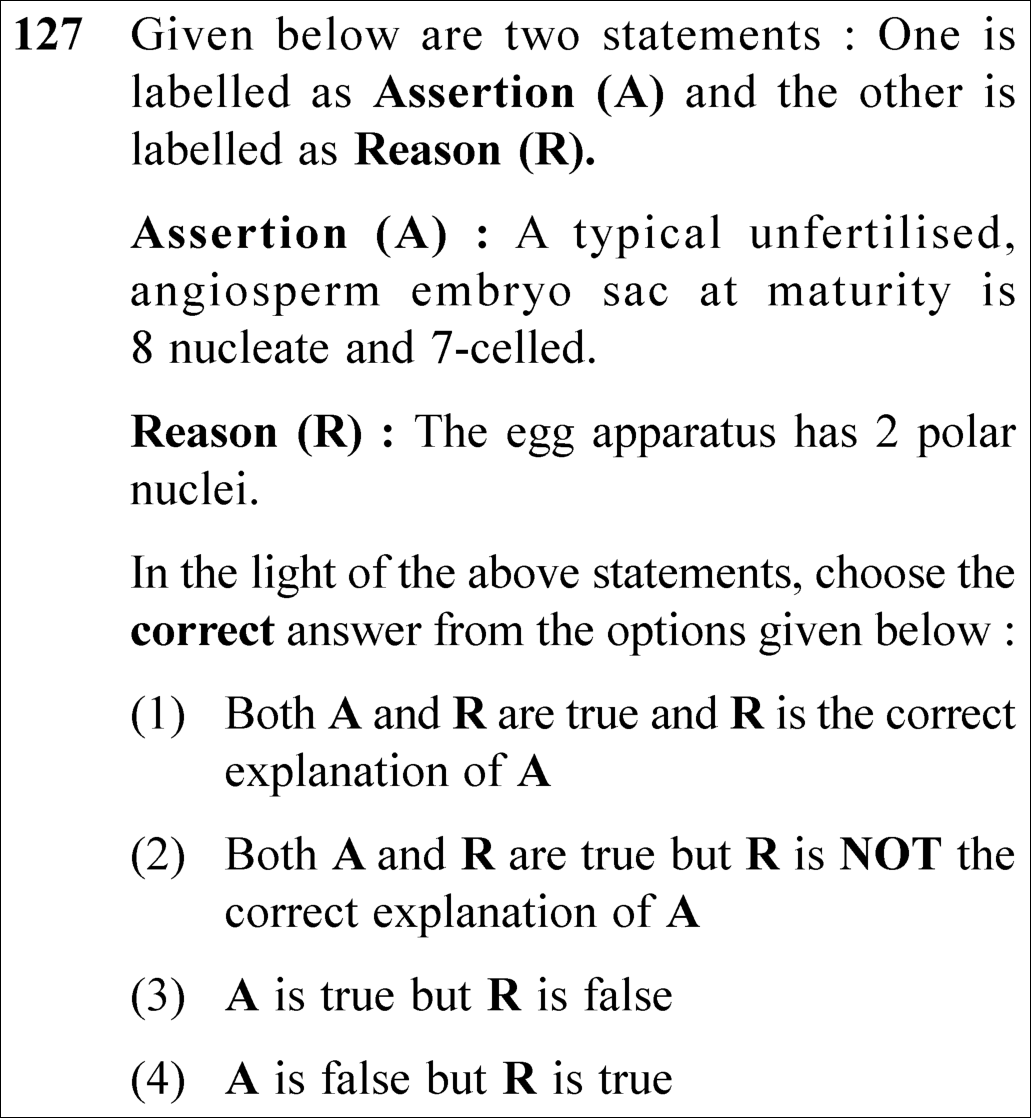
Official NEET 2025 Question 127 - Sexual Reproduction in Flowering Plants
1 Both A and R are true and R is the correct explanation of A
2 Both A and R are true but R is NOT the correct explanation of A
3 A is true but R is false ✓ Key
4 A is false but R is true
💡 Verified Solution & 30-Second Hack
✓
Verified Against NTA Final Answer Key
Option (3) : A is true but R is false
📚 Sexual Reproduction in Flowering Plants Medium
📋 Given Parameters & Problem Setup
Assertion (A) A typical unfertilised, angiosperm embryo sac at maturity is 8 nucleate and 7-celled.
Reason (R) The egg apparatus has 2 polar nuclei.
⚡

The 30-Second Exam Hall Shortcut: ⚡ Embryo Sac Anatomy Fingerprint

⏱️ Save ~25 seconds

Assertion is TRUE (7-celled, 8-nucleate Polygonum type)! Reason is FALSE because polar nuclei are in the CENTRAL CELL, NOT in the egg apparatus (egg apparatus has 1 egg + 2 synergids)! A is true, R is false!

1 Analyze Assertion (A):
2 - "A typical unfertilised angiosperm embryo sac at maturity is 8-nucleate and 7-celled." -> Standard Polygonum type embryo sac! Assertion (A) is TRUE.
3 Analyze Reason (R):
4 - "The egg apparatus has 2 polar nuclei." -> Completely FALSE! The egg apparatus consists of THREE cells: two synergids and one egg cell. The 2 polar nuclei reside in the large CENTRAL CELL!
5 Conclusion: A is true but R is false.
6 Select Option (3)!
🛡️
Why You Can 100% Trust This Shortcut: Pollen Pistil Interaction & Double Fertilization (NCERT Biology · Sexual Reproduction in Flowering Plants: Syngamy and triple fusion).
📐

Step-by-Step Rigorous Workflow & Mathematical Proof

Step 1

Analysis of Assertion (A)

Development of the female gametophyte (embryo sac) in typical angiosperms (Polygonum type):

  • • A single functional megaspore undergoes three successive free nuclear mitotic divisions to produce an 8-nucleate stage.
  • • Cytokinesis subsequently partitions 6 of the nuclei into separate cells, while 2 nuclei remain in the central compartment.
  • • The mature embryo sac comprises 7 cells: 3 antipodal cells at chalazal end, 1 three-celled egg apparatus at micropylar end, and 1 large central cell containing 2 polar nuclei.
  • • Hence, Assertion (A) is completely TRUE.
Step 2

Analysis of Reason (R)

Composition of the Egg Apparatus vs Central Cell:

  • • The egg apparatus is located strictly at the micropylar end and consists of THREE cells: two synergids (with filiform apparatus) and one egg cell (female gamete).
  • • The 2 polar nuclei are located in the large central cell, situated below the egg apparatus.
  • • Therefore, asserting that "The egg apparatus has 2 polar nuclei" is anatomically and biologically FALSE.
Step 3

Conclusion

Assertion (A) is true, but Reason (R) is false. This leads directly to Option (3).

Assertion: True,Reason: False  ⟹  Option (3)\text{Assertion: True}, \quad \text{Reason: False} \implies \text{Option (3)}
⭐

360° Option Elimination Engine Key Feature

Diagnose every choice: Know exactly why the right option works and why distractors fail.

4-Option Deep Scan
1 A
✗ Incorrect
Verdict & Scientific Reason:

Incorrect. Reason R is blatantly false because polar nuclei belong to the central cell, not the egg apparatus.

⚠️
Student Fallacy (Why candidates pick this trap): Believing polar nuclei are part of the egg apparatus.
2 B
✗ Incorrect
Verdict & Scientific Reason:

Incorrect. Reason R is false, so it cannot be true.

⚠️
Student Fallacy (Why candidates pick this trap): Failing to spot the anatomical error in R.
3 C
✓ 100% Correct
Verdict & Scientific Reason:

100% correct. Accurately verifies that A is true while debunking the incorrect anatomical claim in R.

💡
Why this is airtight: None; precise botanical morphology.
4 D
✗ Incorrect
Verdict & Scientific Reason:

Incorrect. Inverts the veracity of both statements.

⚠️
Student Fallacy (Why candidates pick this trap): Doubting the 7-celled, 8-nucleate nature of angiosperm embryo sac.
⚠️

NTA Trap Alert: Components of Egg Apparatus vs Central Cell

Egg Apparatus = 2 Synergids + 1 Egg Cell (Total 3 cells, 3 nuclei). Central Cell = 1 Cell containing 2 Polar Nuclei. Antipodals = 3 Cells, 3 nuclei. Total = 7 cells, 8 nuclei!

🛡️ How to avoid the -1 mark: Never attribute polar nuclei to the egg apparatus; they belong exclusively to the central cell.
📖

Core NEET Syllabus Standard

NEET Biology Core Syllabus · Sexual Reproduction in Flowering Plants Standard Benchmark
Core Scientific Principle Tested:

"An angiosperm embryo sac is 7-celled and 8-nucleate; the egg apparatus consists of 2 synergids and 1 egg cell, while polar nuclei reside in the central cell."

Syllabus Focus: Megasporogenesis & Female Gametophyte
✓ Core NEET UG Syllabus Anchor Syllabus & Academic Standards ↗
Egg Apparatus = 2 Synergids + 1 Egg (NO Polar Nuclei in the apparatus)!
NEET 2025 · Q141 Easy
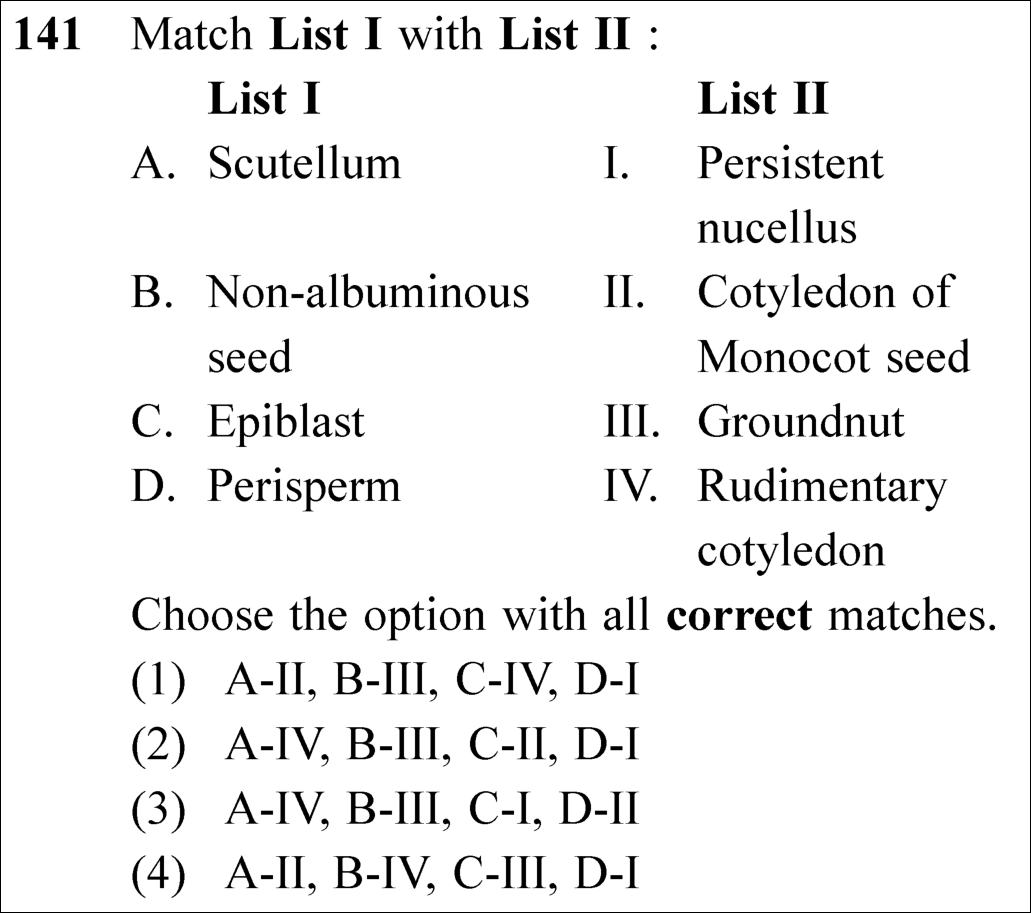
Official NEET 2025 Question 141 - Sexual Reproduction in Flowering Plants
1 ✓ Key
2
3
4
💡 Verified Solution & 30-Second Hack
✓
Verified Against NTA Final Answer Key
Option (1) : A-II, B-III, C-IV, D-I
📚 Sexual Reproduction in Flowering Plants Easy
📋 Given Parameters & Problem Setup
List I (Botanical Terms) A. Scutellum, B. Non-albuminous seed, C. Epiblast, D. Perisperm
List II (Definitions / Examples) I. Persistent nucellus, II. Cotyledon of Monocot seed, III. Groundnut, IV. Rudimentary cotyledon
⚡

The 30-Second Exam Hall Shortcut: ⚡ Seed Anatomy Match Fingerprint

⏱️ Save ~30 seconds

Scutellum = Monocot shield cotyledon (II); Non-albuminous = Groundnut (endosperm fully consumed) (III); Epiblast = Rudimentary 2nd cotyledon (IV); Perisperm = Persistent nucellus (I)! Code: A-II, B-III, C-IV, D-I!

1 Match each term directly from NCERT Section 2.4:
2 - Scutellum: The single large cotyledon of a monocotyledonous (grass) embryo (A -> II).
3 - Non-albuminous seed: Seeds with no residual endosperm (e.g. Groundnut, pea, gram) (B -> III).
4 - Epiblast: Represents the rudimentary second cotyledon opposite the scutellum in grass embryos (C -> IV).
5 - Perisperm: Persistent residual nucellus found in black pepper and beet (D -> I).
6 Unique combination: A-II, B-III, C-IV, D-I (Option 1)!
7 Solved in under 10 seconds!
🛡️
Why You Can 100% Trust This Shortcut: Apomixis and Polyembryony Mechanisms (NCERT Biology · Sexual Reproduction in Flowering Plants: Agamospermy and nucellar adventive embryony).
📐

Step-by-Step Rigorous Workflow & Mathematical Proof

Step 1

Review of the Embryological and Seed Terms

Analyzing each specialized botanical structure:

  • • A. Scutellum: In monocot embryos (especially the grass family / Poaceae), the single shield-shaped cotyledon situated towards one side of the embryonal axis is called the scutellum. Hence, A matches II.
  • • B. Non-albuminous seed: Non-albuminous (exalbuminous) seeds retain no residual endosperm because it is entirely consumed during embryo development. Classic examples include groundnut, pea, and bean. Hence, B matches III.
  • • C. Epiblast: In grass embryos, a small flap-like rudimentary outgrowth situated opposite the scutellum represents the reduced remnant of the second cotyledon, termed the epiblast. Hence, C matches IV.
  • • D. Perisperm: In most seeds, the nucellus is completely consumed during embryo sac enlargement and endosperm development. However, in certain seeds such as black pepper (*Piper nigrum*) and beet (*Beta vulgaris*), remnants of persistent nucellus are retained, known as perisperm. Hence, D matches I.
Step 2

Assembling the Matching Matrix

Compiling the verified associations:

  • • A -> II (Cotyledon of Monocot seed)
  • • B -> III (Groundnut)
  • • C -> IV (Rudimentary cotyledon)
  • • D -> I (Persistent nucellus)
Step 3

Conclusion

The unambiguous combination is A-II, B-III, C-IV, D-I, which is Option (1).

Matching: A-II,  B-III,  C-IV,  D-I\text{Matching: } A\text{-II}, \; B\text{-III}, \; C\text{-IV}, \; D\text{-I}
⭐

360° Option Elimination Engine Key Feature

Diagnose every choice: Know exactly why the right option works and why distractors fail.

4-Option Deep Scan
1 A
✓ 100% Correct
Verdict & Scientific Reason:

100% correct. Accurately matches all 4 seed and embryo structures with their precise definitions.

💡
Why this is airtight: None; comprehensive botanical recall.
2 B
✗ Incorrect
Verdict & Scientific Reason:

Incorrect. Assigns rudimentary cotyledon to scutellum and monocot cotyledon to epiblast.

⚠️
Student Fallacy (Why candidates pick this trap): Swapping scutellum and epiblast.
3 C
✗ Incorrect
Verdict & Scientific Reason:

Incorrect. Reverses perisperm and epiblast mappings.

⚠️
Student Fallacy (Why candidates pick this trap): Confusing persistent nucellus with rudimentary cotyledon.
4 D
✗ Incorrect
Verdict & Scientific Reason:

Incorrect. Claims groundnut is an epiblast.

⚠️
Student Fallacy (Why candidates pick this trap): Careless misreading of List II options.
⚠️

NTA Trap Alert: Scutellum vs Epiblast

Both relate to cotyledons in grasses: SCUTELLUM is the functional, single large shield cotyledon. EPIBLAST is the rudimentary, reduced remnant of the second cotyledon.

🛡️ How to avoid the -1 mark: Scutellum = Shield (1st functional cotyledon); Epiblast = Echo/Rudimentary 2nd cotyledon.
📖

Core NEET Syllabus Standard

NEET Biology Core Syllabus · Sexual Reproduction in Flowering Plants Standard Benchmark
Core Scientific Principle Tested:

"Scutellum is the monocot cotyledon, groundnut is non-albuminous, epiblast is rudimentary cotyledon, and perisperm is persistent nucellus."

Syllabus Focus: Development of Seed and Embryo
✓ Core NEET UG Syllabus Anchor Syllabus & Academic Standards ↗
S-Cot (Scutellum), G-Non (Groundnut), E-Rudi (Epiblast), P-Nuc (Perisperm)!
NEET 2025 · Q153 Medium
Official NEET 2025 Question 153 - Sexual Reproduction in Flowering Plants
1 Both A and R are true and R is the correct explanation of A ✓ Key
2 Both A and R are true but R is NOT the correct explanation of A
3 A is true but R is false
4 A is false but R is true
💡 Verified Solution & 30-Second Hack
✓
Verified Against NTA Final Answer Key
Option (1) : Both A and R are true and R is the correct explanation of A
📚 Sexual Reproduction in Flowering Plants Medium
📋 Given Parameters & Problem Setup
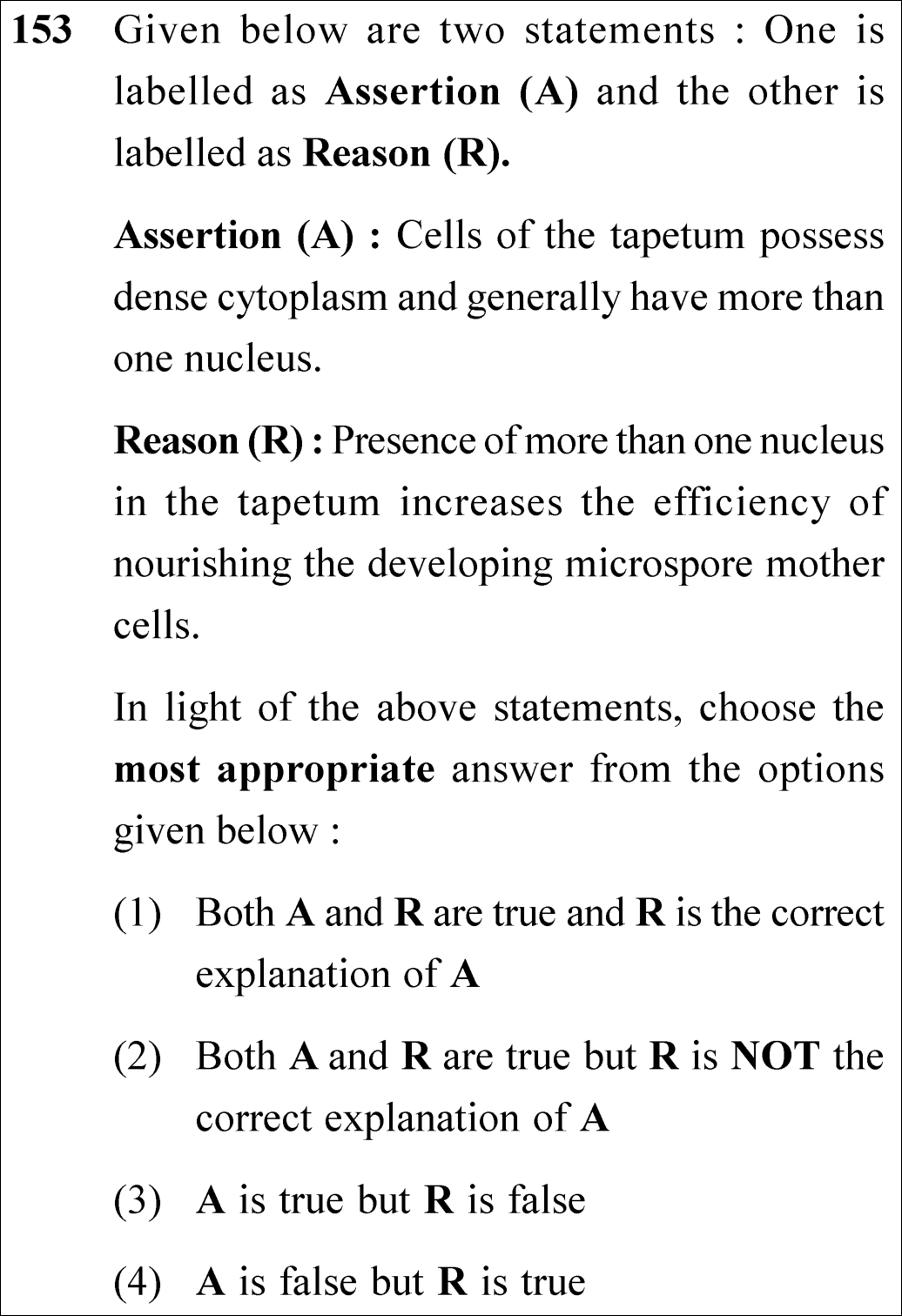
Assertion (A) Cells of the tapetum possess dense cytoplasm and generally have more than one nucleus.
Reason (R) Presence of more than one nucleus in the tapetum increases the efficiency of nourishing the developing microspore mother cells.
⚡

The 30-Second Exam Hall Shortcut: ⚡ Tapetum Polyploidy Fingerprint

⏱️ Save ~30 seconds

Assertion is TRUE (Tapetum has dense cytoplasm and multinucleate cells via endomitosis)! Reason is TRUE (Multiple nuclei enable intense metabolic transcription to nourish sporogenous tissue/MMCs)! R explains WHY tapetum is multinucleate! Both true & R explains A!

1 Analyze Assertion (A):
2 - "The innermost wall layer is the tapetum... Cells of the tapetum possess dense cytoplasm and generally have more than one nucleus." -> NCERT Section 2.2.1 verbatim TRUE!
3 Analyze Reason (R):
4 - Why does the tapetum undergo endomitosis/polyploidy to become multinucleate? To amplify gene transcription and metabolic output required for intense nutrient synthesis (enzymes, proteins, Ubisch bodies, pollenkitt) that nourish developing MMCs and pollen grains! Reason R is TRUE.
5 Check causal explanation link:
6 - Having multiple nuclei directly increases the translational/metabolic efficiency of nourishment described in the assertion. Thus, R is the correct explanation of A!
7 Conclusion: Both A and R are true and R is the correct explanation of A.
8 Select Option (1)!
🛡️
Why You Can 100% Trust This Shortcut: Microsporogenesis & Microspore Tetrad Formation (NCERT Biology · Sexual Reproduction in Flowering Plants: Tapetum nourishment).
📐

Step-by-Step Rigorous Workflow & Mathematical Proof

Step 1

Cytological Architecture of the Tapetum (Assertion A)

A typical microsporangium is bounded by four distinct concentric wall layers: epidermis, endothecium, middle layers, and tapetum:

  • • The tapetum is the innermost nutritive somatic layer in direct contact with the sporogenous tissue.
  • • Tapetal cells are physiologically active, possessing dense cytoplasm and abundant organelles (mitochondria, ribosomes, endoplasmic reticulum).
  • • During early development, tapetal nuclei undergo endomitosis (karyokinesis without cytokinesis) or polyteny, resulting in cells that generally have more than one nucleus (binucleate or multinucleate).
  • • Therefore, Assertion (A) is completely TRUE.
Step 2

Physiological Rationale for the Multinucleate Condition (Reason R)

Connecting nuclear multiplicity to functional efficiency:

  • • The primary physiological role of the tapetum is to provide continuous nutrition to developing microspore mother cells (MMCs) and maturing pollen grains.
  • • The presence of multiple nuclei (or polyploidy) increases gene dosage and elevates transcription rates for critical enzymes (such as callase, which dissolves callose walls of microspore tetrads) and precursors of sporopollenin (pro-Ubisch bodies).
  • • This amplifies the metabolic capacity and nutritive throughput of the tapetum.
  • • Therefore, Reason (R) is scientifically and biologically TRUE.
Step 3

Causal Synthesis

Reason (R) provides the definitive functional adaptation explaining why tapetal cells undergo endomitosis to become multinucleate. Hence, Reason (R) is the correct explanation of Assertion (A).

Multiple Nuclei  ⟹  ↑Transcription  ⟹  ↑Nourishing Efficiency for MMCs\text{Multiple Nuclei} \implies \uparrow \text{Transcription} \implies \uparrow \text{Nourishing Efficiency for MMCs}
⭐

360° Option Elimination Engine Key Feature

Diagnose every choice: Know exactly why the right option works and why distractors fail.

4-Option Deep Scan
1 A
✓ 100% Correct
Verdict & Scientific Reason:

100% correct. Correctly validates both statements and their direct functional-causal link.

💡
Why this is airtight: None; deep botanical and cytological comprehension.
2 B
✗ Incorrect
Verdict & Scientific Reason:

Incorrect. The physiological necessity of nourishment is the exact reason for the multinucleate state.

⚠️
Student Fallacy (Why candidates pick this trap): Treating the functional rationale as an unrelated fact.
3 C
✗ Incorrect
Verdict & Scientific Reason:

Incorrect. Reason R is a valid botanical and physiological principle.

⚠️
Student Fallacy (Why candidates pick this trap): Doubting the metabolic purpose of polyploidy in nurse tissues.
4 D
✗ Incorrect
Verdict & Scientific Reason:

Incorrect. Assertion A is a textbook NCERT fact.

⚠️
Student Fallacy (Why candidates pick this trap): Believing tapetal cells are strictly uninucleate.
⚠️

NTA Trap Alert: Tapetum Origin of Multinucleate State

Tapetal cells become multinucleate due to endomitosis or nuclear division WITHOUT cytokinesis. This nuclear multiplication serves a specific purpose: sustaining massive biosynthetic demands for pollen development.

🛡️ How to avoid the -1 mark: Whenever tapetum multinucleate nature is asked: it exists to maximize nourishment throughput!
📖

Core NEET Syllabus Standard

NEET Biology Core Syllabus · Sexual Reproduction in Flowering Plants Standard Benchmark
Core Scientific Principle Tested:

"Tapetum cells possess dense cytoplasm and multiple nuclei to enhance their nutritive efficiency for developing microspores."

Syllabus Focus: Microsporangium · Tapetum Function
✓ Core NEET UG Syllabus Anchor Syllabus & Academic Standards ↗
More Nuclei = More Nourishment: A and R are true and linked!
NEET 2025 · Q154 Easy
Official NEET 2025 Question 154 - Sexual Reproduction in Flowering Plants
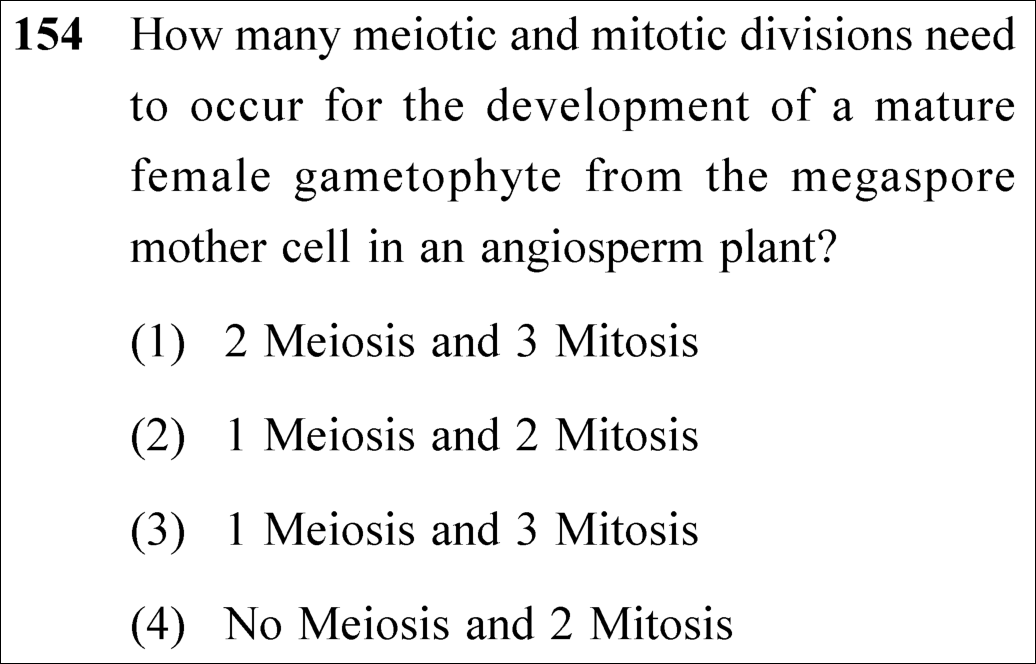
1 2 Meiosis and 3 Mitosis
2 1 Meiosis and 2 Mitosis
3 1 Meiosis and 3 Mitosis ✓ Key
4 No Meiosis and 2 Mitosis
💡 Verified Solution & 30-Second Hack
✓
Verified Against NTA Final Answer Key
Option (3) : 1 Meiosis and 3 Mitosis
📚 Sexual Reproduction in Flowering Plants Easy
📋 Given Parameters & Problem Setup
Starting Cell Megaspore mother cell (MMC, diploid 2n)
End Product Mature female gametophyte / embryo sac (7-celled, 8-nucleate)
⚡

The 30-Second Exam Hall Shortcut: ⚡ Embryo Sac Division Math Fingerprint

⏱️ Save ~25 seconds

MMC (2n) undergoes 1 MEIOSIS -> 4 megaspores (3 degenerate, 1 functional); 1 functional megaspore undergoes 3 MITOSES (1->2->4->8 nuclei) -> 7-celled embryo sac! Exactly 1 Meiosis and 3 Mitosis!

1 Count the cell divisions step-by-step from NCERT Section 2.2.2:
2 Diploid MMC (2n) undergoes MEIOSIS to form a linear tetrad of 4 haploid megaspores (n). -> Count: 1 Meiosis.
3 Three micropylar megaspores degenerate, leaving 1 functional chalazal megaspore.
4 Functional megaspore nucleus divides mitotically: 1 -> 2 nuclei (Mitosis 1).
5 The 2 nuclei divide mitotically: 2 -> 4 nuclei (Mitosis 2).
6 The 4 nuclei divide mitotically: 4 -> 8 nuclei (Mitosis 3).
7 Total: 1 Meiosis + 3 Mitosis!
8 Select Option (3) 1 Meiosis and 3 Mitosis!
🛡️
Why You Can 100% Trust This Shortcut: Outbreeding Devices in Angiosperms (NCERT Biology · Sexual Reproduction in Flowering Plants: Self-incompatibility and dichogamy).
📐

Step-by-Step Rigorous Workflow & Mathematical Proof

Step 1

Megasporogenesis (Meiotic Phase)

The process of formation of megaspores from the megaspore mother cell is called megasporogenesis:

  • • A single diploid megaspore mother cell (MMC) differentiates in the micropylar region of the nucellus.
  • • The MMC undergoes a single meiotic division (1 Meiosis) to produce a linear tetrad of four haploid megaspores.
  • • In a majority of angiosperms (monosporic development), three megaspores at the micropylar end degenerate, and only one functional megaspore (chalazal) develops into the female gametophyte.
Step 2

Megagametogenesis (Mitotic Phase)

Development of the female gametophyte from the functional megaspore:

  • • Mitosis 1: The nucleus of the functional megaspore divides mitotically to form two nuclei, which move to the opposite poles, forming the 2-nucleate embryo sac.
  • • Mitosis 2: Another mitotic division results in the formation of the 4-nucleate embryo sac.
  • • Mitosis 3: A third mitotic division leads to the formation of the 8-nucleate stage of the embryo sac.
  • • Total mitotic divisions = 3 Mitosis (free nuclear).
Step 3

Conclusion

The complete development of a mature female gametophyte from an MMC requires precisely 1 Meiotic division followed by 3 Mitotic divisions.

MMC (2n)→1 Meiosis1 Megaspore (n)→3 MitosesEmbryo Sac (8-nucleate)\text{MMC (2n)} \xrightarrow{1\text{ Meiosis}} 1\text{ Megaspore (n)} \xrightarrow{3\text{ Mitoses}} \text{Embryo Sac (8-nucleate)}
⭐

360° Option Elimination Engine Key Feature

Diagnose every choice: Know exactly why the right option works and why distractors fail.

4-Option Deep Scan
1 A
✗ Incorrect
Verdict & Scientific Reason:

Incorrect. An MMC undergoes only one meiotic division, never two.

⚠️
Student Fallacy (Why candidates pick this trap): Confusing Meiosis I and Meiosis II as two separate full meioses.
2 B
✗ Incorrect
Verdict & Scientific Reason:

Incorrect. 2 mitoses would yield only 4 nuclei, whereas the mature embryo sac requires 8 nuclei.

⚠️
Student Fallacy (Why candidates pick this trap): Under-counting mitotic cycles (22=4≠82^2 = 4 \neq 8).
3 C
✓ 100% Correct
Verdict & Scientific Reason:

100% correct. Exactly matches the monosporic developmental sequence: 1 meiosis to form megaspores + 3 free nuclear mitoses to generate 8 nuclei.

💡
Why this is airtight: None; pristine botanical math.
4 D
✗ Incorrect
Verdict & Scientific Reason:

Incorrect. Omits meiosis entirely, which would fail to reduce ploidy.

⚠️
Student Fallacy (Why candidates pick this trap): Confusing gametophyte development with vegetative apomixis.
⚠️

NTA Trap Alert: Embryo Sac (Female) vs Pollen Grain (Male) Divisions

To form a mature pollen grain from a Microspore Mother Cell: 1 Meiosis + 2 Mitosis (yielding 3-celled pollen). To form a mature Embryo Sac from MMC: 1 Meiosis + 3 Mitosis (yielding 8-nucleate embryo sac)!

🛡️ How to avoid the -1 mark: Female gametophyte needs 8 nuclei (232^3), so it takes 3 MITOSES!
📖

Core NEET Syllabus Standard

NEET Biology Core Syllabus · Sexual Reproduction in Flowering Plants Standard Benchmark
Core Scientific Principle Tested:

"Development of an 8-nucleate monosporic embryo sac from an MMC requires 1 meiotic and 3 mitotic divisions."

Syllabus Focus: Megasporogenesis & Development of Female Gametophyte
✓ Core NEET UG Syllabus Anchor Syllabus & Academic Standards ↗
1 Meiosis makes the Spore, 3 Mitoses build the Embryo Sac door (2³ = 8 nuclei)!
NEET 2024 · Q117 Medium
Official NEET 2024 Question 117 - Sexual Reproduction in Flowering Plants
1
2 ✓ Key
3
4
💡 Verified Solution & 30-Second Hack
✓
Verified Against NTA Final Answer Key
Option (2) : B, C, D and E only
📚 Sexual Reproduction in Flowering Plants Medium
📋 Given Parameters & Problem Setup
Phenomenon Hydrophily (pollination by water)
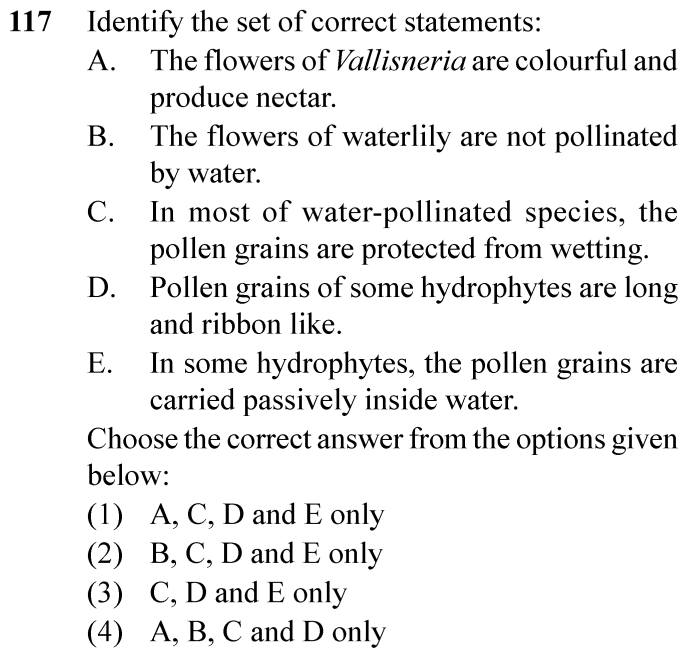
Candidate Statements A: Common in flowering plants; B: Water lily pollinated by insects/wind; C: Mucilaginous covering prevents wetting; D: Ribbon-like pollen in some; E: Carried passively
⚡

The 30-Second Exam Hall Shortcut: ⚡ Hydrophily Rarity Rule

⏱️ Save ~35 seconds

Statement A says pollination by water is 'quite common' in flowering plants. NCERT explicitly states hydrophily is QUITE RARE (limited to about 30 genera, mostly monocots)! Eliminate A immediately!

1 Evaluate Statement A: "Pollination by water is quite common in flowering plants" -> False! It is quite rare (~30 genera).
2 Check remaining statements:
3 - B: Water lily and lotus emerge above water and are pollinated by insects or wind -> True!
4 - C: Mucilaginous covering protects pollen from wetting -> True!
5 - D: In seagrasses (e.g., Zostera), pollen grains are long and ribbon-like -> True!
6 - E: Pollen grains are carried passively by water currents -> True!
7 Therefore, B, C, D and E only -> Option (2) / B.
🛡️
Why You Can 100% Trust This Shortcut: NCERT Biology · Sexual Reproduction in Flowering Plants (Hydrophily and Aquatic Plants)
📐

Step-by-Step Rigorous Workflow & Mathematical Proof

Step 1

Evaluate Prevalence of Hydrophily

NCERT states: "Pollination by water is quite rare in flowering plants and is limited to about 30 genera, mostly monocotyledons." Therefore, Statement A is incorrect.

Step 2

Analyze Aquatic Plants Exceptions

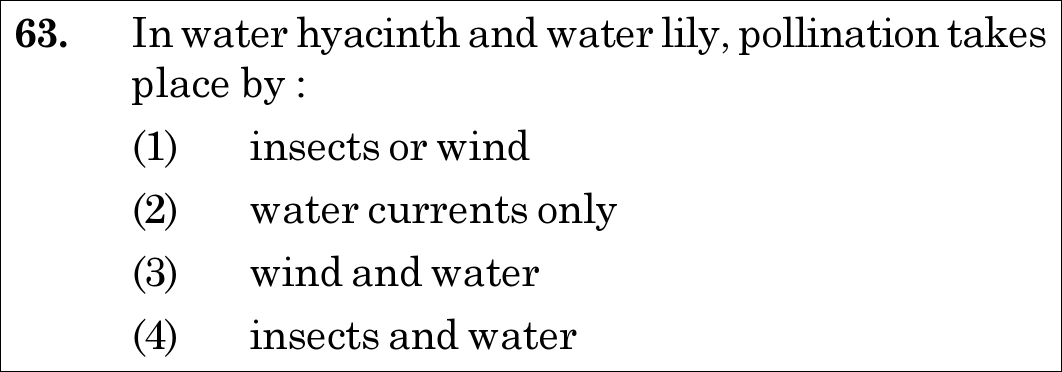
In a majority of aquatic plants such as water hyacinth and water lily, the flowers emerge above the level of water and are pollinated by insects or wind as in most of the land plants. Statement B is true.

Step 3

Examine Adaptations in True Hydrophilous Plants

In seagrasses such as Zostera, female flowers remain submerged and pollen grains are long, ribbon-like and carried passively inside the water. In most water-pollinated species, pollen grains are protected from wetting by a mucilaginous covering. Statements C, D, and E are all true.

Step 4

Conclude Valid Option

The correct set of statements is B, C, D and E only, matching Option (2).

⭐

360° Option Elimination Engine Key Feature

Diagnose every choice: Know exactly why the right option works and why distractors fail.

4-Option Deep Scan
1 (1)
✗ Incorrect
Verdict & Scientific Reason:

Incorrectly includes Statement A (hydrophily is rare, not common).

⚠️
Student Fallacy (Why candidates pick this trap): Incorrectly includes Statement A (hydrophily is rare, not common).
2 (2)
✓ 100% Correct
Verdict & Scientific Reason:

Accurately includes all correct features and exceptions while excluding the false statement A.

💡
Why this is airtight: None.
3 (3)
✗ Incorrect
Verdict & Scientific Reason:

Incorrectly includes Statement A.

⚠️
Student Fallacy (Why candidates pick this trap): Incorrectly includes Statement A.
4 (4)
✗ Incorrect
Verdict & Scientific Reason:

Incorrectly includes Statement A and omits mucilaginous protection (C).

⚠️
Student Fallacy (Why candidates pick this trap): Incorrectly includes Statement A and omits mucilaginous protection (C).
⚠️

NTA Trap Alert: Water Lily Pollination Mode

Assuming all aquatic plants are pollinated by water.

🛡️ How to avoid the -1 mark: Water lily and water hyacinth emerge above water and rely on insects or wind, NOT water.
📖

Core NEET Syllabus Standard

Biology Core Botany · Sexual Reproduction in Flowering Plants Standard Benchmark
Core Scientific Principle Tested:

"Pollination by water is quite rare in flowering plants and is limited to about 30 genera, mostly monocotyledons... In majority of aquatic plants such as water hyacinth and water lily, the flowers emerge above the level of water and are pollinated by insects or wind."

Syllabus Focus: Hydrophily: Water Pollination Adaptations and Exceptions
✓ Core NEET UG Syllabus Anchor Syllabus & Academic Standards ↗
NEET 2024 · Q129 Easy
Official NEET 2024 Question 129 - Sexual Reproduction in Flowering Plants
1 ✓ Key
2
3
4
💡 Verified Solution & 30-Second Hack
✓
Verified Against NTA Final Answer Key
Option (1) : C
📚 Sexual Reproduction in Flowering Plants Easy
📋 Given Parameters & Problem Setup
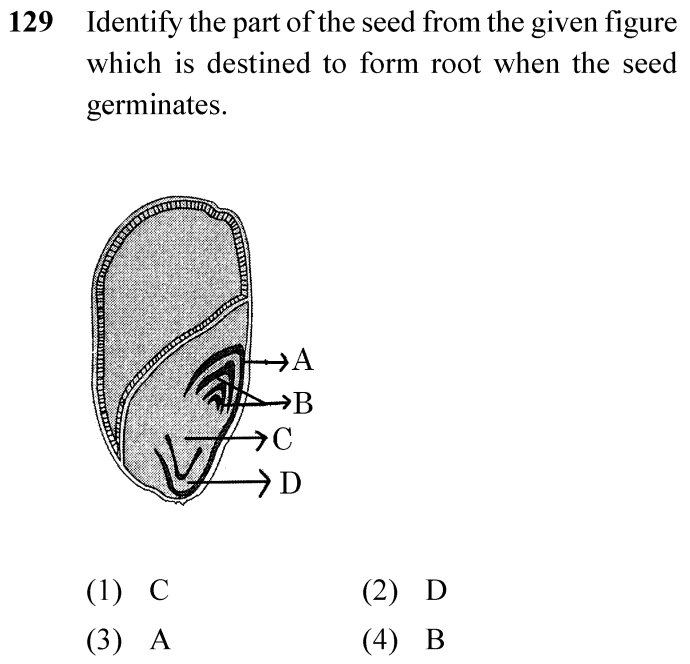
Diagram Longitudinal section of maize grain (monocot seed)
Target Part destined to form root upon germination
⚡

The 30-Second Exam Hall Shortcut: ⚡ Monocot Embryo Anatomical Axis

⏱️ Save ~20 seconds

In a maize grain embryo: Scutellum = cotyledon; Coleoptile = sheath over plumule (shoot); Radicle (C) = future root enclosed by Coleorhiza (D). Root originates from Radicle C!

1 Identify labels in the L.S. of maize embryo:
2 - A: Scutellum (single large shield-shaped cotyledon)
3 - B: Coleoptile (protective sheath covering plumule / shoot apex)
4 - C: Radicle (embryonic root destined to form root system)
5 - D: Coleorhiza (protective sheath covering radicle)
6 The question asks for the part destined to form the root -> Radicle = C -> Option (1) / A.
🛡️
Why You Can 100% Trust This Shortcut: NCERT Biology · Sexual Reproduction in Flowering Plants (Structure of Monocotyledonous Seed)
📐

Step-by-Step Rigorous Workflow & Mathematical Proof

Step 1

Examine the Maize Grain Longitudinal Section

In the monocotyledonous embryo of the grass family (maize/wheat), the embryo consists of one large, shield-shaped cotyledon known as scutellum situated towards one side of the embryonal axis.

Step 2

Identify Upper vs Lower Axis Poles

At the upper end, the embryonal axis has the shoot apex and a few leaf primordia enclosed in a hollow foliar structure called coleoptile. At its lower end, the embryonal axis has the radical and root cap enclosed in an undifferentiated sheath called coleorhiza.

Step 3

Determine the Part Forming the Root

The radicle (labeled C) is the embryonic root that gives rise to the primary root system upon germination.

⭐

360° Option Elimination Engine Key Feature

Diagnose every choice: Know exactly why the right option works and why distractors fail.

4-Option Deep Scan
1 (1)
✓ 100% Correct
Verdict & Scientific Reason:

Label C indicates the radicle, which is destined to develop into the root system upon germination.

💡
Why this is airtight: None.
2 (2)
✗ Incorrect
Verdict & Scientific Reason:

Label D points to the coleorhiza, a protective sheath covering the radicle.

⚠️
Student Fallacy (Why candidates pick this trap): Label D points to the coleorhiza, a protective sheath covering the radicle.
3 (3)
✗ Incorrect
Verdict & Scientific Reason:

Label A points to the scutellum (cotyledon).

⚠️
Student Fallacy (Why candidates pick this trap): Label A points to the scutellum (cotyledon).
4 (4)
✗ Incorrect
Verdict & Scientific Reason:

Label B points to the coleoptile, covering the shoot apex/plumule.

⚠️
Student Fallacy (Why candidates pick this trap): Label B points to the coleoptile, covering the shoot apex/plumule.
⚠️

NTA Trap Alert: Radicle vs Coleorhiza Pointer Identification

Confusing the radicle (inner embryonic organ) with its outer sheath, the coleorhiza.

🛡️ How to avoid the -1 mark: Radicle is the internal root primordium (C); Coleorhiza is the enveloping basal sheath (D).
📖

Core NEET Syllabus Standard

Biology Core Botany · Sexual Reproduction in Flowering Plants Standard Benchmark
Core Scientific Principle Tested:

"At its lower end, the embryonal axis has the radical and root cap enclosed in an undifferentiated sheath called coleorhiza. The radicle develops into the root."

Syllabus Focus: Anatomy of Monocot Seed (Maize Grain) and Embryonal Axis Parts
✓ Core NEET UG Syllabus Anchor Syllabus & Academic Standards ↗
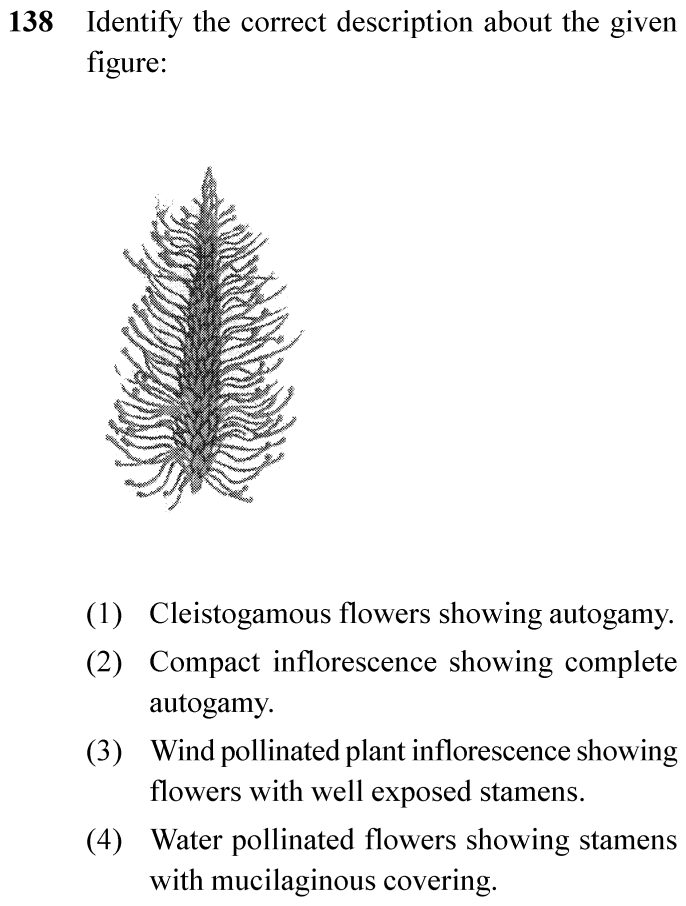
NEET 2024 · Q138 Easy
Official NEET 2024 Question 138 - Sexual Reproduction in Flowering Plants
1
2
3 ✓ Key
4
💡 Verified Solution & 30-Second Hack
✓
Verified Against NTA Final Answer Key
Option (3) : Wind pollinated plant inflorescence showing flowers with well exposed stamens
📚 Sexual Reproduction in Flowering Plants Easy
📋 Given Parameters & Problem Setup
Figure Figure 2.10 (b) from NCERT Biology Sexual Reproduction in Flowering Plants
Structure Dense, brush-like inflorescence with projecting filaments and stamens
⚡

The 30-Second Exam Hall Shortcut: ⚡ NCERT Diagram Figure 2.10 Recognition

⏱️ Save ~25 seconds

The figure illustrates a wind-pollinated plant inflorescence featuring compact flowers with well-exposed stamens to easily disperse pollen into air currents!

1 Recognize the classic diagram from NCERT Sexual Reproduction in Flowering Plants:
2 - Caption in NCERT reads: "A wind-pollinated plant showing compact infloresence and well-exposed stamens".
3 - Stamens protrude outwards so pollen grains can be swept away easily by wind currents.
4 Matches Option (3) / C directly!
🛡️
Why You Can 100% Trust This Shortcut: NCERT Biology · Sexual Reproduction in Flowering Plants (Wind Pollination Adaptations)
📐

Step-by-Step Rigorous Workflow & Mathematical Proof

Step 1

Analyze Structural Features in the Figure

The figure displays a spike-like compact inflorescence where numerous flowers are closely aggregated. Long filaments project out from the axis, exposing stamens to the surrounding air currents.

Step 2

Review Adaptations of Anemophilous Flowers

Wind pollination requires that pollen grains are light and non-sticky so that they can be transported in wind currents. They often possess well-exposed stamens so that the pollens are easily dispersed into wind currents, and large feathery stigmas to easily trap airborne pollen grains.

Step 3

Select Matching Description

Option (3) provides the exact descriptive caption from NCERT Biology.

⭐

360° Option Elimination Engine Key Feature

Diagnose every choice: Know exactly why the right option works and why distractors fail.

4-Option Deep Scan
1 (1)
✗ Incorrect
Verdict & Scientific Reason:

Cleistogamous flowers do not open at all, whereas this inflorescence shows highly exposed reproductive organs.

⚠️
Student Fallacy (Why candidates pick this trap): Cleistogamous flowers do not open at all, whereas this inflorescence shows highly exposed reproductive organs.
2 (2)
✗ Incorrect
Verdict & Scientific Reason:

Well-exposed stamens in wind-pollinated plants are adapted for anemophilous cross-pollination, not obligate autogamy.

⚠️
Student Fallacy (Why candidates pick this trap): Well-exposed stamens in wind-pollinated plants are adapted for anemophilous cross-pollination, not obligate autogamy.
3 (3)
✓ 100% Correct
Verdict & Scientific Reason:

Directly reproduces the NCERT caption and morphological description for wind pollination.

💡
Why this is airtight: None.
4 (4)
✗ Incorrect
Verdict & Scientific Reason:

Mucilaginous coverings protect pollen in submerged hydrophilous plants (e.g., Zostera), not terrestrial wind-pollinated tassels.

⚠️
Student Fallacy (Why candidates pick this trap): Mucilaginous coverings protect pollen in submerged hydrophilous plants (e.g., Zostera), not terrestrial wind-pollinated tassels.
⚠️

NTA Trap Alert: Autogamy Assumption in Dense Spikes

Assuming clustered spike flowers must be self-pollinating.

🛡️ How to avoid the -1 mark: Compact spikes with projecting stamens (like corn cob tassels) are classic anemophilous adaptations for cross-pollination.
📖

Core NEET Syllabus Standard

Biology Core Botany · Sexual Reproduction in Flowering Plants Standard Benchmark
Core Scientific Principle Tested:

"Wind pollination also requires that the pollen grains are light and non-sticky so that they can be transported in wind currents. They often possess well-exposed stamens so that the pollens are easily dispersed into wind currents (Figure 2.10b)."

Syllabus Focus: Anemophily (Wind Pollination): Inflorescence and Exposed Stamens
✓ Core NEET UG Syllabus Anchor Syllabus & Academic Standards ↗
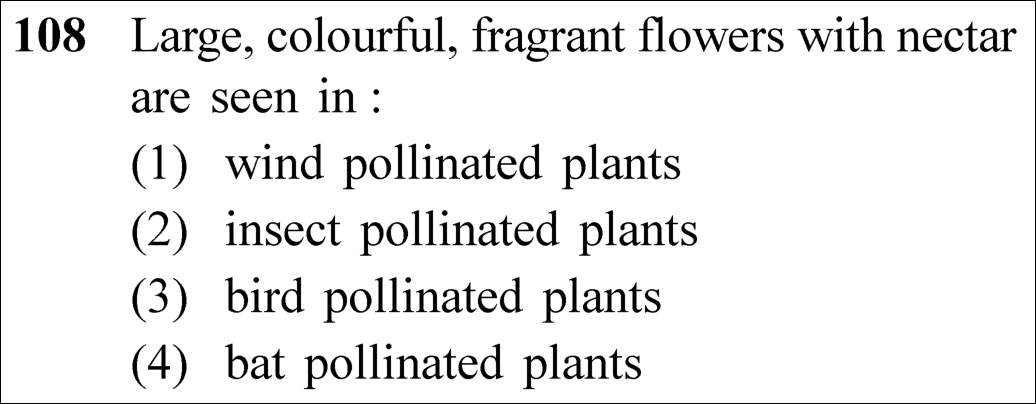
NEET 2023 · Q108 Easy
Official NEET 2023 Question 108 - Sexual Reproduction in Flowering Plants
1 wind pollinated plants
2 insect pollinated plants ✓ Key
3 bird pollinated plants
4 bat pollinated plants
💡 Verified Solution & 30-Second Hack
✓
Verified Against NTA Final Answer Key
Option (2) : insect pollinated plants
📚 Sexual Reproduction in Flowering Plants Easy
📋 Given Parameters & Problem Setup
Floral Traits Large, colourful, fragrant, rich in nectar
Agent Category Pollination syndrome
⚡

The 30-Second Exam Hall Shortcut: ⚡ Floral Sensory Syndrome: Color + Fragrance + Nectar = Insects

⏱️ Save ~20 seconds

Insects rely on visual cues (bright color), olfactory cues (fragrance), and energetic rewards (nectar). Wind plants lack fragrance/nectar; birds have poor smell; bats visit dull nocturnal flowers. Therefore, large colorful fragrant flowers are insect-pollinated!

1 Wind-pollinated (anemophilous) flowers are small, non-colourful, without fragrance or nectar.
2 Bird-pollinated (ornithophilous) flowers are brightly coloured and nectar-rich, but typically scentless (birds lack sense of smell).
3 Bat-pollinated (chiropterophilous) flowers are dull-coloured with musky/fermented odor.
4 Insect-pollinated (entomophilous) flowers feature large, colourful petals, strong fragrance, and nectar.
5 Match Option (2) insect pollinated plants.
🛡️
Why You Can 100% Trust This Shortcut: Canonical NCERT Sexual Reproduction in Flowering Plants pollination syndromes.
📐

Step-by-Step Rigorous Workflow & Mathematical Proof

Step 1

Syndromes of Biotic Pollination

Flowers have evolved specific morphological and physiological suites of traits (pollination syndromes) to attract target biotic vectors:

Entomophily (Insects):Large, brightly coloured, fragrant, nectar-rich, sticky pollenOrnithophily (Birds):Vibrant red/yellow, copious dilute nectar, scentlessChiropterophily (Bats):Large, dull/white, nocturnal opening, strong fermented scentAnemophily (Wind):Inconspicuous, light non-sticky pollen, feathery stigma, no nectar/scent\begin{aligned} \text{\textbf{Entomophily (Insects):}} & \quad \text{Large, brightly coloured, fragrant, nectar-rich, sticky pollen} \\[4pt] \text{Ornithophily (Birds):} & \quad \text{Vibrant red/yellow, copious dilute nectar, scentless} \\[4pt] \text{Chiropterophily (Bats):} & \quad \text{Large, dull/white, nocturnal opening, strong fermented scent} \\[4pt] \text{Anemophily (Wind):} & \quad \text{Inconspicuous, light non-sticky pollen, feathery stigma, no nectar/scent} \end{aligned}
Step 2

Verbatim NCERT Association

NCERT explicitly states: "Majority of insect-pollinated flowers are large, colourful, fragrant and rich in nectar. When the flowers are small, a number of flowers are clustered into an inflorescence to make them conspicuous."

Step 3

Floral Rewards

Nectar and pollen grains constitute the canonical floral rewards provided to insect visitors for facilitating pollen transfer.

⭐

360° Option Elimination Engine Key Feature

Diagnose every choice: Know exactly why the right option works and why distractors fail.

4-Option Deep Scan
1 1
✗ Incorrect
Verdict & Scientific Reason:

Wind pollinated flowers are tiny, dull green/brown, lacking fragrance, petals, and nectar.

⚠️
Student Fallacy (Why candidates pick this trap): Ignoring the energetic waste of fragrance and petals for abiotic vectors.
2 2
✓ 100% Correct
Verdict & Scientific Reason:

Exact match with NCERT: entomophilous blossoms are large, brightly coloured, fragrant, and secrete nectar.

💡
Why this is airtight: None; textbook verbatim.
3 3
✗ Incorrect
Verdict & Scientific Reason:

Birds have poorly developed olfactory systems; ornithophilous flowers are bright and nectar-rich but virtually odorless.

⚠️
Student Fallacy (Why candidates pick this trap): Assuming birds are attracted to sweet floral fragrance.
4 4
✗ Incorrect
Verdict & Scientific Reason:

Bat pollinated flowers are dull or whitish (nocturnal blooming) with heavy, fermenting/musty odors rather than sweet floral fragrance.

⚠️
Student Fallacy (Why candidates pick this trap): Failing to recognize that bats do not need bright daytime coloration.
⚠️

NTA Trap Alert: Bird vs. Insect Pollination Fragrance Distinction

Students often group bird and insect flowers together because both are colorful and offer nectar. The discriminating trait is fragrance: bird flowers are scentless, insect flowers are fragrant.

🛡️ How to avoid the -1 mark: Color + Nectar + Fragrance = Insect. Color + Nectar - Fragrance = Bird.
📖

Core NEET Syllabus Standard

NCERT Biology · Sexual Reproduction in Flowering Plants Standard Benchmark
Core Scientific Principle Tested:

"Majority of insect-pollinated flowers are large, colourful, fragrant and rich in nectar to attract pollinators like bees and butterflies."

Syllabus Focus: Pollination Agents
✓ Core NEET UG Syllabus Anchor Syllabus & Academic Standards ↗
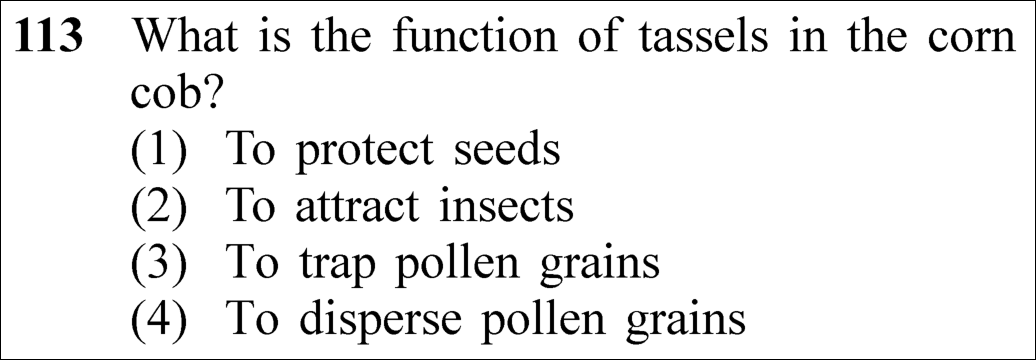
NEET 2023 · Q113 Easy
Official NEET 2023 Question 113 - Sexual Reproduction in Flowering Plants
1 To protect seeds
2 To attract insects
3 To trap pollen grains ✓ Key
4 To disperse pollen grains
💡 Verified Solution & 30-Second Hack
✓
Verified Against NTA Final Answer Key
Option (3) : To trap pollen grains
📚 Sexual Reproduction in Flowering Plants Easy
📋 Given Parameters & Problem Setup
Plant Structure Tassels in the corn cob (maize ear)
Morphological Identity Feathery elongated stigma and styles
Pollination Mode Anemophily (wind pollination)
⚡

The 30-Second Exam Hall Shortcut: ⚡ Corn Cob Tassels = Stigma & Style to Trap Windborne Pollen

⏱️ Save ~20 seconds

In a corn cob, the long silky threads (tassels) waving out are elongated styles and stigmas specifically adapted to capture and trap windborne pollen grains floating in air currents!

1 Maize is wind pollinated (anemophilous).
2 The male inflorescence is at the shoot apex; the female cob is borne in the leaf axil.
3 Silky tassels hanging from the cob represent tremendously elongated styles and stigmas.
4 Their function is to expose a huge receptive surface to trap airborne pollen grains.
5 Match Option (3) To trap pollen grains.
🛡️
Why You Can 100% Trust This Shortcut: Canonical NCERT Sexual Reproduction in Flowering Plants anemophilous adaptations.
📐

Step-by-Step Rigorous Workflow & Mathematical Proof

Step 1

Morphological Identity of Corn Cob Tassels

In maize (Zea mays\textit{Zea mays}), the ear (cob) is a female inflorescence (spadix). The silks or tassels emerging from the husk leaves represent extremely elongated styles and feathery stigmas attached to each ovule:

Corn Cob Tassels≡Elongated Styles and Feathery Stigmas\text{Corn Cob Tassels} \equiv \text{Elongated Styles and Feathery Stigmas}
Step 2

Adaptation for Wind Pollination (Anemophily)

Wind pollination requires large, exposed, feathery stigmas to maximize the probability of intercepting non-motile, lightweight pollen carried by air currents:

Feathery Stigma Surface+Wind Currents⟶Efficient Trapping of Airborne Pollen\text{Feathery Stigma Surface} + \text{Wind Currents} \longrightarrow \text{\textbf{Efficient Trapping of Airborne Pollen}}
Step 3

Verbatim NCERT Confirmation

NCERT states verbatim: "The tassels you see are nothing but the stigma and style which wave in the wind to trap pollen grains."

⭐

360° Option Elimination Engine Key Feature

Diagnose every choice: Know exactly why the right option works and why distractors fail.

4-Option Deep Scan
1 1
✗ Incorrect
Verdict & Scientific Reason:

Protection of developing seeds/grains is provided by the dense outer husk leaves (spathe), not the exposed stigmatic silks.

⚠️
Student Fallacy (Why candidates pick this trap): Confusing vegetative protective bracts/husks with reproductive stigmas.
2 2
✗ Incorrect
Verdict & Scientific Reason:

Maize is anemophilous (wind pollinated) and produces neither nectar nor insect-attracting visual cues.

⚠️
Student Fallacy (Why candidates pick this trap): Assuming floral structures generally serve to attract insects.
3 3
✓ 100% Correct
Verdict & Scientific Reason:

Matches NCERT verbatim: styles and stigmas wave in the breeze to intercept and trap airborne pollen grains.

💡
Why this is airtight: None; textbook verbatim.
4 4
✗ Incorrect
Verdict & Scientific Reason:

Pollen grains are produced and dispersed by the male inflorescence (the staminate tassel at the top of the plant), not by the female cob.

⚠️
Student Fallacy (Why candidates pick this trap): Confusing pollen-producing male tassels at plant apex with female cob silks.
⚠️

NTA Trap Alert: Male Tassel vs. Female Cob Silks Confusion

Botanically, the terminal male inflorescence of maize is also called a tassel. However, the question specifically specifies "tassels in the corn cob", which NCERT explicitly defines as the styles and stigmas of the female inflorescence.

🛡️ How to avoid the -1 mark: Read the prompt carefully: tassels "in the corn cob" = female styles/stigmas that trap pollen.
📖

Core NEET Syllabus Standard

NCERT Biology · Sexual Reproduction in Flowering Plants Standard Benchmark
Core Scientific Principle Tested:

"A common example is the corn cob; the tassels you see are nothing but the stigma and style which wave in the wind to trap pollen grains."

Syllabus Focus: Agents of Pollination (Wind Pollination)
✓ Core NEET UG Syllabus Anchor Syllabus & Academic Standards ↗
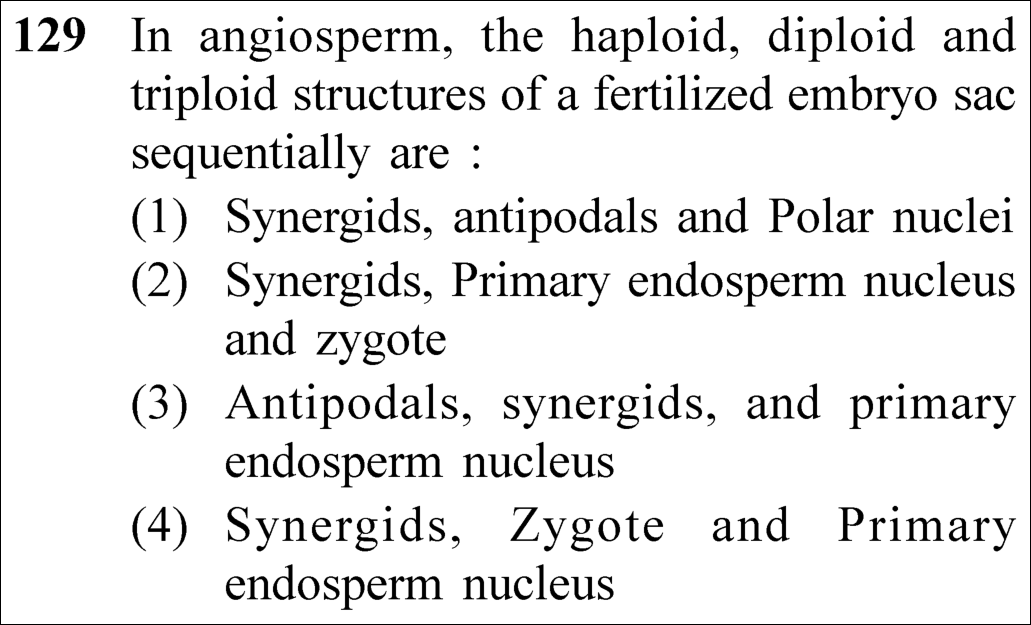
NEET 2023 · Q129 Easy
Official NEET 2023 Question 129 - Sexual Reproduction in Flowering Plants
1 Synergids, antipodals and Polar nuclei
2 Synergids, Primary endosperm nucleus and zygote
3 Antipodals, synergids, and primary endosperm nucleus
4 Synergids, Zygote and Primary endosperm nucleus ✓ Key
💡 Verified Solution & 30-Second Hack
✓
Verified Against NTA Final Answer Key
Option (4) : Synergids, Zygote and Primary endosperm nucleus
📚 Sexual Reproduction in Flowering Plants Easy
📋 Given Parameters & Problem Setup
Organism Angiosperms
Ploidy Sequence Haploid (nn), Diploid (2n2n), and Triploid (3n3n)
⚡

The 30-Second Exam Hall Shortcut: ⚡ Sequential Ploidy Check: n → 2n → 3n

⏱️ Save ~20 seconds

Match the ploidy levels sequentially: Haploid (nn) = Synergid / Antipodal; Diploid (2n2n) = Zygote (from syngamy n+nn+n); Triploid (3n3n) = Primary Endosperm Nucleus / PEN (from triple fusion 2n+n2n+n)! Match Option (4)!

1 Identify Haploid (nn): Synergids, Antipodals, Egg cell, Male gametes.
2 Identify Diploid (2n2n): Zygote (n egg+n spermn \text{ egg} + n \text{ sperm}), secondary nucleus before fertilization.
3 Identify Triploid (3n3n): Primary Endosperm Nucleus (2n central cell+n sperm2n \text{ central cell} + n \text{ sperm}).
4 Check Sequence: Synergids (nn) -> Zygote (2n2n) -> PEN (3n3n).
5 Match Option (4).
🛡️
Why You Can 100% Trust This Shortcut: Canonical NCERT Angiosperm double fertilization and embryo sac cytology.
📐

Step-by-Step Rigorous Workflow & Mathematical Proof

Step 1

Cytological Status of Embryo Sac Cells

Analyzing the ploidy of cells present in a fertilized angiosperm embryo sac following double fertilization:

Haploid (n):Synergids, Antipodals (cells of the gametophyte)Diploid (2n):Zygote (negg+nsperm via Syngamy)Triploid (3n):Primary Endosperm Nucleus/PEN (2npolar nuclei+nsperm via Triple Fusion)\begin{aligned} \text{\textbf{Haploid (}} n \textbf{):} & \quad \text{Synergids, Antipodals (cells of the gametophyte)} \\[4pt] \text{\textbf{Diploid (}} 2n \textbf{):} & \quad \text{Zygote } (n_{\text{egg}} + n_{\text{sperm}} \text{ via Syngamy}) \\[4pt] \text{\textbf{Triploid (}} 3n \textbf{):} & \quad \text{Primary Endosperm Nucleus/PEN } (2n_{\text{polar nuclei}} + n_{\text{sperm}} \text{ via Triple Fusion}) \end{aligned}
Step 2

Matching the Specified Sequence

The question specifically requires the sequence: haploid (nn), diploid (2n2n), and triploid (3n3n):

n⟶2n⟶3n  ⟺  Synergids (n)⟶Zygote (2n)⟶PEN (3n)\mathbf{n \longrightarrow 2n \longrightarrow 3n} \iff \mathbf{\text{Synergids } (n) \longrightarrow \text{Zygote } (2n) \longrightarrow \text{PEN } (3n)}
Step 3

Evaluation of Distractor Options

Option (1) lists synergids (nn), antipodals (nn), polar nuclei (n+nn+n). Option (2) lists synergids (nn), PEN (3n3n), zygote (2n2n)—violating sequential order. Option (3) lists antipodals (nn), synergids (nn), PEN (3n3n). Only Option (4) strictly adheres to the requested n→2n→3nn \to 2n \to 3n sequence.

⭐

360° Option Elimination Engine Key Feature

Diagnose every choice: Know exactly why the right option works and why distractors fail.

4-Option Deep Scan
1 1
✗ Incorrect
Verdict & Scientific Reason:

Synergids and antipodals are both haploid (nn); lacks a diploid (2n2n) and triploid (3n3n) structure.

⚠️
Student Fallacy (Why candidates pick this trap): Failing to track sequential ploidy values.
2 2
✗ Incorrect
Verdict & Scientific Reason:

The sequence is n→3n→2nn \to 3n \to 2n, which violates the required n→2n→3nn \to 2n \to 3n sequence.

⚠️
Student Fallacy (Why candidates pick this trap): Overlooking that triploid PEN is placed before diploid zygote.
3 3
✗ Incorrect
Verdict & Scientific Reason:

Antipodals and synergids are both haploid (nn); no diploid structure is represented.

⚠️
Student Fallacy (Why candidates pick this trap): Confusing two haploid cells with a diploid structure.
4 4
✓ 100% Correct
Verdict & Scientific Reason:

Strictly satisfies the n→2n→3nn \to 2n \to 3n sequence: Synergids (nn), Zygote (2n2n), Primary endosperm nucleus (3n3n).

💡
Why this is airtight: None; rigorous sequence matching.
⚠️

NTA Trap Alert: Order of Words in Sequential Prompts Trap

Students readily know the ploidy of individual cells, but fail to notice that Option (2) switches the order to n→3n→2nn \to 3n \to 2n.

🛡️ How to avoid the -1 mark: Write down "n, 2n, 3n" on scratch paper and match the exact sequence term-by-term.
📖

Core NEET Syllabus Standard

NCERT Biology · Sexual Reproduction in Flowering Plants Standard Benchmark
Core Scientific Principle Tested:

"Syngamy results in the formation of a diploid zygote (2n), while triple fusion produces a triploid primary endosperm nucleus (3n). Synergids remain haploid (n)."

Syllabus Focus: Double Fertilisation
✓ Core NEET UG Syllabus Anchor Syllabus & Academic Standards ↗
NEET 2021 · Q102 Easy
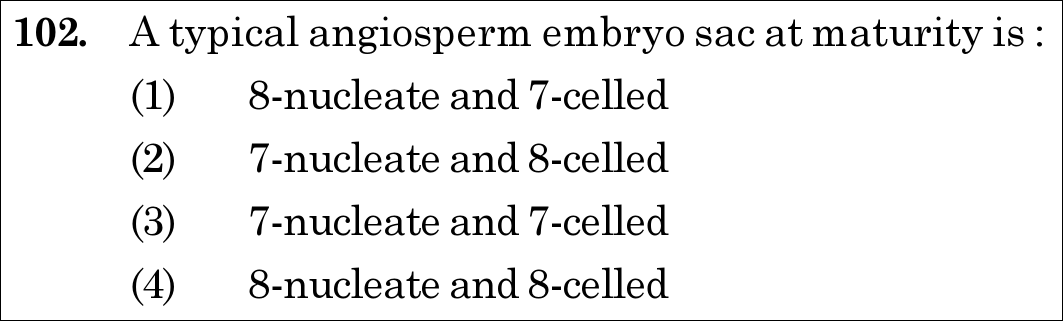
Official NEET 2021 Question 102 - Sexual Reproduction in Flowering Plants
1 8-nucleate and 7-celled ✓ Key
2 7-nucleate and 8-celled
3 7-nucleate and 7-celled
4 8-nucleate and 8-celled
💡 Verified Solution & 30-Second Hack
✓
Verified Against NTA Final Answer Key
Option (1) : 8-nucleate and 7-celled
📚 Sexual Reproduction in Flowering Plants Easy
📋 Given Parameters & Problem Setup
Structure Typical angiosperm embryo sac (Polygonum type female gametophyte)
Developmental Stage At maturity
⚡

The 30-Second Exam Hall Shortcut: ⚡ "7-Celled, 8-Nucleate" Polygonum Formula

⏱️ Save ~20 seconds

The classic monosporic angiosperm embryo sac contains 3 antipodals + 3 egg apparatus cells (2 synergids + 1 egg) + 1 large central cell with 2 polar nuclei = 7 cells total, containing 3 + 3 + 2 = 8 nuclei! Match Option (1) in 5 seconds!

1 Monosporic functional megaspore undergoes 3 successive free-nuclear mitotic divisions: 1→2→4→81 \to 2 \to 4 \to 8 nuclei.
2 Cell wall formation organizes 3 cells at chalazal pole (antipodals) and 3 cells at micropylar pole (egg apparatus).
3 The remaining two polar nuclei remain suspended within the shared single large central cell.
4 Total count: 3+3+1=73 + 3 + 1 = 7 cells, containing 3+3+2=83 + 3 + 2 = 8 nuclei.
5 Match Option (1).
🛡️
Why You Can 100% Trust This Shortcut: Canonical NCERT Angiosperm Embryology on Female Gametophyte Development.
📐

Step-by-Step Rigorous Workflow & Mathematical Proof

Step 1

Free Nuclear Mitotic Divisions in Megaspore

The single functional megaspore undergoes three consecutive mitotic nuclear divisions without immediate cytokinesis:

1 Functional Megaspore Nucleus→M12 Nuclei→M24 Nuclei→M38 Free Nuclei1\text{ Functional Megaspore Nucleus} \xrightarrow{M_1} 2\text{ Nuclei} \xrightarrow{M_2} 4\text{ Nuclei} \xrightarrow{M_3} 8\text{ Free Nuclei}
Step 2

Cell Wall Deposition and Cellular Organization

Cytokinesis and cell wall deposition partition the eight nuclei into specific cellular domains: - Micropylar End (Egg Apparatus): 3 cells total — 1 female gamete (egg cell) and 2 synergids with filiform apparatus. - Chalazal End (Antipodal Cells): 3 distinct uninucleate antipodal cells. - Central Region (Central Cell): 1 very large central cell retaining the 2 remaining polar nuclei.

Step 3

Summation of Cells and Nuclei at Maturity

Summing up the cellular and nuclear inventory at complete maturity:

Total Cells=3 (antipodals)+3 (egg apparatus)+1 (central cell)=7 cellsTotal Nuclei=3+3+2 (polar nuclei)=8 nuclei\begin{aligned} \text{Total Cells} &= 3\text{ (antipodals)} + 3\text{ (egg apparatus)} + 1\text{ (central cell)} = \mathbf{7\text{ cells}} \\[4pt] \text{Total Nuclei} &= 3 + 3 + 2\text{ (polar nuclei)} = \mathbf{8\text{ nuclei}} \end{aligned}
⭐

360° Option Elimination Engine Key Feature

Diagnose every choice: Know exactly why the right option works and why distractors fail.

4-Option Deep Scan
1 1
✓ 100% Correct
Verdict & Scientific Reason:

At maturity, 6 nuclei are enclosed by cell walls into discrete single cells, while the central cell contains 2 polar nuclei, yielding 7 cells and 8 nuclei.

💡
Why this is airtight: None. This is the exact textbook definition.
2 2
✗ Incorrect
Verdict & Scientific Reason:

This inverts the numbers; there are 8 nuclei and 7 cells, not 7 nuclei and 8 cells.

⚠️
Student Fallacy (Why candidates pick this trap): Hasty reading under exam pressure leads candidates to transpose "nucleate" and "celled".
3 3
✗ Incorrect
Verdict & Scientific Reason:

False; the central cell contains two free polar nuclei, so there are 8 nuclei in total.

⚠️
Student Fallacy (Why candidates pick this trap): Assuming every individual cell in the embryo sac must strictly contain exactly one nucleus.
4 4
✗ Incorrect
Verdict & Scientific Reason:

False; the two polar nuclei reside together in the same central cell rather than forming two individual cells.

⚠️
Student Fallacy (Why candidates pick this trap): Assuming 8 nuclear divisions inevitably lead to 8 distinct cellular compartmentalizations.
⚠️

NTA Trap Alert: Numerical Inversion of "Nucleate" and "Celled"

NTA places Option (1) as "8-nucleate and 7-celled" and Option (2) as "7-nucleate and 8-celled". Rushing students scan the numbers 7 and 8 without checking which adjective pairs with cells versus nuclei.

🛡️ How to avoid the -1 mark: Always mentally vocalize: "7 cells because central cell is shared; 8 nuclei because central cell has twin polar nuclei".
📖

Core NEET Syllabus Standard

NEET / NCERT Biology · Sexual Reproduction in Flowering Plants Standard Benchmark
Core Scientific Principle Tested:

"A typical mature angiosperm embryo sac is monosporic, 7-celled, and 8-nucleate."

Syllabus Focus: Development of Female Gametophyte (Embryo Sac)
✓ Core NEET UG Syllabus Anchor Syllabus & Academic Standards ↗
NEET 2021 · Q119 Easy
Official NEET 2021 Question 119 - Sexual Reproduction in Flowering Plants
1 Xenogamy ✓ Key
2 Geitonogamy
3 Chasmogamy
4 Cleistogamy
💡 Verified Solution & 30-Second Hack
✓
Verified Against NTA Final Answer Key
Option (1) : Xenogamy
📚 Sexual Reproduction in Flowering Plants Easy
📋 Given Parameters & Problem Setup
Pollen Source Anther of one plant
Stigma Target Stigma of a different plant
Genetic Consequence Brings genetically different types of pollen to stigma
⚡

The 30-Second Exam Hall Shortcut: ⚡ "Different Plant = Xenogamy" (Genetically Unique Pollen)

⏱️ Save ~15 seconds

Xenogamy is the ONLY type of pollination that transfers pollen from an anther of one plant to the stigma of a genetically different plant, introducing new genetic variations! Geitonogamy is between flowers of the same plant (genetically autogamous). Match Option (1)!

1 Autogamy: Pollination within the same flower   ⟹  \implies genetically identical.
2 Geitonogamy: Transfer between different flowers on the same plant   ⟹  \implies functionally cross-pollination, but genetically autogamy.
3 Xenogamy: Transfer of pollen from anther to stigma of a different plant   ⟹  \implies both functionally and genetically cross-pollination.
4 Match Option (1).
🛡️
Why You Can 100% Trust This Shortcut: Canonical NCERT Angiosperm Reproduction on Modes of Pollination.
📐

Step-by-Step Rigorous Workflow & Mathematical Proof

Step 1

Classification of Pollination by Pollen Source

Angiosperm pollination is categorized into three types depending on the genetic relatedness of the pollen donor and recipient:

Autogamy:Within the same flower (Genetically identical)Geitonogamy:Between different flowers on same individual (Genetically identical)Xenogamy:Between flowers on different individuals (Genetically distinct)\begin{aligned} \text{\textbf{Autogamy:}} & \quad \text{Within the same flower (Genetically identical)} \\[3pt] \text{\textbf{Geitonogamy:}} & \quad \text{Between different flowers on same individual (Genetically identical)} \\[3pt] \text{\textbf{Xenogamy:}} & \quad \mathbf{\text{Between flowers on different individuals (Genetically distinct)}} \end{aligned}
Step 2

Genetic Implications of Xenogamy

Because pollen originates from a genetically distinct donor sporophyte, xenogamy introduces novel allele combinations and promotes outcrossing vigor, providing the ultimate raw material for adaptive evolutionary variation.

⭐

360° Option Elimination Engine Key Feature

Diagnose every choice: Know exactly why the right option works and why distractors fail.

4-Option Deep Scan
1 1
✓ 100% Correct
Verdict & Scientific Reason:

Xenogamy is the transfer of pollen grains from anther to the stigma of a different plant, bringing genetically different pollen to the stigma.

💡
Why this is airtight: None. Direct textbook definition.
2 2
✗ Incorrect
Verdict & Scientific Reason:

Geitonogamy involves transfer to another flower of the same plant, meaning all pollen grains are genetically identical to the parent.

⚠️
Student Fallacy (Why candidates pick this trap): Confusing functional cross-pollination via pollinators (geitonogamy) with true genetic cross-pollination (xenogamy).
3 3
✗ Incorrect
Verdict & Scientific Reason:

Chasmogamy refers to flowers with exposed anthers and stigmas that open at maturity, not a classification of pollination based on pollen origin.

⚠️
Student Fallacy (Why candidates pick this trap): Conflating floral opening morphology (chasmogamous) with pollen source categories.
4 4
✗ Incorrect
Verdict & Scientific Reason:

Cleistogamy refers to closed, non-opening flowers that undergo obligate autogamous self-pollination.

⚠️
Student Fallacy (Why candidates pick this trap): Selecting a floral structural adaptation rather than the genetic pollination category.
⚠️

NTA Trap Alert: Geitonogamy vs Xenogamy Genetic Reality

Geitonogamy involves pollinating agents (looks like cross-pollination ecologically), but genetically it is pure self-pollination since pollen comes from the same plant.

🛡️ How to avoid the -1 mark: Fix the rule: Only XENOGAMY brings genetically different pollen to the stigma.
📖

Core NEET Syllabus Standard

NEET / NCERT Biology · Sexual Reproduction in Flowering Plants Standard Benchmark
Core Scientific Principle Tested:

"Xenogamy: Transfer of pollen grains from anther to the stigma of a different plant. This is the only type of pollination which during pollination brings genetically different types of pollen grains to the stigma."

Syllabus Focus: Pollination: Types of Pollination
✓ Core NEET UG Syllabus Anchor Syllabus & Academic Standards ↗
NEET 2021 · Q143 Easy
Official NEET 2021 Question 143 - Sexual Reproduction in Flowering Plants
1 Poaceae; Rosaceae
2 Poaceae; Leguminosae
3 Poaceae; Solanaceae
4 Rosaceae; Leguminosae ✓ Key
💡 Verified Solution & 30-Second Hack
✓
Verified Against NTA Final Answer Key
Option (4) : Rosaceae ; Leguminosae
📚 Sexual Reproduction in Flowering Plants Easy
📋 Given Parameters & Problem Setup
Pollen Characteristic Retains viability for months after shedding
Candidate Families Poaceae, Rosaceae, Leguminosae, Solanaceae
⚡

The 30-Second Exam Hall Shortcut: ⚡ "Cereals (Poaceae) = 30 Minutes" vs "Rosaceae, Leguminosae, Solanaceae = Months!"

⏱️ Save ~15 seconds

In cereals like rice and wheat (family Poaceae), pollen grains lose viability within 30 minutes of release! In contrast, in members of Rosaceae, Leguminosae, and Solanaceae, pollen grains retain viability for months! Looking for families with months of viability rules out Poaceae immediately, leaving Rosaceae & Leguminosae. Match Option (4)!

1 Poaceae (Gramineae - cereals like wheat, rice): Pollen viability = 30 minutes.
2 Rosaceae (rose family), Leguminosae (pea/legume family), and Solanaceae (potato family): Pollen viability = Several months.
3 Options (1), (2), and (3) all contain Poaceae   ⟹  \implies Eliminate all three!
4 Option (4) pairs Rosaceae with Leguminosae   ⟹  \implies Both retain viability for months!
5 Match Option (4).
🛡️
Why You Can 100% Trust This Shortcut: Canonical NCERT Sexual Reproduction in Flowering Plants on Pollen Viability.
📐

Step-by-Step Rigorous Workflow & Mathematical Proof

Step 1

Pollen Grain Viability Spectrum

The period for which pollen grains remain viable is highly variable and depends on ambient temperature and relative humidity:

Poaceae (Rice, Wheat, Cereals):Viability lost rapidly within 30 minutesRosaceae, Leguminosae, Solanaceae:Pollen retains viability for months\begin{aligned} \text{\textbf{Poaceae (Rice, Wheat, Cereals):}} & \quad \text{Viability lost rapidly within } \mathbf{30 \text{ minutes}} \\[4pt] \mathbf{\text{Rosaceae, Leguminosae, Solanaceae:}} & \quad \mathbf{\text{Pollen retains viability for months}} \end{aligned}
Step 2

Option Elimination Strategy

Because Poaceae exhibits short-lived viability (30 minutes), any option featuring Poaceae is automatically disqualified: - Option (1): Poaceae ; Rosaceae →\to Disqualified due to Poaceae. - Option (2): Poaceae ; Leguminosae →\to Disqualified due to Poaceae. - Option (3): Poaceae ; Solanaceae →\to Disqualified due to Poaceae. - Option (4): Rosaceae ; Leguminosae →\to Both families retain viability for months!

⭐

360° Option Elimination Engine Key Feature

Diagnose every choice: Know exactly why the right option works and why distractors fail.

4-Option Deep Scan
1 1
✗ Incorrect
Verdict & Scientific Reason:

Poaceae pollens lose viability in just 30 minutes.

⚠️
Student Fallacy (Why candidates pick this trap): Ignoring the rapid loss of pollen viability in grasses and cereals.
2 2
✗ Incorrect
Verdict & Scientific Reason:

Poaceae pollen is short-lived (30 minutes).

⚠️
Student Fallacy (Why candidates pick this trap): Overlooking the Poaceae disqualifier.
3 3
✗ Incorrect
Verdict & Scientific Reason:

Poaceae pollen is short-lived (30 minutes).

⚠️
Student Fallacy (Why candidates pick this trap): Failing to eliminate Poaceae.
4 4
✓ 100% Correct
Verdict & Scientific Reason:

Both Rosaceae and Leguminosae (along with Solanaceae) maintain pollen grain viability for several months.

💡
Why this is airtight: None. Accurate multi-family botanical recall.
⚠️

NTA Trap Alert: Poaceae Present in 3 Out of 4 Options Trap

Students who remember that "cereals" have short viability can eliminate 3 out of 4 options in 2 seconds flat by crossing out every choice with Poaceae.

🛡️ How to avoid the -1 mark: Poaceae = 30 minutes; Rosaceae + Leguminosae + Solanaceae = Months.
📖

Core NEET Syllabus Standard

NEET / NCERT Biology · Sexual Reproduction in Flowering Plants Standard Benchmark
Core Scientific Principle Tested:

"In some cereals such as rice and wheat, pollen grains lose viability within 30 minutes of their release, and in some members of Rosaceae, Leguminosae and Solanaceae, they maintain viability for months."

Syllabus Focus: Pre-fertilisation: Microsporogenesis and Pollen Grain
✓ Core NEET UG Syllabus Anchor Syllabus & Academic Standards ↗
NEET 2020 · Q12 Medium
Official NEET 2020 Question 12 - Sexual Reproduction in Flowering Plants
1 (a) only
2 (a), (b) and (c)
3 (c) and (d)
4 (a) and (d) ✓ Key
💡 Verified Solution & 30-Second Hack
✓
Verified Against NTA Final Answer Key
Option (4) : (a) and (d)
📚 Sexual Reproduction in Flowering Plants Medium
📋 Given Parameters & Problem Setup
Criterion Plant parts consisting of two generations - one within the other (Gametophyte inside Sporophyte)
Structure (a) Pollen grains inside the anther
Structure (b) Germinated pollen grain with two male gametes
Structure (c) Seed inside the fruit
Structure (d) Embryo sac inside the ovule
⚡

The 30-Second Exam Hall Shortcut: ⚡ "Two Generations = Gametophyte (n) Encapsulated Within Sporophyte (2n)!"

⏱️ Save ~25 seconds

The anther is sporophytic (2n) containing pollen grains (male gametophyte, n) within it ((a)). The ovule is sporophytic (2n) containing the embryo sac (female gametophyte, n) within it ((d)). Both represent two generations (n inside 2n)! Select Option (4): (a) and (d).

1 Understand the phrase "two generations - one within the other": Means a haploid gametophytic generation (n) residing physically inside the parental diploid sporophytic tissue (2n).
2 Evaluate (a): Anther wall is sporophytic (2n); microspores/pollen grains inside are male gametophytes (n). -> YES (Two generations).
3 Evaluate (b): Germinated pollen grain and male gametes are BOTH haploid gametophytic structures (n). -> NO (Single generation).
4 Evaluate (c): Fruit wall is sporophytic (2n); seed contains embryo (2n sporophyte), endosperm (3n), and seed coat (2n). Seed does not represent gametophyte inside sporophyte. -> NO.
5 Evaluate (d): Ovule (integuments + nucellus) is sporophytic (2n); embryo sac inside is female gametophyte (n). -> YES (Two generations).
6 Conclude: (a) and (d) -> Option (4).
🛡️
Why You Can 100% Trust This Shortcut: NCERT Biology · Sexual Reproduction in Flowering Plants (Pre-fertilisation Structures and Events: The anther contains pollen grains (male gametophyte) inside the sporophytic microsporangium; the ovule (megasporangium) contains the female gametophyte (embryo sac) inside sporophytic nucellar tissue).
📐

Step-by-Step Rigorous Workflow & Mathematical Proof

Step 1

Alternation of Generations in Angiospermic Reproductive Organs

In angiosperms, the dominant conspicuous plant body is the diploid sporophyte (2n2n). The haploid gametophyte (nn) is extremely reduced, non-photosynthetic, and parasitic, developing entirely within sporophytic parental tissues: - (a) Pollen grains inside the anther: The stamen and anther walls (epidermis, endothecium, middle layers, tapetum) are parental sporophytic tissues (2n2n). The pollen grain represents the immature male gametophyte (nn) developing within the microsporangium. This represents generation nn nested directly inside generation 2n2n. - (d) Embryo sac inside the ovule: The ovule (megasporangium with funicle, integuments, and nucellus) is parental sporophytic tissue (2n2n). Within the nucellus sits the 7-celled, 8-nucleate female gametophyte / embryo sac (nn). This is another classic example of generation nn nested directly inside generation 2n2n.

{(a) Anther (2n Sporophyte)⊃Pollen Grain (n Male Gametophyte)(d) Ovule (2n Sporophyte)⊃Embryo Sac (n Female Gametophyte)\begin{cases} \textbf{(a) Anther } (2n\text{ Sporophyte}) & \supset \mathbf{Pollen\,Grain} \, (n\text{ Male Gametophyte}) \\[4pt] \textbf{(d) Ovule } (2n\text{ Sporophyte}) & \supset \mathbf{Embryo\,Sac} \, (n\text{ Female Gametophyte}) \end{cases}
Step 2

Analysis of Non-Qualifying Structures

- (b) Germinated pollen grain with two male gametes: Both the pollen tube/vegetative cell (nn) and the generative-derived sperm cells (nn) belong to the exact same haploid gametophytic generation (nn). - (c) Seed inside the fruit: The seed represents the next sporophytic generation (2n2n embryo) along with endosperm (3n3n) inside the maternal ovary fruit wall (2n2n).

⭐

360° Option Elimination Engine Key Feature

Diagnose every choice: Know exactly why the right option works and why distractors fail.

4-Option Deep Scan
1 A
✗ Incorrect
Verdict & Scientific Reason:

Incorrect because structure (d) (embryo sac inside ovule) also represents two generations.

⚠️
Student Fallacy (Why candidates pick this trap): Stopping after identifying the male structure and missing the female counterpart.
2 B
✗ Incorrect
Verdict & Scientific Reason:

Incorrect because (b) consists of a single generation (haploid gametophyte).

⚠️
Student Fallacy (Why candidates pick this trap): Assuming male gametes inside a pollen tube constitute an independent generation.
3 C
✗ Incorrect
Verdict & Scientific Reason:

Incorrect because (a) is also valid and (c) does not fit the gametophyte-within-sporophyte paradigm.

⚠️
Student Fallacy (Why candidates pick this trap): Overlooking anther-pollen relationship.
4 D
✓ 100% Correct
Verdict & Scientific Reason:

Correct. Both anther/pollen (male) and ovule/embryo sac (female) feature a haploid gametophyte nestled within a diploid sporophyte.

💡
Why this is airtight: None. Candidate grasps the cytogenetic alternation of generations.
⚠️

NTA Trap Alert: Pollen Tube Male Gamete Generation Trap

Students often believe male gametes inside a pollen grain constitute "two generations". A gamete is not a generation; it is a single haploid cell produced by the gametophyte generation (nn).

🛡️ How to avoid the -1 mark: Remember: Two generations = Gametophyte (nn) inside Sporophyte (2n2n). Found in (a) and (d).
📖

Core NEET Syllabus Standard

NEET / NCERT Biology · Sexual Reproduction in Flowering Plants Standard Benchmark
Core Scientific Principle Tested:

"Pollen grains inside anther and embryo sac inside ovule represent the haploid gametophyte generation within the diploid sporophyte generation."

Syllabus Focus: Gametophyte Development within Sporophyte
✓ Core NEET UG Syllabus Anchor Syllabus & Academic Standards ↗
NEET 2020 · Q63 Easy
Official NEET 2020 Question 63 - Sexual Reproduction in Flowering Plants
1 insects or wind ✓ Key
2 water currents only
3 wind and water
4 insects and water
💡 Verified Solution & 30-Second Hack
✓
Verified Against NTA Final Answer Key
Option (1) : insects or wind
📚 Sexual Reproduction in Flowering Plants Easy
📋 Given Parameters & Problem Setup
Plant Species Water hyacinth (Eichhornia crassipes) and Water lily (Nymphaea)
Habitat Aquatic (freshwater)
Question Objective Identify the pollinating agents responsible for pollination
⚡

The 30-Second Exam Hall Shortcut: ⚡ "Water Hyacinth & Water Lily: Emerged Above Water = INSECTS OR WIND, NOT WATER!"

⏱️ 25 seconds

Even though they grow in water, the flowers of water hyacinth and water lily emerge above the level of water and are pollinated by INSECTS OR WIND (anemophily/entomophily), just like land plants! Hydrophily occurs in Vallisneria and Zostera. Mark Option (1) in 5 seconds.

1 Recognize common misconception: Growing in water does NOT mean pollination by water currents!
2 In water hyacinth and water lily, flowers emerge above water surface.
3 They are pollinated by insects or wind as in most land plants.
4 Select Option (1) insects or wind.
🛡️
Why You Can 100% Trust This Shortcut: NCERT Biology · Sexual Reproduction in Flowering Plants (Pollination: Abiotic & Biotic Agents)
📐

Step-by-Step Rigorous Workflow & Mathematical Proof

Step 1

Identify True Aquatic Pollination (Hydrophily)

Pollination by water (hydrophily) is quite rare in flowering plants (limited to about 30 genera, mostly monocotyledons), exemplified by Vallisneria, Hydrilla (freshwater), and Zostera (marine seagrass).

Step 2

Evaluate Water Hyacinth and Water Lily

In a majority of aquatic plants such as water hyacinth (Eichhornia) and water lily (Nymphaea), the flowers emerge above the level of water and are pollinated by insects or wind, just as in most land plants.

Step 3

Scrutinize Floral Adaptations

Water lily and water hyacinth possess conspicuous, colorful, fragrant petals designed to attract insect pollinators (entomophily) or produce wind-borne pollen (anemophily), rendering water currents completely uninvolved in their pollination.

Step 4

Conclude Correct Option

Therefore, pollination takes place by insects or wind (Option 1).

⭐

360° Option Elimination Engine Key Feature

Diagnose every choice: Know exactly why the right option works and why distractors fail.

4-Option Deep Scan
1 A
✓ 100% Correct
Verdict & Scientific Reason:

Factually exact; NCERT verbatim states that in water hyacinth and water lily, flowers emerge above water and are pollinated by insects or wind.

💡
Why this is airtight: None; famous classic botanical exception.
2 B
✗ Incorrect
Verdict & Scientific Reason:

Incorrect; true hydrophily occurs in submerged plants like Vallisneria and Zostera, not emergent water hyacinth/lily.

⚠️
Student Fallacy (Why candidates pick this trap): Assuming every aquatic plant must be pollinated by water.
3 C
✗ Incorrect
Verdict & Scientific Reason:

Incorrect; water currents play no role in pollination of water hyacinth and water lily.

⚠️
Student Fallacy (Why candidates pick this trap): Guessing that water participates in pollination due to the habitat.
4 D
✗ Incorrect
Verdict & Scientific Reason:

Incorrect; water currents do not transport pollen to these elevated aerial flowers.

⚠️
Student Fallacy (Why candidates pick this trap): Combining insect attraction with water transport.
⚠️

NTA Trap Alert: The "Water" in the Plant Name Trap

Students see "Water hyacinth" and "Water lily" and immediately assume water pollination (hydrophily). But their flowers emerge ABOVE water and are pollinated by INSECTS OR WIND!

🛡️ How to avoid the -1 mark: Remember: Water hyacinth & Water lily = Aerial flowers = INSECTS or WIND. Vallisneria & Zostera = WATER!
📖

Core NEET Syllabus Standard

Zoology · Sexual Reproduction in Flowering Plants Standard Benchmark
Core Scientific Principle Tested:

""

Syllabus Focus: Pollination in Emergent Aquatic Plants: Water Hyacinth and Water Lily
✓ Core NEET UG Syllabus Anchor Syllabus & Academic Standards ↗
NEET 2020 · Q88 Easy
Official NEET 2020 Question 88 - Sexual Reproduction in Flowering Plants
1 Hilum ✓ Key
2 Micropyle
3 Nucellus
4 Chalaza
💡 Verified Solution & 30-Second Hack
✓
Verified Against NTA Final Answer Key
Option (1) : Hilum
📚 Sexual Reproduction in Flowering Plants Easy
📋 Given Parameters & Problem Setup
Botanical Structure Anatropous angiosperm ovule (Megasporangium)
Anatomical Region Point where the body of the ovule fuses with the funicle
Question Objective Identify the junction name
⚡

The 30-Second Exam Hall Shortcut: ⚡ "Body of Ovule Fuses with Funicle at HILUM!"

⏱️ 20 seconds

The stalk attaching the ovule to the placenta is the Funicle. The region where the main body of the ovule fuses with the funicle is called the HILUM. Micropyle is the apical pore; Chalaza is the basal region; Nucellus is the central nutritive tissue. Mark Hilum (Option 1) in 5 seconds!

1 Stalk of ovule = Funicle.
2 Junction representing fusion between ovule body and funicle = Hilum.
3 Apical opening for pollen tube entry = Micropyle.
4 Basal part opposite to micropyle = Chalaza.
5 Select Option (1) Hilum.
🛡️
Why You Can 100% Trust This Shortcut: NCERT Biology · Sexual Reproduction in Flowering Plants (The Megasporangium: Ovule Structure)
📐

Step-by-Step Rigorous Workflow & Mathematical Proof

Step 1

Review Ovule Anatomy in NCERT

An ovule is a small structure attached to the placenta by means of a stalk called funicle.

Step 2

Define the Hilum

NCERT states verbatim: "The body of the ovule fuses with funicle in the region called hilum. Thus, hilum represents the junction between ovule and funicle."

Step 3

Examine Other Named Regions

- Micropyle: Small pore at the tip of the integuments where integuments do not encircle the nucellus. - Chalaza: Represents the basal part of the ovule opposite the micropylar end. - Nucellus: The central mass of parenchymatous nutritive cells enclosed within the integuments.

Step 4

Conclude Hilum

The point of attachment and fusion between the ovule body and funicle is unequivocally the Hilum.

⭐

360° Option Elimination Engine Key Feature

Diagnose every choice: Know exactly why the right option works and why distractors fail.

4-Option Deep Scan
1 A
✓ 100% Correct
Verdict & Scientific Reason:

Factually exact; the hilum is the anatomical scar/region where the ovule body fuses with its funicular stalk.

💡
Why this is airtight: None; verbatim NCERT textbook definition.
2 B
✗ Incorrect
Verdict & Scientific Reason:

Incorrect; micropyle is the narrow opening left by the integuments at the apex of the ovule for pollen tube entry.

⚠️
Student Fallacy (Why candidates pick this trap): Confusing the entry pore with the stalk junction.
3 C
✗ Incorrect
Verdict & Scientific Reason:

Incorrect; nucellus is the central mass of diploid nutritive tissue enclosing the female gametophyte (embryo sac).

⚠️
Student Fallacy (Why candidates pick this trap): Confusing internal nutritive tissue with the external stalk junction.
4 D
✗ Incorrect
Verdict & Scientific Reason:

Incorrect; chalaza represents the basal region of the ovule opposite the micropyle.

⚠️
Student Fallacy (Why candidates pick this trap): Confusing the basal pole of the ovule with the funicular junction.
⚠️

NTA Trap Alert: Hilum in Seed vs Hilum in Ovule

In an ovule, the hilum is the junction between ovule body and funicle. In a mature seed, the hilum remains as a visible scar on the seed coat marking where it was attached to the fruit wall via the funicle.

🛡️ How to avoid the -1 mark: Remember: Stalk = Funicle; Scar/Junction = Hilum!
📖

Core NEET Syllabus Standard

Zoology · Sexual Reproduction in Flowering Plants Standard Benchmark
Core Scientific Principle Tested:

""

Syllabus Focus: Anatomy of Angiosperm Ovule: Hilum as the Junction of Ovule Body and Funicle
✓ Core NEET UG Syllabus Anchor Syllabus & Academic Standards ↗

Solve 4 NEET Questions a Day — One per Subject

Cover all 1,140 official NEET questions in 285 days at your own pace. Progress is saved on your device. No login needed.