MyCompetitiveExams Logo MyCompetitiveExams
Search 1,140+ Questions
Chapters, formulas, speed tricks
→
⚡ Brahmastra NEET 2027
720 MARKS

Dynamic 180-question full-length simulator mixed dynamically from all 6 years for 2027 & 2026 aspirants.

Launch Brahmastra 2027 Test →
Start Practice →
100% Free · No Login Required
Q.102 Botany ⭐ 360° Option Elimination Active
Vault ↗

NEET 2025 Botany Question 102 Solution

Topic: Sexual Reproduction in Flowering Plants · Official NTA Booklet Code 45
NEET 2025 Botany Question 102: Morphological Adaptations and Pollen Abundance in Anemophily and Hydrophily

Question

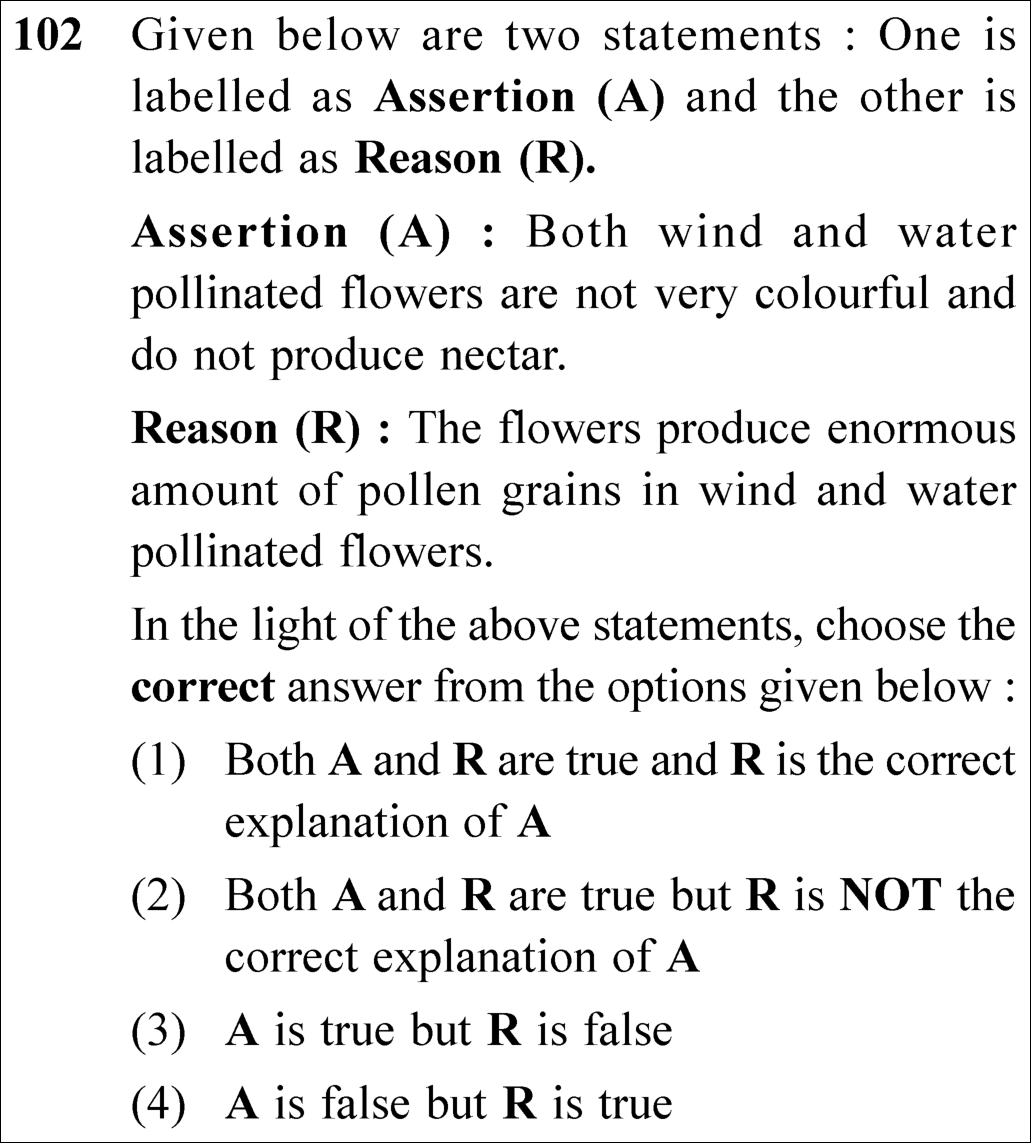
Given below are two statements: One is labelled as Assertion (A) and the other is labelled as Reason (R). Assertion (A): Both wind and water pollinated flowers are not very colourful and do not produce nectar. Reason (R): The flowers produce enormous amount of pollen grains in wind and water pollinated flowers. In the light of the above statements, choose the correct answer from the options given below:

  1. (1)Both A and R are true and R is the correct explanation of A
  2. (2)Both A and R are true but R is NOT the correct explanation of A
  3. (3)A is true but R is false
  4. (4)A is false but R is true
✓
Verified Against NTA Final Answer Key
Option (2) : Both A and R are true but R is NOT the correct explanation of A
📚 Sexual Reproduction in Flowering Plants Easy
📋 Given Parameters & Problem Setup
Assertion (A) Both wind and water pollinated flowers are not very colourful and do not produce nectar.
Reason (R) The flowers produce enormous amount of pollen grains in wind and water pollinated flowers.
⚡

The 30-Second Exam Hall Shortcut: ⚡ Abiotic Pollination Logic Test

⏱️ Save ~35 seconds

Assertion is TRUE (wind and water do not have eyes or tongues, so no bright petals or sweet nectar are needed)! Reason is TRUE (wind/water transport is random and wasteful, so flowers produce enormous pollen to compensate)! But enormous pollen does NOT explain why flowers lack color/nectar! ⟹ Both true, R NOT explanation (Option 2)!

1 Evaluate Assertion (A): Wind-pollinated (anemophilous) and water-pollinated (hydrophilous) flowers rely on non-living physical currents. They do not need to attract animal pollinators, so investing energy in colorful petals, fragrance, or sugary nectar is unnecessary. Assertion (A) is TRUE.
2 Evaluate Reason (R): Abiotic pollination is directional and passive; vast quantities of pollen are lost during dispersal. To compensate for this high probability of loss, flowers produce immense numbers of pollen grains per ovule. Reason (R) is TRUE.
3 Evaluate Causal Relationship: Flowers lack nectar and color because abiotic agents DO NOT NEED ATTRACTION. Enormous pollen production compensates for WASTAGE during flight/floating. The reason for lack of color is absence of animal pollinators, not pollen quantity!
4 Therefore, Both A and R are true, but R is NOT the correct explanation of A.
5 Select Option (2) in under 15 seconds!
🛡️
Why You Can 100% Trust This Shortcut: Anatropous Ovule Anatomy & Megasporogenesis (NCERT Biology · Sexual Reproduction in Flowering Plants).
📐

Step-by-Step Rigorous Workflow & Mathematical Proof

Step 1

Evaluate Assertion (A): Floral Reductions in Abiotic Pollination

Analyze evolutionary energy allocation in anemophilous and hydrophilous angiosperms:

Abiotic Pollination  ⟹  No biotic vectors to attract  ⟹  Absence of bright petals and nectar\text{Abiotic Pollination} \implies \text{No biotic vectors to attract} \implies \text{Absence of bright petals and nectar}
  • • NCERT states verbatim: "Both wind and water pollinated flowers are not very colourful and do not produce nectar."
  • • Assertion (A) is completely TRUE.
Step 2

Evaluate Reason (R): Pollen Compensation for High Wastage

Analyze the reproductive efficiency of wind and water transport:

Passive abiotic transport  ⟹  High probability of loss  ⟹  Enormous pollen grain production\text{Passive abiotic transport} \implies \text{High probability of loss} \implies \text{Enormous pollen grain production}
  • • NCERT states verbatim: "To compensate for this uncertainties and associated loss of pollen grains, the flowers produce enormous amount of pollen when compared to the number of ovules available for pollination."
  • • Reason (R) is completely TRUE.
Step 3

Assess Causal Linkage Between A and R

Determine if R explains A:

True explanation of A: Flowers do not require insect/bird attractants\text{True explanation of A: Flowers do not require insect/bird attractants}
  • • The true cause of absent color/nectar is the lack of a need to attract biotic pollinators.
  • • The true purpose of high pollen output is to overcome statistical wastage in abiotic currents.
  • • While both statements are independently true facts, Reason R does not provide the causal mechanism for Assertion A.
  • • Matches Option (2).
⭐

360° Option Elimination Engine Key Feature

Diagnose every choice: Know exactly why the right option works and why distractors fail.

4-Option Deep Scan
1 A
✗ Incorrect
Verdict & Scientific Reason:

Incorrect. R explains pollen abundance, not the absence of color and nectar.

⚠️
Student Fallacy (Why candidates pick this trap): Assuming any two true related statements explain each other.
2 B
✓ 100% Correct
Verdict & Scientific Reason:

100% correct. Both are established NCERT truths, but R does not causally explain A.

💡
Why this is airtight: None; rigorous logical analysis of Assertion-Reasoning.
3 C
✗ Incorrect
Verdict & Scientific Reason:

Incorrect. R is true (enormous pollen is produced).

⚠️
Student Fallacy (Why candidates pick this trap): Believing wind-pollinated flowers produce few pollen grains.
4 D
✗ Incorrect
Verdict & Scientific Reason:

Incorrect. A is true.

⚠️
Student Fallacy (Why candidates pick this trap): Thinking wind-pollinated flowers have nectar.
⚠️

NTA Trap Alert: Automatic "R Explains A" Assumption

Students frequently assume that if both statements are in the same paragraph of NCERT, R must explain A! Always ask: "DOES producing lots of pollen CAUSE flowers to lose color and nectar?" No! Flowers lack color because wind cannot see!

🛡️ How to avoid the -1 mark: Use the "Because" test: Flowers lack color BECAUSE wind doesn’t need visuals, NOT because they make more pollen!
📖

Core NEET Syllabus Standard

NEET Biology Core Syllabus · Sexual Reproduction in Flowering Plants Standard Benchmark
Core Scientific Principle Tested:

"Wind/water pollinated flowers lack color and nectar (no animal vectors) and produce abundant pollen to counter loss."

Syllabus Focus: Agents of Pollination: Wind and Water Pollination
✓ Core NEET UG Syllabus Anchor Syllabus & Academic Standards ↗
Wind cannot see (No color/nectar, A); Wind loses pollen (High count, R) ⟹ Both true, but separate reasons (Option 2)!

Ready to attempt under real exam pressure?

Test your speed and accuracy in the authentic 180-minute timed NTA simulator.

Launch NEET 2025 CBT Test →

Spotted a mistake in this solution? Report an error (support@mycompetitiveexams.com)

⚖️ Legal & Fair Dealing Notice: Sourced from publicly released NEET 2025 question papers and NEET answer keys for private study, research, and non-commercial educational practice under Fair Dealing (Section 52(1)(a) of the Indian Copyright Act, 1957). Not affiliated with or endorsed by NTA or NMC.

Solve 4 NEET Questions a Day — One per Subject

Cover all 1,140 official NEET questions in 285 days at your own pace. Progress is saved on your device. No login needed.