MyCompetitiveExams Logo MyCompetitiveExams
Search 1,140+ Questions
Chapters, formulas, speed tricks
→
⚡ Brahmastra NEET 2027
720 MARKS

Dynamic 180-question full-length simulator mixed dynamically from all 6 years for 2027 & 2026 aspirants.

Launch Brahmastra 2027 Test →
Start Practice →
100% Free · No Login Required
Q.151 Zoology ⭐ 360° Option Elimination Active
Vault ↗

NEET 2026 Zoology Question 151 Solution

Topic: Sexual Reproduction in Flowering Plants · Official NTA Booklet Code 50
NEET 2026 Zoology Question 151: Anther Structure & Dithecous Morphology

Question

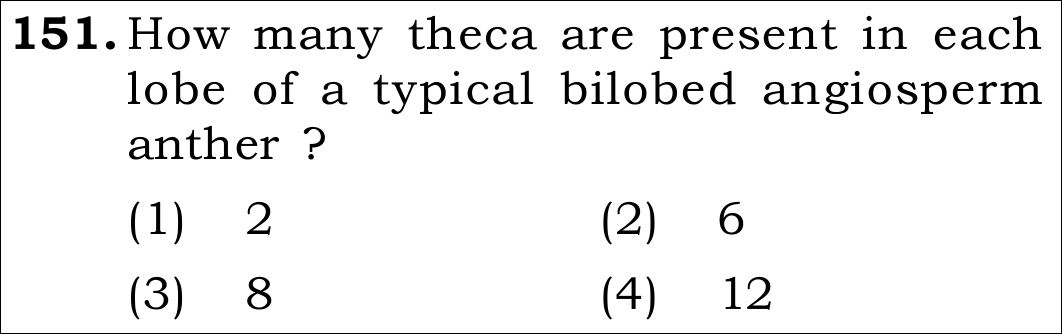
How many theca are present in each lobe of a typical bilobed angiosperm anther?

  1. (1)2
  2. (2)6
  3. (3)8
  4. (4)12
✓
Verified Against NTA Final Answer Key
Option (1) : Two
📚 Sexual Reproduction in Flowering Plants Easy
📋 Given Parameters & Problem Setup
Organ Angiosperm Anther
Morphological Nature Bilobed and Dithecous
Target Scope Number of theca present in EACH lobe
⚡

The 30-Second Exam Hall Shortcut: ⚡ Root Word Decoder ("Di-thecous")

⏱️ Save ~30 seconds

Dithecous = "Di" (Two) Theca per lobe!

1 Read carefully: Question asks for number of theca in EACH LOBE (not entire anther).
2 Recall canonical botanical definition: A typical angiosperm anther is bilobed (2 lobes).
3 Each lobe is dithecous, meaning it possesses 2 theca (separated by a longitudinal groove).
4 Therefore, each lobe has exactly 2 theca.
5 Match Option (1) = Two.
🛡️
Why You Can 100% Trust This Shortcut: NCERT Biology · Sexual Reproduction in Flowering Plants (Structure of Stamen: Microsporangium surrounded by 4 wall layers).
📐

Step-by-Step Rigorous Workflow & Mathematical Proof

Step 1

Anatomy of Angiosperm Anther

A typical angiosperm anther is a bilobed structure with each lobe having two theca (chambers), making it dithecous. Often a longitudinal groove runs lengthwise separating the two theca.

Typical Anther=2 Lobes,Each Lobe=2 Theca (Dithecous)\text{Typical Anther} = 2 \text{ Lobes}, \quad \text{Each Lobe} = 2 \text{ Theca (Dithecous)}
  • • Bilobed structure with a total of 4 microsporangia located at the corners (tetrasporangiate).
Step 2

Per-Lobe Count vs. Whole-Anther Count

The question specifically asks: "How many theca are present in each lobe?". In each lobe, there are 2 theca. Across both lobes combined, the whole anther contains 4 theca / 4 microsporangia.

Per Lobe=2 theca  ⟹  Option (1)\text{Per Lobe} = 2 \text{ theca} \implies \text{Option (1)}
  • • Watch out for the whole-anther trap (4 theca) versus per-lobe count (2 theca).
⭐

360° Option Elimination Engine Key Feature

Diagnose every choice: Know exactly why the right option works and why distractors fail.

4-Option Deep Scan
1 A
✓ 100% Correct
Verdict & Scientific Reason:

100% scientifically accurate. Each anther lobe is dithecous, meaning it contains exactly two theca.

💡
Why this is airtight: None; textbook definition.
2 B
✗ Incorrect
Verdict & Scientific Reason:

Incorrect. Four is the total number of theca/microsporangia in the ENTIRE bilobed anther, not in each individual lobe.

⚠️
Student Fallacy (Why candidates pick this trap): Rushing and confusing total anther count (4) with per-lobe count (2).
3 C
✗ Incorrect
Verdict & Scientific Reason:

Incorrect. An anther lobe with one theca is monothecous, which is an exception found in family Malvaceae (e.g., Hibiscus), not typical angiosperms.

⚠️
Student Fallacy (Why candidates pick this trap): Confusing exceptional monothecous anthers with standard dithecous angiosperm anthers.
4 D
✗ Incorrect
Verdict & Scientific Reason:

Incorrect. No normal angiosperm anther lobe possesses three theca.

⚠️
Student Fallacy (Why candidates pick this trap): Arbitrary guess.
⚠️

NTA Trap Alert: Whole Anther vs. Single Lobe Trap

The word "each lobe" is the key discriminator. Students reading hurriedly see "tetrasporangiate = 4" and immediately bubble 4, forgetting that 4 theca are distributed across 2 lobes (2 per lobe).

🛡️ How to avoid the -1 mark: Circle "EACH LOBE" on the question paper before selecting an answer.
📖

Core NEET Syllabus Standard

NEET Biology Core Syllabus · Sexual Reproduction in Flowering Plants Standard Benchmark
Core Scientific Principle Tested:

"A typical angiosperm anther is bilobed with each lobe having two theca, i.e., they are dithecous."

Syllabus Focus: Stamen, Microsporangium and Pollen Grain
✓ Core NEET UG Syllabus Anchor Syllabus & Academic Standards ↗
DI-thecous = DI (2) theca in each lobe!

Ready to attempt under real exam pressure?

Test your speed and accuracy in the authentic 180-minute timed NTA simulator.

Launch NEET 2026 CBT Test →

Spotted a mistake in this solution? Report an error (support@mycompetitiveexams.com)

⚖️ Legal & Fair Dealing Notice: Sourced from publicly released NEET 2026 question papers and NEET answer keys for private study, research, and non-commercial educational practice under Fair Dealing (Section 52(1)(a) of the Indian Copyright Act, 1957). Not affiliated with or endorsed by NTA or NMC.

Solve 4 NEET Questions a Day — One per Subject

Cover all 1,140 official NEET questions in 285 days at your own pace. Progress is saved on your device. No login needed.