MyCompetitiveExams Logo MyCompetitiveExams
Search 1,140+ Questions
Chapters, formulas, speed tricks
→
⚡ Brahmastra NEET 2027
720 MARKS

Dynamic 180-question full-length simulator mixed dynamically from all 6 years for 2027 & 2026 aspirants.

Launch Brahmastra 2027 Test →
Start Practice →
100% Free · No Login Required
Q.153 Zoology ⭐ 360° Option Elimination Active
Vault ↗

NEET 2025 Zoology Question 153 Solution

Topic: Sexual Reproduction in Flowering Plants · Official NTA Booklet Code 45
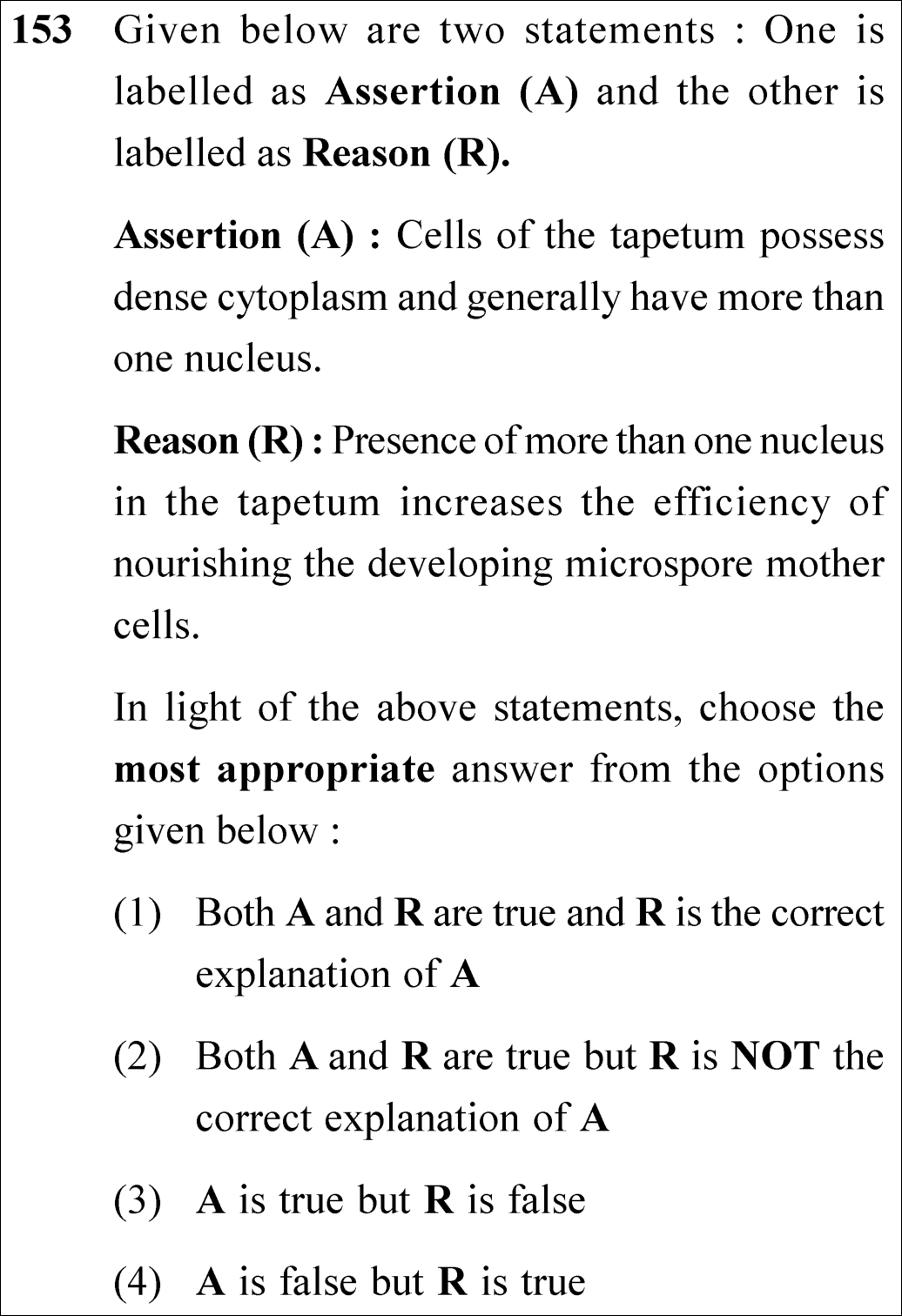
NEET 2025 Zoology Question 153: Structure and Physiological Function of the Tapetum Layer

Question

Given below are two statements: One is labelled as Assertion (A) and the other is labelled as Reason (R). Assertion (A): Cells of the tapetum possess dense cytoplasm and generally have more than one nucleus. Reason (R): Presence of more than one nucleus in the tapetum increases the efficiency of nourishing the developing microspore mother cells. In light of the above statements, choose the most appropriate answer from the options given below:

  1. (1)Both A and R are true and R is the correct explanation of A
  2. (2)Both A and R are true but R is NOT the correct explanation of A
  3. (3)A is true but R is false
  4. (4)A is false but R is true
✓
Verified Against NTA Final Answer Key
Option (1) : Both A and R are true and R is the correct explanation of A
📚 Sexual Reproduction in Flowering Plants Medium
📋 Given Parameters & Problem Setup
Assertion (A) Cells of the tapetum possess dense cytoplasm and generally have more than one nucleus.
Reason (R) Presence of more than one nucleus in the tapetum increases the efficiency of nourishing the developing microspore mother cells.
⚡

The 30-Second Exam Hall Shortcut: ⚡ Tapetum Polyploidy Fingerprint

⏱️ Save ~30 seconds

Assertion is TRUE (Tapetum has dense cytoplasm and multinucleate cells via endomitosis)! Reason is TRUE (Multiple nuclei enable intense metabolic transcription to nourish sporogenous tissue/MMCs)! R explains WHY tapetum is multinucleate! Both true & R explains A!

1 Analyze Assertion (A):
2 - "The innermost wall layer is the tapetum... Cells of the tapetum possess dense cytoplasm and generally have more than one nucleus." -> NCERT Section 2.2.1 verbatim TRUE!
3 Analyze Reason (R):
4 - Why does the tapetum undergo endomitosis/polyploidy to become multinucleate? To amplify gene transcription and metabolic output required for intense nutrient synthesis (enzymes, proteins, Ubisch bodies, pollenkitt) that nourish developing MMCs and pollen grains! Reason R is TRUE.
5 Check causal explanation link:
6 - Having multiple nuclei directly increases the translational/metabolic efficiency of nourishment described in the assertion. Thus, R is the correct explanation of A!
7 Conclusion: Both A and R are true and R is the correct explanation of A.
8 Select Option (1)!
🛡️
Why You Can 100% Trust This Shortcut: Microsporogenesis & Microspore Tetrad Formation (NCERT Biology · Sexual Reproduction in Flowering Plants: Tapetum nourishment).
📐

Step-by-Step Rigorous Workflow & Mathematical Proof

Step 1

Cytological Architecture of the Tapetum (Assertion A)

A typical microsporangium is bounded by four distinct concentric wall layers: epidermis, endothecium, middle layers, and tapetum:

  • • The tapetum is the innermost nutritive somatic layer in direct contact with the sporogenous tissue.
  • • Tapetal cells are physiologically active, possessing dense cytoplasm and abundant organelles (mitochondria, ribosomes, endoplasmic reticulum).
  • • During early development, tapetal nuclei undergo endomitosis (karyokinesis without cytokinesis) or polyteny, resulting in cells that generally have more than one nucleus (binucleate or multinucleate).
  • • Therefore, Assertion (A) is completely TRUE.
Step 2

Physiological Rationale for the Multinucleate Condition (Reason R)

Connecting nuclear multiplicity to functional efficiency:

  • • The primary physiological role of the tapetum is to provide continuous nutrition to developing microspore mother cells (MMCs) and maturing pollen grains.
  • • The presence of multiple nuclei (or polyploidy) increases gene dosage and elevates transcription rates for critical enzymes (such as callase, which dissolves callose walls of microspore tetrads) and precursors of sporopollenin (pro-Ubisch bodies).
  • • This amplifies the metabolic capacity and nutritive throughput of the tapetum.
  • • Therefore, Reason (R) is scientifically and biologically TRUE.
Step 3

Causal Synthesis

Reason (R) provides the definitive functional adaptation explaining why tapetal cells undergo endomitosis to become multinucleate. Hence, Reason (R) is the correct explanation of Assertion (A).

Multiple Nuclei  ⟹  ↑Transcription  ⟹  ↑Nourishing Efficiency for MMCs\text{Multiple Nuclei} \implies \uparrow \text{Transcription} \implies \uparrow \text{Nourishing Efficiency for MMCs}
⭐

360° Option Elimination Engine Key Feature

Diagnose every choice: Know exactly why the right option works and why distractors fail.

4-Option Deep Scan
1 A
✓ 100% Correct
Verdict & Scientific Reason:

100% correct. Correctly validates both statements and their direct functional-causal link.

💡
Why this is airtight: None; deep botanical and cytological comprehension.
2 B
✗ Incorrect
Verdict & Scientific Reason:

Incorrect. The physiological necessity of nourishment is the exact reason for the multinucleate state.

⚠️
Student Fallacy (Why candidates pick this trap): Treating the functional rationale as an unrelated fact.
3 C
✗ Incorrect
Verdict & Scientific Reason:

Incorrect. Reason R is a valid botanical and physiological principle.

⚠️
Student Fallacy (Why candidates pick this trap): Doubting the metabolic purpose of polyploidy in nurse tissues.
4 D
✗ Incorrect
Verdict & Scientific Reason:

Incorrect. Assertion A is a textbook NCERT fact.

⚠️
Student Fallacy (Why candidates pick this trap): Believing tapetal cells are strictly uninucleate.
⚠️

NTA Trap Alert: Tapetum Origin of Multinucleate State

Tapetal cells become multinucleate due to endomitosis or nuclear division WITHOUT cytokinesis. This nuclear multiplication serves a specific purpose: sustaining massive biosynthetic demands for pollen development.

🛡️ How to avoid the -1 mark: Whenever tapetum multinucleate nature is asked: it exists to maximize nourishment throughput!
📖

Core NEET Syllabus Standard

NEET Biology Core Syllabus · Sexual Reproduction in Flowering Plants Standard Benchmark
Core Scientific Principle Tested:

"Tapetum cells possess dense cytoplasm and multiple nuclei to enhance their nutritive efficiency for developing microspores."

Syllabus Focus: Microsporangium · Tapetum Function
✓ Core NEET UG Syllabus Anchor Syllabus & Academic Standards ↗
More Nuclei = More Nourishment: A and R are true and linked!

Ready to attempt under real exam pressure?

Test your speed and accuracy in the authentic 180-minute timed NTA simulator.

Launch NEET 2025 CBT Test →

Spotted a mistake in this solution? Report an error (support@mycompetitiveexams.com)

⚖️ Legal & Fair Dealing Notice: Sourced from publicly released NEET 2025 question papers and NEET answer keys for private study, research, and non-commercial educational practice under Fair Dealing (Section 52(1)(a) of the Indian Copyright Act, 1957). Not affiliated with or endorsed by NTA or NMC.

Solve 4 NEET Questions a Day — One per Subject

Cover all 1,140 official NEET questions in 285 days at your own pace. Progress is saved on your device. No login needed.