MyCompetitiveExams Logo MyCompetitiveExams
Search 1,140+ Questions
Chapters, formulas, speed tricks
→
⚡ Brahmastra NEET 2027
720 MARKS

Dynamic 180-question full-length simulator mixed dynamically from all 6 years for 2027 & 2026 aspirants.

Launch Brahmastra 2027 Test →
Start Practice →
100% Free · No Login Required
Q.175 Zoology ⭐ 360° Option Elimination Active
Vault ↗

NEET 2026 Zoology Question 175 Solution

Topic: Principles of Inheritance and Variation · Official NTA Booklet Code 50
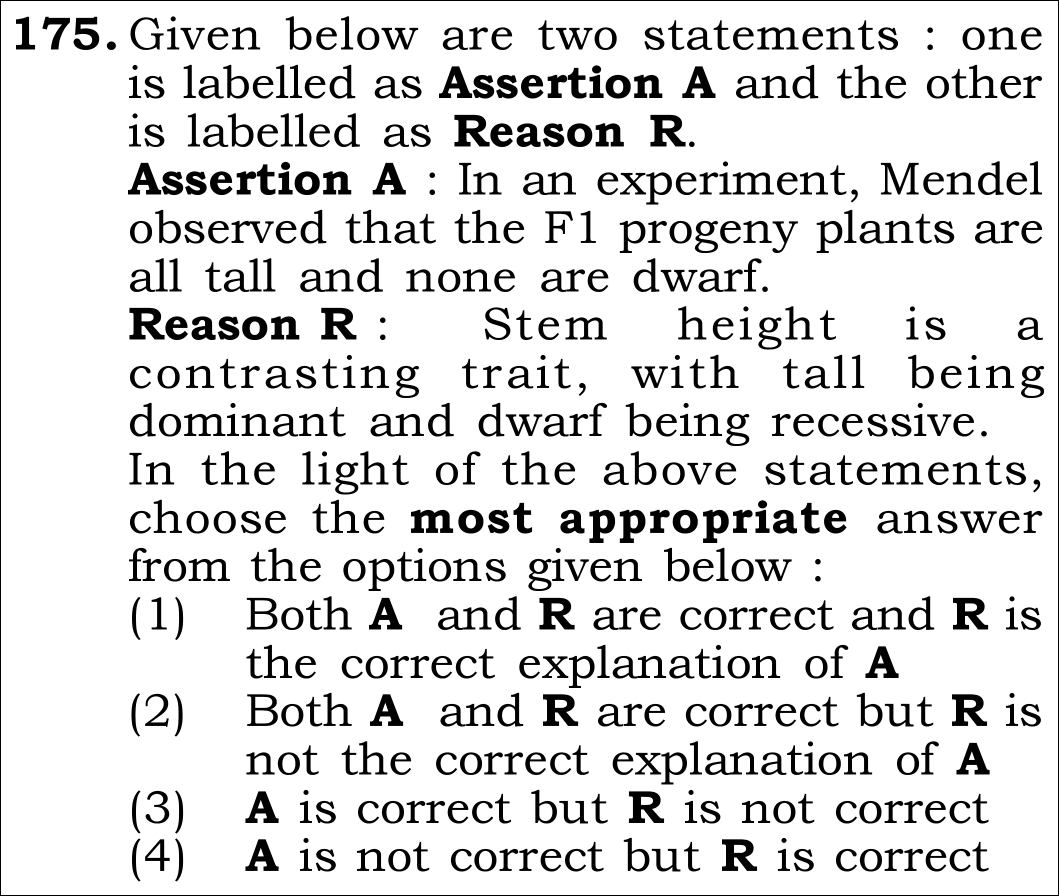
NEET 2026 Zoology Question 175: Mendel's Law of Dominance (Monohybrid Cross)

Question

Given below are two statements: one is labelled as Assertion A and the other is labelled as Reason R. Assertion A: In an experiment, Mendel observed that the F₁ progeny plants are all tall and none are dwarf. Reason R: Stem height is a contrasting trait, with tall being dominant and dwarf being recessive. In the light of the above statements, choose the most appropriate answer from the options given below:

✓
Verified Against NTA Final Answer Key
Option (1) : Both (A) and (R) are true and (R) is the correct explanation of (A)
📚 Principles of Inheritance and Variation Easy
📋 Given Parameters & Problem Setup
Cross True-breeding Tall (TT) × True-breeding Dwarf (tt)
Assertion (A) In a monohybrid cross between true-breeding tall and true-breeding dwarf pea plants, all F₁ progeny were tall.
Reason (R) The allele for tallness is dominant over the allele for dwarfness, expressing itself in heterozygous condition (Tt).
⚡

The 30-Second Exam Hall Shortcut: ⚡ Law of Dominance "Because" Check

⏱️ Save ~35 seconds

All F₁ are tall BECAUSE tall (T) dominates over dwarf (t) in heterozygotes!

1 Read Assertion (A): In cross TT × tt, all F₁ offspring are phenotypically tall -> TRUE (NCERT monohybrid cross).
2 Read Reason (R): Allele for tallness (T) is dominant over allele for dwarfness (t), expressing in heterozygous Tt -> TRUE (Mendel’s Law of Dominance).
3 Apply "BECAUSE": All F₁ progeny are tall BECAUSE the dominant tall allele masks the recessive dwarf allele in the heterozygous Tt genotype.
4 Reason (R) gives the exact genetic explanation for Assertion (A).
5 Pick Option (1) in under 15 seconds!
🛡️
Why You Can 100% Trust This Shortcut: NCERT Biology · Principles of Inheritance and Variation (Incomplete Dominance: Snapdragon Antirrhinum 1:2:1 red, pink, white ratio).
📐

Step-by-Step Rigorous Workflow & Mathematical Proof

Step 1

Mendel’s Monohybrid Cross (F₁ Generation)

When Mendel crossed true-breeding tall pea plants (TT) with true-breeding dwarf pea plants (tt), each parent produced only one type of gamete: T and t respectively. Fusion of these gametes produced F₁ progeny with uniform heterozygous genotype Tt, all exhibiting the tall phenotype.

P1(TT)×P2(tt)  ⟹  Gametes: T×t  ⟹  F1:Tt(100% Tall)P_1 (TT) \times P_2 (tt) \implies \text{Gametes: } T \times t \implies F_1: Tt \quad (\text{100\% Tall})
  • • Assertion (A) is completely true.
Step 2

Law of Dominance as the Mechanism

According to Mendel’s Law of Dominance: (i) Characters are controlled by discrete units called factors (genes). (ii) Factors occur in pairs. (iii) In a dissimilar pair of factors, one member of the pair dominates (dominant) the other (recessive). Because T completely dominates t in Tt, the dwarf trait is masked in F₁, perfectly explaining Assertion (A).

T (Dominant)>t (Recessive)  ⟹  Tt Phenotype=Tall  ⟹  (R) explains (A)T \text{ (Dominant)} > t \text{ (Recessive)} \implies Tt \text{ Phenotype} = \text{Tall} \implies (R) \text{ explains } (A)
  • • Recessive dwarf phenotype reappears only in F₂ in homozygous condition (tt).
⭐

360° Option Elimination Engine Key Feature

Diagnose every choice: Know exactly why the right option works and why distractors fail.

4-Option Deep Scan
1 A
✓ 100% Correct
Verdict & Scientific Reason:

100% correct. Dominance of the tall allele over the dwarf allele is the precise scientific explanation for the 100% tall F₁ generation.

💡
Why this is airtight: None; textbook Mendelian genetics.
2 B
✗ Incorrect
Verdict & Scientific Reason:

Incorrect. (R) is the exact biological cause of the phenotype described in (A).

⚠️
Student Fallacy (Why candidates pick this trap): Failing to recognize the causal relationship.
3 C
✗ Incorrect
Verdict & Scientific Reason:

Incorrect. Reason (R) is the universally accepted definition of complete dominance.

⚠️
Student Fallacy (Why candidates pick this trap): Doubting the dominance of the tall allele.
4 D
✗ Incorrect
Verdict & Scientific Reason:

Incorrect. Assertion (A) is a historic empirical result.

⚠️
Student Fallacy (Why candidates pick this trap): Thinking dwarf plants appeared in F₁.
⚠️

NTA Trap Alert: F₁ vs. F₂ Generation Confusion

Do not confuse F₁ with F₂. In F₁, ALL plants are tall (100% tall, 0% dwarf). The 3:1 phenotypic ratio only appears in the F₂ generation after selfing F₁ plants.

🛡️ How to avoid the -1 mark: Double check whether the statement refers to F₁ or F₂.
📖

Core NEET Syllabus Standard

NEET Biology Core Syllabus · Principles of Inheritance and Variation Standard Benchmark
Core Scientific Principle Tested:

"In a monohybrid cross, only the dominant trait is expressed in the F₁ generation due to masking of the recessive allele."

Syllabus Focus: Law of Dominance
✓ Core NEET UG Syllabus Anchor Syllabus & Academic Standards ↗
Dominant T hides recessive t: F₁ is 100% Tall!

Ready to attempt under real exam pressure?

Test your speed and accuracy in the authentic 180-minute timed NTA simulator.

Launch NEET 2026 CBT Test →

Spotted a mistake in this solution? Report an error (support@mycompetitiveexams.com)

⚖️ Legal & Fair Dealing Notice: Sourced from publicly released NEET 2026 question papers and NEET answer keys for private study, research, and non-commercial educational practice under Fair Dealing (Section 52(1)(a) of the Indian Copyright Act, 1957). Not affiliated with or endorsed by NTA or NMC.

Solve 4 NEET Questions a Day — One per Subject

Cover all 1,140 official NEET questions in 285 days at your own pace. Progress is saved on your device. No login needed.