MyCompetitiveExams Logo MyCompetitiveExams
Search 1,140+ Questions
Chapters, formulas, speed tricks
→
⚡ Brahmastra NEET 2027
720 MARKS

Dynamic 180-question full-length simulator mixed dynamically from all 6 years for 2027 & 2026 aspirants.

Launch Brahmastra 2027 Test →
Start Practice →
100% Free · No Login Required
Q.130 Botany ⭐ 360° Option Elimination Active
Vault ↗

NEET 2025 Botany Question 130 Solution

Topic: Principles of Inheritance and Variation · Official NTA Booklet Code 45
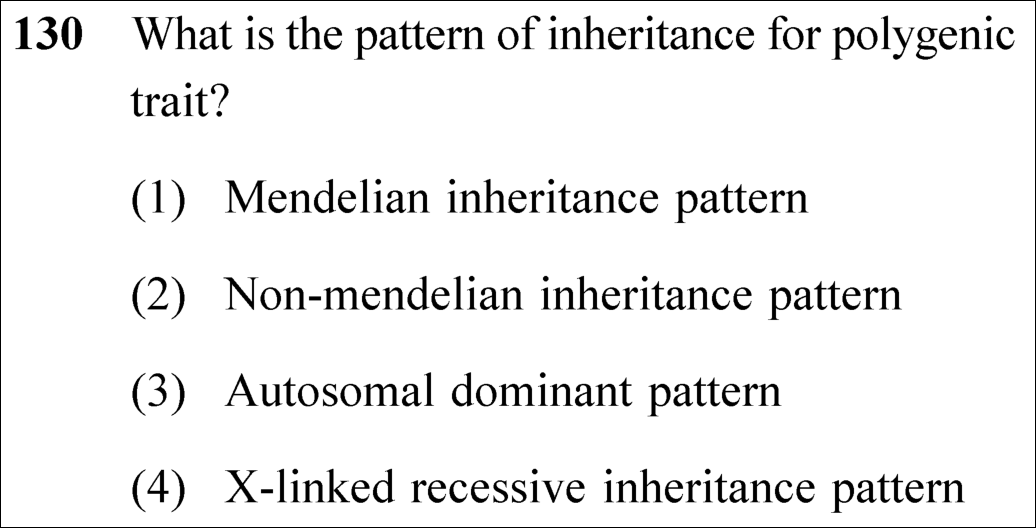
NEET 2025 Botany Question 130: Polygenic Inheritance Pattern (Quantitative Inheritance)

Question

What is the pattern of inheritance for polygenic trait?

  1. (1)Mendelian inheritance pattern
  2. (2)Non-mendelian inheritance pattern
  3. (3)Autosomal dominant pattern
  4. (4)X-linked recessive inheritance pattern
✓
Verified Against NTA Final Answer Key
Option (2) : Non-mendelian inheritance pattern
📚 Principles of Inheritance and Variation Easy
📋 Given Parameters & Problem Setup
Target Trait Class Polygenic trait (quantitative trait, e.g., human skin colour, height)
Target Classification Pattern of inheritance
⚡

The 30-Second Exam Hall Shortcut: ⚡ Mendelian vs Non-Mendelian Fingerprint

⏱️ Save ~20 seconds

Mendelian = Monogenic qualitative traits (distinct discrete ratios 3:1, 9:3:3:1)! Polygenic = Multiple genes with additive continuous quantitative variation -> NON-MENDELIAN inheritance!

1 Distinguish Mendelian vs Non-Mendelian traits:
2 - Mendelian inheritance: Single gene controlling distinct alternate traits (e.g. Tall vs Dwarf) without environmental gradations.
3 - Polygenic inheritance: Traits controlled by three or more genes with cumulative/additive allele effects (e.g., AABBCC dark skin vs aabbcc light skin in human skin colour) producing a bell-shaped continuous phenotypic spectrum.
4 - Because it deviates from classical Mendelian segregation ratios, it is a Non-Mendelian inheritance pattern.
5 Select Option (2) Non-mendelian inheritance pattern!
🛡️
Why You Can 100% Trust This Shortcut: Polygenic Inheritance & Pleiotropy Distinctions (NCERT Biology · Principles of Inheritance and Variation).
📐

Step-by-Step Rigorous Workflow & Mathematical Proof

Step 1

Concept of Polygenic Inheritance

Gregor Mendel studied traits that had distinct alternate forms (e.g. purple vs white flowers, yellow vs green seeds). However, in nature, many traits exhibit continuous gradation rather than distinct all-or-none phenotypes:

  • • Traits that are generally controlled by three or more genes are called polygenic traits.
  • • Classic examples include human skin colour (controlled by three genes A, B, C as explained in NCERT), human height, and intelligence.
  • • Polygenic inheritance also takes into account the influence of the environment.
Step 2

Why Polygenic Inheritance is Non-Mendelian

Evaluating inheritance classifications:

  • • Mendelian inheritance is based on unit factors (genes) with dominant and recessive alleles yielding discrete qualitative phenotypic ratios (3:1 monohybrid, 9:3:3:1 dihybrid).
  • • Polygenic inheritance involves multiple loci exhibiting additive or quantitative effects, where the phenotype reflects the total number of dominant/contributing alleles, resulting in a continuous Gaussian distribution.
  • • Consequently, it represents an extension/deviation from classical Mendelian rules, categorized firmly as a Non-Mendelian inheritance pattern.
Step 3

Conclusion

Polygenic traits display a Non-Mendelian pattern of inheritance.

Polygenic Trait  ⟹  Non-Mendelian Inheritance Pattern\text{Polygenic Trait} \implies \text{Non-Mendelian Inheritance Pattern}
⭐

360° Option Elimination Engine Key Feature

Diagnose every choice: Know exactly why the right option works and why distractors fail.

4-Option Deep Scan
1 A
✗ Incorrect
Verdict & Scientific Reason:

Incorrect. Mendelian inheritance strictly describes single-gene, qualitative discrete traits.

⚠️
Student Fallacy (Why candidates pick this trap): Confusing all genetic inheritance with classical Mendelian ratios.
2 B
✓ 100% Correct
Verdict & Scientific Reason:

100% correct. Polygenic quantitative traits deviate from simple Mendelian single-gene ratios and are classified as Non-Mendelian.

💡
Why this is airtight: None; clear understanding of genetic paradigms.
3 C
✗ Incorrect
Verdict & Scientific Reason:

Incorrect. Autosomal dominant refers to single-gene monogenic conditions (e.g., Huntington chorea, myotonic dystrophy).

⚠️
Student Fallacy (Why candidates pick this trap): Confusing additive multi-gene alleles with single-gene dominance.
4 D
✗ Incorrect
Verdict & Scientific Reason:

Incorrect. X-linked recessive applies to single genes on the X chromosome (e.g., haemophilia, color blindness).

⚠️
Student Fallacy (Why candidates pick this trap): Confusing sex-linkage with polygenic inheritance.
⚠️

NTA Trap Alert: Qualitative vs Quantitative Inheritance

Mendel studied qualitative traits (discontinuous variation). Polygenic inheritance governs quantitative traits (continuous variation, multiple loci, additive alleles). Quantitative traits are inherently Non-Mendelian!

🛡️ How to avoid the -1 mark: Continuous variation / polygenic = Non-Mendelian.
📖

Core NEET Syllabus Standard

NEET Biology Core Syllabus · Principles of Inheritance and Variation Standard Benchmark
Core Scientific Principle Tested:

"Polygenic inheritance involves multiple genes showing additive effects and continuous variation, representing a non-Mendelian pattern."

Syllabus Focus: Polygenic Inheritance
✓ Core NEET UG Syllabus Anchor Syllabus & Academic Standards ↗
POLY-genes = Plenty of genes, Not simple Mendel (Non-Mendelian)!

Ready to attempt under real exam pressure?

Test your speed and accuracy in the authentic 180-minute timed NTA simulator.

Launch NEET 2025 CBT Test →

Spotted a mistake in this solution? Report an error (support@mycompetitiveexams.com)

⚖️ Legal & Fair Dealing Notice: Sourced from publicly released NEET 2025 question papers and NEET answer keys for private study, research, and non-commercial educational practice under Fair Dealing (Section 52(1)(a) of the Indian Copyright Act, 1957). Not affiliated with or endorsed by NTA or NMC.

Solve 4 NEET Questions a Day — One per Subject

Cover all 1,140 official NEET questions in 285 days at your own pace. Progress is saved on your device. No login needed.