MyCompetitiveExams Logo MyCompetitiveExams
Search 1,140+ Questions
Chapters, formulas, speed tricks
→
⚡ Brahmastra NEET 2027
720 MARKS

Dynamic 180-question full-length simulator mixed dynamically from all 6 years for 2027 & 2026 aspirants.

Launch Brahmastra 2027 Test →
Start Practice →
100% Free · No Login Required
Q.152 Zoology ⭐ 360° Option Elimination Active
Vault ↗

NEET 2025 Zoology Question 152 Solution

Topic: Principles of Inheritance and Variation · Official NTA Booklet Code 45
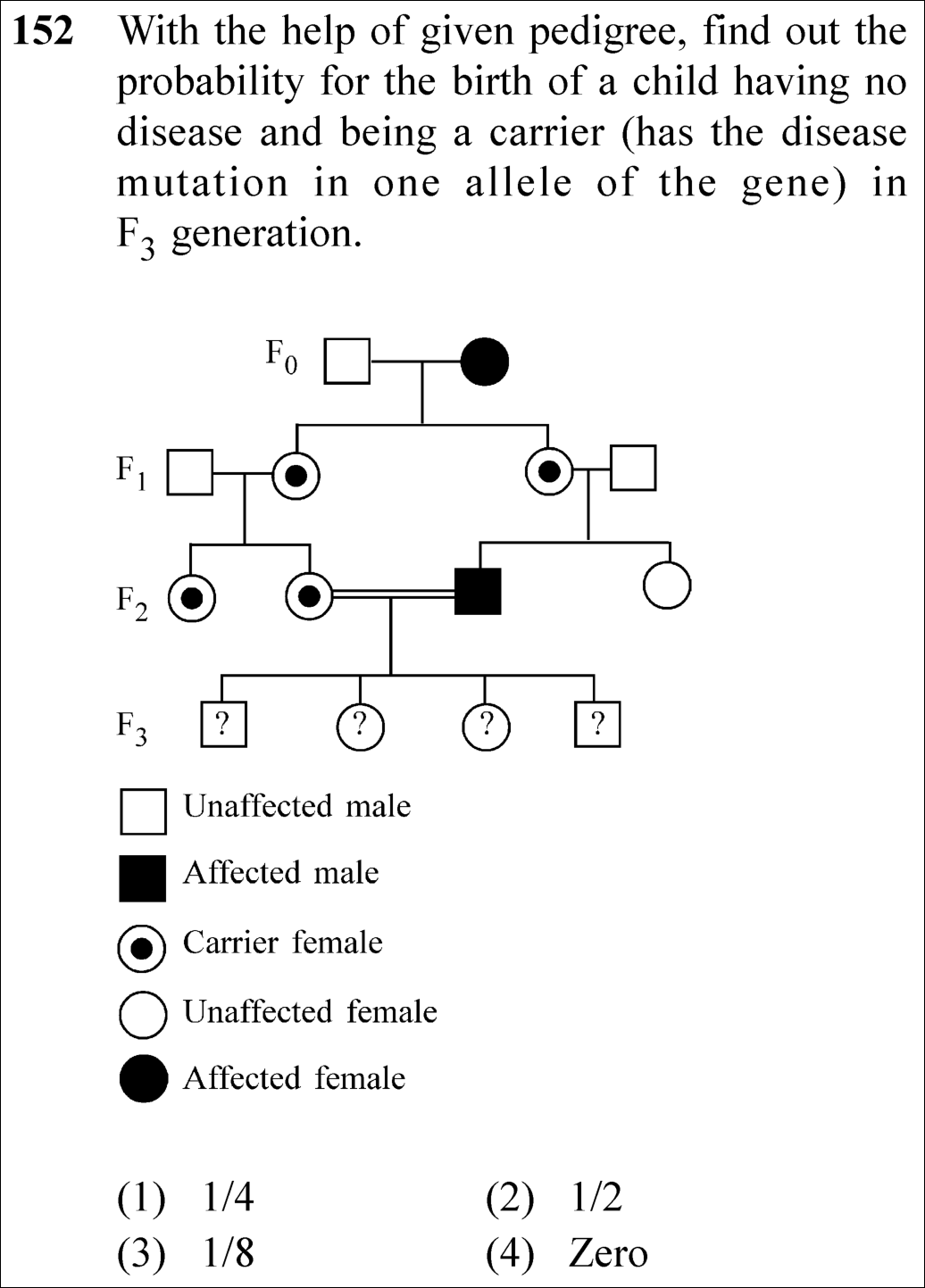
NEET 2025 Zoology Question 152: Pedigree Probability Calculation for X-Linked Recessive Carrier Offspring

Question

With the help of given pedigree, find out the probability for the birth of a child having no disease and being a carrier (has the disease mutation in one allele of the gene) in F3 generation.

✓
Verified Against NTA Final Answer Key
Option (1) : 1/4
📚 Principles of Inheritance and Variation Medium
📋 Given Parameters & Problem Setup
Mother in F2 Carrier female (XᴬXᵃ, circle with central dot)
Father in F2 Affected male (XᵃY, filled black square)
Target Condition in F3 Child having no disease AND being a carrier (mutation in one allele)
⚡

The 30-Second Exam Hall Shortcut: ⚡ Pedigree Punnett Cross Fingerprint

⏱️ Save ~40 seconds

Carrier mother (XᴬXᵃ) × Affected father (XᵃY) -> Zygotes: 1/4 XᴬXᵃ (carrier female, healthy), 1/4 XᵃXᵃ (affected female), 1/4 XᴬY (healthy male, non-carrier), 1/4 XᵃY (affected male)! Probability of healthy carrier child = 1/4!

1 Deduce the mode of inheritance from the pedigree:
2 - F0 affected female (XaXaX^a X^a) passes disease allele to all sons and makes all daughters carriers (XAXaX^A X^a).
3 - Carrier female (XAXaX^A X^a) in F1 mated to normal male (XAYX^A Y) produces an affected son (XaYX^a Y) in F2.
4 - Thus, the trait is classical X-linked recessive (e.g. Haemophilia or Colour blindness).
5 Identify parental genotypes mating to yield F3:
6 - Mother (F2): Carrier female = XAXaX^A X^a.
7 - Father (F2): Affected male = XaYX^a Y.
8 Perform the genetic cross: XAXa×XaYX^A X^a \times X^a Y:
9 - Gametes: Mother produces XAX^A (1/2) and XaX^a (1/2); Father produces XaX^a (1/2) and YY (1/2).
10 - Offspring distribution (total 4 equally probable classes):
11 XAXaX^A X^a: Carrier female, no disease (1/4).
12 XaXaX^a X^a: Affected female, has disease (1/4).
13 XAYX^A Y: Normal male, no disease, NOT a carrier (1/4).
14 XaYX^a Y: Affected male, has disease (1/4).
15 Who satisfies "child having no disease and being a carrier"? ONLY XAXaX^A X^a! Probability = 1/4 (Option 1)!
16 Select Option (1) 1/4!
🛡️
Why You Can 100% Trust This Shortcut: Mendelian vs Chromosomal Genetic Disorders (NCERT Biology · Principles of Inheritance and Variation: Aneuploidy, Down, Turner, Klinefelter).
📐

Step-by-Step Rigorous Workflow & Mathematical Proof

Step 1

Deciphering the Pedigree and Mode of Inheritance

Analyzing the transmission pattern across generations:

  • • In F0, an affected female (black circle, XaXaX^a X^a) mates with an unaffected male (empty square, XAYX^A Y). All daughters inherit one paternal XAX^A and one maternal XaX^a, making them obligate carrier females (circles with central dot, XAXaX^A X^a) in F1.
  • • In F1, a carrier female (XAXaX^A X^a) mates with an unaffected male (XAYX^A Y). They produce an affected son (XaYX^a Y) in F2. This confirms X-linked recessive inheritance beyond doubt.
  • • The consanguineous marriage in F2 involves a carrier female (XAXaX^A X^a) and an affected male (XaYX^a Y).
Step 2

Constructing the F2 × F2 Punnett Square for F3 Offspring

Determining all possible genotypic and phenotypic outcomes:

  • • Maternal gametes: XAX^A (50%50\%) and XaX^a (50%50\%).
  • • Paternal gametes: XaX^a (50%50\%) and YY (50%50\%).
  • • Cross outcomes (44 equally likely quadrants, each p=0.25p = 0.25):
  • • 1. XAXaX^A X^a: Phenotypically normal female, carries one mutated allele (Heterozygous carrier female).
  • • 2. XaXaX^a X^a: Phenotypically affected female (Homozygous mutant).
  • • 3. XAYX^A Y: Phenotypically normal male (Hemizygous wild-type, carries zero mutant alleles, cannot be a carrier).
  • • 4. XaYX^a Y: Phenotypically affected male (Hemizygous mutant).
Step 3

Evaluating the Probability Condition

The question specifically requires the birth of a child (of either sex) having: (i) NO disease, AND (ii) being a carrier (bearing the disease mutation in one allele).

P(Carrier child)=P(XAXa)=12×12=14P(\text{Carrier child}) = P(X^A X^a) = \frac{1}{2} \times \frac{1}{2} = \frac{1}{4}
Step 4

Conclusion

Out of all 4 possible zygotic combinations, exactly 1 corresponds to an unaffected carrier child (XAXaX^A X^a). The probability is 1/4.

Probability=14 (Option 1)\text{Probability} = \frac{1}{4} \text{ (Option 1)}
⭐

360° Option Elimination Engine Key Feature

Diagnose every choice: Know exactly why the right option works and why distractors fail.

4-Option Deep Scan
1 A
✓ 100% Correct
Verdict & Scientific Reason:

100% correct. Only the XᴬXᵃ genotype (1 out of 4 total offspring) is both disease-free and a carrier of one mutated allele.

💡
Why this is airtight: None; flawless pedigree probability calculation.
2 B
✗ Incorrect
Verdict & Scientific Reason:

Incorrect. 1/2 is the probability of a daughter being a carrier, but the question asks for the probability of a "child" (which includes sons and daughters).

⚠️
Student Fallacy (Why candidates pick this trap): Conditioning on female sex only instead of all children.
3 C
✗ Incorrect
Verdict & Scientific Reason:

Incorrect. Unnecessary multiplication by extra generation factors.

⚠️
Student Fallacy (Why candidates pick this trap): Over-multiplying parental probabilities.
4 D
✗ Incorrect
Verdict & Scientific Reason:

Incorrect. Carrier daughters are readily produced with 25% overall probability.

⚠️
Student Fallacy (Why candidates pick this trap): Assuming affected fathers cannot produce carrier daughters.
⚠️

NTA Trap Alert: Child vs Daughter Probability Trap

A classic genetics trap: If asked "probability of a DAUGHTER being a carrier", the answer is 1/2 (since among daughters, 1 is XᴬXᵃ and 1 is XᵃXᵃ). But when asked "probability of a CHILD being a carrier", all 4 children are considered, so probability is 1/4!

🛡️ How to avoid the -1 mark: Check the wording: "child" = divide by 4; "daughter" = divide by 2.
📖

Core NEET Syllabus Standard

NEET Biology Core Syllabus · Principles of Inheritance and Variation Standard Benchmark
Core Scientific Principle Tested:

"In an X-linked cross of XᴬXᵃ × XᵃY, the probability of an unaffected carrier child (XᴬXᵃ) is 1/4."

Syllabus Focus: Mendelian Disorders · Pedigree Analysis (Sex-Linked Recessive)
✓ Core NEET UG Syllabus Anchor Syllabus & Academic Standards ↗
1 in 4 is the Carrier Door: XᴬXᵃ = 1/4 total progeny!

Ready to attempt under real exam pressure?

Test your speed and accuracy in the authentic 180-minute timed NTA simulator.

Launch NEET 2025 CBT Test →

Spotted a mistake in this solution? Report an error (support@mycompetitiveexams.com)

⚖️ Legal & Fair Dealing Notice: Sourced from publicly released NEET 2025 question papers and NEET answer keys for private study, research, and non-commercial educational practice under Fair Dealing (Section 52(1)(a) of the Indian Copyright Act, 1957). Not affiliated with or endorsed by NTA or NMC.

Solve 4 NEET Questions a Day — One per Subject

Cover all 1,140 official NEET questions in 285 days at your own pace. Progress is saved on your device. No login needed.