MyCompetitiveExams Logo MyCompetitiveExams
Search 1,140+ Questions
Chapters, formulas, speed tricks
→
⚡ Brahmastra NEET 2027
720 MARKS

Dynamic 180-question full-length simulator mixed dynamically from all 6 years for 2027 & 2026 aspirants.

Launch Brahmastra 2027 Test →
Start Practice →
100% Free · No Login Required
Q.169 Zoology ⭐ 360° Option Elimination Active
Vault ↗

NEET 2026 Zoology Question 169 Solution

Topic: Principles of Inheritance and Variation · Official NTA Booklet Code 50
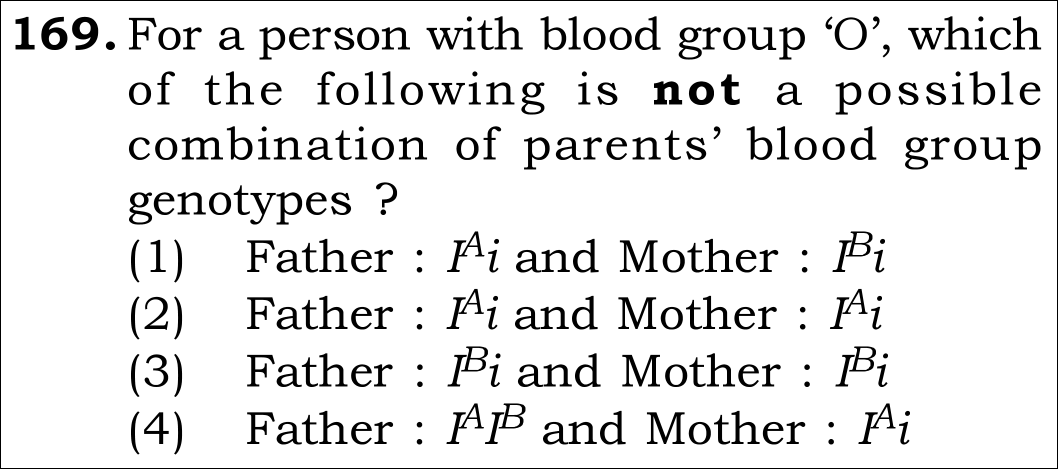
NEET 2026 Zoology Question 169: ABO Blood Group Genetics & Exclusion of Paternity/Offspring

Question

For a person with blood group 'O', which of the following is not a possible combination of parents' blood group genotypes?

✓
Verified Against NTA Final Answer Key
Option (4) : Father: I^A I^B, Mother: I^A i
📚 Principles of Inheritance and Variation Medium
📋 Given Parameters & Problem Setup
Offspring Blood Group Group 'O' (Genotype: ii)
Target Condition Parental combination that CANNOT produce this child
⚡

The 30-Second Exam Hall Shortcut: ⚡ The "AB Cannot Have O Child" Law

⏱️ Save ~45 seconds

A parent with blood group AB (I^A I^B) can NEVER produce a child with blood group O (ii)!

1 Target offspring has blood group O, meaning homozygous recessive genotype: ii.
2 To produce an ii child, BOTH father and mother MUST contribute at least one "i" allele.
3 Scan parental combinations for any parent who has ZERO "i" alleles.
4 In Option (4): Father has genotype I^A I^B. His gametes can ONLY be I^A or I^B; he can NEVER produce a gamete with "i".
5 Therefore, an I^A I^B father can NEVER have an "O" (ii) child!
6 Option (4) is immediately identified in 5 seconds.
🛡️
Why You Can 100% Trust This Shortcut: NCERT Biology · Principles of Inheritance and Variation (Sex Linkage & Recombination: Morgan’s Drosophila crosses show tight linkage).
📐

Step-by-Step Rigorous Workflow & Mathematical Proof

Step 1

Genetics of ABO Blood Group System

ABO blood groups are controlled by the gene I, which has three alleles: I^A, I^B, and i. I^A and I^B are codominant with each other and completely dominant over the recessive allele i.

Blood Group O  ⟹  Genotype: ii  ⟹  (One i from father)+(One i from mother)\text{Blood Group O} \implies \text{Genotype: } ii \implies (\text{One } i \text{ from father}) + (\text{One } i \text{ from mother})
  • • Any child with blood group O requires that both parents carry at least one recessive i allele.
Step 2

Evaluate Parental Combinations

Examine each given parental pair to check if both parents can produce an "i" gamete:

(1) Father: IAi, Mother: IBi  ⟹  i×i→ii(Possible: 25%)(2) Father: IAi, Mother: ii  ⟹  i×i→ii(Possible: 50%)(3) Father: ii, Mother: ii  ⟹  i×i→ii(Possible: 100%)(4)Father: IAIB, Mother: IAi  ⟹  Father can only donate IA or IB  ⟹  Child ii is IMPOSSIBLE!\begin{aligned} (1) & \text{ Father: } I^A i, \text{ Mother: } I^B i \implies i \times i \rightarrow ii \quad (\text{Possible: 25\%}) \\ (2) & \text{ Father: } I^A i, \text{ Mother: } ii \implies i \times i \rightarrow ii \quad (\text{Possible: 50\%}) \\ (3) & \text{ Father: } ii, \text{ Mother: } ii \implies i \times i \rightarrow ii \quad (\text{Possible: 100\%}) \\ (4) & \mathbf{\text{Father: } I^A I^B}, \text{ Mother: } I^A i \implies \text{Father can only donate } I^A \text{ or } I^B \implies \text{Child } \mathbf{ii} \text{ is } \mathbf{IMPOSSIBLE!} \end{aligned}
  • • Possible offspring of (4) are only: I^A I^A (A), I^A i (A), I^A I^B (AB), or I^B i (B). None can be O.
⭐

360° Option Elimination Engine Key Feature

Diagnose every choice: Know exactly why the right option works and why distractors fail.

4-Option Deep Scan
1 A
✗ Incorrect
Verdict & Scientific Reason:

Incorrect choice because both parents carry the i allele and can produce an ii (O) child with 25% probability.

⚠️
Student Fallacy (Why candidates pick this trap): Thinking parents with blood groups A and B cannot have an O child.
2 B
✗ Incorrect
Verdict & Scientific Reason:

Incorrect choice because father provides i (50% chance) and mother always provides i, yielding 50% blood group O children.

⚠️
Student Fallacy (Why candidates pick this trap): Failing to realize heterozygous A cross with O gives O.
3 C
✗ Incorrect
Verdict & Scientific Reason:

Incorrect choice because both parents are homozygous ii, producing 100% group O offspring.

⚠️
Student Fallacy (Why candidates pick this trap): Misunderstanding homozygous recessive crosses.
4 D
✓ 100% Correct
Verdict & Scientific Reason:

100% correct. An AB father (I^A I^B) has no i allele to transmit; hence producing an ii child is genetically impossible.

💡
Why this is airtight: None; rigorous application of Mendelian segregation.
⚠️

NTA Trap Alert: Confusing Phenotype with Genotype

Students sometimes write "Parent is A and parent is B, so child can only be AB". They forget that A can be I^A i and B can be I^B i. But blood group AB is ALWAYS I^A I^B without exception, leaving zero possibility for an i allele.

🛡️ How to avoid the -1 mark: Remember: Blood group AB has NO "i" allele. An AB parent can NEVER have an O child, and an O parent can NEVER have an AB child!
📖

Core NEET Syllabus Standard

NEET Biology Core Syllabus · Principles of Inheritance and Variation Standard Benchmark
Core Scientific Principle Tested:

"Blood group O requires two i alleles (ii); an individual with genotype I^A I^B cannot pass on an i allele."

Syllabus Focus: Multiple Alleles & ABO Blood Grouping
✓ Core NEET UG Syllabus Anchor Syllabus & Academic Standards ↗
AB parent has NO "i" to give = NO "O" child possible!

Ready to attempt under real exam pressure?

Test your speed and accuracy in the authentic 180-minute timed NTA simulator.

Launch NEET 2026 CBT Test →

Spotted a mistake in this solution? Report an error (support@mycompetitiveexams.com)

⚖️ Legal & Fair Dealing Notice: Sourced from publicly released NEET 2026 question papers and NEET answer keys for private study, research, and non-commercial educational practice under Fair Dealing (Section 52(1)(a) of the Indian Copyright Act, 1957). Not affiliated with or endorsed by NTA or NMC.

Solve 4 NEET Questions a Day — One per Subject

Cover all 1,140 official NEET questions in 285 days at your own pace. Progress is saved on your device. No login needed.