MyCompetitiveExams Logo MyCompetitiveExams
Search 1,140+ Questions
Chapters, formulas, speed tricks
→
⚡ Brahmastra NEET 2027
720 MARKS

Dynamic 180-question full-length simulator mixed dynamically from all 6 years for 2027 & 2026 aspirants.

Launch Brahmastra 2027 Test →
Start Practice →
100% Free · No Login Required
🌿 Botany 🔥 High-Yield Core Topic (~3–4 Qs/Year)

NEET Morphology of Flowering Plants Previous Year Questions with Solutions

Complete repository of official NTA NEET questions for Morphology of Flowering Plants from 2020 to 2026. Every question includes 30-second elimination tricks, step-by-step NCERT solutions, option-by-option traps, and official answer keys.

18 Questions 6 Exam Years (2026, 2025, 2024, 2023, 2021, 2020) 15 Easy · 3 Medium · 0 Challenging
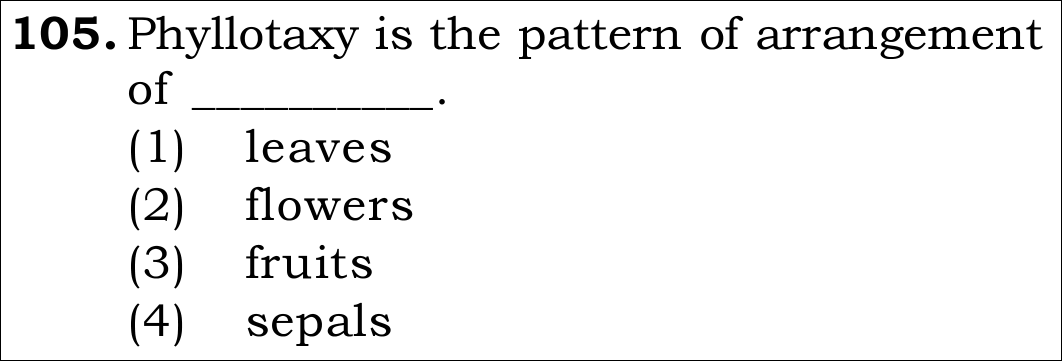
NEET 2026 · Q105 Easy
Official NEET 2026 Question 105 - Morphology of Flowering Plants
1 leaves ✓ Key
2 flowers
3 fruits
4 sepals
💡 Verified Solution & 30-Second Hack
✓
Verified Against NTA Final Answer Key
Option (1) : leaves
📚 Morphology of Flowering Plants Easy
📋 Given Parameters & Problem Setup
Morphological Term Phyllotaxy (Greek: phyllon = leaf, taxis = arrangement)
Target Organ whose pattern of arrangement is described by phyllotaxy
⚡

The 30-Second Exam Hall Shortcut: ⚡ Root Word Decoder: Phyllo = Leaf!

⏱️ Save ~40 seconds

Phyllo means LEAF! Phyllotaxy is the arrangement of leaves on stem or branch!

1 Etymology: "Phyllo-" is the biological prefix for leaf (e.g., chlorophyll, phyllode, phylloclade).
2 "Taxis" means orderly arrangement.
3 Phyllotaxy = Arrangement of LEAVES.
4 Contrast: Inflorescence = arrangement of flowers; Aestivation = arrangement of sepals/petals.
5 Option (1) is Leaves! Pick Option (1) in 3 seconds flat!
🛡️
Why You Can 100% Trust This Shortcut: NCERT Morphology of Flowering Plants verbatim: Phyllotaxy is the pattern of arrangement of leaves on the stem or branch.
📐

Step-by-Step Rigorous Workflow & Mathematical Proof

Step 1

Define Phyllotaxy

Phyllotaxy is the pattern of arrangement of leaves on the stem or branch. Its primary adaptive purpose is to orient leaves in a manner that avoids self-shading and maximizes light interception for photosynthesis.

Phyllotaxy≡Pattern of arrangement of leaves on stem/branch\text{Phyllotaxy} \equiv \text{Pattern of arrangement of leaves on stem/branch}
  • • There are three primary types of phyllotaxy: Alternate, Opposite, and Whorled.
Step 2

Review Types and Canonical Examples of Phyllotaxy

1. Alternate Phyllotaxy: A single leaf arises at each node in an alternate manner (e.g., China rose, Mustard, Sunflower). 2. Opposite Phyllotaxy: A pair of leaves arise at each node and lie opposite to each other (e.g., Calotropis, Guava). 3. Whorled Phyllotaxy: More than two leaves arise at a node and form a whorl (e.g., Alstonia).

Types: Alternate (Mustard), Opposite (Guava), Whorled (Alstonia)\text{Types: Alternate (Mustard), Opposite (Guava), Whorled (Alstonia)}
  • • All three describe patterns of leaf arrangement.
Step 3

Contrast with Other Botanical Terms in Options

1. Flowers: The arrangement of flowers on the floral axis is called INFLORESCENCE (Racemose or Cymose). 2. Sepals and Petals: The mode of arrangement of sepals or petals in floral bud with respect to other members is called AESTIVATION (Valvate, Twisted, Imbricate, Vexillary). 3. Fruits: Developed from fertilized ovaries; arrangement is not termed phyllotaxy.

Flowers →Inflorescence;Sepals/Petals →Aestivation;Leaves →Phyllotaxy\text{Flowers } \to \text{Inflorescence}; \quad \text{Sepals/Petals } \to \text{Aestivation}; \quad \text{Leaves } \to \text{Phyllotaxy}
  • • Matches Option (1).
⭐

360° Option Elimination Engine Key Feature

Diagnose every choice: Know exactly why the right option works and why distractors fail.

4-Option Deep Scan
1 A
✓ 100% Correct
Verdict & Scientific Reason:

Exact botanical definition matching NCERT Morphology chapter verbatim.

💡
Why this is airtight: None; fundamental botanical terminology.
2 B
✗ Incorrect
Verdict & Scientific Reason:

Incorrect. Arrangement of flowers on the floral axis is called inflorescence.

⚠️
Student Fallacy (Why candidates pick this trap): Confusing phyllotaxy with inflorescence.
3 C
✗ Incorrect
Verdict & Scientific Reason:

Incorrect. Phyllotaxy has nothing to do with fruit distribution.

⚠️
Student Fallacy (Why candidates pick this trap): Random morphological guess.
4 D
✗ Incorrect
Verdict & Scientific Reason:

Incorrect. Arrangement of sepals or petals in the floral bud is called aestivation.

⚠️
Student Fallacy (Why candidates pick this trap): Confusing phyllotaxy with aestivation.
⚠️

NTA Trap Alert: Confusing Phyllotaxy, Inflorescence, and Aestivation

NEET examiners love testing these three arrangement terms together: (1) Leaves = Phyllotaxy; (2) Flowers = Inflorescence; (3) Sepals/Petals = Aestivation.

🛡️ How to avoid the -1 mark: Phyllo = Leaf (Phyllotaxy); Flora = Flower (Inflorescence); Bud Petals = Aestivation.
📖

Core NEET Syllabus Standard

NEET Biology Core Syllabus · Morphology of Flowering Plants Standard Benchmark
Core Scientific Principle Tested:

"Phyllotaxy is the pattern of arrangement of leaves on the stem or branch (alternate, opposite, whorled)."
Syllabus Focus: The Leaf - Venation, types of leaves, and phyllotaxy
✓ Core NEET UG Syllabus Anchor Syllabus & Academic Standards ↗
Phyllo means Leaf: Phyllotaxy lays leaves without grief!
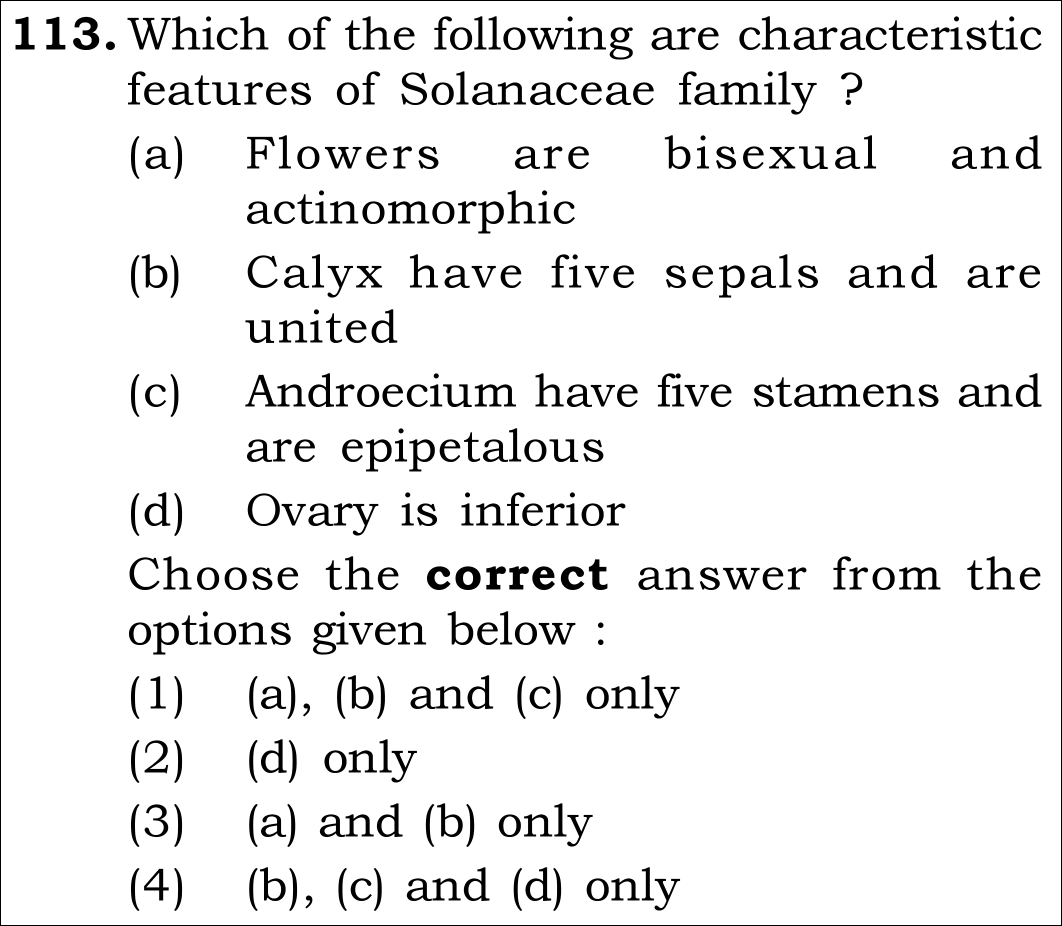
NEET 2026 · Q113 Medium
Official NEET 2026 Question 113 - Morphology of Flowering Plants
1 (a), (b) and (c) only ✓ Key
2 (d) only
3 (a) and (b) only
4 (b), (c) and (d) only
💡 Verified Solution & 30-Second Hack
✓
Verified Against NTA Final Answer Key
Option (1) : (a), (b) and (c) only
📚 Morphology of Flowering Plants Medium
📋 Given Parameters & Problem Setup
Family Solanaceae (Potato Family)
Candidate Features (a) Bisexual and actinomorphic flowers, (b) Calyx five sepals and united, (c) Androecium five stamens and epipetalous, (d) Ovary is inferior
⚡

The 30-Second Exam Hall Shortcut: ⚡ Superior Solanaceae Ovary Rule

⏱️ Save ~45 seconds

Solanaceae has a SUPERIOR ovary (G_), NOT an inferior one! (d) is FALSE!

1 Examine statement (d): "Ovary is inferior".
2 Recall the floral formula of Solanaceae: ⊕ ⚥ K₍₅₎ C₍₅₎ A₅ G₍₂₎ with superior ovary (hypogynous flower).
3 Therefore, statement (d) is definitively FALSE!
4 Eliminate any option containing (d): eliminates (2), eliminates (4).
5 Now choose between (1) [(a), (b) and (c) only] and (3) [(a) and (b) only].
6 Androecium has 5 stamens epipetalous (attached to petals) -> statement (c) is TRUE.
7 Select Option (1) in under 10 seconds!
🛡️
Why You Can 100% Trust This Shortcut: NCERT Biology · Morphology of Flowering Plants (Family Solanaceae Floral Formula: Bisexual, actinomorphic, K(5) C(5) A5 G(2) superior).
📐

Step-by-Step Rigorous Workflow & Mathematical Proof

Step 1

Analyze Statement (a): Symmetry & Sexuality

In Solanaceae (e.g., Solanum nigrum, Petunia, Datura), flowers are bisexual (hermaphrodite, ⚥) and actinomorphic (radial symmetry, ⊕).

Floral Symmetry=⊕andSexuality=⚥  ⟹  (a) is TRUE\text{Floral Symmetry} = \oplus \quad \text{and} \quad \text{Sexuality} = \text{⚥} \implies \text{(a) is TRUE}
  • • Flowers can be divided into equal vertical halves in any radial plane.
Step 2

Analyze Statement (b): Calyx Characteristics

Calyx consists of 5 sepals that are united (gamosepalous, K(5)K_{(5)}), persistent (as seen in brinjal and Physalis), and exhibit valvate aestivation.

Calyx=K(5)  (five sepals, united, persistent)  ⟹  (b) is TRUE\text{Calyx} = K_{(5)} \; (\text{five sepals, united, persistent}) \implies \text{(b) is TRUE}
  • • Statement (b) is an accurate diagnostic feature.
Step 3

Analyze Statement (c): Androecium & Epipetaly

Androecium consists of 5 alternipetalous stamens (A5A_5) whose filaments are adnate/attached to the corolla tube (epipetalous condition, denoted by an arch over C(5)C_{(5)} and A5A_5).

C(5)A5⎴  ⟹  Five stamens, epipetalous [statement (c) is TRUE]\overbracket{C_{(5)} \quad A_5} \implies \text{Five stamens, epipetalous [statement (c) is TRUE]}
  • • Anthers are dithecous, dehiscing longitudinally or poricidally.
Step 4

Analyze Statement (d): Gynoecium & Ovary Position

The gynoecium is bicarpellary, syncarpous, with an obliquely oriented ovary and a swollen placenta bearing many ovules. Most importantly, the flower is hypogynous, meaning the ovary is SUPERIOR (G‾(2)\underline{G}_{(2)}), NOT inferior.

Gynoecium=G‾(2)  ⟹  Ovary is SUPERIOR (statement (d) is FALSE)\text{Gynoecium} = \underline{G}_{(2)} \implies \text{Ovary is SUPERIOR (statement (d) is FALSE)}
  • • Inferior ovary (epigynous flower) is found in Asteraceae, Cucurbitaceae, guava, and cucumber, never in Solanaceae.
Step 5

Conclusion

Statements (a), (b), and (c) are correct, while (d) is incorrect. The matching choice is Option (1).

Correct Set=(a),(b) and (c) only  ⟹  Option (1)\text{Correct Set} = \mathbf{(a), (b) \text{ and } (c) \text{ only}} \implies \text{Option (1)}
  • • Matches official NTA final answer key Option A / (1).
⭐

360° Option Elimination Engine Key Feature

Diagnose every choice: Know exactly why the right option works and why distractors fail.

4-Option Deep Scan
1 A
✓ 100% Correct
Verdict & Scientific Reason:

100% accurate. Solanaceae has bisexual actinomorphic flowers, united sepals, and epipetalous stamens, with a superior ovary.

💡
Why this is airtight: None; complete mastery of floral formula.
2 B
✗ Incorrect
Verdict & Scientific Reason:

Incorrect. Ovary is superior in Solanaceae, making (d) completely false.

⚠️
Student Fallacy (Why candidates pick this trap): Confusing Solanaceae with epigynous families.
3 C
✗ Incorrect
Verdict & Scientific Reason:

Incorrect. Statement (c) is also true (epipetalous stamens is a hallmark of Solanaceae).

⚠️
Student Fallacy (Why candidates pick this trap): Forgetting that stamens are epipetalous in Solanaceae.
4 D
✗ Incorrect
Verdict & Scientific Reason:

Incorrect. Includes the false statement (d).

⚠️
Student Fallacy (Why candidates pick this trap): Failing to recognize superior ovary in hypogynous flowers.
⚠️

NTA Trap Alert: Inferior vs Superior Ovary in Angiosperm Families

NEET core families (Fabaceae, Solanaceae, Liliaceae) ALL have SUPERIOR ovaries! Only families like Asteraceae (Sunflower) and Cucurbitaceae have inferior ovaries.

🛡️ How to avoid the -1 mark: Remember: All three main NCERT families (Fabaceae, Solanaceae, Liliaceae) sit high on the thalamus with SUPERIOR ovaries!
📖

Core NEET Syllabus Standard

NEET Biology Core Syllabus · Morphology of Flowering Plants Standard Benchmark
Core Scientific Principle Tested:

"Solanaceae flowers are actinomorphic, bisexual, with gamosepalous calyx, epipetalous stamens, and a superior bicarpellary syncarpous ovary with oblique septum."

Syllabus Focus: Description of Some Important Families - Solanaceae
✓ Core NEET UG Syllabus Anchor Syllabus & Academic Standards ↗
Solanaceae is Superior (Superior Ovary)! 5 Petals, 5 Stamens glued on top, (d) is inferior so it must drop!
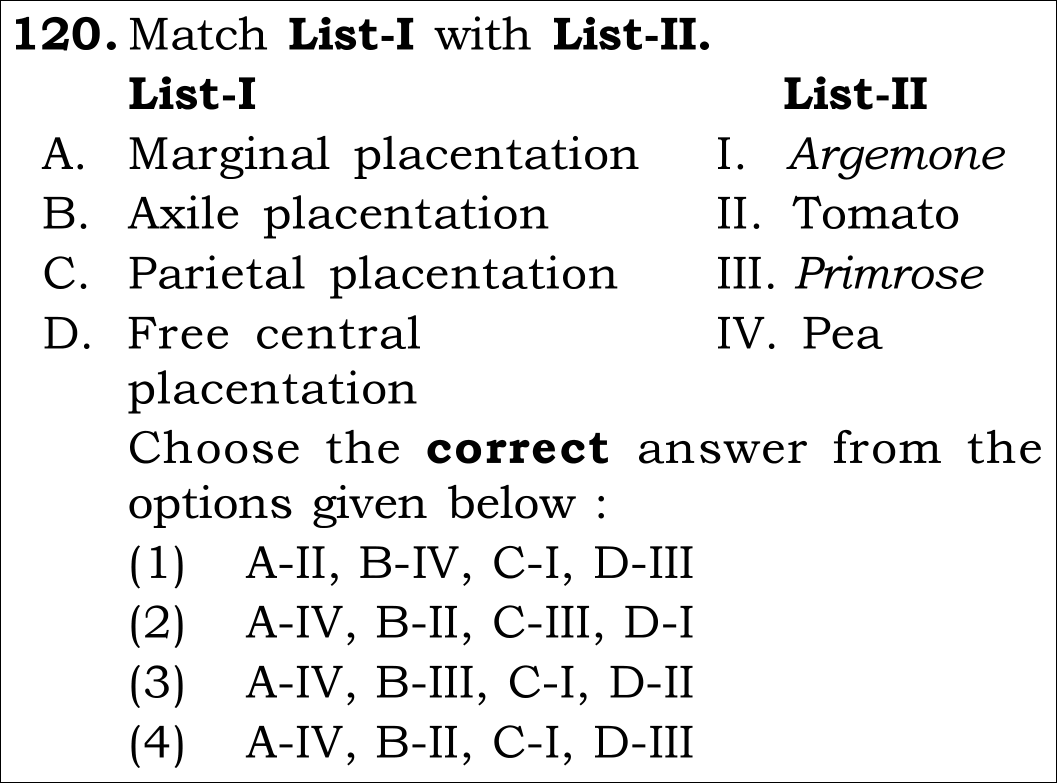
NEET 2026 · Q120 Easy
Official NEET 2026 Question 120 - Morphology of Flowering Plants
1
2
3
4 ✓ Key
💡 Verified Solution & 30-Second Hack
✓
Verified Against NTA Final Answer Key
Option (4) : A-IV, B-II, C-I, D-III
📚 Morphology of Flowering Plants Easy
📋 Given Parameters & Problem Setup
List-I Placentation Types A. Marginal, B. Axile, C. Parietal, D. Free central
List-II Plant Examples I. Argemone, II. Tomato, III. Primrose, IV. Pea
⚡

The 30-Second Exam Hall Shortcut: ⚡ Placentation Rapid Matcher

⏱️ Save ~40 seconds

Marginal = Pea (IV), Axile = Tomato (II), Parietal = Argemone (I), Free central = Primrose (III)!

1 Recall canonical NCERT placentation examples:
2 A. Marginal -> Pea (IV).
3 B. Axile -> Tomato / China rose / Lemon (II).
4 C. Parietal -> Argemone / Mustard (I).
5 D. Free central -> Primrose / Dianthus (III).
6 Direct pairing: A-IV, B-II, C-I, D-III -> Option (4)!
7 Select Option (4) in under 5 seconds.
🛡️
Why You Can 100% Trust This Shortcut: NCERT Biology · Morphology of Flowering Plants (Placentation Types: Marginal, axile, parietal, free central, and basal placentation).
📐

Step-by-Step Rigorous Workflow & Mathematical Proof

Step 1

Understand Marginal Placentation (A)

In marginal placentation, the placenta forms a ridge along the ventral suture of the monocarpellary ovary, and ovules are borne along this ridge in two rows. Canonical example: Pea (Pisum sativum).

Marginal→ExamplePea (IV)\text{Marginal} \xrightarrow{\text{Example}} \text{Pea (IV)}
  • • A pairs with IV.
Step 2

Understand Axile Placentation (B)

In axile placentation, the placenta is axial and the ovules are attached to it in a multilocular ovary divided by septa. Canonical examples: Tomato, China rose, Lemon.

Axile→ExampleTomato (II)\text{Axile} \xrightarrow{\text{Example}} \text{Tomato (II)}
  • • B pairs with II.
Step 3

Understand Parietal Placentation (C)

In parietal placentation, ovules develop on the inner wall of the unilocular ovary or on peripheral parts. The ovary becomes two-chambered due to the formation of a false septum (replum). Canonical examples: Mustard, Argemone.

Parietal→ExampleArgemone (I)\text{Parietal} \xrightarrow{\text{Example}} \text{Argemone (I)}
  • • C pairs with I.
Step 4

Understand Free Central Placentation (D)

In free central placentation, ovules are borne on a central axis and septa are completely absent. Canonical examples: Dianthus, Primrose.

Free central→ExamplePrimrose (III)\text{Free central} \xrightarrow{\text{Example}} \text{Primrose (III)}
  • • D pairs with III.
Step 5

Synthesize the Complete Match

Assembling all pairs gives: A-IV, B-II, C-I, D-III. Looking at the options, this matches Option (4).

Match:A-IV,  B-II,  C-I,  D-III  ⟹  Option (4)\text{Match}: \mathbf{A}\text{-IV}, \; \mathbf{B}\text{-II}, \; \mathbf{C}\text{-I}, \; \mathbf{D}\text{-III} \implies \text{Option (4)}
  • • Matches official NTA final answer key Option D / (4).
⭐

360° Option Elimination Engine Key Feature

Diagnose every choice: Know exactly why the right option works and why distractors fail.

4-Option Deep Scan
1 A
✗ Incorrect
Verdict & Scientific Reason:

Incorrect. Assigns Tomato to Marginal and Pea to Axile.

⚠️
Student Fallacy (Why candidates pick this trap): Swapped Marginal and Axile placentation examples.
2 B
✗ Incorrect
Verdict & Scientific Reason:

Incorrect. Swaps Argemone and Primrose.

⚠️
Student Fallacy (Why candidates pick this trap): Confusing Parietal with Free Central placentation.
3 C
✗ Incorrect
Verdict & Scientific Reason:

Incorrect. Places Primrose in Axile and Tomato in Free Central.

⚠️
Student Fallacy (Why candidates pick this trap): Confusing multilocular axile with unilocular central.
4 D
✓ 100% Correct
Verdict & Scientific Reason:

100% accurate match for all four placentation types according to NCERT Morphology.

💡
Why this is airtight: None; textbook precision.
⚠️

NTA Trap Alert: Confusing Parietal (False Septum) and Free Central (No Septum)

Both Parietal (Argemone) and Free Central (Primrose) feature unilocular ovaries, but Parietal ovules are on peripheral walls with false septa, while Free Central ovules are on an unattached central axis.

🛡️ How to avoid the -1 mark: Remember: Free Central has "Dian & Prim" running FREE (Dianthus & Primrose).
📖

Core NEET Syllabus Standard

NEET Biology Core Syllabus · Morphology of Flowering Plants Standard Benchmark
Core Scientific Principle Tested:

"Placentation types: Marginal in Pea, Axile in Tomato/Citrus, Parietal in Argemone/Mustard, Free Central in Primrose/Dianthus."

Syllabus Focus: The Flower - Gynoecium & Placentation
✓ Core NEET UG Syllabus Anchor Syllabus & Academic Standards ↗
Pea is on the Margin; Tomato has Axile chambers; Argemone is on the Parietal wall; Primrose is Free in the middle of it all!
NEET 2025 · Q104 Easy
Official NEET 2025 Question 104 - Morphology of Flowering Plants
1
2
3
4 ✓ Key
💡 Verified Solution & 30-Second Hack
✓
Verified Against NTA Final Answer Key
Option (4) : Statement I is incorrect but Statement II is correct
📚 Morphology of Flowering Plants Easy
📋 Given Parameters & Problem Setup
Symbol ⊕ Actinomorphic (radial symmetry)
Symbol G Superior ovary (hypogynous flower, line below G)
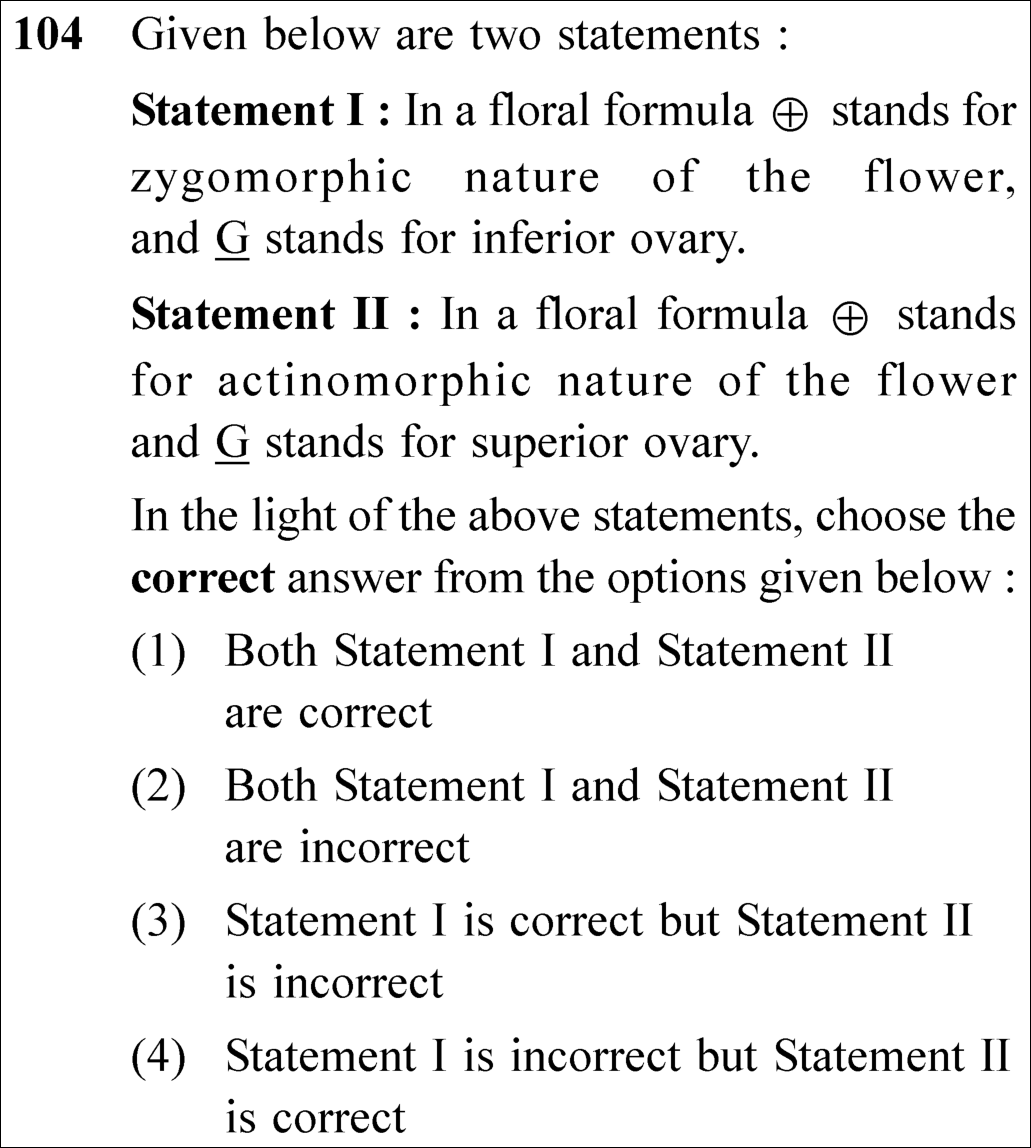
Statement I ⊕ stands for zygomorphic nature, and G stands for inferior ovary. (False)
Statement II ⊕ stands for actinomorphic nature, and G stands for superior ovary. (True)
⚡

The 30-Second Exam Hall Shortcut: ⚡ Floral Formula Decoding Shortcut

⏱️ Save ~20 seconds

⊕ has a circle with a cross = Radial / Actinomorphic symmetry! % = Bilateral / Zygomorphic! G has a line UNDER G = Ovary is ABOVE other whorls = SUPERIOR ovary! Statement I is FALSE; Statement II is TRUE ⟹ Option (4)!

1 Recall floral formula symbols from NCERT Chapter 5 Section 5.9:
2 - ⊕: Actinomorphic (radial symmetry).
3 - %: Zygomorphic (bilateral symmetry).
4 - G (bar below G): Superior ovary (flower is hypogynous).
5 - Ḡ (bar above G): Inferior ovary (flower is epigynous).
6 - G- (bar beside G): Half-inferior ovary (perigynous flower).
7 Statement I claims ⊕ is zygomorphic and G is inferior ⟹ completely FALSE.
8 Statement II claims ⊕ is actinomorphic and G is superior ⟹ completely TRUE.
9 Conclusion: Statement I is incorrect but Statement II is correct.
10 Select Option (4) in under 5 seconds!
🛡️
Why You Can 100% Trust This Shortcut: Floral Formulas & Diagnostic Family Characteristics (NCERT Biology · Morphology of Flowering Plants).
📐

Step-by-Step Rigorous Workflow & Mathematical Proof

Step 1

Floral Symmetry Symbols in Floral Formulas

Floral symmetry indicates the geometric planes along which a flower can be divided into identical halves:

⊕=Actinomorphic (Radial symmetry),%=Zygomorphic (Bilateral symmetry)\oplus = \text{Actinomorphic (Radial symmetry)}, \quad \% = \text{Zygomorphic (Bilateral symmetry)}
  • • Actinomorphic flowers (e.g., mustard, datura, chilli) can be divided into equal halves in any radial plane passing through the center.
  • • Therefore, ⊕ represents actinomorphy, not zygomorphy.
Step 2

Ovary Position Symbols in Floral Formulas

The horizontal line placed relative to the letter G (Gynoecium) designates the position of the ovary relative to the calyx, corolla, and androecium:

G‾=Superior ovary (Hypogynous),Gˉ=Inferior ovary (Epigynous)\underline{\text{G}} = \text{Superior ovary (Hypogynous)}, \quad \bar{\text{G}} = \text{Inferior ovary (Epigynous)}
  • • In a hypogynous flower, sepals, petals, and stamens insert below the ovary, so the line is drawn beneath the letter G (G).
  • • In an epigynous flower, floral parts arise above the ovary, so the line is drawn above G (Ḡ).
Step 3

Evaluate Statements I and II

Compare with the statements presented:

Statement I: Inverts both symbols  ⟹  False,Statement II: Accurate  ⟹  True\text{Statement I: Inverts both symbols} \implies \text{False}, \quad \text{Statement II: Accurate} \implies \text{True}
  • • Statement I is incorrect and Statement II is correct, matching Option (4).
⭐

360° Option Elimination Engine Key Feature

Diagnose every choice: Know exactly why the right option works and why distractors fail.

4-Option Deep Scan
1 A
✗ Incorrect
Verdict & Scientific Reason:

Incorrect. Statement I reverses both definitions.

⚠️
Student Fallacy (Why candidates pick this trap): Failing to notice the errors in Statement I.
2 B
✗ Incorrect
Verdict & Scientific Reason:

Incorrect. Statement II is correct.

⚠️
Student Fallacy (Why candidates pick this trap): Doubting canonical floral symbols.
3 C
✗ Incorrect
Verdict & Scientific Reason:

Incorrect. Inverts truth values.

⚠️
Student Fallacy (Why candidates pick this trap): Swapping definitions of actinomorphic and zygomorphic.
4 D
✓ 100% Correct
Verdict & Scientific Reason:

100% correct. ⊕ is actinomorphic and G is superior ovary.

💡
Why this is airtight: None; flawless recall of botanical floral notation.
⚠️

NTA Trap Alert: Confusing Underline Position on G

A common slip is thinking the line shows where the ovary is located (line below = inferior). In botany, the line represents the OTHER floral whorls: line below G means other whorls are BELOW the ovary, so the ovary is SUPERIOR!

🛡️ How to avoid the -1 mark: Remember: Line BELOW G means ovary sits on top = SUPERIOR!
📖

Core NEET Syllabus Standard

NEET Biology Core Syllabus · Morphology of Flowering Plants Standard Benchmark
Core Scientific Principle Tested:

"⊕ designates actinomorphic symmetry; G designates a superior ovary."

Syllabus Focus: Semi-Technical Description of a Typical Flowering Plant: Floral Formula
✓ Core NEET UG Syllabus Anchor Syllabus & Academic Standards ↗
Circle cross ⊕ = Radial (Actino); Line under G = G is on top (Superior) ⟹ Statement II is TRUE (Option 4)!
NEET 2025 · Q124 Easy
Official NEET 2025 Question 124 - Morphology of Flowering Plants
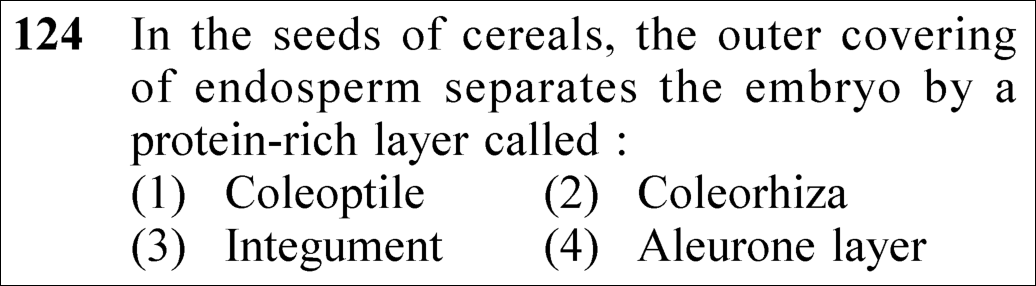
1 Coleoptile
2 Coleorhiza
3 Integument
4 Aleurone layer ✓ Key
💡 Verified Solution & 30-Second Hack
✓
Verified Against NTA Final Answer Key
Option (4) : Aleurone layer
📚 Morphology of Flowering Plants Easy
📋 Given Parameters & Problem Setup
Plant Group Cereal grains (Monocotyledonous seeds, e.g., maize, wheat)
Structure Description Outer protein-rich layer of endosperm separating it from the embryo
⚡

The 30-Second Exam Hall Shortcut: ⚡ Monocot Seed Protein Layer Fingerprint

⏱️ Save ~20 seconds

Endosperm of cereal grains is surrounded by a special PROTEIN-RICH layer separating it from the scutellum/embryo -> ALEURONE LAYER (3n)!

1 Recall monocot seed anatomy (maize grain) from NCERT:
2 - Seed coat is fused with the pericarp (caryopsis fruit).
3 - Endosperm is bulky and stores food (starch).
4 - The outer covering of endosperm separates the embryo by a proteinous layer called the ALEURONE LAYER.
5 - Coleoptile protects plumule; coleorhiza protects radicle.
6 Protein-rich layer = Aleurone layer!
7 Select Option (4) directly!
🛡️
Why You Can 100% Trust This Shortcut: Fruit Types & Pericarp Differentiation (NCERT Biology · Morphology of Flowering Plants: Drupe in Mango and Coconut).
📐

Step-by-Step Rigorous Workflow & Mathematical Proof

Step 1

Anatomy of a Monocotyledonous (Cereal) Seed

Cereal grains (such as maize, wheat, barley, and rice) are single-seeded fruits (caryopsis) where the seed coat is membranous and generally fused with the fruit wall (pericarp):

  • • The seed is divided into two unequal regions: a large storage endosperm and a small laterally placed embryo.
  • • The outer covering of the endosperm differentiates into a specialized protein-rich peripheral layer termed the aleurone layer.
  • • The aleurone layer synthesizes hydrolytic enzymes (such as α\alpha-amylase induced by gibberellins) during seed germination to mobilize stored starch from the endosperm to the developing embryo.
Step 2

Evaluating Alternative Embryonic Structures

Distinguishing protective coverings of the monocot embryo:

  • • Coleoptile: A conical protective foliar sheath enclosing the plumule (shoot tip).
  • • Coleorhiza: An undifferentiated protective sheath enclosing the radicle and root cap.
  • • Integument: The diploid maternal layer enveloping the ovule that matures into the seed coat (testa and tegmen).
Step 3

Conclusion

The protein-rich boundary layer separating the endosperm from the embryo is the Aleurone layer.

Outer Endosperm Protein Layer=Aleurone Layer\text{Outer Endosperm Protein Layer} = \text{Aleurone Layer}
⭐

360° Option Elimination Engine Key Feature

Diagnose every choice: Know exactly why the right option works and why distractors fail.

4-Option Deep Scan
1 A
✗ Incorrect
Verdict & Scientific Reason:

Incorrect. Coleoptile is the sheath protecting the plumule, not a protein layer separating endosperm from embryo.

⚠️
Student Fallacy (Why candidates pick this trap): Confusing shoot sheath with endosperm covering.
2 B
✗ Incorrect
Verdict & Scientific Reason:

Incorrect. Coleorhiza is the sheath covering the radicle and root cap.

⚠️
Student Fallacy (Why candidates pick this trap): Confusing root sheath with endosperm covering.
3 C
✗ Incorrect
Verdict & Scientific Reason:

Incorrect. Integument is the ovular covering that becomes the seed coat.

⚠️
Student Fallacy (Why candidates pick this trap): Confusing seed coat origin with internal seed layers.
4 D
✓ 100% Correct
Verdict & Scientific Reason:

100% correct. Verbatim NCERT fact: "The outer covering of endosperm separates the embryo by a proteinous layer called aleurone layer."

💡
Why this is airtight: None; textbook mastery.
⚠️

NTA Trap Alert: Ploidy and Nature of Aleurone Layer

Because the aleurone layer is morphologically the outermost cell layer of the endosperm, its cells are triploid (3n) in angiosperms and specialized for protein storage and hydrolytic enzyme secretion.

🛡️ How to avoid the -1 mark: Aleurone = Protein layer of endosperm (3n). Coleoptile/Coleorhiza = Sheaths of the embryo (2n).
📖

Core NEET Syllabus Standard

NEET Biology Core Syllabus · Morphology of Flowering Plants Standard Benchmark
Core Scientific Principle Tested:

"In cereal seeds, a proteinous layer called the aleurone layer separates the endosperm from the embryo."

Syllabus Focus: Structure of Monocotyledonous Seed
✓ Core NEET UG Syllabus Anchor Syllabus & Academic Standards ↗
ALEURONE = All-protein outer endosperm zone!
NEET 2025 · Q155 Easy
Official NEET 2025 Question 155 - Morphology of Flowering Plants
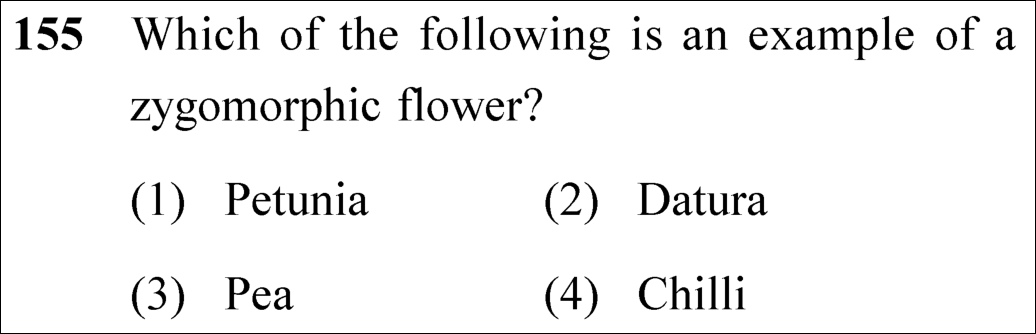
1 Petunia
2 Datura
3 Pea ✓ Key
4 Chilli
💡 Verified Solution & 30-Second Hack
✓
Verified Against NTA Final Answer Key
Option (3) : Pea
📚 Morphology of Flowering Plants Easy
📋 Given Parameters & Problem Setup
Symmetry Type Zygomorphic (bilateral floral symmetry)
Target Example Representative plant species
⚡

The 30-Second Exam Hall Shortcut: ⚡ Floral Symmetry Fingerprint

⏱️ Save ~15 seconds

Actinomorphic (radial) = Mustard, Datura, Chilli! Zygomorphic (bilateral) = PEA, Gulmohur, Bean, Cassia! Pea is Zygomorphic!

1 Recall floral symmetry definitions and examples from NCERT Section 5.3:
2 - Actinomorphic (radial symmetry): Can be divided into two equal radial halves in any radial plane passing through the centre. Examples: Mustard, Datura, Chilli, Petunia (Solanaceae).
3 - Zygomorphic (bilateral symmetry): Can be divided into two similar halves only in ONE particular vertical plane. Examples: Pea, Gulmohur, Bean, Cassia.
4 - Asymmetric (irregular): Canna.
5 Direct match for zygomorphic: Pea!
6 Select Option (3) Pea!
🛡️
Why You Can 100% Trust This Shortcut: Stem Modifications & Tendril/Thorn Homology (NCERT Biology · Morphology of Flowering Plants: Axillary bud origin).
📐

Step-by-Step Rigorous Workflow & Mathematical Proof

Step 1

Definition of Zygomorphic Symmetry

Floral symmetry is a primary taxonomic character in angiosperm classification:

  • • A flower is zygomorphic (bilaterally symmetrical) when it can be divided into two equal and similar halves along only one single vertical median longitudinal plane.
  • • In floral diagrams and formulas, zygomorphic symmetry is denoted by the percentage sign (%\%).
Step 2

Evaluation of the Given Candidates

Classifying the provided options based on NCERT examples:

  • • 1. Petunia: Belongs to family Solanaceae; flowers are actinomorphic (radial symmetry, ⊕\oplus).
  • • 2. Datura: Belongs to family Solanaceae; flowers are actinomorphic (radial symmetry, ⊕\oplus).
  • • 3. Pea (*Pisum sativum*): Belongs to family Fabaceae; flowers have vexillary (papilionaceous) aestivation with standard, wings, and keel, making them distinctly zygomorphic (%,C1+2+(2)\%, C_{1+2+(2)}).
  • • 4. Chilli (*Capsicum annuum*): Belongs to family Solanaceae; flowers are actinomorphic (radial symmetry, ⊕\oplus).
Step 3

Conclusion

Among the choices, Pea is the definitive example of a zygomorphic flower.

Zygomorphic Flower=Pea (Pisum sativum)\text{Zygomorphic Flower} = \text{Pea (Pisum sativum)}
⭐

360° Option Elimination Engine Key Feature

Diagnose every choice: Know exactly why the right option works and why distractors fail.

4-Option Deep Scan
1 A
✗ Incorrect
Verdict & Scientific Reason:

Incorrect. Petunia has actinomorphic flowers characteristic of family Solanaceae.

⚠️
Student Fallacy (Why candidates pick this trap): Confusing Solanaceae symmetry with Fabaceae symmetry.
2 B
✗ Incorrect
Verdict & Scientific Reason:

Incorrect. Datura is an NCERT textbook example of an actinomorphic flower.

⚠️
Student Fallacy (Why candidates pick this trap): Ignoring NCERT explicit listing of Datura as actinomorphic.
3 C
✓ 100% Correct
Verdict & Scientific Reason:

100% correct. Pea possesses classic papilionaceous zygomorphic flowers dividable along only one vertical plane.

💡
Why this is airtight: None; textbook mastery.
4 D
✗ Incorrect
Verdict & Scientific Reason:

Incorrect. Chilli is explicitly cited by NCERT as an actinomorphic flower.

⚠️
Student Fallacy (Why candidates pick this trap): Confusing chilli with pea.
⚠️

NTA Trap Alert: Fabaceae vs Solanaceae Symmetry

Remember the family-level symmetries: All Fabaceae (Pea, Bean, Gram, Moong, Arhar) are ZYGOMORPHIC (%). All Solanaceae (Potato, Tomato, Brinjal, Chilli, Datura, Petunia) are ACTINOMORPHIC (⊕)!

🛡️ How to avoid the -1 mark: Solanaceae = Actinomorphic; Fabaceae = Zygomorphic.
📖

Core NEET Syllabus Standard

NEET Biology Core Syllabus · Morphology of Flowering Plants Standard Benchmark
Core Scientific Principle Tested:

"Flowers of pea, gulmohur, bean, and cassia are zygomorphic (bilaterally symmetrical)."

Syllabus Focus: The Flower · Floral Symmetry
✓ Core NEET UG Syllabus Anchor Syllabus & Academic Standards ↗
Z-PGBC: Zygomorphic = Pea, Gulmohur, Bean, Cassia!
NEET 2024 · Q113 Medium
Official NEET 2024 Question 113 - Morphology of Flowering Plants
1
2 ✓ Key
3
4
💡 Verified Solution & 30-Second Hack
✓
Verified Against NTA Final Answer Key
Option (2) : (a) Perigynous; (b) Perigynous
📚 Morphology of Flowering Plants Medium
📋 Given Parameters & Problem Setup
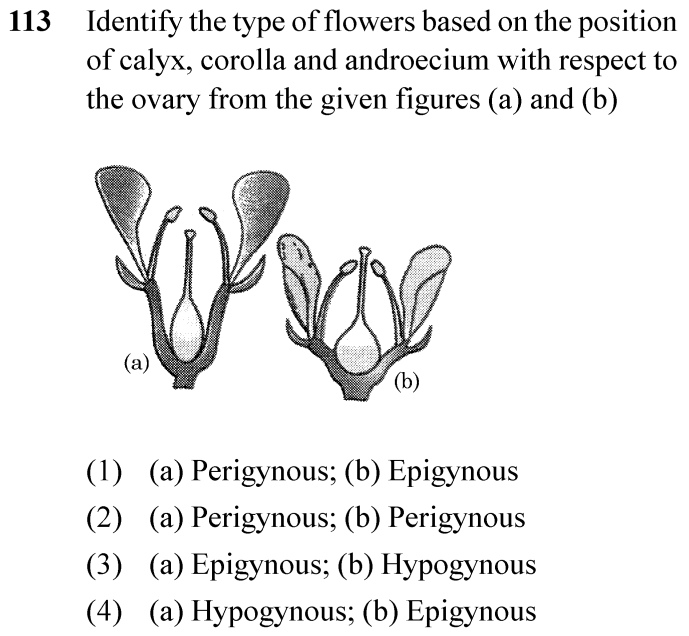
Diagrams Figures (a) and (b) showing floral parts arranged on the thalamus rim with half-inferior ovary
Morphological Classification Hypogynous / Perigynous / Epigynous
⚡

The 30-Second Exam Hall Shortcut: ⚡ NCERT Floral Diagram Recognition

⏱️ Save ~30 seconds

In Figure 5.13 of NCERT, diagram (a) is hypogynous, diagrams (b) and (c) are both perigynous (cup/rim shaped thalamus with half-inferior ovary), and (d) is epigynous. The two given diagrams are both perigynous forms!

1 Look at both figures depicting perigynous flowers:
2 - In both figures, the thalamus forms a cup or rim-like receptacle.
3 - Gynoecium is situated at the center, and other parts of the flower are located on the rim of the thalamus almost at the same level.
4 - The ovary is half-inferior.
5 - Both diagrams (a) and (b) represent perigynous conditions (seen in plum, rose, peach).
6 Answer: (a) Perigynous; (b) Perigynous -> Option (2) / B.
🛡️
Why You Can 100% Trust This Shortcut: NCERT Biology · Morphology of Flowering Plants (Position of Floral Parts on Thalamus)
📐

Step-by-Step Rigorous Workflow & Mathematical Proof

Step 1

Review NCERT Classification of Flowers by Ovary Position

Based on the position of calyx, corolla and androecium in respect of the ovary on thalamus, flowers are described as hypogynous, perigynous and epigynous.

Step 2

Anatomical Criteria for Perigynous Flowers

If gynoecium is situated in the centre and other parts of the flower are located on the rim of the thalamus almost at the same level, it is called perigynous. The ovary here is said to be half inferior (e.g., plum, rose, peach). NCERT illustrates two complementary section diagrams of perigynous arrangements demonstrating variation in thalamus cup depth.

Step 3

Identify the Provided Figures

Both figures depict the gynoecium situated centrally with floral appendages attached along the elevated thalamus rim at the same horizontal plane—both are perigynous flowers.

⭐

360° Option Elimination Engine Key Feature

Diagnose every choice: Know exactly why the right option works and why distractors fail.

4-Option Deep Scan
1 (1)
✗ Incorrect
Verdict & Scientific Reason:

In hypogynous flowers the ovary occupies the highest position; in epigynous the thalamus completely encloses the ovary and fuses with it.

⚠️
Student Fallacy (Why candidates pick this trap): In hypogynous flowers the ovary occupies the highest position; in epigynous the thalamus completely encloses the ovary and fuses with it.
2 (2)
✓ 100% Correct
Verdict & Scientific Reason:

Both diagrams illustrate perigynous floral structures featuring half-inferior ovaries with appendages on the thalamus rim.

💡
Why this is airtight: None.
3 (3)
✗ Incorrect
Verdict & Scientific Reason:

Diagram (b) does not show complete thalamic fusion over the ovary.

⚠️
Student Fallacy (Why candidates pick this trap): Diagram (b) does not show complete thalamic fusion over the ovary.
4 (4)
✗ Incorrect
Verdict & Scientific Reason:

Diagram (a) shows the receptacle elevated around the gynoecium, not inferior to it.

⚠️
Student Fallacy (Why candidates pick this trap): Diagram (a) shows the receptacle elevated around the gynoecium, not inferior to it.
⚠️

NTA Trap Alert: Assuming All Diagrams Must Be Different Types

Students intuitively assume that if two diagrams are shown, one must be hypogynous and the other perigynous or epigynous.

🛡️ How to avoid the -1 mark: Notice that NCERT provides two distinct sectional diagrams (dish-shaped and cup-shaped) specifically for the perigynous condition.
📖

Core NEET Syllabus Standard

Biology Core Botany · Morphology of Flowering Plants Standard Benchmark
Core Scientific Principle Tested:

"If gynoecium is situated in the centre and other parts of the flower are located on the rim of the thalamus almost at the same level, it is called perigynous. The ovary here is said to be half inferior, e.g., plum, rose, peach."

Syllabus Focus: Types of Flowers Based on Ovary Position: Perigynous Flowers
✓ Core NEET UG Syllabus Anchor Syllabus & Academic Standards ↗
NEET 2024 · Q120 Easy
Official NEET 2024 Question 120 - Morphology of Flowering Plants
1
2
3 ✓ Key
4
💡 Verified Solution & 30-Second Hack
✓
Verified Against NTA Final Answer Key
Option (3) : Datura
📚 Morphology of Flowering Plants Easy
📋 Given Parameters & Problem Setup
Feature Actinomorphic flower (radial symmetry)
Candidate Genera Mustard, Datura, Chilli vs Pea, Gulmohur, Bean, Cassia
⚡

The 30-Second Exam Hall Shortcut: ⚡ Floral Symmetry Mnemonic

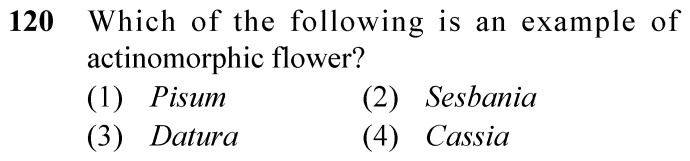
⏱️ Save ~20 seconds

Actinomorphic = Mustard, Datura, Chilli (MDC -> Medical Dental College). Zygomorphic = Pea, Gulmohur, Bean, Cassia (PGBC). Datura is Actinomorphic!

1 Recall floral symmetry examples:
2 - Actinomorphic (radial symmetry): Mustard, Datura, Chilli.
3 - Zygomorphic (bilateral symmetry): Pea, Gulmohur, Bean, Cassia.
4 - Asymmetric (irregular): Canna.
5 Among the choices, Datura is actinomorphic -> Option (3) / C.
🛡️
Why You Can 100% Trust This Shortcut: NCERT Biology · Morphology of Flowering Plants (Floral Symmetry)
📐

Step-by-Step Rigorous Workflow & Mathematical Proof

Step 1

Define Actinomorphic Symmetry

When a flower can be divided into two equal radial halves in any radial plane passing through the centre, it is said to be actinomorphic (radial symmetry).

Step 2

Evaluate NCERT Genera

NCERT provides specific examples: Mustard, Datura, and Chilli are actinomorphic. Pea, Gulmohur, Bean, and Cassia are zygomorphic (can be divided into two similar halves only in one particular vertical plane).

Step 3

Match with Options

Datura possesses actinomorphic floral symmetry.

⭐

360° Option Elimination Engine Key Feature

Diagnose every choice: Know exactly why the right option works and why distractors fail.

4-Option Deep Scan
1 (1)
✗ Incorrect
Verdict & Scientific Reason:

Pea exhibits zygomorphic (bilateral) symmetry (papilionaceous corolla).

⚠️
Student Fallacy (Why candidates pick this trap): Pea exhibits zygomorphic (bilateral) symmetry (papilionaceous corolla).
2 (2)
✗ Incorrect
Verdict & Scientific Reason:

Cassia flowers are zygomorphic.

⚠️
Student Fallacy (Why candidates pick this trap): Cassia flowers are zygomorphic.
3 (3)
✓ 100% Correct
Verdict & Scientific Reason:

Datura flowers exhibit radial symmetry (actinomorphic).

💡
Why this is airtight: None.
4 (4)
✗ Incorrect
Verdict & Scientific Reason:

Gulmohur flowers exhibit zygomorphic symmetry.

⚠️
Student Fallacy (Why candidates pick this trap): Gulmohur flowers exhibit zygomorphic symmetry.
⚠️

NTA Trap Alert: Cassia vs Chilli Confusion

Confusing Cassia (zygomorphic) with Chilli (actinomorphic).

🛡️ How to avoid the -1 mark: Remember: MDC = Mustard, Datura, Chilli are all Actinomorphic.
📖

Core NEET Syllabus Standard

Biology Core Botany · Morphology of Flowering Plants Standard Benchmark
Core Scientific Principle Tested:

"When a flower can be divided into two equal radial halves in any radial plane passing through the centre, it is said to be actinomorphic, e.g., mustard, datura, chilli."

Syllabus Focus: Actinomorphic (Radial) vs Zygomorphic (Bilateral) Floral Symmetry
✓ Core NEET UG Syllabus Anchor Syllabus & Academic Standards ↗
NEET 2024 · Q136 Easy
Official NEET 2024 Question 136 - Morphology of Flowering Plants
1
2
3 ✓ Key
4
💡 Verified Solution & 30-Second Hack
✓
Verified Against NTA Final Answer Key
Option (3) : A-II, B-IV, C-I, D-III
📚 Morphology of Flowering Plants Easy
📋 Given Parameters & Problem Setup
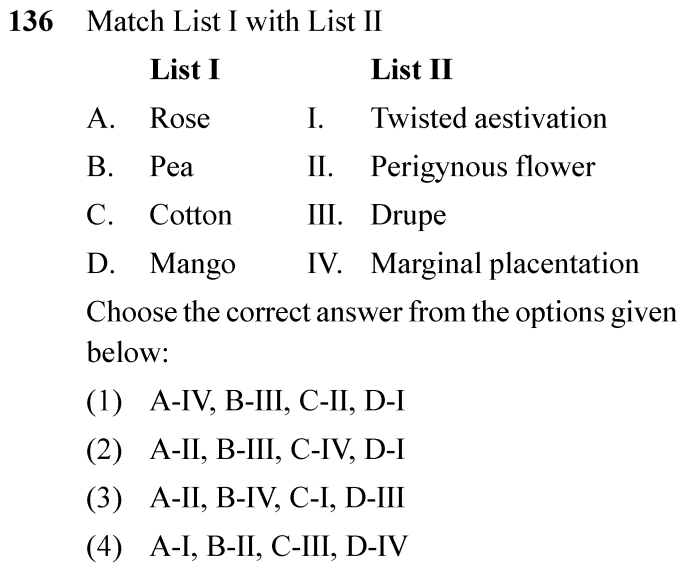
List I (Plants) A: Rose; B: Pea; C: Cotton; D: Mango
List II (Morphological Traits) I: Twisted aestivation; II: Perigynous flower; III: Drupe; IV: Marginal placentation
⚡

The 30-Second Exam Hall Shortcut: ⚡ Plant Morphology Classic Matching

⏱️ Save ~25 seconds

Rose = Perigynous (II); Pea = Marginal placentation (IV); Cotton = Twisted aestivation (I); Mango = Drupe fruit (III). Matches: A-II, B-IV, C-I, D-III!

1 A. Rose: flower is perigynous with half-inferior ovary (II).
2 B. Pea: gynoecium has marginal placentation (IV).
3 C. Cotton: petals exhibit twisted aestivation (I) (China rose, lady’s finger, cotton).
4 D. Mango: fruit is a classic single-seeded Drupe (III).
5 Matches: A-II, B-IV, C-I, D-III -> Option (3) / C.
🛡️
Why You Can 100% Trust This Shortcut: NCERT Biology · Morphology of Flowering Plants (Aestivation, Placentation, and Fruits)
📐

Step-by-Step Rigorous Workflow & Mathematical Proof

Step 1

Match Rose and Pea Features

Rose possesses perigynous flowers where the rim of the thalamus bears floral organs at the level of the half-inferior ovary (A -> II). Pea exhibits marginal placentation along the ventral suture of the monocarpellary ovary (B -> IV).

Step 2

Match Cotton and Mango Features

Cotton belongs to Malvaceae, showing twisted aestivation where one margin of an appendage overlaps that of the next (C -> I). Mango fruit develops from a monocarpellary superior ovary as a drupe with stony endocarp (D -> III).

Step 3

Verify Matching Combination

The corresponding combination is A-II, B-IV, C-I, D-III, matching Option (3).

⭐

360° Option Elimination Engine Key Feature

Diagnose every choice: Know exactly why the right option works and why distractors fail.

4-Option Deep Scan
1 (1)
✗ Incorrect
Verdict & Scientific Reason:

Mismatches Rose with Marginal placentation and Mango with Twisted aestivation.

⚠️
Student Fallacy (Why candidates pick this trap): Mismatches Rose with Marginal placentation and Mango with Twisted aestivation.
2 (2)
✗ Incorrect
Verdict & Scientific Reason:

Mismatches Pea with Drupe and Mango with Twisted aestivation.

⚠️
Student Fallacy (Why candidates pick this trap): Mismatches Pea with Drupe and Mango with Twisted aestivation.
3 (3)
✓ 100% Correct
Verdict & Scientific Reason:

Accurately pairs all four species with their distinctive morphological features.

💡
Why this is airtight: None.
4 (4)
✗ Incorrect
Verdict & Scientific Reason:

Mismatches Rose with Drupe and Mango with Perigynous flower.

⚠️
Student Fallacy (Why candidates pick this trap): Mismatches Rose with Drupe and Mango with Perigynous flower.
⚠️

NTA Trap Alert: Drupe vs Berry Classification

Confusing drupe fruits (mango, coconut) with hesperidium or berries.

🛡️ How to avoid the -1 mark: Remember: Mango and coconut are textbook drupes with a hard, stony endocarp.
📖

Core NEET Syllabus Standard

Biology Core Botany · Morphology of Flowering Plants Standard Benchmark
Core Scientific Principle Tested:

"In rose, the flower is perigynous. In marginal placentation, the placenta forms a ridge along the ventral suture of the ovary (e.g. pea). In twisted aestivation, one margin overlaps the next (cotton). In mango and coconut, the fruit is known as a drupe."

Syllabus Focus: Floral Characteristics: Ovary Position, Placentation, Aestivation, and Fruit
✓ Core NEET UG Syllabus Anchor Syllabus & Academic Standards ↗
NEET 2024 · Q145 Easy
Official NEET 2024 Question 145 - Morphology of Flowering Plants
1
2
3 ✓ Key
4
💡 Verified Solution & 30-Second Hack
✓
Verified Against NTA Final Answer Key
Option (3) : A-IV, B-II, C-I, D-III
📚 Morphology of Flowering Plants Easy
📋 Given Parameters & Problem Setup
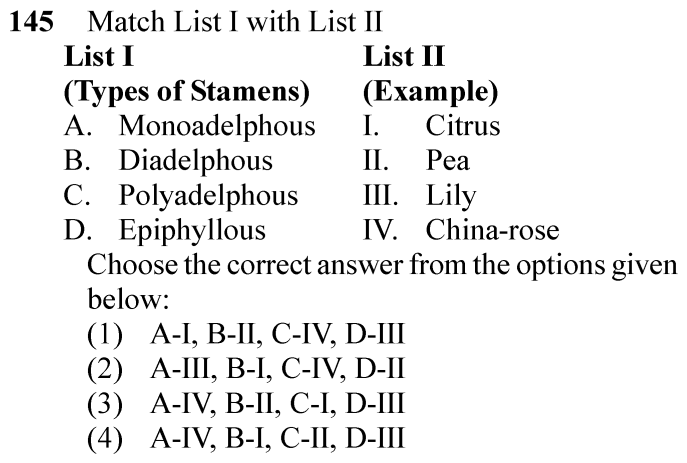
List I (Stamen Arrangement) A: Monoadelphous; B: Diadelphous; C: Polyadelphous; D: Epiphyllous
List II (Plant Examples) I: Citrus; II: Pea; III: Lily; IV: China-rose
⚡

The 30-Second Exam Hall Shortcut: ⚡ Stamen Cohesion/Adhesion Mnemonic

⏱️ Save ~25 seconds

Monoadelphous = China-rose (IV); Diadelphous = Pea (9+1) (II); Polyadelphous = Citrus (I); Epiphyllous = Lily (attached to perianth) (III)! Match: A-IV, B-II, C-I, D-III!

1 A. Monoadelphous: stamens united into one bundle -> China-rose (IV).
2 B. Diadelphous: stamens united into two bundles -> Pea (9+1) (II).
3 C. Polyadelphous: stamens united into more than two bundles -> Citrus (I).
4 D. Epiphyllous: stamens attached to the perianth (tepals) -> Lily (III).
5 Matching order: A-IV, B-II, C-I, D-III -> Option (3) / C.
🛡️
Why You Can 100% Trust This Shortcut: NCERT Biology · Morphology of Flowering Plants (Androecium and Stamen Fusion)
📐

Step-by-Step Rigorous Workflow & Mathematical Proof

Step 1

Define Types of Stamen Cohesion

The stamens may be united into one bunch or one bundle (monoadelphous) as in China rose, or into two bundles (diadelphous) as in pea, or into more than two bundles (polyadelphous) as in citrus.

Step 2

Define Epiphylly Adhesion

When stamens are attached to the perianth, as in the flowers of lily, they are described as epiphyllous (in contrast to epipetalous when attached to petals, as in brinjal).

Step 3

Combine Mappings

A-IV, B-II, C-I, D-III correctly represents all conditions, matching Option (3).

⭐

360° Option Elimination Engine Key Feature

Diagnose every choice: Know exactly why the right option works and why distractors fail.

4-Option Deep Scan
1 (1)
✗ Incorrect
Verdict & Scientific Reason:

Mismatches Monoadelphous with Citrus and Polyadelphous with China-rose.

⚠️
Student Fallacy (Why candidates pick this trap): Mismatches Monoadelphous with Citrus and Polyadelphous with China-rose.
2 (2)
✗ Incorrect
Verdict & Scientific Reason:

Mismatches Monoadelphous with Lily.

⚠️
Student Fallacy (Why candidates pick this trap): Mismatches Monoadelphous with Lily.
3 (3)
✓ 100% Correct
Verdict & Scientific Reason:

Accurately pairs China-rose (monoadelphous), Pea (diadelphous), Citrus (polyadelphous), and Lily (epiphyllous).

💡
Why this is airtight: None.
4 (4)
✗ Incorrect
Verdict & Scientific Reason:

Mismatches Diadelphous with Citrus and Polyadelphous with Pea.

⚠️
Student Fallacy (Why candidates pick this trap): Mismatches Diadelphous with Citrus and Polyadelphous with Pea.
⚠️

NTA Trap Alert: Epipetalous vs Epiphyllous

Confusing epiphyllous (attached to perianth in Lily) with epipetalous (attached to petals in Brinjal).

🛡️ How to avoid the -1 mark: Lily lacks distinct petals/sepals (has perianth/tepals), so its stamens are epi-PHYLLOUS.
📖

Core NEET Syllabus Standard

Biology Core Botany · Morphology of Flowering Plants Standard Benchmark
Core Scientific Principle Tested:

"The stamens may be united into one bunch or one bundle (monoadelphous) as in china rose, or two bundles (diadelphous) as in pea, or into more than two bundles (polyadelphous) as in citrus... when attached to the perianth as in the flowers of lily they are epiphyllous."

Syllabus Focus: Stamen Cohesion (Adelphy) and Adhesion (Epiphylly)
✓ Core NEET UG Syllabus Anchor Syllabus & Academic Standards ↗
NEET 2023 · Q111 Easy
Official NEET 2023 Question 111 - Morphology of Flowering Plants
1 Epiphyllous and Dithecous anthers
2 Diadelphous and Dithecous anthers ✓ Key
3 Polyadelphous and epipetalous stamens
4 Monoadelphous and Monothecous anthers
💡 Verified Solution & 30-Second Hack
✓
Verified Against NTA Final Answer Key
Option (2) : Diadelphous and Dithecous anthers
📚 Morphology of Flowering Plants Easy
📋 Given Parameters & Problem Setup
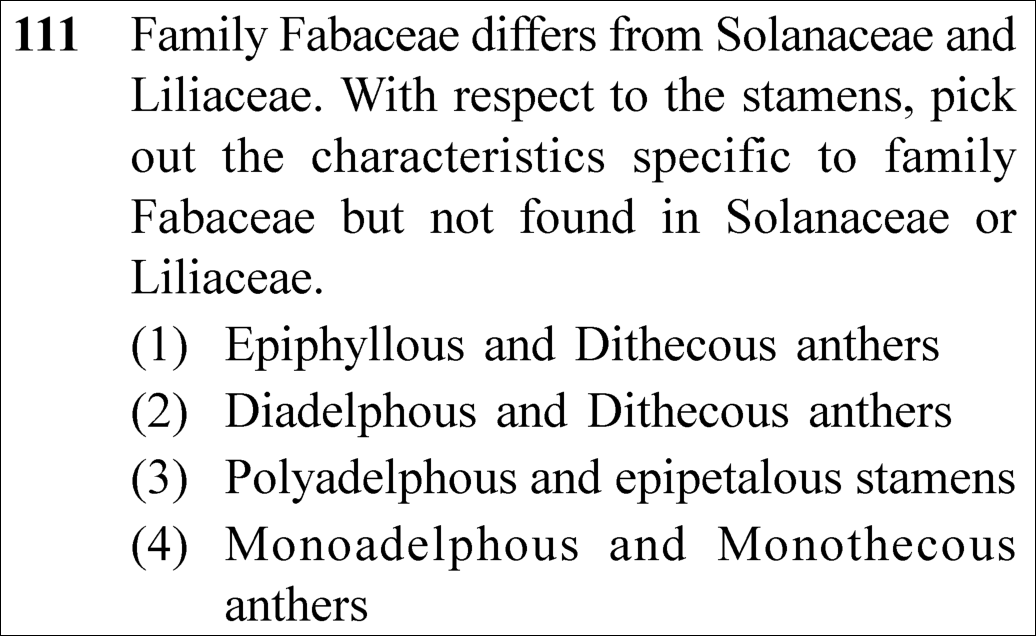
Target Family Fabaceae (Papilionoideae / Legume family)
Comparison Families Solanaceae (Potato family) and Liliaceae (Lily family)
Organ Androecium (stamens)
⚡

The 30-Second Exam Hall Shortcut: ⚡ Fabaceae Androecium Formula: 9 + 1 Diadelphous

⏱️ Save ~25 seconds

The classic hallmark of Fabaceae androecium is ten stamens arranged in two bundles: 9 fused into a sheath and 1 free, i.e., diadelphous condition A(9)+1A_{(9)+1} with dithecous anthers!

1 Fabaceae androecium: Stamens ten, diadelphous A(9)+1A_{(9)+1}, anther dithecous.
2 Solanaceae androecium: Stamens five, epipetalous, free, dithecous.
3 Liliaceae androecium: Stamens six, 3+33+3, epiphyllous, dithecous.
4 Only Fabaceae possesses the diadelphous condition.
5 Match Option (2) Diadelphous and Dithecous anthers.
🛡️
Why You Can 100% Trust This Shortcut: Canonical NCERT Angiosperm family floral formulas and morphological diagnostics.
📐

Step-by-Step Rigorous Workflow & Mathematical Proof

Step 1

Comparative Androecium Morphology Across Families

Analyzing the androecium of the three canonical NCERT angiosperm families:

Fabaceae:Stamens ten, diadelphous (9)+1, anther dithecousSolanaceae:Stamens five, epipetalous (\overparenC A5), polyandrous, anther dithecousLiliaceae:Stamens six, epiphyllous (\overparenP A3+3), anther dithecous\begin{aligned} \text{\textbf{Fabaceae:}} & \quad \text{Stamens ten, } \mathbf{\text{diadelphous } (9)+1}, \text{ anther } \mathbf{\text{dithecous}} \\[4pt] \text{Solanaceae:} & \quad \text{Stamens five, epipetalous } (\overparen{C\ A}_5), \text{ polyandrous, anther dithecous} \\[4pt] \text{Liliaceae:} & \quad \text{Stamens six, epiphyllous } (\overparen{P\ A}_{3+3}), \text{ anther dithecous} \end{aligned}
Step 2

Elimination of Non-Fabaceae Features

Epiphyllous stamens (adnate to perianth) are unique to Liliaceae. Epipetalous stamens (adnate to corolla) characterize Solanaceae. Monadelphous monothecous stamens characterize Malvaceae (China rose).

Step 3

Conclusion

The combination of diadelphous stamens and dithecous anthers uniquely differentiates Fabaceae from Solanaceae and Liliaceae.

⭐

360° Option Elimination Engine Key Feature

Diagnose every choice: Know exactly why the right option works and why distractors fail.

4-Option Deep Scan
1 1
✗ Incorrect
Verdict & Scientific Reason:

Epiphyllous stamens (attached to perianth) are characteristic of Liliaceae, not Fabaceae.

⚠️
Student Fallacy (Why candidates pick this trap): Confusing perianth adnation (Liliaceae) with legume floral morphology.
2 2
✓ 100% Correct
Verdict & Scientific Reason:

Accurate NCERT floral formula: Fabaceae stamens are ten, diadelphous (9)+1(9)+1, with dithecous anthers.

💡
Why this is airtight: None; canonical diagnostic.
3 3
✗ Incorrect
Verdict & Scientific Reason:

Polyadelphous stamens occur in Citrus; epipetalous stamens occur in Solanaceae.

⚠️
Student Fallacy (Why candidates pick this trap): Confusing multi-bundle Citrus stamens with Fabaceae diadelphy.
4 4
✗ Incorrect
Verdict & Scientific Reason:

Monadelphous and monothecous stamens are characteristic of Malvaceae (China rose), not Fabaceae.

⚠️
Student Fallacy (Why candidates pick this trap): Confusing cotton/hibiscus floral traits with legumes.
⚠️

NTA Trap Alert: Stamen Fusion Terminology Trap

Students frequently mix up "monadelphous" (one bundle, e.g., China rose), "diadelphous" (two bundles, e.g., pea), and "polyadelphous" (more than two bundles, e.g., Citrus).

🛡️ How to avoid the -1 mark: Remember: Pea/Fabaceae has 9 united + 1 free = 2 bundles = Diadelphous.
📖

Core NEET Syllabus Standard

NCERT Biology · Morphology of Flowering Plants Standard Benchmark
Core Scientific Principle Tested:

"Androecium of Fabaceae: ten, diadelphous, anther dithecous."

Syllabus Focus: Description of Some Important Families (Fabaceae)
✓ Core NEET UG Syllabus Anchor Syllabus & Academic Standards ↗
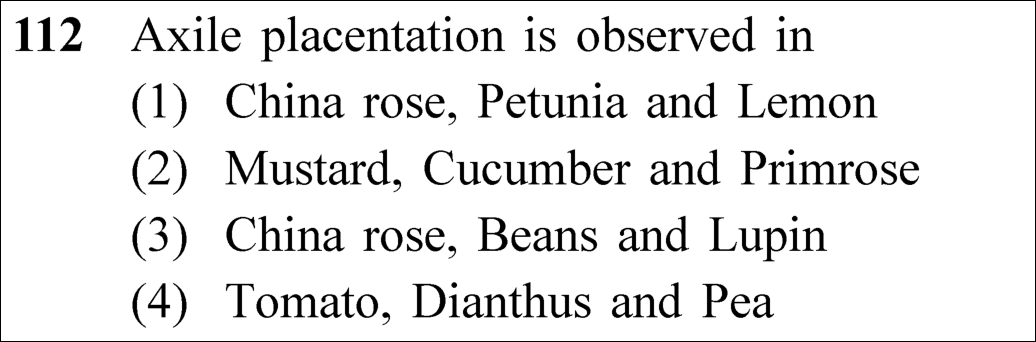
NEET 2023 · Q112 Easy
Official NEET 2023 Question 112 - Morphology of Flowering Plants
1 China rose, Petunia and Lemon ✓ Key
2 Mustard, Cucumber and Primrose
3 China rose, Beans and Lupin
4 Tomato, Dianthus and Pea
💡 Verified Solution & 30-Second Hack
✓
Verified Against NTA Final Answer Key
Option (1) : China rose, Petunia and Lemon
📚 Morphology of Flowering Plants Easy
📋 Given Parameters & Problem Setup
Placentation Type Axile placentation
Anatomy Placenta axial, ovules attached in multilocular ovary
⚡

The 30-Second Exam Hall Shortcut: ⚡ Axile Placentation Mnemonic: "TLC in China Pet"

⏱️ Save ~25 seconds

Axile placentation occurs in multilocular syncarpous ovaries where ovules attach to the central axis: Tomato, Lemon, China rose, and Petunia (Solanaceae)!

1 Axile placentation: China rose, Tomato, Lemon, Petunia.
2 Marginal: Pea, Beans, Lupin (Legumes).
3 Parietal: Mustard, Argemone, Cucumber.
4 Free Central: Dianthus, Primrose.
5 Option (1) groups China rose, Petunia, and Lemon together.
🛡️
Why You Can 100% Trust This Shortcut: Canonical NCERT Angiosperm carpel and placentation classification.
📐

Step-by-Step Rigorous Workflow & Mathematical Proof

Step 1

Definition of Axile Placentation

When the placenta is axial and the ovules are attached to it in a multilocular ovary, the placentation is termed axile:

Axile Placentation  ⟺  Multilocular syncarpous ovary with ovules attached to central axis\text{\textbf{Axile Placentation}} \iff \text{Multilocular syncarpous ovary with ovules attached to central axis}
Step 2

NCERT Examples Analysis Across Options

Reviewing canonical plant examples classified by placentation:

Axile:China rose, Tomato, Lemon, Petunia (Solanaceae)Marginal:Pea, Beans, Lupin (Fabaceae)Parietal:Mustard, Argemone, CucumberFree Central:Dianthus, PrimroseBasal:Sunflower, Marigold\begin{aligned} \text{\textbf{Axile:}} & \quad \textit{China rose, Tomato, Lemon, Petunia (Solanaceae)} \\[3pt] \text{Marginal:} & \quad \textit{Pea, Beans, Lupin (Fabaceae)} \\[3pt] \text{Parietal:} & \quad \textit{Mustard, Argemone, Cucumber} \\[3pt] \text{Free Central:} & \quad \textit{Dianthus, Primrose} \\[3pt] \text{Basal:} & \quad \textit{Sunflower, Marigold} \end{aligned}
Step 3

Option Cross-Verification

Option (1) contains China rose (Malvaceae), Petunia (Solanaceae), and Lemon (Rutaceae)—all of which possess multilocular ovaries with axile placentation.

⭐

360° Option Elimination Engine Key Feature

Diagnose every choice: Know exactly why the right option works and why distractors fail.

4-Option Deep Scan
1 1
✓ 100% Correct
Verdict & Scientific Reason:

All three plants possess syncarpous multilocular ovaries with axile placentation.

💡
Why this is airtight: None; perfect textbook alignment.
2 2
✗ Incorrect
Verdict & Scientific Reason:

Mustard and Cucumber show parietal placentation; Primrose shows free central placentation.

⚠️
Student Fallacy (Why candidates pick this trap): Confusing parietal peripheral ovule attachment with central axile columns.
3 3
✗ Incorrect
Verdict & Scientific Reason:

Beans and Lupin (Fabaceae) have unilocular ovaries with marginal placentation.

⚠️
Student Fallacy (Why candidates pick this trap): Overlooking that legumes have marginal placentation along the ventral suture.
4 4
✗ Incorrect
Verdict & Scientific Reason:

Tomato is axile, but Dianthus is free central and Pea is marginal.

⚠️
Student Fallacy (Why candidates pick this trap): Failing to eliminate Dianthus (classic free central example).
⚠️

NTA Trap Alert: Free Central vs. Axile Confusion

Both axile and free central feature ovules positioned centrally. However, axile possesses septa dividing the ovary into multiple locules, whereas free central completely lacks septa (unilocular).

🛡️ How to avoid the -1 mark: Axile = Septa present (Lemon, Tomato, Petunia, China rose). Free Central = Septa absent (Dianthus, Primrose).
📖

Core NEET Syllabus Standard

NCERT Biology · Morphology of Flowering Plants Standard Benchmark
Core Scientific Principle Tested:

"When the placenta is axial and the ovules are attached to it in a multilocular ovary, the placentation is said to be axile, as in china rose, tomato and lemon."

Syllabus Focus: Placentation
✓ Core NEET UG Syllabus Anchor Syllabus & Academic Standards ↗
NEET 2023 · Q146 Medium
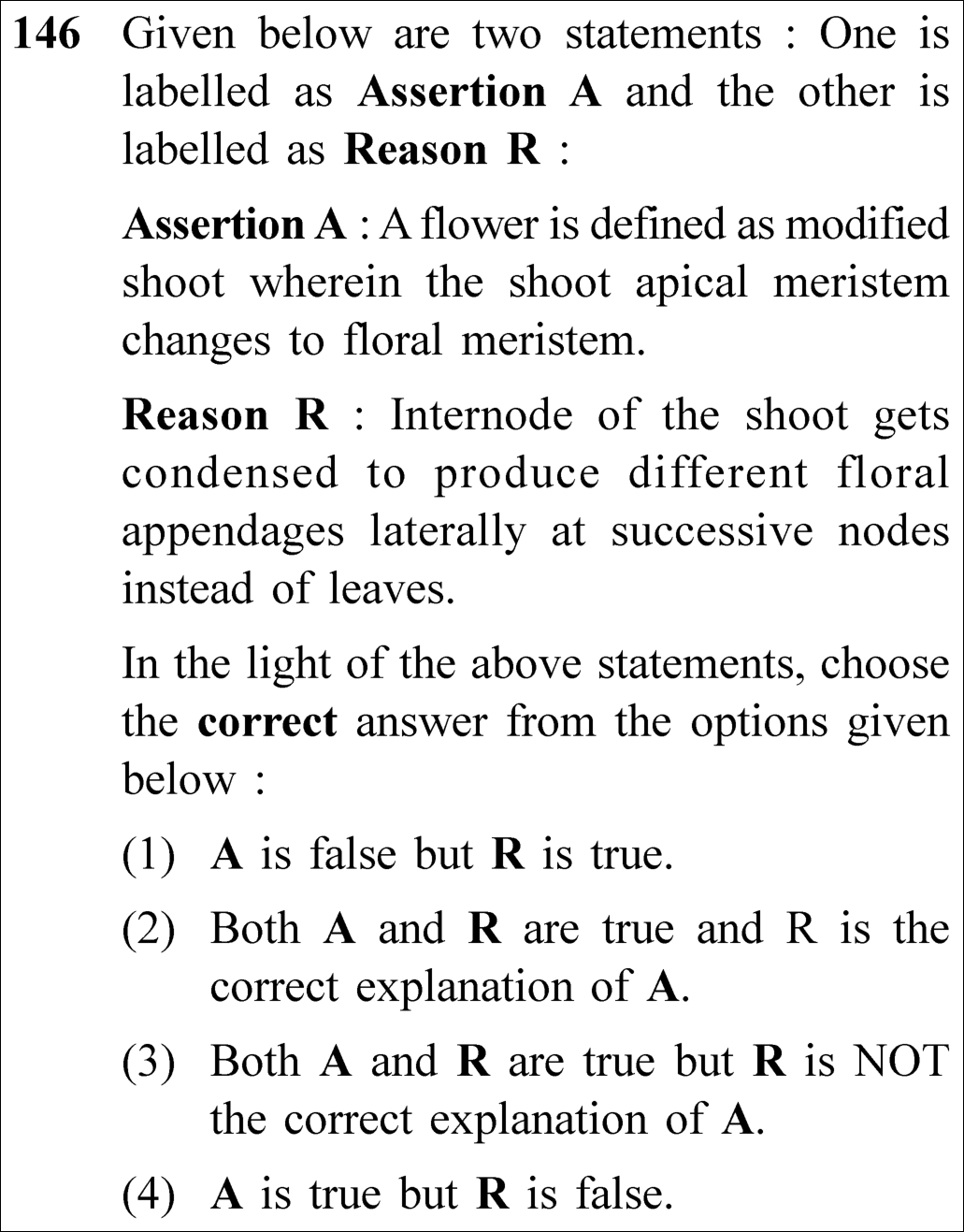
Official NEET 2023 Question 146 - Morphology of Flowering Plants
1 A is false but R is true.
2 Both A and R are true and R is the correct explanation of A. ✓ Key
3 Both A and R are true but R is NOT the correct explanation of A.
4 A is true but R is false.
💡 Verified Solution & 30-Second Hack
✓
Verified Against NTA Final Answer Key
Option (2) : Both A and R are true and R is the correct explanation of A.
📚 Morphology of Flowering Plants Medium
📋 Given Parameters & Problem Setup
Assertion (A) A flower is defined as modified shoot wherein shoot apical meristem changes to floral meristem.
Reason (R) Internode of shoot gets condensed to produce different floral appendages laterally at successive nodes instead of leaves.
⚡

The 30-Second Exam Hall Shortcut: ⚡ Goethe's Classic Flower Rule: Flower = Condensed Modified Shoot

⏱️ Save ~25 seconds

Why is a flower morphologically defined as a modified shoot? Because the floral axis (thalamus/receptacle) represents condensed internodes bearing floral appendages (sepals, petals, stamens, carpels) at successive nodes instead of foliage leaves! Both true, R explains A!

1 Assertion: Flower is a modified shoot where shoot apical meristem converts into floral meristem -> True.
2 Reason: Internodes do not elongate/condense, producing floral appendages laterally at successive nodes instead of leaves -> True.
3 Reason provides the precise morphological justification for why a flower is categorized as a shoot.
4 Select Option (2) Both A and R are true and R is the correct explanation of A.
🛡️
Why You Can 100% Trust This Shortcut: Canonical NCERT Morphology of Flowering Plants inflorescence and floral shoot homology.
📐

Step-by-Step Rigorous Workflow & Mathematical Proof

Step 1

Morphological Nature of the Flower

In plant morphology (Goethe's foliar theory), a flower is fundamentally a determinate, modified reproductive shoot:

Shoot Apical Meristem (SAM)→Floral inductionFloral Meristem (Determinate growth)\text{Shoot Apical Meristem (SAM)} \xrightarrow{\text{Floral induction}} \text{\textbf{Floral Meristem (Determinate growth)}}
Step 2

Verbatim NCERT Explanation

NCERT states under The Inflorescence: "A flower is a modified shoot wherein the shoot apical meristem changes to floral meristem. Internodes do not elongate and the axis gets condensed. The apex produces different kinds of floral appendages laterally at successive nodes instead of leaves."

Step 3

Assertion-Reason Causal Validation

The shoot nature of the flower is proven by the presence of nodes and condensed internodes on the thalamus, and the lateral appendages (sepals, petals, stamens, carpels) being homologous to modified leaves. Therefore, Reason R directly explains Assertion A.

⭐

360° Option Elimination Engine Key Feature

Diagnose every choice: Know exactly why the right option works and why distractors fail.

4-Option Deep Scan
1 1
✗ Incorrect
Verdict & Scientific Reason:

Assertion is factually true: a flower is definitively a modified shoot.

⚠️
Student Fallacy (Why candidates pick this trap): Thinking flowers are distinct de novo organs unrelated to shoots.
2 2
✓ 100% Correct
Verdict & Scientific Reason:

Both statements are true and Reason provides the exact morphological basis explaining Assertion.

💡
Why this is airtight: None; textbook verbatim alignment.
3 3
✗ Incorrect
Verdict & Scientific Reason:

Condensation of internodes and production of floral appendages at nodes is the exact anatomical definition of a modified shoot; the link is directly causal.

⚠️
Student Fallacy (Why candidates pick this trap): Failing to see that node-internode condensation is the proof of shoot homology.
4 4
✗ Incorrect
Verdict & Scientific Reason:

Reason is factually true according to plant morphology.

⚠️
Student Fallacy (Why candidates pick this trap): Doubting that floral appendages arise at successive nodes.
⚠️

NTA Trap Alert: Determinate Growth vs. Shoot Identity Trap

Students often assume that because flower growth is determinate (it terminates with a pistil), it cannot be considered a shoot. The condensed thalamus with nodes and internodes is the proof of shoot origin.

🛡️ How to avoid the -1 mark: Thalamus = Condensed stem axis. Floral whorls = Modified leaves at successive nodes.
📖

Core NEET Syllabus Standard

NCERT Biology · Morphology of Flowering Plants Standard Benchmark
Core Scientific Principle Tested:

"A flower is a modified shoot wherein the shoot apical meristem changes to floral meristem. Internodes do not elongate and the axis gets condensed, producing floral appendages laterally at successive nodes instead of leaves."

Syllabus Focus: The Inflorescence
✓ Core NEET UG Syllabus Anchor Syllabus & Academic Standards ↗
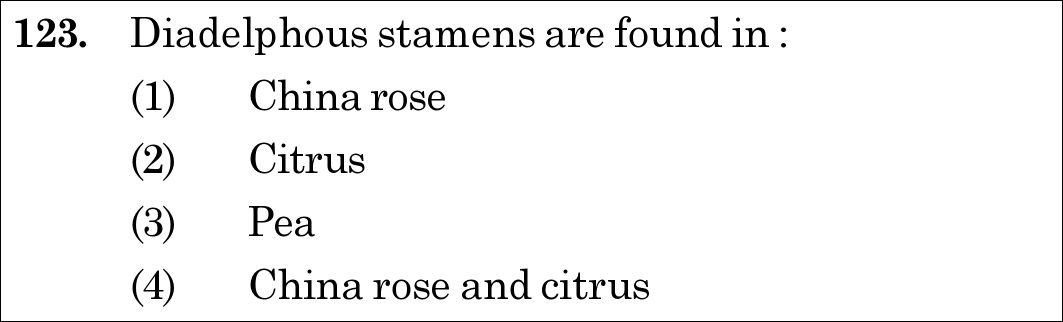
NEET 2021 · Q123 Easy
Official NEET 2021 Question 123 - Morphology of Flowering Plants
1 China rose
2 Citrus
3 Pea ✓ Key
4 China rose and citrus
💡 Verified Solution & 30-Second Hack
✓
Verified Against NTA Final Answer Key
Option (3) : Pea
📚 Morphology of Flowering Plants Easy
📋 Given Parameters & Problem Setup
Stamen Arrangement Diadelphous (filaments united into two distinct bundles)
⚡

The 30-Second Exam Hall Shortcut: ⚡ "Pea = Diadelphous (9)+1" | "China Rose = Monadelphous" | "Citrus = Polyadelphous"

⏱️ Save ~15 seconds

The classic NCERT androecium trio: China rose is monadelphous (1 bundle), Pea is diadelphous (2 bundles: (9)+1), and Citrus is polyadelphous (many bundles)! Looking for diadelphous stamens leads directly to Pea (*Pisum sativum*). Match Option (3)!

1 Monadelphous: Stamens united into one bundle   ⟹  \implies China rose (*Hibiscus*).
2 Diadelphous: Stamens united into two bundles   ⟹  \implies Pea (*Pisum sativum*, Fabaceae).
3 Polyadelphous: Stamens united into more than two bundles   ⟹  \implies Citrus (lemon/orange).
4 Match Option (3).
🛡️
Why You Can 100% Trust This Shortcut: Canonical NCERT Morphology of Flowering Plants on Androecium Cohesion.
📐

Step-by-Step Rigorous Workflow & Mathematical Proof

Step 1

Definition of Stamen Cohesion Types

When the filaments of stamens are fused together while anthers remain free, the condition is termed adelphy:

Monadelphous:United into a single staminal tube (e.g., China rose)Diadelphous:United into two distinct bundles (e.g., Pea: (9)+1)Polyadelphous:United into more than two bundles (e.g., Citrus)\begin{aligned} \text{\textbf{Monadelphous:}} & \quad \text{United into a single staminal tube (e.g., China rose)} \\[4pt] \text{\textbf{Diadelphous:}} & \quad \mathbf{\text{United into two distinct bundles (e.g., Pea: } (9) + 1\text{)}} \\[4pt] \text{\textbf{Polyadelphous:}} & \quad \text{United into more than two bundles (e.g., Citrus)} \end{aligned}
Step 2

Androecium in Family Fabaceae (Pea)

In the pea flower (*Pisum sativum*, family Fabaceae), there are 10 stamens. Nine stamens fuse by their filaments into a common sheath enclosing the ovary, while the tenth posterior stamen remains free. This configuration is denoted in the floral formula as A(9)+1\mathbf{A_{(9)+1}}, representing the classic diadelphous condition.

⭐

360° Option Elimination Engine Key Feature

Diagnose every choice: Know exactly why the right option works and why distractors fail.

4-Option Deep Scan
1 1
✗ Incorrect
Verdict & Scientific Reason:

China rose (family Malvaceae) possesses monadelphous stamens fused into a single staminal tube around the style.

⚠️
Student Fallacy (Why candidates pick this trap): Confusing monadelphous (China rose) with diadelphous (pea).
2 2
✗ Incorrect
Verdict & Scientific Reason:

Citrus possesses polyadelphous stamens united into several distinct bundles.

⚠️
Student Fallacy (Why candidates pick this trap): Conflating polyadelphous with diadelphous.
3 3
✓ 100% Correct
Verdict & Scientific Reason:

Pea exhibits the characteristic diadelphous androecium where filaments form two bundles: (9) + 1.

💡
Why this is airtight: None. Direct textbook exemplar.
4 4
✗ Incorrect
Verdict & Scientific Reason:

Neither China rose (monadelphous) nor Citrus (polyadelphous) is diadelphous.

⚠️
Student Fallacy (Why candidates pick this trap): Selecting a paired distractor without verifying individual adelphic states.
⚠️

NTA Trap Alert: Monadelphous vs Diadelphous vs Polyadelphous Triad

NCERT defines all three consecutively in a single paragraph. Candidates often mix up the exemplar plants across the three terms.

🛡️ How to avoid the -1 mark: Use the mnemonic: "1-China, 2-Pea, Many-Citrus"   ⟹  \implies Mono = China rose, Di = Pea, Poly = Citrus.
📖

Core NEET Syllabus Standard

NEET / NCERT Biology · Morphology of Flowering Plants Standard Benchmark
Core Scientific Principle Tested:

"The stamens may be united into one bunch or one bundle (monadelphous) as in China rose, or two bundles (diadelphous) as in pea, or into more than two bundles (polyadelphous) as in citrus."

Syllabus Focus: The Flower: Androecium
✓ Core NEET UG Syllabus Anchor Syllabus & Academic Standards ↗
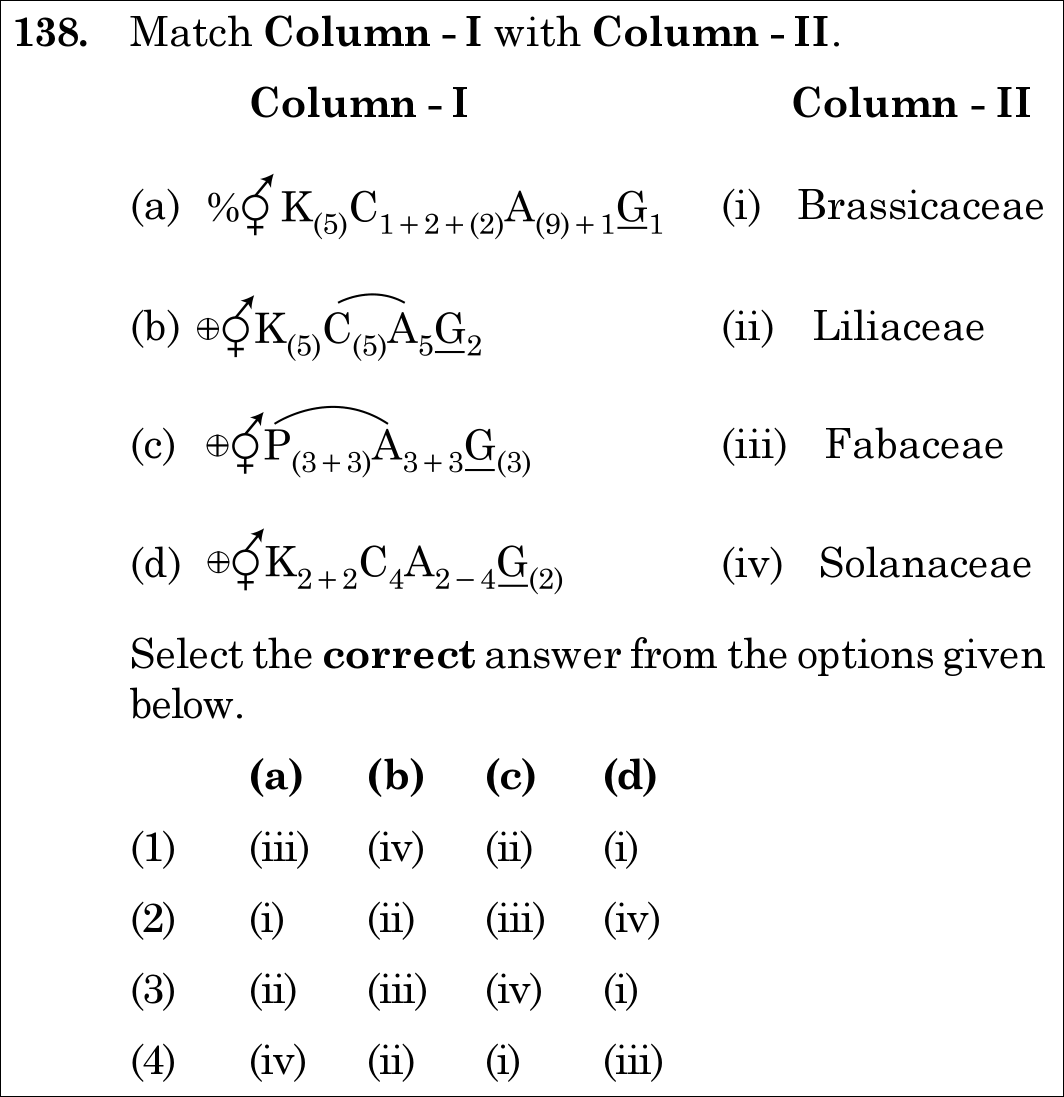
NEET 2021 · Q138 Easy
Official NEET 2021 Question 138 - Morphology of Flowering Plants
1 (iii) (iv) (ii) (i) ✓ Key
2 (i) (ii) (iii) (iv)
3 (ii) (iii) (iv) (i)
4 (iv) (ii) (i) (iii)
💡 Verified Solution & 30-Second Hack
✓
Verified Against NTA Final Answer Key
Option (1) : (a)-(iii), (b)-(iv), (c)-(ii), (d)-(i)
📚 Morphology of Flowering Plants Easy
📋 Given Parameters & Problem Setup
Column I (Formulas) (a) Zygomorphic diadelphous, (b) Actinomorphic pentamerous bicarpellary, (c) Perianth trimerous tricarpellary, (d) Tetradynamous cruciform
Column II (Families) (i) Brassicaceae, (ii) Liliaceae, (iii) Fabaceae, (iv) Solanaceae
⚡

The 30-Second Exam Hall Shortcut: ⚡ Instant Floral Fingerprint Identification!

⏱️ Save ~20 seconds

Vexillary / diadelphous (K(5)C1+2+(2)A(9)+1K_{(5)} C_{1+2+(2)} A_{(9)+1}) = Fabaceae (a-iii); Epipetalous pentamerous (C(5)A5C_{(5)} A_5) = Solanaceae (b-iv); Perianth (P(3+3)A3+3P_{(3+3)} A_{3+3}) = Liliaceae (c-ii); Tetradynamous cruciform (K2+2C4A2+4K_{2+2} C_4 A_{2+4}) = Brassicaceae (d-i)! Matches Option (1)!

1 (a) % indicates zygomorphic; C1+2+(2)A(9)+1G1  ⟹  C_{1+2+(2)} A_{(9)+1} G_1 \implies Fabaceae (iii).
2 (b) ⊕\oplus actinomorphic, K(5)C(5)A⏞5G(2)  ⟹  K_{(5)} \overbrace{C_{(5)} A}_5 G_{(2)} \implies Solanaceae (iv).
3 (c) Perianth P(3+3)A⏞3+3G(3)  ⟹  P_{(3+3)} \overbrace{A}_{3+3} G_{(3)} \implies Liliaceae (ii).
4 (d) K2+2C4A2+4G(2)  ⟹  K_{2+2} C_4 A_{2+4} G_{(2)} \implies Brassicaceae (Cruciferae) (i).
5 Match Option (1).
🛡️
Why You Can 100% Trust This Shortcut: Canonical NCERT Morphology of Flowering Plants on Semi-Technical Description of Families.
📐

Step-by-Step Rigorous Workflow & Mathematical Proof

Step 1

Deconstruction of Diagnostic Floral Formulas

Each angiosperm family in the NCERT syllabus possesses unambiguous diagnostic floral characteristics:

(a) %  K(5)C1+2+(2)A(9)+1G‾1⟷Fabaceae (Papilionoideae)  ⟹  (iii)(b) ⊕  K(5)C(5)A5⏞G‾(2)⟷Solanaceae (Potato family)  ⟹  (iv)(c) ⊕  P(3+3)A3+3⏞G‾(3)⟷Liliaceae (Lily family)  ⟹  (ii)(d) ⊕  K2+2C4A2+4G‾(2)⟷Brassicaceae (Mustard family)  ⟹  (i)\begin{aligned} \text{(a) } \% \; \text{K}_{(5)} \text{C}_{1+2+(2)} \text{A}_{(9)+1} \underline{\text{G}}_1 & \longleftrightarrow \text{\textbf{Fabaceae (Papilionoideae)}} \implies \text{(iii)} \\[4pt] \text{(b) } \oplus \; \text{K}_{(5)} \overbrace{\text{C}_{(5)} \text{A}_5} \underline{\text{G}}_{(2)} & \longleftrightarrow \text{\textbf{Solanaceae (Potato family)}} \implies \text{(iv)} \\[4pt] \text{(c) } \oplus \; \overbrace{\text{P}_{(3+3)} \text{A}_{3+3}} \underline{\text{G}}_{(3)} & \longleftrightarrow \text{\textbf{Liliaceae (Lily family)}} \implies \text{(ii)} \\[4pt] \text{(d) } \oplus \; \text{K}_{2+2} \text{C}_4 \text{A}_{2+4} \underline{\text{G}}_{(2)} & \longleftrightarrow \text{\textbf{Brassicaceae (Mustard family)}} \implies \text{(i)} \end{aligned}
Step 2

Option Alignment

Matching (a)-(iii), (b)-(iv), (c)-(ii), (d)-(i) directly and exclusively points to Option (1).

⭐

360° Option Elimination Engine Key Feature

Diagnose every choice: Know exactly why the right option works and why distractors fail.

4-Option Deep Scan
1 1
✓ 100% Correct
Verdict & Scientific Reason:

Exact diagnostic alignment of all 4 botanical family floral formulas.

💡
Why this is airtight: None. Flawless knowledge of floral formulas.
2 2
✗ Incorrect
Verdict & Scientific Reason:

Mismatches Fabaceae with Brassicaceae and Solanaceae with Liliaceae.

⚠️
Student Fallacy (Why candidates pick this trap): Random assignment.
3 3
✗ Incorrect
Verdict & Scientific Reason:

Mismatches Fabaceae with Liliaceae and Solanaceae with Fabaceae.

⚠️
Student Fallacy (Why candidates pick this trap): Confusing monocot perianth with dicot zygomorphy.
4 4
✗ Incorrect
Verdict & Scientific Reason:

Mismatches Fabaceae with Solanaceae and Brassicaceae with Fabaceae.

⚠️
Student Fallacy (Why candidates pick this trap): Conflating pentamerous with papilionaceous symmetry.
⚠️

NTA Trap Alert: Perianth (P) vs Calyx/Corolla (K/C) Distinction

The presence of Perianth (P) immediately identifies the monocot family Liliaceae! Looking for P first saves immense time.

🛡️ How to avoid the -1 mark: Identify P(3+3)  ⟹  P_{(3+3)} \implies Liliaceae instantly.
📖

Core NEET Syllabus Standard

NEET / NCERT Biology · Morphology of Flowering Plants Standard Benchmark
Core Scientific Principle Tested:

"Fabaceae exhibits diadelphous papilionaceous corolla; Solanaceae exhibits epipetalous pentamerous flowers; Liliaceae exhibits perianth; Brassicaceae exhibits tetradynamous stamens."

Syllabus Focus: Description of Some Important Families
✓ Core NEET UG Syllabus Anchor Syllabus & Academic Standards ↗
NEET 2020 · Q3 Easy
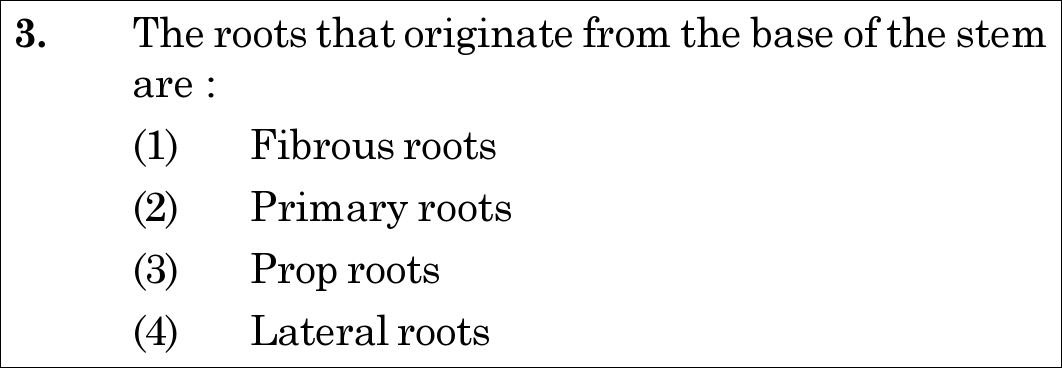
Official NEET 2020 Question 3 - Morphology of Flowering Plants
1 Fibrous roots ✓ Key
2 Primary roots
3 Prop roots
4 Lateral roots
💡 Verified Solution & 30-Second Hack
✓
Verified Against NTA Final Answer Key
Option (1) : Fibrous roots
📚 Morphology of Flowering Plants Easy
📋 Given Parameters & Problem Setup
Anatomical Origin Base of the stem
Plant Group Monocotyledonous plants (e.g. Wheat, Grasses)
Question Objective Identify the root system type
⚡

The 30-Second Exam Hall Shortcut: ⚡ "Roots from Base of Stem = Fibrous Roots (Monocots like Wheat)"

⏱️ Save ~20 seconds

In monocots, the short-lived primary taproot is replaced early by a cluster of roots originating from the BASE of the stem — these are Fibrous roots! Taproot arises from the radicle; Prop roots arise from aerial branches. Mark Fibrous roots (Option 1) in 5 seconds!

1 Recall NCERT root origins: - Radicle elongation →\to Primary root (Tap root system in dicots). - Base of stem →\to Fibrous root system (monocots like wheat). - Parts other than radicle/stem-base (e.g. branches, leaves) →\to Adventitious / Prop roots.
2 Origin specified in prompt: "Base of the stem".
3 Select Option (1): Fibrous roots.
🛡️
Why You Can 100% Trust This Shortcut: NCERT Biology · Morphology of Flowering Plants (The Root: In monocotyledonous plants, the primary root is short lived and is replaced by a large number of roots. These roots originate from the base of the stem and constitute the fibrous root system, as seen in the wheat plant).
📐

Step-by-Step Rigorous Workflow & Mathematical Proof

Step 1

Morphological Classification of Root Systems

Flowering plants exhibit three fundamental types of root systems based on their ontogeny and developmental origin: 1. Tap Root System: In dicots (e.g. mustard), direct elongation of the embryonic radicle forms the persistent primary root, which bears lateral roots of several orders (secondary, tertiary roots). 2. Fibrous Root System: In monocotyledonous plants (e.g. wheat, maize), the primary root is short-lived. It is quickly replaced by a large cluster of thin, thread-like roots that originate from the base of the stem. 3. Adventitious Roots: Roots that arise from any organ of the plant other than the embryonic radicle (e.g. *Monstera*, banyan tree prop roots, stilt roots of sugarcane).

Base of Stem Origin  ⟹  Fibrous Root System(e.g. Monocots / Wheat)\text{Base of Stem Origin} \implies \mathbf{Fibrous\,Root\,System} \quad (\text{e.g. Monocots / Wheat})
Step 2

Analysis of Distractors

- Primary roots: Direct downward continuation of the embryonic radicle. - Prop roots: Pillar-like massive adventitious roots hanging down from horizontal aerial tree branches (e.g. banyan tree) to provide columnar support. - Lateral roots: Endogenous branch roots originating from the pericycle of the primary root.

⭐

360° Option Elimination Engine Key Feature

Diagnose every choice: Know exactly why the right option works and why distractors fail.

4-Option Deep Scan
1 A
✓ 100% Correct
Verdict & Scientific Reason:

Correct. NCERT explicitly defines fibrous roots as roots originating from the base of the stem in monocots.

💡
Why this is airtight: None. Direct recall of textbook morphological definitions.
2 B
✗ Incorrect
Verdict & Scientific Reason:

Incorrect. Primary root arises from the embryonic radicle, not from the stem base.

⚠️
Student Fallacy (Why candidates pick this trap): Confusing primary root with early adventitious/fibrous roots.
3 C
✗ Incorrect
Verdict & Scientific Reason:

Incorrect. Prop roots arise from aerial branches of the banyan tree, not the stem base.

⚠️
Student Fallacy (Why candidates pick this trap): Confusing pillar prop roots with basal fibrous roots.
4 D
✗ Incorrect
Verdict & Scientific Reason:

Incorrect. Lateral roots develop endogenously from the pericycle of primary and secondary roots.

⚠️
Student Fallacy (Why candidates pick this trap): Mistaking horizontal branching roots for stem-borne roots.
⚠️

NTA Trap Alert: Fibrous vs Adventitious Root Overlap Trap

While fibrous roots are technically adventitious in a broad developmental sense (because they do not arise from the radicle), NCERT defines fibrous roots specifically by their unique locus: "originate from the base of the stem" in monocots.

🛡️ How to avoid the -1 mark: Remember verbatim cue: "Base of the stem" = Fibrous root system (Wheat).
📖

Core NEET Syllabus Standard

NEET / NCERT Biology · Morphology of Flowering Plants Standard Benchmark
Core Scientific Principle Tested:

"In monocots, roots originating from the base of the stem constitute the fibrous root system."

Syllabus Focus: Root Types
✓ Core NEET UG Syllabus Anchor Syllabus & Academic Standards ↗
NEET 2020 · Q20 Easy
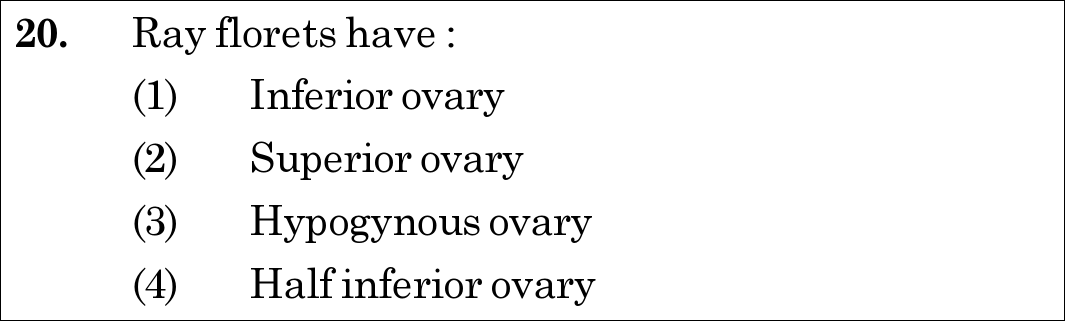
Official NEET 2020 Question 20 - Morphology of Flowering Plants
1 Inferior ovary ✓ Key
2 Superior ovary
3 Hypogynous ovary
4 Half inferior ovary
💡 Verified Solution & 30-Second Hack
✓
Verified Against NTA Final Answer Key
Option (1) : Inferior ovary
📚 Morphology of Flowering Plants Easy
📋 Given Parameters & Problem Setup
Floral Structure Ray florets of Asteraceae (Sunflower head / Capitulum)
Question Objective Identify the position and type of ovary
⚡

The 30-Second Exam Hall Shortcut: ⚡ "Ray Florets of Sunflower = Epigynous Flower with INFERIOR Ovary!"

⏱️ Save ~20 seconds

In ray florets of sunflower (Asteraceae), the thalamus encloses the ovary completely and fuses with it, with calyx, corolla, and stamens arising ABOVE the ovary (Epigynous flower). Therefore, ray florets have an Inferior Ovary! Mark Option (1) in 5 seconds.

1 Recall NCERT ovary position types: - Hypogynous (Superior ovary): Mustard, China rose, Brinjal. - Perigynous (Half inferior ovary): Plum, Rose, Peach. - Epigynous (Inferior ovary): Guava, Cucumber, and ray florets of sunflower.
2 Identify target floral type: Ray florets of sunflower.
3 Match with Epigynous →\to Inferior ovary.
4 Select Option (1).
🛡️
Why You Can 100% Trust This Shortcut: NCERT Biology · Morphology of Flowering Plants (The Flower: In epigynous flowers, the margin of thalamus grows upward enclosing the ovary completely and getting fused with it, the other parts of flower arise above the ovary. Hence, the ovary is said to be inferior as in flowers of guava and cucumber, and the ray florets of sunflower).
📐

Step-by-Step Rigorous Workflow & Mathematical Proof

Step 1

Morphological Classification of Ovary Insertion

Based on the spatial insertion of calyx, corolla, and androecium relative to the gynoecium on the thalamus: - 1. Hypogynous Flower (Superior Ovary): Gynoecium occupies the highest position on the convex/conical thalamus while other floral whorls arise below it (e.g. mustard, China rose, brinjal). - 2. Perigynous Flower (Half-Inferior Ovary): Gynoecium is situated in the centre of a cup-shaped thalamus, and other parts arise on the rim of the thalamus at the same level (e.g. plum, rose, peach). - 3. Epigynous Flower (Inferior Ovary): The margin of the hollowed cup-shaped thalamus grows completely upward, enclosing and fusing with the ovary wall. The sepals, petals, and stamens arise above the top of the ovary. The ovary is consequently inferior. - NCERT explicitly provides three canonical examples of epigynous flowers with inferior ovaries: guava, cucumber, and the ray florets of sunflower.

Ray Florets of Sunflower  ⟺  Epigynous Flower  ⟹  Inferior Ovary\textbf{Ray Florets of Sunflower} \iff \mathbf{Epigynous\,Flower} \implies \mathbf{Inferior\,Ovary}
Step 2

Floral Morphology of the Capitulum Inflorescence

In the composite head (capitulum) of sunflower (*Helianthus annuus*), the marginal zygomorphic strap-shaped ray florets are pistillate or sterile and strictly epigynous, with the ovary situated inferior to the attached ligulate petal tube.

⭐

360° Option Elimination Engine Key Feature

Diagnose every choice: Know exactly why the right option works and why distractors fail.

4-Option Deep Scan
1 A
✓ 100% Correct
Verdict & Scientific Reason:

Correct. Ray florets of sunflower are epigynous and possess an inferior ovary.

💡
Why this is airtight: None. Direct recall of standard NCERT floral morphology examples.
2 B
✗ Incorrect
Verdict & Scientific Reason:

Incorrect. Superior ovaries belong to hypogynous flowers (mustard, brinjal).

⚠️
Student Fallacy (Why candidates pick this trap): Confusing hypogynous with epigynous flowers.
3 C
✗ Incorrect
Verdict & Scientific Reason:

Incorrect. "Hypogynous ovary" is a misnomer; the flower is hypogynous and the ovary is superior.

⚠️
Student Fallacy (Why candidates pick this trap): Confusing flower descriptor (hypogynous) with ovary descriptor (superior).
4 D
✗ Incorrect
Verdict & Scientific Reason:

Incorrect. Half-inferior ovaries characterize perigynous flowers (plum, rose, peach).

⚠️
Student Fallacy (Why candidates pick this trap): Confusing perigynous examples with epigynous sunflower florets.
⚠️

NTA Trap Alert: Ray Florets vs Disc Florets Capitulum Trap

Both ray florets (marginal ligulate) and disc florets (central tubular) of the sunflower capitulum have an inferior ovary (epigynous). Do not confuse epigynous flowers (guava, cucumber, sunflower) with perigynous flowers (plum, rose, peach).

🛡️ How to avoid the -1 mark: Remember the NCERT triad for Inferior Ovary: Guava, Cucumber, and Ray florets of Sunflower.
📖

Core NEET Syllabus Standard

NEET / NCERT Biology · Morphology of Flowering Plants Standard Benchmark
Core Scientific Principle Tested:

"In epigynous flowers like ray florets of sunflower, other floral parts arise above the ovary, making the ovary inferior."

Syllabus Focus: Ovary Positions in Flowers
✓ Core NEET UG Syllabus Anchor Syllabus & Academic Standards ↗
NEET 2020 · Q58 Easy
Official NEET 2020 Question 58 - Morphology of Flowering Plants
1 Brinjal
2 Mustard
3 Sunflower
4 Plum ✓ Key
💡 Verified Solution & 30-Second Hack
✓
Verified Against NTA Final Answer Key
Option (4) : Plum
📚 Morphology of Flowering Plants Easy
📋 Given Parameters & Problem Setup
Ovary Position Half inferior (Perigynous condition)
Candidate Genera Brinjal, Mustard, Sunflower, Plum
⚡

The 30-Second Exam Hall Shortcut: ⚡ "Perigynous = Half Inferior = Plum, Rose, Peach!"

⏱️ 20 seconds

Mustard, China rose, and Brinjal have Superior ovary (Hypogynous). Guava, Cucumber, and ray florets of Sunflower have Inferior ovary (Epigynous). Plum, Rose, and Peach have Half Inferior ovary (Perigynous)! Mark Plum (Option 4) in 5 seconds.

1 Hypogynous (Superior ovary): Mustard, China rose, Brinjal.
2 Epigynous (Inferior ovary): Guava, Cucumber, ray florets of Sunflower.
3 Perigynous (Half inferior ovary): Plum, Rose, Peach.
4 Select Option (4) Plum.
🛡️
Why You Can 100% Trust This Shortcut: NCERT Biology · Morphology of Flowering Plants (The Flower: Position of Floral Parts)
📐

Step-by-Step Rigorous Workflow & Mathematical Proof

Step 1

Classify Types of Flowers by Floral Insertion

Based on the position of calyx, corolla, and androecium in respect of the ovary on thalamus, flowers are described as hypogynous, perigynous, and epigynous.

Step 2

Define Perigynous Flowers

If gynoecium is situated in the centre and other parts of the flower are located on the rim of the thalamus almost at the same level, it is called perigynous. The ovary here is said to be half inferior.

Step 3

Review NCERT Examples for Perigynous Flowers

The canonical NCERT examples of perigynous flowers with half inferior ovaries are Plum, Rose, and Peach.

Step 4

Evaluate Other Candidate Genera

Brinjal and Mustard have hypogynous flowers with superior ovaries. Sunflower ray florets have epigynous flowers with inferior ovaries.

⭐

360° Option Elimination Engine Key Feature

Diagnose every choice: Know exactly why the right option works and why distractors fail.

4-Option Deep Scan
1 A
✗ Incorrect
Verdict & Scientific Reason:

Incorrect; Brinjal (Solanaceae) possesses a hypogynous flower with a superior ovary.

⚠️
Student Fallacy (Why candidates pick this trap): Confusing superior ovary of Solanaceae with half inferior.
2 B
✗ Incorrect
Verdict & Scientific Reason:

Incorrect; Mustard (Brassicaceae) has a hypogynous flower with a superior ovary.

⚠️
Student Fallacy (Why candidates pick this trap): Mixing up hypogynous and perigynous examples.
3 C
✗ Incorrect
Verdict & Scientific Reason:

Incorrect; ray florets of Sunflower have an epigynous flower with a completely inferior ovary.

⚠️
Student Fallacy (Why candidates pick this trap): Confusing inferior ovary of Asteraceae with half-inferior ovary.
4 D
✓ 100% Correct
Verdict & Scientific Reason:

Factually exact; Plum has a perigynous flower where the ovary is half inferior.

💡
Why this is airtight: None; standard botanical classification.
⚠️

NTA Trap Alert: Mnemonic for Ovary Positions

Hypogynous (Superior): "M-C-B" (Mustard, China rose, Brinjal). Perigynous (Half Inferior): "P-R-P" (Plum, Rose, Peach). Epigynous (Inferior): "G-C-S" (Guava, Cucumber, Sunflower ray florets).

🛡️ How to avoid the -1 mark: Memorize the trio: "Plum, Rose, Peach = Half inferior"!
📖

Core NEET Syllabus Standard

Zoology · Morphology of Flowering Plants Standard Benchmark
Core Scientific Principle Tested:

""

Syllabus Focus: Ovary Position: Perigynous Flower and Half Inferior Ovary
✓ Core NEET UG Syllabus Anchor Syllabus & Academic Standards ↗

Solve 4 NEET Questions a Day — One per Subject

Cover all 1,140 official NEET questions in 285 days at your own pace. Progress is saved on your device. No login needed.