MyCompetitiveExams Logo MyCompetitiveExams
Search 1,140+ Questions
Chapters, formulas, speed tricks
→
⚡ Brahmastra NEET 2027
720 MARKS

Dynamic 180-question full-length simulator mixed dynamically from all 6 years for 2027 & 2026 aspirants.

Launch Brahmastra 2027 Test →
Start Practice →
100% Free · No Login Required
Q.104 Botany ⭐ 360° Option Elimination Active
Vault ↗

NEET 2025 Botany Question 104 Solution

Topic: Morphology of Flowering Plants · Official NTA Booklet Code 45
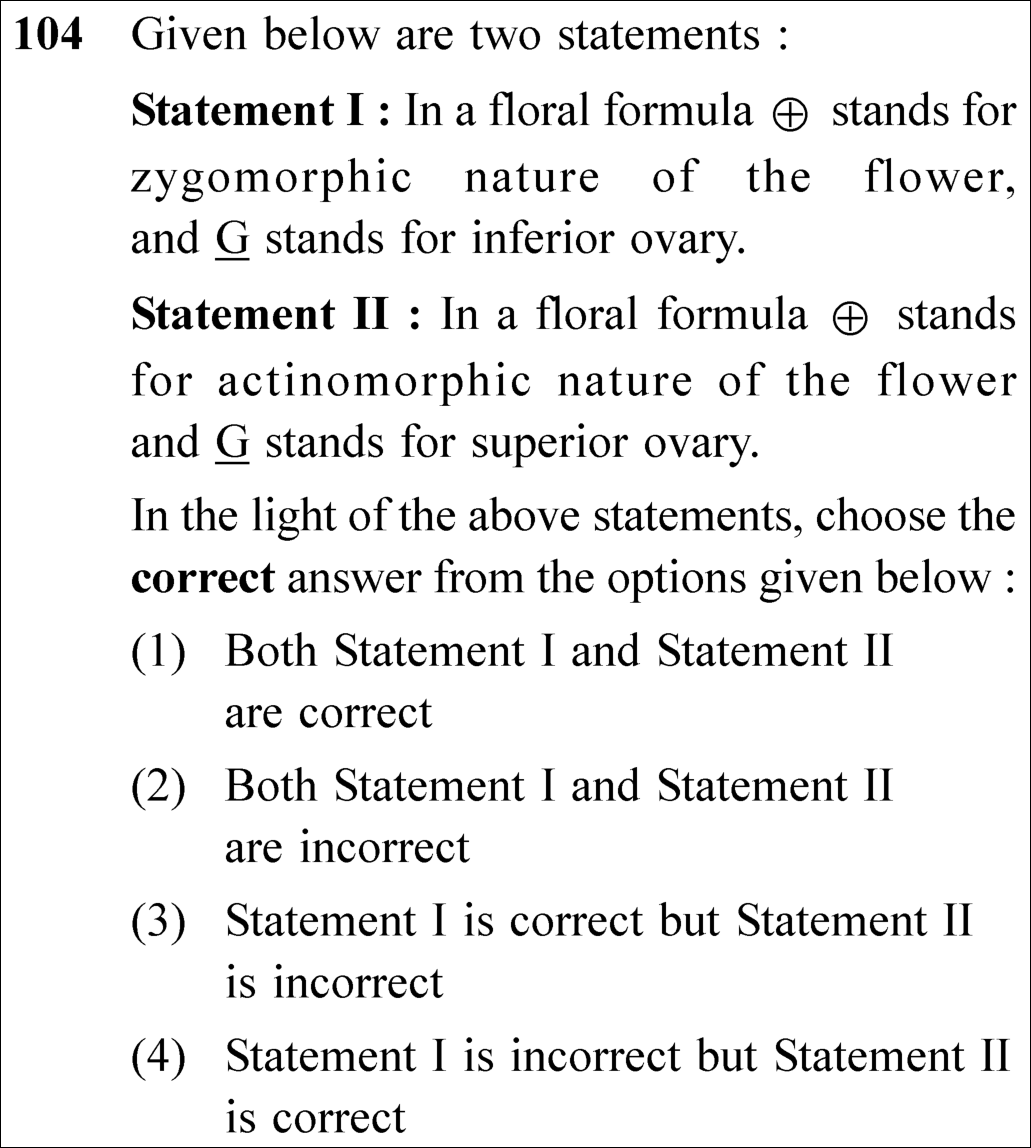
NEET 2025 Botany Question 104: Decoding Floral Symbols: Symmetry (⊕) and Gynoecium Position (G)

Question

Given below are two statements: Statement I: In a floral formula ⊕ stands for zygomorphic nature of the flower, and G̲ stands for inferior ovary. Statement II: In a floral formula ⊕ stands for actinomorphic nature of the flower and G̲ stands for superior ovary. In the light of the above statements, choose the correct answer from the options given below:

✓
Verified Against NTA Final Answer Key
Option (4) : Statement I is incorrect but Statement II is correct
📚 Morphology of Flowering Plants Easy
📋 Given Parameters & Problem Setup
Symbol ⊕ Actinomorphic (radial symmetry)
Symbol G Superior ovary (hypogynous flower, line below G)
Statement I ⊕ stands for zygomorphic nature, and G stands for inferior ovary. (False)
Statement II ⊕ stands for actinomorphic nature, and G stands for superior ovary. (True)
⚡

The 30-Second Exam Hall Shortcut: ⚡ Floral Formula Decoding Shortcut

⏱️ Save ~20 seconds

⊕ has a circle with a cross = Radial / Actinomorphic symmetry! % = Bilateral / Zygomorphic! G has a line UNDER G = Ovary is ABOVE other whorls = SUPERIOR ovary! Statement I is FALSE; Statement II is TRUE ⟹ Option (4)!

1 Recall floral formula symbols from NCERT Chapter 5 Section 5.9:
2 - ⊕: Actinomorphic (radial symmetry).
3 - %: Zygomorphic (bilateral symmetry).
4 - G (bar below G): Superior ovary (flower is hypogynous).
5 - Ḡ (bar above G): Inferior ovary (flower is epigynous).
6 - G- (bar beside G): Half-inferior ovary (perigynous flower).
7 Statement I claims ⊕ is zygomorphic and G is inferior ⟹ completely FALSE.
8 Statement II claims ⊕ is actinomorphic and G is superior ⟹ completely TRUE.
9 Conclusion: Statement I is incorrect but Statement II is correct.
10 Select Option (4) in under 5 seconds!
🛡️
Why You Can 100% Trust This Shortcut: Floral Formulas & Diagnostic Family Characteristics (NCERT Biology · Morphology of Flowering Plants).
📐

Step-by-Step Rigorous Workflow & Mathematical Proof

Step 1

Floral Symmetry Symbols in Floral Formulas

Floral symmetry indicates the geometric planes along which a flower can be divided into identical halves:

⊕=Actinomorphic (Radial symmetry),%=Zygomorphic (Bilateral symmetry)\oplus = \text{Actinomorphic (Radial symmetry)}, \quad \% = \text{Zygomorphic (Bilateral symmetry)}
  • • Actinomorphic flowers (e.g., mustard, datura, chilli) can be divided into equal halves in any radial plane passing through the center.
  • • Therefore, ⊕ represents actinomorphy, not zygomorphy.
Step 2

Ovary Position Symbols in Floral Formulas

The horizontal line placed relative to the letter G (Gynoecium) designates the position of the ovary relative to the calyx, corolla, and androecium:

G‾=Superior ovary (Hypogynous),Gˉ=Inferior ovary (Epigynous)\underline{\text{G}} = \text{Superior ovary (Hypogynous)}, \quad \bar{\text{G}} = \text{Inferior ovary (Epigynous)}
  • • In a hypogynous flower, sepals, petals, and stamens insert below the ovary, so the line is drawn beneath the letter G (G).
  • • In an epigynous flower, floral parts arise above the ovary, so the line is drawn above G (Ḡ).
Step 3

Evaluate Statements I and II

Compare with the statements presented:

Statement I: Inverts both symbols  ⟹  False,Statement II: Accurate  ⟹  True\text{Statement I: Inverts both symbols} \implies \text{False}, \quad \text{Statement II: Accurate} \implies \text{True}
  • • Statement I is incorrect and Statement II is correct, matching Option (4).
⭐

360° Option Elimination Engine Key Feature

Diagnose every choice: Know exactly why the right option works and why distractors fail.

4-Option Deep Scan
1 A
✗ Incorrect
Verdict & Scientific Reason:

Incorrect. Statement I reverses both definitions.

⚠️
Student Fallacy (Why candidates pick this trap): Failing to notice the errors in Statement I.
2 B
✗ Incorrect
Verdict & Scientific Reason:

Incorrect. Statement II is correct.

⚠️
Student Fallacy (Why candidates pick this trap): Doubting canonical floral symbols.
3 C
✗ Incorrect
Verdict & Scientific Reason:

Incorrect. Inverts truth values.

⚠️
Student Fallacy (Why candidates pick this trap): Swapping definitions of actinomorphic and zygomorphic.
4 D
✓ 100% Correct
Verdict & Scientific Reason:

100% correct. ⊕ is actinomorphic and G is superior ovary.

💡
Why this is airtight: None; flawless recall of botanical floral notation.
⚠️

NTA Trap Alert: Confusing Underline Position on G

A common slip is thinking the line shows where the ovary is located (line below = inferior). In botany, the line represents the OTHER floral whorls: line below G means other whorls are BELOW the ovary, so the ovary is SUPERIOR!

🛡️ How to avoid the -1 mark: Remember: Line BELOW G means ovary sits on top = SUPERIOR!
📖

Core NEET Syllabus Standard

NEET Biology Core Syllabus · Morphology of Flowering Plants Standard Benchmark
Core Scientific Principle Tested:

"⊕ designates actinomorphic symmetry; G designates a superior ovary."

Syllabus Focus: Semi-Technical Description of a Typical Flowering Plant: Floral Formula
✓ Core NEET UG Syllabus Anchor Syllabus & Academic Standards ↗
Circle cross ⊕ = Radial (Actino); Line under G = G is on top (Superior) ⟹ Statement II is TRUE (Option 4)!

Ready to attempt under real exam pressure?

Test your speed and accuracy in the authentic 180-minute timed NTA simulator.

Launch NEET 2025 CBT Test →

Spotted a mistake in this solution? Report an error (support@mycompetitiveexams.com)

⚖️ Legal & Fair Dealing Notice: Sourced from publicly released NEET 2025 question papers and NEET answer keys for private study, research, and non-commercial educational practice under Fair Dealing (Section 52(1)(a) of the Indian Copyright Act, 1957). Not affiliated with or endorsed by NTA or NMC.

Solve 4 NEET Questions a Day — One per Subject

Cover all 1,140 official NEET questions in 285 days at your own pace. Progress is saved on your device. No login needed.