NEET 2025 Botany Question 124 Solution
Question
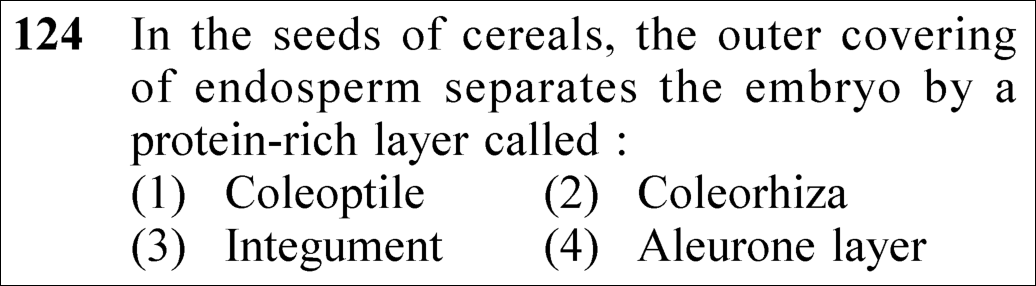
In the seeds of cereals, the outer covering of endosperm separates the embryo by a protein-rich layer called:
- (1)Coleoptile
- (2)Coleorhiza
- (3)Integument
- (4)Aleurone layer
Dynamic 180-question full-length simulator mixed dynamically from all 6 years for 2027 & 2026 aspirants.
In the seeds of cereals, the outer covering of endosperm separates the embryo by a protein-rich layer called:
Endosperm of cereal grains is surrounded by a special PROTEIN-RICH layer separating it from the scutellum/embryo -> ALEURONE LAYER (3n)!
Cereal grains (such as maize, wheat, barley, and rice) are single-seeded fruits (caryopsis) where the seed coat is membranous and generally fused with the fruit wall (pericarp):
Distinguishing protective coverings of the monocot embryo:
The protein-rich boundary layer separating the endosperm from the embryo is the Aleurone layer.
Diagnose every choice: Know exactly why the right option works and why distractors fail.
Incorrect. Coleoptile is the sheath protecting the plumule, not a protein layer separating endosperm from embryo.
Incorrect. Coleorhiza is the sheath covering the radicle and root cap.
Incorrect. Integument is the ovular covering that becomes the seed coat.
100% correct. Verbatim NCERT fact: "The outer covering of endosperm separates the embryo by a proteinous layer called aleurone layer."
Because the aleurone layer is morphologically the outermost cell layer of the endosperm, its cells are triploid (3n) in angiosperms and specialized for protein storage and hydrolytic enzyme secretion.
"In cereal seeds, a proteinous layer called the aleurone layer separates the endosperm from the embryo."
Test your speed and accuracy in the authentic 180-minute timed NTA simulator.
Spotted a mistake in this solution? Report an error (support@mycompetitiveexams.com)
Cover all 1,140 official NEET questions in 285 days at your own pace. Progress is saved on your device. No login needed.