MyCompetitiveExams Logo MyCompetitiveExams
Search 1,140+ Questions
Chapters, formulas, speed tricks
→
⚡ Brahmastra NEET 2027
720 MARKS

Dynamic 180-question full-length simulator mixed dynamically from all 6 years for 2027 & 2026 aspirants.

Launch Brahmastra 2027 Test →
Start Practice →
100% Free · No Login Required
Q.155 Zoology ⭐ 360° Option Elimination Active
Vault ↗

NEET 2025 Zoology Question 155 Solution

Topic: Morphology of Flowering Plants · Official NTA Booklet Code 45
NEET 2025 Zoology Question 155: Floral Symmetry: Zygomorphic (Bilateral) Flowers

Question

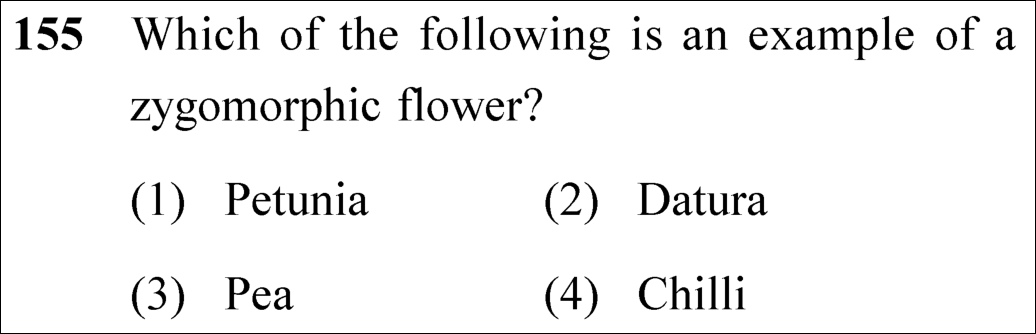
Which of the following is an example of a zygomorphic flower?

  1. (1)Petunia
  2. (2)Datura
  3. (3)Pea
  4. (4)Chilli
✓
Verified Against NTA Final Answer Key
Option (3) : Pea
📚 Morphology of Flowering Plants Easy
📋 Given Parameters & Problem Setup
Symmetry Type Zygomorphic (bilateral floral symmetry)
Target Example Representative plant species
⚡

The 30-Second Exam Hall Shortcut: ⚡ Floral Symmetry Fingerprint

⏱️ Save ~15 seconds

Actinomorphic (radial) = Mustard, Datura, Chilli! Zygomorphic (bilateral) = PEA, Gulmohur, Bean, Cassia! Pea is Zygomorphic!

1 Recall floral symmetry definitions and examples from NCERT Section 5.3:
2 - Actinomorphic (radial symmetry): Can be divided into two equal radial halves in any radial plane passing through the centre. Examples: Mustard, Datura, Chilli, Petunia (Solanaceae).
3 - Zygomorphic (bilateral symmetry): Can be divided into two similar halves only in ONE particular vertical plane. Examples: Pea, Gulmohur, Bean, Cassia.
4 - Asymmetric (irregular): Canna.
5 Direct match for zygomorphic: Pea!
6 Select Option (3) Pea!
🛡️
Why You Can 100% Trust This Shortcut: Stem Modifications & Tendril/Thorn Homology (NCERT Biology · Morphology of Flowering Plants: Axillary bud origin).
📐

Step-by-Step Rigorous Workflow & Mathematical Proof

Step 1

Definition of Zygomorphic Symmetry

Floral symmetry is a primary taxonomic character in angiosperm classification:

  • • A flower is zygomorphic (bilaterally symmetrical) when it can be divided into two equal and similar halves along only one single vertical median longitudinal plane.
  • • In floral diagrams and formulas, zygomorphic symmetry is denoted by the percentage sign (%\%).
Step 2

Evaluation of the Given Candidates

Classifying the provided options based on NCERT examples:

  • • 1. Petunia: Belongs to family Solanaceae; flowers are actinomorphic (radial symmetry, ⊕\oplus).
  • • 2. Datura: Belongs to family Solanaceae; flowers are actinomorphic (radial symmetry, ⊕\oplus).
  • • 3. Pea (*Pisum sativum*): Belongs to family Fabaceae; flowers have vexillary (papilionaceous) aestivation with standard, wings, and keel, making them distinctly zygomorphic (%,C1+2+(2)\%, C_{1+2+(2)}).
  • • 4. Chilli (*Capsicum annuum*): Belongs to family Solanaceae; flowers are actinomorphic (radial symmetry, ⊕\oplus).
Step 3

Conclusion

Among the choices, Pea is the definitive example of a zygomorphic flower.

Zygomorphic Flower=Pea (Pisum sativum)\text{Zygomorphic Flower} = \text{Pea (Pisum sativum)}
⭐

360° Option Elimination Engine Key Feature

Diagnose every choice: Know exactly why the right option works and why distractors fail.

4-Option Deep Scan
1 A
✗ Incorrect
Verdict & Scientific Reason:

Incorrect. Petunia has actinomorphic flowers characteristic of family Solanaceae.

⚠️
Student Fallacy (Why candidates pick this trap): Confusing Solanaceae symmetry with Fabaceae symmetry.
2 B
✗ Incorrect
Verdict & Scientific Reason:

Incorrect. Datura is an NCERT textbook example of an actinomorphic flower.

⚠️
Student Fallacy (Why candidates pick this trap): Ignoring NCERT explicit listing of Datura as actinomorphic.
3 C
✓ 100% Correct
Verdict & Scientific Reason:

100% correct. Pea possesses classic papilionaceous zygomorphic flowers dividable along only one vertical plane.

💡
Why this is airtight: None; textbook mastery.
4 D
✗ Incorrect
Verdict & Scientific Reason:

Incorrect. Chilli is explicitly cited by NCERT as an actinomorphic flower.

⚠️
Student Fallacy (Why candidates pick this trap): Confusing chilli with pea.
⚠️

NTA Trap Alert: Fabaceae vs Solanaceae Symmetry

Remember the family-level symmetries: All Fabaceae (Pea, Bean, Gram, Moong, Arhar) are ZYGOMORPHIC (%). All Solanaceae (Potato, Tomato, Brinjal, Chilli, Datura, Petunia) are ACTINOMORPHIC (⊕)!

🛡️ How to avoid the -1 mark: Solanaceae = Actinomorphic; Fabaceae = Zygomorphic.
📖

Core NEET Syllabus Standard

NEET Biology Core Syllabus · Morphology of Flowering Plants Standard Benchmark
Core Scientific Principle Tested:

"Flowers of pea, gulmohur, bean, and cassia are zygomorphic (bilaterally symmetrical)."

Syllabus Focus: The Flower · Floral Symmetry
✓ Core NEET UG Syllabus Anchor Syllabus & Academic Standards ↗
Z-PGBC: Zygomorphic = Pea, Gulmohur, Bean, Cassia!

Ready to attempt under real exam pressure?

Test your speed and accuracy in the authentic 180-minute timed NTA simulator.

Launch NEET 2025 CBT Test →

Spotted a mistake in this solution? Report an error (support@mycompetitiveexams.com)

⚖️ Legal & Fair Dealing Notice: Sourced from publicly released NEET 2025 question papers and NEET answer keys for private study, research, and non-commercial educational practice under Fair Dealing (Section 52(1)(a) of the Indian Copyright Act, 1957). Not affiliated with or endorsed by NTA or NMC.

Solve 4 NEET Questions a Day — One per Subject

Cover all 1,140 official NEET questions in 285 days at your own pace. Progress is saved on your device. No login needed.