MyCompetitiveExams Logo MyCompetitiveExams
Search 1,140+ Questions
Chapters, formulas, speed tricks
→
⚡ Brahmastra NEET 2027
720 MARKS

Dynamic 180-question full-length simulator mixed dynamically from all 6 years for 2027 & 2026 aspirants.

Launch Brahmastra 2027 Test →
Start Practice →
100% Free · No Login Required
Q.128 Botany ⭐ 360° Option Elimination Active
Vault ↗

NEET 2025 Botany Question 128 Solution

Topic: Cell: The Unit of Life · Official NTA Booklet Code 45
NEET 2025 Botany Question 128: Functions and Structure of Bacterial Mesosomes

Question

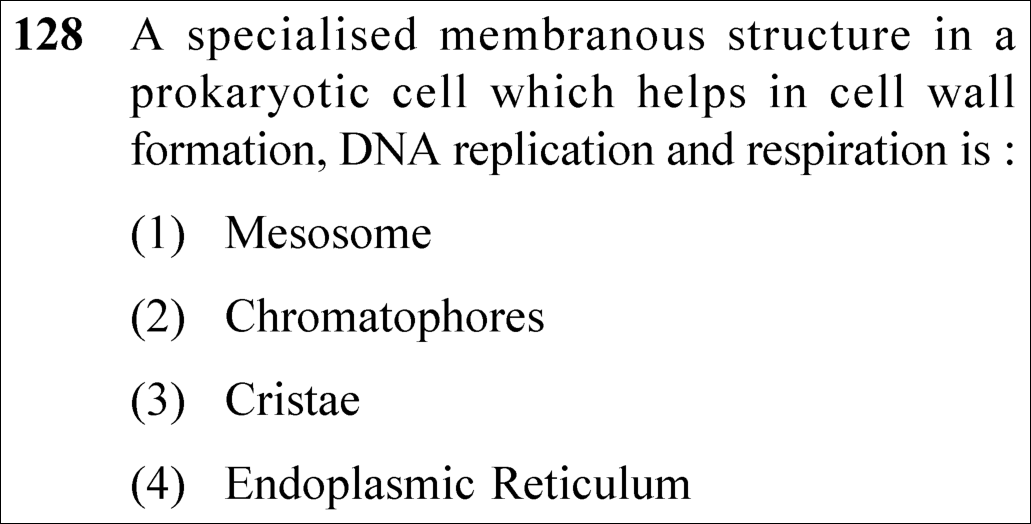
A specialised membranous structure in a prokaryotic cell which helps in cell wall formation, DNA replication and respiration is:

  1. (1)Mesosome
  2. (2)Chromatophores
  3. (3)Cristae
  4. (4)Endoplasmic Reticulum
✓
Verified Against NTA Final Answer Key
Option (1) : Mesosome
📚 Cell: The Unit of Life Easy
📋 Given Parameters & Problem Setup
Cell Type Prokaryotic cell (Bacteria)
Structure Nature Specialised membranous structure formed by plasma membrane extension
Functions Cell wall formation, DNA replication, and respiration
⚡

The 30-Second Exam Hall Shortcut: ⚡ Prokaryotic Mesosome Fingerprint

⏱️ Save ~20 seconds

Prokaryotic plasma membrane invagination that helps in cell wall formation, DNA replication, and cellular respiration = MESOSOME (analogous to eukaryotic mitochondria)!

1 Recall NCERT Section "Cell Envelope and its Modifications":
2 - "A special membranous structure is the mesosome which is formed by the extensions of plasma membrane into the cell."
3 - "They help in cell wall formation, DNA replication and distribution to daughter cells. They also help in respiration, secretion processes, to increase the surface area of the plasma membrane and enzymatic content."
4 - Matches MESOSOME verbatim!
5 Select Option (1) Mesosome!
🛡️
Why You Can 100% Trust This Shortcut: Fluid Mosaic Model of Plasma Membrane (NCERT Biology · Cell: The Unit of Life: Singer and Nicolson quasifluid lipid bilayer).
📐

Step-by-Step Rigorous Workflow & Mathematical Proof

Step 1

Definition and Morphology of Mesosomes

In prokaryotes, membrane-bound organelles (like mitochondria, Golgi apparatus, ER) are absent. Instead, extensions of the plasma membrane invaginate into the cytoplasm to form specialised membranous structures called mesosomes:

  • • These extensions can be in the form of vesicles, tubules, and lamellae.
  • • They are characteristic features of prokaryotes (predominantly Gram-positive bacteria).
Step 2

Multiple Physiological Functions of Mesosomes

According to NCERT, mesosomes perform vital coordinated cellular roles:

  • • 1. Cell wall synthesis: Assist in synthesizing and assembling peptidoglycan layers.
  • • 2. DNA replication and segregation: Help in anchoring the bacterial chromosome during binary fission and distributing replicated DNA to daughter cells.
  • • 3. Respiration: Carry respiratory electron transport chains and dehydrogenases (functioning analogous to mitochondrial cristae).
  • • 4. Secretion processes and surface area enhancement for enzymatic activities.
Step 3

Elimination of Distractors

Evaluating the other options:

  • • Chromatophores: Pigment-containing membrane extensions in photosynthetic prokaryotes (e.g. cyanobacteria).
  • • Cristae: Infoldings of the inner membrane of mitochondria in eukaryotic cells.
  • • Endoplasmic Reticulum: A eukaryotic endomembrane network, completely absent in prokaryotes.
Step 4

Conclusion

The prokaryotic membranous structure responsible for cell wall synthesis, DNA replication, and respiration is the Mesosome.

Prokaryotic Structure=Mesosome\text{Prokaryotic Structure} = \text{Mesosome}
⭐

360° Option Elimination Engine Key Feature

Diagnose every choice: Know exactly why the right option works and why distractors fail.

4-Option Deep Scan
1 A
✓ 100% Correct
Verdict & Scientific Reason:

100% correct. Direct verbatim NCERT description of mesosomal functions.

💡
Why this is airtight: None; textbook mastery.
2 B
✗ Incorrect
Verdict & Scientific Reason:

Incorrect. Chromatophores contain photosynthetic pigments in photosynthetic prokaryotes, not respiratory/DNA machinery.

⚠️
Student Fallacy (Why candidates pick this trap): Confusing photosynthetic prokaryotic membranes with respiratory mesosomes.
3 C
✗ Incorrect
Verdict & Scientific Reason:

Incorrect. Cristae are eukaryotic mitochondrial structures, absent in prokaryotes.

⚠️
Student Fallacy (Why candidates pick this trap): Selecting a eukaryotic organelle component for a prokaryotic question.
4 D
✗ Incorrect
Verdict & Scientific Reason:

Incorrect. Endoplasmic reticulum is strictly eukaryotic and absent in all prokaryotes.

⚠️
Student Fallacy (Why candidates pick this trap): Overlooking the fundamental prokaryotic premise.
⚠️

NTA Trap Alert: Prokaryotic vs Eukaryotic Respiratory Membranes

Eukaryotes use mitochondrial cristae for respiration. Prokaryotes lack mitochondria, so they use plasma membrane invaginations known as MESOSOMES. Do not pick Cristae for a prokaryotic cell!

🛡️ How to avoid the -1 mark: Prokaryote + Respiration/DNA replication = Mesosome.
📖

Core NEET Syllabus Standard

NEET Biology Core Syllabus · Cell: The Unit of Life Standard Benchmark
Core Scientific Principle Tested:

"Mesosomes are plasma membrane extensions in prokaryotes that assist in cell wall formation, DNA replication, and respiration."

Syllabus Focus: Prokaryotic Cells · Cell Envelope and its Modifications
✓ Core NEET UG Syllabus Anchor Syllabus & Academic Standards ↗
MESOSOME = Membrane Extension Serving Organelle-like Metabolism (Wall, DNA, Respiration)!

Ready to attempt under real exam pressure?

Test your speed and accuracy in the authentic 180-minute timed NTA simulator.

Launch NEET 2025 CBT Test →

Spotted a mistake in this solution? Report an error (support@mycompetitiveexams.com)

⚖️ Legal & Fair Dealing Notice: Sourced from publicly released NEET 2025 question papers and NEET answer keys for private study, research, and non-commercial educational practice under Fair Dealing (Section 52(1)(a) of the Indian Copyright Act, 1957). Not affiliated with or endorsed by NTA or NMC.

Solve 4 NEET Questions a Day — One per Subject

Cover all 1,140 official NEET questions in 285 days at your own pace. Progress is saved on your device. No login needed.