📋 Given Parameters & Problem Setup
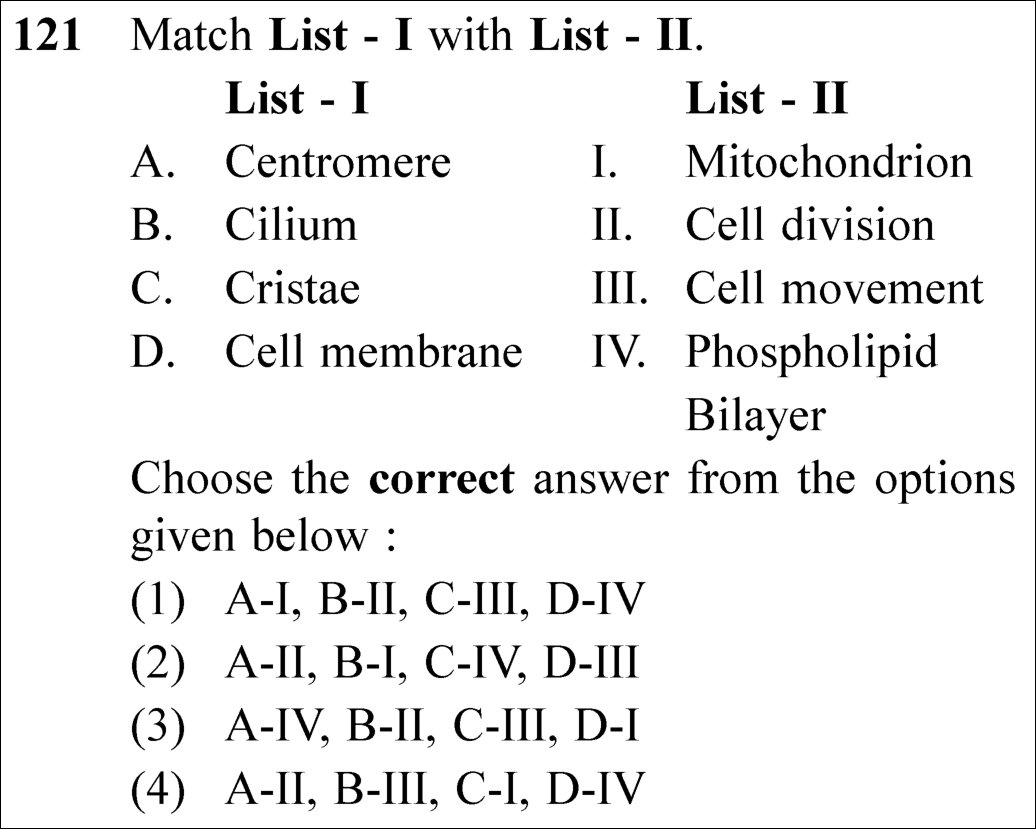
List - I (Cellular Structures) A. Centromere, B. Cilium, C. Cristae, D. Cell membrane
List - II (Associations / Functions) I. Mitochondrion, II. Cell division, III. Cell movement, IV. Phospholipid Bilayer
Centromere = Spindle attachment in Cell division (II); Cilium = 9+2 axoneme for Cell movement (III); Cristae = Infoldings of Mitochondrion (I); Cell membrane = Phospholipid Bilayer (IV)!
1 Perform instant one-to-one pairings from NCERT:
2 - Centromere: Primary constriction holding sister chromatids; kinetochores attach spindle fibres during Cell division (A -> II).
3 - Cilium: Microtubular hair-like projection causing locomotion of cell or fluid (B -> III).
4 - Cristae: Shelf-like infoldings of inner mitochondrial membrane increasing surface area in Mitochondrion (C -> I).
5 - Cell membrane: Singer-Nicolson fluid mosaic model consisting of a Phospholipid Bilayer (D -> IV).
6 Unique combination: A-II, B-III, C-I, D-IV -> Option (4)!
7 Solved in 5 seconds!
🛡️ Why You Can 100% Trust This Shortcut: Eukaryotic Endomembrane System Components (NCERT Biology · Cell: The Unit of Life: ER, Golgi, Lysosomes, Vacuoles).
⚠️
Do not confuse CRISTAE (infoldings of the inner membrane of mitochondria) with CISTERNAE (flattened disc-shaped sacs of the Golgi apparatus or endoplasmic reticulum)!
🛡️ How to avoid the -1 mark: Cristae = Mitochondria (respiration); Cisternae = Golgi apparatus (packaging).
📖
NEET Biology Core Syllabus · Cell: The Unit of Life Standard Benchmark
Core Scientific Principle Tested:
"Centromere coordinates chromosome segregation during cell division, cilia mediate motility, cristae expand inner mitochondrial membrane area, and cell membranes are phospholipid bilayers."
Syllabus Focus: Cell Organelles · Structure and Function
C-Division (Centromere), C-Motion (Cilium), C-Mito (Cristae), C-Bilayer (Cell membrane)!