MyCompetitiveExams Logo MyCompetitiveExams
Search 1,140+ Questions
Chapters, formulas, speed tricks
→
⚡ Brahmastra NEET 2027
720 MARKS

Dynamic 180-question full-length simulator mixed dynamically from all 6 years for 2027 & 2026 aspirants.

Launch Brahmastra 2027 Test →
Start Practice →
100% Free · No Login Required
Q.126 Botany ⭐ 360° Option Elimination Active
Vault ↗

NEET 2026 Botany Question 126 Solution

Topic: Cell: The Unit of Life · Official NTA Booklet Code 50
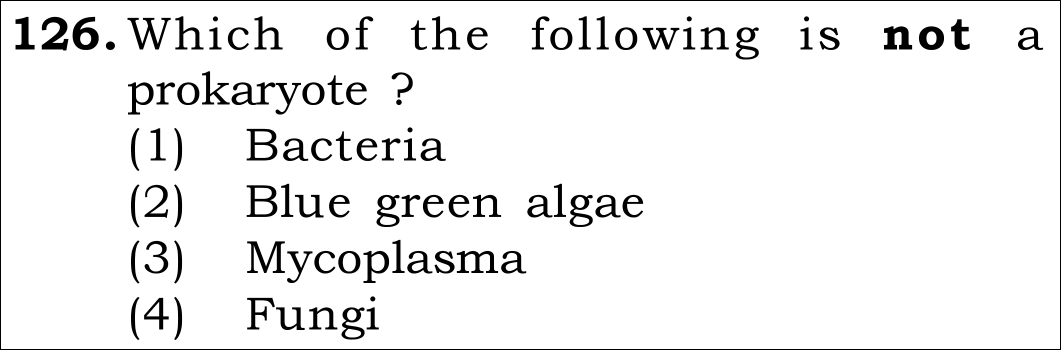
NEET 2026 Botany Question 126: Distinction Between Prokaryotes and Eukaryotes

Question

Which of the following is not a prokaryote?

  1. (1)Bacteria
  2. (2)Blue green algae
  3. (3)Mycoplasma
  4. (4)Fungi
✓
Verified Against NTA Final Answer Key
Option (4) : Fungi
📚 Cell: The Unit of Life Easy
📋 Given Parameters & Problem Setup
Criterion Organism that is NOT a prokaryote (i.e. is a Eukaryote)
Candidate Groups (1) Bacteria, (2) Blue green algae, (3) Mycoplasma, (4) Fungi
⚡

The 30-Second Exam Hall Shortcut: ⚡ Monera vs Fungi Test

⏱️ Save ~40 seconds

Kingdom Monera = Prokaryotes; Kingdom Fungi = EUKARYOTES!

1 Identify prokaryotic kingdoms: In Whittaker’s Five Kingdom system, ONLY Kingdom Monera consists of prokaryotes.
2 Evaluate: Bacteria (Monera - prokaryote), Blue-green algae / Cyanobacteria (Monera - prokaryote), Mycoplasma (Monera - prokaryote lacking cell wall).
3 Evaluate Fungi: Fungi possess a true membrane-bound nucleus, 80S cytosolic ribosomes, mitochondria, and chitinous cell walls -> EUKARYOTIC!
4 Therefore, Fungi is NOT a prokaryote.
5 Select Option (4) in under 5 seconds!
🛡️
Why You Can 100% Trust This Shortcut: NCERT Biological Classification & Cell Biology: Fungi are multicellular/unicellular eukaryotes.
📐

Step-by-Step Rigorous Workflow & Mathematical Proof

Step 1

Definition of Prokaryote and Eukaryote

Prokaryotes lack a membrane-delimited nucleus (their genetic material is an unclad circular naked DNA nucleoid) and lack membrane-bound cytoplasmic organelles (mitochondria, chloroplasts, Golgi, ER). In contrast, eukaryotes possess a double-membraned nucleus and compartmentalized membrane-bound organelles.

Prokaryote=No nuclear membrane, no membrane-bound organelles\text{Prokaryote} = \text{No nuclear membrane, no membrane-bound organelles}
  • • All prokaryotes belong to Kingdom Monera.
Step 2

Analyze Options (1), (2), and (3)

Bacteria, Blue-green algae (cyanobacteria, like Nostoc and Anabaena), and Mycoplasma (PPLO) are all definitive members of Kingdom Monera and are typical prokaryotic organisms.

{Bacteria,  Blue green algae,  Mycoplasma}⊂Kingdom Monera (Prokaryota)\{\text{Bacteria}, \; \text{Blue green algae}, \; \text{Mycoplasma}\} \subset \text{Kingdom Monera (Prokaryota)}
  • • All three are prokaryotes.
Step 3

Analyze Option (4): Fungi

Fungi (e.g. Yeast, Rhizopus, Agaricus) constitute a separate eukaryotic kingdom of heterotrophic organisms characterized by chitinous cell walls, true nuclei, linear chromatin organized with histones, and 80S cytosolic ribosomes.

Fungi∈Eukaryota  ⟹  Fungi is NOT a prokaryote\text{Fungi} \in \mathbf{Eukaryota} \implies \text{Fungi is NOT a prokaryote}
  • • Matches official NTA final answer key Option D / (4).
⭐

360° Option Elimination Engine Key Feature

Diagnose every choice: Know exactly why the right option works and why distractors fail.

4-Option Deep Scan
1 A
✗ Incorrect
Verdict & Scientific Reason:

Incorrect. Bacteria are the classic representative prokaryotes (Kingdom Monera).

⚠️
Student Fallacy (Why candidates pick this trap): Misunderstanding prokaryotic definition.
2 B
✗ Incorrect
Verdict & Scientific Reason:

Incorrect. Blue-green algae are cyanobacteria (photosynthetic prokaryotes with 70S ribosomes and peptidoglycan cell walls).

⚠️
Student Fallacy (Why candidates pick this trap): Deceived by the word "algae" into thinking they are eukaryotic green algae.
3 C
✗ Incorrect
Verdict & Scientific Reason:

Incorrect. Mycoplasma are the smallest living prokaryotes, lacking a cell wall.

⚠️
Student Fallacy (Why candidates pick this trap): Confusing wall-less nature with eukaryotic organization.
4 D
✓ 100% Correct
Verdict & Scientific Reason:

100% accurate. Fungi are eukaryotic organisms possessing true nuclei and membrane-bound organelles.

💡
Why this is airtight: None; immediate kingdom recognition.
⚠️

NTA Trap Alert: The "Blue-Green Algae" Misnomer Trap

Students often assume "Blue green algae" are eukaryotic algae like Spirogyra. Blue-green algae are actually Cyanobacteria, which are strictly PROKARYOTES!

🛡️ How to avoid the -1 mark: Remember: Blue-green algae = Cyanobacteria = Monera = Prokaryote; Fungi = Eukaryote.
📖

Core NEET Syllabus Standard

NEET Biology Core Syllabus · Cell: The Unit of Life Standard Benchmark
Core Scientific Principle Tested:

"Prokaryotes encompass bacteria, blue-green algae, mycoplasma, and PPLO. Fungi are eukaryotes."

Syllabus Focus: Prokaryotic and Eukaryotic Cells
✓ Core NEET UG Syllabus Anchor Syllabus & Academic Standards ↗
Monera has the Prokaryote run; Fungi is Eukaryotic having fun!

Ready to attempt under real exam pressure?

Test your speed and accuracy in the authentic 180-minute timed NTA simulator.

Launch NEET 2026 CBT Test →

Spotted a mistake in this solution? Report an error (support@mycompetitiveexams.com)

⚖️ Legal & Fair Dealing Notice: Sourced from publicly released NEET 2026 question papers and NEET answer keys for private study, research, and non-commercial educational practice under Fair Dealing (Section 52(1)(a) of the Indian Copyright Act, 1957). Not affiliated with or endorsed by NTA or NMC.

Solve 4 NEET Questions a Day — One per Subject

Cover all 1,140 official NEET questions in 285 days at your own pace. Progress is saved on your device. No login needed.